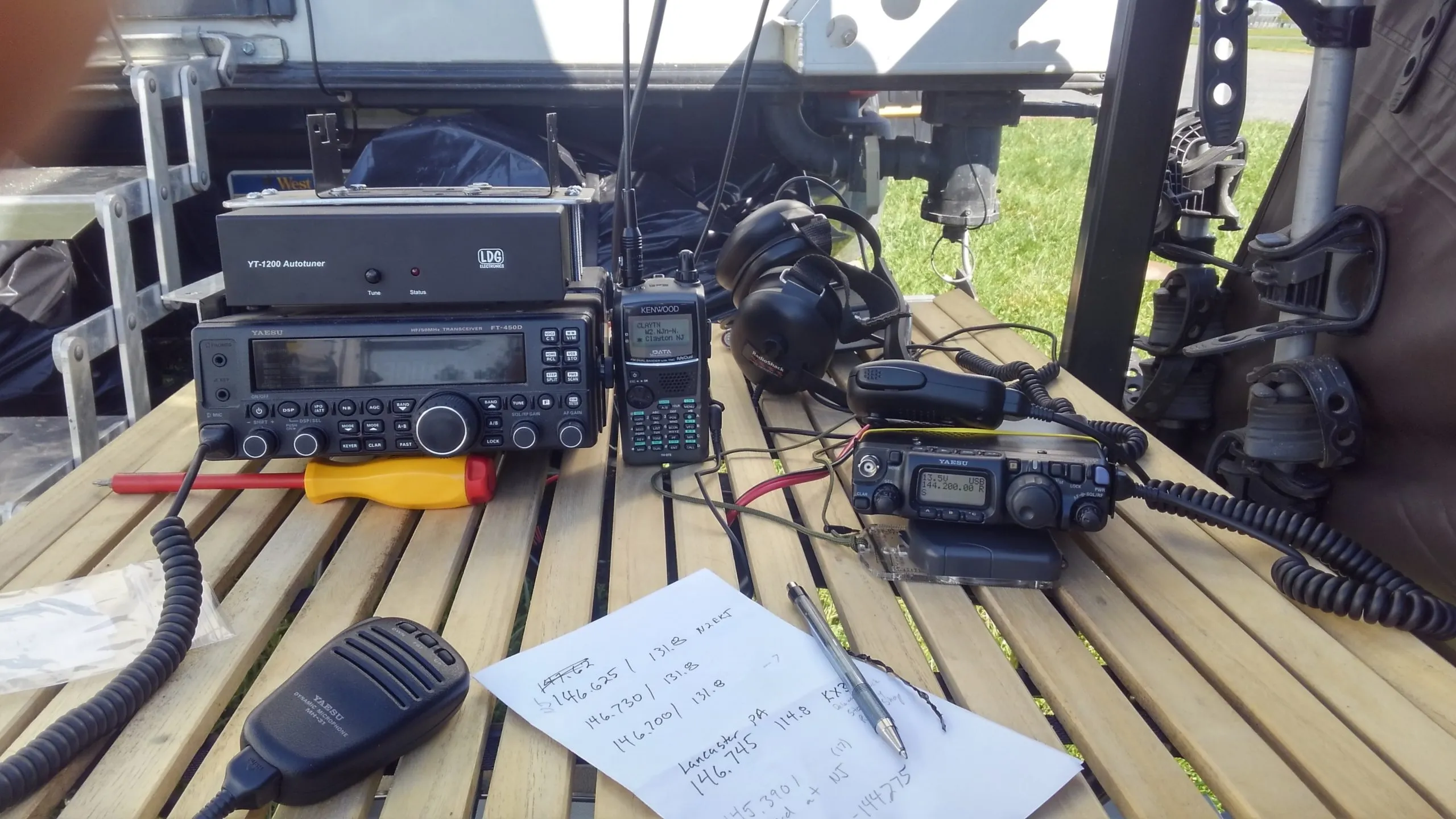

A ham radio can mean a pocket-sized handheld for local contacts, a mobile transceiver for a vehicle, or the study guide that gets a new operator licensed in the first place. The hard part is separating useful capability from long feature lists, especially when several Baofeng models look nearly identical.
Our Best best ham radio picks cover dual-band handhelds, tri-band radios, DMR, mobile rigs, and the Technician exam. The Baofeng BF-F8HP Pro is the strongest all-around handheld, while the Retevis RT95 Mobile Kit is the better fit for a vehicle or fixed operating position.
Comparison table
| # | Product | Award | Bands or mode | Channels | Best for |
|---|---|---|---|---|---|
| 1 | Baofeng BF-F8HP Pro | Best overall | Tri-band, analog | 1, 000 | Licensed operators wanting modern handheld features |
| 2 | Baofeng AR-5RM 10W Two-Pack | Best two-radio kit | Dual-band transmit, wide receive | 999 | Outdoor pairs and emergency communication |
| 3 | Retevis RT95 Mobile Kit | Best mobile radio | 2m and 70cm | 200 | Vehicles and compact base stations |
| 4 | Baofeng DM32 DMR | Best digital handheld | DMR and analog | 4, 000 | Operators who need digital features |
| 5 | Retevis RT95 Base Station Kit | Best base station starter | 2m and 70cm | 200 | Home, office, and vehicle installations |
| 6 | Baofeng UV-5RM 999-Channel Two-Pack | Best weather-ready pair | Dual-band transmit, wide receive | 999 | Camping and field teams |
| 7 | Baofeng UV-5RM Walkie Talkie Pair | Best hands-free pair | Dual-band transmit, wide receive | 999 | Outdoor users wanting speaker mics |
| 8 | Baofeng UV-5R Mini | Best compact handheld | Dual-band transmit, wide receive | 999 | Portable operation and phone programming |
| 9 | Baofeng UV-5R | Best simple starter | 2m and 70cm | 128 | New operators learning the basics |
| 10 | ARRL License Manual | Best licensing resource | Technician exam study | Not applicable | People preparing for the license exam |
1. Baofeng BF-F8HP Pro: Best Overall

Pros
- Tri-band amateur transmission
- GPS tools and organized channel zones
- USB-C charging
- IP54 dust and splash protection
- Firmware can be updated
Cons
- Computer programming requires a separate compatible cable
- More features mean a steeper learning curve
- No second radio included
Best for: licensed operators who want a modern handheld with room to grow.
The Baofeng BF-F8HP Pro is the handheld we would choose when a basic dual-band radio starts to feel limiting. Its useful advantage is not simply the stated 10W output. It combines that output with three amateur bands, GPS tools, USB-C charging, and a channel system that is much easier to organize than a single long memory list.
Transmission covers the 2-meter, 1.25-meter, and 70-centimeter amateur bands. On receive, it can monitor Airband AM, NOAA weather, FM broadcast, and additional VHF and UHF frequencies. That receive flexibility makes it more interesting for scanning and field work than the simpler Baofeng UV-5R, which is limited to 2m and 70cm operation.
The 1, 000 channels are split across 10 zones, so home repeaters, travel frequencies, simplex contacts, and receive-only services can stay separate. GPS and BeiDou tools add coordinates, altitude, speed, distance, and direction information. IP54 protection is useful around dust and splashing water, while direct USB-C charging works from a compatible wall adapter, vehicle charger, or power bank.
There is a catch. The radio is easier to manage from a computer, but the required BTECH PC03 cable is sold separately. Firmware updates and programming therefore take more preparation than on a simple handheld. The feature set can also overwhelm a first-time operator, and the product is sold as one radio rather than a coordinated pair.
Choose it if you already understand the basics or want to learn on a radio that will not immediately box you in. For a second radio and bundled outdoor accessories, the Baofeng AR-5RM 10W Two-Pack is more practical. For a vehicle, the Retevis RT95 Mobile Kit remains the better physical design.
2. Baofeng AR-5RM 10W Two-Pack: Best Two-Radio Kit

Pros
- Two radios included
- 2500mAh batteries
- USB-C and desktop charging
- NOAA weather reception
- Speaker microphones, antennas, and programming cable included
Cons
- Only dual-band transmission
- The package is bulky
- Programming still takes some setup
Best for: two people who need matching handhelds for camping, events, or emergency communication.
The Baofeng AR-5RM 10W Two-Pack makes more sense as a communication kit than as a single-radio purchase. Two radios, two batteries, two USB-C cables, two desktop chargers, a programming cable, speaker microphones, antennas, earpieces, belts, and hand straps give a pair of users a common starting point without assembling accessories separately.
Its transmit bands are 144 to 148MHz and 420 to 450MHz, while the receiver covers 108 to 136MHz, 136 to 174MHz, 220 to 260MHz, 350 to 390MHz, and 400 to 520MHz. That distinction matters: the wide receive range does not mean the radio transmits across every listed frequency. The 999 memory channels and 1.77-inch color screen make the expanded feature set manageable.
Each radio uses a 2500mAh rechargeable battery. USB-C charging is convenient from a laptop, vehicle, power bank, or other USB source, and the included base chargers offer a more permanent home setup. NOAA reception gives the pair a useful weather-monitoring role when cellular service is unreliable. Frequency copying can also simplify setup when compatible radios already have the desired channel programmed.
Compared with the similar Baofeng UV-5RM 999-Channel Two-Pack, this kit has a clearer bundled-accessory story because the listing specifically includes the programming cable, speaker microphones, earpieces, and two antenna types. The weakness is that it is still a conventional dual-band handheld, so the Baofeng BF-F8HP Pro is the more capable choice for tri-band work, GPS, organized zones, and firmware updates.
The large bundle is not ideal for someone who wants one light radio in a pocket. It is also not a substitute for understanding licensing and frequency rules. Pick it when two users need matching equipment and weather reception, particularly for outdoor trips where charging options may vary.
3. Retevis RT95 Mobile Kit: Best Mobile Radio

Pros
- Designed for vehicle or base use
- Rotatable 180-degree display
- VFO operation without a computer
- VOX and microphone gain
- Built-in cooling fan
Cons
- Requires a 13.8V/10A power source for full-power base use
- Larger and less portable than a handheld
- Antenna installation is still part of the setup
Best for: operators who want a dedicated radio in a vehicle or compact operating station.
The Retevis RT95 Mobile Kit is the first pick here that feels designed around a fixed operating position. Its 6.42 by 4.88 by 1.54-inch body can fit into a vehicle console or a compact station, and the microphone puts key controls close to hand. It is a much better match for regular mobile operation than trying to make a handheld do everything from a dashboard.
This is a dual-band 2-meter and 70-centimeter transceiver with 200 channels. VFO mode lets you change frequency and other parameters directly from the radio, so occasional field adjustments do not require a computer. CHIRP support remains available for larger channel-management jobs. CTCSS, DCS, DTMF, 5Tone, alarm, and related functions give experienced operators more control than the basic Baofeng UV-5R.
The 180-degree rotatable TFT LCD is a thoughtful installation feature. It allows the radio to be mounted upside down while keeping the display oriented for viewing, and brightness control helps in both daylight and darker cabins. VOX can free the operator's hands, while adjustable microphone gain can make weak speech easier to hear, although high gain can also bring up more background noise.
A built-in fan supports sustained operation at higher output, and the listing also describes a shockproof and dustproof structure with voltage protection. Those claims do not eliminate the need for sensible installation or ventilation. For home or field base use, the radio needs a 13.8V/10A power source, which is not included.
This model beats every handheld here for installation flexibility and operating comfort, but it loses on grab-and-go convenience. If the radio will spend most of its life in a backpack, choose the Baofeng BF-F8HP Pro or Baofeng UV-5R Mini. If it will live in a truck, RV, or desk station, the RT95 is the more coherent choice.
4. Baofeng DM32 DMR: Best Digital Handheld

Pros
- DMR digital and analog modes
- GPS and APRS
- Up to 4, 000 channels
- Text messaging and voice recording
- USB-C for charging, programming, and firmware
Cons
- Digital features require compatible systems and setup
- Encryption features may not suit every amateur-radio use
- Less straightforward for a first radio
Best for: operators who specifically want digital radio functions alongside analog compatibility.
The Baofeng DM32 DMR is not just another analog handheld with a different shell. It supports DMR digital mode and traditional analog operation, so it can fit into an existing analog setup while opening the door to digital systems. That makes it the specialist pick in this group rather than the obvious beginner radio.
The feature list is substantial. The radio offers up to 10W output with mid and low settings, GPS, APRS location reporting, emergency alarms, and up to 4, 000 channels. TDMA dual-time-slot operation is part of the DMR design, while the 2.0-inch screen and full keyboard make on-radio control more realistic than it is on a tiny basic handheld.
Digital functions include text messaging, call recording, remote monitoring, and voice recording. USB-C handles charging, frequency writing, and firmware updates through one connection. The listing also cites ARC4, AES128, and AES256 encryption options. Operators should confirm that any chosen system and local rules support the intended functions before relying on them.
The trade-off is complexity. A radio with DMR, APRS, multiple channel structures, and digital safety tools takes more planning than the Baofeng UV-5R. It also does not automatically provide useful digital contacts without compatible repeaters, groups, or other radios. For someone who simply wants clear local analog communication, the extra controls are distractions.
The DM32 is the better buy for an operator who already knows why DMR matters. It is also a reasonable option for teams that need location reporting or text features, provided their radio system is compatible. If your goal is uncomplicated two-band voice communication, the Baofeng UV-5R Mini is easier to live with.
5. Retevis RT95 Base Station Kit: Best Base Station Starter

Pros
- Works in a home, office, or vehicle
- High-gain antenna included in the kit
- Dual-frequency monitoring
- Rotatable color display
- CHIRP support and VFO operation
Cons
- Full-power operation needs a separate 13.8V/10A source
- The kit is not handheld
- More installation work than a portable radio
Best for: a new fixed station that may also move between a home desk and a vehicle.
The Retevis RT95 Base Station Kit shares the RT95 platform with the mobile kit, but the bundle changes its role. The included high-gain antenna is the important distinction in the listing, giving a new operator more of the pieces needed to establish a usable station rather than starting with the transceiver alone.
It supports the 2-meter and 70-centimeter bands and can display and monitor dual frequencies at the same time. The radio stores 200 channels, and VFO mode allows direct frequency changes without a computer. CHIRP compatibility helps with importing and exporting channel parameters once the station grows beyond a handful of repeaters or simplex frequencies.
The 180-degree TFT color screen can be adjusted for different mounting positions, while brightness controls and illuminated buttons help during night operation. Dual speakers are intended to produce fuller audio, and RCA output ports can connect to a vehicle audio system. Microphone gain is adjustable, but the same rule applies as with the other RT95: raising it too far can bring in more ambient noise.
The built-in cooling fan and voltage protection support continuous operation, but the base-station label should not be mistaken for a complete mains-powered setup. Full-power use requires a 13.8V/10A power source, and that source is not included. The antenna and radio also need sensible placement and installation.
The Retevis RT95 Mobile Kit is the cleaner choice when the radio will stay in a vehicle and you already have an antenna plan. This base-station kit is more appealing when the operator wants to begin at home, retain dual-band mobile flexibility, and have a path into vehicle use later. It is too much hardware for someone who only needs a portable backup.
6. Baofeng UV-5RM 999-Channel Two-Pack: Best Weather-Ready Pair
Pros
- Two radios with 2500mAh batteries
- NOAA weather reception
- USB-C and desktop charging
- 999 memory channels
- Frequency-copy function
Cons
- Dual-band transmission only
- The listing's dimensions are unusually large for a handheld
- Accessories and programming still need careful organization
Best for: outdoor partners who want matching radios and weather information.
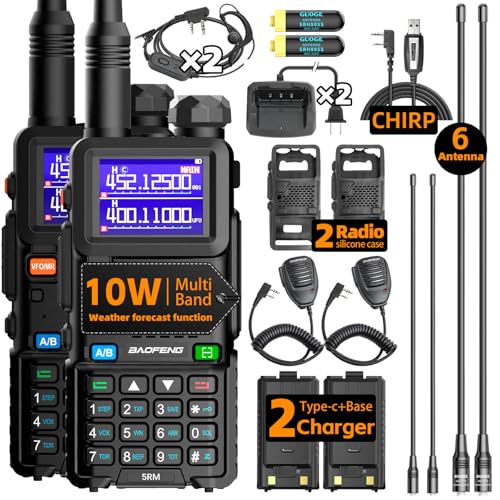
The Baofeng UV-5RM 999-Channel Two-Pack is built around the same practical idea as the AR-5RM bundle: put matching handhelds in the hands of two people and make charging easy away from home. The listing specifies two radios, two 2500mAh batteries, USB-C cables, desktop charging bases, and speaker microphones.
Its receive coverage spans 108 to 136MHz, 136 to 174MHz, 220 to 260MHz, 350 to 390MHz, and 400 to 520MHz, while transmit coverage is listed for 144 to 148MHz and 420 to 450MHz. That makes it suitable for licensed amateur transmission on the listed bands and broader monitoring on receive. The 1.77-inch color display and 999 memory channels are useful when the radio carries more than a few local frequencies.
NOAA weather reception gives this pair a clear outdoor purpose. Frequency copying can reduce the setup burden when another compatible radio already has the desired channel, and CHIRP support is available for more deliberate programming. USB-C charging from a laptop, vehicle, or power bank is convenient when a standard wall outlet is not nearby.
The limitation is that the feature set is not as advanced as the Baofeng BF-F8HP Pro. There is no listed GPS, tri-band transmission, IP54 rating, or firmware-update platform. The product information also gives unusually large dimensions, so shoppers should not assume this is a particularly small handheld from the word “walkie-talkie” in the title.
This pair makes sense for camping groups, event crews, and emergency kits that need two matching units. Choose the Baofeng AR-5RM 10W Two-Pack if its more extensive included accessory package matters more, or choose the Baofeng UV-5R Mini if portability and phone-based programming are the priorities.
7. Baofeng UV-5RM Walkie Talkie Pair: Best Hands-Free Pair

Pros
- Two 2500mAh radios
- Speaker microphones included
- NOAA receiver
- USB-C charging
- One-touch frequency copying
Cons
- Similar capabilities to the other UV-5RM pair
- No stated water-resistance rating
- Dual-band transmit range is narrower than the receive range
Best for: two users who expect to keep the radios clipped on and use remote microphones.
The Baofeng UV-5RM Walkie Talkie Pair is very close to the preceding UV-5RM listing, so the sensible reason to consider it is the kit format rather than a radically different radio platform. It includes two radios with 2500mAh batteries, USB-C cables, desktop charging bases, and speaker microphones for hands-free use.
Like the other model, it receives across 108 to 136MHz, 136 to 174MHz, 220 to 260MHz, 350 to 390MHz, and 400 to 520MHz, while transmitting on 144 to 148MHz and 420 to 450MHz. The 1.77-inch color display and 999 memory channels give it more room than the 128-channel Baofeng UV-5R, especially for an operator who stores repeaters, simplex channels, and receive-only frequencies.
The one-touch frequency-copy feature is aimed at reducing setup friction. CHIRP compatibility provides a more structured path for programming, and NOAA reception adds weather monitoring for hikes, road trips, and emergency preparations. USB-C charging is also easier to integrate into a vehicle or portable power setup than a charger tied to one type of outlet.
The product is not listed with an IP54 rating, so it should not be treated as weather-sealed simply because it is marketed for outdoor activities. The receive range is broad, but the transmission bands remain limited. Those details matter more than the generic “long range” wording in the title.
Compared with the Baofeng UV-5RM 999-Channel Two-Pack, the two listings describe nearly the same core features. This version is most defensible for someone who specifically wants a speaker microphone with each radio. If you want more distinctive capability, the Baofeng BF-F8HP Pro adds tri-band transmission, GPS tools, organized zones, and firmware updates.
8. Baofeng UV-5R Mini: Best Compact Handheld

Pros
- Phone programming through the OLA Radio app
- USB-C charging
- NOAA, AM, and FM reception
- Two antennas included
- 999 channels and dual PTT
Cons
- App programming adds another dependency
- Listed output is 5W, not 10W
- The compact design has fewer advanced features than the DM32
Best for: operators who want a portable handheld with a modern setup option.
The Baofeng UV-5R Mini takes the familiar handheld format and adds a more contemporary approach to programming. Its most interesting feature is phone programming through the OLA Radio app, which can be more approachable than connecting a radio to a computer. The product also supports frequency copying, so there are two ways to avoid entering every channel manually.
The radio offers up to 999 channels, dual PTT, VOX, DTMF, and a stated 5W output. It receives AM, FM, and NOAA broadcasts, making it more versatile as a monitoring tool than a basic voice-only handheld. CHIRP support is listed as well, with UV-5R Mini compatibility specified for the programming software.
USB-C charging is built into the rear of the rechargeable battery, allowing charging from a car, laptop, power bank, or other USB source. The package includes two radios, two batteries, two 9cm antennas, two 38cm antennas, two headsets, and two charging cables. The longer antenna option can be useful when the radio is used in different environments, though antenna changes do not remove the need for proper frequency and power practices.
The phone-based workflow is not entirely frictionless. It depends on a compatible mobile device and the OLA Radio app, while computer programming may still be preferable for a carefully organized channel list. The Baofeng BF-F8HP Pro is more capable for tri-band use, GPS, firmware updates, and weather-resistant construction, while the Baofeng UV-5R is simpler for someone who wants fewer controls.
This is the handheld to choose when charging flexibility, a larger display than traditional compact radios, and phone programming matter more than maximum output. It is also a useful companion for readers comparing how handheld radios differ from general walkie-talkies in outdoor use.
9. Baofeng UV-5R: Best Simple Starter

Pros
- Straightforward 2m and 70cm operation
- 128 memory channels
- Dual standby and dual-frequency display
- Manual, PC, and CHIRP programming
- VOX, flashlight, and keypad lock
Cons
- Older, less capable platform
- No USB-C charging listed
- No NOAA reception listed
Best for: a new licensed operator who wants to learn on a familiar dual-band handheld.
The Baofeng UV-5R is the uncomplicated pick in this group. It does not try to compete with the GPS, DMR, and expanded receiving features of newer models. Instead, it concentrates on the core handheld functions that a new operator needs to understand first.
Transmission covers 144 to 148MHz and 420 to 450MHz, the common 2-meter and 70-centimeter amateur bands represented in this roundup. The radio stores 128 channels and can display two frequencies at once, with independent A and B band operation. Dual standby lets the operator monitor two programmed frequencies, while high and low transmit power settings help control battery use and operating behavior.
Programming can be done manually or through a computer, with CHIRP support listed. The radio also includes 50 CTCSS and 104 DCS codes, tone searching, VOX, keypad lock, a selectable tri-color backlight, and an LED flashlight. Those functions are enough to learn repeater tones, channel memories, and basic operating habits without navigating a much larger system.
Its age shows when it is placed beside the Baofeng UV-5R Mini. The newer model adds USB-C charging, NOAA reception, AM and FM reception, 999 channels, and phone programming. The UV-5R listing does not specify those features, so buyers who need weather monitoring or modern charging should move up the list.
This radio is best for someone who wants a traditional entry point and is willing to program it carefully. New operators should also remember that owning a transceiver is not the same as being authorized to transmit. For that first step, the ARRL License Manual is the more relevant purchase.
10. ARRL License Manual: Best Licensing Resource

Pros
- Focused on the Technician Class exam
- Fifth edition
- Includes a question pool
- Covers the fundamentals needed before transmitting
Cons
- It is a study guide, not a radio
- The question pool is tied to exam preparation
- Does not replace hands-on radio setup
Best for: beginners who need to prepare for the Technician Class amateur radio exam.
The ARRL License Manual is the outlier in this roundup, but it solves the problem that every new amateur operator faces before using a transmitter. It is a fifth-edition study guide for the Technician Class exam, with the question pool included for structured preparation.
That makes it more useful to a beginner than buying a feature-heavy handheld and trying to learn by trial and error. The radios in this list expose operators to frequency ranges, tones, output settings, and programming menus. The manual provides the foundation for understanding what those controls mean and which operating practices are permitted.
The physical book is listed at 10 by 8 by 2 inches and weighs 1.1 pounds. Those details are less important than the role it plays in a new station. A handheld such as the Baofeng UV-5R can be a practical first radio after licensing, while the manual helps make the transition from unlicensed curiosity to responsible operation.
It is not a replacement for learning how to program a radio, choose an antenna, or make clear contacts. It also is not the right pick for an experienced operator studying for a different license class. People assembling emergency communication plans may also want to compare the features that matter in a radio during a power outage, since an amateur transceiver and a broadcast emergency receiver serve different purposes.
Buy this before transmitting if you are new to the hobby. Among the hardware picks, the Baofeng BF-F8HP Pro gives a licensed operator the broadest handheld feature set, but the ARRL manual is the necessary starting point for someone who has not yet earned the Technician license.

How to choose best ham radio
The right choice depends first on where you will operate, then on the bands, programming method, power arrangement, and radio features you can actually use.
Handheld or mobile format
Handheld radios are easy to carry and can run from rechargeable batteries, making them suitable for field work and short conversations away from a vehicle. Mobile radios such as the Retevis RT95 Mobile Kit need a more deliberate installation but provide a better operating position in a car, truck, RV, or home station.
A handheld is the better fit when portability is central. Choose a mobile radio when the unit will spend most of its time connected to a vehicle electrical system or a fixed 13.8V supply.
Transmit and receive bands
Do not confuse a wide receive range with wide transmit capability. The AR-5RM and UV-5RM models list broad receive coverage but transmit on the 2-meter and 70-centimeter amateur bands. The Baofeng BF-F8HP Pro adds 1.25-meter transmission, while the Baofeng UV-5R stays with 2m and 70cm.
A radio should match the repeaters, simplex contacts, and other services you genuinely plan to use. More bands can expand your options, but they also add programming and operating details.
Channel organization
Channel capacity matters when it is paired with a usable organization system. The UV-5R has 128 channels, enough for a straightforward local setup. The BF-F8HP Pro stores 1, 000 channels across 10 zones, and the DM32 supports up to 4, 000 channels.
A large number alone does not make a radio easier to use. Zones, names, scan lists, and computer programming are what turn a long memory list into something manageable.
Charging and power
USB-C charging is convenient for handhelds because the same power banks and vehicle adapters used for other devices can often serve the radio. Desktop chargers still make sense at home, especially when two radios need to be ready at once.
Mobile radios need a suitable electrical supply. The RT95 listings specify a 13.8V/10A source for full-power base operation, and that source is not included. Plan the power system before choosing a mobile chassis.
A radio is only as useful as the antenna, power source, and channel plan supporting it.
Analog and digital operation
Analog radios are usually the simpler place to begin. DMR adds digital voice, text messaging, GPS or APRS functions, and more elaborate channel structures, but those benefits depend on compatible systems and careful configuration.
The Baofeng DM32 DMR is the specialist option here. Pick it because you need digital capability, not because a longer feature list automatically makes everyday voice contacts better.

Frequently asked questions
Do I need a license to use a ham radio?
You need the appropriate amateur radio license before transmitting on amateur frequencies in the United States. Receiving broadcasts and monitoring frequencies is different from transmitting, but you should still follow applicable regulations and radio instructions.
What is the best ham radio for a beginner?
The Baofeng UV-5R is the simplest hardware starting point in this list because it focuses on 2-meter and 70-centimeter operation. A beginner who wants USB-C charging, NOAA reception, and phone programming may prefer the Baofeng UV-5R Mini instead.
Is a 10W handheld always better than a 5W handheld?
Not necessarily. More output can help in some situations, but range also depends on antenna performance, terrain, obstructions, repeater access, and the receiving station. A well-organized 5W radio can be more useful than a poorly configured 10W radio.
Can these radios communicate with each other?
The analog handhelds can communicate when they use compatible frequencies, tones, modes, and settings within their transmit ranges. The DM32 can operate in analog mode, but its DMR functions require compatible digital configuration.
Are the wide frequency ranges legal to transmit on?
The listed receive ranges do not mean the radio is authorized to transmit everywhere within them. The product listings specify narrower amateur transmit ranges for the handhelds, and operators must use frequencies and power levels allowed by their license and local regulations.
Is a mobile radio suitable for home use?
Yes. The Retevis RT95 Mobile Kit and Retevis RT95 Base Station Kit can be used as compact base stations when connected to an appropriate 13.8V/10A power source. A suitable antenna and installation plan are still required.
Should I buy a study manual before a handheld radio?
If you are not licensed, yes. The ARRL License Manual is designed for Technician Class exam preparation, while the radio becomes useful for transmitting only after you have the required authorization.

The bottom line
The Baofeng BF-F8HP Pro is the strongest Best best ham radio choice for a licensed operator who wants one handheld with tri-band transmission, GPS tools, 1, 000 organized channels, USB-C charging, and firmware updates. Its weakness is the learning curve, plus the need for a separate programming cable for computer work.
For two people in the field, the Baofeng AR-5RM 10W Two-Pack is the more complete handheld kit. For a vehicle or home station, choose the Retevis RT95 Mobile Kit, while the Baofeng DM32 DMR is the specialist pick for digital operation.
If you are undecided, choose the format first: handheld for portability, mobile for a permanent operating position, and the ARRL manual before any transmitting.
As an Amazon Associate we earn from qualifying purchases.