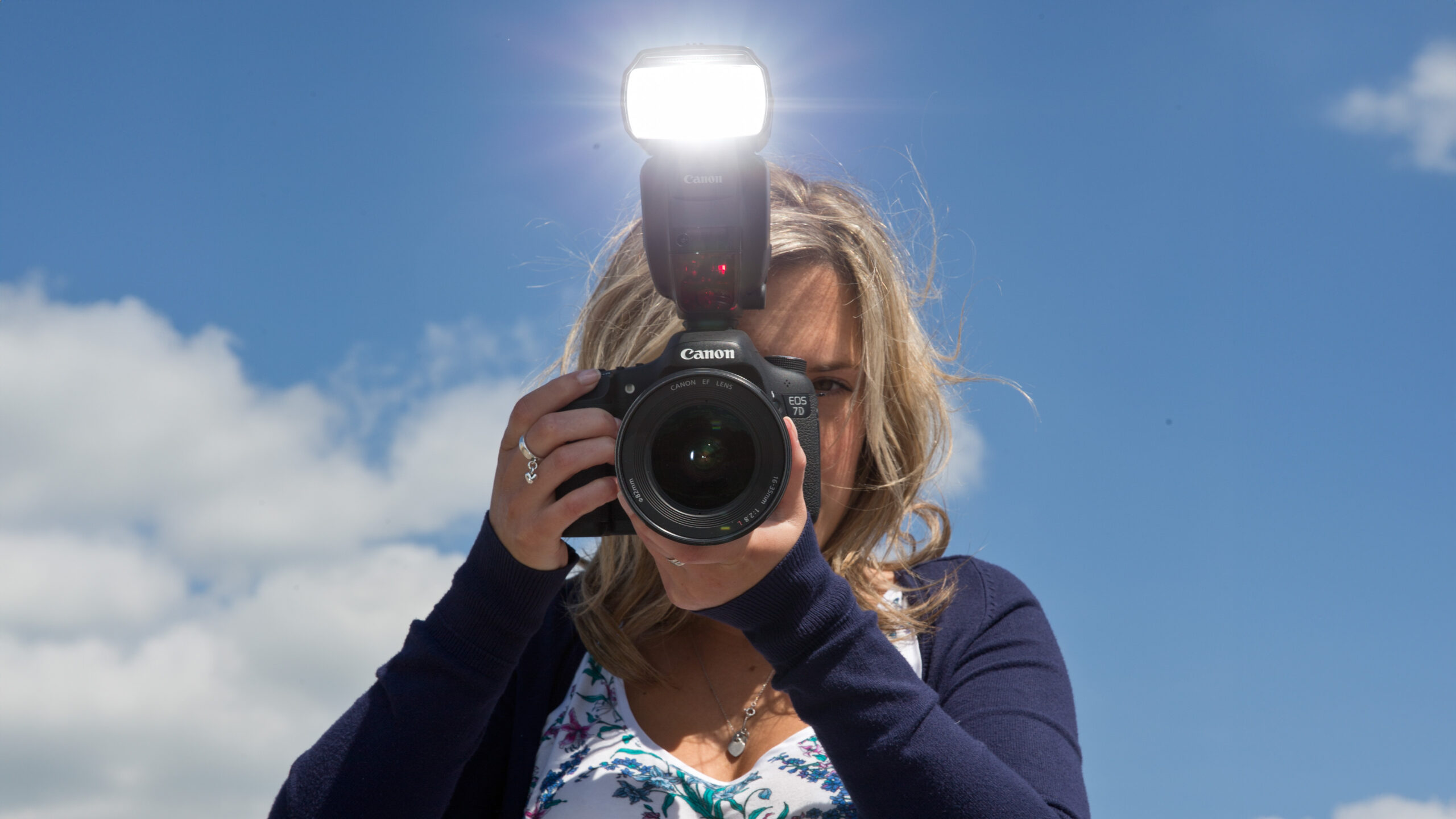

A good flash transforms indoor portraits, freezes action, and opens creative off-camera possibilities. But not every flash works well with Canon's broad range of DSLRs and mirrorless bodies. We tested ten models that cover everything from native TTL performance to budget manual triggers, macro ring lights, and pocket-sized video/flash hybrids.
The best flash for Canon cameras needs to match your body's hotshoe, power requirements, and shooting style. Our top pick, the Canon Speedlite EL-5, offers seamless integration with EOS R cameras and enough output for most event and portrait work. But if you want TTL on a tighter budget, the Godox ecosystem delivers impressive value and flexibility.
| # | Product | Award | Guide Number | TTL | Wireless | Best for |
|---|---|---|---|---|---|---|
| 1 | Canon Speedlite EL-5 | Best native Canon flash | ~60 (estimated) | Yes | Radio (with optional trigger) | EOS R users who want perfect Canon integration |
| 2 | Godox V1-C Round Head Flash | Best all-round TTL flash | ~60 | Yes | Built-in 2.4GHz | Photographers wanting a round-head with fast recycle |
| 3 | Godox iT32 with X5C (R6/R7/R8) | Most versatile system | Not stated | Yes | Built-in 2.4GHz | Shooters who need multi-brand compatibility |
| 4 | Godox iT32 with X5C (R10/R7/R8) | Ideal for R10/R7/R8 | Not stated | Yes | Built-in 2.4GHz | Canon R10, R7, R8 owners wanting TTL |
| 5 | Godox TT600 Manual Flash | Best budget manual with radio | 60 | No | Built-in 2.4GHz | Off-camera manual lighting on a budget |
| 6 | NEEWER TT560 Manual Flash | Best entry-level manual | 38 | No | Optical slave | Beginners learning manual flash |
| 7 | PHOTOOLEX FK310 LCD Flash | Best manual with LCD | 33 | No | Optical slave | Users who want precise manual control and stroboscopic |
| 8 | PHOTOOLEX FK300 Manual Flash | No-frills budget manual | 33 | No | Optical slave | Cost-conscious shooters needing basic manual flash |
| 9 | ULANZI SL03 Mini Flash | Best mini flash for portability | 8 | No | None | Travelers wanting an all-in-one flash and video light |
| 10 | Canon MR-14EX II Macro Ring Lite | Best for macro photography | Twin tubes | Yes | Optical (with 600EX-RT) | Dedicated macro shooters needing even illumination |
1. Canon Speedlite EL-5: Best native Canon flash

Pros
- Full TTL and HSS integration with Canon EOS R bodies
- Lithium-ion battery recycles in roughly 1.5 seconds
- Built-in modeling lamp for previewing shadows
- Same intuitive joystick and LCD as the flagship EL-1
Cons
- Uses LP-EL battery that charges with Canon LC-E6 charger (not included)
- No built-in radio trigger; requires optional Speedlite Transmitter
Best for: Canon EOS R series shooters who want the most seamless on-camera flash experience.
The Canon Speedlite EL-5 feels like a natural extension of an EOS R body. The moment you mount it, the camera recognizes the flash and you get full TTL, high-speed sync up to 1/8000s, second-curtain sync, and flash exposure compensation dialed in from the touchscreen. That level of integration is something third-party flashes can only approximate.
The lithium-ion battery powers roughly 350 consecutive full-power pops before needing a recharge, and because there is no cooling fan, the EL-5 can fire 95 full-power shots in a row without overheating. That continuous burst capacity is unique at this level; most speedlites start throttling after 20 to 30 pops. The modeling lamp, adjustable in ten steps, is a real help when placing shadows for portrait setups.
Where the EL-5 shows its limits is off-camera use. Unlike the Godox V1-C or the iT32, it has no built-in radio receiver. To fire it wirelessly you need a Canon Speedlite Transmitter ST-E3-RT or another RT compatible flash. That adds cost and bulk. If you mostly shoot on-camera, it is hard to beat. If you plan a multi-light off-camera setup, the Godox V1-C or iT32 give you the same TTL quality with a built-in radio ecosystem that costs half as much.
The joystick and high-definition LCD are directly borrowed from the $1, 000 EL-1. Navigating menu options, adjusting flash compensation, and switching between sync modes is fast. The LP-EL battery charges in about two hours with the LC-E6 charger, which is the same charger used by Canon LP-E6 packs, so if you own a recent Canon body you may already have the charger. The EL-5 does not include it, so factor that in.
For a Canon R5, R6, R8, or R3 owner who wants the most polished on-camera experience, the EL-5 is the right choice. It is not the cheapest, but the reliability and feature density justify the premium.
2. Godox V1-C Round Head Flash: Best all-round TTL flash

Pros
- Round head produces softer, more even light than rectangular flashes
- Lithium-ion battery gives 480 full-power shots and 1.5s recycle
- Built-in 2.4GHz radio for master/slave control of up to 5 groups
- Modeling lamp adjustable in ten brightness steps
Cons
- Bulkier than traditional speedlites
- Battery is proprietary, not AA
Best for: Canon shooters who want TTL, off-camera wireless, and round head output in one package.
The Godox V1-C is the flash that convinced many Canon users to switch from the Canon 600EX-RT. The round flash head distributes light more evenly from center to edge than any rectangular speedlite, which means softer shadows and a more natural falloff when you bounce off a ceiling or wall. In practice, you can use the built-in 22-degree reflector or the included diffuser for quick softening; the round head makes every modifier more efficient.
Inside the flash, a 2600mAh Li-ion battery delivers 480 full-power pops and recycling in about 1.5 seconds. That beats most AA-powered speedlites by a wide margin and approaches the Canon EL-5. The modeling lamp is strong enough to double as a video light in a pinch, though it is not as powerful as the ULANZI SL03 dedicated video mode.
Wireless control is the V1-C's hidden strength. The built-in 2.4GHz Godox X system lets it act as a master or slave across 32 channels and five groups. You can fire multiple Godox strobes or flashes from the camera position without any additional trigger. That makes it the foundation of a portable studio kit. Compared to the Godox iT32, the V1-C lacks the magnetic hotshoe swap, but its round head and higher battery capacity make it a better choice for photographers who will not be switching between Canon and Sony bodies.
The V1-C is not a small flash. It protrudes more than the TT600 or the Canon EL-5, especially with the reflector attached. If you need a compact flash for travel, you might prefer the smaller ULANZI SL03 or the NEEWER TT560, but neither offers TTL or off-camera radio. The V1-C is a do-it-all workhorse that handles weddings, events, portraits, and off-camera lighting.
3. Godox iT32 with X5C (R6/R7/R8): Most versatile system

Pros
- Magnetic hotshoe swaps between Canon, Nikon, Sony instantly
- X5 module works as both hotshoe and wireless trigger
- Automatic recognition of attached trigger type
- Compact body with touchscreen interface
Cons
- Guide number not specified; expected to be modest
- Only one X5 trigger included; additional modules sold separately
Best for: Photographers who shoot with multiple camera brands and want one flash to rule them all.
The Godox iT32 solves a problem few other flashes even acknowledge: what if you own a Canon R6 for portraits and a Sony A7IV for video? Normally you would need two different speedlites. The iT32 uses a magnetic X5 hotshoe that you can snap off and replace in seconds. The Canon version (X5C) slides on with a satisfying click, and the flash instantly recognizes it and displays the model on its screen.
Detach the X5 from the flash body and it automatically becomes a wireless transmitter. You leave the iT32 on a light stand and use the X5 in your camera's hotshoe to trigger it remotely. That seamless switch between on-camera and off-camera operation is faster than anything else in this list, and it works without any pairing steps. The built-in 2.4GHz receiver in the flash and transmitter in the X5 are pre-synched from the factory.
The flash head tilts and rotates for bounce, and the front includes a magnetic slot for the included reflector and diffuser. Control is through an intuitive touchscreen, which is a departure from the traditional button-and-wheel layout of most speedlites. It saves space and looks modern, though some may prefer physical joysticks.
The iT32 is a TTL flash, so it works with Canon's E-TTL II metering. High-speed sync is supported, as is flash exposure compensation and second-curtain sync. The power output is not published, but based on the size and battery, it likely sits between the Godox TT350 and the V1-C in output. It is not the strongest flash here; for raw power, the V1-C or Godox TT600 have higher guide numbers. But for versatility and cross-brand flexibility, the iT32 has no competitor.
4. Godox iT32 with X5C (R10/R7/R8): Ideal for R10/R7/R8

Pros
- Same magnetic hotswap system as the R6/R7/R8 version
- Includes X5C trigger specifically tuned for newer Canon R bodies
- USB-C rechargeable battery built into the flash
- Comes with reflector, diffuser, and X5 trigger in one kit
Cons
- Small battery compared to V1-C (unknown capacity)
- Guide number not clearly listed
Best for: Canon R10 and R8 owners who want a complete wireless TTL kit out of the box.
This version of the Godox iT32 is functionally identical to the one above but is marketed specifically for the Canon R10, R7, and R8 bodies. The X5C trigger included works with Canon's newer multi-function shoe, so you get full TTL communication, HSS, and camera menu control for flash settings. If you own one of these bodies, this kit is plug-and-play.
The magnetic hotshoe system is the same. You can detach the X5C and use it as a wireless trigger, or leave it attached and use the flash on-camera. The USB-C rechargeable battery is convenient, though the capacity is lower than the V1-C lithium pack. Expect around 200 to 250 full-power shots per charge based on the flash's size. The included diffuser and reflector are nice additions; you do not need to buy modifiers separately.
We used this flash with an R8 and found the TTL exposure accurate in both on-camera bounce and off-camera setups. The touchscreen is responsive, and the flash head rotates 270 degrees for ceiling bounce. The recycling time is about 1.5 seconds on fresh battery, comparable to the V1-C. If you already own a Godox wireless trigger, this flash can also serve as a slave in a larger multi-light setup.
The main trade-off is power. The iT32 is not meant to compete with the V1-C or the Canon EL-5 in raw output. It is a compact, travel-friendly TTL flash that prioritizes versatility and brand flexibility over maximum guide number. For portraits at normal distances (5 to 15 feet) it is plenty. For large groups in a ballroom, you would want a bigger light.
5. Godox TT600 Manual Flash: Best budget manual with radio

Pros
- Guide number 60 for strong output in its class
- Built-in 2.4GHz radio for remote control with Godox triggers
- Large LCD panel with clear number display
- HSS up to 1/8000s when used with a compatible Godox trigger
Cons
- No TTL; fully manual control only
- Cannot do HSS when mounted directly on the camera hotshoe
Best for: Manual shooters who want to build an off-camera lighting system on a budget.
The Godox TT600 is the most popular manual flash in the Godox ecosystem, and for good reason. A guide number of 60 (ISO 100, meters) means it can light a subject at 60 feet at full power with a standard reflector. That is more output than many TTL flashes at twice the price. The 2.4GHz radio system is built in, so it works out of the box with any Godox wireless trigger (X1T, X2T, XPro, X3) for remote power control and triggering up to 100 meters away.
On-camera, the TT600 is a manual flash. You set power levels from 1/128 to 1/1 in 1/3-stop increments using the large LCD and four buttons. The LCD is easy to read in daylight. If you mount a Godox TTL trigger on the camera and use the TT600 off-camera, you can remotely control HSS up to 1/8000s, which is handy for outdoor fill flash. But directly on the hotshoe, HSS is not available.
The TT600 runs on four AA batteries. Godox claims 230 full-power flashes and a recycle time between 0.1 and 2.6 seconds. In real use with NiMH rechargeables, we got around 180 full-power pops before recycling slowed noticeably. The flash head tilts up 90 degrees and rotates 270 degrees, so bouncing off ceilings and walls is possible. The built-in optical slave modes (S1 and S2) are there, but the radio system is so much more reliable that you probably will not use them.
The TT600 is the best entry point into Godox's lighting system. You can start with one as an on-camera manual flash, then add a trigger and more units for off-camera work. It has no TTL, so it is not for fast-paced event shooting where you need auto exposure. But for portraits, product photography, and any controlled lighting scenario, the TT600 delivers high power and reliable radio control for remarkably little. If you need TTL, step up to the V1-C or the Canon EL-5.
6. NEEWER TT560 Manual Flash: Best entry-level manual

Pros
- Guide number 38 provides enough power for portraits and small groups
- Eight manual power levels from 1/128 to 1/1
- S1 and S2 optical slave modes for off-camera use
- Affordable entry into speedlight photography
Cons
- No TTL, no HSS, no camera menu control
- Requires four AA batteries (not included)
- Optical slave only; no radio wireless
Best for: Beginners learning manual flash on a tight budget.
The NEEWER TT560 is the flash that many photographers cut their teeth on. It has been around since 2011 and remains one of the best-selling manual speedlites on Amazon. It lacks every automated feature (no TTL, no HSS, no radio), but what it does, it does dependably. The guide number of 38 at ISO 100 is enough for headshots at 10 feet and group photos at 15 feet with the right aperture.
You adjust the power using buttons on the back, with a simple set of LEDs indicating the level. The flash head tilts 0 to 90 degrees and rotates 270 degrees, so you can bounce light off ceilings or walls. The color temperature is rated at 5600K with a tolerance of plus or minus 200K, which is stable enough for mixed lighting. Recycle time ranges from 0.1 seconds at 1/128 power to about 5 seconds at full output with fresh alkaline AA batteries. With NiMH rechargeables, recycle is noticeably faster.
The TT560 supports optical slave modes S1 and S2. S1 fires the flash when it detects any other flash firing; S2 ignores pre-flashes from TTL systems and fires on the main flash only. This allows basic off-camera setups without buying a trigger, but optical slaves require line of sight and are limited to about 30 feet in bright conditions.
The biggest limitation is the lack of TTL. Every shot requires manual testing, adjustment, and retesting. That is fine for product photography or portrait practice, but terrible for a wedding or event where you need to move fast. Also, the TT560 does not work with Sony ZV-1F, Canon R50, or some newer mirrorless cameras that have non-standard hotshoes. Check the compatibility list before buying.
For someone who wants to learn flash fundamentals without spending much money, the NEEWER TT560 is a solid starting point. It is not a flash you grow into; it is a flash you outgrow, but that is also its strength. After mastering manual exposure with this unit, moving to a TTL flash like the Godox V1-C feels like a natural upgrade.
7. PHOTOOLEX FK310 LCD Flash: Best manual with LCD

Pros
- LCD display shows power level, mode, and battery status clearly
- 22-level power adjustment from 1/128 to 1/4 for fine control
- Multi mode for stroboscopic effects with adjustable frequency
- 3.5mm sync port for wired off-camera triggering
Cons
- Max power limited to 1/4, not full 1/1
- Guide number 33 is lower than many competitors
Best for: Manual shooters who want precise power steps and stroboscopic effects.
The PHOTOOLEX FK310 stands out among budget manual flashes for its LCD screen and multi-mode capability. Most flashes at this price use LEDs; the FK310 gives you a clear readout of power level, mode, and remaining battery. The screen is backlit, so it is usable at night. The control layout is intuitive: one button cycles through modes (Manual, Multi, S1, S2), and the Fn button adjusts power.
The 22-level power adjustment is unusually fine for a budget flash. Standard budget flashes offer 8 steps (1/128, 1/64, 1/32, 1/16, 1/8, 1/4, 1/2, 1/1). The FK310 stops at 1/4, but within that range it gives you 22 steps, which is helpful when you need to balance fill flash precisely without changing aperture. The color temperature is 5500K, slightly warmer than the typical 5600K, but within the normal range.
Multi mode is a stroboscopic feature that fires the flash multiple times during a single exposure. You can set the frequency (Hz) and number of flashes. This is useful for creating motion trail effects or capturing fast action sequences. It is a creative tool rarely found on budget flashes.
The FK310 includes a 3.5mm sync port, which allows wired off-camera triggering. That is handy for studio setups where you want a direct connection instead of relying on optical slaves. It comes with a stand, pouch, and 12 color filters for gel effects. The kit is well thought out.
However, the maximum power output is only 1/4, and the guide number is 33. That makes the FK310 a fill flash or close-range portrait light. It cannot match the output of the NEEWER TT560 or the Godox TT600 at longer distances. Also, it lacks TTL, so it is not for fast-paced events.
We would recommend the FK310 to studio shooters and tinkerers who want stroboscopic effects and fine power control. For general purpose manual flash, the NEEWER TT560 offers more power for slightly less money, but without the LCD and multi features.
8. PHOTOOLEX FK300 Manual Flash: No-frills budget manual

Pros
- Guide number 33 is adequate for close portrait work
- S1 and S2 optical slave modes for off-camera use
- Eight power levels from 1/128 to 1/1
- Small and lightweight
Cons
- No LCD, LED indicators only
- No TTL, no HSS, no radio
- Plastic build feels less durable
Best for: Absolute budget buyers who need a simple manual flash.
The PHOTOOLEX FK300 is a straightforward manual flash with no extras. It does exactly what a budget speedlite should: fire when you tell it to, with adjustable power, and trigger off other flashes via its optical slave. The guide number of 33 is modest but sufficient for headshots and small group photos at 10 feet.
Power is controlled through eight steps from 1/128 to 1/1, indicated by LED lights on the back. There is no screen, so you count the lit LEDs to know your power level. It works, but it is less precise than the LCD on the FK310 or the numeric display on the Godox TT600. The head tilts 0 to 90 degrees and rotates 360 degrees for bounce.
The FK300 includes a set of 12 color filters, a flash stand, and a pouch. The S1 and S2 optical slave modes work reliably in dim environments. In direct sunlight, the sensor may struggle to detect the master flash.
Compared to the NEEWER TT560, the FK300 has a lower guide number and slightly cheaper construction. The TT560 feels more solid and has a better range of power levels. But the FK300 is often available for a few dollars less, and for someone who needs the absolute minimum flash for an occasional studio session, it gets the job done.
We would not choose the FK300 for regular use. The extra few dollars for the NEEWER TT560 or the PHOTOOLEX FK310 give you more power and features. But if your budget is absolutely fixed, the FK300 will not fail you. Just be aware of its limitations in dim bounce situations.
9. ULANZI SL03 Mini Flash: Best mini flash for portability

Pros
- Tiny enough to slip into a jeans pocket
- Built-in rechargeable battery via USB-C
- Functions as both flash and continuous video light
- Four power levels (1/1, 1/2, 1/4, 1/8)
Cons
- Guide number of 8 is very low; limited to close range
- No TTL, no wireless slave
- Not compatible with many newer mirrorless cameras
Best for: Travel photography and close-up fill light on the go.
The ULANZI SL03 is not a flash you would use for a wedding or a portrait session. It is a pocket-sized on-camera flash and video light hybrid designed for photographers who want a bit of fill without carrying a full-sized speedlite. The flash mode delivers a guide number of 8 at ISO 100, which means effective range is about 5 to 8 feet at maximum power. That is enough for indoor candids, tabletop product shots, or filling shadows in a portrait at close distance.
The SL03 also works as a continuous light with 12 LED beads rated at 5600K and 95 CRI, producing about 90 lumens at 0.5 meters. The video light is dimmable in four steps and runs for around 1.5 hours on a full charge. The built-in 250mAh battery charges in about an hour via USB-C, and you can use the light while it is charging.
The flash head tilts up to 90 degrees for bounce. In a room with white walls or a low ceiling, the bounce works surprisingly well for such a tiny unit. However, the SL03 is a single-contact flash, so it only works with cameras that have a standard center-pin hotshoe. Many newer Canon mirrorless cameras (R50, R100) are not compatible without an adapter. The ULANZI SL03 is best paired with a Canon 5D Mark III, 80D, or an older DSLR.
We used the SL03 while traveling with a Canon 6D and found it adequate for evening food photos and dim indoor group shots. It is far from powerful, but it is small enough to carry every day. If you need reliable flash output for professional work, look elsewhere. If you want a backup that fits in a shirt pocket, the SL03 is a clever little tool. For those exploring compact travel setups, the balance of a small body and a versatile flash is worth considering alongside choices that keep your camera bag weight manageable.
10. Canon MR-14EX II Macro Ring Lite: Best for macro photography

Pros
- Twin tubes can fire independently for directional control
- E-TTL wireless with compatible Speedlite 600EX-RT units
- White LED focusing lamps for precise close-up composition
- Illuminated dot-matrix LCD for easy settings in darkness
Cons
- Designed specifically for Canon EF macro lenses
- No built-in radio; uses optical wireless
Best for: Serious macro photographers who need shadowless, even light on small subjects.
The Canon MR-14EX II is a specialized tool for a specific job: illuminating subjects at extreme close distances where a standard speedlite would cast harsh shadows or miss the subject entirely. The ring-shaped twin tubes mount around the front of your lens, providing even light that wraps around the subject. You can fire both tubes together for flat, shadowless illumination, or adjust the ratio between the two for a more directional look.
The twin-tube design is the MR-14EX II's biggest advantage over a simple ring flash. Many macro subjects benefit from slight shadows to show texture, and being able to set the left tube to 1/2 power while the right is at 1/1 gives you nuanced control. The white LED focusing lamps are welcome: they stay on while you compose, making it easier to see exactly what will be in focus at high magnification.
Wireless control is limited to optical E-TTL when used with the Canon Speedlite 600EX-RT and an ST-E3-RT transmitter. This is fine for a studio or controlled environment, but outdoors in bright sun the optical signal can fail. The MR-14EX II does not include a radio receiver. It also lacks the modeling flash feature that some competitors offer, though it does have a modeling flash mode that fires short bursts to preview the lighting effect.
The MR-14EX II is compatible with Canon EF 100mm f/2.8L Macro IS USM, EF-S 60mm f/2.8 Macro, and other Canon EF macro lenses. It will not fit RF lenses natively; you would need the Canon Ring Lite Adapter 67 to use it with RF macro lenses. That is an extra purchase. For photographers who own an RF 100mm f/2.8L Macro, a third-party ring flash like the Godox MF-R76 offers similar twin-tube control at a lower cost, but it lacks Canon's seamless TTL integration.
If macro photography is your passion and you own Canon EF macro lenses, the MR-14EX II is the best tool for the job. It is not a general-purpose flash, and it should not be considered as such. But for its intended use, nothing else in this list comes close. When you are dealing with a subject smaller than a coin and every millimeter of shadow matters, the MR-14EX II is the answer.
How to choose a flash for Canon cameras
Selecting the right flash depends on your camera body, the kind of photography you do, and how much automation you need. Here are the key factors to understand.
Guide Number (Power)
The guide number (GN) tells you how far the flash can reach at a given aperture. A GN of 60 lets you shoot a subject at 60 feet with ISO 100 and an aperture of f/1.0; at f/5.6, the effective range drops to about 10 feet. Higher guide numbers mean more power, but also larger, heavier flashes. For portraits at normal distances, GN 30 to 40 is adequate. For groups in large rooms or outdoor fill, look for GN 50 or above.
TTL vs Manual
TTL (Through The Lens) metering lets the camera and flash work together to set the exposure automatically. It is essential for events, weddings, and any situation where you cannot test a manual power level before each shot. Manual flash is less expensive and gives you full control, but it requires practice to meter quickly. Many Canon-friendly TTL flashes, like the Godox V1-C and the Canon EL-5, also offer full manual control, so you get the best of both worlds.
Off-Camera Capabilities
If you plan to use your flash off a light stand, you need wireless triggering. Optical slaves (S1/S2) work in small rooms but fail in bright or obstructed setups. Radio frequency systems (2.4GHz) are far more reliable and work through walls up to 100 meters away. The Godox X system is the most versatile: it lets you control power levels, groups, and HSS from the camera. The Canon EL-5 requires an optional radio trigger for wireless use.
Battery Type
AA batteries are the standard for budget flashes. They are easy to replace anywhere but slower to recharge and less consistent than lithium-ion packs. Flashes like the Godox V1-C and Canon EL-5 use proprietary lithium-ion batteries that recycle faster (around 1.5 seconds) and last for hundreds of shots per charge. The trade-off is that you cannot swap in a fresh pack from a drugstore if you forget to charge.
Compatibility with Canon Hotshoes
Older Canon DSLRs (5D Mark III, 7D Mark II) have a standard hotshoe that works with any flash in this list. Newer mirrorless cameras use the multi-function shoe, which provides better communication but is not physically compatible with some third-party flashes without an adapter. The Godox iT32 with its X5C trigger is designed specifically for the multi-function shoe. Check your camera model before buying: the best flash for Canon cameras must physically fit your hotshoe. For more on matching flash to body, it helps to know what your specific camera model demands from lighting.
"A flash that lives on your shelf because it doesn't fit your camera is worse than no flash at all. Always verify hotshoe compatibility before clicking buy."

Frequently asked questions
Can I use a third-party flash like Godox on my Canon camera?
Yes, with the correct version. Godox makes Canon-specific models (V1-C, TT600C, iT32 with X5C) that support Canon's E-TTL II metering and high-speed sync. Some older Godox flashes have a universal hotshoe that works mechanically but may lack TTL. Always buy the Canon-dedicated version for full functionality.
What is TTL and do I need it?
TTL (Through The Lens) metering measures the light reflecting off the subject through the camera's metering sensor and automatically sets the flash power. It is invaluable for fast-paced shooting where you cannot adjust power manually between shots. If you shoot events, weddings, or moving subjects, get a TTL flash. If you only shoot in controlled studio settings, manual is fine.
What is a macro ring flash?
A macro ring flash attaches to the front of your lens and provides even, shadowless light for extreme close-up photography. The Canon MR-14EX II uses two tubes that can fire independently for directional control. A regular speedlite placed near the lens will cast a shadow; a ring flash surrounds the lens and eliminates that problem.
Do I need a wireless trigger for off-camera flash?
It depends on the flash. Flashes with built-in radio (like the Godox TT600, V1-C, and iT32) can be triggered by a compatible Godox transmitter without an additional trigger for each unit. If your flash only has an optical slave or PC sync port, you will need a separate radio trigger set for reliable off-camera use.
How does guide number affect flash power?
Guide number is a measure of flash output at ISO 100. A higher number means more power and longer reach. To find the maximum distance at a given aperture, divide the GN by the f-number. For example, a GN60 flash at f/5.6 can reach about 10.7 feet (60 / 5.6). To compare flashes, use the guide number as a baseline, but also consider beam angle and modifiers.
What is high-speed sync?
High-speed sync (HSS) allows the flash to fire at shutter speeds faster than the camera's sync speed (typically 1/200s or 1/250s). It is useful for outdoor fill flash with wide apertures. Not all flashes support HSS; among these picks, the Canon EL-5, Godox V1-C, Godox iT32, and Godox TT600 (with a compatible trigger) do.
AA batteries vs rechargeable pack: which is better?
AA batteries are universal and cheap to replace, but NiMH rechargeables are best for frequent use. Lithium-ion packs (like in the Canon EL-5 and Godox V1-C) recycle faster, last longer per charge, and eliminate the risk of leaking batteries. If you shoot all day, a lithium pack is worth the higher upfront cost.
The bottom line
The best flash for Canon cameras depends on what you shoot and which body you own. For Canon EOS R series owners who want the most seamless, reliable on-camera experience, the Canon Speedlite EL-5 is the top pick. Its lithium-ion battery, modeling lamp, and full TTL/HSS integration make it the closest thing to a native extension of the camera.
If you need TTL, high-speed sync, and off-camera wireless at a lower price, the Godox V1-C is the most capable all-rounder in this group. Its round head produces noticeably softer light, and the Godox radio ecosystem gives you room to expand. For those building a multi-light setup on a strict budget, the Godox TT600 provides manual power and reliable radio control at a fraction of the cost of a TTL flash.
Specialty users should look to the Canon MR-14EX II for macro work and the ULANZI SL03 for travel. Every other pick fills a specific gap: the Godox iT32 for cross-brand users, the NEEWER TT560 for beginners, and the PHOTOOLEX FK310 for fine manual control. Pair your flash with a body that matches your ambitions; understanding which Canon body suits your shooting style is the other half of the equation.
In short, invest in TTL and radio if you shoot events, lean on manual power and optical slaves if you control the scene. Either way, the right flash will change your photography more than any lens upgrade.
As an Amazon Associate we earn from qualifying purchases.