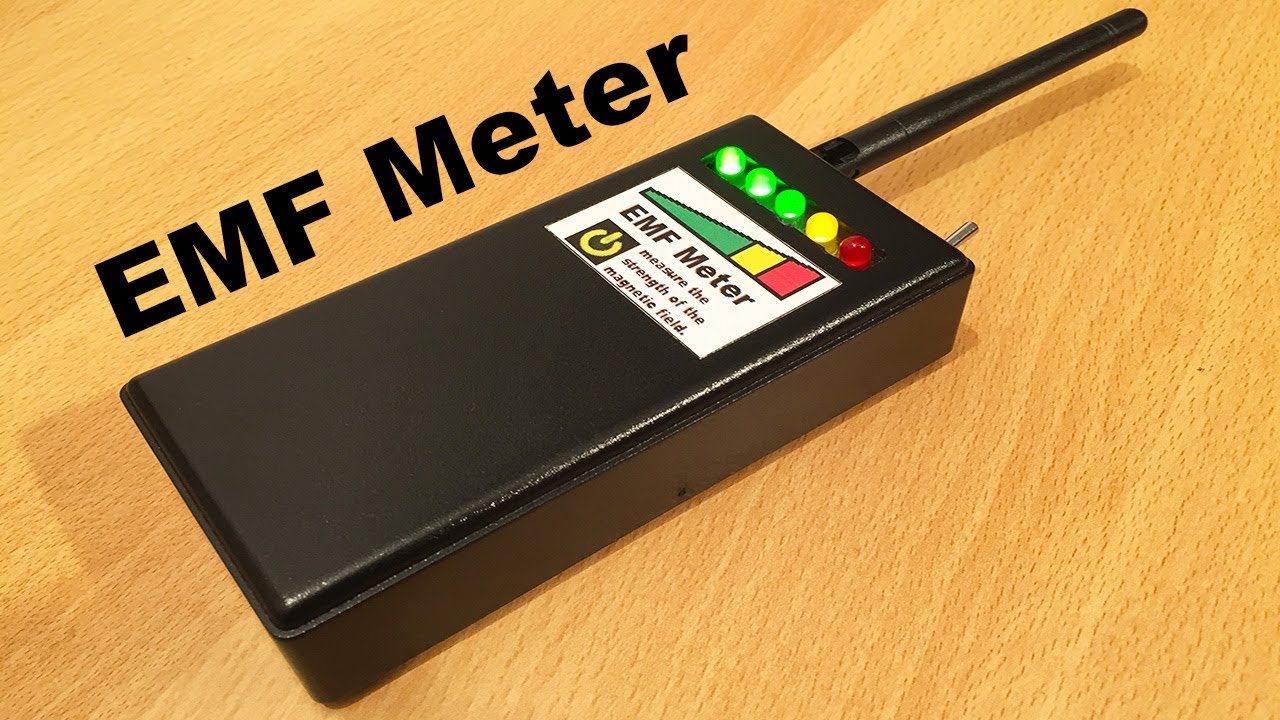

Finding an EMF source is easy. Finding out what kind of field you are seeing is harder, especially when a simple meter reacts to a nearby appliance but gives you no useful context. The Best EMF Detector should separate electric, magnetic, and radio-frequency readings clearly enough to help you scan a room without guessing.
We compared compact home meters, more advanced RF instruments, and simple field indicators. Some are built for practical household checks, while others make more sense for detailed RF work or paranormal investigations.
ERICKHILL RT-100S 3-in-1 is our top pick. The list spans straightforward electric and magnetic field meters, broad 5G and Wi-Fi detection, temperature and humidity monitoring, and one specialized instrument that reaches 10 GHz.
| # | Product | Award | Field coverage | Display and alerts | Best for |
|---|---|---|---|---|---|
| 1 | ERICKHILL RT-100S 3-in-1 | Best overall | EF, MF, RF | Color screen, sound, light | Home and office scans |
| 2 | TriField TF2 | Best for fast RF response | Magnetic, electric, RF | Bars, averaged readings | Serious field checking |
| 3 | GQ EMF-390 | Best advanced RF tool | EF, MF, RF | Spectrum analyzer, data logger | RF investigation |
| 4 | ERICKHILL Dual Field Meter | Best for appliance checks | EF, MF | LCD, sound, light | Low-frequency sources |
| 5 | POROMETISTO ET01Pro | Best with climate readings | EF, MF, RF | Analog color display, audio | Room monitoring |
| 6 | ERICKHILL 3-in-1 LCD Meter | Best for peak readings | EF, MF, RF | Backlit LCD, sound, light | Mobile inspections |
| 7 | COLOR TREE LED Meter | Best simple indicator | Magnetic fields | LED scale | Basic low-frequency checks |
| 8 | RDINSCOS 3-in-1 Meter | Best compact LCD meter | AC magnetic, AC electric, microwave | Tri-color LCD, buzzer | Quick home checks |
| 9 | TEMIRUP 5-in-1 Meter | Best for climate data | EF, MF, RF | Color LCD, analog bar | Home and office scanning |
| 10 | TRAKLUME 5-in-1 Meter | Best multifunction option | EF, MF, RF | Color screen, analog bar | General-purpose monitoring |
1. ERICKHILL RT-100S 3-in-1: Best Overall

Pros
- Measures electric, magnetic, and radio-frequency fields
- Shows all three field strengths at a glance
- Color-coded screen and triple alert system
- Rechargeable USB-C design
- Automatic shutoff helps conserve power
Cons
- The listing does not provide detailed measurement ranges
- It cannot replace a specialized spectrum analyzer
- RF coverage is described broadly rather than by a precise upper limit
Best for: homeowners who want one readable, rechargeable meter for everyday EMF scans.
The RT-100S is the easiest meter here to recommend to someone who wants to walk through a home and understand what the device is reporting. It does not force you to choose between electric, magnetic, and RF modes before every reading. All three field strengths appear directly on the screen, which makes it more useful for comparing a wall outlet, appliance, router, or phone from the same session.
The color-coded display is a practical touch. Green, orange, and red provide a quick visual indication of changing levels, while sound, screen, and light alerts give you several ways to notice a spike. The sound can be disabled, so the meter works in a quiet bedroom or office without turning every scan into an alarm exercise. That combination is more approachable than the TriField TF2, whose strength is rapid response and measurement behavior rather than a simple all-in-one presentation.
This ERICKHILL uses a Type-C charging port and includes automatic shutoff. Those details matter when the meter is used repeatedly around a house instead of stored for occasional investigations. Its stated uses include appliances, power-related sources, Wi-Fi, cell phones, and 5G signals. The product dimensions are about 3.94 by 2.36 by 1.57 inches, so it is compact enough for one-handed scanning.
The weakness is the lack of a detailed frequency and measurement-range specification in the supplied information. Buyers who need to know exactly how an RF instrument behaves across a defined band should look at the GQ EMF-390 or TriField TF2 instead. It is also not the right tool for identifying a particular RF carrier. For ordinary room-to-room comparisons, though, the clear display and three-mode coverage make it the most balanced pick.
If you want to change device placement after identifying a hotspot, the next question is often how shielding choices affect everyday EMF exposure. The RT-100S is a sensible starting point for that kind of practical check.
2. TriField TF2: Best for Fast RF Response

Pros
- Covers magnetic, electric, and RF fields
- RF range runs from 20 MHz to 6 GHz
- Three-axis magnetic measurement
- Fast bar response for digital signals
- Includes a carry case and detailed manual
Cons
- Does not detect radioactivity
- RF coverage stops below the GQ EMF-390 maximum
- Uses a 9V battery rather than a rechargeable design
Best for: users who care more about responsive field readings than a simplified beginner interface.
The TF2 feels like the specialist in this group. Its defining advantage is how it handles changing fields. The bars update instantly, while RF and numerical averages refresh four times per second. That matters around phones, wireless routers, and other digital equipment, where a slow or heavily averaged meter can make a changing signal look deceptively stable.
Its coverage is clearly stated: magnetic fields, electric fields, and RF from 20 MHz to 6 GHz. That includes most common 4G and 5G signals, Wi-Fi, Bluetooth, cell towers, smart meters, and AC powerlines, but not experimental millimeter-wave applications. The magnetic sensor is three-axis, while electric and RF readings are single-axis. That division gives the TF2 a more informative magnetic scan than many basic handheld meters.
The meter also offers standard or weighted frequency responses for electric readings. Weighted readings emphasize effects on the human body, while the unweighted RF measurement reports the field without that weighting. This is the sort of distinction that makes the TF2 more useful to someone comparing readings systematically rather than simply waiting for a light to change color. It comes with a 9V battery, a quick-start card, a detailed instruction manual, and a soft-shell zipper case.
Compared with the ERICKHILL RT-100S, the TF2 gives you more explicit information about response behavior and sensor axes, but it is less convenient as a rechargeable household gadget. The GQ EMF-390 reaches higher RF frequencies and adds spectrum tools, so it is the better choice for advanced RF exploration. Skip the TF2 if you need data logging or a spectrum view. Choose it when fast, readable field changes are the priority.
3. GQ EMF-390: Best Advanced RF Tool

Pros
- RF detection reaches up to 10 GHz
- Built-in RF spectrum analyzer
- Includes a data logger
- Designed to recognize several common sources
- Covers power lines, phones, microwaves, and cell towers
Cons
- More complicated than basic room scanners
- The supplied information does not list complete measurement ranges
- Its advanced features may be unnecessary for occasional checks
Best for: technically minded users who want more than a simple low, medium, or high indication.
The EMF-390 is the pick for readers who want to investigate RF rather than merely notice it. Its headline capability is detection up to 10 GHz, which extends beyond the TriField TF2's stated 6 GHz limit. That wider reach is useful when the source may sit higher in the RF spectrum, though the meter's real appeal is the combination of broad coverage with analysis features.
A built-in RF spectrum analyzer and GQ RF Browser provide real-time RF monitoring. The product also includes a data logger, giving you a way to preserve readings instead of relying only on memory or a quick glance at the display. The listing describes multiple high-sensitivity sensors and source recognition for power lines, smart meters, cell phones, microwaves, cell towers, and static. Those tools should make a longer inspection more structured.
The EMF-390 measures electric, magnetic, and RF fields in a three-in-one design. It is about 5.5 inches long, 3 inches wide, and 1 inch high, with a listed weight of 0.625 pounds. That is still portable, though it is less of a pocket-simple instrument than the smaller ERICKHILL dual-field meter. The safety suggestion feature is intended to help interpret the current situation quickly, but users still need to understand what each field mode is showing.
The trade-off is complexity. Someone checking a microwave, router, or bedroom may find the extra browsing and spectrum functions distracting. The RT-100S gives a friendlier summary, and the TF2 offers a more explicitly described fast-response workflow. The EMF-390 earns its place when you need frequency context and logged observations. It is the one to skip if all you want is a quick alarm around household appliances.
For phone-focused concerns, a meter is only part of the process. Placement, distance, and what changes when a phone is used inside a shielding pouch can matter just as much as the first reading.
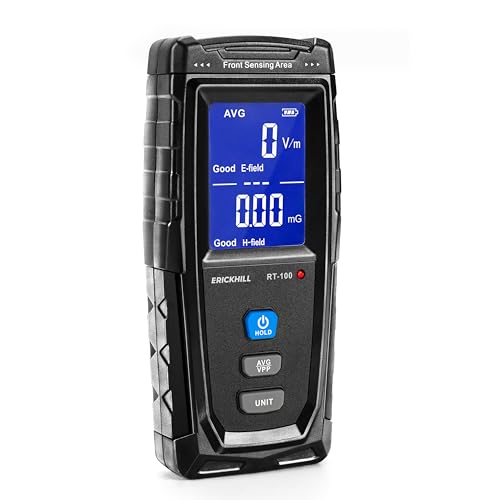
4. ERICKHILL Dual Field Meter: Best for Appliance Checks
Pros
- Provides specific electric and magnetic ranges
- Offers V/m, µT, and mG units
- Data hold freezes a reading
- Sound and light alarms can be muted
- Backlit LCD and five-minute shutoff
Cons
- Does not measure RF
- The supplied guidance emphasizes close positioning
- Less suitable for Wi-Fi and cell-signal checks
Best for: checking low-frequency electric and magnetic fields from appliances, wiring, and power equipment.
This ERICKHILL is a fundamentally different tool from the RT-100S. It concentrates on electric and magnetic fields, making it a better fit for someone investigating a refrigerator, induction cooker, computer, television, or nearby power line. There is no RF mode, so it will not tell you much about a Wi-Fi router or cell signal, but the narrower mission makes the display easier to understand.
The specifications are unusually concrete for this group. Electric field readings run from 1 to 1, 999 V/m, with an alarm threshold above 40 V/m. Magnetic readings cover 0.01 to 99.99 µT, or 0.1 to 999.99 mG, with an alarm threshold above 0.4 µT, or 4 mG. The meter can switch between mG and µT for magnetic readings, while electric readings use V/m.
The screen turns red, the indicator flashes, and the buzzer sounds when those stated thresholds are exceeded. A mute mode keeps the device usable in quiet rooms. Data hold is helpful when a reading is awkward to view while you are moving around an appliance, and the LCD is backlit for dark spaces. Automatic shutoff after five minutes is shorter than the 15-minute behavior on several other meters, which is useful for battery conservation but can interrupt a long inspection.
The main limitation is obvious: there is no RF measurement. The RT-100S, TF2, GQ EMF-390, and several later picks are much more flexible. This model is preferable when your question is specifically about low-frequency sources and you want stated ranges rather than a general three-color warning. Skip it if your first concern is a router, phone, or 5G signal.
5. POROMETISTO ET01Pro: Best with Climate Readings

Pros
- Measures EF, MF, and RF
- Covers EF and MF from 40 Hz to 100 kHz
- RF coverage runs from 30 MHz to 8 GHz
- Adds temperature and humidity readings
- Max, minimum, and data-hold functions
Cons
- Uses three AAA batteries
- Analog bars are less precise than a detailed spectrum view
- Climate readings do not make it a more capable RF analyzer
Best for: room scans where electromagnetic readings and basic environmental conditions belong together.
The ET01Pro stands out because it adds temperature and humidity to a conventional three-field meter. That does not make those readings evidence of an EMF source, but it can be useful when you are recording the condition of different rooms or comparing a bedroom, office, and basement during the same inspection.
Its core measurement coverage is solid on paper. Electric and magnetic fields are covered from 40 Hz to 100 kHz, while RF runs from 30 MHz to 8 GHz. That includes modern wireless signals such as Wi-Fi and 5G within the stated band, along with common household electrical sources. The tri-color analog display gives you an immediate green, yellow, or red visual cue, and audio alarms can be muted.
The ET01Pro includes maximum and minimum values, data hold, a low-battery warning, and automatic shutdown after 15 minutes. The shutoff can be canceled for extended measurements. It uses three 1.5V AAA batteries and comes with a screwdriver, velvet bag, and manual. At about 6.69 inches long and 2.87 inches wide, it is larger than the compact ERICKHILL dual-field meter, but still shaped for handheld use.
The extra environmental sensors are the reason to choose it, not a substitute for RF detail. The GQ EMF-390 remains the stronger tool for analyzing RF behavior, and the RT-100S is simpler for a quick whole-home scan. The ET01Pro makes sense for someone who wants one screen to log field levels and room conditions without moving to a more technical instrument.
6. ERICKHILL 3-in-1 LCD Meter: Best for Peak Readings

Pros
- Measures EF, MF, and RF
- RF detection reaches up to 10 GHz
- Shows average, peak, and maximum readings
- Backlit LCD with hold function
- Rechargeable design with sound and light warnings
Cons
- The listed product dimensions include an unusually low weight figure
- No detailed numeric ranges are supplied for each field
- Its display modes may require more interpretation than a simple color meter
Best for: users who want rechargeable three-field coverage with peak and average readings.
This ERICKHILL model is the more measurement-focused companion to the RT-100S. It covers electric, magnetic, and RF fields, but its strongest differentiator is the ability to view average, peak, and maximum readings. That is useful when a source changes as you move the meter closer, turn an appliance on, or bring a phone into the area.
The RF function is described as detecting 5G and frequencies up to 10 GHz. Electric and magnetic modes are intended for appliances such as televisions, induction cookers, rice cookers, refrigerators, computers, and wires. A large backlit LCD, one-button data hold, and sound and light warnings give it the controls needed for both quick checks and more deliberate comparisons.
It also has a 15-minute automatic shutoff and a rechargeable design with a charging cable. The black-and-white display mode is a small but useful option if the standard presentation is hard to read in a particular setting. The listed body is about 5.51 inches long, 2.56 inches wide, and 1.26 inches high. The supplied weight value is unusually low, so we would not use it to predict how substantial the meter feels in hand.
The RT-100S has the clearer beginner presentation, with all three field strengths and color-coded feedback visible at once. The GQ EMF-390 goes further for RF analysis. This ERICKHILL sits between them, offering the useful middle ground of peak readings without the spectrum-browser complexity. Choose it when changing levels are more important than a simple pass-or-alert indicator.
7. COLOR TREE LED Meter: Best Simple Indicator

Pros
- Very simple push-on and push-off operation
- LED scale is readable in dark and bright conditions
- Covers 50 Hz to 20, 000 Hz
- Registers a nearby cell phone
- Uses a single battery
Cons
- Measures magnetic fields rather than EF, MF, and RF separately
- Reports five milliGauss ranges instead of detailed numerical data
- Lacks data hold, logging, and environmental readings
Best for: quick magnetic-field checks and paranormal investigation sessions where simplicity matters most.
The COLOR TREE meter is the least complicated product here, and that is its entire appeal. Press the button, move it near a suspected source, and watch the LED scale respond. There is no menu system, mode selection, or numerical display to slow down a basic scan.
Its stated frequency coverage is 50 Hz to 20, 000 Hz, and it reports EMF measurements in five milliGauss ranges. The product is aimed at magnetic-field detection, including appliances and locations associated with paranormal investigations. It can register a cell phone within two feet, but that should not be confused with broad RF measurement. This is not a replacement for the TriField TF2, GQ EMF-390, or any of the three-field meters.
The LED scale is designed to be readable in darkness and sunlight, and the compact handheld design uses a single battery. Push-on and push-off operation keeps it accessible to a first-time user. It is also the easiest meter here to hand to someone who wants to follow a signal without learning units such as V/m, µT, or µW/cm².
The limitation is the lack of field separation and detail. If a high reading appears, the meter does not tell you whether you are dealing with electric, magnetic, or RF energy in the way the RT-100S does. Choose this one for a fast indicator, not for diagnosing a complicated home environment. Readers who want a more informative but still compact device should move up to the RDINSCOS meter.
8. RDINSCOS 3-in-1 Meter: Best Compact LCD Meter

Pros
- Detects AC magnetic, AC electric, and microwave fields
- Tri-color illuminated LCD
- Audible alert can be muted
- Automatic shutoff can be disabled
- Compact one-hand design
Cons
- The supplied information does not state detailed frequency ranges
- Electric readings require holding the device in your hand
- No data logger or rechargeable battery is listed
Best for: straightforward handheld checks around homes and offices.
The RDINSCOS keeps the basic meter formula clean: three types of field detection, a readable screen, and a warning when readings rise. It identifies AC magnetic, AC electric, and microwave fields, so it has broader coverage than the COLOR TREE indicator but a simpler mission than the GQ EMF-390.
The tri-color LCD uses green, yellow, and red to make changes visible without staring at a small number. A backlight helps in low-light rooms, and the buzzer can be muted. Automatic shutdown normally occurs after 15 minutes, but the function can be disabled for a continuous measurement session. That flexibility is helpful when you are tracing a field slowly across a room.
One important operating note is that the product says to hold the device in your hand when measuring electric fields. The human body acts as a grounding source, while placing the unit on a surface can introduce interference. That is not a minor footnote. It means two people may get different results if one follows the handling instructions and the other leaves the meter on a table.
The RT-100S provides more explicit three-mode presentation and rechargeable charging, while the ERICKHILL dual-field model gives more detailed numerical ranges for low-frequency work. The RDINSCOS is the compact middle option for users who want a color LCD and simple controls. Skip it if you need RF frequency detail, stored readings, or a precise analysis workflow.
9. TEMIRUP 5-in-1 Meter: Best for Climate Data

Pros
- Measures EF, MF, RF, temperature, and humidity
- RF coverage is stated as 30 MHz to 8 GHz
- Displays average, peak, and held readings
- Rechargeable and includes a carry bag
- Color LCD with analog warning bar
Cons
- The supplied information does not give detailed EF and MF ranges
- The listed weight is relatively high for a compact handheld meter
- Climate sensors add capability without improving RF analysis
Best for: users who want a rechargeable room monitor with field and climate readings.
TEMIRUP takes the same broad concept as the POROMETISTO ET01Pro and presents it in a rechargeable handheld format. Its five functions cover electric field, magnetic field, RF, temperature, and humidity. That makes it useful for recording a room's general conditions while scanning appliances, wiring, Wi-Fi equipment, and phones.
The RF mode is stated to cover 30 MHz to 8 GHz and to detect Wi-Fi, 5G signals, and microwave radiation from appliances. Magnetic readings can use mG or µT, electric readings use V/m, and RF readings use µW/cm². The meter can show average or peak values and hold a reading with one button, giving it more practical measurement control than a basic LED indicator.
The large color LCD and three-color analog display make the warning behavior easy to follow. When the bar reaches the yellow area, the device gives an audible prompt, and the sound can be useful when you are watching the source rather than the screen. Automatic shutoff after 15 minutes, low-battery indication, a charging cable, a carry bag, and a manual round out the handheld design.
Compared with the POROMETISTO, TEMIRUP has a similar environmental-monitoring angle but uses rechargeable power. The RT-100S remains the cleaner general recommendation, and the GQ EMF-390 is more appropriate for serious RF inspection. Pick TEMIRUP when temperature and humidity belong in the same room-by-room record. If you only need EMF readings, its extra sensors may not justify the larger feature set.
10. TRAKLUME 5-in-1 Meter: Best Multifunction Option

Pros
- Measures EF, MF, RF, temperature, and humidity
- RF detection reaches up to 8 GHz
- Provides numeric and tri-color analog displays
- Includes average, maximum, and hold readings
- Auto-shutoff can be disabled
Cons
- Uses three AAA batteries
- The supplied information does not state full measurement ranges
- It offers no spectrum analyzer or data logger
Best for: general-purpose EMF checks that benefit from environmental readings and flexible display controls.
The TRAKLUME is a broad-feature meter for readers who want the familiar five-in-one layout. It measures electric field in V/m, magnetic field in mG or µT, and RF in µW/cm², while built-in sensors report temperature and humidity. That gives it a useful spread for home, office, and general inspection work.
Its RF coverage reaches up to 8 GHz, with the listing naming 4G, 5G, Wi-Fi routers, and household appliances among the intended sources. Thresholds are given for the warning system: above 40 V/m for electric field, above 0.4 µT or 4 mG for magnetic field, and above 40 µW/cm² for RF. The numerical display is paired with a tri-color analog bar, so you can either watch a value or scan for a visual change.
The meter also shows maximum and average values, holds data, warns when the battery is low, and shuts down after 15 minutes unless that function is disabled. Its high-impact ABS housing is designed for one-handed use. The package includes three alkaline AAA batteries, a carrying pouch, screwdriver, and manual, while the supplied product information describes a 12-month replacement policy for damage.
The TEMIRUP is the closer rival because both combine three field modes with temperature and humidity. TEMIRUP is rechargeable, while TRAKLUME supplies replaceable batteries and a stated high-impact housing. Neither approaches the GQ EMF-390 for RF analysis, and the RT-100S remains easier to read at a glance. TRAKLUME is best for someone who wants thresholds, held readings, and environmental data in one general-purpose instrument.
How to choose best emf detector
The right meter depends on the fields you need to identify, how much detail you want from each reading, and whether the device will be used for quick checks or repeatable inspections.
Field types
Electric, magnetic, and radio-frequency fields are different measurement tasks. A dual-field meter such as the ERICKHILL Dual Field Meter suits appliances, wiring, and power-related sources, while a three-in-one model adds RF coverage for Wi-Fi, phones, and wireless equipment. A simple magnetic indicator cannot substitute for separate EF and RF modes.
Frequency coverage
Frequency range determines which signals a meter can see. The TriField TF2 states RF coverage from 20 MHz to 6 GHz, while the POROMETISTO, TEMIRUP, and TRAKLUME models extend to 8 GHz. The GQ EMF-390 and one ERICKHILL model state coverage up to 10 GHz. Wider coverage is useful only if it matches the sources you are investigating, so do not treat a larger number as a guarantee of better readings everywhere.
Readings and response
A color bar is convenient, but numerical readings show how much a field changes as you move the probe. Peak, maximum, average, and hold functions help when a source fluctuates or when the display is difficult to watch during a scan. The TF2's fast response is particularly relevant around digital RF sources, while the GQ EMF-390 adds spectrum and logging features for deeper work.
A three-color alarm tells you that something changed. Field separation and frequency coverage help explain what changed.
Alerts and display
Sound, light, and color alerts let you scan without constantly looking down. Mute controls matter in bedrooms, offices, and investigations where an audible alarm becomes distracting. Backlighting helps in dark spaces, while a large color LCD is easier to interpret than a small LED scale. The COLOR TREE meter is intentionally simple, but it cannot show the same context as the RT-100S or TRAKLUME.
Power and handling
Rechargeable models reduce battery changes during regular room scans, while AAA or 9V designs are easy to restore with spare batteries. Auto-shutoff preserves power, but a disable option is useful for longer measurements. Handling also affects results. RDINSCOS specifically says to hold the device in your hand for electric-field readings, and the probe should be moved slowly toward a source rather than pressed against it.

Frequently asked questions
What does an EMF detector measure?
An EMF detector measures electromagnetic fields, but different models cover different parts of the spectrum. Electric and magnetic modes are commonly used around appliances, wiring, and power equipment, while RF mode is intended for wireless signals, phones, routers, and some microwave-frequency sources.
Do all EMF meters detect Wi-Fi and 5G?
No. The COLOR TREE meter is a magnetic-field indicator, and the ERICKHILL Dual Field Meter measures electric and magnetic fields without an RF mode. Look for a stated RF range if Wi-Fi, cellular signals, or wireless equipment are central to the inspection.
Is a wider frequency range always better?
Not necessarily. A wider range can cover more potential sources, but the instrument still needs suitable sensors, response behavior, and a readable output. The GQ EMF-390 is the most specialized choice here because it combines broad RF coverage with a spectrum analyzer and data logging.
What is the difference between EF, MF, and RF?
EF means electric field, MF means magnetic field, and RF means radio frequency. They come from different sources and are expressed using different units in these products, so a reading in V/m should not be compared directly with a magnetic reading in µT or an RF reading in µW/cm².
Can an EMF meter detect radioactivity?
The TriField TF2 specifically states that it does not detect radioactivity. EMF meters are not substitutes for a radiation detector designed for ionizing radiation.
Should I use the alarm or the numerical reading?
Use the alarm to find changing or elevated areas quickly, then use the numerical display to compare locations and distances. A held or peak reading can help when the value changes as you move, but it should be interpreted according to the meter's field mode and units.
Are temperature and humidity readings necessary?
They are optional. The POROMETISTO, TEMIRUP, and TRAKLUME models add those readings for room monitoring, but they do not make the EMF measurement more precise. Choose that feature if you want environmental conditions in the same inspection record.

The bottom line
The Best EMF Detector for most homes and offices is the ERICKHILL RT-100S 3-in-1. It combines EF, MF, and RF coverage, a clear color display, multiple alerts, USB-C charging, and a simple presentation that does not bury the useful information.
Choose the TriField TF2 for fast RF response and more explicit sensor behavior, or the GQ EMF-390 when spectrum analysis, data logging, and RF coverage up to 10 GHz matter more than beginner-friendly operation. The ERICKHILL Dual Field Meter is the better specialist for appliance and wiring checks.
If you are undecided, choose the RT-100S for broad everyday scanning, the TF2 for responsive field work, or the GQ EMF-390 for advanced RF investigation.
As an Amazon Associate we earn from qualifying purchases.