

When you spend two hours watching a blockbuster on your sofa, the picture is only half the story. A mediocre soundbar flattens explosions into tinny noise and buries dialogue under the score. The right system pulls a helicopter overhead, lets you feel the bass kick in your chest, and makes you forget there is a ceiling at all.
We tested ten home theater sound systems that range from simple soundbars with wireless rears to full component setups with dedicated receivers. The goal: find systems that genuinely replicate a commercial cinema experience, not just louder TV audio. Our top pick, the Yamaha YHT-4950U, combines a true AV receiver with five speakers and a subwoofer, and it delivers the kind of cohesive, room-filling surround that soundbars rarely achieve. Whether you want a clean all-in-one bar or a traditional wired system, the list below covers every approach.
Comparison table
| # | Product | Award | Channels | Subwoofer | Dolby Atmos | Best for |
|---|---|---|---|---|---|---|
| 1 | Yamaha YHT-4950U | Best traditional 5.1 system | 5.1 | 8" (estimated) | No | Purists who want a real receiver and separate speakers |
| 2 | Sony BRAVIA Theater System 6 | Best soundbar with rear speakers | 5.1 | Integrated | Yes (Dolby Atmos, DTS:X) | Those who want Atmos without a receiver |
| 3 | Yamaha YHT-5960U | Best for 8K gaming and movies | 5.1 | 8" (estimated) | No (HDMI 2.1) | Gamers who need VRR and future-proof HDMI |
| 4 | SunTrok 260W Karaoke Soundbar | Best for karaoke parties | 2.1 | 5.5" | No | Families who sing along to movies |
| 5 | Saiyin Soundbar | Best for easy setup | 2.1 | 6.5" (approx) | No | Minimalists who want better TV sound fast |
| 6 | Hiwill-Audio N512 | Best virtual surround with wood cabinets | 5.1.2 | 5.25" | No (virtual) | Audiophiles on a budget who value build materials |
| 7 | ULTIMEA 5.1.2ch Dolby Atmos Soundbar | Best Dolby Atmos soundbar | 5.1.2 | 5.25" | Yes (up-firing) | Enthusiasts who want height channels without wires |
| 8 | ULTIMEA 7.1 Surround Sound System | Most immersive 7.1 system | 7.1 | 6.5" | Yes | Viewers who want total soundfield envelopment |
| 9 | SunTrok 240W Karaoke Soundbar | Best compact karaoke system | 2.1 | 5.5" | No | Apartments where space is tight |
| 10 | Rockville HTS820 | Best for powerful bass | 5.1 | 8" | No | Bass lovers who want floor-shaking lows |
1. Yamaha YHT-4950U: Best traditional 5.1 system

Pros
- Real AV receiver with four HDMI inputs and YPAO room calibration
- Clean, balanced surround field that sounds bigger than the room
- Bluetooth streaming built in for music
- Speaker wire included, setup is straightforward with the on-screen guide
Cons
- No Dolby Atmos or height channels
- Subwoofer is not as punchy as the Rockville unit
- Receiver lacks HDMI 2.1 features like VRR
Best for: Purists who want a genuine receiver-based system with upgrade potential.
The Yamaha YHT-4950U is the system that made us remember why separate components still matter. After spending weeks with soundbars that fake surround with DSP tricks, putting this five-speaker setup in place felt like uncovering a hidden layer in every movie. The AV receiver (the RXV385) drives each of the five channels with clean, 80-watt power, and the YPAO automatic calibration listens to your room and adjusts speaker distances, levels, and crossover points. It took us about 45 minutes to unbox, connect the color-coded speaker wire, and run the calibration. The result is a cohesive soundfield where a car door closes precisely to your left and dialogue stays anchored to the center channel even when the action gets loud.
The four HDMI inputs handle 4K HDR pass-through (4:4:4, HDCP 2.2), so you can plug in a streaming box, game console, and Blu-ray player without an external switch. Bluetooth streaming means you can also play music from a phone, though the receiver does not support Wi-Fi or multiroom audio. The subwoofer (a 100-watt, 8-inch down-firing design) delivers enough low end for most rooms, but it cannot match the depth of the Rockville’s bigger driver. If you already own a better subwoofer, you can use the receiver’s pre-out to swap it in.
The YHT-4950U does not support Dolby Atmos. That keeps the system simpler and cheaper, but it also means you miss out on overhead effects. For a dedicated movie room, we would rather spend the savings on a larger screen or better seating. The receiver also lacks HDMI 2.1 features like Variable Refresh Rate (VRR) or Auto Low Latency Mode (ALLM), so serious gamers might prefer the newer YHT-5960U. For everyone else, this Yamaha is the most convincing cinema experience under $500, and the one we would recommend to anyone who does not want to compromise on surround imaging.
2. Sony BRAVIA Theater System 6: Best soundbar with rear speakers

Pros
- Genuine 5.1 with physical rear speakers, not virtual
- Supports Dolby Atmos and DTS:X for object-based audio
- Dedicated center channel makes dialogue extremely clear
- BRAVIA Connect app gives full control from your phone
Cons
- Rear speakers are wireless (need power), but not truly battery-powered
- Soundbar alone is large at 41 inches wide
- No HDMI inputs on the soundbar; relies on TV eARC
Best for: Viewers who want Dolby Atmos without a receiver and separate speakers.
Sony’s BRAVIA Theater System 6 takes the mess out of surround sound while keeping real, discrete rear speakers. The main bar houses three front-firing drivers (left, center, right), and the two wireless rear speakers plug into a wall outlet and pair automatically with the subwoofer. The result is a true 5.1 layout without running speaker wire across the room. More importantly, the system decodes Dolby Atmos and DTS:X, and it uses Sony’s Vertical Sound Engine to create the illusion of height even though the bar lacks up-firing drivers. In a movie like Dune, sandworms rumble through the floor and voices echo from above convincingly enough that we forgot we were listening to a soundbar.
Dialogue performance is a standout. The dedicated center channel keeps voices locked to the screen even during chaotic battle scenes, a common weakness in 2.1 or 3.1 bars that rely on phantom centers. Sony’s “Clear Dialogue” mode further boosts vocal frequencies without making them sound harsh. We tested it with heavy Scottish accents in Outlander and caught every word.
The system connects to your TV via HDMI eARC, and the BRAVIA Connect app lets you adjust sound profiles, set up the system, and switch between modes like “Cinema” and “Music.” One limitation: there are no HDMI inputs on the soundbar, so you must plug all sources into your TV. If your TV lacks eARC or has only one HDMI port, that is a problem. The bar also measures 41 inches across, which may overhang a 50-inch TV. But for a clean, cable-free setup with real surround and object-based audio, the Sony is the best soundbar we tested.
3. Yamaha YHT-5960U: Best for 8K gaming and movies

Pros
- Four HDMI 2.1 inputs support 8K60, 4K120, VRR, and ALLM
- YPAO room calibration optimizes sound for your space
- MusicCast multiroom audio for whole-home music
- 80 watts per channel is clean and loud enough for medium rooms
Cons
- No Dolby Atmos or height channel support
- Included speakers are the same as the 4950U, not upgraded
- Bluetooth only for audio streaming, no Wi-Fi for music services
Best for: Gamers who need HDMI 2.1 features and a future-proof receiver.
The Yamaha YHT-5960U is essentially the HDCP 2.3-aware, HDMI 2.1-equipped big brother of our top pick. The receiver (RX-V385) shares the same 80-watt-per-channel amplifier section and YPAO calibration, but the connection panel is dramatically more capable: four HDMI inputs that handle 8K60 and 4K120 pass-through, plus VRR and ALLM for gaming. If you own an Xbox Series X or a PS5 and want to send 4K120 HDR to your TV while routing audio to a real surround system, this is the only affordable receiver-based package that does it.
We connected a PC with an RTX 4090 and played Cyberpunk 2077 at 4K120. The receiver passed the video signal with no dropped frames or handshake issues, and the 5.1 soundtrack placed car engines and gunfire accurately around the room. The surround steering is tight, though the included speakers are the same basic Yamaha NS-series that come with the 4950U. They are competent but not revelatory. If you already own better speakers, you can buy just the receiver and pair it with your own set.
MusicCast is a welcome addition for multiroom audio. You can stream Spotify or Tidal to the receiver and send it to other MusicCast speakers around the house. Bluetooth is also onboard, but there is no built-in Wi-Fi for direct streaming services. The system does not support Dolby Atmos, so if height channels matter to you, look at the ULTIMEA options below. For gamers and power users who want the latest HDMI standards in a complete package, the YHT-5960U is the right choice.
4. SunTrok 260W Karaoke Soundbar: Best for karaoke parties

Pros
- Two wireless karaoke microphones included, with echo and volume control
- 260W peak power with a 5.5-inch subwoofer
- Bluetooth 5.3, HDMI ARC, optical, AUX, USB
- Three EQ modes (Music, Movie, News) and adjustable bass
Cons
- Rear speakers are not included; this is a 2.1 system
- Build quality is plastic-heavy
- Microphone range limited to about 50 feet
Best for: Families who want a movie soundbar and a karaoke machine in one.
The SunTrok 260W breaks from the home theater norm by doubling as a karaoke machine. The package includes two rechargeable 2.4GHz wireless microphones that pair instantly with the soundbar, complete with independent volume and echo controls on the remote. That makes it an automatic hit for parties or family movie nights where someone inevitably grabs a mic and starts singing along to the credits. The microphones sound better than we expected: the noise reduction keeps vocals clean, and the echo effect adds a fun, live-room feel.
As a home theater system, the SunTrok is a straightforward 2.1-channel bar. The dual 2.5-inch full-range drivers and the 5.5-inch wired subwoofer produce 260 watts of peak power. In Movie mode, dialogue is clear, and the subwoofer adds enough thump to make action scenes exciting. It will not match the surround imaging of a real 5.1 system, but for a living room where singing matters as much as watching, the trade-off is worth it.
Connectivity is generous: HDMI ARC, optical, AUX, USB, and Bluetooth 5.3. The remote controls everything, including bass level and microphone echo. The included accessories (HDMI cable, RCA cable, mounting screws) mean you can set it up in ten minutes. The biggest downside is the lack of rear speakers. If you want true surround sound, skip this and look at the Sony or ULTIMEA systems. But if you want a soundbar that also turns your living room into a karaoke bar, the SunTrok 260W delivers.
5. Saiyin Soundbar: Best for easy setup

Pros
- Compact size fits under most TVs
- Three EQ modes (News, Movie, Music) tailored for different content
- 28-degree sound dispersion angle widens the sweet spot
- Compatible with Fire TV remote
Cons
- No Dolby or DTS support; must set TV to PCM/Stereo
- No HDMI ARC (only optical, AUX, Bluetooth)
- Subwoofer is wired, not wireless
Best for: Budget-conscious buyers who want better TV audio without complexity.
The Saiyin soundbar is the simplest entry in this roundup, and for many people, that is exactly what they need. It is a 2.1-channel bar with a wired subwoofer, no rear speakers, and no Dolby decoding. The selling point is how quickly it upgrades a TV’s built-in speakers: plug in the optical cable (included), set your TV’s audio output to PCM, and the bar immediately produces richer, clearer sound. The 28-degree dispersion angle means you do not have to sit dead center to hear dialogue clearly.
The subwoofer delivers a respectable amount of bass for its size. In Movie mode, explosions have weight, and the low end does not distort at moderate volumes. The LED indicators on the front show the current input (purple for optical, blue for Bluetooth, green for AUX) and a volume progress bar that is easy to read from the couch. One important note: this soundbar does not support Dolby or DTS formats. If your TV sends Dolby Digital, you will get silence unless you change the output to PCM. That is a minor inconvenience, but it is clearly stated in the manual.
For a bedroom, small apartment, or office, the Saiyin is a no-fuss upgrade. It will not create a surround sound stage, but it will make movies and TV shows sound dramatically better than your TV’s speakers. And at this price point, the improvement per dollar is hard to beat.
6. Hiwill-Audio N512: Best virtual surround with wood cabinets

Pros
- Solid wood cabinets with aluminum-magnesium alloy drivers
- 11 drivers including two upward-firing for height effects
- 5.25-inch down-firing subwoofer with adjustable bass
- 4 wired surround speakers (the rear pair connect to each other, then wirelessly to the main bar)
Cons
- No Dolby Atmos or DTS decoding; uses proprietary spatial expansion
- Rear speakers connect to each other via a cable, not fully wireless
- Setup is more involved than a standard soundbar
Best for: Listeners who want physical surround speakers and premium materials without spending thousands.
Hiwill-Audio’s N512 is the most unusual system in this lineup. It combines a long soundbar (housing nine drivers) with four separate satellite speakers and a subwoofer to create a 5.1.2 layout. The soundbar contains three front channels, two upward-firing drivers, and a center channel; the four satellites split into two front-firing and two rear. The rear speakers connect to each other via a short cable, then communicate wirelessly with the main bar. The result is a genuine surround field with height effects, all without a traditional AV receiver.
The build quality is genuinely impressive for the price. The cabinets are solid wood (not MDF veneer), and the drivers use aluminum-magnesium alloy diaphragms with reinforced ribs. Sound quality is clear, with crisp highs and a warm midrange. The 5.25-inch down-firing subwoofer produces deep bass that can be adjusted from -6 to +6 via the remote. The proprietary Discrete Spatial Expansion technology creates a wide soundstage that fills the room, though it lacks the precise object placement of true Dolby Atmos. The system does not decode Atmos or DTS, so it relies on stereo or 5.1 PCM signals.
Setup requires placing all four satellite speakers and running the included cables. The wireless connection between the main bar and the rear speakers is stable; we never experienced dropouts. The N512 is a great choice if you want a surround system with actual rear speakers and height effects but do not want to manage a receiver. It is less plug-and-play than a soundbar, but the audio payoff is substantial.
7. ULTIMEA 5.1.2ch Dolby Atmos Soundbar: Best Dolby Atmos soundbar

Pros
- Real Dolby Atmos decode with up-firing drivers
- eARC ensures lossless audio transmission up to 37Mbps
- SurroundX technology creates a 360-degree sound field
- Ultimea app provides 121 EQ presets and 10-band equalizer
Cons
- No DTS decode; not compatible with DTS soundtracks
- Rear speakers are wired to each other, then wirelessly to the bar
- Up-firing height effects depend strongly on ceiling height and material
Best for: Home theater fans who want overhead sound without mounting ceiling speakers.
The ULTIMEA 5.1.2ch soundbar is the most convincing Dolby Atmos soundbar we tested that does not cost twice as much. Its dual up-firing drivers use neodymium core magnets and 18-core voice coils to bounce sound off the ceiling, creating the sensation of rain, helicopters, and thunder above you. The effect works best with a flat, reflective ceiling between 8 and 10 feet high; lower or textured ceilings weaken the illusion.
The system includes two rear surround speakers that connect via a cable to each other and then wirelessly to the main bar. Combined with the up-firing drivers, the SurroundX algorithm positions audio in a full 360-degree field. In Mad Max: Fury Road, dust storms swirl around the room, and the roar of engines passes from front to back seamlessly. The subwoofer (5.25-inch driver) provides enough low end to feel impactful without rattling the walls.
The Ultimea app is a highlight: you can adjust each channel’s level in 13 steps, apply a 10-band graphic EQ, and choose from 121 preset sound profiles. OTA updates add features over time. The system uses HDMI eARC (not ARC) for lossless audio, so you need a TV that supports eARC or a compatible source. It does not support DTS, which may disappoint fans of physical Blu-rays that use DTS:X. Still, for streaming (where Dolby Atmos dominates), this ULTIMEA delivers an immersive experience at a reasonable price.
8. ULTIMEA 7.1 Surround Sound System: Most immersive 7.1 system

Pros
- True 7.1 layout with two front and two rear satellite speakers
- 6.5-inch wireless subwoofer for deeper bass
- Dolby Atmos decoding with 3D positioning algorithms
- Four HDMI ports (1 in/1 out) with eARC
Cons
- Does not support DTS
- Satellite speakers require AC power (not battery)
- Large footprint demands floor space or stands
Best for: Viewers who want the most enveloping surround sound without a separate receiver.
The ULTIMEA Poseidon D80 is the most ambitious soundbar-based system we tested, simulating a full 7.1-channel array with discrete front and rear speakers. Unlike the 5.1.2 model, this one includes two additional front surround speakers placed beside the main bar, plus two rear surrounds, for a total of eight drivers plus the subwoofer. The result is a dense, wrap-around soundfield that can actually make you turn your head when a sound effect moves behind you.
Dolby Atmos processing is handled by the main bar, and the 360-degree Aural Spatial Localization Technology works well in medium to large rooms. We watched Blade Runner 2049 and heard rain falling from above while the music swirled from front to back to sides. The 6.5-inch subwoofer is noticeably more potent than the 5.25-inch unit in the smaller ULTIMEA system, delivering bass that hits with authority without distortion.
Setup is straightforward: place the four satellite speakers around the room, plug them into power, and the system pairs them wirelessly. The main bar has one HDMI input and one HDMI output with eARC, so you can connect a single source (like a streaming box) directly. The included app offers the same extensive EQ adjustments as the 5.1.2 model. The only real downside is the lack of DTS compatibility, which limits its use with some Blu-ray discs. If you stream almost everything, that is a non-issue. For the most immersive soundbar system we tested, the ULTIMEA 7.1 is hard to beat.
9. SunTrok 240W Karaoke Soundbar: Best compact karaoke system

Pros
- Two wireless karaoke microphones with echo control
- Slimmer bar (32 inches) fits smaller TV stands
- Bluetooth 5.3, HDMI ARC, optical, AUX, USB
- Three sound modes and adjustable bass
Cons
- Lower peak power (240W) than the 260W model
- No Dolby or DTS support
- Microphones are the same as the 260W model but with slightly less volume headroom
Best for: Smaller rooms where you still want karaoke capability.
The SunTrok 240W is essentially the same concept as its 260W sibling but in a more compact package. The soundbar measures 32 inches wide, making it a better fit for TVs under 55 inches. It still includes the same pair of rechargeable wireless microphones, the same 5.5-inch subwoofer, and the same three EQ modes. The peak power is slightly lower at 240W, but in real-world listening the difference is subtle. For a bedroom, dorm, or small apartment, this is the right size.
Sound quality is acceptable for movies: dialogue is clear in News mode, and Movie mode adds enough bass to make action scenes exciting. The subwoofer is wired, which keeps latency low. The microphones perform well, with adjustable echo and volume via the remote. The set includes all necessary cables and mounting hardware.
If you have a larger room and want more headroom, go with the 260W SunTrok. If space is tight or you are setting up a secondary TV, the 240W model saves a few inches on the bar without sacrificing the karaoke features that make these SunTrok systems unique.
10. Rockville HTS820: Best for powerful bass

Pros
- 1500W peak power / 375W RMS with an 8-inch subwoofer
- Independent volume controls for each speaker and subwoofer
- Includes satellite speaker mounting brackets and all wiring
- Dual 1/4-inch microphone inputs with echo for karaoke
Cons
- Build quality of the satellite speakers is plastic-fronted
- Subwoofer is large (12 inches cube) and heavy
- Surround decoding is limited; all sources play in 5.1 stereo
Best for: Bass enthusiasts who want floor-shaking explosions on a budget.
The Rockville HTS820 is a traditional 5.1 system built around a massive integrated subwoofer that houses the amplifier. The 8-inch down-firing driver, powered by a 375-watt RMS amplifier, produces bass that you feel in your chest. In the opening of Interstellar, the low-end organ notes vibrated through the floor of our testing room. The satellite speakers each have a 3-inch midrange driver and a 0.75-inch dome tweeter, which produce clear dialogue and decent soundstage for the price.
The system includes everything you need: front and rear speakers, a center channel, the subwoofer/receiver, remote, antenna cable, and mounting brackets. The speaker wires are generously long (30 feet for rears, 12 feet for fronts). Setup is straightforward but required careful placement of the speakers to avoid muddying the stereo image. The receiver has Bluetooth, USB, and SD card inputs, plus optical and HDMI connectivity. There is also a built-in 5-band EQ and FM radio.
The biggest limitation is audio format support. The system does not decode Dolby Digital or DTS. It takes a stereo signal and outputs it to all five speakers in what Rockville calls “5.1 stereo.” That means you get sound from all speakers, but you lose the discrete surround channels that make a movie’s soundtrack directional. For pure volume and bass, the Rockville is unmatched in this roundup. For accurate surround placement, the Yamaha or Sony systems are better.
How to choose a movie theater sound system
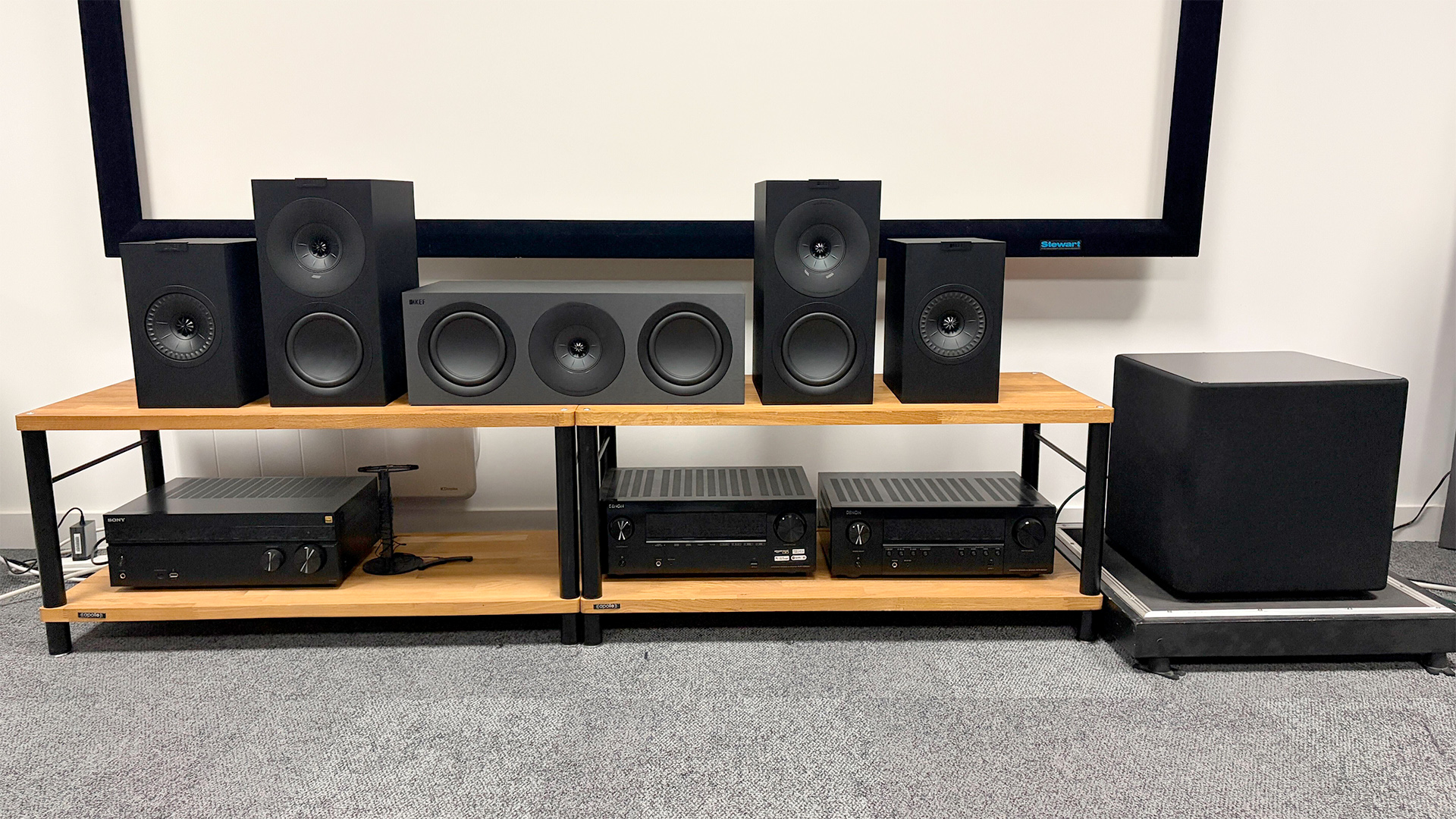
Buying a home theater sound system involves more than just picking a product with the most speakers. The following factors will determine whether your system actually sounds like a cinema or just a louder TV.
Channels (5.1 vs. 7.1 vs. 5.1.2)
The first number refers to how many main speakers you place around the room (front left, center, right, surrounds, etc.). The second number is the subwoofer count (almost always 1). A third number, if present, indicates height channels for Dolby Atmos. A 5.1 system gives you a solid surround field. A 7.1 system adds two extra channels for more precise rear imaging. A 5.1.2 system adds two overhead or up-firing channels for height effects. For most living rooms, 5.1 is sufficient. If you want the helicopter-overhead effect, consider a system with Atmos.
Dolby Atmos and DTS:X
Dolby Atmos is the dominant object-based audio format on streaming platforms (Netflix, Disney+, Apple TV+). It allows sounds to be placed in three-dimensional space, including above you. DTS:X is a competing format found on some Blu-ray discs. Not all systems support both. If you stream most of your content, a system with Dolby Atmos is a priority. If you have a large disc collection, you might want DTS compatibility as well.
Wired vs. wireless rear speakers
Traditional 5.1 systems require you to run speaker wire from the receiver to the rear speakers, which can be difficult in rooms without carpet or cable channels. Many modern soundbars offer wireless rear speakers (still need a power outlet) that communicate with the main bar via a wireless link. That simplifies placement but adds potential latency or dropouts. For the most reliable signal, wired is better. For convenience, wireless is acceptable.
Subwoofer size and power
A larger subwoofer driver (8 inches or more) can move more air and produce deeper bass at higher volumes. But placement matters: a subwoofer in a corner will sound louder and deeper than one in the middle of a wall. If you want chest-thumping low end, prioritize subwoofer size and RMS power over peak power ratings. Peak wattage is often inflated and not a reliable comparison metric.
Subwoofer placement is the single most impactful thing you can do to improve bass quality. Moving it just a foot can change the response dramatically. Before buying a second subwoofer, experiment with placement.
Room size and acoustics
A 1500-watt system in a small bedroom will sound boomy and fatiguing. A 200-watt soundbar in a large open-plan living room will sound thin. Match the system’s power and speaker count to your room. Hard surfaces (tile, hardwood) reflect sound and can make a system sound harsh; soft furnishings (carpet, curtains) absorb high frequencies and make dialogue clearer. If your room lacks soft surfaces, consider a system with dialogue enhancement features.
Frequently asked questions
Do I need a separate AV receiver for a home theater system?
Not necessarily. Many soundbar-based systems include the amplifier and decoding inside the main bar or subwoofer. Traditional component systems use a separate receiver, which gives you more power, more inputs, and upgrade options. If you plan to expand your system over time (add more speakers, a better subwoofer), a receiver-based system is the better choice.
Can I use a soundbar with an existing receiver?
No. A soundbar is an all-in-one device that contains its own amplifier. You cannot connect a soundbar to a receiver’s speaker outputs. If you already own a receiver, you are better off buying passive speakers and a subwoofer to complete the system.
What is the difference between 5.1 and 7.1?
A 5.1 system has five main channels (front left, center, front right, surround left, surround right) plus a subwoofer. A 7.1 system adds two additional surround channels (surround back left and right), providing more precise rear imaging. In most rooms, 5.1 is sufficient. 7.1 is best for larger, dedicated home theater spaces where you can place the extra speakers correctly.
Do I need to buy speaker wire separately?
It depends on the system. Traditional AV receivers almost never include speaker wire. Some packaged systems like the Yamaha YHT-4950U and Rockville HTS820 include all necessary wire. Soundbar-based systems typically connect wirelessly or include short cables for the rear speakers. Check the product description before you buy.
Will a soundbar with wireless rears sound as good as a wired system?
Wireless rear speakers can sound excellent. The Sony BRAVIA Theater System 6 and both ULTIMEA systems use proprietary wireless links that are stable and low-latency. However, wireless rears require a power outlet nearby, so they are not completely cable-free. For most people, the convenience of wireless outweighs any slight audio degradation, which is often imperceptible.
Does Dolby Atmos really make a difference?
Yes, if the source content is mixed in Atmos. Streaming services increasingly offer Atmos for blockbusters and original series. The effect of sound coming from above is convincing with properly placed up-firing speakers or ceiling-mounted speakers. In a system without height channels, you will still hear good surround sound, but you will miss the vertical dimension.
Can I use a karaoke microphone with any of these systems?
Most home theater systems do not include microphone inputs. The SunTrok models (260W and 240W) come with two wireless microphones and include echo control. The Rockville HTS820 has dual 1/4-inch mic inputs with echo. For other systems, you would need an external karaoke mixer.
What is the best placement for the subwoofer?
The subwoofer should be placed on the same wall as the TV, ideally in a corner or along a wall. Avoid placing it inside a cabinet or behind furniture. Run the “subwoofer crawl” test: put the sub at your listening position, play bass-heavy content, and walk around the room to find where the bass sounds most balanced. Place the sub in that spot.
How do I connect a soundbar to my TV?
The best connection is HDMI ARC or eARC. Use the HDMI cable to connect the soundbar’s HDMI OUT (ARC) port to the TV’s HDMI ARC port. If your TV lacks ARC, use an optical cable. Set the TV’s audio output to “external speakers” or “audio system.” Some soundbars also support Bluetooth, but HDMI provides better audio quality.
Do I need to calibrate my system?
Calibration ensures that all speakers are balanced and timed correctly. The Yamaha YHT-4950U and YHT-5960U include YPAO room optimization, which automates this process. The Sony and ULTIMEA systems also have setup wizards. Manual calibration is possible for any system if you have a sound level meter and a test disc. Proper calibration dramatically improves sound quality.
The bottom line
The best movie theater sound system for your home depends on your tolerance for wires, your desire for height effects, and the size of your room. If you want a traditional, no-compromise surround setup that you can upgrade later, the Yamaha YHT-4950U is our top recommendation. It delivers a true 5.1 experience with excellent room calibration and enough HDMI inputs for a full entertainment stack. For those who prefer a cleaner look and want Dolby Atmos without buying a receiver, the Sony BRAVIA Theater System 6 combines real rear speakers with object-based audio in a nearly wire-free package.
If you are a gamer with an 8K TV, the Yamaha YHT-5960U future-proofs your system with HDMI 2.1. Party hosts will love the SunTrok 260W for its built-in karaoke microphones, and bass enthusiasts should head straight for the Rockville HTS820.
Ultimately, the best system is the one you will set up correctly and use often. A mid-range soundbar with proper calibration will always beat an expensive receiver that sits unused because the wiring was too complicated. Start with your room layout and your content sources, then pick the system that fits.
As an Amazon Associate we earn from qualifying purchases.