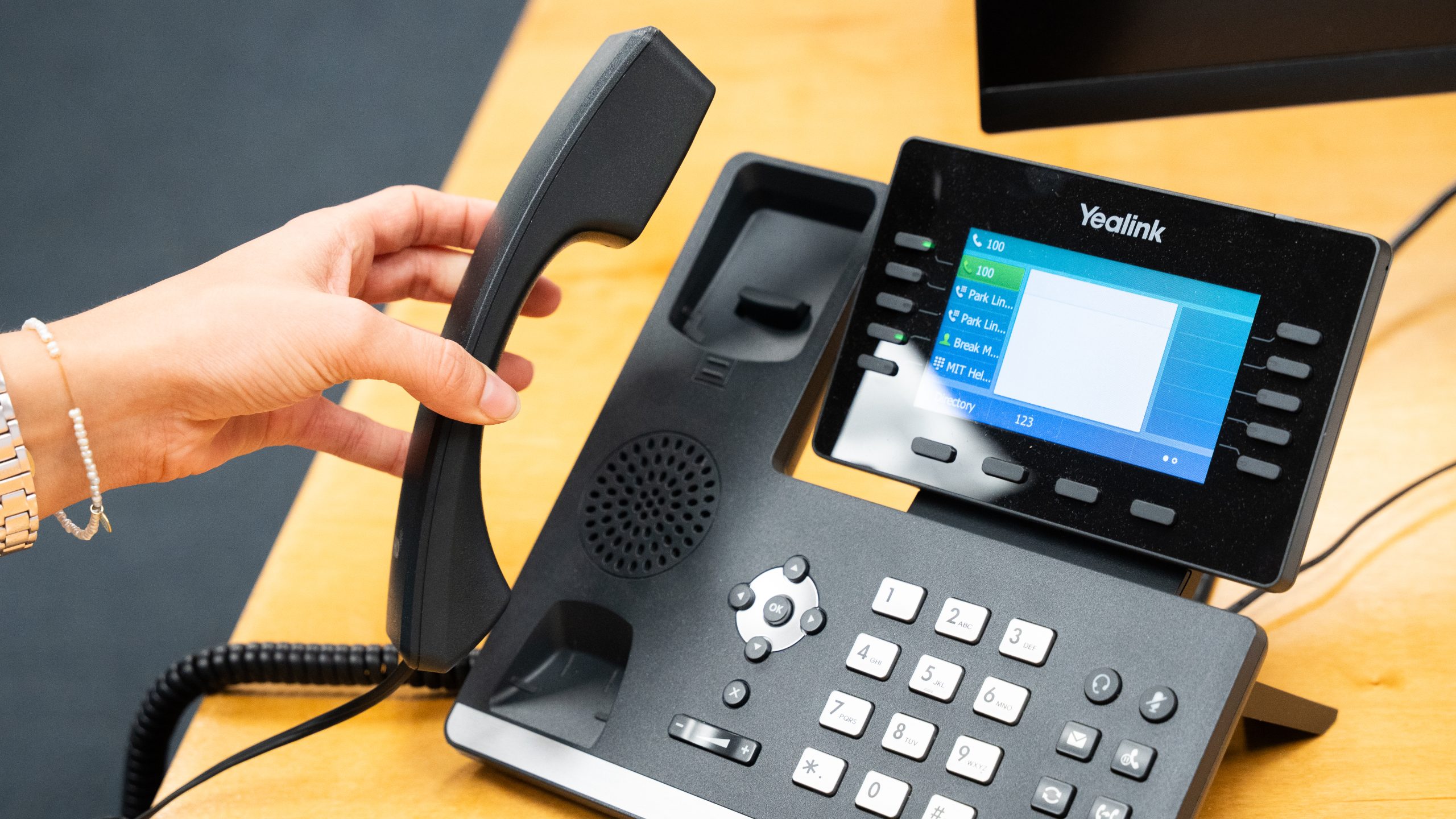

A business phone can be perfectly capable and still be the wrong tool if it cannot handle more than one caller, route extensions, or work where your staff actually sits. The first decision is not the handset. It is whether you need a traditional line-based system, a networked SIP phone, or a complete hosted phone platform.
Our Best business voip phone system picks cover all three approaches. The VTech AM18447 is the strongest traditional office system, while Mission Machines and XBLUE provide the clearest path to hosted calling, mobile extensions, and remote workers.
VTech AM18447 is our top pick, with the list ranging from a compact two-line cordless system to an eight-phone cloud-ready office package.
| # | Product | Award | Lines or service | Handsets or phones | Best for |
|---|---|---|---|---|---|
| 1 | VTech AM18447 | Best overall | 4 analog lines | Up to 10 stations | Small offices needing routing and room to grow |
| 2 | Mission Machines G400C | Best hosted system | 3 VoIP lines included | 4 Grandstream phones | Offices wanting a ready-to-use cloud platform |
| 3 | AT&T DLP73590 | Best for large cordless coverage | Single-line cordless system | 5 handsets | Teams needing several mobile extensions |
| 4 | Eagaton T52P | Best standalone SIP phone | 2 SIP accounts | 1 desk phone | Businesses with an existing PBX or SIP provider |
| 5 | Panasonic KX-TG9582B | Best hybrid system | 2 lines | 2 cordless handsets | Offices combining desk, cordless, and mobile calls |
| 6 | VTech 80-0328-00 | Best four-line cordless setup | 4 lines | Cordless system | Businesses prioritizing DECT coverage |
| 7 | AT&T TL88102BK | Best expandable two-line system | 2 lines | 3 handsets | Small teams that may add many extensions |
| 8 | VTech DS6151-2 | Best simple two-line system | 2 lines | 2 handsets | Home offices and very small businesses |
| 9 | XBLUE QB1 8-Phone | Best for larger remote teams | 4 landline ports, up to 10 XBLUE lines | 8 IP8g phones | Offices needing many extensions and mobility |
| 10 | XBLUE QB1 4-Phone | Best compact cloud bundle | 4 landline ports, up to 10 XBLUE lines | 4 IP8g phones | Smaller offices moving to hosted calling |
1. VTech AM18447: Best Overall

Pros
- Four-line operation
- Auto attendant on every line
- Expandable to 10 stations
- 180 shared minutes of digital message storage
- Custom music on hold
Cons
- Uses analog RJ11 lines rather than native SIP
- Expansion handsets or desksets are separate
- The main console is not a fully cordless setup
Best for: a small office that wants professional call handling without moving to a hosted platform.
The VTech AM18447 is the system we would start with for a conventional small office. It gives the receptionist a proper central console, then lets the business place cordless handsets or desksets where people need them. That arrangement feels more organized than scattering unrelated cordless phones around the office, especially when several people share incoming calls.
Its four-line capacity is the important distinction. Each line gets a professional auto attendant that can answer, offer directory access, route callers to extensions, and record voicemail. The system also includes intercom, caller ID, call waiting, a 100-name phonebook, and 32 speed dials. Those features address the daily friction points that make a basic phone feel inadequate at a front desk.
The expansion ceiling is unusually useful here. The console can support up to 10 stations, so an office can start with a central phone and add extensions as desks are added. The digital answering system stores up to 180 shared minutes of incoming messages, announcements, and memos. A full-duplex speakerphone and cordless headset support make the console more practical for reception work, while the 2.5mm jack allows custom music on hold.
The limitation is just as clear: this is an analog RJ11 system, not a native SIP endpoint. It is a better fit than the Eagaton T52P for an office with existing analog service, but the Mission Machines G400C is the more capable choice for cloud routing, remote access, and mobile or PC calling. Choose the VTech when physical lines and straightforward office control matter more than app-based flexibility.
2. Mission Machines G400C: Best Hosted System

Pros
- Four Grandstream GXP2615 phones included
- Automated attendant and flexible call routing
- Call recording and contact center capability
- Wi-Fi network connection supported
- US-based technical support
Cons
- Requires an ongoing phone service subscription
- The bundle is more involved than a traditional cordless system
- Included service is limited to three months
Best for: an office that wants a preconfigured cloud phone system with remote and mobile calling options.
The Mission Machines G400C is the most complete hosted phone package in this group. It arrives as a four-phone bundle built around the G400C cloud business phone system and Grandstream GXP2615 phones. The appeal is not merely having four desk phones. It is having the call logic behind them already organized for an office.
The feature set covers automated attendant menus, flexible routing, conferencing, forwarding, call logs, paging, intercom, hold, park, music on hold, and call recording capability. It is also described as contact-center capable. That makes it far more suitable for a small customer-service operation than the VTech DS6151-2, whose strengths are separate mailboxes and simple two-line calling.
Setup is designed around a network connection, with wired or Wi-Fi operation supported. The system is preprogrammed to work once connected to the network, and the service can port an existing number or assign one. The included service covers three lines, with unlimited calling to the US and Canada described in the product details. Those service terms are central to the purchase, so a buyer should be comfortable with a hosted platform rather than treating this as a collection of ordinary telephones.
The ongoing subscription is the main reason to skip it if you only need a local line system. The XBLUE QB1 systems offer a similar hosted direction with four or eight IP8g phones, while Mission Machines makes the cleaner case for buyers who want a smaller bundle and preconfigured support. Select the G400C for an office that expects calls to move between desk phones, mobile users, and PCs.
3. AT&T DLP73590: Best for Large Cordless Coverage

Pros
- Five handsets included
- Large 5-inch color base display
- Conference calls with up to four cordless handsets
- Bluetooth connects to cell phones
- Smart call blocking with a 1, 000-entry block list
Cons
- Not a multi-line VoIP platform
- The base display takes substantial desk space
- Less suited to extension-heavy offices
Best for: a business that needs several cordless stations and strong call-blocking tools.
The AT&T DLP73590 is the most approachable choice for a small team that wants phones in several rooms rather than a networked desk at every workstation. Five handsets are included, and the DECT 6.0 design is intended to provide long-range coverage with noise filtering. That is a practical advantage in a shop, clinic, or office where staff move away from the main desk.
The base is built around a 5-inch color display, which is much easier to navigate than the monochrome screens on the VTech DS6151-2 and Panasonic KX-TG9582B. Soft keys sit beside and below the display, and personalized shortcuts can be assigned to contacts, messages, call history, and other functions. The large interface makes the system feel less like a basic home phone, even though it is not a full multi-line VoIP platform.
Conference calling can combine an outside line with up to four cordless handsets, and intercom calling works between handsets and the base. Bluetooth Connect to Cell adds a useful bridge for a mobile-first business, letting the system handle calls from a paired smartphone. Smart Call Blocker can automatically stop robocalls from ringing through and stores up to 1, 000 names and numbers on the block list.
The catch is that its business usefulness depends on your calling setup. It cannot match the four-line routing and auto attendant of the VTech AM18447, and it lacks the hosted extension features of Mission Machines. It is the better choice when cordless reach, a readable base, and mobile-phone integration matter more than formal departments and queues.
4. Eagaton T52P: Best Standalone SIP Phone

Pros
- Supports two SIP accounts
- HD audio with G.722 and Opus codecs
- Six-party conferencing
- Dual 100M Ethernet ports
- PoE and power adapter support
Cons
- Requires a SIP provider or active PBX
- Not compatible with standard RJ11 landlines
- Only one phone is included
Best for: a business that already has SIP service, an IP PBX, or a self-hosted phone platform.
The Eagaton T52P is the only product here that is plainly a standalone professional VoIP phone. That makes it easy to misclassify. It is not a complete phone system and it is not compatible with a standard home landline connection. It needs a SIP service provider or an active PBX such as 3CX, Asterisk, or FreePBX.
For the right setup, the T52P has a sensible feature mix. It supports two SIP accounts, so one handset can manage two registered services or identities. Its HD handset and speaker use wideband codecs including G.722 and Opus, while noise reduction is intended to keep voices intelligible in a busy office. Six-party conferencing gives it more collaborative capability than a basic cordless handset.
The 2.4-inch color display has a 320 by 240 pixel resolution and an adjustable backlight. The stand can sit at 60 or 45 degrees, with a 15-degree wall-mount angle. Dual 100M Ethernet ports and PoE support can keep the desk installation tidy, while the included 5V/1A adapter gives an alternative when the network switch does not provide PoE.
This is a better building block than the VTech products, but only if you already understand SIP provisioning. The Mission Machines G400C and XBLUE QB1 are more appropriate for a buyer who wants phones and service in one package. Skip the T52P if you expect to plug directly into a phone jack. Pick it when you want a configurable endpoint for an existing IP phone environment.
5. Panasonic KX-TG9582B: Best Hybrid System

Pros
- Two-line operation
- Corded base and two cordless handsets
- Link2Cell supports up to four smartphones
- Three-way conference calling
- USB calling with Outlook contacts
Cons
- Older monochrome display
- Not native SIP VoIP
- Only two cordless handsets are included
Best for: a home office or small business blending conventional lines with smartphone calling.
The Panasonic KX-TG9582B makes sense for a business that does not want to choose between a fixed desk phone and cordless mobility. It combines a corded phone with two cordless handsets and supports two lines. That layout gives a main desk a stable base while letting staff carry extensions through the office.
Its Link2Cell Bluetooth feature is the standout. Up to four smartphones can connect to the system, allowing cellular calls to be answered on the cordless handsets. The system also supports three-way conferencing between the corded phone and two cordless phones. Noise reduction is designed to suppress background interference, and the listed cordless figures are up to seven days of standby and up to 15 hours of talk time.
The Panasonic adds a surprisingly specific office feature through USB connectivity. It can connect to a PC and Outlook contacts for outgoing calls, with incoming calls handled through a single click. The DECT 6.0 signal is intended for long-range operation through thick walls, while the 1.8-inch monochrome display keeps the interface simple.
The screen feels dated beside the 5-inch color display on the AT&T DLP73590, and the system does not offer the auto attendant or extension management found on the VTech AM18447. For readers comparing traditional cordless options, how to place phones where coverage matters most is a useful related consideration. Choose Panasonic when smartphone integration and a corded base are more important than a modern hosted platform.
6. VTech 80-0328-00: Best Four-Line Cordless Setup

Pros
- Supports up to four lines
- DECT 6.0 digital technology
- Conference calling support
- Cordless office design
- Monochrome LCD display
Cons
- Limited feature detail is provided
- No stated hosted VoIP features
- The system is physically large
Best for: an office that wants four-line cordless calling without moving to a hosted system.
The VTech 80-0328-00 is the least complicated four-line option in the group. Its core promise is straightforward: support up to four lines, use DECT 6.0 for cordless communication, and provide conference calling for multiple participants. That makes it a sensible fit for a small office that needs more than one active line but does not need the cloud controls of Mission Machines.
DECT 6.0 is useful here because it is designed for interference-free digital communication and wider cordless coverage. The system uses a monochrome LCD rather than a color interface, so it will not feel as immediately legible as the AT&T DLP73590. Still, the simpler display may be all a team needs for line status and basic call handling.
The system is sold as one unit, and its listed dimensions are 17.25 inches high, 12.75 inches long, and 17.25 inches wide, with a weight of 8.35 pounds. Those measurements deserve attention before ordering because this is not a discreet base for a crowded counter. The available features specifically mention conference calling, four-line compatibility, and DECT audio, but do not provide the AM18447's detailed auto attendant and message-storage functions.
That makes the AM18447 the stronger all-around traditional office pick. The 80-0328-00 is better for a buyer who puts cordless operation first and does not need a long list of routing tools. If your team needs hosted calling, remote extensions, or smartphone operation, move to the XBLUE QB1 family instead.
7. AT&T TL88102BK: Best Expandable Two-Line System

Pros
- Two-line operation
- Three handsets included
- Expandable to 12 handsets
- Four-way conferencing
- English, Spanish, and French menus
Cons
- No native SIP or hosted service
- Monochrome display
- Smaller line capacity than the four-line picks
Best for: a growing small office that needs several cordless extensions on two lines.
The AT&T TL88102BK gets the important small-office decision right: it starts with three handsets but leaves room to expand. The system supports up to 12 handsets, which is a useful ceiling for a business that expects more rooms or desks but only needs two active lines.
Its DECT 6.0 technology is intended to reduce interference, improve clarity, and extend range. Two-line operation supports up to four-way conferencing, while the extra-large LCD has an adjustable tilt. Those details make the phone easier to share at a reception counter or use from different seated positions.
The system also includes dual caller ID and call waiting, an answering system, and trilingual menus in English, Spanish, and French. Compared with the VTech DS6151-2, the AT&T gives a larger expansion path and more included handsets. Compared with the VTech AM18447, it gives up two lines, auto attendant functions, and the more formal front-desk workflow.
That trade-off makes it a poor fit for a call-heavy office with departments or menu routing. It is a good fit for a small team where employees need mobile handsets and callers mainly reach one of two lines. Readers choosing handsets for older staff may also want to consider which controls make everyday calling less frustrating, even when the phones will be used in an office.
8. VTech DS6151-2: Best Simple Two-Line System

Pros
- Two independent lines
- Separate digital mailboxes
- Expandable to 12 handsets
- Handset and base speakerphones
- Wall-mountable design
Cons
- Only two handsets included
- Limited message storage at 13 minutes
- Not a hosted VoIP system
Best for: a home office or very small business that needs two lines and separate voicemail.
The VTech DS6151-2 is the cleanest answer for a very small operation that needs two lines without a complicated installation. It includes two handsets, and both the base and handsets have speakerphones. That is enough for a home office, a shared reception area, or a business where one line handles general calls and the other handles a second function.
The separate mailboxes are more useful than they first sound. Each line gets its own digital answering system and mailbox, so messages do not collapse into one shared queue. The answering system records up to 13 minutes, includes remote access, and works with caller ID and call waiting. The phonebook stores 50 names and numbers.
Expansion is a strong point. Additional VTech DS6101 handsets can bring the system to 12 handsets while using one phone jack. DECT 6.0 helps avoid Wi-Fi interference, and the wall-mountable design gives it flexibility in a small workspace. Conference calling is supported on both lines, so the basic setup is not limited to one-to-one calls.
It cannot compete with the AM18447's four-line auto attendant or the cloud capabilities of the XBLUE QB1 4-Phone. The 13-minute message limit is also modest beside the AM18447. Still, this is the right uncomplicated choice for a tiny office that needs separate line handling, reliable cordless coverage, and no hosted platform.
9. XBLUE QB1 8-Phone: Best for Larger Remote Teams

Pros
- Eight IP8g color-display phones
- Supports up to 20 extensions
- Four landline ports and up to 10 XBLUE lines
- Call queues, recording, and multiple auto attendants
- Smartphone and remote-worker support
Cons
- More equipment than a small office may need
- Mobility software is optional
- Requires a hosted service relationship
Best for: a larger office that needs many desk phones, remote extensions, and queue management.
The XBLUE QB1 8-Phone is the most scalable bundle in the roundup. Eight IP8g color-display phones are included, while the QB1 system supports up to 20 individual extensions. That changes the conversation from replacing a few office handsets to planning a small communications system for multiple departments or locations.
The system can connect up to four phone-company landlines and up to 10 XBLUE phone lines. Its standard features include voicemail, email delivery of messages, multiple auto attendants, call queues, ring groups, call recording, and music or announcements on hold. The IP8g phones show call status, call details, and call logs, which is more useful for a busy office than a basic cordless display.
Remote operation is the main reason to choose this model over the VTech 80-0328-00. XBLUE describes smartphone operation that can ring alongside the office phone, plus remote-worker extensions that operate like main-office phones. Wi-Fi and Bluetooth capability are built into the IP8g phones, with an optional Wi-Fi dongle available for offices trying to reduce phone wiring.
The eight-phone bundle is excessive for a two-person office, and the full mobility feature set includes optional software. The four-phone QB1 is the more sensible starting point for a smaller team, while Mission Machines is easier to approach if you want a preconfigured four-phone hosted package. Choose this XBLUE when extension count, queues, and distributed staff are the priority.
10. XBLUE QB1 4-Phone: Best Compact Cloud Bundle

Pros
- Four IP8g color-display phones
- Supports up to 20 extensions
- Four landline ports and up to 10 XBLUE lines
- Voicemail-to-email and call queues
- Remote-worker and smartphone options
Cons
- Requires hosted phone service
- Advanced mobility software is optional
- Less hardware than the eight-phone bundle
Best for: a small or midsize business starting with hosted calling and four desk phones.
The XBLUE QB1 4-Phone is the smaller version of the company's cloud-oriented system, but it retains much of the platform's capability. Four IP8g color-display phones are included, and the system can still grow to as many as 20 extensions. That makes it a more future-proof starting point than a fixed two-line cordless system.
The QB1 accepts up to four phone-company landlines and supports up to 10 XBLUE phone lines. It includes voicemail, email delivery of messages, multiple auto attendants, call queues, ring groups, call recording, and music or announcements on hold. Those are the features that separate a genuine business platform from a collection of desk phones.
The IP8g phones include Wi-Fi and Bluetooth capability and show call status, call details, and call logs. A smartphone can be configured to ring with an office phone, and remote users can operate XBLUE IP phones as extensions of the main office. The product details also describe an optional QB Advanced Mobility software package and Geo App for fuller smartphone operation.
The Mission Machines G400C is a closer rival because it also combines four phones with hosted service and support. XBLUE has the stronger stated extension ceiling, while Mission Machines presents a more explicitly preprogrammed setup. For a business moving from traditional phones to a hosted system, the QB1 4-Phone is the balanced entry point. For a simpler four-line physical setup, choose the VTech AM18447 instead.
How to choose best business voip phone system
Start with the way your business receives calls. The right choice depends on line type, extension count, cordless coverage, and how much call management needs to happen in the cloud.
Line and service compatibility
A traditional analog system connects through RJ11 lines. The VTech AM18447, Panasonic KX-TG9582B, AT&T systems, and VTech systems belong in that category. SIP phones such as the Eagaton T52P require an active SIP provider or PBX, while Mission Machines and XBLUE bundle their own hosted service.
Do not assume that a phone with “VoIP” in its title is a complete phone system. A standalone SIP phone still needs provisioning, network access, and a calling service.
Extension capacity
Count the people and rooms that need their own handset now, then consider how many may need one later. The VTech AM18447 supports up to 10 stations, AT&T TL88102BK supports up to 12 handsets, and the XBLUE QB1 platform supports up to 20 extensions.
A system with a high ceiling is not automatically better. Extra capacity matters only when the routing, handset registration, and service model can support the way your team works.
Call management
Look for auto attendants, call queues, ring groups, voicemail, call park, recording, and music on hold if callers need to reach departments. The Mission Machines G400C and XBLUE QB1 systems are the most capable here. The VTech AM18447 adds a useful auto attendant for each of its four lines.
Basic cordless systems focus on answering, intercom, and conferencing instead. That may be exactly right for a small office where every call goes to one of a few people.
A four-line phone without call routing is still a receptionist tool, not a complete business communications platform.
Cordless coverage and desk placement
DECT 6.0 is the key wireless specification across many of these systems. It is intended to provide clear, interference-resistant calls over a wider area than a basic wireless design. Count handsets, not just lines, when planning coverage.
The AT&T DLP73590 includes five handsets, the Panasonic includes two cordless handsets alongside its corded base, and the AT&T TL88102BK starts with three. If the office has fixed desks and remote staff, IP phones with Wi-Fi or hosted extensions may make more sense than adding cordless handsets.
Mobile and remote calling
Hosted systems are the natural fit when staff work from home, travel, or need a smartphone to ring alongside the office phone. Mission Machines includes mobile and PC access in its service description, while XBLUE supports smartphone operation and remote-worker extensions.
The XBLUE systems also support color-display IP phones with Wi-Fi and Bluetooth. Keep in mind that some advanced mobility features are optional, so confirm the exact service and software setup before choosing a hosted bundle.
Frequently asked questions
Is the Eagaton T52P a complete business phone system?
No. The Eagaton T52P is a standalone SIP phone. It requires a SIP service provider or an active PBX such as 3CX, Asterisk, or FreePBX, along with network configuration.
Can the VTech AM18447 work with VoIP service?
The product details describe connecting the main console to analog lines through RJ11. If your VoIP provider supplies an analog telephone adapter, compatibility depends on that adapter and service configuration, so confirm those details before ordering.
Which system is best for several remote employees?
The Mission Machines G400C and the two XBLUE QB1 bundles are the strongest fits. They include hosted service features, and their product details describe smartphone or remote-worker operation.
How many lines does a small business really need?
That depends on simultaneous calls, not employee count alone. A two-line system can work for a tiny office, while a reception desk handling several callers may benefit from four lines and an auto attendant.
Are cordless phones suitable for a business office?
Yes, when staff move around a defined space and the system has enough handsets. DECT 6.0 systems such as the AT&T DLP73590 and VTech AM18447 are designed for cordless office use, though hosted IP systems are better for distributed teams.
What is the difference between hosted VoIP and a traditional phone system?
A traditional system connects physical phone lines to a local base and handsets. Hosted VoIP places the phone service and call management on a provider's platform, which can make mobile extensions, remote users, queues, and voicemail delivery easier to manage.
The bottom line
The Best business voip phone system for most conventional small offices is the VTech AM18447. Its four lines, per-line auto attendant, expandable 10-station design, answering system, and office-friendly controls give it the best balance of practical business functions.
Choose the Mission Machines G400C when your priority is a hosted system with four phones, routing, conferencing, mobile and PC access, and support. Larger distributed teams should look at the XBLUE QB1 8-Phone, while the Eagaton T52P is the specialist pick for an existing SIP or PBX installation.
If you are undecided, choose analog for a self-contained local office and hosted VoIP for a team that needs to work beyond its desks.
As an Amazon Associate we earn from qualifying purchases.