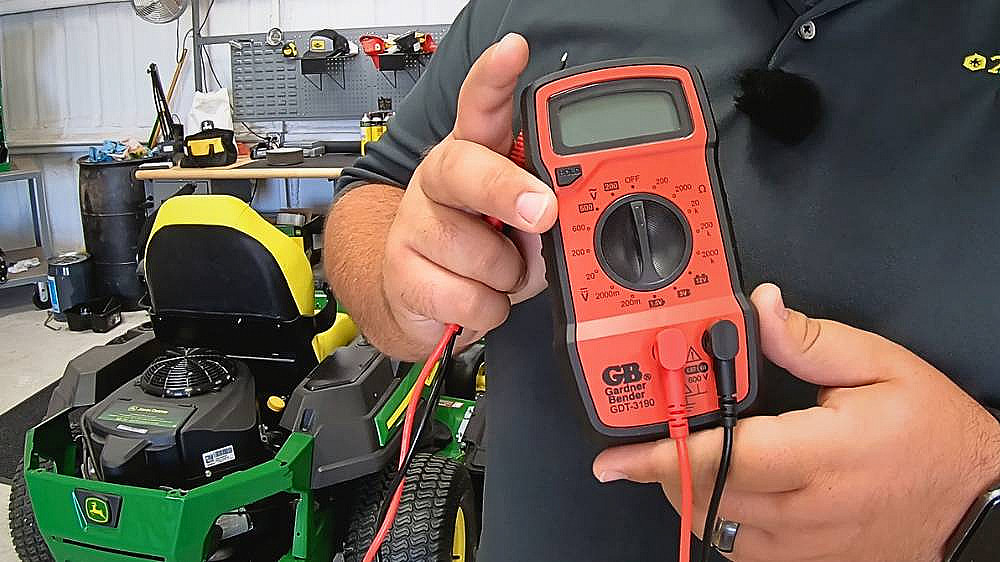

A battery can show a normal voltage reading and still fail when a device demands current. That is why choosing among the Best multimeters for battery testing means looking beyond a basic voltage display. Household cells, vehicle batteries, rechargeable packs, and electrical troubleshooting each call for a different kind of tester.
We ranked these ten products by the work they are designed to handle. The AstroAI 2000 Counts Blue is our top pick for general battery checks, while the list also includes a dedicated household tester, a car battery analyzer, and full electrical kits.
Comparison table
| # | Product | Award | Battery focus | Other capability | Best for |
|---|---|---|---|---|---|
| 1 | AstroAI 2000 Counts Blue | Best overall | 1.5V, 9V, and 12V batteries | AC/DC voltage, DC current, resistance, diode, continuity | General household and vehicle checks |
| 2 | LJPXHHU 2000 Counts Multimeter | Best beginner meter | Battery testing | AC/DC voltage, DC current, resistance, diode, continuity | Basic home and school use |
| 3 | Klein Tools MM325 | Best rugged manual meter | Dedicated battery mode | 600V AC/DC, 10A DC, 2MΩ, diode, continuity | Electrical work and garage use |
| 4 | AstroAI M4K0R 4000 Counts | Best advanced AstroAI | 1.5V, 9V, and 12V modes | TRMS, auto-ranging, NCV, 600V, 10A, 40MΩ | Mixed electrical troubleshooting |
| 5 | AstroAI 2000 Counts Black | Best compact battery mode | 1.5V, 9V, and 12V batteries | AC/DC voltage, DC current, resistance, diode, continuity | Portable battery checks |
| 6 | VTECHOLOGY Two-Pack Tester | Best simple household tester | AA, AAA, C, D, 9V, button cells | Analog good, low, and replace display | Battery drawers and family use |
| 7 | ANENG SZ301 Multimeter | Best broad-range meter | Voltage and current testing | AC/DC voltage, current, resistance, capacitance, live wire | Electronics and repair work |
| 8 | La Crosse Portable Battery Tester | Best guided household tester | Alkaline, rechargeable, lithium button cells | LED voltage and strength display | Fast cell sorting |
| 9 | KAIWEETS KIT01 Test Kit | Best complete kit | 1.5V and 9V battery modes | Multimeter, NCV tester, GFCI tester | DIY electrical projects |
| 10 | OBDResource BR502 | Best automotive analyzer | 6V, 12V, and 24V batteries | CCA, SOH, SOC, internal resistance | Cars, trucks, boats, and motorcycles |
1. AstroAI 2000 Counts Blue: Best Overall

Pros
- Dedicated 1.5V, 9V, and 12V battery modes
- Measures AC/DC voltage, DC current, resistance, and diode
- Backlit display with data hold
- Double-fuse overload protection
Cons
- Manual rotary-switch operation takes attention
- Does not test AC current
- Limited for advanced electrical diagnostics
Best for: someone who wants one approachable meter for household, automotive, and battery checks.
The AstroAI 2000 Counts Blue is the meter we would hand to most people first. It is small enough to keep in a tool drawer, but it is not restricted to checking whether an AA cell has any charge left. Its dedicated battery modes make routine checks less confusing than selecting a general voltage range, and the backlit LCD remains useful when a battery compartment is tucked inside a dark cabinet or vehicle.
The meter reads AC and DC voltage, DC current, resistance, and diode values. Its 1999-count display and sampling speed of two readings per second are suited to ordinary troubleshooting rather than fast-changing laboratory work. For batteries, the practical advantage is the combination of 1.5V, 9V, and 12V modes. The 1.5V and 9V settings are useful for common household cells, while the 12V mode gives it a place in basic vehicle checks.
AstroAI includes data hold and a continuity buzzer, so a reading can be captured while both hands are occupied. The silicone cover helps with minor knocks, and the double fuse design adds protection against overloads. It weighs about 0.56 pounds, which is light enough for a portable kit without feeling like a fragile pen tester.
There are clear limits. This model cannot test AC current, and the instructions caution that it cannot test all AC current or AC voltage below 100mV. The manual dial also leaves room for an incorrect setting or lead placement, so it rewards careful use. The AstroAI M4K0R 4000 Counts offers auto-ranging and TRMS for more varied electrical work, while the Klein Tools MM325 is the sturdier choice for rougher environments.
For ordinary battery checks, continuity work, fuses, and basic automotive troubleshooting, the AstroAI 2000 Counts Blue has the right balance of dedicated modes and useful general functions. It is the pick for readers who want a conventional multimeter without stepping into unnecessary complexity.
2. LJPXHHU 2000 Counts Multimeter: Best Beginner Meter

Pros
- Measures batteries, voltage, current, resistance, diodes, and continuity
- Large 2.7-inch backlit LCD
- Fold-out stand and protective shell
- Overload protection on all ranges
Cons
- Brand and model identification are less clear
- Requires manual selection of measurement modes
- Not designed as a dedicated automotive analyzer
Best for: beginners, students, and households that need a general-purpose meter.
The LJPXHHU 2000 Counts Multimeter takes the familiar handheld-meter approach and makes the display its strongest feature. Its 2.7-inch backlit LCD is larger than the display on several compact meters here, which helps when reading a value from an awkward angle. The fold-out stand also lets it sit on a bench instead of being held against the test leads.
It measures AC and DC voltage, DC current, resistance, continuity, diodes, and batteries. That is enough for checking cells, tracing a broken wire, testing a fuse, or confirming whether a simple circuit is complete. The meter includes a continuity buzzer, so users do not need to keep looking at the screen while probing a short run of wire.
The orange and black protective shell has a slightly soft, nonslip exterior intended to help with minor bumps. Double insulation and overload protection across all ranges are useful features for a general household tool. A 9V battery, test leads, and the manual are included, and the product description states a two-year guarantee against faulty materials and workmanship.
This is still a manual meter, and that matters for first-time users. The leads must be placed in the correct sockets and the dial must match the measurement. The AstroAI 2000 Counts Blue offers more clearly stated dedicated battery modes, while the LJPXHHU makes a stronger case for users who prioritize a large screen and a stand.
The LJPXHHU is a sensible teaching and home-maintenance meter when the goal is to learn the basics without needing advanced readings. It is less compelling for someone who routinely works on vehicle charging systems or wants automated range selection.
3. Klein Tools MM325: Best Rugged Manual Meter

Pros
- Measures up to 600V AC/DC and 10A DC
- Dedicated battery test mode
- Lead-alert LEDs help confirm socket placement
- Designed to withstand a 6.6-foot drop
Cons
- Manual-ranging operation is slower for casual users
- Resistance range stops at 2MΩ
- Larger and heavier than the simplest household meters
Best for: users who want a more durable meter for regular electrical and garage work.
The Klein Tools MM325 feels aimed at the person who will use a meter repeatedly rather than store it until the next dead remote control. Its key advantage is not a flashy display or a long list of modes. It is the combination of a dedicated battery test, lead-alert indicators, a kickstand, and construction rated to withstand a 6.6-foot drop.
Its measurement range covers AC/DC voltage up to 600V, DC current up to 10A, resistance up to 2MΩ, continuity, diodes, and batteries. That makes it a useful bridge between battery testing and household electrical diagnosis. The backlit LCD helps in dim areas, while the rear lead holders keep the probes attached to the meter when it is carried between jobs.
The lead-alert LEDs are particularly helpful on a manual meter. They illuminate to indicate proper test lead placement, a useful reminder before a measurement begins. The included leads have CAT III and CAT IV safety caps, and two AAA batteries are included. Klein also provides a kickstand, with optional magnetic hanging accessories listed separately in the product information.
Manual ranging is the main compromise. A beginner has to understand which range fits the measurement, and the 2MΩ resistance ceiling is lower than the ANENG SZ301's stated 200MΩ capability. For straightforward battery checks, the AstroAI 2000 Counts Blue is less bulky and more inviting. For work where drops, lead management, and safety reminders matter, the MM325 earns its higher position.
Skip this one if you only need a quick household battery indicator and do not want to learn a traditional meter. Choose it if you prefer physical controls, a clear battery mode, and a tool built for more demanding everyday handling.
4. AstroAI M4K0R 4000 Counts: Best Advanced AstroAI
Pros
- TRMS and auto-ranging
- 1.5V, 9V, and 12V battery modes
- Non-contact voltage detection
- Measures resistance up to 40MΩ
- Includes flashlight, data hold, and visual alarms
Cons
- More functions can make the dial less familiar
- Not a dedicated load tester for vehicle batteries
- Battery modes remain separate from automotive battery analysis
Best for: DIYers who want battery modes alongside broader electrical diagnostics.
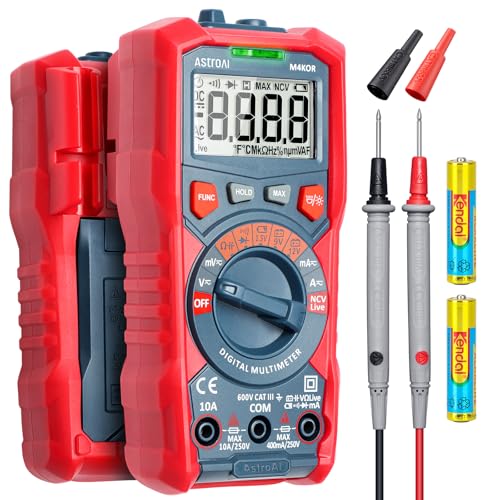
The AstroAI M4K0R 4000 Counts is the most versatile general-purpose meter in the AstroAI pair. It adds auto-ranging and TRMS to the basic battery-testing idea, so the user does not have to make as many guesses about range selection. It also adds non-contact voltage detection, which makes it useful before a probe ever touches a conductor.
The meter measures AC/DC voltage up to 600V, current up to 10A, and resistance up to 40MΩ. TRMS is useful when an AC waveform is less straightforward than a clean household sine wave, although it is more capability than most battery-only users need. The dedicated battery modes cover 1.5V, 9V, and 12V cells, and the product describes visual battery status indications that distinguish low voltage from sufficient voltage.
A continuity buzzer, data hold, maximum reading, auto shutoff, low-battery indicator, and flashlight round out the feature set. The meter uses a backlit screen and audible and visual alarms for non-contact voltage detection. Its double ceramic fuse and stated CAT III 600V safety standard provide a more substantial safety package than a basic pocket tester.
The extra capability does not turn it into a battery load tester. It reports voltage and supports several battery modes, but it does not provide the state-of-health, state-of-charge, CCA, or internal-resistance analysis found on the OBDResource BR502. The AstroAI 2000 Counts Blue is simpler for occasional household use, while the M4K0R is the better fit for someone also troubleshooting outlets, wires, and electronics.
This is the AstroAI to choose when battery testing is one task among several. It is a poor match for someone who wants only a single green or red battery verdict, but a strong option for a home toolbox that needs broader electrical coverage.
5. AstroAI 2000 Counts Black: Best Compact Battery Mode

Pros
- Automatic battery status on 1.5V and 9V modes
- Dedicated 12V battery mode
- Backlit LCD, data hold, and auto shutoff
- Lightweight silicone-covered body
Cons
- Cannot test AC current
- Manual control still requires correct lead placement
- Less capable than the 4000-count AstroAI model
Best for: portable checks of household cells and basic vehicle voltage.
The AstroAI 2000 Counts Black is a close relative of the blue AstroAI pick, but its stated battery behavior gives it a slightly different role. It has 1.5V, 9V, and 12V battery modes, with automatic status detection on the 1.5V and 9V settings. That makes it useful when the question is not just the number on the screen, but whether a familiar household cell is showing enough voltage to keep using.
It measures AC/DC voltage, DC current, resistance, continuity, and diodes. The backlit LCD, data hold, continuity buzzer, and auto shutoff all support routine troubleshooting. At about 0.33 pounds, it is the lightest of the two 2000-count AstroAI models listed here, making it easy to carry in a small vehicle or electronics kit.
The silicone cover provides a layer of protection, and the meter includes double-fuse overload protection plus a low-battery indicator. The product description specifically warns that this model cannot test AC current. That is not a problem for basic battery work, but it is important for anyone expecting a full AC/DC current meter.
Compared with the AstroAI 2000 Counts Blue, the Black version has the clearer automatic battery status description and a lighter listed body. The Blue model has more explicit guidance around continuity and general troubleshooting, while the M4K0R 4000 Counts adds TRMS, auto-ranging, and non-contact voltage detection.
Pick the Black model for a compact conventional meter that spends much of its life checking cells and 12V systems. Skip it if you need AC current measurement or want a meter that makes every range decision automatically.
6. VTECHOLOGY Two-Pack Tester: Best Simple Household Tester

Pros
- Tests AA, AAA, C, D, 9V, and button cells
- Requires no separate operating battery
- Analog good, low, and replace/recharge display
- Compact and lightweight
Cons
- Does not provide a precise digital voltage reading
- Indicates voltage condition rather than exact capacity
- Test time should be kept short to reduce battery drain
Best for: households that want quick sorting of common batteries without a multimeter dial.
The VTECHOLOGY Two-Pack Tester is the outlier in this group, and that is precisely why it deserves a place. It is not a multimeter for probing circuits. It is a simple analog battery checker designed to answer a narrow question quickly: should this household battery stay in the drawer, go into a device, or be replaced?
It accepts AA, AAA, C, D, 9V, 1.5V, and 1.5V button batteries. The tester draws its operating power from the battery being checked, so no separate tester battery is required. The analog needle points into good, low, or replace/recharge zones, which is easier for a child or a nontechnical household member to interpret than a decimal voltage reading.
The two-unit format is convenient for a home with several battery storage areas. The compact body can remain near a drawer of cells, while the second tester can stay with a tool kit or in another room. There is no dial, lead socket, backlight, or continuity mode to learn.
That simplicity also sets the limits. It does not directly detect a battery's capacity, and the product information explains that it determines whether voltage is low or high rather than measuring remaining capacity precisely. Test times should be kept short because the unit is powered by the cell under test. For vehicle batteries, electronics repair, and circuit diagnosis, any of the digital meters here is more suitable.
Choose the VTECHOLOGY when convenience matters more than detailed measurements. It is the right household companion for sorting common cells, but not a substitute for the AstroAI 2000 Counts Blue or the OBDResource BR502.
7. ANENG SZ301 Multimeter: Best Broad-Range Meter

Pros
- AC/DC voltage range up to 600V
- Resistance measurement up to 200MΩ
- Measures AC/DC current, capacitance, continuity, diode, and live wire
- Includes case, leads, and two AA batteries
Cons
- No dedicated battery status modes are stated
- Accuracy specifications vary by measurement type
- More oriented to electrical measurements than household battery sorting
Best for: electronics hobbyists and repair users who need a broad set of measurements.
The ANENG SZ301 is the meter to consider when battery testing is part of a larger electronics job. Its feature list is broader than the dedicated household testers, with capacitance, live-wire detection, AC and DC current, resistance, diode, and continuity measurements. It arrives with a silicone protective case, two leads, and two pre-installed AA batteries.
Its stated DC and AC voltage ranges run from 200mV to 600V. Current measurement spans 2mA to 10A, while resistance extends from 0Ω to 200MΩ. That high resistance ceiling is useful for checking components and insulation-related behavior where a basic 2MΩ meter would run out of range. The product also lists capacitance measurement from 0nF to 2mF.
The display is described as clear and easy to read, and the case helps with portability and minor impact protection. Double fuses, overload protection, and insulated probes are included in the safety design. The published accuracy figures differ by function, with DC voltage listed at ±(1%+5), AC voltage at ±(2.0%+10), and resistance at ±(4.0%+10), so this is not a reason to treat every mode as equally precise.
The weakness for battery-focused buyers is the lack of a stated dedicated 1.5V, 9V, or 12V battery status mode. You can measure battery voltage, but the meter does not offer the guided battery interpretation found on the La Crosse Portable Battery Tester or the AstroAI models. It also requires more attention than an auto-ranging meter when moving between tasks.
The ANENG SZ301 makes sense for a workbench where capacitors, wires, current, and resistance matter alongside batteries. For a drawer of AA cells, it is more instrument than necessary. For broad electrical diagnosis, it has capabilities that the simpler picks cannot match.
8. La Crosse Portable Battery Tester: Best Guided Household Tester

Pros
- Supports alkaline and rechargeable batteries
- Handles AAA, AA, C, D, N, 9V, and lithium button cells
- Separate settings for 1.5V, 1.2V, and 3.0V cells
- Sliding tray and LED strength display
Cons
- Focused on batteries rather than general electrical testing
- Requires selecting the correct voltage range
- Does not show the wider diagnostic information of a multimeter
Best for: people who want guided testing for several household battery chemistries.
The La Crosse Portable Battery Tester is a more structured alternative to the VTECHOLOGY unit. Instead of a general analog scale, it asks the user to select a voltage category, insert the cell into a sliding tray, and read the LED indication for voltage and strength. That makes it particularly well suited to households that use both disposable and rechargeable cells.
It supports alkaline and rechargeable AAA, AA, C, D, and N batteries, along with 9V cells and lithium-ion button cells. The selector distinguishes 1.5V alkaline batteries, 1.2V rechargeable batteries, and 3.0V lithium button cells. That distinction matters because a rechargeable cell can have a lower nominal voltage than an alkaline equivalent without automatically being defective.
The sliding orange tray holds the cell in place and closes the contact path with the correct polarity. For 9V batteries, the tester uses touch contacts on the left side. The listed three-step process is straightforward: choose the voltage range, insert the battery, and close the tray. The LED then displays voltage and strength levels.
This is not a replacement for the AstroAI 2000 Counts Blue when you need to test a fuse, circuit, diode, or vehicle charging system. It also requires the user to select the right range, while the VTECHOLOGY tester keeps operation even more basic. The La Crosse advantage is its better handling of rechargeable cells and its more guided physical layout.
Choose it when your battery drawer includes several formats and chemistries. It is less suitable for a garage or electronics bench where exact voltage readings and electrical functions matter.
9. KAIWEETS KIT01 Test Kit: Best Complete Kit

Pros
- Combines a multimeter, NCV tester, and GFCI tester
- Measures 600V AC/DC, 10A DC, and 20MΩ
- Includes 1.5V and 9V battery modes
- Carrying case and six AAA batteries included
- Three-year warranty
Cons
- More equipment than a battery-only buyer needs
- Battery modes do not cover the dedicated automotive analysis of the BR502
- Several separate tools require storage and setup
Best for: DIYers and electrical users who want a portable diagnostic kit rather than one meter.
The KAIWEETS KIT01 is a toolkit built around battery testing rather than a battery tester built around one job. Inside the case are a digital multimeter, a smart non-contact voltage tester, and a GFCI outlet tester. For a DIYer working through household electrical problems, that combination can reduce the need to gather separate tools before starting.
The multimeter measures AC/DC voltage to 600V, DC current to 10A, resistance to 20MΩ, continuity, diodes, and batteries. Its battery modes cover 1.5V and 9V cells. The backlit LCD, data hold, auto-off function, and stated CAT III 600V safety rating give it the core features expected from a general-purpose meter.
The non-contact tester adds dual ranges of 12V to 1000V AC and 70V to 1000V AC, with an LCD percentage and color readout, beeps, flashing LEDs, and a built-in flashlight. The GFCI tester can identify wiring configurations and common wiring faults on GFCI and standard outlets, with results held automatically for five minutes. Those functions are far outside the scope of a household battery checker.
The trade-off is focus. If your main need is checking AA, AAA, or vehicle batteries, the kit takes up more space and introduces more devices than necessary. The BR502 is a much better fit for 6V, 12V, and 24V automotive batteries, while the AstroAI M4K0R is a more compact choice for mixed measurements.
The KIT01 is a strong pick for a serious DIY tool bag. It makes sense when batteries, outlets, live wires, and GFCI checks all belong to the same projects. It is excessive for someone who only wants to identify weak cells.
10. OBDResource BR502: Best Automotive Analyzer

Pros
- Tests 6V, 12V, and 24V batteries
- Supports 100 to 2000 CCA batteries
- Reports SOH, SOC, CCA, voltage, and internal resistance
- Tests flooded, AGM, and gel batteries
- Reverse-polarity protection
Cons
- Specialized for vehicle batteries
- Not a general multimeter for household circuits
- Results depend on correct clip placement and battery information
Best for: vehicle owners and mechanics diagnosing starting batteries.
The OBDResource BR502 is the product to buy when “battery testing” means diagnosing a car, truck, boat, motorcycle, or similar vehicle. It does not try to be a general multimeter. Instead, it connects through battery clips and produces an automotive battery report that is far more useful for starting-system questions than a simple open-circuit voltage reading.
It supports 6V, 12V, and 24V batteries rated from 100 to 2000 CCA. The product lists compatibility with regular flooded batteries, AGM flat plate batteries, AGM spiral batteries, and gel batteries. It can report state of health, state of charge, CCA, internal resistance, and voltage, then classify the result as good, normal, or poor on its 1.8-inch screen.
The analyzer is designed for batteries installed in a vehicle or removed from it, and the description says a dead battery can also be tested. Results are presented within two seconds according to the product information. Reverse-polarity protection prevents the tester from operating when the clips are connected backward, while a flickering display can indicate that the clips are not clamped correctly.
The obvious limitation is scope. There is no claim here of continuity, diode, resistance, household AC voltage, or current measurement. The AstroAI 2000 Counts Blue is a much better all-purpose tool, and the Klein Tools MM325 is more appropriate for electrical work that extends beyond a vehicle battery.
For a garage, the BR502 is the specialist choice. It tells you more about a vehicle battery's starting condition than the general multimeters in this roundup. Skip it if your batteries are mostly AA, AAA, button cells, or small electronics.
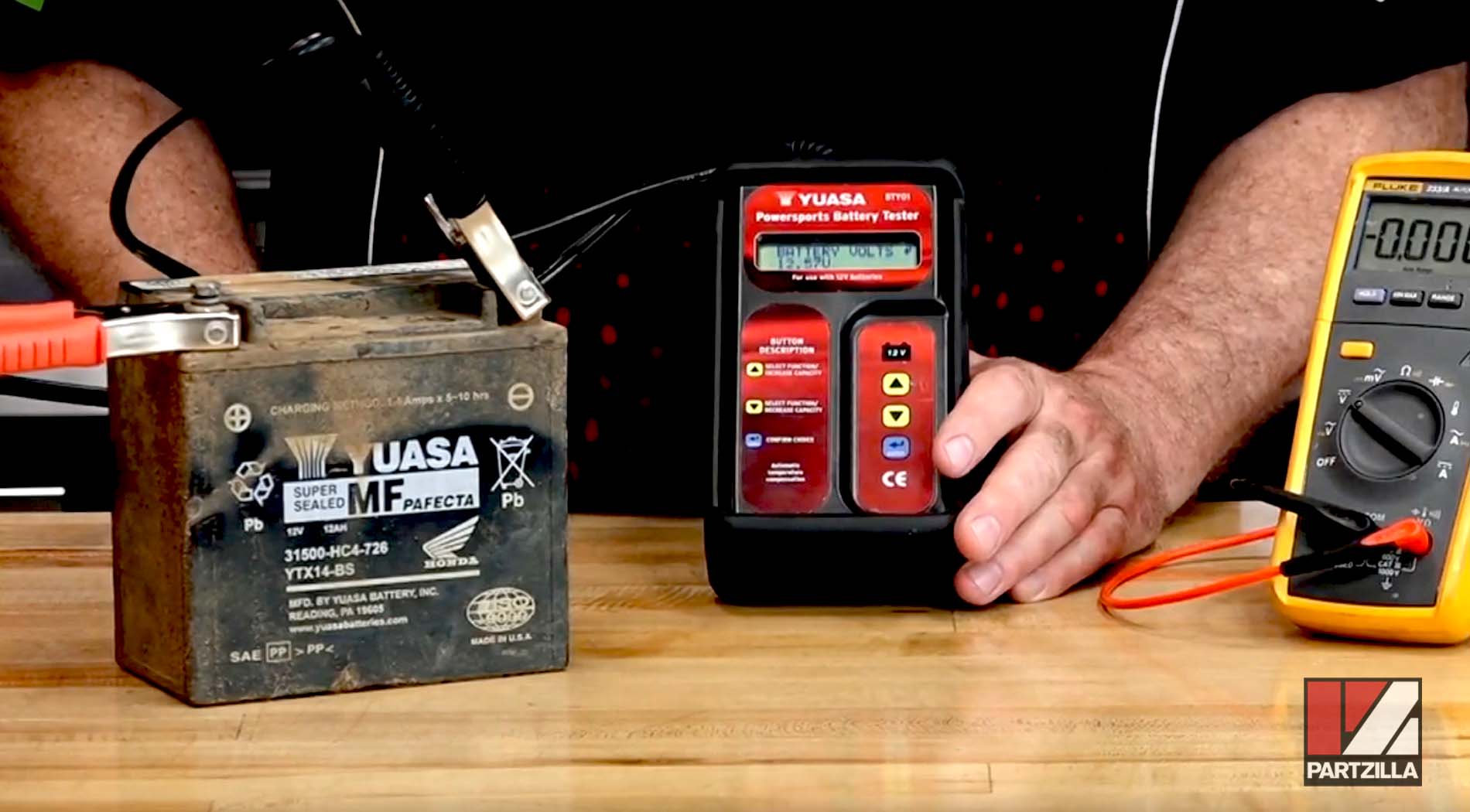
How to choose best multimeters for battery testing
The right meter depends on the battery types you handle and whether you need a voltage number, a simple condition indicator, or a deeper automotive diagnosis.
Battery type and measurement mode
A basic 1.5V cell and a 12V vehicle battery are not interchangeable tasks. Dedicated 1.5V, 9V, and 12V modes can simplify the process, while a 6V, 12V, and 24V automotive analyzer is better for vehicle systems. Rechargeable cells also deserve attention because their nominal voltage can differ from alkaline cells.
Look for clear battery settings if other people will use the tool. A general voltage range works, but it requires selecting the correct mode and interpreting the result yourself.
Voltage and current range
Voltage range determines the electrical systems a meter can safely and usefully measure. Models reaching 600V are suited to broader household and electrical troubleshooting, while a simple household tester may not provide a numerical voltage reading at all.
Current measurement is separate from voltage measurement. Several general meters measure DC current to 10A, but the AstroAI 2000 Counts models specifically caution that they cannot test AC current. Do not assume a meter that measures AC voltage also measures AC current.
Battery diagnosis
Voltage alone does not reveal every battery problem. The VTECHOLOGY and La Crosse testers provide condition-oriented household indications, while the OBDResource BR502 adds CCA, internal resistance, state of health, and state of charge for vehicle batteries.
A voltage reading tells you what the battery shows at rest. An automotive analyzer can tell you whether it is likely to start an engine.
Display and operation
Backlighting matters when checking batteries inside dark equipment or under a vehicle hood. Data hold helps when the screen is difficult to watch during probing. Auto-ranging reduces dial decisions, while manual ranging can be perfectly practical for users who understand electrical measurements.
A fold-out stand, lead holders, or a protective case also affect how easy a meter is to use repeatedly. The LJPXHHU emphasizes a large 2.7-inch display, the Klein MM325 adds lead-alert LEDs, and the AstroAI M4K0R includes a flashlight and visual alarms.
Safety and protection
Fuses, overload protection, insulated leads, protective covers, and safety-category ratings all matter when a meter will be used beyond small batteries. Check lead placement before measuring, select the correct function, and never use a current socket for a voltage test.
For a wider electrical toolkit, the equipment that helps keep electrical checks organized is less important than learning the meter's sockets and modes. The key is matching the tool's stated safety features to the work you actually intend to perform.
Portability and specialization
A compact household tester can remain in a battery drawer, while a full multimeter belongs in a tool case. Automotive analyzers use clips and specialized reports, so they are convenient in a garage but not useful for testing a diode or outlet.
If you are also assembling a mobile electronics setup, how to keep portable devices powered away from an outlet is a separate concern from measuring battery voltage. Keep those jobs distinct when choosing what belongs in the same kit.
Frequently asked questions
Can a multimeter test AA and AAA batteries?
Yes. A general multimeter can measure the DC voltage of AA and AAA cells, and several models here include a 1.5V battery mode. Dedicated household testers such as the VTECHOLOGY and La Crosse models are simpler when you only need a condition indication.
Is battery voltage enough to tell if a battery is good?
Not always. Voltage provides useful information, but it does not directly measure capacity or how a battery behaves under load. The VTECHOLOGY product information explicitly limits its reading to a voltage-based low or high indication, while the BR502 provides additional automotive measurements.
What multimeter setting should be used for a car battery?
Use a DC voltage setting for a basic car battery voltage check, or use a dedicated 12V battery mode when the meter provides one. The BR502 is designed for a deeper vehicle analysis and supports CCA, state of health, state of charge, and internal resistance.
Are dedicated battery testers better than multimeters?
They are easier for a narrow task. The La Crosse and VTECHOLOGY testers guide users through common household battery formats, while a multimeter adds voltage, resistance, continuity, diode, and current functions. Choose the dedicated tester when simplicity matters more than versatility.
Can these meters test rechargeable batteries?
The La Crosse Portable Battery Tester specifically supports rechargeable AAA, AA, C, D, and N batteries through its 1.2V setting. The VTECHOLOGY tester can check rechargeable cells by voltage, but its product information warns that it does not directly measure capacity.
What safety precautions matter when using a multimeter?
Inspect the leads, insert them into the correct sockets, select the correct function, and confirm the expected voltage before probing. Never place a meter set for current directly across a battery or voltage source. Protective fuses and overload features help, but they do not replace correct operation.
The bottom line
The Best multimeters for battery testing are not all the same kind of tool. The AstroAI 2000 Counts Blue is the strongest general pick because it combines dedicated 1.5V, 9V, and 12V modes with voltage, current, resistance, diode, and continuity functions. The Klein Tools MM325 is the better choice for users who need tougher construction and more deliberate electrical work.
For a household battery drawer, the La Crosse Portable Battery Tester is easier to understand, while the VTECHOLOGY Two-Pack Tester is the simplest option for quick good, low, or replace decisions. Vehicle owners should choose the OBDResource BR502 instead of a general meter when CCA, state of health, and internal resistance are the information they need.
If you are undecided, buy the AstroAI 2000 Counts Blue for general use, or choose the BR502 when your battery testing is specifically automotive.
As an Amazon Associate we earn from qualifying purchases.