

A pedalboard can become confusing fast. One box may promise dozens of effects, while another does only delay but gives you the tactile control that makes a single sound easy to shape. The right choice depends on whether you need a full practice rig, a focused live effect, or something to help you learn the signal chain.
The Best guitar pedals and effects in this roundup range from compact multi-effects units to a dedicated metal distortion, a classic delay, a power supply, and a useful instructional book. Our top pick is the MOOER GE100, with the MOOER GE150 Pro and Zoom G1X Four offering more advanced alternatives.
Comparison
| # | Product | Award | Effects or control | Practice and connection features | Best for |
|---|---|---|---|---|---|
| 1 | MOOER GE100 | Best overall | 66 effects, 80 presets, expression pedal | 180-second looper, drum machine, line out mode | Most players building a versatile setup |
| 2 | Zoom G1X Four | Best for practice | 71 effects, 13 amp models | 30-second looper, 68 rhythm patterns, aux input | Practice and songwriting |
| 3 | Guitar Pedals Mastering Effects | Best learning resource | Effect and chain guidance | Printed instructional format | Beginners learning pedal order |
| 4 | MOOER GE150 Pro | Best for advanced rigs | 170 effects, 55 amp models, 26 cab simulations | USB OTG, 80-second stereo looper, four footswitches | Recording and live control |
| 5 | AFOT Heavy Metal Distortion | Best metal distortion | Bass, mid, treble, boost, volume, distortion controls | True bypass, usable headphone output | Metal, rock, and punk |
| 6 | Flatsons KMF-1 | Best for structured practice | 77 effects, 18 amp models, 18 cabinet simulators | 30-second looper, 42 drum rhythms, aux input | Guided practice and editing |
| 7 | LEKATO Multi Effects | Best portable option | 9 amp models, 8 IR cabinets | Bluetooth, recording, six to eight hours of battery use | Headphone practice and travel |
| 8 | Donner Yellow Fall Delay | Best compact delay | 20ms to 620ms delay time | Adjustable level and feedback, true bypass | Simple pedalboards |
| 9 | JOYO 9V Power Supply | Best pedalboard power starter | 9V DC, 1.2A output | Five-way daisy chain, tip-negative design | Powering compatible pedals |
1. MOOER GE100: Best Overall

Pros
- 66 effect types cover the essential sounds
- 80 factory presets and 80 user patches
- 180-second looper and built-in drum machine
- Assignable expression pedal control
- Line out mode supports playing without an amplifier
Cons
- Less advanced than the GE150 Pro for recording and modeling
- Only one product in the roundup combines a full rig with a relatively simple control layout
- The power supply is not described in the provided product information
Best for: guitarists who want one flexible pedal for learning, practicing, and exploring different tones.
The MOOER GE100 is the easiest unit here to recommend as a starting point because it gives a player plenty to explore without turning the pedalboard into a software project. Its 80 preset patches are joined by 80 user patches, so you can keep the factory sounds available while saving your own clean, driven, ambient, and experimental combinations. The saving process is deliberately direct, using the dedicated Save button rather than burying the function in a complicated menu.
Its eight effect modules contain 66 effect types. That number matters less than the way the modules organize the unit: you can move from one part of a signal chain to another, adjust a sound, and hear how the different sections affect the result. The six assignable expression pedal parameters also give it a more playable feel than a box that only changes presets. You can map the pedal to useful tone controls and make changes while playing instead of reaching for a knob.
The GE100 is particularly strong as a practice machine. Its 180-second looper leaves enough room for a chord progression and a reasonably developed lead part, while the drum machine provides rhythm patterns for timing work. A scale and chord learning function gives beginners something productive to do when they are not simply cycling through presets. Players who are still building an amplification setup may also appreciate the adjustable output mode, which includes a line out setting intended to retain a usable tone without an amp. For a broader home rig, pairing it with a beginner amplifier that keeps controls easy to understand makes more sense than buying a complex effects unit and leaving most of its features untouched.
The limitation is its ceiling. The MOOER GE150 Pro has far more effects, amp models, cabinet simulations, recording options, and footswitch control. The Zoom G1X Four has a more developed practice ecosystem with 68 rhythm patterns and computer-based patch editing. Still, the GE100 is less intimidating than either when the goal is to learn what different effects do. It is the one we'd keep for a first serious multi-effects setup, especially for a player who wants to practice, save tones, and experiment without assembling several separate pedals.
2. Zoom G1X Four: Best for Practice

Pros
- 71 built-in effects and 13 amp models
- 68 rhythm patterns for timing practice
- 30-second looper for layered playing
- Aux input and headphone monitoring
- Guitar Lab software for patch editing
Cons
- Its looper is shorter than the GE100's
- Fewer amp models and broader modeling features than the GE150 Pro
- The compact layout can take time to learn
Best for: players who want a practice-focused multi-effects pedal with rhythms, looping, and headphone use.
The Zoom G1X Four feels designed around the moment when a guitarist sits down with an instrument and wants to keep playing. Its 68 built-in rhythm patterns are more than a token metronome, giving you a way to work on timing, chord changes, and improvisation without starting a separate backing track. The 30-second looper is shorter than the MOOER GE100's 180-second loop time, but it is enough for a riff, a chord cycle, or a short rhythmic idea.
There are 71 effects and 13 amp models to work through, covering the expected path from clean tones to high-gain sounds. The expression pedal gives the unit another layer of control, which is useful for volume swells, changing effect intensity, or shaping a sound during a phrase. The key distinction from a small single-effect pedal is that the G1X Four lets a player practice several musical roles without continually unplugging cables.
The aux input and headphone monitoring make it practical for quiet sessions. You can bring in external audio and play along, then monitor through headphones when an amplifier would be disruptive. Zoom Guitar Lab for Mac and Windows adds a computer-based way to edit patches and build sounds. That makes the G1X Four more appealing to players who enjoy organizing tones on a screen, while the GE100 remains more immediately approachable from the pedal itself.
Its weakness is focus. It is not the right pick for someone who needs the GE150 Pro's 55 amp models, 26 cabinet simulations, four multi-purpose footswitches, or USB OTG recording. The 30-second looper also feels restrictive beside the GE100 when songwriting is the priority. But for regular practice, especially with rhythms and an aux source, the G1X Four has a clear purpose. It is the better choice for a guitarist who wants the pedal to encourage consistent playing rather than serve as a deep modeling workstation.
3. Guitar Pedals Mastering Effects: Best Learning Resource

Pros
- Focuses on using pedals and chaining effects
- Useful companion for beginners
- Helps explain how signal order changes tone
- Lightweight printed format
Cons
- It is an instructional book, not an effects pedal
- No built-in sounds or hands-on hardware
- It cannot replace an actual multi-effects unit
Best for: new guitarists who need to understand effects order before building a pedalboard.
Guitar Pedals Mastering Effects is the outlier in this roundup, but it addresses a problem that hardware alone cannot solve. A beginner can own distortion, delay, modulation, and reverb pedals and still struggle to understand why a chain sounds muddy or why moving one effect changes the entire character of a riff. This book is aimed at the practical question of how to use pedals and chain effects to shape a guitar tone.
Its listed dimensions are 11 inches high, 8.5 inches wide, and 0.25 inches thick, with a listed weight of about 0.6 pounds. Those details make it easy to keep beside a pedalboard or amplifier while experimenting. The useful part is not a preset count or a collection of modeled sounds. It is the framework for thinking about signal flow, effect roles, and the relationship between individual pedals.
That makes the book a natural partner to the MOOER GE100 or Zoom G1X Four. Both processors expose beginners to a large number of effects, but a large library can create the same confusion as a crowded pedalboard. Reading about chaining while adjusting the GE100's modules gives the player a reason to change one thing at a time. If your wider setup includes headphones, choosing accessories that keep practice clear and comfortable can make those longer learning sessions easier.
There is no way around its limitation: it produces no sound. A guitarist looking for immediate distortion, delay, looping, or amp modeling should choose hardware first. This is the right purchase for someone who wants to stop guessing and understand why a pedal belongs before or after another effect. It also makes sense for a player who already owns a few pedals but has not yet developed a repeatable method for building tones.
4. MOOER GE150 Pro: Best for Advanced Rigs
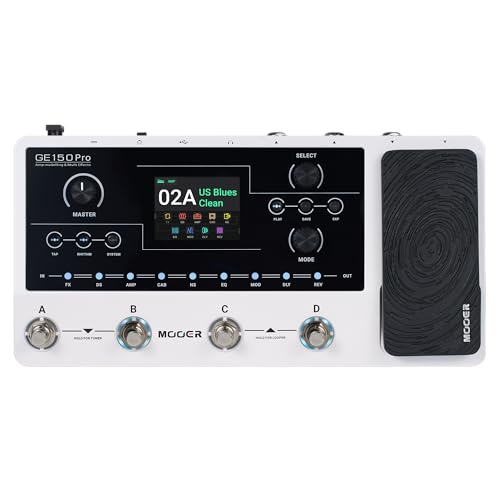
Pros
- 170 effects, 55 amp models, and 26 cabinet simulations
- 200 factory presets
- Four multi-purpose footswitches
- 20 amp and 20 cabinet sample slots
- USB OTG recording and stereo looping
Cons
- Larger and heavier than the GE100 and LEKATO
- More features mean a steeper learning curve
- The standard version is mains-powered rather than the battery edition described separately in the listing
Best for: guitarists who need deep modeling, live foot control, and direct recording connections.
The MOOER GE150 Pro is the serious workstation in this group. It has 200 factory presets, 170 effects, 55 amp preamps, and 26 cabinet simulations, giving it a much wider modeling palette than the GE100. The important difference is not simply the size of the library. The GE150 Pro is built for a player who wants to shape a rig around amp and cabinet choices, save many sounds, and control changes from the floor.
MOOER's MNRS support is central to that approach. The amp and cabinet sections support MNRS sample files, with 20 slots for the amp module and another 20 for the cabinet module. That gives experienced users room to work with their own compatible samples rather than relying only on the factory collection. Four multi-purpose footswitches make preset changes and effect actions more practical during a performance, while the expression pedal can control parameters or output volume. The toe tap feature can switch the expression assignment between those modes.
The GE150 Pro also has the strongest connection set here. Its Type-C USB interface supports tone editing, data management, and firmware updates, while OTG connectivity supports audio recording and playback. The listing also specifies a mono quarter-inch input, stereo quarter-inch outputs, an eighth-inch auxiliary input, and an eighth-inch headphone output. That combination suits a home recording setup, silent practice, and a live rig. Its 80-second stereo looper, 40 drum rhythms, and 10 metronome modes add useful musical functions without requiring a separate practice device.
The trade-off is physical and mental space. At about 2.43 pounds and 12.2 by 12.2 by 6.02 inches, it is considerably more substantial than the compact options. The GE100 is easier for a beginner to grasp, and the Zoom G1X Four makes a more direct case for rhythm-led practice. A player looking for a simple distortion pedal should skip all of those modeling menus. For recording, live control, and a rig that can grow with more demanding tone work, though, the GE150 Pro is the strongest option in the roundup.
5. AFOT Heavy Metal Distortion: Best Metal Distortion

Pros
- Six dedicated rotary controls
- Separate bass, mid, and treble shaping
- Designed for metal, rock, punk, and hard blues tones
- True bypass
- Headphone-useable output
Cons
- A power adapter is not included
- Focused on distortion rather than multi-effects flexibility
- High-gain players still need to shape the sound around their amplifier
Best for: players who want a dedicated high-gain pedal with detailed three-band tone control.
The AFOT Heavy Metal Distortion takes the opposite approach from the GE150 Pro. Instead of modeling a large collection of amps and effects, it concentrates on the gain sound and provides enough control to shape it. The six rotary controls are treble, mid, bass, boost, volume, and distortion. That layout is immediately understandable, and the three-band EQ gives the player more control over the balance than a basic drive pedal with only tone and gain.
The listed tonal range runs from heavy blues through hard rock and into high-gain metal. The boost control adds another way to push the sound, while the separate mid control matters when a dense distortion patch needs to stay audible in a band mix. The product description also emphasizes clarity and definition at higher gain settings. That is an ambition rather than a guarantee for every amplifier and guitar combination, but the control set gives you a practical way to search for a clearer result.
True bypass is useful when the effect is switched off because the pedal is intended to leave the signal path transparent. The headphone-useable output is an unusual inclusion for a focused distortion pedal and may help with quiet practice. It is still a conventional single-effect unit, so it does not offer the looping, drum patterns, amp models, or recording connections found on the multi-effects pedals.
The main ownership detail is easy to miss: there is no power adapter included. The AFOT is also not the right purchase for a player who wants clean, chorus, delay, and reverb from one box. The Donner Yellow Fall Delay makes more sense for someone specifically chasing repeats, while the AFOT is the sharper choice when the central problem is adding a heavy, adjustable drive voice to an existing setup.
6. Flatsons KMF-1: Best for Structured Practice

Pros
- 77 effects across eight modules
- 18 amp models and 18 cabinet simulators
- 30-second looper and 42 drum rhythms
- Stomp Mode with five independent effect blocks
- Built-in battery compartment
Cons
- Listed battery use is up to 2.5 hours
- Heavier than the GE100 and LEKATO
- Cab simulation must be managed carefully with a real amp or cabinet
Best for: players who want an organized multi-effects interface with hands-on stomp and edit modes.
The Flatsons KMF-1 occupies an interesting middle ground. It has the broad menu of a multi-effects processor but puts extra emphasis on practice and direct control. Its 77 effects are arranged across eight modules: amplifier, cabinet, drive, modulation, delay, dynamics, reverb, and filter. That is a sensible structure for a player who wants to understand where each sound sits in a chain rather than simply selecting an all-in-one preset.
The unit offers 18 amp models and 18 cabinet simulators, with 512-point IR sampling and 32-bit signal processing described in the product information. Those numbers point toward the KMF-1's intended audience: someone who wants more than a basic collection of effects and cares about how the cabinet stage affects the finished sound. The 128 by 32 LCD is specified as an upgraded display, and the knobs, buttons, and expression pedal are meant to keep editing visible rather than hidden in an app.
Stomp Mode gives five independent effect blocks that can be enabled and sequenced, while Edit Mode allows individual parameters to be adjusted. That is more hands-on than the LEKATO's compact preset approach and less expansive than the GE150 Pro's sample-based system. For practice, the KMF-1 includes 50 preset patches, a 30-second looper, 42 drum rhythms, a tuner, and an aux input for playing along with a phone.
The built-in battery compartment supports six AA batteries and is listed for up to 2.5 hours of use. That is useful for occasional unplugged sessions, but it is not the same as the LEKATO's longer rechargeable operation. The cabinet reminder also matters: use the cab module with headphones, studio monitors, or powered speakers without a real cabinet, and disable it with a real cabinet or amp to avoid doubled cabinet coloration. Skip the KMF-1 if you want a tiny travel unit. Choose it if the process of editing and practicing is as important as the sound library.
7. LEKATO Multi Effects: Best Portable Option

Pros
- Nine amp models and eight IR cabinet models
- Supports loading and deleting third-party IR files
- Built-in rechargeable battery
- Six to eight hours of listed operation
- Bluetooth, headphone output, and recording support
Cons
- Only three presets are available in its stated preset mode
- Smaller control system than the GE100 and GE150 Pro
- Its effects and connections are aimed more at practice than complex live rigs
Best for: guitarists who want a small rechargeable effects unit for headphones, backing tracks, and mobile recording.
The LEKATO Multi Effects is the most convenient option for playing away from a conventional amplifier. Its built-in battery takes about two hours to fully charge and is listed for six to eight hours of operation. It can charge from a power bank or phone adapter, and it supports charging while working. That gives it a practical edge for a practice room, a dorm, or a trip where carrying a full pedalboard is inconvenient.
The sound engine includes nine amp preamps and eight IR cabinet models. The unit supports loading or deleting third-party IR files, with eight third-party IR slots available through the Cube-Suite software. This is a more focused modeling system than the MOOER GE150 Pro, but it gives a player a clear way to experiment with cabinet responses. The core effect set includes distortion, overdrive, delay, and reverb, which covers the sounds most likely to matter in a compact practice unit.
Preset, Edit, and Live modes make the control scheme more flexible than the small footprint suggests. The stated preset mode includes three slots labeled Lead, Rhythm, and Clean, and those can be replaced with sounds created in Live Mode. Bluetooth playback lets you play along with an accompaniment source, while the 3.5mm headphone output keeps the session quiet. Recording to a computer or phone is also supported through the included cable.
The limitation is scale. The GE100 has 80 factory patches and 80 user patches, and the GE150 Pro is in another class for foot control and recording. The LEKATO is better viewed as a portable practice and sketching tool than the center of a complicated live setup. If portability, battery operation, Bluetooth, and headphone use matter most, it is the most convenient pick here.
8. Donner Yellow Fall Delay: Best Compact Delay

Pros
- Warm analog-style delay character
- 20ms to 620ms delay range
- Adjustable delay level and feedback
- Compact aluminum-alloy enclosure
- True bypass and status LED
Cons
- A power supply is not included
- It provides delay only
- Smaller controls are less suitable for rapid changes during a performance
Best for: guitarists who want a focused, pedalboard-friendly delay with a vintage-leaning character.
The Donner Yellow Fall Delay is a reminder that a single effect can be more satisfying than a large menu when you already know what sound is missing. It is built around a warm, natural analog delay character, with controls for delay time, level, and feedback. The 20ms to 620ms range covers short slapback-style ambience, rhythmic repeats, and longer echoes without asking the player to navigate presets.
Its compact aluminum-alloy enclosure is well suited to a crowded pedalboard. At about 3.7 inches long, 1.7 inches wide, and 2 inches high, it takes up far less space than any of the multi-effects processors here. True bypass is included, and the LED shows when the pedal is active. Those are simple features, but they are the ones that matter when a dedicated delay is placed in a chain with several other pedals.
The Yellow Fall is not competing with the MOOER GE100 on range. It cannot provide distortion, modulation, amp modeling, looping, or drum patterns. It also lacks the AFOT's dedicated gain and EQ controls. Its advantage is concentration: three delay controls are easier to reach and understand than a modeled effect buried inside a patch. Players building around a real amplifier may prefer that directness, much as they might prefer a straightforward amplifier setup for learning core guitar tones.
The product requires 9V DC power, and the power supply is not included. The JOYO 9V Power Supply below may work with compatible tip-negative pedals, but polarity and current requirements should always be checked before connecting anything. Choose the Donner when you want a compact delay that does one job clearly. Skip it if you are still exploring effects and need a complete signal chain in one enclosure.
9. JOYO 9V Power Supply: Best Pedalboard Power Starter
Pros
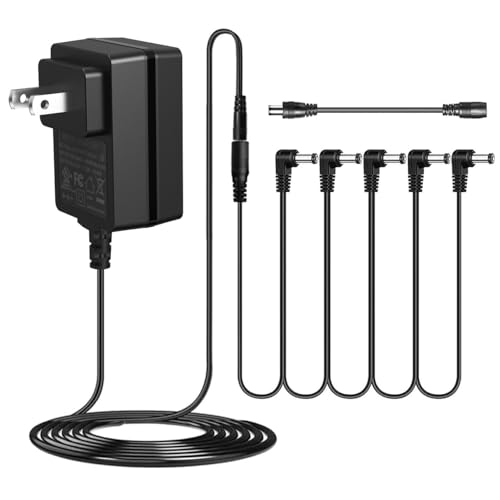
- 9V DC, 1.2A output
- Five-way daisy chain
- Tip-negative design
- 100V to 240V AC input
- Includes reverse-polarity converter cable
Cons
- It is a power accessory, not an effects pedal
- Only compatible pedals should be connected
- Daisy-chain power can require careful noise and current management
Best for: players powering several compatible 9V tip-negative pedals from one wall adapter.
The JOYO 9V Power Supply is the practical accessory in this list. A pedalboard can have excellent effects and still fail to be useful if each unit needs a separate wall connection. This adapter provides 9V DC at 1.2A, or 10.8W, and includes a five-way daisy chain so several compatible pedals can share the supply.
The adapter accepts AC input from 100V to 240V at 50 to 60Hz. Its main cable is listed at 4.92 feet, and the daisy-chain cable is also listed at 4.92 feet in total, with individual sections described in the product information. The barrel size is 5.5 by 2.1mm, and the tip-negative design matches many guitar effects pedals. A reverse-polarity converter cable is included for compatible situations, but it is not a reason to ignore a pedal's own polarity requirement.
The copper wire and PVC construction are described as intended to support quiet pedal operation. That may help keep a simple board tidy, but a daisy chain is not automatically the quietest solution for every combination of pedals. Digital multi-effects units and analog drive pedals can have different current demands, and connecting incompatible equipment can cause noise or malfunction. Check each pedal's voltage, polarity, connector size, and current requirement first.
This is not a substitute for a feature-rich isolated power system when a board becomes complex. It is a sensible starting point for a small collection of compatible 9V pedals, including the Donner Yellow Fall if its requirements match. Players shopping for an effects sound should choose one of the actual pedals above. Players whose board already works but needs one organized power connection should consider the JOYO.
Best guitar pedals and effects buying guide
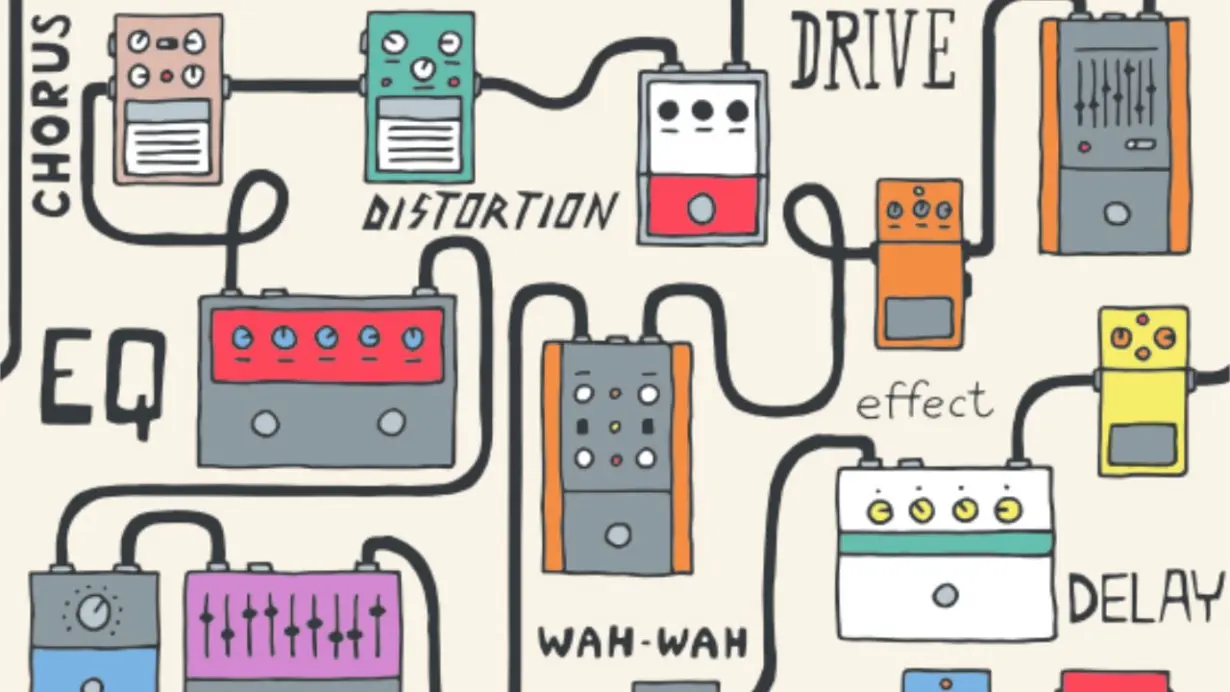
The right pedal depends on the sound you need, the way you practice, and how much control you want under your foot. These are the traits that separate the products in this roundup.
Effect range and signal chain
Multi-effects pedals such as the MOOER GE100, Zoom G1X Four, Flatsons KMF-1, and MOOER GE150 Pro combine several categories in one unit. Effect modules matter because they determine how much of a complete rig you can create without adding separate hardware. Dedicated pedals such as the AFOT and Donner are narrower, but their controls are usually faster to understand.
Buy a multi-effects pedal for exploration, and a dedicated pedal when you already know the sound you want.
Amp and cabinet modeling
Amp models and cabinet simulations matter when you use headphones, powered speakers, a recording interface, or a direct connection rather than a traditional guitar amp. The GE150 Pro goes furthest with 55 amp models, 26 cabinet simulations, and sample slots. The LEKATO offers nine amp models and eight IR cabinets, while the Flatsons KMF-1 has 18 of each. If you connect a modeler to a real amp and cabinet, check whether cabinet simulation should be disabled.
Foot control
Footswitch count changes how practical a pedal is during a song. The GE150 Pro has four multi-purpose footswitches, while expression pedals on the GE100, Zoom G1X Four, and KMF-1 allow real-time control of selected parameters. A compact delay has fewer options but can be easier to activate and adjust. Consider whether you need patch changes, effect toggles, volume control, or only one sound at a time.
Looping and rhythm practice
A looper is useful for chord work, improvisation, and songwriting. The GE100 offers 180 seconds, the GE150 Pro offers an 80-second stereo looper, and the Zoom G1X Four and KMF-1 each provide 30 seconds. Rhythm features also vary: the Zoom has 68 patterns, the GE150 Pro has 40 drum rhythms and 10 metronome modes, and the KMF-1 has 42 drum rhythms. A shorter loop can be enough for practice, but longer capacity helps when an idea grows.
Power and monitoring
Power requirements are easy to overlook. The Donner needs 9V DC, the AFOT does not include a power adapter, and the JOYO supply is designed for compatible 9V tip-negative pedals. The LEKATO has a rechargeable battery, while the KMF-1 can use six AA batteries for a listed maximum of 2.5 hours. For quiet practice, look for a headphone output. The GE150 Pro, Zoom G1X Four, and LEKATO specifically include headphone-oriented connections or monitoring support.

Frequently asked questions
Should a beginner choose a multi-effects pedal or a single pedal?
A multi-effects pedal is usually more useful for learning because it exposes you to several effect types and signal-chain positions. A single pedal is easier to understand when you already know the sound you want, such as the AFOT for high-gain distortion or the Donner for delay.
Which pedal has the longest looper?
The MOOER GE100 has a 180-second looper. The MOOER GE150 Pro has an 80-second stereo looper, while the Zoom G1X Four and Flatsons KMF-1 each have a 30-second looper.
Can these pedals be used with headphones?
The Zoom G1X Four, MOOER GE150 Pro, and LEKATO specifically include headphone or monitoring connections in their product information. The AFOT listing also describes an earphone-useable output. With modelers, cabinet simulation is often important when using headphones or powered speakers.
What is the difference between amp modeling and cabinet simulation?
Amp modeling recreates the response and character of an amplifier stage. Cabinet simulation shapes the sound as if it has passed through a speaker cabinet and microphone setup. Using a cabinet simulation with headphones can make a direct tone more natural, while using it with a real guitar cabinet may create unwanted layering.
Can the JOYO supply power every pedal in this roundup?
Not automatically. The JOYO provides 9V DC, 1.2A output with a tip-negative connector and is intended for compatible pedals. Check each pedal's voltage, polarity, connector size, and current requirement before using the daisy chain.
Is the Donner Yellow Fall a good first effect?
It is a good first effect if you specifically want delay and prefer a small, direct control layout. It is less suitable if you are still trying to learn distortion, modulation, reverb, and other effect families, where a multi-effects unit or instructional book will teach more quickly.

The bottom line
The Best guitar pedals and effects pick is the MOOER GE100 because it balances 66 effects, 80 factory and user patches, expression control, a long looper, rhythms, and learning features in one approachable unit. The MOOER GE150 Pro is the stronger choice for recording, advanced amp and cabinet modeling, sample support, and live control from four footswitches.
For focused needs, choose the Zoom G1X Four for rhythm-led practice, the AFOT Heavy Metal Distortion for dedicated high-gain tones, the Donner Yellow Fall Delay for compact analog-style delay, or the LEKATO Multi Effects for rechargeable headphone practice. The Flatsons KMF-1 adds structured editing and drum practice, while the book and JOYO supply solve learning and power problems rather than replacing an effects unit.
If you are undecided, start with the MOOER GE100 unless you already know you need the GE150 Pro's deeper recording and modeling controls.
As an Amazon Associate we earn from qualifying purchases.