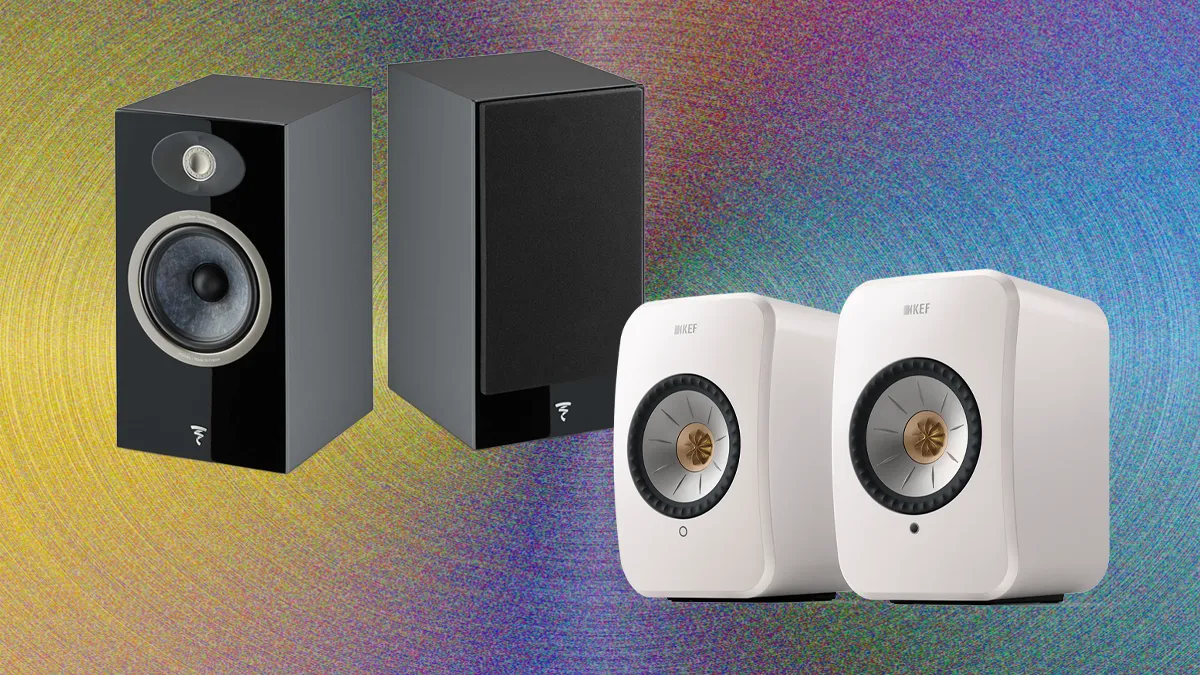

A passive speaker system can sound excellent, but it also needs an amplifier, the right cables, and more room for components. Powered bookshelf speakers put the amplification inside one cabinet, making it much easier to connect a TV, turntable, computer, or phone without building a full stereo system.
The Best powered bookshelf speakers range from compact desktop pairs to substantial models with HDMI ARC, phono inputs, subwoofer outputs, and room-filling power. We ranked these 10 picks by their real-world flexibility, driver design, connection options, and suitability for different rooms.
Edifier R1280T is our top pick for most listeners, while the other nine cover TV systems, vinyl setups, desktops, larger rooms, and wireless-first listening.
Comparison table
| # | Product | Award | Inputs | Driver and power | Best for |
|---|---|---|---|---|---|
| 1 | Edifier R1280T | Best overall | Two AUX inputs | 4-inch full-range unit, 13mm silk dome tweeter, 42W RMS | Simple stereo setups |
| 2 | Klipsch R-51PM | Best for vinyl and digital sources | Phono, Bluetooth, USB, 3.5mm | Powered monitor system | Turntables and versatile listening |
| 3 | ULTIMEA BS-3 | Best for TV features | HDMI ARC, RCA, optical, USB, Bluetooth 6.0 | 5.25-inch woofer, 3-way design, 70W RMS | TV and full-room sound |
| 4 | Saiyin 3.5-inch Speakers | Best compact connectivity | Optical, coaxial, RCA, 3.5mm, Bluetooth 5.3 | 3.75-inch woofer, 0.5-inch horn tweeter | Small rooms and desks |
| 5 | Edifier R980T | Best wired desktop pair | Two AUX inputs | 4-inch active speakers, 24W RMS | Computers and near-field listening |
| 6 | Saiyin 4-inch Speakers | Best for adding a subwoofer | Optical, coaxial, RCA, Bluetooth 5.3 | 4-inch woofer, 0.5-inch silk dome tweeter | Expandable TV systems |
| 7 | Electrohome Huntley EB10B | Best small retro-style pair | RCA, Aux, Bluetooth 5 | 3-inch drivers | Small spaces and casual listening |
| 8 | Klipsch R-40PM | Best horn-loaded sound | Phono, Bluetooth, digital and analog | 4-inch woofers, 1-inch LTS tweeters | Dynamic music and movies |
| 9 | RIOWOIS DS6701NP | Best for simple TV setups | TV ARC, optical, AUX, Bluetooth 5.3 | Powered stereo pair | TVs and small living rooms |
| 10 | Edifier R1280DBs | Best with subwoofer expansion | Optical, coaxial, line-in, Bluetooth 5.0 | 4-inch woofer, 13mm silk dome tweeter, 42W RMS | Wireless stereo with future upgrades |
1. Edifier R1280T: Best Overall

Pros
- Two AUX inputs allow two wired sources at once
- 4-inch driver and 13mm silk dome tweeter
- 42W RMS output
- Remote control and side-mounted tone controls
- MDF cabinet with wood-effect vinyl finish
Cons
- No Bluetooth input
- No optical, coaxial, HDMI ARC, or subwoofer output
- Needs a preamp for turntables with phono-level output
Best for: listeners who want a straightforward stereo pair for a desk, shelf, or small living room.
The Edifier R1280T is the pair we would recommend first to someone who wants to connect a computer, phone, or basic TV and start listening without a receiver. It has the familiar shape and warm wood-style finish of a traditional bookshelf speaker, but the built-in amplification keeps the system compact. The active speaker houses the controls and connects to the other speaker with the included speaker cable.
Its driver arrangement is well suited to near-field listening. A 4-inch full-range unit handles the body of voices and instruments, while the 13mm silk dome tweeter adds detail above it. Edifier rates the system at 42W RMS, enough to give a desk or modest room more authority than typical computer speakers. The front-ported design is not listed in the data, so we would not assume it can be pushed flush against a wall without affecting the bass.
Connection options are deliberately simple. Two AUX inputs let you leave two wired devices connected at the same time, which is useful for a computer and a small streaming device. A remote handles volume, while bass and treble knobs on the side of the powered speaker allow quick adjustment from the listening position. There is no Bluetooth, optical input, phono stage, or subwoofer output, so the R1280T is less adaptable than the Edifier R1280DBs and Saiyin 4-inch Speakers.
That lack of modern inputs is the main reason to skip it. A TV with only optical or HDMI ARC will need another way to feed analog audio, and a turntable with only a phono output needs a preamp. For a simple analog setup, though, the R1280T is easier to understand than the more feature-heavy ULTIMEA BS-3. It is the right choice for anyone who values dependable two-channel sound and physical controls over wireless convenience.
2. Klipsch R-51PM: Best for Vinyl and Digital Sources

Pros
- Built-in phono and line inputs with ground terminal
- Bluetooth wireless connection
- USB, 3.5mm, and analog connectivity
- Full powered-monitor design
- Large 13-inch cabinet height
Cons
- Larger than the compact Edifier pairs
- No HDMI ARC listed
- Less convenient for a TV that lacks analog output
Best for: vinyl listeners who also want USB, Bluetooth, and analog sources in one system.
The Klipsch R-51PM is a serious step up in source flexibility. Its built-in amplifier means you do not need a separate receiver, yet the pair accepts a turntable through a phono or line connection, a computer through USB, a phone over Bluetooth, and an analog device through the 3.5mm mini jack. That mixture makes it a natural center for a vinyl system that also handles modern digital music.
The phono and line connection includes a switch and ground screw terminal. That matters because a turntable may output either a low-level phono signal or a line-level signal, depending on whether it has a built-in preamp. The R-51PM can accommodate the appropriate connection, but users still need to select the correct mode. Its Bluetooth support makes casual streaming easy, while USB avoids an extra analog conversion step for a compatible computer.
The cabinet measures 13 inches high, 8.5 inches long, and 7 inches wide. That is more imposing than the Edifier R1280T, and the size should be considered before placing it on a shallow desk. In return, the R-51PM feels better suited to a dedicated listening shelf or a larger stereo arrangement. It is also more versatile than the Klipsch R-40PM for someone who specifically needs USB, although the R-40PM has a newer horn and woofer design.
The weakness is the lack of HDMI ARC. It can work with a TV through an available analog connection, but it does not offer the single-cable TV integration found on the ULTIMEA BS-3 or RIOWOIS DS6701NP. The R-51PM makes the most sense for a listener whose system starts with a turntable and expands into Bluetooth and computer audio, not for someone buying a soundbar replacement first.
3. ULTIMEA BS-3: Best for TV Features

Pros
- HDMI ARC for TV audio and control
- Three-way design with 5.25-inch woofer
- 70W RMS output
- Optical, RCA, USB, and Bluetooth 6.0
- Dedicated subwoofer output
- App-based EQ and dialogue mode
Cons
- Large and heavy for a desktop
- Turntable needs a built-in preamp or external phono preamp
- More setup choices than a basic stereo pair
Best for: TV owners who want stereo separation, dialogue controls, and room-filling output without an AVR.
The ULTIMEA BS-3 is the most home-theater-minded system here. It is not just a pair of powered cabinets with a Bluetooth receiver. HDMI ARC lets it connect to a compatible TV with one cable and allows convenient control from the television setup. That makes it much more practical for movies, shows, sports, and console play than a pair such as the Edifier R980T.
Its three-way layout gives each part of the frequency range a more specific job. The 5.25-inch woofer is joined by a dedicated midrange driver and a tweeter, and ULTIMEA lists 70W RMS output. The larger woofer and higher stated output should give the system more low-end weight and headroom than compact 3-inch and 3.75-inch designs. The cabinets measure 13.15 inches wide, 9.17 inches high, and 7.4 inches deep, so these are better on a media console or sturdy shelf than a crowded computer desk.
The connection list is unusually complete. HDMI ARC handles a compatible TV, while optical, RCA, USB, and Bluetooth 6.0 cover computers, turntables with suitable output, and mobile devices. A subwoofer output leaves room to add an external powered subwoofer later. The app provides EQ adjustment and modes for music, movies, games, dialogue, deep bass, and clear highs, which gives the owner more ways to tailor the presentation than the fixed controls on the Edifier R1280T.
There are two important caveats. A turntable without a built-in preamp still needs an external phono preamp, and the BS-3 weighs 18.96 pounds, making it the least casual option among the compact systems. It is also more elaborate than necessary for a desk. For a TV-first buyer, however, it beats the Klipsch R-51PM on HDMI convenience and beats the RIOWOIS on three-way design and stated output. It is the strongest fit for a living room that needs clear dialogue and real stereo width.
4. Saiyin 3.5-inch Speakers: Best Compact Connectivity

Pros
- Bluetooth 5.3
- Optical, coaxial, RCA, and 3.5mm inputs
- Remote with input switching
- 3.75-inch woofer and horn tweeter
- No separate amplifier required
Cons
- Smaller woofer than the Saiyin 4-inch model
- Turntable must provide line output or Bluetooth transmission
- Requires PCM, stereo, or non-surround source signals
Best for: small desks and rooms that need many inputs in a compact cabinet.
The smaller Saiyin pair is easy to underestimate. Its cabinets measure 8.5 inches high, 6.5 inches long, and 10.6 inches wide, giving it a compact footprint while still offering more than a basic analog desktop speaker. The active speaker powers the passive one, so there is no receiver to find space for. A top panel and remote provide the main controls.
A 3.75-inch woofer handles the lower and middle ranges, and a 0.5-inch silk dome horn tweeter handles higher frequencies. That combination is aimed at a more expansive presentation than a single full-range computer driver. Saiyin does not provide a power figure in the supplied information, so it would be misleading to compare its loudness directly with the 42W Edifier systems or the 70W ULTIMEA.
The input selection is the reason to choose this model. Bluetooth 5.3 handles phones, tablets, Macs, and PCs, while optical and coaxial inputs suit TVs and digital sources. RCA and 3.5mm cover older or simpler equipment. The remote can switch between optical, coaxial, line-in, and Bluetooth modes, and the product also provides buttons on the active cabinet. This is more flexible than the wired-only Edifier R980T.
The small woofer limits how much bass and room scale to expect. It should be a sensible fit for a desk, bedroom, or small office, but a larger room will favor the Saiyin 4-inch Speakers or ULTIMEA BS-3. Turntable buyers need to check the output carefully: a unit with only phono output requires a preamp, and a turntable used over Bluetooth must transmit rather than merely receive. Choose it when cabinet size and input variety matter more than deep bass.
5. Edifier R980T: Best Wired Desktop Pair

Pros
- 24W RMS total output
- Front bass reflex port
- Two AUX inputs
- RCA, 3.5mm cables, and speaker wire included
- Wooden enclosures designed to reduce resonance
Cons
- No Bluetooth
- No optical, coaxial, HDMI ARC, or subwoofer output
- Less suitable for a large room
Best for: a computer desk or small analog system with two wired sources.
The Edifier R980T is the no-nonsense desktop option. It avoids Bluetooth and digital inputs, but that restraint keeps the controls and setup simple. Connect a computer, game console, or analog source through the two AUX inputs, place the passive speaker beside the active one, and the system is ready for near-field listening.
Edifier specifies 24W RMS total power, which is appropriate for a desk, bedroom, or small office. The 4-inch drivers are supported by a calibrated flared bass reflex port on the front. That front placement is useful when the speakers sit close to a wall, since a rear port can be more difficult to position in a tight workspace. The cabinets are described as 100 percent wooden enclosures intended to minimize acoustic resonance.
The supplied RCA and 3.5mm cables remove a common setup annoyance, and the universal 110V to 240V power supply broadens its compatibility. Two AUX inputs let a computer and another analog source stay connected without swapping cables. It is a cleaner desktop proposition than the larger ULTIMEA BS-3, but the Saiyin 3.5-inch Speakers are the better fit if optical or Bluetooth matters.
The obvious weakness is its wired-only design. A modern TV with optical or ARC output cannot connect directly, and wireless phone playback is not available. It also lacks a subwoofer output, so there is no documented expansion path for adding powered low-frequency support. The R980T is best for a listener who already has analog output and wants a compact stereo pair rather than a multi-input living-room hub.
6. Saiyin 4-inch Speakers: Best for Adding a Subwoofer

Pros
- 4-inch woofer and 0.5-inch silk dome tweeter
- Subwoofer output
- Optical and coaxial inputs support digital sources
- Bluetooth 5.3
- Remote and top-panel controls
Cons
- Larger than the Saiyin 3.5-inch version
- Turntables with phono-only output need a preamp
- Digital sources must provide PCM, stereo, or non-surround audio
Best for: listeners who want a flexible stereo system with a clear route to deeper bass.
The Saiyin 4-inch Speakers are the more expandable member of the two Saiyin entries. Their 4-inch woofer gives them a little more physical scale than the 3.75-inch unit in the smaller model, while the 0.5-inch silk dome tweeter handles the upper range. The system measures 11.8 inches long, 9 inches wide, and 6.7 inches high, so it needs more shelf room than the compact Saiyin pair.
The subwoofer output is the key distinction. A listener can use the speakers as a complete stereo system now and connect a powered subwoofer later if music or movies need more low-frequency impact. That is a meaningful advantage over both Edifier models in this list that lack a sub out. It does not include a subwoofer, and the output is intended for a powered subwoofer, so it is not a way to drive a passive bass cabinet.
Optical and coaxial inputs support digital audio, with the supplied information specifying support for 24-bit, 192k digital audio. Bluetooth 5.3 handles wireless playback, while RCA accepts a line-level turntable or another analog source. The remote switches inputs and controls volume, and buttons on top provide a backup. For shoppers comparing the practical differences between wired and wireless speaker systems, this is the more adaptable direction.
The caveat is source compatibility. A phono-only turntable needs a preamplifier, and optical or coaxial sources should be set to PCM, stereo, or non-surround output. Its larger cabinet also makes it less natural on a narrow desk than the Edifier R980T. Pick it over the Saiyin 3.5-inch model when a subwoofer upgrade and a larger woofer matter more than saving shelf space.
7. Electrohome Huntley EB10B: Best Small Retro-Style Pair

Pros
- Compact 3-inch drivers
- Bluetooth 5
- RCA and Aux inputs
- Built-in amplifier
- Rear-ported wood cabinets
- Suitable for turntables, TVs, PCs, and mobile devices
Cons
- Smaller drivers limit large-room output
- No optical, HDMI ARC, or subwoofer output
- Turntable connection depends on the turntable's output level
Best for: compact rooms where a warm, retro-style cabinet matters as much as simple connectivity.
The Electrohome Huntley EB10B is designed for listeners who want a small speaker system that does not look like computer equipment. Its wood cabinets have a retro character, and the pair is compact enough for a small shelf, bedroom console, or office. The built-in amplifier removes the need for a separate receiver.
The 3-inch drivers are intended to create a warm, balanced sound profile, and the rear-ported cabinet is designed to support bass response. That combination should suit vocals, podcasts, casual music, and television dialogue at close range. The speakers measure 5.9 inches high, 4.8 inches long, and 4.5 inches wide, with a listed weight of 4.08 pounds, making them the lightest-feeling option in this group.
Bluetooth 5 provides wireless music from a phone or tablet, while RCA and Aux inputs handle older wired sources. The stated compatibility includes turntables, TVs, computers, and gaming consoles, but a turntable still needs to provide a line-level output or be paired with an appropriate preamp. Compared with the RIOWOIS DS6701NP, the Huntley is less ambitious on TV connectivity because it does not list optical or TV ARC.
The 3-inch drivers are also the reason to avoid it for a large room or bass-heavy listening. The ULTIMEA BS-3 and Klipsch R-40PM are better suited to listeners who want a bigger presentation and more physical impact. The Huntley makes sense when the listening distance is short, the cabinet needs to stay small, and RCA, Aux, and Bluetooth are enough.
8. Klipsch R-40PM: Best Horn-Loaded Sound

Pros
- 90-degree by 90-degree Tractrix horn
- 1-inch Linear Travel Suspension tweeter
- 4-inch spun-copper woofer
- Phono, Bluetooth, digital, and analog connections
- Built-in customized amplifier
Cons
- Tall, heavy cabinets
- No HDMI ARC listed
- More speaker than a small desktop needs
Best for: listeners who prefer an energetic, directional presentation for music and movies.
The Klipsch R-40PM has a very different design brief from the small Edifier and Electrohome pairs. Its 90-degree by 90-degree Tractrix horn is intended to control high-frequency direction over a broad range, while the 1-inch Linear Travel Suspension tweeter focuses on detail and reduced distortion. The result should appeal to listeners who like a clear, immediate presentation rather than a deliberately soft one.
A 4-inch spun-copper thermoformed crystalline polymer woofer handles the lower range. Klipsch says the steeper cone angle is designed for a smoother response and improved accuracy and transparency. The cabinets measure 11.8 inches high, 10.1 inches long, and 5.7 inches wide, and the pair weighs 18.3 pounds. That weight suggests a sturdier placement than a flimsy desktop shelf.
The integrated amplifier supports Bluetooth, phono with a ground screw terminal, and digital and analog connections. It therefore handles many of the same source types as the Klipsch R-51PM, though the two models differ in their documented driver and horn designs. The R-40PM is also more current in design than the R-51PM, while the ULTIMEA BS-3 remains the stronger option for HDMI ARC and app-based TV controls.
The R-40PM is not the ideal pick for someone who wants a discreet computer speaker. Its cabinet size and assertive horn design can be excessive in a close listening position, and the absence of HDMI ARC weakens its case as a direct TV replacement. Choose it for a dedicated shelf where music and movie dynamics matter more than the smallest footprint.
9. RIOWOIS DS6701NP: Best for Simple TV Setups

Pros
- TV ARC and optical inputs
- Bluetooth 5.3
- AUX input for analog sources
- Remote with three sound effects
- Reinforced MDF cabinet
- No receiver or amplifier required
Cons
- Optical input is limited to PCM, stereo, or non-surround signals
- Optical and ARC cables are not included
- Turntables need compatible output
Best for: a small TV setup that needs ARC control and wireless music in one pair.
The RIOWOIS DS6701NP is a practical answer to the problem of weak TV speakers without adding a soundbar. Its TV ARC input can pass audio from a compatible television and lets the TV remote control the speaker volume. That is more convenient than switching to a separate remote every time, provided the television supports ARC and is configured correctly.
Bluetooth 5.3 covers phones, tablets, laptops, and other smart devices. AUX provides a straightforward wired path for a computer or compatible turntable, while optical offers a digital TV connection. The remote controls power and volume, changes inputs, disconnects the current Bluetooth device, and switches among three sound effects. The main speaker also has physical buttons.
The reinforced MDF cabinet is intended to reduce unwanted cabinet noise, and the rounded wood-grain design is less stark than a plain black computer speaker. At 6.22 inches high, 9.69 inches long, and 7.6 inches wide, it sits between the small Electrohome Huntley and the larger Saiyin 4-inch Speakers. It is a sensible middle ground for a bedroom or compact living room.
The input restrictions deserve attention. The product information says optical sources should be set to PCM, stereo, or non-surround audio and are not compatible with Dolby or DTS. The ARC and optical cables are not included, and a phono-only turntable requires additional preamplification. Those limitations make the ULTIMEA BS-3 a better choice for a more complex TV system, but the RIOWOIS is appealing if the right speaker size for a tight room or desk is the main concern.
10. Edifier R1280DBs: Best with Subwoofer Expansion

Pros
- 42W RMS continuous power
- Bluetooth 5.0
- Optical and coaxial inputs
- Subwoofer output with built-in crossover
- 4-inch woofer and 13mm silk dome tweeter
- Remote and side-panel EQ controls
Cons
- No HDMI ARC
- Larger than the R1280T
- Turntable phono output needs a preamp
Best for: Edifier fans who want wireless audio, digital inputs, and a future subwoofer upgrade.
The Edifier R1280DBs keeps the approachable shape of the R1280T but adds the connections that many modern systems need. Bluetooth 5.0 handles wireless music, while optical and coaxial inputs make it a more natural partner for a TV or computer with digital output. The built-in amplifier keeps the system self-contained.
The speaker uses a 4-inch woofer and 13mm silk dome tweeter, with Edifier specifying 42W of continuous undistorted power. That gives it the same stated power figure as the R1280T, but the DBs adds a subwoofer output with automatic detection and a built-in crossover. A powered subwoofer can therefore take over more of the low-frequency work later, leaving the stereo pair to focus on the rest of the range.
The remote changes volume, mute, input mode, and Bluetooth selection, while side-panel controls adjust bass and treble. The cabinets measure approximately 7.2 inches high, 12.6 inches wide, and 16.97 inches long according to the supplied product information. That makes the pair less suited to a narrow desk than the R980T, although the broader cabinet can work well on a media console.
The main omission is HDMI ARC. If TV remote integration is central, the RIOWOIS or ULTIMEA is more convenient. The R1280DBs also does not include a phono stage, so a turntable with phono-only output needs a preamp. Choose it over the R1280T when Bluetooth, optical, coaxial, and subwoofer expansion matter more than the simplest possible setup.
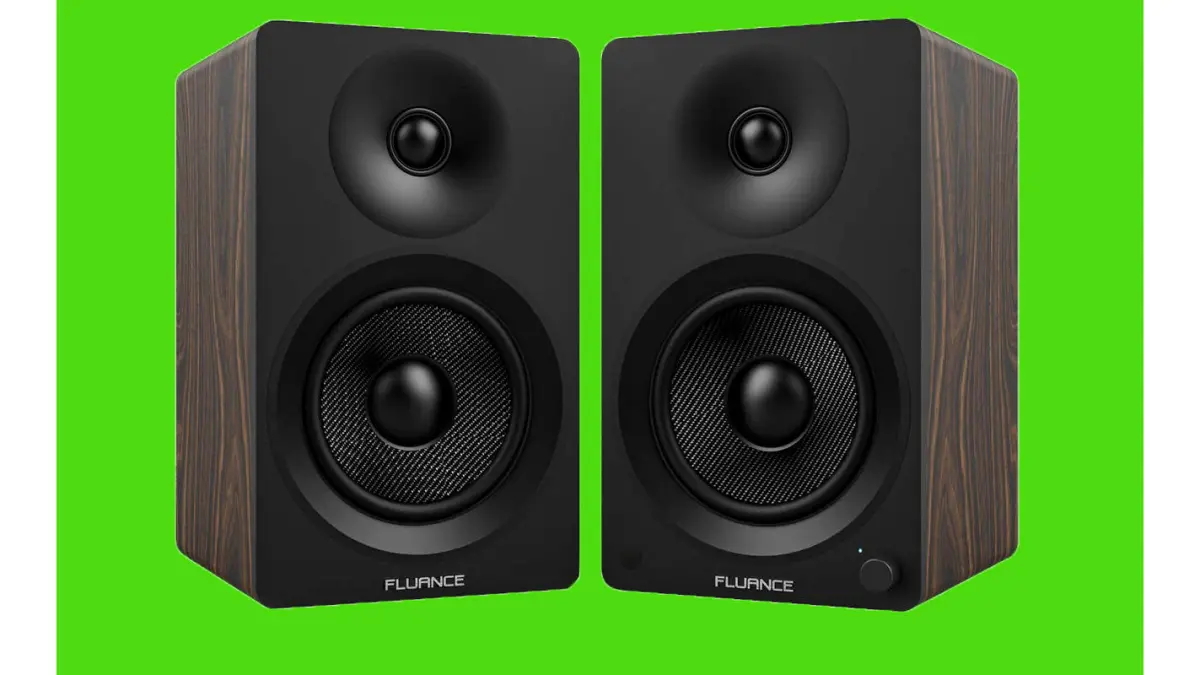
How to choose best powered bookshelf speakers
The right powered speaker depends on the source devices, listening distance, room size, and whether you want a complete system or an expandable one.
Inputs and source compatibility
Start with the devices you will actually connect. RCA and 3.5mm inputs cover many computers, older TVs, and line-level turntables. Optical and coaxial inputs are useful for digital TV and computer audio, while HDMI ARC is the most convenient choice for a compatible TV because it can carry sound and simplify volume control.
Turntable owners need to check whether the turntable has a built-in preamp. A line output can connect to suitable RCA input, but a phono-only output needs an external phono preamp unless the speakers specifically include a phono input and ground terminal, as the Klipsch models do.
Driver size and cabinet scale
A 3-inch driver can work well for close listening in a bedroom or office, but it is not the same as a 5.25-inch woofer in a larger room. The 3.75-inch and 4-inch models in this guide occupy the middle ground, while the ULTIMEA BS-3 has the largest woofer and a three-way design.
Cabinet dimensions matter as much as driver size. Measure the shelf depth and width, then leave room for cable connections and airflow. The Klipsch R-51PM, Klipsch R-40PM, and ULTIMEA BS-3 need more substantial placement than the Electrohome Huntley or Edifier R980T.
Power and listening distance
Power figures are useful for separating a desktop system from a room-filling one, but they do not tell the whole story. The Edifier R980T lists 24W RMS, the Edifier R1280T and R1280DBs list 42W RMS, and the ULTIMEA BS-3 lists 70W RMS. Those figures suggest increasing headroom, but driver design, cabinet construction, and room acoustics also shape the result.
For a desk, clarity at a short distance matters more than maximum output. For a living room, look for a larger woofer, a suitable cabinet, and enough power to avoid strained sound at normal listening levels.
Subwoofer expansion
A subwoofer output is useful if you want stronger low-frequency performance without replacing the speakers. The ULTIMEA BS-3, Saiyin 4-inch Speakers, and Edifier R1280DBs provide a documented path to an external powered subwoofer.
Buy the speakers that solve your source and placement problems first. Bass expansion only helps if the room can accommodate it.
Wireless and remote control
Bluetooth is convenient for phones and tablets, but it should not replace the wired input you need for a TV or turntable. Bluetooth versions vary across the list, from Bluetooth 5 and 5.0 to Bluetooth 5.3 and Bluetooth 6.0. A remote is also useful when the speakers sit across the room, especially if it can switch inputs rather than merely adjust volume.

Frequently asked questions
Do powered bookshelf speakers need a receiver?
No. Powered speakers contain their own amplification, so they can connect directly to compatible audio sources. Do not connect them to a receiver's amplified speaker output unless the speaker manufacturer specifically says it is supported.
Can I connect a turntable directly to powered speakers?
It depends on the turntable and the speaker inputs. A turntable with a built-in preamp and line output can connect to a suitable line input, while a phono-only turntable needs an external phono preamp unless the speakers include a phono input.
Are powered bookshelf speakers good for a TV?
Yes, particularly models with optical or HDMI ARC inputs. HDMI ARC is the most convenient because a compatible TV can often control speaker volume through its remote. Optical works well too, but some speakers require the TV output to be set to PCM or stereo.
Can these speakers connect to a phone?
Models with Bluetooth can connect wirelessly to a phone, tablet, or computer. The Edifier R1280T and Edifier R980T do not list Bluetooth, so they require a wired analog connection.
Can I add a subwoofer to powered bookshelf speakers?
Only if the speakers have a subwoofer output or another documented compatible connection. The ULTIMEA BS-3, Saiyin 4-inch Speakers, and Edifier R1280DBs include a subwoofer output for an external powered subwoofer.
Are larger speakers always better?
No. Larger cabinets and drivers can produce more scale, but they also need more shelf space and may be unsuitable for close desktop listening. A compact pair can be the better fit when the listening distance and room are small.
What audio format should I use with optical input?
Several models in this list specify PCM, stereo, or non-surround output for optical sources. If a TV is set to Dolby or DTS and the speakers do not support those formats, you may get silence or unwanted noise.
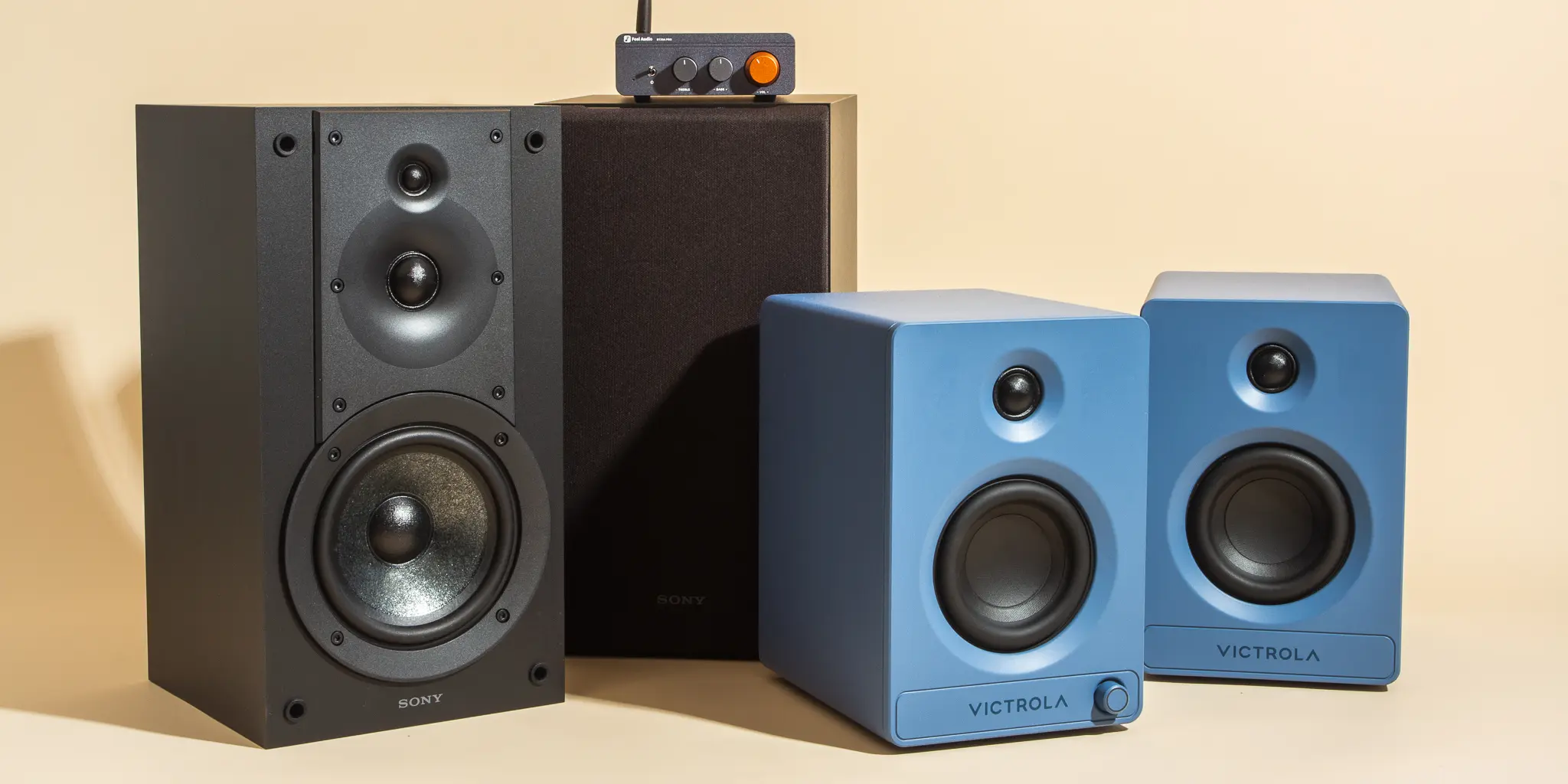
The bottom line
The Best powered bookshelf speakers for most people are the Edifier R1280T because they combine a useful 4-inch driver, 42W RMS output, two AUX inputs, a remote, and straightforward tone controls. They are not the most modern option, but their simplicity is a strength when your sources are analog.
For a TV-centered setup, choose the ULTIMEA BS-3 for HDMI ARC, three-way design, 70W RMS output, app EQ, and a subwoofer output. Vinyl listeners should look closely at the Klipsch R-51PM, while the Edifier R1280DBs is the better Edifier choice when Bluetooth, optical, coaxial, and future subwoofer expansion all matter.
If you are undecided, match the speaker's inputs and cabinet size to your room before comparing sound features.
As an Amazon Associate we earn from qualifying purchases.