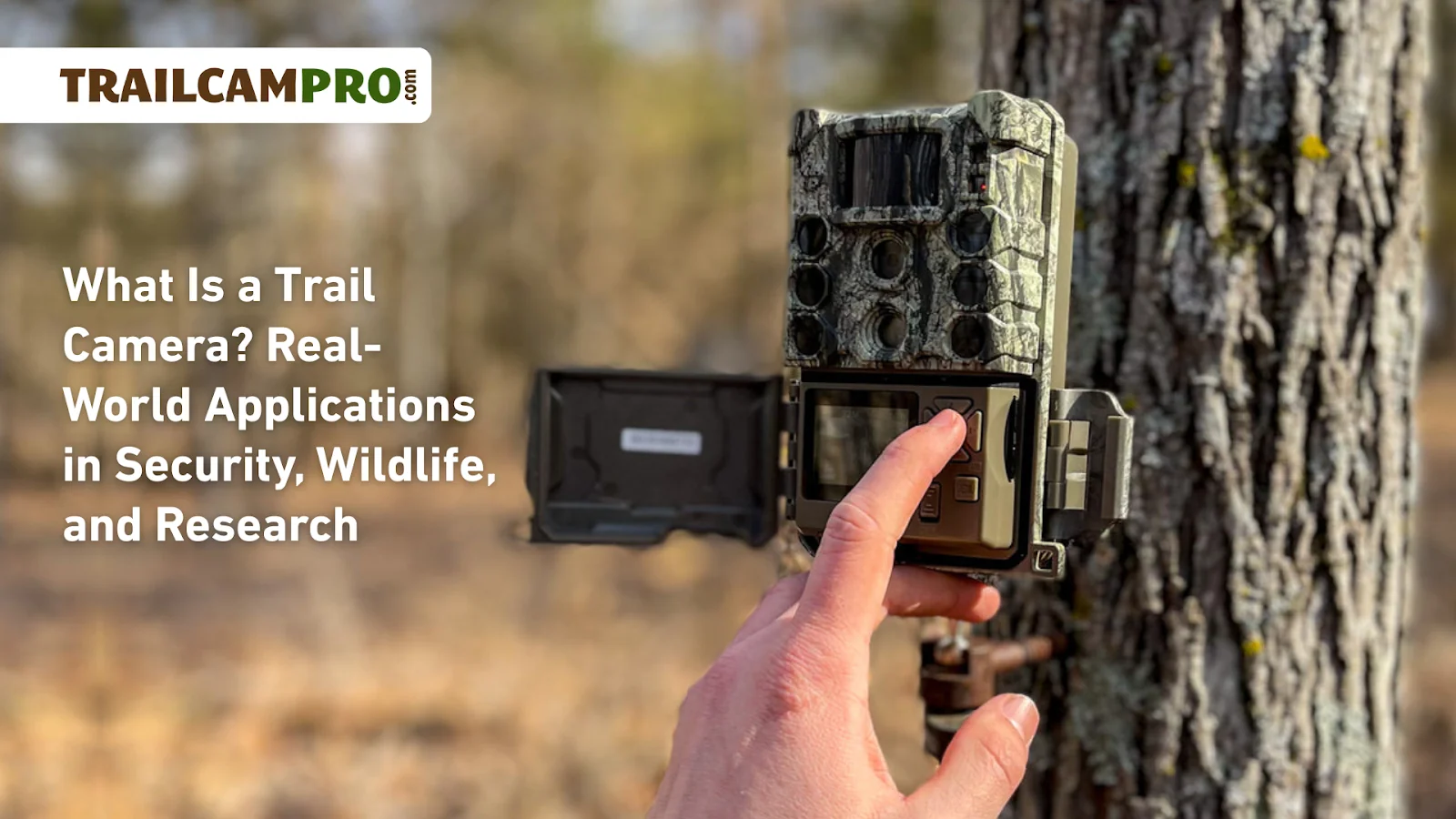

A trail camera has one job: stay in the woods, notice movement, and give you useful evidence without making you visit the site every day. The hard part is deciding whether you need instant cellular alerts, stealthy local recording, solar power, or a genuinely fast trigger.
Our Best trail camera picks cover cellular cameras, non-cellular models, twin packs, solar-assisted designs, and cameras with unusually broad detection zones. The differences matter more than headline megapixels, especially after sunset.
The TACTACAM Reveal X 3.0 is our single best pick, with the Moultrie Edge 3 2-Pack, SPYPOINT Flex-M Twin Pack, and GardePro E5S 2-Pack covering the strongest alternatives.
Comparison table
| # | Product | Award | Trigger | Night vision | Connectivity | Best for |
|---|---|---|---|---|---|---|
| 1 | TACTACAM Reveal X 3.0 | Best overall | Sub-half-second | Night vision | Multi-carrier LTE, GPS | Remote property monitoring |
| 2 | Moultrie Edge 3 2-Pack | Best cellular twin pack | 0.5 second | Low-glow infrared, 100 feet | Four-carrier cellular, GPS | Deer activity tracking |
| 3 | SPYPOINT Flex-M Twin Pack | Best app experience | Not specified | Night vision | Dual-SIM LTE, GPS | Multi-camera scouting |
| 4 | GardePro E5S 2-Pack | Best non-cellular pack | 0.1 second | No-glow, 100 feet | SD card | Two-location wildlife monitoring |
| 5 | GardePro E5S | Best simple trail camera | 0.1 second | No-glow, 100 feet | SD card | Straightforward local recording |
| 6 | Meidase P70 | Best with built-in screen | 0.1 second | No-glow, 100 feet | SD card | Checking footage in the field |
| 7 | GardePro A3S 2-Pack | Best low-light twin pack | 0.1 second | No-glow, 100 feet | SD card | Wide-area night monitoring |
| 8 | MAXDONE Solar Camera | Best solar design | 0.1 second | Infrared, 65 feet | Local Wi-Fi hotspot, Bluetooth | Long-term fixed installation |
| 9 | WOSPORTS 4K Camera | Best wide detection angle | 0.2 second | No-glow, 940nm | SD card | Broad paths and property edges |
| 10 | GardePro A3S | Best single A3S | 0.1 second | No-glow, 100 feet | SD card | Low-light wildlife viewing |
1. TACTACAM Reveal X 3.0: Best Overall

Pros
- Multi-carrier LTE automatically seeks a stronger signal
- Built-in GPS and storage simplify remote deployment
- Sub-half-second trigger with three-shot burst mode
- Designed for long unattended operation
- Setup can take less than 10 minutes
Cons
- Cellular operation depends on a suitable service connection
- Night vision distance is not specified
- A single camera covers only one location
Best for: hunters, landowners, and farmers who need alerts from remote property.
The TACTACAM Reveal X 3.0 is the camera we would put in the hardest-to-reach location. Its main advantage is not a flashy image figure. It is the way the camera removes several small sources of failure at once. The integrated SIM can connect to AT&T or Verizon, choosing the stronger carrier at the location, and the pre-installed antenna and activated SIM make the initial setup less intimidating than many cellular cameras.
Its sub-half-second trigger is well suited to animals crossing rather than standing in front of the lens. The three-shot burst mode adds useful insurance, capturing three consecutive photos when the camera detects movement. That matters at a trail crossing where a deer may be in the frame for only a moment. TACTACAM also includes built-in GPS, so the REVEAL app can keep track of where the unit is placed, and the camera sends photos to your phone without requiring an SD card.
The advertised battery life reaches up to six months, though actual endurance will depend on signal strength, activity, settings, and the power setup. The camera can be paired with a lithium cartridge, solar panel, folding solar panel, or battery belt. That range of options makes the Reveal X 3.0 more adaptable than the local-recording GardePro models, which require you to retrieve an SD card to see what happened.
The weakness is that the feature set is built around cellular access. If the placement has poor service, the camera cannot turn that weak signal into instant alerts. It also gives less detail about its night vision range than the Moultrie Edge 3 and the GardePro cameras. Readers who simply want to inspect footage once a month should skip the cellular overhead and choose the GardePro E5S instead.
For remote gates, feeders, cabins, and hunting properties, the Reveal X 3.0 is the most complete Best trail camera here. It is the one we'd keep when missed visits are more frustrating than a little extra setup complexity.
2. Moultrie Edge 3 2-Pack: Best Cellular Twin Pack
Pros
- Two cellular cameras cover separate locations
- Four-carrier auto-connect helps with remote placement
- 40MP photos and 1080p HD video
- AI buck detection can reduce irrelevant alerts
- Live aim and GPS simplify installation
Cons
- A 0.5-second trigger is slower than the fastest local cameras
- Cellular features require an active plan
- Night illumination is low-glow rather than no-glow
Best for: hunters who want two connected cameras and deer-focused alerts.
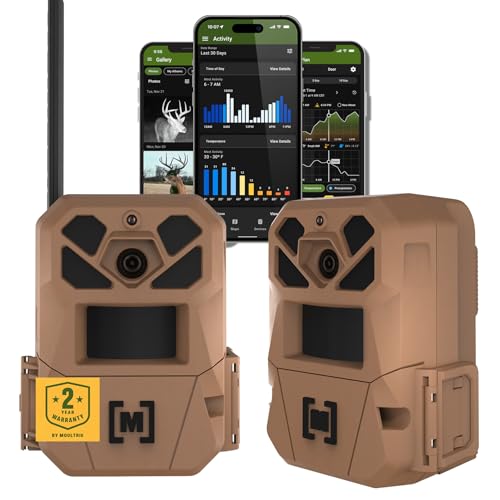
The Moultrie Edge 3 2-Pack makes sense when one camera is not enough. Put one unit on a trail and another near a feeder or staging area, then monitor both through the Moultrie app. A twin pack also gives a better view of movement patterns than repeatedly moving one camera between locations.
Moultrie lists 40MP still images and 1080p HD video, along with a 0.5-second trigger and detection range up to 100 feet. The image specification is generous, while the video resolution is more useful for following behavior than simply examining a still frame. Low-glow infrared is intended to keep nighttime illumination discreet, though it is not the same stealth approach as the no-glow infrared used by the GardePro E5S and A3S models.
The Edge 3 automatically connects to the strongest of four major US networks, and its live aim feature lets you preview the view while positioning the camera. Built-in GPS maps the cameras in the app. AI buck detection can identify bucks and send alerts, which is a focused tool for deer scouting rather than a general wildlife feature. The app can also report battery life and control compatible feeders remotely.
Compared with the Reveal X 3.0, Moultrie gives you two cameras, better stated video resolution, and more specialized deer tools. TACTACAM counters with a faster trigger, three-shot burst mode, and built-in storage that avoids SD card handling. The Edge 3's real limitation is the need to maintain a cellular plan, and its half-second trigger is not as quick as the 0.1-second local models.
Choose this pair when coverage and deer-specific alerts matter more than absolute trigger speed. It is particularly well suited to a property where the cameras need to stay in place while you make decisions from a phone.
3. SPYPOINT Flex-M Twin Pack: Best App Experience

Pros
- Two cellular cameras in one setup
- Cross-carrier coverage without manual carrier selection
- Photo, video, time-lapse, and Time-Lapse+ modes
- GPS, weather, maps, and remote settings in the app
- Dual-SIM LTE and no Wi-Fi requirement
Cons
- 28MP photos and 720p video trail the Moultrie on resolution
- A microSD card is required
- The listing does not specify trigger speed or night range
Best for: users who want flexible remote control across two scouting locations.
The SPYPOINT Flex-M Twin Pack is the most app-centered option in this group. It is designed for someone who wants to activate, configure, and review two cameras from a phone rather than treat each unit as a sealed box that must be opened in the woods.
Its capture modes are unusually broad. Photo, video, time-lapse, and Time-Lapse+ let you monitor a large area even when movement does not pass directly through the detection zone. Time-Lapse+ combines scheduled interval images with the detection sensor, while Constant Capture can send and record images at the same time. That flexibility makes it more useful for studying a property than a camera restricted to motion-triggered stills.
The Flex-M uses cross-carrier coverage and dual-SIM LTE, with no Wi-Fi needed for transmission. The SPYPOINT app handles activation, maps, weather updates, firmware changes, and remote settings. BUCK TRACKER AI can help filter for species. The cameras record 28MP photos and 720p video, and the twin pack includes two units for separate views.
Resolution is the clear compromise. The Moultrie Edge 3 produces 40MP photos and 1080p video, while the local GardePro cameras offer 64MP stills and 1296p video. SPYPOINT also requires a microSD card, so it does not have the same card-free simplicity as the Reveal X 3.0. The product information does not state a trigger speed or night vision distance, which makes it harder to compare directly on fast-moving subjects.
The Flex-M pair is a good fit for people who value control, mapping, and varied capture modes over maximum image resolution. If your priority is an easy-to-manage two-camera cellular system, this is the more flexible choice than a conventional SD-card setup.
4. GardePro E5S 2-Pack: Best Non-Cellular Pack

Pros
- Two cameras with 0.1-second triggers
- 64MP photos and 1296p HD video
- 100-foot no-glow night vision
- IP66 weather-resistant construction
- Supports SD cards up to 512GB
Cons
- No cellular or Wi-Fi viewing
- Eight AA batteries are not included
- The listed weight is higher than the single-camera E5S
Best for: monitoring two wildlife routes without cellular transmission.
The GardePro E5S 2-Pack is the practical answer for a property with two obvious routes and no need for phone alerts. Both cameras use local recording, so there is no carrier setup, app activation, or network signal to troubleshoot. You visit the cameras, remove the SD cards, and review the results.
The core hardware is strong for this type of deployment. GardePro lists 64MP photos, 1296p HD video, and a 0.1-second trigger assisted by three PIR sensors. That quick response is better suited to animals moving across the frame than the 0.5-second trigger on the Moultrie Edge 3. No-glow night vision reaches 100 feet, helping keep the infrared illumination discreet around cautious wildlife.
IP66 weather resistance gives the pair a sturdier outdoor brief than a camera described only as waterproof. Each unit runs on eight AA batteries and supports the GardePro SP350 solar panel. Motion detection, time-lapse, and hybrid modes provide more control than a basic motion-only camera. In-camera playback and support for standard SD cards up to 512GB are helpful when you want to check a deployment before leaving the property.
The obvious drawback is the lack of remote access. Cellular cameras such as the TACTACAM Reveal X 3.0 can notify you while you are away, but the E5S pair stays silent until you retrieve the card. The listed dimensions and weight also make this pair less compact than the single E5S, though the extra coverage may matter more than portability.
For readers who want two dependable, stealthy recording points and do not need live alerts, this is one of the strongest sets in the roundup. It is also a good fit for anyone who wants to avoid placing a networked device deep in the woods.
5. GardePro E5S: Best Simple Trail Camera

Pros
- Very fast 0.1-second trigger
- 64MP photos and 1296p HD video
- No-glow night vision reaches 100 feet
- Compact 0.66-pound listed weight
- IP66 weather resistance
Cons
- No cellular or Wi-Fi connectivity
- Requires eight AA batteries
- Storage card is not included
Best for: first-time buyers who want local recording without connected features.
The single GardePro E5S is the least complicated recommendation here. It has no cellular plan and no wireless app to learn. That simplicity is exactly what many trail camera owners want when the camera is placed near a garden, a known game trail, or a property boundary that is easy to revisit.
The E5S records 64MP photos and 1296p HD video, with three PIR sensors supporting a 0.1-second trigger. Those figures put it ahead of the Moultrie Edge 3 on trigger speed and ahead of the SPYPOINT Flex-M on stated image and video resolution. In practice, a fast trigger is useful when the animal is moving through rather than pausing directly in front of the camera.
Its 100-foot no-glow night vision gives the camera a long stated reach without using visible illumination. IP66 weather resistance is reassuring for fixed outdoor placement, and the camera has a 1/4-inch-20 mounting thread for attachment to trees, posts, or fences. It uses eight AA batteries and supports the GardePro SP350 solar panel for longer deployments.
The limitation is the same feature that makes it easy to own: there is no remote viewing. You need a standard SD card, and the card must be retrieved before you can see the footage. The E5S 2-Pack is the better choice for two sites, while the Meidase P70 is more convenient if you want a built-in screen for checking clips in the field.
The E5S is the Best trail camera for a straightforward local setup. Pick it when a fast trigger, discreet night coverage, and uncomplicated operation matter more than live notifications.
6. Meidase P70: Best With Built-In Screen

Pros
- 2.4-inch color display for field review
- 0.1-second trigger
- 64MP photos and 1296p HD video
- 100-foot no-glow night vision
- Solar-ready and supports compressed video formats
Cons
- No cellular or Wi-Fi transmission
- Eight AA batteries are sold separately
- Heavier and bulkier than the single GardePro E5S
Best for: checking images and clips at the camera without carrying a separate reader.
The Meidase P70 stands out for a feature that sounds ordinary but is genuinely useful in the field: a 2.4-inch color display. You can review footage at the camera rather than guessing whether the lens is aimed correctly or waiting until you get home to discover a branch was blocking the view.
The P70 uses a 64MP still image setting and 1296p video, matching the headline capture specifications of the GardePro E5S. Its 0.1-second trigger uses side sensors to detect fast-moving wildlife, while the f/1.6 aperture lens is intended to help gather light. The 100-foot no-glow night vision uses 940nm infrared LEDs, a useful detail for discreet nighttime monitoring.
Video is saved in H.264-compressed MP4 or MOV formats, which can make files easier to move and play on common devices. The camera supports motion activation and can pair with the Meidase SP350 solar panel, with eight AA batteries as backup. That gives it a familiar local-recording workflow but with a more convenient inspection step.
The P70 does not transmit images, so it cannot compete with the TACTACAM Reveal X 3.0 or SPYPOINT Flex-M when you need alerts from a distant property. Its listed weight is also higher than the single GardePro E5S, and its body is larger. If you are placing several cameras and rarely inspect them in person, the lighter GardePro is the cleaner choice.
Choose the P70 for hands-on scouting, installation checks, and wildlife monitoring where the camera is reachable. The screen turns routine card retrieval into a quicker review rather than a blind swap.
7. GardePro A3S 2-Pack: Best Low-Light Twin Pack
Pros
- Sony Starvis sensor for enhanced low-light performance
- Two cameras with 120-degree detection
- 0.1-second trigger and up to five-shot bursts
- 64MP photos with 1296p video and sound
- 100-foot no-glow infrared coverage
Cons
- No cellular or Wi-Fi access
- Eight AA batteries are not included for each camera
- SD cards are not included
Best for: covering two areas where nighttime detail and wide detection matter.
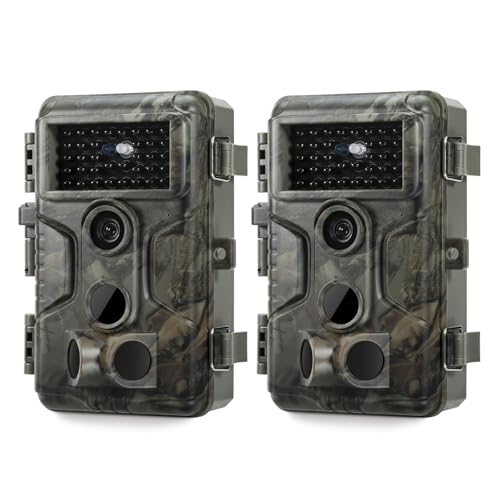
The GardePro A3S 2-Pack is the more capable twin-pack alternative to the E5S pair when low-light behavior is the priority. Both cameras use a Sony Starvis sensor, and the added low-light emphasis should appeal to people watching a shaded trail, a wooded edge, or a place where daylight fades quickly.
The A3S records 64MP photos and 1296p HD video with sound. Its 0.1-second trigger is paired with a 120-degree wide PIR detection angle and bursts of up to five photos. That combination increases the chance of getting a useful sequence when an animal enters from the side. No-glow 940nm infrared reaches up to 100 feet, keeping the camera discreet during nighttime activity.
Flexible recording modes include motion detection, time-lapse, and hybrid operation. Each camera supports SD cards up to 512GB, in-camera playback, and loop recording. Eight AA batteries power each unit, while the GardePro SP350 solar panel can support more continuous operation. The 2-pack lets you place one unit on the approach and one near the destination, which is often more informative than chasing maximum resolution from one location.
The trade-off is a complete lack of remote access. The Moultrie Edge 3 2-Pack can send images and identify bucks through its connected system, while the A3S pair requires a visit. It is also more equipment to mount and maintain than a single camera, and no batteries or SD cards are included.
The A3S 2-Pack is a strong local setup for wildlife behavior rather than instant hunting alerts. Choose it when wide detection, sound, and low-light capture are more important than checking a phone from home.
8. MAXDONE Solar Camera: Best Solar Design

Pros
- Adjustable split solar panel design
- 6000mAh rechargeable power system
- 4K video and 64MP photos
- Local Wi-Fi hotspot and Bluetooth file transfer
- 0.1-second trigger and IP66 construction
Cons
- Wi-Fi works only as a short-range camera hotspot
- Night vision is rated to 65 feet
- Solar performance depends on placement and sunlight
Best for: fixed monitoring locations where reducing battery changes is the main goal.
The MAXDONE Solar Camera is aimed at a different problem than the cellular models. It is built to stay installed and keep running, using an adjustable split solar panel, a 6000mAh rechargeable power source, and three charging options: solar, USB Type-C, and rechargeable power. That makes it appealing for a garden, farm, or fixed woodland position where regular battery changes are inconvenient.
The camera records 4K video and 64MP photos, with infrared night vision reaching 65 feet. Its 0.1-second trigger and customizable detection zones help it respond quickly while limiting some false activations. It also supports time-lapse, scheduled shooting, motion detection, and five-shot bursts. IP66 protection gives it a clear outdoor role, and the included 32GB SD card means the initial setup is less dependent on buying storage separately.
The wireless feature needs careful interpretation. MAXDONE creates its own short-range Wi-Fi hotspot for setup and file downloads, with Bluetooth pairing through the TrailCamGO app. It does not connect to home Wi-Fi, does not provide remote viewing over the internet, and works best within roughly 10 feet for the app, with a stated open-area range of 33 to 49 feet. That is convenient when standing near the camera, but it is not cellular monitoring.
Compared with the Meidase P70, the MAXDONE offers solar power and phone downloads without removing the card, while the P70 has a built-in color screen. Compared with the cellular picks, MAXDONE avoids transmission plans but cannot send an alert from a distant location. Its 65-foot night range is also shorter than the 100-foot figures on the GardePro cameras.
This is the Best trail camera for a fixed site with usable sunlight and a nearby phone connection. It is not the right choice for a remote property that needs real-time alerts.
9. WOSPORTS 4K Camera: Best Wide Detection Angle

Pros
- 120-degree wide detection angle
- Adjustable 56MP still image modes
- 4K video recording
- 0.2-second trigger with burst shooting
- Built-in 2-inch color LCD
Cons
- No cellular or Wi-Fi transmission
- Night vision range is not specified
- Requires eight AA batteries unless upgraded
Best for: broad paths, driveways, and property edges where animals approach from different angles.
The WOSPORTS 4K Camera earns its place through coverage rather than a connected feature set. Its 120-degree detection angle is useful when the camera cannot be aimed perfectly at a narrow trail. That broader view can also help around a farm entrance, backyard edge, or open property boundary.
Still photos can be set from 5MP through 56MP, and the camera records 4K video at 3840 by 2160 or a lower 2560 by 1440 mode. Its 0.2-second trigger is slower than the 0.1-second GardePro and Meidase models but still quick enough for general motion monitoring. One to three burst shots can capture more than a single frame when an animal crosses the zone.
The camera uses 32 940nm infrared LEDs for no-glow night vision and has a 2-inch color LCD for reviewing images and clips without removing the SD card. It supports up to a 256GB card, with a 16GB card included according to the listing. Eight AA batteries are supported, as are a WOSPORTS rechargeable lithium battery and a compatible solar panel.
The missing detail is night vision distance. The GardePro and Meidase models state 100 feet, while WOSPORTS does not provide a comparable range in the product information. It also has no cellular or Wi-Fi transmission, so the LCD is useful only when you are physically at the camera. Readers focused on the fastest possible response should choose the GardePro E5S instead.
The WOSPORTS is a sensible pick when framing is difficult and a wide sensor matters. It is also worth considering if you want adjustable photo resolution and a screen without moving into a connected camera.
10. GardePro A3S: Best Single A3S

Pros
- Sony Starvis sensor for low-light scenes
- 0.1-second trigger and 120-degree detection
- 64MP photos and 1296p video with sound
- Five-shot burst mode
- 100-foot no-glow night vision
Cons
- No cellular or Wi-Fi access
- Eight AA batteries and SD card are not included
- No built-in display is specified
Best for: one-location monitoring with strong low-light capability.
The single GardePro A3S is the one-camera version of the A3S approach. It makes the most sense when you have one important location and want the low-light sensor, wide detection zone, and rapid response without committing to a two-camera set.
Its Sony Starvis sensor is designed for enhanced low-light performance, while the camera records 64MP photos and 1296p HD video with sound. The 0.1-second trigger, 120-degree PIR angle, and up to five-shot burst mode are a strong combination for animals that move unpredictably through the frame. At night, invisible 940nm infrared provides no-glow illumination out to 100 feet.
The A3S supports motion detection, time-lapse, and hybrid modes, along with in-camera playback, loop recording, and SD cards up to 512GB. It runs on eight AA batteries and can use the GardePro SP350 solar panel for extended operation. This is a familiar, low-maintenance design for anyone who prefers to collect footage locally.
The GardePro E5S has the same headline trigger, photo, video, and night range figures, so the A3S earns its place mainly through the Sony Starvis low-light sensor, sound recording, and wider detection angle. The Meidase P70 is easier to check in the field because it includes a 2.4-inch display. Neither GardePro model can compete with cellular cameras for remote alerts.
Choose the A3S when one well-placed camera needs to handle dim conditions and animals approaching from the side. It is a focused option, not a remote-monitoring system.
How to choose best trail camera
The right Best trail camera depends on how often you can visit the site and what you need to know when you are not there. Start with the connection type, then judge trigger behavior, night coverage, power, storage, and placement.
Cellular connection
Cellular cameras send photos or video to an app without nearby Wi-Fi. The TACTACAM Reveal X 3.0 uses AT&T and Verizon, while the Moultrie Edge 3 connects across four major US networks and the SPYPOINT Flex-M uses cross-carrier dual-SIM LTE. These are the cameras to consider for remote acreage, but cellular operation requires an appropriate service plan and a usable signal.
Non-cellular models store footage on an SD card. They use less connected hardware and avoid remote transmission, but you must return to the camera to see the results.
Trigger speed and detection angle
A 0.1-second trigger is the quickest stated figure in this group, appearing on the GardePro E5S, GardePro A3S, Meidase P70, and MAXDONE. The WOSPORTS lists 0.2 seconds, while the Moultrie Edge 3 lists 0.5 seconds. Faster is generally more useful when animals cross the frame quickly, though placement still matters.
A wide detection angle helps when movement can approach from the side. The GardePro A3S and WOSPORTS list 120 degrees, while the SPYPOINT Flex-M offers time-lapse modes that can help monitor a wider area over time.
A fast trigger cannot rescue a camera aimed at the wrong path, so placement comes before megapixels.
Night vision
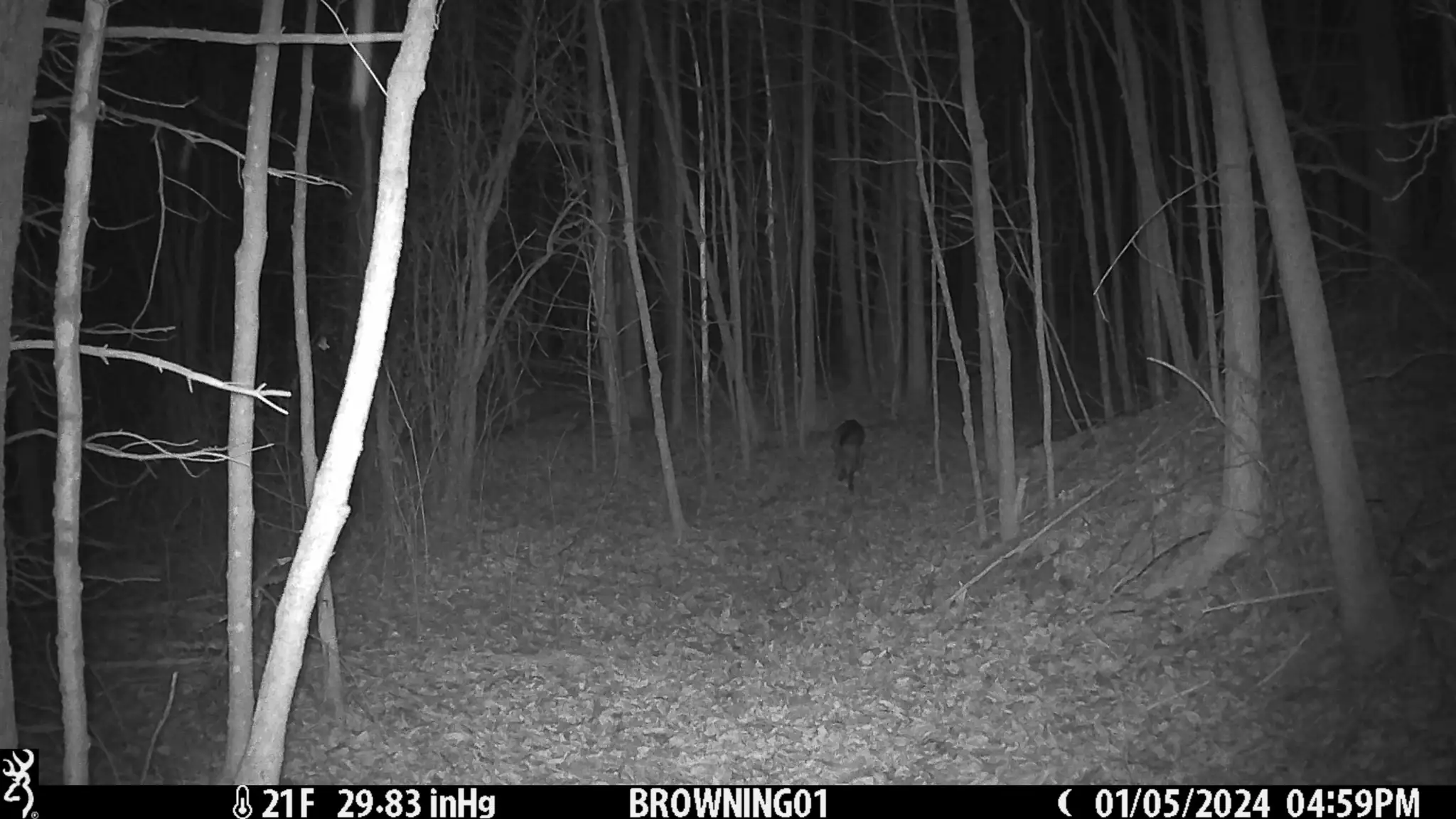
No-glow infrared is the stealth choice for wary animals. The GardePro E5S, GardePro A3S, Meidase P70, and WOSPORTS use 940nm no-glow illumination, while the MAXDONE lists infrared night vision to 65 feet. The GardePro and Meidase models state a 100-foot range.
Low-glight sensor performance also matters. The GardePro A3S models use a Sony Starvis sensor, while the Meidase P70 lists an f/1.6 aperture lens. Look for a stated range and illumination type rather than assuming a larger megapixel number guarantees better nighttime footage.
Power and installation
Cellular cameras can use substantial power when they transmit frequently, so solar panels, lithium cartridges, and battery belts are useful for unattended deployments. The Reveal X 3.0, Moultrie Edge 3, and SPYPOINT Flex-M all support longer-term remote use in different ways.
Local cameras commonly use eight AA batteries. The MAXDONE takes a different approach with a 6000mAh rechargeable power source, solar charging, and Type-C charging. Solar works best when the panel can face the sun without branches or seasonal shade blocking it.
Storage and field review
Local cameras need an SD card, and capacities vary. The GardePro E5S and A3S support cards up to 512GB, while WOSPORTS supports up to 256GB. The MAXDONE includes a 32GB card, and the WOSPORTS listing includes a 16GB card.
A built-in screen changes the workflow. The Meidase P70 has a 2.4-inch color display, and WOSPORTS has a 2-inch LCD. MAXDONE can send files to a nearby phone through its own hotspot, but that is local transfer rather than remote viewing.
Frequently asked questions
Do trail cameras need Wi-Fi?
No. Cellular cameras use mobile networks, and local trail cameras save photos and video to an SD card. The MAXDONE creates its own short-range Wi-Fi hotspot for nearby downloads, but it does not connect to a home Wi-Fi network or provide internet viewing.
What trigger speed should a trail camera have?
A faster trigger helps capture animals that move quickly across the frame. Several cameras here list a 0.1-second trigger, while the WOSPORTS lists 0.2 seconds and the Moultrie Edge 3 lists 0.5 seconds. Correct height, angle, and detection-zone placement remain just as important.
Are cellular trail cameras better than SD-card cameras?
They are better for remote alerts and checking activity without visiting the property. SD-card cameras are simpler when you can retrieve footage yourself and do not need a live connection. The TACTACAM Reveal X 3.0 is the strongest remote-monitoring pick, while the GardePro E5S is better for straightforward local recording.
What does no-glow night vision mean?
No-glow infrared illumination is designed to be invisible to animals and people during operation. The GardePro E5S, GardePro A3S, Meidase P70, and WOSPORTS use 940nm infrared. No-glow does not guarantee perfect night images, since distance, weather, movement, and placement still affect results.
Can a trail camera run on solar power?
Several can. TACTACAM, Moultrie, GardePro, Meidase, WOSPORTS, and MAXDONE list solar power options or compatibility. Solar performance depends on sunlight, panel placement, camera activity, and the camera's rechargeable or backup battery arrangement.
Is 64MP better than 4K video?
They describe different capture modes. Megapixels refer to still photos, while 4K describes video resolution. A camera can offer high-resolution photos and lower-resolution video, so compare both figures separately and consider whether still images or moving footage matter more for your use.
The bottom line
The TACTACAM Reveal X 3.0 is our top Best trail camera because it combines multi-carrier LTE, GPS, built-in storage, a fast trigger, and three-shot bursts in a system designed for remote property monitoring. The Moultrie Edge 3 2-Pack is the better choice when two cellular locations and deer-focused app features matter more than the fastest trigger.
For local recording, the GardePro E5S is the simplest single-camera recommendation, while the GardePro A3S 2-Pack is the stronger choice for two locations and low-light behavior. The MAXDONE Solar Camera deserves a look for a fixed site where solar power and nearby phone downloads are more useful than cellular alerts.
If you are undecided, choose cellular for remote alerts and a GardePro or Meidase model for dependable footage you can collect in person.
As an Amazon Associate we earn from qualifying purchases.