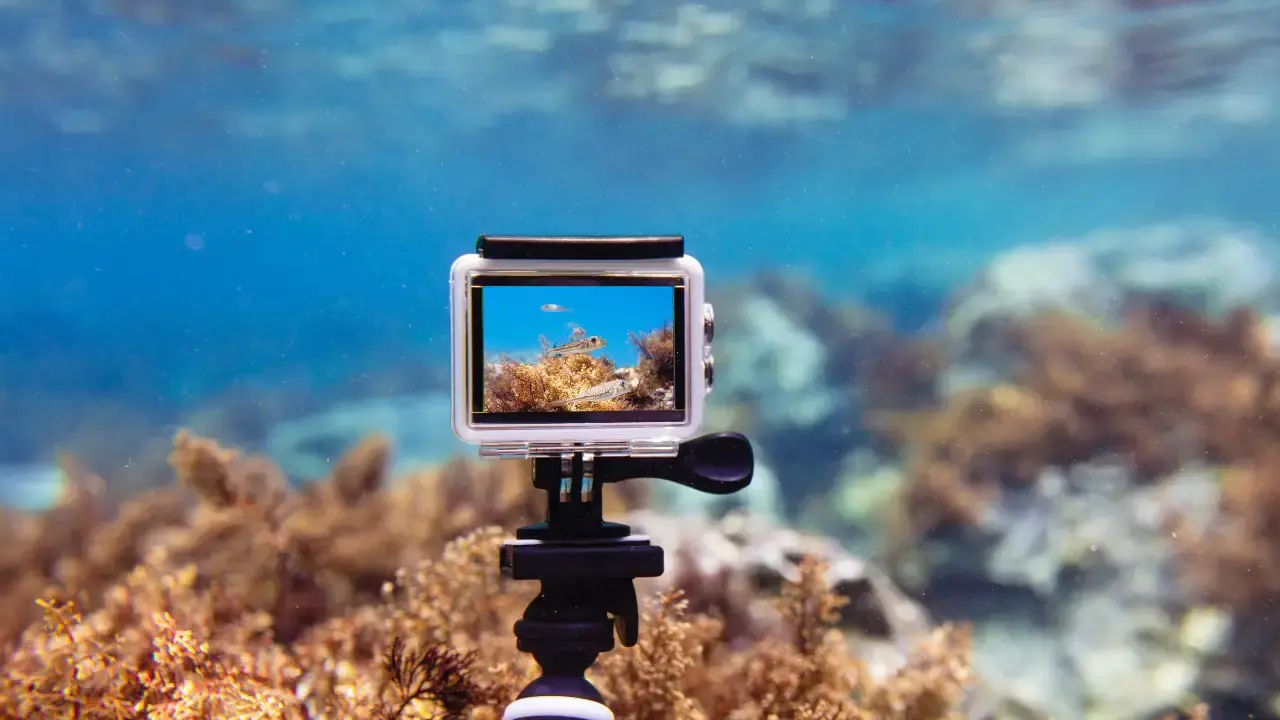

A waterproof camera has one job your phone cannot reliably handle: recording the moment it goes underwater without a separate housing or a frantic dash back to shore. The trouble is that “waterproof” covers everything from a simple pool camera to a serious action camera built for fast movement and low light.
Our Best underwater camera picks range from the pocketable KODAK PIXPRO WPZ2 to the capable DJI Osmo Action 4 and the unusually rugged OM System TG-7. There are also several inexpensive dual-screen cameras with impressive headline resolutions, but their depth ratings, controls, and real-world strengths differ sharply.
The OM System TG-7 is our top pick for still photography and underwater versatility, while the DJI Osmo Action 4 is the better choice for smooth action video. The rest cover simple family use, deeper dives, long recording sessions, and starter action-camera kits.
Comparison table
| # | Product | Award | Waterproof depth | Video and photo | Best for |
|---|---|---|---|---|---|
| 1 | OM System TG-7 | Best overall | 50 ft / 15 m | 4K video, high-resolution F2.0 lens | Serious underwater stills and macro |
| 2 | DJI Osmo Action 4 | Best for action video | 18 m | 4K at 120fps, 10-bit color | Diving, vlogging, and fast movement |
| 3 | KODAK PIXPRO WPZ2 | Best rugged point-and-shoot | 50 ft / 15 m | 1080p video, 16MP photos | Straightforward family use |
| 4 | AKASO EK7000 Pro Bundle | Best starter action kit | 131 ft with case | 4K at 30fps, 20MP photos | Accessories and long sessions |
| 5 | AKASO EK7000 Black | Best deep-water action camera | 131 ft with case | 4K at 30fps, 20MP photos | Snorkeling and mounted footage |
| 6 | AKASO EK7000 Blue | Best lightweight action camera | 131 ft with case | 4K at 30fps, 20MP photos | A small, simple action setup |
| 7 | SiSuSy 8K Camera | Best dual-screen design | 50 ft | 8K video, 75MP autofocus photos | Selfies and beginner vlogging |
| 8 | Yifecial 4K Camera | Best compact pool camera | 16 ft | 4K video, 64MP photos | Shallow-water family trips |
| 9 | YAXTIFIU 5K Camera | Best beginner selfie camera | 33 ft | 5K video, 96MP autofocus photos | Kids, teens, and vacation clips |
| 10 | Ruysaie 8K Camera | Best long-battery camera | 33 ft | 8K video, 70MP photos | Extended outdoor recording |
1. OM System TG-7: Best Overall

Pros
- Waterproof to 50 feet without an external housing
- Bright F2.0 lens helps in dim underwater scenes
- Four macro modes focus as close as 1 centimeter
- Underwater HDR and microscope modes are genuinely useful
- Freezeproof, dustproof, shockproof, and crushproof design
Cons
- Its 15-meter depth rating is lower than the AKASO cameras with cases
- The optical zoom reaches only 4x
- Heavier and less video-focused than a small action camera
Best for: photographers who want a durable camera for underwater stills, close-ups, and outdoor travel.
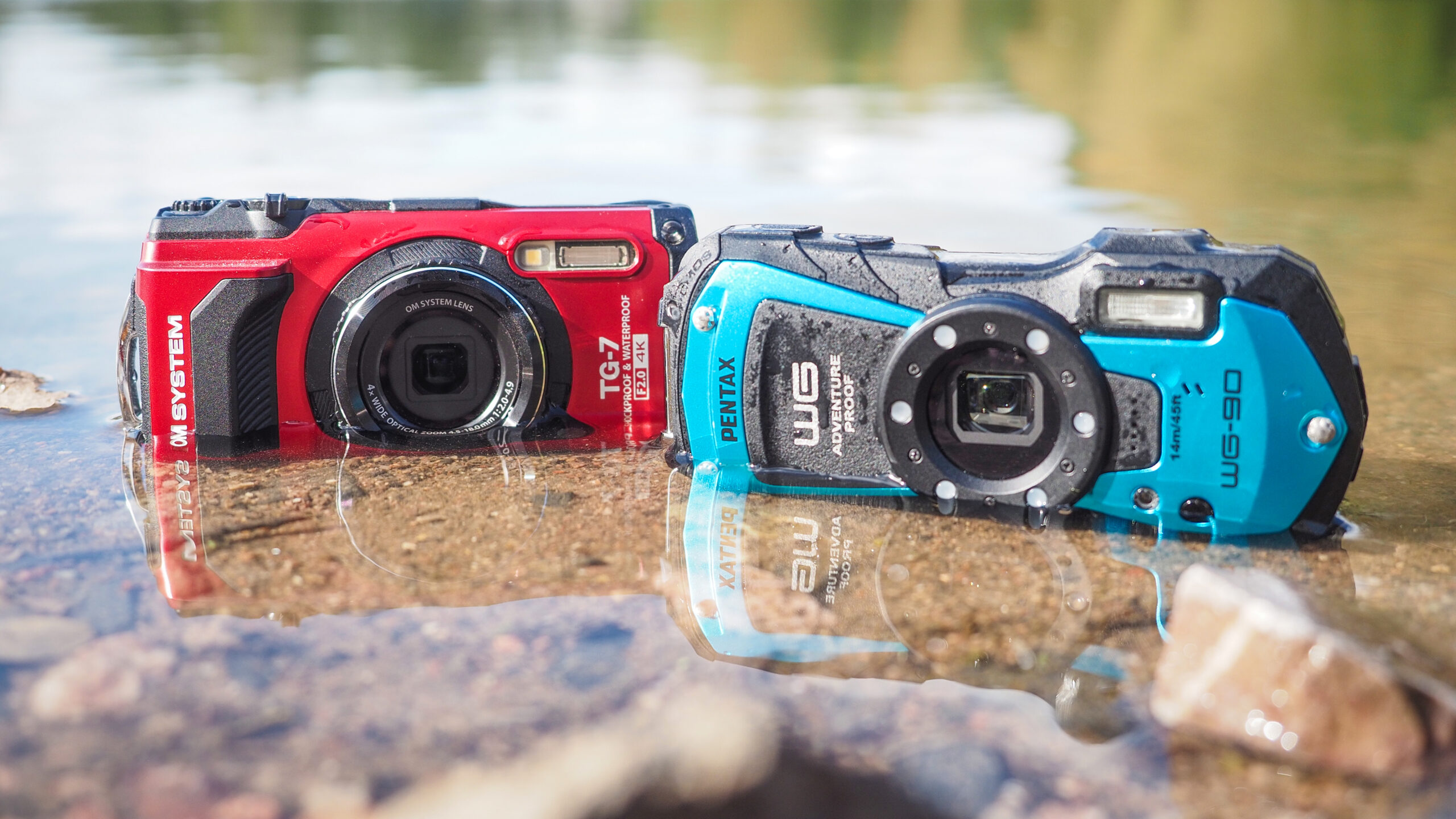
The OM System TG-7 is the camera we would hand to someone who cares about more than simply proving they went swimming. It feels like a real compact camera rather than an action camera in a waterproof shell, and that distinction matters when you want to frame a reef, a small fish, or a family portrait instead of relying on a wide fixed view.
Its 15-meter waterproof rating is enough for snorkeling, swimming, and many recreational dives. The body is also rated as dustproof, shockproof to 2.1 meters, crushproof to 100 kilogram-force, and freezeproof to -10 degrees Celsius. Those protections make it useful above water too, particularly for hiking, skiing, and beach trips where sand and accidental drops are as much of a threat as splashes.
The F2.0 high-resolution lens is the key photographic advantage. A brighter lens can help the camera gather more light when water absorbs the sun, and the TG-7 adds five underwater modes, including underwater microscope and underwater HDR. Its variable macro system has four modes and can capture subjects as close as 1 centimeter from the lens. That is a much more flexible setup for coral textures and tiny creatures than the broad action-camera perspective offered by the DJI Osmo Action 4.
Video is still well covered, with 4K recording, 120fps high-speed movie recording, and a vertical video mode. The weakness is that this is not the deepest-diving model here, and its 4x zoom is modest. Someone planning to mount a camera to a helmet or prioritize ultrawide, stabilized footage should choose DJI instead. For underwater photography, close-up detail, and a camera that can survive the rest of an outdoor trip, the TG-7 is the most complete option.
2. DJI Osmo Action 4: Best for Action Video

Pros
- 4K recording at 120fps for smooth fast action
- 1/1.3-inch sensor with 2.4μm pixels
- 10-bit color and D-Log M for editing flexibility
- Three stabilization modes
- Dual full-color touchscreens
Cons
- Waterproof depth is 18 meters, not 131 feet
- Essential Combo omits the extra curved adhesive base
- More features to learn than a basic point-and-shoot
Best for: divers, vloggers, and active shooters who want smooth, editable video.
The DJI Osmo Action 4 is the strongest video camera in this group. Its footage-oriented design makes more sense for diving clips, cycling, swimming, and vlogging than a conventional waterproof compact. The dual touchscreens are especially practical: the front display helps with self-recording, while the rear screen handles framing and settings when the camera faces outward.
The 1/1.3-inch sensor and 2.4μm pixel size give it a meaningful low-light advantage over the small-sensor cameras that advertise much larger still-image numbers. Underwater scenes often lose brightness quickly, so the ability to record cleaner footage in dim conditions matters more than an inflated megapixel figure. DJI also includes auto white balance designed to maintain natural color underwater.
The video tools are unusually serious for this list. The camera records 4K at 120fps, uses a 155-degree ultrawide view, and supports 10-bit color with D-Log M. That gives experienced editors more room to adjust color and preserve subtle shades. Three stabilization modes help keep footage smooth and level, while the magnetic quick-release system makes it easier to switch angles or move into a vertical setup.
Its 1770mAh battery can run for up to 150 minutes, and the camera works in temperatures down to -20 degrees Celsius. It is waterproof to 18 meters, which beats the OM System TG-7 on depth but does not match the cased AKASO models. DJI also supports direct connections to DJI Mic 2 and Mic Mini transmitters, a major advantage for spoken vlogs. Choose the AKASO EK7000 Pro Bundle if you want a larger accessory package, but choose DJI when smooth, polished video is the priority. Anyone who only wants occasional pool snapshots will not use enough of its video control to justify the learning curve.
3. KODAK PIXPRO WPZ2: Best Rugged Point-and-Shoot

Pros
- Waterproof to 15 meters
- Shockproof from drops up to 2 meters
- Dustproof body needs no protective housing
- 4x optical zoom
- Built-in Wi-Fi and remote viewfinder support
Cons
- Video tops out at 1080p
- Older interface than the action-camera picks
- No stated stabilization feature
Best for: families and travelers who want a simple rugged camera instead of a phone or action-camera setup.
The KODAK PIXPRO WPZ2 is the least complicated camera here. It has the shape and handling of a traditional point-and-shoot, with a 2.7-inch display, physical controls, and a 4x optical zoom that helps frame subjects without relying entirely on digital cropping. That makes it approachable for a family trip where several people may use the camera.
Its 16MP backside-illuminated CMOS sensor is paired with 1080p video. That resolution is behind the 4K and 5K cameras in this roundup, but it is still suitable for casual clips and sharing. The optical zoom is more useful than a large digital zoom number because it changes framing without simply enlarging the pixels.
The WPZ2 is waterproof to 15 meters, shockproof from drops up to 2 meters, and fully dustproof. It does not need an extra case for underwater use, which simplifies preparation and reduces one more seal to inspect before swimming. Built-in Wi-Fi can transfer photos to a phone and supports remote control and remote viewing for group shots.
The OM System TG-7 is a far better photographic tool, and the DJI Osmo Action 4 is a better video camera. The WPZ2 wins by being easy to understand and physically reassuring. Its rechargeable lithium-ion battery and microSD or microSDHC compatibility suit a day outside, but serious video users should skip it. It is the sensible pick for a beach bag, a family pool, or a vacation where convenience matters more than advanced footage.
4. AKASO EK7000 Pro Bundle: Best Starter Action Kit

Pros
- 4K at 30fps and 1080p at 60fps
- Waterproof to 131 feet with its case
- Two 1350mAh rechargeable batteries
- Floating hand grip and carrying case included
- Touchscreen and electronic image stabilization
Cons
- External microphone is not included
- Waterproof protection depends on the case
- More limited image quality than DJI in difficult light
Best for: first-time action-camera buyers who want the essential handling accessories in one kit.
The AKASO EK7000 Pro Bundle is the easiest action-camera package to start using immediately. The touchscreen removes some of the menu friction found on basic action cameras, and the included floating hand grip is a practical safety accessory around water. The carrying case and USB dual charger make the kit feel organized rather than like a camera surrounded by loose parts.
It records 4K at 30fps, 1080p at 60fps, and still images at 20MP. The 1080p 60fps option is useful for moving subjects because it can produce smoother footage without requiring the storage and processing demands of 4K. Electronic image stabilization helps reduce small shakes, although it is not the same class of stabilization as DJI's action-focused system.
The included upgraded waterproof case takes the camera to 131 feet, which is substantially deeper than the KODAK PIXPRO WPZ2, DJI Osmo Action 4, and TG-7 ratings. That depth figure is useful for diving, but remember that the camera itself depends on the case and its seal. Check the case carefully before entering the water, and do not treat the included wrist remote as waterproof.
Battery endurance is the bundle's strongest practical feature. It includes two 1350mAh batteries, each rated for up to 140 minutes of recording. The trade-off is that an external microphone is not included, and the camera does not offer DJI's larger sensor or advanced color profiles. Choose it for a complete first kit, especially if you want long sessions and a floating grip. Vloggers who need clean spoken audio should move up to DJI.
5. AKASO EK7000 Black: Best Deep-Water Action Camera

Pros
- 4K at 30fps with 20MP still photos
- 131-foot waterproof case
- Electronic image stabilization
- 2.4G wrist remote
- Wi-Fi range up to 10 meters
Cons
- Remote control is not waterproof
- microSD card is not included
- No touchscreen
Best for: swimmers, snorkelers, and divers who want a compact camera for mounted or handheld footage.
The black AKASO EK7000 is a straightforward action camera with a particularly deep case rating. It is small, measuring 2 by 1.5 by 0.9 inches and weighing 0.125 pounds according to the listed product information. That low weight makes it easy to mount, carry, or attach to a grip without turning the camera into a burden.
Its 4K at 30fps mode is the headline setting, while 2.7K at 30fps offers another high-definition option. The 20MP photo mode is useful for pulling still moments from an outing, and EIS helps reduce movement in footage. This is a sensible feature mix for snorkeling and outdoor action, though it cannot match the DJI Osmo Action 4 when the light drops or the camera is moving quickly.
The included case supports underwater use to 131 feet. That is the deepest stated protection in this roundup, but it is case-dependent. The 2.4G wrist remote can start recording and help frame shots from a distance, yet the listing specifically says the remote is not waterproof. Keep it on dry land or protect it separately.
Built-in Wi-Fi works with the AKASO GO app and has a stated range of up to 10 meters. That makes transferring clips easier, but the microSD card is not included. The lack of a touchscreen also makes setup less immediate than on the AKASO EK7000 Pro Bundle. Pick this model when case depth and a very light body matter most, and skip it if you want the simplest touch controls or the strongest image processing.
6. AKASO EK7000 Blue: Best Lightweight Action Camera

Pros
- 4K at 30fps and 20MP photos
- 131-foot waterproof case
- EIS for steadier footage
- Compact 0.11-pound body
- Wi-Fi and wrist remote control
Cons
- Remote control is not waterproof
- No touchscreen
- No microSD card is listed as included
Best for: users who want a lightweight action camera with the same core format as the black EK7000.
The blue AKASO EK7000 is functionally very close to the black model, so its appeal comes down to the same compact action-camera formula and the finish that separates the two listings. The body is listed at 0.11 pounds and measures 2.3 by 1.6 by 0.95 inches. It is easy to forget in a swim bag and light enough for a helmet, handlebar, or handheld mount.
Recording options include 4K at 30fps and 2.7K at 30fps, with 20MP photos. Electronic image stabilization is intended to smooth footage when the camera or subject moves, which is helpful for water sports. It remains an entry-level action camera, though, and the AKASO EK7000 Pro Bundle adds a touchscreen, extra batteries, a floating grip, and a carrying case.
The case supports a stated depth of 131 feet, making this camera more suited to diving than the shallow-water compact cameras below. The wrist remote can control the camera and assist with framing, but it is not waterproof. That limitation makes it more useful for starting a recording before entering the water than for controlling the camera during a dive.
Wi-Fi connects to the AKASO GO app for editing and sharing, with a listed range of up to 10 meters. There is no touchscreen, and a memory card is not listed as included, so preparation takes more attention than it does with the SiSuSy 8K Camera or YAXTIFIU 5K Camera. Choose this version when low weight and the 131-foot case matter, especially if you already have action-camera accessories. If you want a more complete kit, the Pro Bundle is the stronger choice.
7. SiSuSy 8K Camera: Best Dual-Screen Design

Pros
- Dual screens with a 3-inch rear touchscreen
- 50-foot waterproof and IP68-rated body
- 8K video and 75MP autofocus photos
- 1800mAh replaceable battery
- 32GB card included
Cons
- Listed claims are more ambitious than the established camera brands
- Heavier than the AKASO EK7000 models
- 50 feet is not suitable for deep diving
Best for: beginners who want front-screen framing and a simple touchscreen interface.
The SiSuSy 8K Camera is built around ease of use. Its 2-inch front screen and 3-inch rear touchscreen make it convenient for selfies, group shots, and vlogging, while the dual-screen layout avoids the awkward guesswork of a single rear display. A teenager or first-time camera user should be able to frame a shot quickly.
The listing gives it an 8K video mode and 75MP autofocus photos, with autofocus intended to lock onto moving subjects. Those are striking headline specifications, but buyers should treat them as maximum modes rather than a guarantee of cinema-quality underwater footage. Water absorbs light and reduces contrast, so technique, visibility, and subject distance will still have more influence on the result than the mode name.
Its 50-foot waterproof rating and IP68 protection cover snorkeling, pool use, beach days, and many recreational dives. The camera also has a buoyancy strap, which can make retrieval easier if it slips from a hand. A replaceable 1800mAh battery is rated for more than 90 minutes of continuous recording, and the included 32GB card gets the camera ready for its first outing.
Wi-Fi supports phone transfers and remote control. The YAXTIFIU 5K Camera offers a similar beginner-friendly dual-lens approach, while the OM System TG-7 is the more convincing option for close-up photography and difficult outdoor conditions. The SiSuSy's weakness is brand and image-processing uncertainty compared with those better-established choices. Pick it for simple selfies, front-screen composition, and family water activities, not for demanding underwater wildlife work.
8. Yifecial 4K Camera: Best Compact Pool Camera

Pros
- 4K video and 64MP photos
- Autofocus with an IPS display
- Floats if dropped
- 650mAh removable battery
- 16GB card included
Cons
- Waterproof only to 16 feet
- Digital zoom can reduce detail
- Shorter stated continuous recording time
Best for: shallow-water swimming, pool days, and casual family photography.
The Yifecial 4K Camera is designed for shallow water and casual handling. It weighs 0.29 pounds and measures 3.9 by 2.5 by 1.2 inches, so it is still small enough for a palm or a small travel bag. The built-in buoyancy is useful around a pool or lake because a dropped camera should rise rather than disappear immediately.
Its 4K video mode and 64MP photo mode cover the needs of holiday clips and snapshots. The autofocus system lets the user half-press the shutter to pre-focus before taking a picture, while the IPS screen is intended to stay clear and colorful in bright outdoor conditions. A 16x zoom is included, but it is digital, so distant subjects may not retain the same detail as a close subject.
The 16-foot waterproof rating is the major boundary. It is fine for swimming, paddling, shallow snorkeling, and pool play, but it is not a sensible choice for deeper diving. The 650mAh removable battery is rated for more than 70 minutes of continuous shooting, and the included 16GB card can hold approximately 2, 000 photos or up to 100 minutes of video according to the listing.
The KODAK PIXPRO WPZ2 is the better rugged point-and-shoot for deeper water and has a 4x optical zoom, while the Yifecial gives you higher listed video and photo modes in a smaller, more casual package. Its multifunction modes include flash, continuous shooting, self-timer, smile detection, and face detection. Choose it for children, pools, and shallow vacations. Divers and serious snorkelers should move to a deeper camera.
9. YAXTIFIU 5K Camera: Best Beginner Selfie Camera

Pros
- 5K video and 96MP autofocus photos
- Front and rear displays for selfies
- 33-foot waterproof body
- Two batteries and a 32GB card included
- Wi-Fi, 6-axis stabilization, and 16x digital zoom
Cons
- Less deep than the AKASO case-based cameras
- Digital zoom cannot replace optical reach
- Many effects and modes may overwhelm young users
Best for: kids, teens, and beginners who want easy vacation video and selfie framing.
The YAXTIFIU 5K Camera is aimed squarely at easy family use. Its front and rear displays help users see themselves while recording, and the interface is described as simple enough for kids and beginners. That makes it more approachable for a vacation group than a camera with a dense action-sports menu.
The camera records 5K video and takes 96MP autofocus photos. Autofocus should help when a subject moves between the camera and the background, while 6-axis stabilization is designed to reduce hand movement. The 16x digital zoom can bring a distant subject closer in the preview, but it should be used sparingly if image detail matters.
Waterproofing reaches 33 feet, with 5-foot shock protection and IP6X dustproofing. That combination is useful for beaches, swimming, and shallow snorkeling, although it does not compete with the 131-foot case rating of the AKASO EK7000 Black. Two batteries are included, along with a 32GB microSD card, a carry bag, and a lanyard, so it is ready for a trip without much additional preparation.
Wi-Fi works with the Viipulse app for transfers, previews, and remote shooting. The camera also includes a flashlight, 60 filter effects, slow motion, time lapse, continuous shooting, face detection, and a self-timer. That breadth is fun for casual users but distracting for photographers who want direct control. Choose it for family selfies and vacation clips. The OM System TG-7 is a much better pick for macro detail, weather resistance, and controlled underwater photography.
10. Ruysaie 8K Camera: Best Long-Battery Camera

Pros
- Up to 2.5 hours of continuous video
- 8K video and 70MP photos
- Autofocus macro shooting to 1.97 inches
- 33-foot waterproof and 4-foot drop protection
- 32GB card and SOS light included
Cons
- Rear screen is only 1.44 inches
- Depth rating is limited for diving
- Headline resolutions do not guarantee better low-light footage
Best for: travelers who prioritize long recording sessions and close-up shooting in shallow water.
The Ruysaie 8K Camera stands out for endurance. Its built-in 2500mAh battery is rated for up to 2.5 hours of continuous video, which is useful on a boat trip, a long hike, or a day when charging access is limited. The included 32GB card is also a practical starting point for recording.
It records 8K video and captures 70MP photos, with autofocus and a macro mode that can focus as close as 1.97 inches. The close-focus capability is more relevant underwater than the headline resolution because small subjects are often nearby. A green focus indicator tells the user when focus is locked, which is a helpful touch for beginners.
The body is waterproof to 33 feet, dust resistant, and rated to withstand falls up to 4 feet. A 2.88-inch front screen and 1.44-inch rear screen use a 4:3 layout. The front display is useful for selfies, but the small rear display is less comfortable for detailed settings than the 3-inch touchscreen on the SiSuSy 8K Camera.
Wi-Fi transfers images to smart devices, and the built-in SOS light adds a practical safety feature for outdoor use. The YAXTIFIU 5K Camera is more clearly aimed at children and selfie use, while the Ruysaie makes more sense for longer recording and macro work. Its 33-foot depth limit rules it out for serious diving, and the large resolution claims should not be mistaken for the low-light performance of the DJI Osmo Action 4. Choose it for extended shallow-water trips where battery life matters most.
How to choose best underwater camera
The right underwater camera depends less on the biggest resolution number and more on depth, movement, light, focus, and how you plan to handle the footage afterward.
Waterproof depth and protection
Check whether the depth rating applies to the camera body or only to an included case. A 16-foot model such as the Yifecial 4K Camera is suited to pools and shallow swimming, while the 131-foot AKASO models are designed for much deeper use with their cases. Shockproof and dustproof protection also matter on beaches, boats, and rocky trails.
Sensor and lens
A bright lens and a capable sensor help more underwater than an impressive megapixel label. The TG-7's F2.0 lens and DJI's 1/1.3-inch sensor are better indicators of challenging-light performance than the 90MP, 96MP, or 70MP claims on smaller compact models. Optical zoom is also preferable to digital zoom when you need to frame a distant subject.
Underwater, a bright lens and stable framing usually matter more than another 20 megapixels.
Video frame rate and stabilization
Choose 4K at 30fps for ordinary travel video, or look for 60fps and 120fps when you want smoother movement or slow motion. Stabilization is particularly important on a swimmer, diver, or mounted camera. The DJI Osmo Action 4 has three stabilization modes, while the AKASO models provide electronic image stabilization for a simpler setup.
Screens and controls
A front screen is valuable for selfies, group shots, and vlogging. The SiSuSy camera has a 2-inch front screen and a 3-inch rear touchscreen, while the Ruysaie uses a larger front display and a smaller rear screen. Physical controls can be easier to use underwater, but a touchscreen is more convenient when changing modes before entering the water.
Battery and storage
Water activities rarely happen near a wall outlet. A removable battery, spare batteries, or a high-capacity battery can matter more than a compact body. The Ruysaie is rated for up to 2.5 hours of continuous video, the AKASO EK7000 Pro Bundle includes two 1350mAh batteries, and the DJI battery is rated for up to 150 minutes. Confirm whether a memory card is included before a trip.
For more context on choosing a camera that can handle a broader trip, consider how a camera fits into a full travel photography setup. If your plans are mostly reef viewing from the surface, the practical limits of snorkeling photography are more useful than a deep-diving specification.
Frequently asked questions
What is the best underwater camera for snorkeling?
The OM System TG-7 is the strongest all-around choice for snorkeling because it combines a bright F2.0 lens, underwater modes, macro capability, and a 50-foot waterproof rating. The DJI Osmo Action 4 is better if your snorkeling trips are primarily about smooth video.
Can these cameras be used without a waterproof case?
The KODAK PIXPRO WPZ2, OM System TG-7, DJI Osmo Action 4, and the compact digital models list built-in waterproof ratings. The AKASO EK7000 and EK7000 Pro reach their stated 131-foot depth with waterproof cases, so inspect the case seal before every session.
Is 8K better than 4K underwater?
Not automatically. Higher resolution can preserve more detail in good light, but underwater conditions reduce light and contrast. A bright lens, effective stabilization, autofocus, and sensible framing can produce more useful footage than a higher recording mode.
How deep can the AKASO EK7000 cameras go?
The AKASO EK7000 Black, AKASO EK7000 Blue, and AKASO EK7000 Pro Bundle list waterproofing to 131 feet with their cases. The wrist remote included with the EK7000 models is not waterproof, so it should not be used underwater.
Do I need Wi-Fi on an underwater camera?
Wi-Fi is useful for transferring clips to a phone and sometimes for remote shooting. It is not necessary for capturing photos, and underwater wireless communication will not replace physical camera controls. Treat it as a convenience for reviewing and sharing after the camera is dry.
Which underwater camera is best for close-ups?
The OM System TG-7 is the most capable close-up option because its macro system has four modes and can shoot subjects as close as 1 centimeter from the lens. The Ruysaie 8K Camera also lists autofocus macro shooting to 1.97 inches, making it a reasonable shallow-water alternative.
Are waterproof cameras suitable for children?
Simple compact models such as the KODAK PIXPRO WPZ2 and YAXTIFIU 5K Camera are easier for children to handle than advanced action cameras. Adults should still check seals, supervise use in deeper water, and confirm that the camera is within its stated depth rating.
The bottom line
The OM System TG-7 is the Best underwater camera for buyers who want dependable still photography, close-up detail, and a body that can handle more than a pool. Its F2.0 lens, underwater modes, macro system, and broad environmental protection give it a clear advantage over the headline-resolution compact cameras.
For action video, the DJI Osmo Action 4 is the better pick. Its 4K at 120fps recording, strong stabilization, low-light sensor, dual screens, and color tools make it the camera to choose for diving footage, vlogging, and fast movement. The AKASO EK7000 Pro Bundle is a good alternative when a deep case, spare batteries, and a floating grip matter more than advanced image quality.
If you are undecided, choose the TG-7 for photographs and the DJI Osmo Action 4 for video.
As an Amazon Associate we earn from qualifying purchases.