
The camera that looks impressive on a product page is not always the one that makes photography easier. A beginner needs controls that make sense, autofocus that does not get in the way, and a lens that suits the subjects they actually photograph. Someone moving into wildlife or distant subjects needs a very different kit.
Our Best best photography cameras picks cover capable Canon DSLRs, a compact Canon mirrorless body, and a pair of inexpensive fixed-lens cameras aimed at casual shooting and video. The Canon EOS R100 Mirrorless is the best starting point, while the Canon EOS Rebel T7 kits make a strong case for traditional controls and a broad lens system.
Comparison table
| # | Product | Award | Sensor | Lens setup | Video | Best for |
|---|---|---|---|---|---|---|
| 1 | Canon EOS R100 Mirrorless | Best overall | 24.1MP APS-C CMOS | RF-S 18-45mm | 4K, Full HD 60 fps | Beginners who want modern autofocus |
| 2 | Canon EOS Rebel T7 18-55mm | Best beginner DSLR | 24.1MP APS-C CMOS | EF-S 18-55mm | Full HD | Learning photography fundamentals |
| 3 | Canon EOS Rebel T7 Dual Zoom | Best two-lens kit | 24.1MP APS-C CMOS | EF-S 18-55mm and EF 75-300mm | Full HD 1080p | Travel and distant subjects |
| 4 | Canon EOS Rebel T7 Bundle | Best ready-to-shoot bundle | 24.1MP APS-C CMOS | 18-55mm | Not specified | A complete starter package |
| 5 | Toberto 8K Touchscreen Camera | Best compact creator kit | 88MP claimed | Built-in dual lens | 8K claimed | Vlogging and casual travel |
| 6 | Tecglem 8K Dual-Lens Camera | Best for simple controls | 88MP claimed | Built-in dual lens | 8K claimed | Easy point-and-shoot use |
| 7 | Canon EOS Rebel T7 Renewed | Best renewed DSLR | 24.1MP APS-C CMOS | 18-55mm | Not specified | A basic interchangeable-lens entry |
| 8 | Canon EOS Rebel T7 13-Item Kit | Best accessory-heavy kit | 24.1MP APS-C CMOS | 18-55mm, 75-300mm, 500mm preset | Full HD 1080p | New photographers wanting extras |
| 9 | Canon EOS 2000D Three-Lens Kit | Best renewed multi-lens kit | 24.1MP APS-C CMOS | 18-55mm, wide-angle, telephoto | Full HD 1080p | Experimenting with different perspectives |
| 10 | Canon EOS Rebel T7 Triple-Lens Kit | Best long-reach bundle | 24.1MP APS-C CMOS | 18-55mm, 75-300mm, 500mm preset | Full HD 1080p | Beginners focused on distant subjects |
1. Canon EOS R100 Mirrorless: Best Overall

Pros
- Compact mirrorless design
- 24.1MP APS-C sensor
- Modern face and eye detection
- 4K video and Full HD at 60 fps
- Compatible with interchangeable RF-S lenses
Cons
- The bundled lens has a modest F4.5-6.3 aperture range
- 4K recording is limited to 24 fps
- Its small body leaves less room for physical controls
Best for: beginners who want a current mirrorless camera that can grow with their skills.
The Canon EOS R100 Mirrorless is the one we would hand to a new photographer who wants to learn without buying into an aging control system. It is compact enough to carry regularly, yet it still accepts interchangeable lenses. The 18-45mm kit lens is a sensible first optic for everyday scenes, family portraits, and travel. It does not turn the camera into a pocket compact, but the smaller mirrorless body is easier to live with than the bulkier DSLR kits here.
Its 24.1 megapixel APS-C CMOS sensor gives the R100 the same broad resolution class as the Rebel T7 cameras, but the newer DIGIC 8 processor and autofocus system make it feel more current. Dual Pixel CMOS AF can cover up to 143 zones and includes human face and eye detection, along with animal and vehicle detection. That matters when a subject moves across the frame. The T7 models use a 9-point AF system with AI Servo AF, which can work well for deliberate shooting but gives you fewer places to put focus.
The R100 also has the clearest advantage for creators. It records 4K video at up to 24 frames per second, Full HD at up to 60 fps, and HD at up to 120 fps. Those modes give you more flexibility for motion and slow-motion clips than the T7 cameras, whose listed video capability tops out at Full HD. Still photographs remain the priority, and the R100 can shoot up to 6.5 frames per second with One-Shot AF. That is a meaningful step up from the T7 kits' listed 3 fps continuous shooting.
The weakness is the kit lens. Its F4.5-6.3 aperture is not especially bright, so indoor scenes and evening work may require higher sensitivity or careful support. The camera also has fewer traditional controls than a larger DSLR, and its 4K mode is not a high-frame-rate setting. Buyers who specifically want an optical viewfinder and a simple 9-point focus system may prefer the Canon EOS Rebel T7 18-55mm.
For most new owners, though, this is the more adaptable starting point. It combines a familiar APS-C sensor size with face and eye detection, modern video modes, Wi-Fi and Bluetooth, and a lens mount that leaves room to expand. Readers deciding between a compact interchangeable-lens body and a traditional DSLR can also compare the camera features that matter most for beginner photography before choosing.
2. Canon EOS Rebel T7 18-55mm: Best Beginner DSLR

Pros
- Straightforward DSLR controls
- 24.1MP APS-C sensor
- Optical viewfinder
- Built-in Wi-Fi and NFC
- Broad EF and EF-S lens compatibility
Cons
- 9-point autofocus system is limited
- Viewfinder shows approximately 95% of the frame
- Full HD video rather than 4K
Best for: a first-time photographer who wants to learn exposure through a traditional DSLR.
The Canon EOS Rebel T7 18-55mm is uncomplicated in the best sense. It has the familiar shape, optical viewfinder, and physical shooting controls that make the relationship between shutter speed, aperture, and ISO easier to understand. The included EF-S 18-55mm lens is the right kind of first lens for a learner because it covers ordinary wide shots and short portraits without asking the owner to swap glass constantly.
The 24.1 megapixel CMOS sensor uses an APS-C format and has a listed ISO range of 100 to 6400, expandable to 12800. In practical terms, that gives a beginner room to keep shooting as daylight fades, while the larger sensor area compared with many basic compact cameras supports more control over background blur. The DIGIC processor is not listed for this particular product record, so there is no reason to make claims about processing speed beyond the camera's stated capabilities.
Autofocus is the clearest compromise. The T7 has 9 focus points and AI Servo AF, enough for portraits, still life, family photographs, and subjects that move predictably. It is less comfortable when a small subject darts around the frame. The optical viewfinder covers approximately 95% of the final image, so the edges may contain a little more than you saw while composing. That is a minor adjustment for a learner, but it is worth understanding before framing tightly.
Wireless connectivity is useful here. Built-in Wi-Fi and NFC make it easier to move images to compatible devices, and the camera can work as a webcam through Canon's EOS Utility Webcam Beta Software on Mac and Windows. Video is limited to Full HD rather than the R100's 4K, and the listed camera is not the better pick for someone whose main interest is filmmaking or fast-moving video.
The T7's strongest quality is that it gives beginners a clear, forgiving path into Canon's EF and EF-S lens system. The Canon EOS R100 Mirrorless is more advanced in autofocus and video, while the Canon EOS Rebel T7 Dual Zoom adds useful reach. Choose this single-lens kit when the goal is to learn composition and exposure with the least distracting bundle.
3. Canon EOS Rebel T7 Dual Zoom: Best Two-Lens Kit

Pros
- Includes 18-55mm and 75-300mm lenses
- 24.1MP APS-C sensor
- Optical viewfinder
- Wi-Fi and NFC
- Full HD 1080p recording
Cons
- Telephoto lens adds considerable bulk
- Autofocus uses 9 points
- No 4K video
Best for: photographers who want one camera system for everyday scenes and distant subjects.
The Canon EOS Rebel T7 Dual Zoom makes a more convincing case than the single-lens T7 when the photographer already knows they will shoot beyond ordinary portraits and street scenes. The EF-S 18-55mm lens handles general work, while the EF 75-300mm lens brings distant subjects closer in the frame. That second lens is the important difference, not a minor accessory tucked into the box.
Both lenses sit in front of the same 24.1 megapixel APS-C sensor, with an ISO range of 100 to 6400 and expansion to 12800. The sensor is well suited to family photographs, landscapes, and casual outdoor work. The 75-300mm lens opens up opportunities for field sports, animals at a distance, and compressed landscape views, though the long lens also demands steadier technique. At the telephoto end, camera shake becomes easier to see, particularly in dim light.
The optical viewfinder provides a direct, natural way to follow a subject, but its approximately 95% coverage means the final image includes a little more around the edges than the viewfinder shows. The 9-point AF system with AI Servo AF is adequate for subjects moving through a predictable path. It is not as flexible as the R100's face, eye, animal, and vehicle detection, so the R100 remains the better choice for action and video-first users.
This kit records Full HD 1080p video and includes Wi-Fi and NFC. Those features cover casual clips and basic sharing, but the Canon EOS R100 Mirrorless has a much stronger video specification with 4K at 24 fps, Full HD at 60 fps, and HD at 120 fps. The T7 Dual Zoom wins on included reach, not on autofocus sophistication or recording options.
The main drawback is the amount of gear. A beginner has to learn when to change lenses, carry the telephoto, and keep a steadier hand at longer focal lengths. The lens pair also makes the package less convenient for a quick walk than the T7 with its 18-55mm lens. Pick it if distant subjects are a real part of the plan. If they are not, the standard T7 is easier to learn with.
4. Canon EOS Rebel T7 Bundle: Best Ready-to-Shoot Bundle
Pros
- Camera and 18-55mm lens included
- 24.1MP APS-C CMOS sensor
- Wi-Fi and NFC connectivity
- 3.0-inch LCD screen
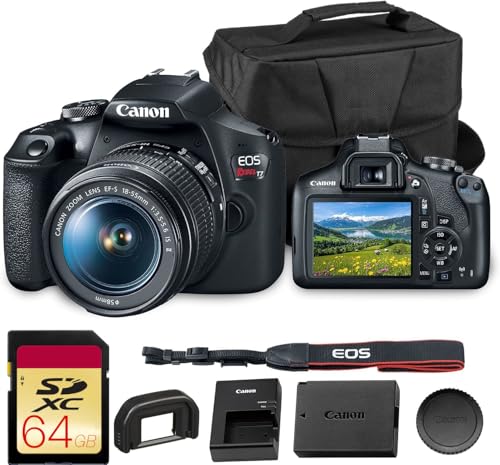
- Includes battery, charger, bag, strap, and 64GB card
Cons
- No second lens
- Full HD capability rather than 4K
- DSLR autofocus is basic
Best for: beginners who want the core camera gear and useful starter accessories together.
The Canon EOS Rebel T7 Bundle is aimed at the person who wants to open one package and start shooting. The camera is paired with an 18-55mm lens, LP-E10 battery, charger, eyecup, body cap, neck strap, shoulder bag, and 64GB memory card. That makes it more immediately usable than a body-only listing, while keeping the setup less complicated than the larger multi-lens bundles farther down this list.
The camera's 24.1MP APS-C CMOS sensor is the core attraction. The listing describes vibrant color, sharp detail, and useful low-light performance, while the DIGIC 4+ processor supports the T7's familiar operation. Its 3.0-inch LCD and simplified menus are friendly to new owners. The lens is a flexible first choice for daily photographs, portraits, and travel scenes, although it will not provide the distant framing of a 75-300mm lens.
Built-in Wi-Fi and NFC allow wireless transfers to compatible devices, and the Canon Camera Connect app supports remote shooting and live view from a phone. That is a practical feature for group photos or a camera placed on a stable surface. The optical viewfinder keeps the shooting experience traditional, which some learners will prefer to composing every photograph on the rear screen.
This bundle's limitation is the camera platform itself. The autofocus system is not specified in the bundle features, but the T7 family listing identifies a 9-point system and AI Servo AF. Video details are also not given in this particular bundle record, so buyers should not assume it has the R100's 4K modes. The Canon EOS Rebel T7 18-55mm is the cleaner choice when the camera specification matters more than the extra items in the box.
The bundle makes sense for someone beginning with no memory card or carrying case. It provides the essential working pieces without forcing a new photographer to decide among multiple lenses on the first day. It is less suitable for wildlife, sports, or creators who want advanced autofocus and 4K capture.
5. Toberto 8K Touchscreen Camera: Best Compact Creator Kit

Pros
- Front and rear lenses
- 3.2-inch touchscreen
- Wi-Fi and HDMI output
- Hot shoe for an external microphone or light
- Two batteries and 64GB card included
Cons
- Listed 88MP and 8K claims are not directly comparable to Canon sensor specifications
- Minimum focusing distance is 10 cm
- Built-in lens cannot be changed
Best for: casual creators who prioritize simple vlogging and phone-friendly sharing.
The Toberto 8K Touchscreen Camera is not trying to imitate the handling of a Canon DSLR. Its appeal is convenience. Front and rear lenses support selfies, group shots, and vlogging, while the 3.2-inch touchscreen makes framing and menu control feel closer to using a phone. The compact body is listed at 5 by 2.8 by 3.4 inches, so it is easier to slip into a travel bag than a camera with two interchangeable lenses.
The listing claims an 88MP sensor, 8K video, autofocus, a 16x zoom, and anti-shake. Those headline numbers should not be read as a direct image-quality comparison with the Canon cameras' 24.1MP APS-C sensors. The data does not identify the sensor format or explain whether the zoom is optical or digital. It does specify a minimum focusing distance of 10 cm and says a macro lens is not included, so close-up subjects need more space than a dedicated macro setup.
Connectivity is a real strength. Wi-Fi supports transfers to a smartphone, and HDMI output lets you show clips on a compatible television or monitor. The camera can also function as a webcam for livestreams, video chats, online classes, and meetings. A hot shoe provides a mounting point for an external microphone or fill light, which gives a new creator a simple route to improve production quality without moving to a full camera rig.
The package includes two rechargeable batteries, a 64GB card, USB and HDMI cables, a charger, lens hood, lens cap, camera bag, strap, and cleaning cloth. That is a practical collection for travel and casual content. The fixed dual-lens design is also the main restriction. Unlike the Canon EOS R100 Mirrorless, it cannot accept a brighter portrait lens or a longer telephoto lens as your interests develop.
Choose the Toberto when touch control, front-facing shooting, and easy transfers matter more than lens flexibility and established sensor performance. For deliberate still photography, the Canon cameras are stronger tools. For a teenager, traveler, or first-time vlogger who wants a compact standalone device, this camera has a clearer purpose.
6. Tecglem 8K Dual-Lens Camera: Best for Simple Controls

Pros
- Front and rear dual-lens design
- 3.2-inch touchscreen
- Wi-Fi transfer through the iSmart DV2 app
- 6-axis stabilization
- Two batteries and charging stand
Cons
- 16x zoom is digital
- Listed 88MP and 8K claims lack sensor-format context
- Fixed-lens design limits future expansion
Best for: everyday snapshots and beginner video where quick operation matters most.
The Tecglem 8K Dual-Lens Camera is built around immediacy. A 360-degree mode dial provides quick access to time-lapse, filters, portrait, scene, slow motion, landscape, auto, and program modes. The front and rear lenses cover ordinary forward-facing shooting and selfie-style content, while the touchscreen reduces the amount of time spent navigating physical buttons.
Its feature list claims an 88MP sensor, 8K video, quick autofocus, and 16x digital zoom. The word digital is important here. Digital zoom enlarges the captured image rather than giving the camera the optical reach of the Canon 75-300mm lens, so distant subjects should not be expected to have the same rendering or detail. The listing also says the camera has 6-axis stabilization, which can help reduce shake during handheld shooting, but it does not turn the fixed lens into a telephoto system.
The camera includes a built-in flash, continuous shooting, slow motion, and a 32GB SD card. Two batteries are supplied, and a charging stand is included. Wi-Fi works through the iSmart DV2 app for transfers and sharing. That combination is convenient for travel diaries, family events, and short clips destined for a phone. It is less useful for someone who wants to make careful exposure decisions or build a collection of interchangeable lenses.
The Canon alternatives have a different kind of strength. The Canon EOS Rebel T7 18-55mm offers an APS-C sensor, optical viewfinder, and EF and EF-S lens compatibility. The Toberto 8K Touchscreen Camera has a larger listed 64GB card and HDMI output, while the Tecglem adds the more explicit 6-axis stabilization and mode dial. Neither compact camera offers the same upgrade path as a Canon DSLR or mirrorless body.
The Tecglem should be skipped by photographers who want the most predictable image-quality specification or who plan to photograph wildlife at long range. It is a sensible fit for someone who wants a light, self-contained camera with lots of automatic modes, dual-lens flexibility, and a simple sharing workflow.
7. Canon EOS Rebel T7 Renewed: Best Renewed DSLR

Pros
- 24.1MP APS-C CMOS sensor
- ISO 100 to 6400, expandable to 12800
- Optical viewfinder
- Wi-Fi and NFC
- Simple Scene Intelligent Auto mode
Cons
- Renewed condition requires closer inspection
- 9-point autofocus is limited
- No listed 4K video
Best for: learners who want the T7 platform in a renewed single-lens kit.
The Canon EOS Rebel T7 Renewed has the same basic photographic proposition as the new single-lens T7, but its condition changes the buying decision. It includes the 18-55mm lens and retains the straightforward controls, optical viewfinder, and beginner-oriented Scene Intelligent Auto mode that make the T7 easy to understand. For someone learning composition, it provides a genuine DSLR experience rather than a phone-like compact interface.
The 24.1MP CMOS sensor is supported by an ISO range of 100 to 6400, with expansion to 12800. That range is useful for moving from bright outdoor scenes into ordinary indoor lighting, though a kit lens and a basic sensor do not remove the need for good light. The camera also has a 3.0-inch LCD, which is helpful when reviewing focus and exposure after a shot.
Focus uses 9 points and AI Servo AF. That arrangement is fine for a person standing still, a posed portrait, or a subject moving in a predictable direction. It is not the right tool for demanding action. The Canon EOS R100 Mirrorless covers up to 143 autofocus zones and adds face, eye, animal, and vehicle detection, making it much more comfortable for unpredictable movement.
Wireless sharing through Wi-Fi and NFC remains useful, especially for a learner who wants to move images to a phone without a separate reader. The camera's listed dimensions are 5.1 by 4 by 3.1 inches, with a listed weight of 2.5 pounds. That is manageable, but the DSLR body and optical viewfinder make it less compact than the R100 or either fixed-lens 8K camera.
The renewed condition is the deciding weakness. Buyers should be comfortable checking the physical state of the camera, lens, battery, charger, and viewfinder when it arrives. Someone wanting a predictable new package should choose the Canon EOS Rebel T7 18-55mm instead. Someone who wants the T7 controls and a single everyday lens can choose this version if the condition terms are acceptable.
8. Canon EOS Rebel T7 13-Item Kit: Best Accessory-Heavy Kit

Pros
- Includes 18-55mm, 75-300mm, and 500mm preset lenses
- Canon USA warranty is listed
- 24.1MP APS-C sensor
- Full HD 1080p recording
- Includes bag, flash, filters, tripod, and 64GB card
Cons
- Large accessory collection can overwhelm a beginner
- Preset 500mm lens requires careful expectations
- T7 autofocus remains basic
Best for: a new photographer who specifically wants a broad collection of lenses and accessories.
The Canon EOS Rebel T7 13-Item Kit is less about choosing one camera accessory and more about assembling a small photography setup in one purchase. The main kit includes the T7 body, EF-S 18-55mm lens, EF 75-300mm lens, shoulder bag, battery, charger, strap, and a listed Canon USA one-year warranty. The additional bundle items add a 500mm preset telephoto lens, wide-angle and telephoto attachments, filters, flash, tripod grip, cleaning tools, card reader, and a 64GB memory card.
The camera itself is familiar T7 hardware. Its 24.1MP APS-C sensor, DIGIC 4+ processor, ISO 100 to 6400 range with expansion to 12800, and 9-point autofocus system provide a solid platform for learning. The 3.0-inch LCD is listed at 920, 000 dots, and the optical viewfinder covers approximately 95% of the frame. Full HD 1080p recording and built-in Wi-Fi and NFC cover basic video and sharing.
The 18-55mm lens is the sensible starting point. It is the one to use for landscapes, family photographs, and general practice. The 75-300mm lens gives a genuine longer focal-length option for outdoor subjects, though it adds size and makes camera shake more apparent. The 500mm preset lens is a specialty addition, and beginners should treat it as an experiment rather than assume it will behave like a modern autofocus telephoto.
This is a much more involved package than the Canon EOS Rebel T7 Dual Zoom. The Dual Zoom kit is easier to understand because its two lenses have clear roles. Here, there are enough filters, attachments, and accessories to create confusion before the photographer has learned the basics. The Canon EOS 2000D Three-Lens Kit is also a more focused alternative for someone who wants a wide-angle and telephoto option without this many extras.
The kit makes sense for a person who enjoys learning by trying different tools and wants the listed Canon warranty. It is not our first recommendation for a complete beginner who simply needs a camera and everyday lens. Start with the 18-55mm, add the 75-300mm when distant subjects become important, and leave the specialty accessories until you understand what problem each one solves.
9. Canon EOS 2000D Three-Lens Kit: Best Renewed Multi-Lens Kit

Pros
- 24.1MP APS-C CMOS sensor
- 18-55mm lens plus wide-angle and telephoto accessories
- 128GB memory included
- Built-in Wi-Fi and NFC
- Full HD 1080p recording
Cons
- Renewed camera and accessories need careful checking
- Accessory lenses are not the same as Canon interchangeable lenses
- 9-point AF and 3 fps shooting are modest
Best for: beginners who want to experiment with different views from one renewed package.
The Canon EOS 2000D Three-Lens Kit uses a second name for the same camera family as the Rebel T7. The body offers a 24.1MP APS-C CMOS sensor, DIGIC 4+ processor, 3.0-inch LCD with 920, 000 dots, and an optical viewfinder. The included 18-55mm lens is the dependable part of the kit, while the wide-angle and telephoto additions give a learner a chance to explore perspectives without immediately building a larger native lens collection.
Its core shooting specification is sensible for still photography practice. The ISO range runs from 100 to 6400, expandable to 12800, and the 9-point AF system includes AI Servo AF. Continuous shooting is listed at up to 3 fps. That is enough for ordinary candid moments and posed subjects, but it leaves the camera behind the R100's listed 6.5 fps One-Shot shooting and much newer subject detection.
The camera records Full HD 1080p at 30 fps and includes Wi-Fi with NFC. Scene Intelligent Auto, Basic+ and Creative Auto modes, and an onboard feature guide help a beginner get started. These modes are useful as training wheels, but the camera becomes more rewarding when the owner starts adjusting exposure and focus manually.
The word renewed deserves attention. The condition applies to the camera, and the bundle includes several separate pieces that should be checked for fit and function. The supplied wide-angle and telephoto accessories are not equivalent to the EF 75-300mm lens in the Canon EOS Rebel T7 Dual Zoom. They can change the view, but they should not be mistaken for a complete set of native Canon lenses.
This kit is appealing to a curious learner who wants a broad starter set and a large 128GB memory card. It is less suitable for someone who wants the cleanest, simplest setup or the most responsive autofocus. If the extras are the attraction, this is a more coherent choice than the accessory-heavy 13-item bundle, but the standard T7 remains easier to recommend as a first camera.
10. Canon EOS Rebel T7 Triple-Lens Kit: Best Long-Reach Bundle

Pros
- Includes 18-55mm, 75-300mm, and 500mm preset lenses
- 24.1MP APS-C CMOS sensor
- Full HD 1080p video
- Wi-Fi and NFC
- Includes camera case, flash, tripod, and 32GB card
Cons
- Renewed camera condition adds uncertainty
- 500mm preset lens is a specialized manual-style option
- Basic 9-point autofocus and 3 fps shooting
Best for: hobbyists who want a T7 body with several ways to approach distant subjects.
The Canon EOS Rebel T7 Triple-Lens Kit is the most reach-focused package in this roundup. It combines the 18-55mm IS II lens for general work, the EF 75-300mm III for longer subjects, and a 500mm preset lens. A case, flash, filters, monopod, flexible tripod, card reader, and 32GB card round out the package. It is aimed at a photographer who already knows that distant subjects will be part of the hobby.
The T7 body provides the same 24.1MP APS-C CMOS sensor found in the other Rebel T7 kits. It also has a DIGIC 4+ processor, 3.0-inch LCD with 920, 000 dots, Full HD 1080/30p video, ISO 100 to 6400 with expansion to 12800, and up to 3 fps shooting. Built-in Wi-Fi and NFC help with transfers, but this remains a traditional DSLR rather than a current high-speed mirrorless camera.
The 18-55mm lens should be the everyday default. It offers the broadest useful range for ordinary scenes, and its image stabilization is specifically identified in the listing. The 75-300mm lens is the more practical long lens for many owners, but long focal lengths expose poor technique quickly. A tripod, monopod, or faster shutter speed becomes more important as the subject gets farther away.
The 500mm preset lens is the unusual part of the kit. It provides an ambitious focal length for distant subjects, but the listing does not describe autofocus for it. Buyers should approach it as a specialty lens that may require patience and careful support. The Canon EOS Rebel T7 13-Item Kit offers a similar 500mm preset lens and a larger accessory collection, while the Canon EOS R100 Mirrorless is a better foundation for modern subject detection and video.
The renewed condition is another reason to be deliberate. Inspect the body, lenses, mount, battery, and accessories when the kit arrives. This bundle is not the right answer for someone who simply wants an uncomplicated first camera. It is for the hobbyist who enjoys having options and is willing to learn the technique that long lenses demand.
How to choose best photography cameras
The right camera depends less on the largest number in a title and more on the sensor, lens system, autofocus, and controls you will use repeatedly.
Sensor format
The Canon models here use 24.1MP APS-C CMOS sensors. APS-C gives a larger imaging area than the small sensors typically found in simple point-and-shoot cameras, which helps with detail, low-light work, and background separation. The Tecglem and Toberto listings claim 88MP, but they do not identify the sensor format, so that number cannot be compared directly with Canon's APS-C specification.
Lens system
An interchangeable-lens camera lets you change how the camera sees. An 18-55mm lens is the most useful starting point for everyday subjects, while a 75-300mm lens is better suited to distant subjects. Fixed dual-lens cameras are simpler and often easier for selfies or vlogging, but they cannot grow with your photography in the same way.
Autofocus
Autofocus matters most when the subject moves. The Rebel T7 family uses 9 points with AI Servo AF, which is workable for deliberate shooting. The EOS R100 is more capable on paper, with up to 143 Dual Pixel CMOS AF zones and human face, eye, animal, and vehicle detection. For children, pets, sports, or video, the R100 has the more useful system.
A camera with fewer headline features but a lens you carry everywhere will make more photographs than a bundle that stays at home.
Viewfinder and screen
The T7 DSLRs use an optical viewfinder with approximately 95% coverage and a 3.0-inch LCD on the listed models. An optical viewfinder gives a direct view through the lens and works well in bright outdoor conditions. The compact cameras use touchscreens, including a 3.2-inch screen on the Toberto and Tecglem listings, which can make tapping to frame and shoot more intuitive.
Video modes
The EOS R100 has the broadest listed video options, with 4K at up to 24 fps, Full HD at 60 fps, and HD at 120 fps. The T7 cameras support Full HD, with several listings specifying 1080p or 1080/30p. The Tecglem and Toberto claim 8K, but the sensor and recording details are less developed, so creators should consider the whole workflow rather than one resolution number.
Bundled accessories
A second lens can be useful. A large pile of filters, adapters, flashes, tripods, and cleaning tools can also create clutter. Decide whether you need real focal-length options, such as the 75-300mm lens in the Canon dual-zoom kits, or simply want a card, bag, and charger to get started. Native Canon lenses are a more meaningful expansion path than generic attachments.
For a broader look at choosing between compact and interchangeable-lens designs, the differences between everyday digital camera types can help narrow the field. Travelers may also want to think about the camera size and lens range that travel shooting demands before choosing a large bundle.

Frequently asked questions
Is the Canon EOS R100 better for beginners than the Rebel T7?
For most new photographers, yes. The R100 has newer autofocus with face, eye, animal, and vehicle detection, plus 4K video and faster listed continuous shooting with One-Shot AF. The Rebel T7 is still easier to recommend for someone who specifically wants an optical viewfinder and traditional DSLR controls.
Is 24.1MP enough for photography?
Yes. A 24.1MP sensor can provide detailed photographs for everyday sharing, prints, portraits, landscapes, and learning manual photography. Lens quality, focus accuracy, light, and technique often matter more than moving to a larger megapixel number.
Which camera here is best for wildlife?
The Canon Rebel T7 kits with the EF 75-300mm lens provide the most practical included reach. The 500mm preset lenses offer more reach on paper, but they are specialty options and the listings do not establish the same autofocus capability. For moving wildlife, the EOS R100's subject detection is a strong advantage, although the lens kit shown here is shorter.
Do the 8K cameras have interchangeable lenses?
No interchangeable lens system is specified for the Tecglem or Toberto cameras. Both use built-in dual-lens designs. That makes them convenient for casual shooting and vlogging, but Canon's EOS R100 and Rebel T7 bodies offer a much clearer route to adding lenses later.
Are renewed cameras safe to buy?
A renewed camera can be a practical way to get a known model, but the condition of the body, lens, battery, and accessories matters. Check the listing's condition terms and inspect the equipment when it arrives. Buyers who want a simpler new purchase should consider the new Rebel T7 or EOS R100 listings instead.
Can these cameras transfer photos to a phone?
The Canon T7 models list built-in Wi-Fi and NFC, and the EOS R100 lists Wi-Fi and Bluetooth. The Tecglem uses Wi-Fi through the iSmart DV2 app, while the Toberto lists Wi-Fi transfer. The exact setup differs, so a phone transfer workflow should be part of the decision if immediate sharing is important.
The bottom line
The Best best photography cameras choice for most beginners is the Canon EOS R100 Mirrorless. Its 24.1MP APS-C sensor, face and eye detection, compact body, interchangeable RF-S lens system, and 4K video make it the most capable long-term starting point in this group. The Canon EOS Rebel T7 18-55mm is the better fit for someone who values an optical viewfinder and wants to learn with classic DSLR controls.
Choose the Canon EOS Rebel T7 Dual Zoom when distant subjects matter more than compact handling. Choose the Toberto or Tecglem when simple touch controls, dual-lens shooting, and casual video are the priority. The renewed and accessory-heavy T7 kits make sense for specific buyers, but their extra equipment should not distract from the limitations of the older autofocus system.
If you are undecided, choose the EOS R100 for modern autofocus and video, or the standard Rebel T7 when a traditional DSLR experience matters more.
As an Amazon Associate we earn from qualifying purchases.