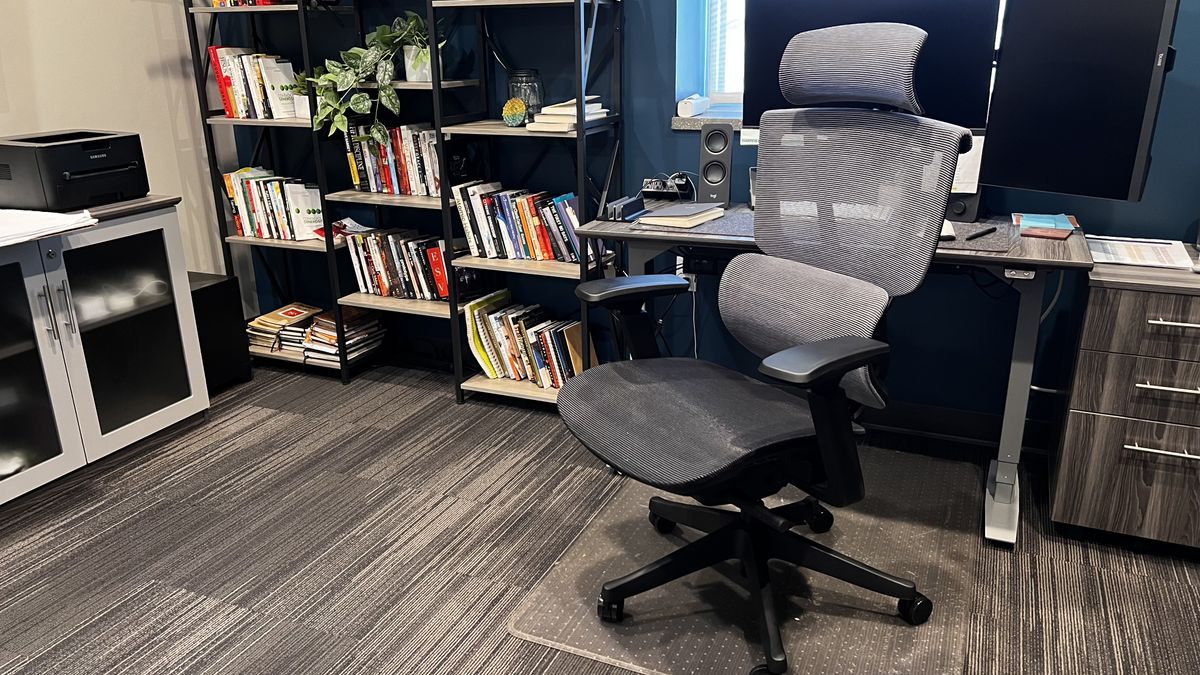

A chair can look supportive for five minutes and still leave your lower back, shoulders, and neck aching before lunch. The useful test is not how many adjustment labels appear in the listing. It is whether the lumbar support meets your back, the seat fits your legs, and the armrests let your shoulders relax.
Our guide to the Best ergonomic office chairs focuses on those practical differences. The group includes breathable mesh chairs, wide-seat models, a footrest-equipped chair, a padded leather-style option, and compact designs for home offices.
Marsail Ergonomic Chair is our top pick for its unusually useful lumbar adjustment, comfortable foam seat, breathable back, and flexible armrests. The other nine cover heavier-duty seating, reclining, neck support, quiet casters, and softer cushioning.
Comparison table
| # | Product | Award | Lumbar support | Recline | Best for |
|---|---|---|---|---|---|
| 1 | Marsail Ergonomic Chair | Best overall | Forward/back and up/down | 90° to 120° | Most home office users |
| 2 | ELABEST X100 | Best with footrest | 3D, spring-loaded, 3-way adjustment | 3-stage | Work and relaxation in one chair |
| 3 | CAPOT Ergonomic Chair | Best heavy-duty design | 2 inches over 8 levels | 90°, 110°, 125° | Larger users and long desk sessions |
| 4 | GABRYLLY Ergonomic Chair | Best wide mesh seat | Proper lumbar support | 90° to 120° | Tall users who want a roomy seat |
| 5 | MOLENTS Ergonomic Chair | Best adjustable armrests | Forward/back and up/down | 90° to 120° | Flexible arm positioning |
| 6 | Fizzin Mesh Chair | Best capacity on a lighter frame | Forward/back and up/down | Up to 125° | A broad range of users |
| 7 | TRALT Office Chair | Best foam seat | Adjustable depth | Not specified | Supportive padded seating |
| 8 | CASASIO Virgin Foam Chair | Best rocking comfort | 2D adjustment | Tilt and rock | Reading and relaxed work |
| 9 | CLOUVOU CleverSeat | Best quiet casters | Targeted lumbar support | 3-position | Quiet workspaces |
| 10 | YFO Leather Chair | Best padded executive style | Built-up back support | Reclining function | Traditional office decor |
1. Marsail Ergonomic Chair: Best Overall

Pros
- Lumbar support moves forward, backward, up, and down
- Breathable mesh back and thick foam seat
- 3D armrests can swivel, slide, and flip up
- Reclines from 90° to 120°
- Supports up to 330 pounds
Cons
- Headrest adjustment is limited to 2D movement
- The chair is fairly wide for a small desk
- The seat is foam rather than full mesh
Best for: home office users who want meaningful adjustment without an overly complicated chair.
The Marsail is the chair we would put in the most ordinary home office. It does not lean too hard into gaming styling or executive bulk. Instead, it combines a cool mesh back with a 3.14-inch-thick high-density foam seat, so the back stays ventilated while the sitting surface feels more forgiving than a taut mesh seat.
Its lumbar support is the standout feature. It moves 1.18 inches forward and backward and 2.16 inches up and down, which gives you a better chance of positioning the support at the curve of your lower back rather than accepting a fixed pad in the wrong place. That matters more than a long adjustment list. A chair can have many controls and still fail if its main support lands too high or too far away.
The armrests are similarly practical. They move forward and backward, swivel left and right, and flip up when you want to slide the chair under the desk. The backrest reclines from 90° to 120°, enough to shift from upright typing to a more relaxed posture. The chair supports up to 330 pounds and has a wider seat, though its listed dimensions of 24.8 inches wide and 24.4 inches high mean it needs some room around the desk.
Compared with the TRALT Office Chair, the Marsail offers more explicit upper-body adjustment and a headrest. The CAPOT Ergonomic Chair has a higher stated capacity and more defined recline positions, while the Marsail feels like the easier fit for a typical desk setup. Its weakness is that the 2D headrest is less versatile than the 3D designs on several rivals, and the foam seat may feel warmer than a fully mesh cushion.
Choose the Marsail if you want a chair that gets the fundamentals right without requiring you to tune every part of your body separately. It is the safest starting point in this group for a full workday at a home desk.
2. ELABEST X100: Best With Footrest

Pros
- Includes an 18-inch extendable footrest
- 5D flip-up armrests offer extensive positioning
- Spring-loaded 3D lumbar system tracks movement
- Extra-wide 3D headrest
- Seat height adjusts from 18.3 to 23 inches
Cons
- 43-pound construction is harder to move
- Many controls may take time to set up properly
- The footrest adds bulk beneath the seat
Best for: people who want one chair for focused desk work, reclining, and occasional leg support.
The ELABEST X100 is less a basic desk chair than a small workstation lounger. Its defining feature is the 18-inch extendable footrest, which turns the chair into a place to read, watch something, or take a break without moving elsewhere. That can be useful in a compact room where the office chair also serves as a relaxation seat.
The support system is unusually elaborate. The 3D lumbar mechanism adjusts depth by up to 1.6 inches, height by up to 2 inches, and rotation by 15 degrees. Spring loading is intended to let the support follow your movement rather than pressing against one fixed point. The 5D armrests adjust in height, width, forward and backward position, rotation, and flip-up direction. That is more control than the Marsail provides, but it also means correct setup matters.
The headrest has a 3D design, and the chair pairs its three-stage recline with the footrest. The seat height runs from 18.3 to 23 inches, giving shorter and taller users more room to find a position where their feet rest properly. Its BIFMA-certified structure is listed for up to 300 pounds, and the chair weighs 43 pounds. The Dual-Stripe AirMesh back is designed for airflow and elasticity, which helps offset the extra padding and hardware.
The X100 beats the GABRYLLY Ergonomic Chair for reclining versatility and lower-leg support, while CLOUVOU CleverSeat is a simpler choice if quiet movement matters more than a footrest. The ELABEST is not the obvious pick for a narrow desk. Its hardware, extended footrest, and wide headrest need clearance, and the large number of adjustments can feel excessive if you only want to sit upright and type.
For users who regularly alternate between work and downtime, that complexity is the point. The X100 is the most convincing all-in-one chair here, provided you have the space to let it recline.
3. CAPOT Ergonomic Chair: Best Heavy-Duty Design

Pros
- Supports up to 400 pounds
- Lumbar support adjusts over 8 levels
- Three locked recline positions
- Large mesh seat stays cool
- Flip-up arms and PU wheels
Cons
- Intended fit is narrower than the capacity suggests
- Headrest movement is less extensive than the X100's
- Assembly is listed at about 30 minutes
Best for: larger users who need a sturdy chair with a broad seat and clearly defined recline stops.
The CAPOT is built around stability and a generous sitting area. Its seat is 20 inches wide and 19.3 inches deep, with a listed height range of 18.5 to 22.05 inches. That gives the chair a substantial footprint, but it also gives your thighs and hips more room than a narrow task chair.
Its lumbar support has 8 levels across 2 inches of adjustment. The important distinction is that this is not just a height slider. The support can be positioned with small increments, making it easier to find a point that supports the lower back without forcing the pelvis forward. The mesh seat and back are intended to keep airflow moving during long sessions, and the chair's stainless steel base supports up to 400 pounds.
The backrest locks at 90, 110, or 125 degrees. Those stops are useful if you prefer repeatable positions instead of free movement. The 4D flip-up arms, adjustable headrest, and quiet PU wheels round out the office-focused design. CAPOT lists the chair for users between 5 feet 5 inches and 6 feet 2 inches, so the capacity does not automatically make it a fit for every larger or taller body.
Compared with the Fizzin Mesh Chair, the CAPOT has a more structured lumbar system and three specific backrest locks, but it is heavier and less minimalist. The ELABEST X100 offers more armrest movement and adds a footrest. CAPOT's real advantage is that it concentrates on load support and lumbar positioning rather than adding a relaxation feature.
This is a strong choice for someone who wants a broad, cool seat and a firm sense of support. Skip it if you need a very compact chair or fall well outside its stated height range.
4. GABRYLLY Ergonomic Chair: Best Wide Mesh Seat

Pros
- Wide 20-inch seat
- Mesh seat and back promote airflow
- Headrest and seat height are adjustable
- Arms flip up for storage
- PU wheels are designed for quiet rolling
Cons
- Recommended height range is 5 feet 5 inches to 6 feet 2 inches
- Capacity is listed at 300 pounds
- Lumbar adjustment is less detailed than on the top picks
Best for: tall or broad users who want a spacious mesh chair for a standard workday.
The GABRYLLY stands out because it gives the seat as much attention as the backrest. The cushion measures 20 inches wide and 19.3 inches deep, with a seat height from 18.5 to 22.05 inches. That is a useful shape for people who feel boxed in by narrow task chairs, while the mesh construction keeps the chair from feeling overly padded.
The backrest reclines from 90° to 120°, so it can remain upright for keyboard work or lean back for a change of posture. The chair has a headrest, flip-up arms, and a wide back that provides four stated support areas for the head, back, hips, and hands. Its overall footprint is 25.6 inches wide by 22 inches deep, and the full height reaches from 45.3 to 54.9 inches.
The mesh seat is the key difference from the Marsail. Some users will prefer its cooler feel, especially in a warm room, while others may prefer the Marsail's thick foam cushion. The GABRYLLY supports up to 300 pounds and is recommended for users from 5 feet 5 inches to 6 feet 2 inches. That makes it a clear fit guide rather than a universal chair.
The CAPOT Ergonomic Chair is the better pick for a higher stated capacity and finer lumbar adjustment. MOLENTS Ergonomic Chair offers more explicit armrest movement. GABRYLLY answers a simpler question: do you want a wide seat and breathable contact surfaces without a large collection of complicated controls?
Its main weakness is that the lumbar support is described broadly rather than with a precise travel range. Still, for a taller user who values room and airflow, it is one of the more comfortable-looking layouts in the group.
5. MOLENTS Ergonomic Chair: Best Adjustable Armrests

Pros
- Lumbar support moves up, down, forward, and backward
- 3D armrests slide and rotate
- Wide 19.8-inch seat
- Three recline positions from 90° to 120°
- Breathable, high-elasticity mesh
Cons
- Overall width is 28 inches
- The armrest panels can move when a fixed surface is preferred
- Seat height starts at 19.5 inches
Best for: users who are particular about where their arms rest while typing.
The MOLENTS is a broad, full-mesh office chair that makes arm positioning its main selling point. Its 3D armrests can slide forward and backward and rotate left and right, giving you a way to bring support closer during keyboard work or move it aside when you change position.
The lumbar support follows the same two-direction approach, moving up and down as well as forward and backward. That is useful when a fixed lumbar pad hits the wrong part of your back. The seat is 19.8 inches wide and 18.9 inches deep, with a floor-to-seat range of 19.5 to 23.3 inches. Taller users should check that starting height before ordering.
The backrest has three reclining positions between 90° and 120°. That provides an upright setting and two more relaxed angles without turning the chair into a dedicated lounge seat. Its breathable, high-elasticity mesh should suit warm rooms, though the 28-inch overall width is a concern for smaller desks and tight passages.
The Marsail Ergonomic Chair is more compact and uses a foam seat, while MOLENTS is the better match for someone who wants mesh under both the back and seat. The GABRYLLY Ergonomic Chair has a similarly roomy approach but fewer stated armrest directions. MOLENTS is more adjustable, though that flexibility can be annoying if you prefer an armrest that stays completely still.
MOLENTS is a good fit for a multi-user home office or anyone who changes between keyboard, controller, and reading positions. Measure the desk area first, and do not choose it if a low seat or rigid arm support is essential.
6. Fizzin Mesh Chair: Best Capacity on a Lighter Frame

Pros
- Supports up to 400 pounds
- Headrest moves up 3.9 inches and changes angle
- Lumbar support moves up, down, forward, and backward
- Reclines to 125°
- Listed assembly time is about 15 minutes
Cons
- Medium size may not suit every larger user
- Warranty is listed at 1 year
- The product information does not specify seat dimensions
Best for: users seeking a high capacity with a lighter chair and straightforward setup.
Fizzin takes a practical approach to the high-capacity chair. It supports up to 400 pounds, yet the listed chair weight is about 25.35 pounds. That makes it easier to move than the 38-pound CAPOT or 43-pound ELABEST, though a lighter frame does not tell us how firm or substantial the chair will feel in every situation.
The adjustment range is useful. The headrest moves up 3.9 inches and changes angle, while the lumbar support moves up and down by 3.15 inches and forward and backward by 1 inch. Those figures give the chair more opportunity to line up with different users. Fizzin lists an intended height range of approximately 5 feet 4 inches to 6 feet 3 inches.
The backrest tilts to 125 degrees, and the armrests adjust to 90 degrees and can be reversed. The mesh back promotes airflow, while silent casters are designed for carpet and hard floors. A 360-degree swivel makes the chair suitable for switching between a desk, a side table, and a nearby shelf without standing each time.
The CAPOT Ergonomic Chair is the more substantial choice if you want a wide, explicitly measured seat and stainless steel base. Marsail Ergonomic Chair has a thicker foam seat and more detailed armrest movement. Fizzin's advantage is its combination of broad capacity, headrest travel, and relatively light construction.
The compromise is missing seat measurements in the supplied product information. That makes fit harder to judge before purchase, especially for someone who needs a specific seat depth. Choose it when weight capacity and a wide height range matter more than a precisely documented cushion.
7. TRALT Office Chair: Best Foam Seat

Pros
- High-resilience molded foam seat
- Adjustable lumbar depth
- 19.7-inch-wide seat
- Breathable mesh back
- Silent casters and reinforced base
Cons
- Headrest is not listed among the features
- Recline range is not specified
- Armrest adjustment details are limited
Best for: users who prefer a supportive foam cushion over a mesh seat.
The TRALT makes a persuasive case for keeping the seat simple. Its high-resilience molded foam is designed to rebound rather than flatten, which should appeal to people who dislike the firm, suspended feel of mesh seats. The 19.7-inch width gives the cushion room without making the chair look like a large executive recliner.
The seat depth is 17.3 inches, and the listed height range is 17.7 to 21.7 inches. Those numbers suggest a chair that can suit users from approximately 5 feet 4 inches to 6 feet 2 inches, provided the depth leaves the right space behind the knees. That fit relationship matters more than a thick cushion alone. A soft seat that is too deep can still create pressure in the wrong place.
The lumbar support adjusts in depth, letting you match it to the curve of your back. Behind it is a high-tension mesh backrest that promotes airflow and avoids peeling upholstery. TRALT lists a 330-pound capacity, a reinforced nylon base with a metal core, and silent 360-degree casters for hardwood, tile, or carpet.
Compared with the Marsail Ergonomic Chair, TRALT offers the more clearly emphasized seat construction, while Marsail provides a headrest and more adjustable armrests. The CASASIO Virgin Foam Chair is better for rocking and relaxation. TRALT is the more focused work chair, but its weakness is the lack of detailed recline and headrest information in the supplied features.
Choose TRALT if your main complaint about office chairs is a seat that sags, hardens, or bottoms out. Skip it if you need extensive neck support or a heavily adjustable recline mechanism.
8. CASASIO Virgin Foam Chair: Best Rocking Comfort

Pros
- Virgin foam seat is designed for long sitting
- 3D headrest adjusts in three directions
- Lumbar support moves in two directions
- Tilt and rocking function
- Flip-up arms suit small workspaces
Cons
- Supports up to 300 pounds
- Compact 20-inch width may feel narrow
- White and gold finish may not suit every office
Best for: people who want an office chair that can rock and relax between work sessions.
The CASASIO is the most relaxation-oriented chair in this list. Its virgin foam seat is intended to retain softness and resilience through long sitting, while the tilt and rocking function lets you shift away from a fixed upright posture. That makes it a natural choice for a desk that also serves as a reading or leisure space.
Its 3D headrest adjusts in height, depth, and angle. That is the kind of movement a headrest needs to support the neck rather than simply touch the back of the head. The 2D lumbar support moves in two directions, although the supplied features do not give a numerical travel range. The contoured mesh back adds airflow behind the padded seat.
Flip-up arms allow the chair to tuck away or give you more freedom when you recline. The chair has a reinforced metal base and premium casters, with a listed capacity of up to 300 pounds. Its dimensions are 20 inches wide, 20 inches deep, and 50 inches high. That narrow footprint can help in a compact room, but it may feel restrictive to users who want a broad cushion.
The TRALT Office Chair has a stronger case for a dedicated foam work seat, while CASASIO adds movement and a more flexible headrest. The ELABEST X100 is the better reclining choice if you want a footrest and more armrest positions. CASASIO's weakness is that its decorative finish and relatively narrow footprint will not suit every desk or body type.
Pick it when gentle rocking is part of how you want to use the chair. If you sit upright all day and want firm, highly measured lumbar adjustment, Marsail or CAPOT is a better direction.
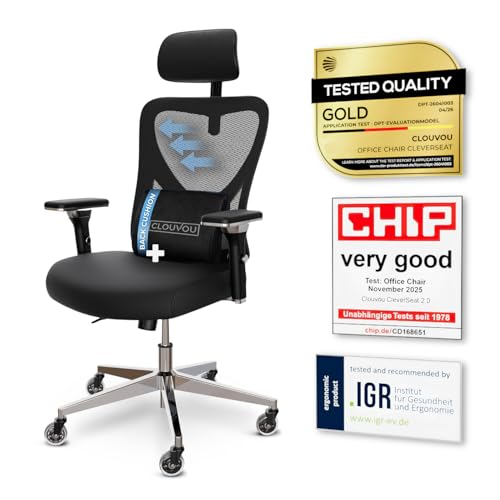
9. CLOUVOU CleverSeat: Best Quiet Casters
Pros
- Ultra-quiet blade wheels
- 4D armrests
- Targeted lumbar support and back cushion
- Three-position backrest tilt
- Designed for users up to 6.5 feet
Cons
- Seat measurements are not specified
- The chair weighs 40 pounds
- Recline angles are not provided
Best for: quiet offices where rolling noise is a genuine distraction.
The CleverSeat's reason to exist is quiet movement. Its blade wheels are designed for silent rolling, which could matter in a shared room, a bedroom office, or a space where every floor noise carries. The chair also uses a breathable design, so it does not rely entirely on thick upholstery to create comfort.
The support package includes targeted lumbar support, a back cushion, an integrated headrest, and 4D armrests. CLOUVOU describes the chair as supporting users up to 6.5 feet, which gives taller users a reason to look beyond the more tightly specified height ranges of the GABRYLLY and CAPOT. Its three-position backrest tilt offers basic posture changes without requiring a complicated mechanism.
The chair measures about 27.56 inches wide, 20.47 inches deep, and 47.24 inches high, and weighs 40 pounds. The overall dimensions indicate a broad base, but the supplied information does not specify seat width, depth, or height. That makes it difficult to assess leg fit from measurements alone.
The MOLENTS Ergonomic Chair provides more explicit seat measurements and lumbar movement, while the CLOUVOU CleverSeat has the stronger case for a quiet floor transition. Marsail Ergonomic Chair is the easier general recommendation because its seat and lumbar dimensions are clearer. CLOUVOU's weakness is a lack of detailed fit information, not a lack of features.
Choose it for a quiet study or shared workspace, especially if you value smooth rolling and tall-user support. Look elsewhere if seat geometry is your first concern.
10. YFO Leather Chair: Best Padded Executive Style

Pros
- Padded back and spring-supported seat
- 22-inch seat width
- Rubber casters suit several floor types
- Armrests can be installed or omitted
- Adjustable height and reclining function
Cons
- Mid-back design lacks a listed headrest
- Lumbar adjustment details are limited
- Product information lists unusual overall dimensions
Best for: users who prefer a traditional padded executive appearance over mesh.
The YFO is the outlier here. Instead of a ventilated mesh back, it uses a brown leather-style padded design with extra sponge in the back. The seat combines a wooden board, soft sponge, and spring packs, creating a more conventional cushioned feel than the Marsail, Fizzin, or GABRYLLY.
The 22-inch seat width is generous, and the seat height and reclining function can be adjusted. YFO also lists 8.3-inch armrests and gives users the option to install the armrests or leave them off. Removing them could help someone who sits cross-legged or needs to pull close to a narrow desk, although it also removes a useful point of upper-body support.
Rubber casters are intended for wood floors, carpet, and marble, with quieter rolling and less floor marking. The supplied product information identifies the chair as mid-back, so it does not provide the head and neck support found on the ELABEST X100, CAPOT, or CASASIO. Its dimensions also need careful checking before purchase because the listed measurements are not presented in the same way as the other chairs.
The TRALT Office Chair is the better padded option for someone who specifically wants a breathable mesh back and detailed seat geometry. YFO instead suits a room where visual style and a soft, conventional cushion matter more. Its main weakness is ergonomic detail: the lumbar support is described as built up and supportive, but the available information does not provide its adjustment range.
Choose YFO for a traditional executive look, a wide seat, and the flexibility to use the chair with or without arms. It is not the right pick if neck support, mesh airflow, or precise lumbar tuning is non-negotiable.
How to choose best ergonomic office chairs
The right chair should fit your body first, then give you enough adjustment to maintain a relaxed working posture as the day changes.
Lumbar adjustment
Lumbar support should meet the inward curve of your lower back without pushing you toward the front edge of the seat. Height adjustment is useful because a support that sits near the pelvis on one person can land in the mid-back on another. Forward and backward adjustment lets you control how strongly it contacts your back.
Marsail, MOLENTS, and Fizzin provide movement in more than one direction. CAPOT goes further with 8 levels over 2 inches. A chair with only vaguely described lumbar support may still be comfortable, but it gives you less information about whether the shape will fit.
The most useful lumbar control is the one that lets the support meet your spine, not the one with the longest marketing description.
Seat dimensions and material
Seat width and depth determine whether your hips feel cramped and whether the edge presses behind your knees. A good depth leaves a small gap between the front of the seat and your knees while allowing your back to contact the lumbar support. CAPOT, GABRYLLY, TRALT, and MOLENTS provide useful seat measurements. Fizzin and CLOUVOU provide less seat-specific detail.
Mesh seats promote airflow and can feel cooler, while foam seats offer a more cushioned, stable surface. Marsail uses a 3.14-inch foam cushion, TRALT emphasizes molded foam, and CASASIO uses virgin foam. The choice is partly about heat and partly about whether you prefer a suspended or padded feel.
Seat height and user fit
Your feet should rest flat while your knees remain comfortably positioned. Compare the chair's lowest and highest seat settings with your desk and your own leg length. Marsail, ELABEST, CAPOT, GABRYLLY, MOLENTS, and TRALT all provide useful height figures.
Do not treat a stated capacity as a complete fit guide. CAPOT supports up to 400 pounds but lists a recommended height range of 5 feet 5 inches to 6 feet 2 inches. Fizzin supports up to 400 pounds and lists a broader approximate height range. Body proportions still matter more than a single capacity figure.
Armrest movement
Armrests should support your forearms without forcing your shoulders upward. Height is the basic adjustment. Forward and backward movement is useful when switching between a keyboard and a controller, while rotation can accommodate different wrist angles. Flip-up arms help chairs tuck beneath a desk.
ELABEST has the most extensive stated armrest adjustment, with 5D movement. MOLENTS provides 3D movement, and Marsail offers forward, backward, swivel, and flip-up functions. GABRYLLY, Fizzin, and CASASIO focus more on flip-up flexibility.
Recline and head support
A recline function lets you change posture, but the useful range depends on how securely the chair supports you at each angle. CAPOT's 90°, 110°, and 125° locks are easy to understand. Marsail, GABRYLLY, and MOLENTS cover 90° to 120°, while Fizzin reaches 125°.
Headrests are most useful when they adjust for height and angle. CASASIO's 3D headrest, Fizzin's 3.9 inches of height movement, and ELABEST's 3D headrest offer more control than a fixed pad. The YFO is a mid-back chair without a listed headrest, so it is better suited to users who do not need neck support.
When planning the room around a chair, also consider how much desk depth a comfortable setup needs. A wide chair or a model with a footrest can require more clearance than its seat dimensions suggest.
Frequently asked questions
What makes an office chair ergonomic?
An ergonomic chair lets you adjust the parts that affect posture, including seat height, lumbar support, armrests, and backrest angle. It should also fit your seat width and depth so you can sit back without pressure behind your knees. No adjustment system can compensate for a chair that is the wrong size.
Is mesh or foam better for long work sessions?
Mesh usually allows more airflow and can feel cooler in a warm room. Foam provides a more cushioned, stable sitting surface and may appeal to people who dislike the firm feel of a mesh seat. Marsail and TRALT are useful examples of foam-seat designs, while GABRYLLY and Fizzin use mesh seating.
Do I need a headrest for desk work?
Not necessarily. A headrest is most useful when you recline, read, or want support during breaks. For upright keyboard work, correct seat height, lumbar placement, and armrest height usually matter more.
What chair is suitable for a heavier user?
Check both the stated weight capacity and the recommended height range. CAPOT and Fizzin list capacities up to 400 pounds, while Marsail and TRALT list 330 pounds. Capacity alone does not reveal whether the seat depth, back height, or cushion shape will fit.
Are flip-up armrests useful?
They are useful when you want to tuck the chair under the desk or move your arms freely. They also help in smaller rooms where every inch of clearance matters. If you want constant forearm support, make sure the armrests also have enough height and horizontal adjustment.
How much recline do I need?
A range that keeps you upright near 90 degrees and lets you lean back around 120 degrees covers most desk tasks and short breaks. A deeper angle can be useful for reading or relaxing, especially when paired with a footrest. ELABEST is the clearest choice for that use because it includes an 18-inch extendable footrest.
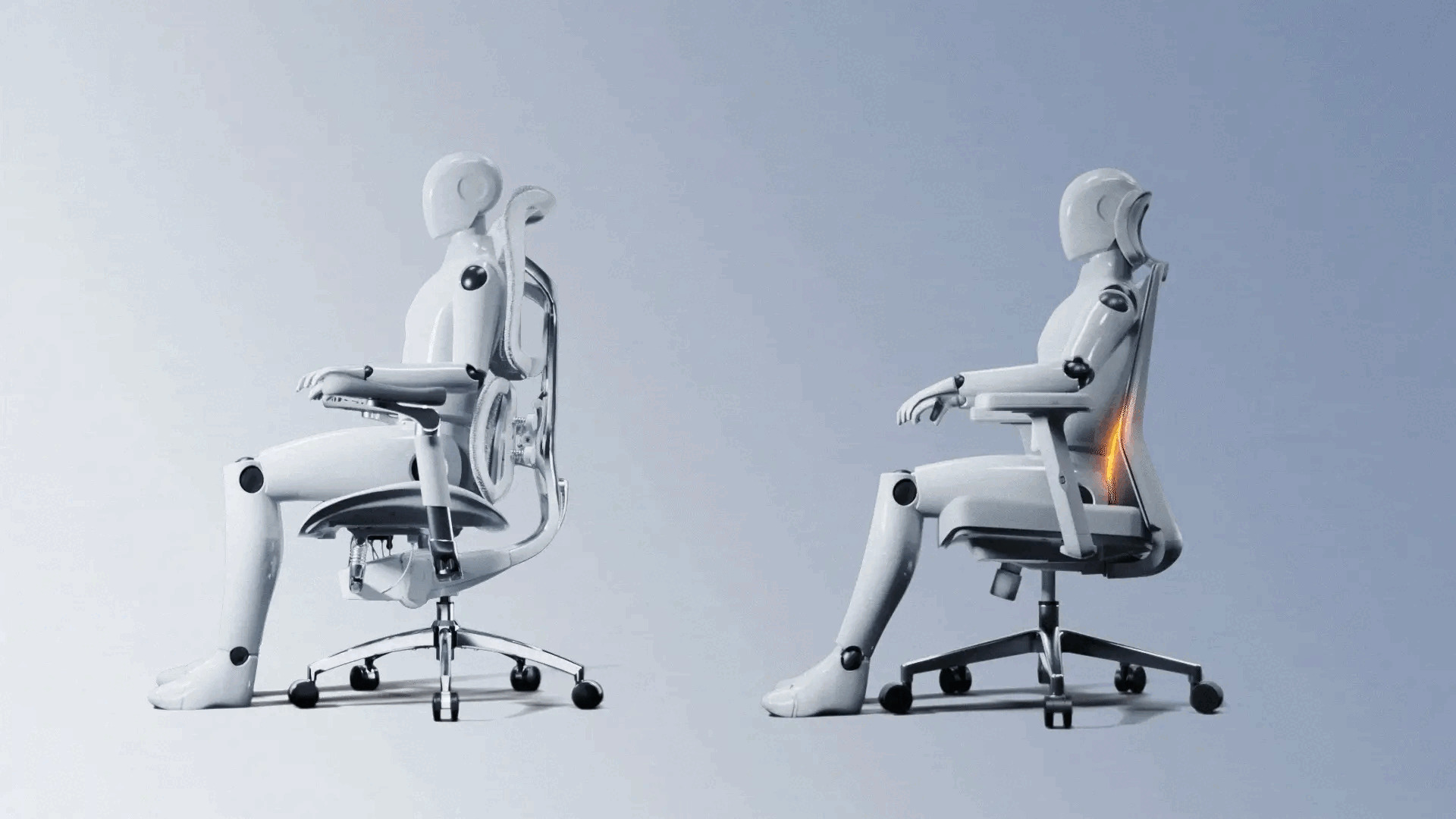
The bottom line
The Best ergonomic office chairs in this group are led by the Marsail Ergonomic Chair, which combines adjustable lumbar support, a thick foam seat, breathable mesh, and flexible armrests without making the chair feel specialized. It is the model we would choose for most home offices.
Choose the ELABEST X100 if a footrest, extensive armrest control, and a more relaxed multi-use setup matter most. CAPOT Ergonomic Chair is the better direction for a higher stated capacity and a wide seat with clearly defined recline positions.
If you are undecided, choose Marsail unless you specifically need a footrest, a 400-pound capacity, or a traditional padded executive design.
As an Amazon Associate we earn from qualifying purchases.