

A hotel room can leave you juggling a laptop, phone, tablet, streaming stick, and work gear across one unreliable Wi-Fi login. A travel router fixes that by creating one private network, so you authenticate once and keep your devices together.
The Best travel router picks range from simple AC750 boxes to Wi-Fi 7 models with multi-gigabit Ethernet, VPN support, touchscreens, and even cellular service. We put the most capable models first, then include smaller and simpler options for travelers who do not need advanced networking.
Our top pick is the GL.iNet Slate 7, with the GL.iNet Beryl AX, TP-Link Roam 6 AX1500, and GL.iNet MUDI 7 covering different travel styles.
Best travel router comparison
| # | Product | Award | Wi-Fi | Wired connectivity | Best for |
|---|---|---|---|---|---|
| 1 | GL.iNet Slate 7 | Best overall | Wi-Fi 7, 688 + 2882 Mbps | Dual 2.5G WAN and LAN, USB 3.0 | Travelers who want maximum control |
| 2 | GL.iNet Beryl AX | Best balance | Wi-Fi 6, 574 + 2402 Mbps | 2.5G WAN, 1G LAN, USB 3.0 | Most travelers |
| 3 | GL.iNet Slate AX | Best VPN performance | Wi-Fi 6, 600 + 1200 Mbps | USB file sharing | VPN and private storage |
| 4 | GL.iNet Opal | Best compact wired option | AC1200, 300 + 867 Mbps | Two 1G LAN, one 1G WAN | Basic hotel networking |
| 5 | TP-Link Roam 6 AX1500 | Best for simple setup | Wi-Fi 6, 300 + 1201 Mbps | 1G WAN/LAN, 1G LAN | App-based setup |
| 6 | TP-Link Roam 7 BE3600 | Best TP-Link Wi-Fi 7 option | Wi-Fi 7, 688 + 2882 Mbps | 2.5G WAN, 1G LAN | Wi-Fi 7 and easy hotel sharing |
| 7 | GL.iNet Beryl 7 | Best high-speed VPN router | Wi-Fi 7, 688 + 2882 Mbps | Dual 2.5G, USB 3.0 | Fast encrypted connections |
| 8 | TP-Link Roam 6 TL-WR1502X | Best lightweight option | Wi-Fi 6, 300 + 1201 Mbps | 1G wired connectivity | Travelers carrying little gear |
| 9 | TP-Link TL-WR902AC | Best nano router | AC750 dual-band | USB 2.0, Ethernet | Occasional hotel use |
| 10 | GL.iNet MUDI 7 | Best cellular travel router | Tri-band Wi-Fi 7 | 2.5G Ethernet, 10G USB-C | Travelers who need mobile internet |
1. GL.iNet Slate 7: Best Overall

Pros
- Touchscreen controls for everyday network tasks
- Wi-Fi 7 with dual 2.5G Ethernet
- WireGuard and OpenVPN support
- VPN client and server can run together
- WPA3 and encrypted DNS support
Cons
- More router than casual travelers need
- VPN speeds depend on protocol and network conditions
- The touchscreen toggle must be configured before use
Best for: travelers who want a powerful, configurable router without opening an admin panel for every task.
The GL.iNet Slate 7 feels like the most complete travel networking kit here. Its standout feature is the color touchscreen, which can scan Wi-Fi QR codes, show network status, display speed information, and toggle selected features. That matters in a hotel because you can handle common jobs from the device itself instead of reaching for a phone or computer.
Its Wi-Fi 7 radio is rated at 688 Mbps on 2.4 GHz and 2882 Mbps on 5 GHz. The dual 2.5G Ethernet ports are more unusual on a travel router, giving you one WAN and one LAN port for fast wired connections. A USB 3.0 port adds another practical connection, while OpenWrt 23.05 and 512MB of storage leave room for customization.
VPN support is unusually flexible. OpenVPN and WireGuard are pre-installed, and the router can operate as a VPN client and server at the same time. The listed local-network limits are 100 Mbps for OpenVPN and 540 Mbps for WireGuard, so WireGuard is the better fit when speed matters. WPA3, DNS over HTTPS, DNS over TLS, and IPv6 round out the privacy features.
The weakness is its complexity. The touchscreen makes routine use easier, but advanced features still require configuration, and the programmable button does nothing until assigned. The GL.iNet Beryl AX is smaller and simpler, while the GL.iNet Beryl 7 offers faster VPN figures. Choose the Slate 7 when its screen and dual 2.5G ports matter more than absolute simplicity.
2. GL.iNet Beryl AX: Best Balance

Pros
- Strong Wi-Fi 6 performance
- 2.5G WAN port in a small body
- OpenWrt customization
- VPN client and server support
- Physical shortcut switch
Cons
- Gigabit LAN limits wired output
- OpenWrt setup can take patience
- No built-in touchscreen
Best for: most travelers who want a capable private network with room to grow.
The GL.iNet Beryl AX is the router we would hand to a frequent traveler who wants advanced features without carrying a large device. It measures about 4.7 by 3.2 by 1.3 inches and weighs about 0.43 pounds, so it fits naturally into a laptop pouch. The blue enclosure is compact, but the feature set is closer to a home networking device.
Wi-Fi 6 provides a listed 574 Mbps on 2.4 GHz and 2402 Mbps on 5 GHz. Its 2.5G WAN port can accept a fast wired hotel or home connection, while the 1G LAN port handles a wired device. USB 3.0 is useful for compatible accessories and storage, and the router supports WPA3, encrypted DNS, and IPv6.
The Beryl AX runs OpenWrt 21.02 and supports more than 5, 000 ready-made plug-ins through its admin panel. OpenVPN and WireGuard are already installed, with listed local-network VPN speeds of 150 Mbps and 300 Mbps respectively. It can also run a VPN client and server simultaneously, which is useful for reaching a home network while routing travel traffic through a VPN.
The GL.iNet Slate 7 is faster and easier to operate from its display, while the GL.iNet Slate AX has stronger listed VPN performance. The Beryl AX sits between them nicely. Its real limitation is the 1G LAN port, and its OpenWrt flexibility may be wasted if you only need a one-button hotel connection. For the person who wants one travel router for work trips, international travel, and occasional tinkering, this is the safest pick.
3. GL.iNet Slate AX: Best VPN Performance

Pros
- Strong listed OpenVPN and WireGuard speeds
- Wi-Fi 6 with support for up to 120 devices
- USB storage sharing through Samba and WebDAV
- Repeater mode works with captive portals
- Physical feature switch
Cons
- Larger than the smallest travel routers
- Older OpenWrt 21.02 firmware
- No 2.5G Ethernet port listed
Best for: remote workers who want fast VPN routing and private file access on the road.
The GL.iNet Slate AX is less flashy than the Slate 7, but it has one compelling reason to choose it: its listed VPN performance. OpenVPN reaches up to 500 Mbps and WireGuard up to 550 Mbps in local-network testing. That makes it a strong fit for work traffic, private browsing, and other uses where the router itself needs to handle encryption.
Its dual-band Wi-Fi 6 connection is rated at 600 Mbps on 2.4 GHz and 1200 Mbps on 5 GHz. MU-MIMO, OFDMA, and BSS coloring are designed to help when multiple devices share the network, and the device is listed as supporting up to 120 devices. Those figures do not guarantee hotel Wi-Fi speed, but they leave ample wireless capacity for a small group.
The Slate AX also has a useful file-sharing angle. Connect an external USB hard drive, and its NAS features support Samba and WebDAV for sharing documents across the private network. Repeater mode can turn hotel or public Wi-Fi into a private network, including networks with captive portals. That is more useful than a simple wireless bridge when every travel device needs the same connection.
The Beryl AX is smaller and gives you a 2.5G WAN port, while the Slate 7 adds a touchscreen and newer firmware. The Slate AX remains attractive for VPN-focused users, but it is not the pick for someone chasing Wi-Fi 7 or multi-gigabit wired networking. If your travel bag includes a drive and your work depends on encrypted traffic, its strengths are easy to understand.
4. GL.iNet Opal: Best Compact Wired Option

Pros
- Dual-band AC1200 wireless
- Two gigabit LAN ports and one gigabit WAN
- Retractable antennas
- OpenVPN and WireGuard included
- Lightweight design
Cons
- No easy tethering support
- Older Wi-Fi standard than most picks here
- Antennas need positioning for best coverage
Best for: travelers who connect wired hotel internet to several devices.
The GL.iNet Opal is the straightforward wired travel router in this group. It uses retractable antennas, weighs about 145 grams, and provides a familiar set of ports: two gigabit LAN ports and one gigabit WAN port. That arrangement is handy in a hotel room with wired internet, a streaming box, and another device that still needs Ethernet.
Its AC1200 wireless connection is rated at 300 Mbps on 2.4 GHz and 867 Mbps on 5 GHz. That is enough for ordinary browsing, calls, streaming, and several connected devices, although it has less headroom than the Wi-Fi 6 and Wi-Fi 7 models. Extending the antennas vertically can improve reception, which is useful when the router sits behind a desk or beside a bed.
OpenVPN and WireGuard are pre-installed, and the Opal supports IPv6 and Cloudflare encryption. It can repeat public Wi-Fi and create a private network, but it does not support easytethering. That distinction matters if your normal fallback is sharing a phone connection by USB.
The Opal is a better fit for wired hotel rooms than the tiny TP-Link TL-WR902AC, since it has more Ethernet capacity and newer dual-band hardware. The TP-Link Roam 6 TL-WR1502X is a lighter modern alternative for phone tethering and app control. Pick the Opal when retractable antennas and multiple wired ports are more important than the newest wireless standard.
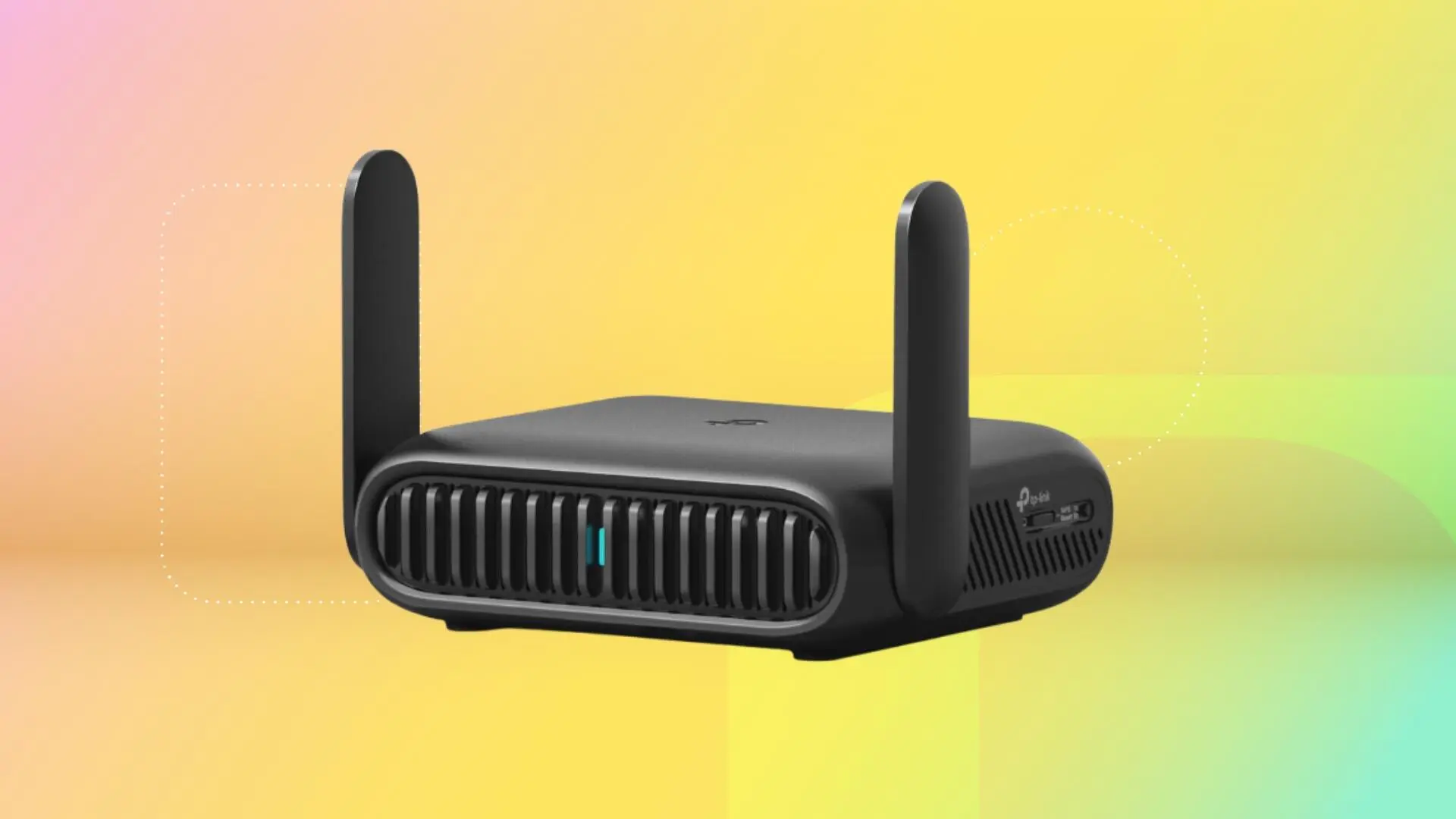
5. TP-Link Roam 6 AX1500: Best for Simple Setup

Pros
- Wi-Fi 6 performance for up to 60 devices
- Tether app and web setup
- One-step captive portal authentication
- USB-C power from a power bank
- OpenVPN and WireGuard support
Cons
- Does not support OpenWrt
- Wired ports are limited to 1G
- Actual performance depends heavily on the source network
Best for: travelers who want a modern router managed from a familiar app.
The TP-Link Roam 6 AX1500 is built around an easier travel routine. Connect it to hotel Wi-Fi, authenticate through the Tether App, and let the router share one private network with your devices. One-step captive portal authentication is the feature that separates it from many generic travel routers, since you do not need to repeat the hotel login on every device.
Wi-Fi 6 is rated at 300 Mbps on 2.4 GHz and 1201 Mbps on 5 GHz. TP-Link lists support for up to 60 devices, enough for a personal kit or a small family group. The router has a 1G WAN/LAN port and a separate 1G LAN port, so wired connectivity is practical but not designed for multi-gigabit service.
Roam 6 supports router, access point, repeater, and client modes. It can use public Wi-Fi, an ISP connection, or USB tethering from a phone. USB-C power works with the included adapter or a 5V/3A PD source such as a power bank. OpenVPN and WireGuard support adds protection for remote work and browsing on shared networks.
The important caveat is that this model does not support OpenWrt. That makes it less appealing than the GL.iNet Beryl AX for people who want plug-ins, custom routing, or deeper control. It is a better choice for travelers who prefer guided setup, firmware updates in the app, and fewer decisions.
6. TP-Link Roam 7 BE3600: Best TP-Link Wi-Fi 7 Option

Pros
- Wi-Fi 7 with 2.5G WAN
- One-step captive portal authentication
- Supports up to 90 devices
- USB-C power and phone tethering
- VPN client and server support
Cons
- No 6 GHz band
- Does not support OpenWrt
- 1G LAN port limits wired devices
Best for: travelers who want Wi-Fi 7 hardware with TP-Link's guided setup.
The TP-Link Roam 7 BE3600 takes the easy setup approach of the Roam 6 and pairs it with faster wireless hardware. Its 5 GHz band is rated at 2882 Mbps and its 2.4 GHz band at 688 Mbps. It also supports up to 90 devices, giving a group more room for laptops, phones, tablets, cameras, and entertainment gear.
Its 2.5G WAN port is the headline wired upgrade, while the LAN port is 1G. The router supports Ethernet, USB phone tethering, public Wi-Fi hotspot mode, and access point, repeater, and client modes. Multi-Link Operation is intended to combine frequency bands for improved throughput and reliability, although this model does not support the 6 GHz band.
The Tether App handles setup and the one-step captive portal process. OpenVPN and WireGuard work as both client and server, and PPTP and L2TP are also supported. USB-C power can come from the supplied adapter or a 5V source such as a power bank.
The GL.iNet Slate 7 gives you a touchscreen and OpenWrt, while the GL.iNet Beryl 7 lists much faster VPN performance. Roam 7 is the better fit for people who want TP-Link's more guided experience. Its lack of 6 GHz and OpenWrt support should rule it out for enthusiasts who want deep customization.
7. GL.iNet Beryl 7: Best High-Speed VPN Router

Pros
- Very high listed VPN throughput
- Dual 2.5G Ethernet ports
- Wi-Fi 7 wireless performance
- OpenWrt customization
- VPN client and server can run together
Cons
- No touchscreen
- OpenWrt 21.02 requires more hands-on setup
- Physical shortcut switch needs configuration
Best for: advanced users who need fast encrypted traffic from a compact router.
The GL.iNet Beryl 7 is the performance specialist. It has the same listed Wi-Fi 7 wireless rates as the Slate 7, 688 Mbps on 2.4 GHz and 2882 Mbps on 5 GHz, plus dual 2.5G Ethernet ports and USB 3.0. It can support up to 120 devices, making it a serious small-network hub rather than just a personal hotspot accessory.
The most striking figures concern VPN routing. GL.iNet lists up to 1100 Mbps for WireGuard and 1000 Mbps for OpenVPN-DCO in local-network testing. Those are unusually high claims for a travel router, and actual results will vary with the source connection, VPN provider, and configuration. Still, the hardware is clearly aimed at users who do not want encryption to become the main bottleneck.
OpenWrt 21.02 provides access to plug-ins and customization, while WPA3, encrypted DNS, IPv6, and VPN cascading cover the security side. VPN cascading lets the router run a client and server at the same time, which can help travelers reach local resources while using a separate encrypted path for internet traffic.
The Slate 7 is friendlier because of its touchscreen, and the TP-Link Roam 7 BE3600 is easier for people who prefer an app-led experience. The Beryl 7 is the one to choose when VPN throughput and dual 2.5G ports matter most. Skip it if you want a device that works without learning an admin panel.
8. TP-Link Roam 6 TL-WR1502X: Best Lightweight Option

Pros
- Compact 0.34-pound design
- Wi-Fi 6 with 1G wired ports
- USB-C power from a PD source
- Router, hotspot, repeater, and client modes
- Phone Wi-Fi tethering support
Cons
- Does not support OpenWrt
- No 2.5G Ethernet
- Requires a separate phone or public network connection
Best for: light packers who want a modern router for hotels, airports, and RV trips.
The TP-Link Roam 6 TL-WR1502X is the lighter version of the Roam concept. It measures 4.09 by 3.54 by 1.10 inches and weighs about 0.34 pounds, which makes it one of the easiest models here to forget inside a travel pouch. Its durable pocket-sized design suits hotel rooms, RVs, and temporary workspaces.
The dual-band Wi-Fi 6 connection is rated at 300 Mbps on 2.4 GHz and 1201 Mbps on 5 GHz. One 1G WAN/LAN port and one 1G LAN port allow a wired source and a wired device, while the router can also use public Wi-Fi or USB phone tethering. It does not create cellular service by itself, so the phone or upstream network remains essential.
Router, hotspot, access point, repeater, and client modes give it useful flexibility. USB-C power works with the included adapter or a 5V/3A PD source, including a power bank. The device does not support OpenWrt, but that is consistent with its simpler, more guided role.
The newer TP-Link Roam 6 AX1500 offers similar wireless capability and app-based management, while the GL.iNet Opal has more emphasis on wired ports and antennas. Choose this Roam 6 when low weight and USB-C power matter more than advanced customization.
9. TP-Link TL-WR902AC: Best Nano Router

Pros
- Very small travel design
- Multiple operating modes
- Dual-band AC750 Wi-Fi
- Micro USB power
- Two-year warranty and 24/7 technical support
Cons
- Older wireless standard
- Only one USB 2.0 port
- No VPN features listed
Best for: occasional travelers who need a small Ethernet-based wireless network.
The TP-Link TL-WR902AC is the smallest, simplest design in this roundup. It measures about 2.64 by 2.91 by 0.87 inches, and its single switch changes among router, hotspot, bridge, range extender, access point, and client modes. That makes it useful in a hotel room when the goal is simply to put several devices on one connection.
AC750 dual-band Wi-Fi provides up to 300 Mbps on 2.4 GHz and 433 Mbps on 5 GHz. It is suitable for ordinary browsing and HD streaming when the upstream connection is good, but it has less capacity than every Wi-Fi 6 and Wi-Fi 7 model here. The router creates a Wi-Fi network from Ethernet, and a micro USB port can draw power from an adapter, portable charger, or laptop.
The design remains appealing for a spare router or occasional trip. A single USB 2.0 port adds limited peripheral flexibility, and the included support coverage is reassuring for a basic device. There are no VPN features listed, so users handling work traffic on public Wi-Fi should look to another model or use protection on each device.
The GL.iNet Opal is the stronger wired travel router, and the TP-Link Roam 6 TL-WR1502X is the better modern choice for phone tethering. Choose the TL-WR902AC when physical size and a simple mode switch matter more than wireless speed or integrated VPN support.
10. GL.iNet MUDI 7: Best Cellular Travel Router

Pros
- Built-in eSIM and dual nano-SIM slots
- 5G support with listed downloads up to 4.67 Gbps
- Tri-band Wi-Fi 7
- 13.5-hour listed battery life
- 2.5G Ethernet and 10G USB-C
Cons
- Much larger than a basic travel router
- Cellular plans are separate
- Maximum device count is lower than several Wi-Fi-only picks
Best for: international travelers and mobile teams who need internet independent of hotel Wi-Fi.
The GL.iNet MUDI 7 is not merely a hotel Wi-Fi repeater. It is a portable 5G gateway with a built-in eSIM, two nano-SIM slots, and dual standby support. That makes it the most independent option here for international travel, especially when hotel Wi-Fi is unreliable or a group needs its own connection.
Its tri-band Wi-Fi 7 system is rated at 688 Mbps on 2.4 GHz, 2882 Mbps on 5 GHz, and 5765 Mbps on 6 GHz. It supports up to 64 connected devices. The router also includes a 2.5G Ethernet WAN/LAN port and a 10G USB-C port for tethering, OTG storage, and external NAS synchronization.
The 2.8-inch touchscreen handles SIM switching, VPN controls, QR-code Wi-Fi sharing, and data monitoring. GL.iNet lists up to 13.5 hours from the built-in 5380mAh battery, with 30W PD/PPS charging that can refill it in roughly 1.3 hours. Quad-path multi-WAN failover can combine Ethernet, Wi-Fi repeater, USB tethering, and 5G, then move traffic to another link when one fails.
Its weakness is that the cellular capability adds size, complexity, and the need for a compatible data plan. The GL.iNet Slate 7 is a better fit if hotel Wi-Fi is your normal source, while the MUDI 7 is the obvious choice when cellular independence matters. For creators, mobile teams, and travelers crossing regions, its SIM flexibility is the reason to carry it.
How to choose the best travel router
The right travel router depends less on the label on the box than on the connection you expect to use, the devices you need to share, and how much control you want over security.
Wireless standard and capacity
Wi-Fi 6 is enough for most hotel rooms, apartments, and small groups. Wi-Fi 7 adds more capacity and newer wireless features, but its advantage is easiest to see when your connected devices also support it and the upstream connection is fast. Look at the separate 2.4 GHz and 5 GHz figures rather than treating the combined number as a guaranteed internet speed.
WAN and LAN ports
A gigabit WAN port is suitable for most wired hotel connections. A 2.5G WAN is more useful with fast home, office, or venue networking, while a second LAN port lets you connect a wired computer, television, or console. The Slate 7 and Beryl 7 stand out because both Ethernet ports are 2.5G.
A travel router should solve the login problem first, then add speed and features without creating a setup problem of its own.
VPN support
OpenVPN and WireGuard are the main features to look for if the router will handle work traffic or public Wi-Fi. WireGuard is generally the better choice when the router lists much higher throughput. Some models support both VPN client and server operation, which is useful for reaching a home network while traveling.
Tethering and captive portals
A router that can repeat public Wi-Fi is useful, but hotel login pages can still cause friction. One-step captive portal authentication, as found on the TP-Link Roam models, is designed to reduce repeated logins. Phone tethering is another important fallback, although not every model supports it.
Size, power, and cellular service
USB-C power lets you use a power bank and avoid carrying a dedicated adapter. A small router is easier to pack, but models with screens, antennas, batteries, and cellular radios are naturally larger. If you need internet away from hotels and airports, a router such as the MUDI 7 with eSIM and physical SIM support is a different class of device.
For a broader look at devices that create a private connection away from home, the practical differences between portable travel connections are useful to understand before choosing a router.

Frequently asked questions
What does a travel router do?
A travel router connects to hotel Ethernet, public Wi-Fi, or sometimes a phone, then creates one private network for your devices. You can connect phones, laptops, tablets, and streaming devices without signing each one into the upstream network separately.
Can a travel router work with hotel Wi-Fi?
Yes. Models with repeater or hotspot mode can connect to a hotel's wireless network and share it privately. Captive portal support is important because many hotels require a browser login before granting internet access.
Do travel routers need a SIM card?
No. Most travel routers use hotel Wi-Fi or Ethernet as their internet source. Cellular models such as the MUDI 7 can use an eSIM or nano-SIM, but they require a compatible cellular data plan.
Is Wi-Fi 7 necessary for a travel router?
Not for most people. Wi-Fi 6 already provides enough wireless capacity for ordinary travel devices, while Wi-Fi 7 is more useful when you have compatible equipment, a fast source connection, or a larger group sharing the router.
Can a travel router use a VPN?
Many models support VPN clients, and some can also operate as VPN servers. The Slate 7, Beryl AX, Slate AX, and Beryl 7 include OpenVPN and WireGuard support. The TP-Link TL-WR902AC does not list integrated VPN support.
Can a travel router be powered by a power bank?
Models with USB-C or micro USB power can generally use a compatible power bank. Check the required power specification, since the Roam 6 models list a 5V/3A PD source while the TL-WR902AC uses micro USB.
Can I connect wired devices to a travel router?
Yes, if the router has LAN ports. The Opal has two gigabit LAN ports, while the Slate 7 and Beryl 7 have 2.5G WAN and LAN ports. Smaller models may offer only one usable wired connection.

The bottom line
The GL.iNet Slate 7 is the Best travel router for readers who want a high-end, configurable device with a touchscreen, Wi-Fi 7, dual 2.5G Ethernet, and strong privacy controls. The GL.iNet Beryl AX is the more sensible choice for most travelers because it is compact, powerful, and easier to justify when you do not need a screen.
Choose the TP-Link Roam 6 AX1500 if app-guided setup and captive portal handling matter more than OpenWrt. Choose the GL.iNet MUDI 7 when cellular independence, battery life, and SIM flexibility are more important than carrying the smallest possible router.
If you are undecided, get the Beryl AX for hotel and work travel, or the MUDI 7 if your trips regularly take you beyond dependable Wi-Fi.
As an Amazon Associate we earn from qualifying purchases.