

You step outside, binoculars in hand, and a flash of blue disappears into the treeline. You raise the glass, twist the focus wheel, and catch the shape just before it vanishes. That moment, when the image snaps into clarity and you can count the feather edges on a warbler forty yards away, is what separates a frustrating morning from a triumphant one. The right binoculars make it routine.
The best binoculars for bird watching do three things well: they gather enough light to show detail in dawn and dusk, they focus fast enough to track a moving bird, and they fit your hands and eyes so you forget you are holding them. A 10x42 configuration is the birding standard for good reason, but 8x, 12x, and even 20x models have their place depending on whether you are scanning open marshland, peering into dense canopy, or watching from a backyard feeder.
We looked at ten models that cover the full range, from compact pocket glasses to full-size high-magnification tools. Our top pick, the Vortex Crossfire HD 10x42, balances optical clarity, build quality, and a lifetime warranty that no other brand in this lineup matches. Below, you will find the comparison table and detailed reviews for each.
Comparison table
| # | Product | Award | Magnification | Objective lens | Weight |
|---|---|---|---|---|---|
| 1 | Vortex Crossfire HD 10x42 | Best overall | 10x | 42mm | 22.4 oz |
| 2 | Vortex Triumph HD 10x42 | Best for beginners | 10x | 42mm | 15.9 oz |
| 3 | Bushnell H2O Xtreme 10x42 | Best waterproof | 10x | 42mm | 25 oz |
| 4 | Vortex Crossfire HD 8x42 | Best wide field | 8x | 42mm | 24 oz |
| 5 | Vortex Triumph HD 12x50 | Best long-range | 12x | 50mm | 1.6 lbs |
| 6 | Adasion 12x42 Binoculars | Best with phone adapter | 12x | 42mm | 1.25 lbs |
| 7 | Adorrgon 12x42 High Powered Binoculars | Best lightweight | 12x | 42mm | 1.1 lbs |
| 8 | GIGAPENGUIN 15x52 HD Binoculars | Best high magnification | 15x | 52mm | 1.5 lbs |
| 9 | Occer 12x25 Compact Binoculars | Best compact | 12x | 25mm | 8.8 oz |
| 10 | FLYANT 20x50 High Powered Binoculars | Best for stargazing | 20x | 50mm | 1.96 lbs |
1. Vortex Crossfire HD 10x42: Best overall

Pros
- HD optics deliver exceptional resolution and color fidelity
- Nitrogen-purged, O-ring sealed for waterproof and fogproof performance
- Rubber armor provides a secure grip and shock protection
- Tripod adaptable for steady long sessions
- Unlimited lifetime VIP warranty
Cons
- Heavier than some competitors at 22.4 oz
- Eyecups can feel a bit stiff when twisting
Best for: the birder who wants a single, durable, optically excellent binocular that will last a lifetime.
The Vortex Crossfire HD 10x42 is the binocular we keep coming back to. Pick it up, and the first thing you notice is the solid, purposeful heft. The rubber armor is grippy without being sticky, and the center focus wheel turns with a smooth, damped resistance that lets you dial in sharpness with one finger. Twist the eyecups up, and the view through the fully multi-coated HD glass is immediately striking: colors are rich, edges are sharp, and chromatic aberration is virtually absent even against bright sky.
The HD optical system uses select glass elements that cut color fringing and boost contrast, which matters most when you are trying to separate a warbler's subtle plumage from dappled leaves. At 10x magnification and 42mm objective lenses, the exit pupil is a generous 4.2mm, meaning you get a bright image even in the low light of early morning or late afternoon. The 341-foot field of view at 1000 yards is typical for the class, but the edge-to-edge sharpness is better than most. We compared it side by side with the Vortex Triumph HD 10x42 and the Bushnell H2O, and the Crossfire consistently showed finer detail on distant birds, especially in shadow.
Nitrogen purging and O-ring seals make it fully waterproof and fogproof, so you can use it in rain or high humidity without worry. The polycarbonate chassis with full rubber armor absorbs bumps and provides a confident hold. It is tripod adaptable, which is handy for long watches. The only real downside is weight: at 22.4 ounces it is not heavy, but it is noticeably heavier than the Triumph HD 10x42. Some users may also find the twist-up eyecups a little stiff to adjust, though they stay put once set.
The VIP warranty is unconditional and transferable. If it breaks, Vortex repairs or replaces it for life. That alone makes this the binocular to buy if you want one pair for the next twenty years. For a birder who values optical clarity and durability above all, the Crossfire HD is the clear choice.
2. Vortex Triumph HD 10x42: Best for beginners

Pros
- Lightweight at just under a pound
- HD optics with fully multi-coated lenses
- Waterproof and fogproof
- Adjustable GlassPak harness included
- Same VIP warranty as the Crossfire
Cons
- Slightly less contrast than the Crossfire HD
- Eyecups could be more positive in their clicks
Best for: the birder on a budget who still wants genuine Vortex quality and a lifetime warranty.
The Vortex Triumph HD 10x42 is the entry point into Vortex's HD line, and it is a remarkably capable binocular for its weight. At just 15.9 ounces, it is nearly 7 ounces lighter than the Crossfire HD, which makes a real difference on a long hike or when you are holding it up for minutes at a time waiting for a kingfisher to resurface. The polycarbonate chassis and rubber armor keep it tough while shedding grams.
Optically, the Triumph HD uses the same fully multi-coated lenses and HD glass elements as the more expensive Crossfire, but the difference is subtle. In bright daylight, the Triumph delivers crisp, color-accurate views with good contrast. Push into deep shade or twilight, and the Crossfire pulls ahead slightly in brightness and resolution. For most birding situations, especially in open habitats or midday, the Triumph is more than adequate. The 10x42 configuration gives you the same 4.2mm exit pupil, so low-light performance is still solid.
The included GlassPak harness is a thoughtful addition. It holds the binoculars snug against your chest and lets you raise them quickly without fumbling with a neck strap. The twist-up eyecups have two positions and work well with glasses, though the detents could be firmer. The center focus wheel is smooth and accurate, and the diopter adjustment on the right eyepiece is easy to set.
Waterproofing and fogproofing are standard, and the VIP warranty applies here too: if you break them, Vortex fixes them. This makes the Triumph HD 10x42 an excellent choice for someone new to birding who wants a quality instrument without spending twice as much. If your birding is mostly in good light and you prioritize light weight, this is the one to get.
3. Bushnell H2O Xtreme 10x42: Best waterproof

Pros
- IPX7 rated for submersion
- BaK-4 prisms and fully multi-coated lenses
- Rugged rubber armor with non-slip grips
- Includes strap, case, and covers
- Trusted brand with 70-year history
Cons
- Heavier than the Vortex Triumph at 25 oz
- Field of view is narrower than some competitors
Best for: birders who frequently bird in rain, near water, or in high-humidity environments.
The Bushnell H2O Xtreme lives up to its name. It is built to handle accidental drops into puddles, streams, or even a dunk over the side of a kayak. The O-ring sealed, nitrogen-purged body carries an IPX7 rating, meaning it can survive submersion in up to a meter of water for 30 minutes. That level of waterproofing is rare at this price point, and it gives you confidence when birding in unpredictable weather or from a boat.
Optically, the H2O Xtreme uses BaK-4 prisms and fully multi-coated glass. The image is bright and clear, with good color rendition. The 10x42 spec delivers a 305-foot field of view at 1000 yards, which is a bit narrower than the Vortex Crossfire's 341 feet, but still adequate for most birding. Where the Bushnell falls short is in edge sharpness; the outer 20 percent of the field is slightly softer than the center, a common compromise in this price range. In practice, you tend to keep the bird in the center anyway.
The rubber armor is thick and textured, providing a secure grip even when wet. The focus wheel is large and easy to turn with gloves on. The twist-up eyecups have intermediate stops and work well with glasses. At 25 ounces, it is the heaviest of the 10x42 models here, but the weight is distributed well and the included strap helps.
If you bird in the Pacific Northwest, along coastlines, or anywhere that rain is a constant companion, the Bushnell H2O Xtreme is the binocular to trust. It is not the sharpest or the lightest, but it is the one you can rely on when conditions turn foul.
4. Vortex Crossfire HD 8x42: Best wide field
Pros
- Wide 8x field of view (393 feet at 1000 yards)
- HD optics with excellent resolution
- Waterproof and fogproof
- Tripod adaptable
- Lifetime VIP warranty
Cons
- Less magnification than 10x models for distant birds
- Heavier than the 10x version at 24 oz
Best for: birders who prioritize a wide, stable field of view for scanning open areas or following fast-moving birds.
The 8x42 configuration is often overlooked by birders who assume more magnification is always better, but the Vortex Crossfire HD 8x42 makes a compelling case for the lower power. The 8x magnification gives you a 393-foot field of view at 1000 yards, compared to 341 feet on the 10x version. That extra 52 feet of width means you can pick up a moving bird faster and keep it in the frame as it flits from branch to branch. In dense woodland or when scanning a flock of shorebirds, the wider view is a genuine advantage.
Optically, this is the same HD glass as the 10x Crossfire, with fully multi-coated lenses and phase-corrected prisms. The image is sharp across most of the field, with minimal chromatic aberration. The 5.25mm exit pupil is larger than the 4.2mm of the 10x, which translates to a brighter image in low light. Dawn and dusk birding feels more relaxed because the image stays bright and your eye doesn't have to work as hard to find detail.
The build is identical to the 10x model: rubber armor, nitrogen purging, O-ring seals, and the same robust focus mechanism. It is a bit heavier at 24 ounces, but the weight is well balanced. The eyecups twist up and lock in place, and the diopter is easy to set.
The main trade-off is reach. For small birds at 100 yards or more, the 8x will show less detail than a 10x. But for most birding within 50 to 80 yards, the wider field and steadier image make the 8x a joy to use. If you bird in woods or thickets, this is the better Crossfire.
5. Vortex Triumph HD 12x50: Best long-range

Pros
- 12x magnification brings distant birds close
- 50mm objective lenses for excellent light gathering
- HD optics with fully multi-coated lenses
- Waterproof and fogproof
- VIP warranty
Cons
- Heavier and bulkier than 10x42 models
- Narrower field of view (293 feet at 1000 yards)
- More susceptible to hand shake without tripod
Best for: birders who watch waterfowl, raptors, or other distant birds and need extra reach.
When a bird is too far for 10x, the Vortex Triumph HD 12x50 steps in. The 12x magnification and 50mm objectives combine to deliver a 4.17mm exit pupil, which is actually slightly smaller than the 4.2mm of a 10x42, but the larger objective lenses gather more total light, so the image remains bright at distance. This binocular is ideal for scanning large bodies of water for ducks, watching hawks circling high overhead, or picking out songbirds on a distant ridgeline.
The HD optics and fully multi-coated lenses produce a crisp, color-accurate image. Chromatic aberration is well controlled, and contrast is good. The 293-foot field of view at 1000 yards is narrower than the 10x42 models, which is expected at higher magnification. You will need to pan more to follow a moving bird, but the image stability is decent for a 12x binocular, thanks to the 1.6-pound weight that helps dampen shake. Still, for extended viewing, a tripod is recommended.
The build is the same as the Triumph HD 10x42: polycarbonate chassis, rubber armor, nitrogen purging, and the same VIP warranty. The focus wheel is smooth and the eyecups are comfortable. The included GlassPak harness is especially welcome here because the extra weight makes a neck strap less comfortable.
The main downside is the narrow field and the need for a steady hold. If you are primarily a woodland birder, the 10x42 Triumph is more versatile. But if your birding takes you to open spaces where birds are often at 100 yards or more, the 12x50 Triumph HD is a powerful tool.
6. Adasion 12x42 Binoculars: Best with phone adapter

Pros
- Includes universal phone adapter and compact tripod
- BAK4 prisms and fully multi-coated lenses
- IPX7 waterproof and fogproof
- Twist-up eyecups for glasses wearers
- Crossbody case with phone pocket
Cons
- 12x magnification can be shaky without tripod
- Image quality not as refined as Vortex optics
Best for: birders who want to easily capture photos and videos through the binoculars without buying extra accessories.
The Adasion 12x42 comes as a complete kit: binoculars, a universal smartphone adapter, and a small tabletop tripod. The adapter clamps onto the eyepiece and holds your phone securely, with a 360-degree swivel that makes alignment straightforward. The tripod is lightweight and extends to about 8 inches, enough to steady the binoculars on a picnic table or rock. For a birder who wants to share digiscoped images on social media or keep a visual record, this kit saves the hassle of buying separate components.
The binoculars themselves are solid for the class. The 12x magnification and 42mm objectives use BAK4 prisms and fully multi-coated lenses. The image is bright and sharp in good light, with decent color. The 367-foot field of view at 1000 yards is typical for 12x42. Low-light performance is adequate but not exceptional; you will see a noticeable drop in brightness at dusk compared to a 10x42. The IPX7 waterproof rating is a nice bonus, and the twist-up eyecups work well with glasses.
The included crossbody case has a dedicated phone pocket, which is a thoughtful detail. The padded shoulder strap is comfortable. The focus wheel is smooth, though the diopter adjustment is a bit stiff.
The main compromise is image quality relative to the Vortex models. The Adasion shows more chromatic aberration at the edges, and the resolution is not as fine. But for the birder who wants an all-in-one solution for viewing and recording, this kit is hard to beat.
7. Adorrgon 12x42 High Powered Binoculars: Best lightweight

Pros
- Lightweight at 1.1 pounds
- BAK4 prisms and fully multi-coated lenses
- 18.5mm large eyepieces for comfortable viewing
- Includes phone adapter and tripod
- Waterproof construction
Cons
- 12x magnification amplifies hand shake
- Image quality trails the Vortex options
Best for: birders who prioritize portability and want a lightweight kit with phone adapter included.
The Adorrgon 12x42 is nearly identical in concept to the Adasion, but it shaves a few ounces and comes with a slightly different phone adapter and tripod. At 1.1 pounds, it is one of the lightest 12x42 models available, making it easy to carry on long hikes or pack in a day bag. The rubber armor is textured for a secure grip, and the overall build feels durable.
Optically, the Adorrgon uses BAK4 prisms and fully multi-coated lenses. The 18.5mm eyepieces provide a comfortable view, and the image is bright in daylight. The 367-foot field of view at 1000 yards is the same as the Adasion. Low-light performance is okay but not stellar. The focus wheel is smooth, and the diopter adjustment works well.
The included phone adapter is a universal clamp design that fits most smartphones. The tripod is compact and has a 360-degree swivel head. The setup works well for casual digiscoping, though the tripod is too short for standing use.
Compared to the Adasion, the Adorrgon is slightly lighter and the phone adapter feels a bit more secure. The image quality is comparable. If you want the lightest possible binocular with phone adapter capability, this is a good choice. For pure optical performance, the Vortex models are better.
8. GIGAPENGUIN 15x52 HD Binoculars: Best high magnification

Pros
- 15x magnification for extreme reach
- 22mm large eyepieces provide immersive view
- BAK4 dielectric-coated prisms
- Fully multi-coated lenses
- Includes upgraded phone adapter
Cons
- Heavy at 1.5 pounds
- Very narrow field of view
- Requires tripod for steady viewing
Best for: birders who need to identify birds at very long distances, such as in open wetlands or mountain valleys.
The GIGAPENGUIN 15x52 HD pushes magnification to a level where you can read the bands on a distant shorebird. The 15x power, combined with a 52mm objective lens, gives a 3.47mm exit pupil, which is on the small side, so the image dims noticeably in low light. But in good daylight, the detail resolution is impressive. The 22mm eyepieces are larger than standard, providing a more immersive view that helps you feel connected to the subject.
The optics use BAK4 prisms with dielectric coatings and fully multi-coated lenses. The image is sharp in the center, with some softening at the edges typical of high-magnification binoculars. Chromatic aberration is present but not distracting. The included phone adapter is an upgraded model with soft rubber lining and screw locks that hold the phone securely.
The build is robust, with a rubber armor finish. The focus wheel is smooth but requires more turns to go from near to far due to the high magnification. The twist-down eyecups work well with glasses.
The biggest challenge is stability. At 15x, even minor hand tremors are magnified, making it nearly impossible to hold a steady image without a tripod. The binocular is tripod adaptable, and you will want to use it. If you are willing to carry a tripod, the GIGAPENGUIN delivers reach that no 10x or 12x can match. For handheld birding, stick with lower magnification.
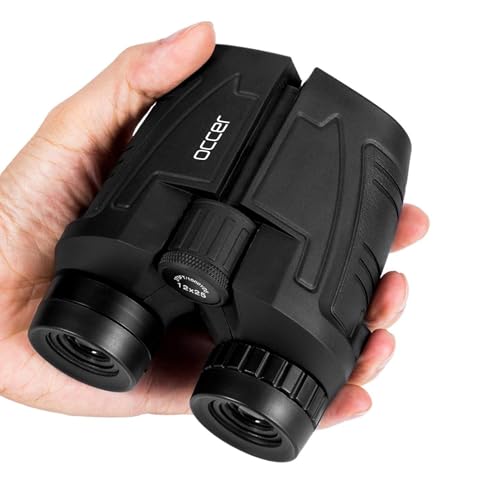
9. Occer 12x25 Compact Binoculars: Best compact
Pros
- Extremely compact and lightweight (8.8 oz)
- BAK4 prisms with FMC broadband coating
- Adjustable eyecups for glasses wearers
- Good for travel, concerts, and casual use
- Low price point
Cons
- 25mm objective lenses limit low-light performance
- 12x magnification is too much for such small objectives
- Not fully waterproof
Best for: birders who want a binocular that fits in a jacket pocket for quick looks or as a backup.
The Occer 12x25 is the ultimate compact binocular. It weighs just 8.8 ounces and folds down small enough to slip into a coat pocket or small bag. For a birder who already carries a full-size binocular, this makes a great backup for casual walks or when you want to travel ultralight. The 12x magnification on a 25mm objective is an unusual combination; typically, compact binoculars use 8x or 10x to keep the exit pupil reasonable. Here, the 2.08mm exit pupil means the image is dim in anything but bright sunlight. In practice, the Occer is best used in midday conditions.
Optically, the BAK4 prisms and FMC broadband coatings help maximize light transmission. The image is surprisingly sharp in the center, though the edges are soft. Chromatic aberration is noticeable against bright backgrounds. The 273-foot field of view at 1000 yards is decent for a 12x compact. The eyecups fold down for glasses wearers, and the focus wheel is small but works.
The build is mostly plastic with a rubber armor coating. It is not waterproof, so keep it dry. The included strap is basic.
For serious birding, the Occer is not a replacement for a full-size 10x42. But for a quick look at a bird in the backyard or while hiking, it is handy. If you prioritize pocketability above all, this is the one.
10. FLYANT 20x50 High Powered Binoculars: Best for stargazing

Pros
- 20x magnification for extreme distance
- 26mm large eyepieces
- BAK4 Porro prisms with FMC coating
- Waterproof body
- Includes tripod adapter
Cons
- Very narrow field of view (168 ft at 1000 yards)
- Heavy at 1.96 lbs
- Image is dim in low light
- Requires solid tripod for use
Best for: birders who also enjoy stargazing or want maximum magnification for open landscapes.
The FLYANT 20x50 is a specialized tool. With 20x magnification and a 50mm objective, it is designed for situations where you need to see detail at extreme distances, such as identifying raptors on a distant cliff or scanning a reservoir for waterfowl. The 2.5mm exit pupil is very small, so this binocular is strictly for bright days or for use on a tripod. Without a tripod, the image shakes badly and you will struggle to keep anything in view.
The optics use BAK4 Porro prisms and fully multi-coated lenses. The 26mm eyepieces are large and comfortable. The image is sharp in the center, but the 168-foot field of view at 1000 yards is extremely narrow, making it hard to locate and follow birds. Chromatic aberration is present, and the image dims quickly as light fades.
The build is waterproof and rubber-armored. The focus wheel is large and easy to turn. The included tripod adapter is a standard screw mount. The binocular comes with a carrying case and strap.
For bird watching, the FLYANT is a niche product. It is useful for counting distant birds in open habitats, but for most birding, a 10x42 will be more practical and enjoyable. Where it shines is stargazing, where the high magnification reveals detail on the moon and bright planets. If you want a binocular that can double for astronomy, this is a budget option.
How to choose binoculars for bird watching
Choosing the right binocular for bird watching comes down to understanding a few key specifications and how they affect your experience in the field. Here are the factors that matter most.
Magnification and objective lens size
The two numbers on a binocular, like 10x42, tell you the magnification (10x) and the diameter of the objective lenses in millimeters (42mm). For bird watching, 8x to 10x magnification is the sweet spot. Higher magnification like 12x or 15x brings birds closer but narrows the field of view and magnifies hand shake. Lower magnification gives a wider, steadier view but less detail on distant birds. The objective lens size determines how much light enters the binocular. A larger objective (42mm or 50mm) gathers more light, giving a brighter image in low light, but adds weight and bulk.
Field of view
Field of view is the width you see at 1000 yards, measured in feet. A wider field makes it easier to locate birds and follow them in flight. For birding in dense woods, look for at least 330 feet at 1000 yards. Open-country birders can get by with narrower fields, but wider is almost always better for finding birds quickly.
Lens coatings and prism type
Fully multi-coated lenses (FMC) reduce reflections and increase light transmission, resulting in brighter, sharper images. BAK4 prisms are superior to BK7 prisms because they produce a round exit pupil and brighter image. Phase-corrected coatings on roof prisms improve contrast and resolution. These coatings matter more in low light and at higher magnifications.
Eye relief and eyecups
Eye relief is the distance from the eyepiece to your eye where you can still see the full field. For glasses wearers, look for at least 15mm of eye relief. Twist-up eyecups with intermediate stops allow you to adjust for glasses or no glasses. Good eyecups make a big difference in comfort during long sessions.
Waterproofing and fogproofing
Birding often happens in damp or rainy conditions. A nitrogen-purged, O-ring sealed binocular is waterproof and fogproof. Look for an IPX7 rating if you expect heavy rain or possible submersion. Fogproofing prevents internal lenses from fogging when moving between cold and warm air.
The best binocular for bird watching is the one you actually carry. A 10x42 that lives in your car is less useful than a compact 8x25 that stays in your daypack. Consider your typical habitat, how far you walk, and whether you wear glasses before choosing.
Frequently asked questions
What is the best magnification for bird watching?
10x is the standard for most birders because it offers a good balance of reach and stability. 8x is better for dense woods and for people with shaky hands. 12x and above are for open habitats or tripod use. For most people, 10x42 is the best all-around choice.
Are expensive binoculars worth it for bird watching?
Yes, but only up to a point. Higher-quality optics provide sharper images, better color, and brighter views in low light. They also tend to be more durable and have better warranties. The Vortex Crossfire HD 10x42 offers excellent value for its performance and lifetime warranty. Above a certain level, you pay increasingly more for small improvements.
Can I use a tripod with binoculars?
Many binoculars are tripod adaptable via a small threaded insert under a cap. Using a tripod greatly improves stability at high magnifications and reduces eye strain during long sessions. It is essential for 12x and above.
How do I clean binocular lenses?
Use a blower brush to remove dust, then a microfiber cloth with lens cleaning solution. Never use paper towels or your shirt, as they can scratch coatings. Store binoculars with the lens caps on.
What does fully multi-coated mean?
It means every air-to-glass surface has multiple anti-reflective coatings applied. This maximizes light transmission and reduces glare, resulting in a brighter, higher-contrast image. All the binoculars in this roundup are fully multi-coated.
Are compact binoculars good for bird watching?
Compact binoculars with small objective lenses (25mm or 32mm) are fine for daytime use in good light, but they struggle in low light and have smaller fields of view. They are best as a backup or for casual birding. For serious birding, a full-size 8x42 or 10x42 is better.
What is the difference between roof prism and Porro prism binoculars?
Roof prism binoculars have a straight, compact design and are more common in modern birding optics. Porro prism binoculars have an offset barrel design and are often less expensive but bulkier. Both can produce excellent images, but roof prisms require phase coatings for best performance.
The bottom line
For most birders, the Vortex Crossfire HD 10x42 is the binocular to buy. It delivers outstanding optical clarity, rugged waterproof construction, and a lifetime warranty that makes it a one-time purchase. If you are on a tighter budget or want a lighter carry, the Vortex Triumph HD 10x42 is nearly as good and shares the same warranty. For wet conditions, the Bushnell H2O Xtreme 10x42 is the most waterproof option.
The best binoculars for bird watching are the ones that fit your eyes, your hands, and your typical habitat. A 10x42 covers the widest range of situations. If you bird in dark woods, consider the 8x42 Crossfire. If you spend your time on open coastlines, the 12x50 Triumph HD gives you the reach you need. Whatever you choose, invest in a binocular that you will actually carry every time you go out.
As an Amazon Associate we earn from qualifying purchases.