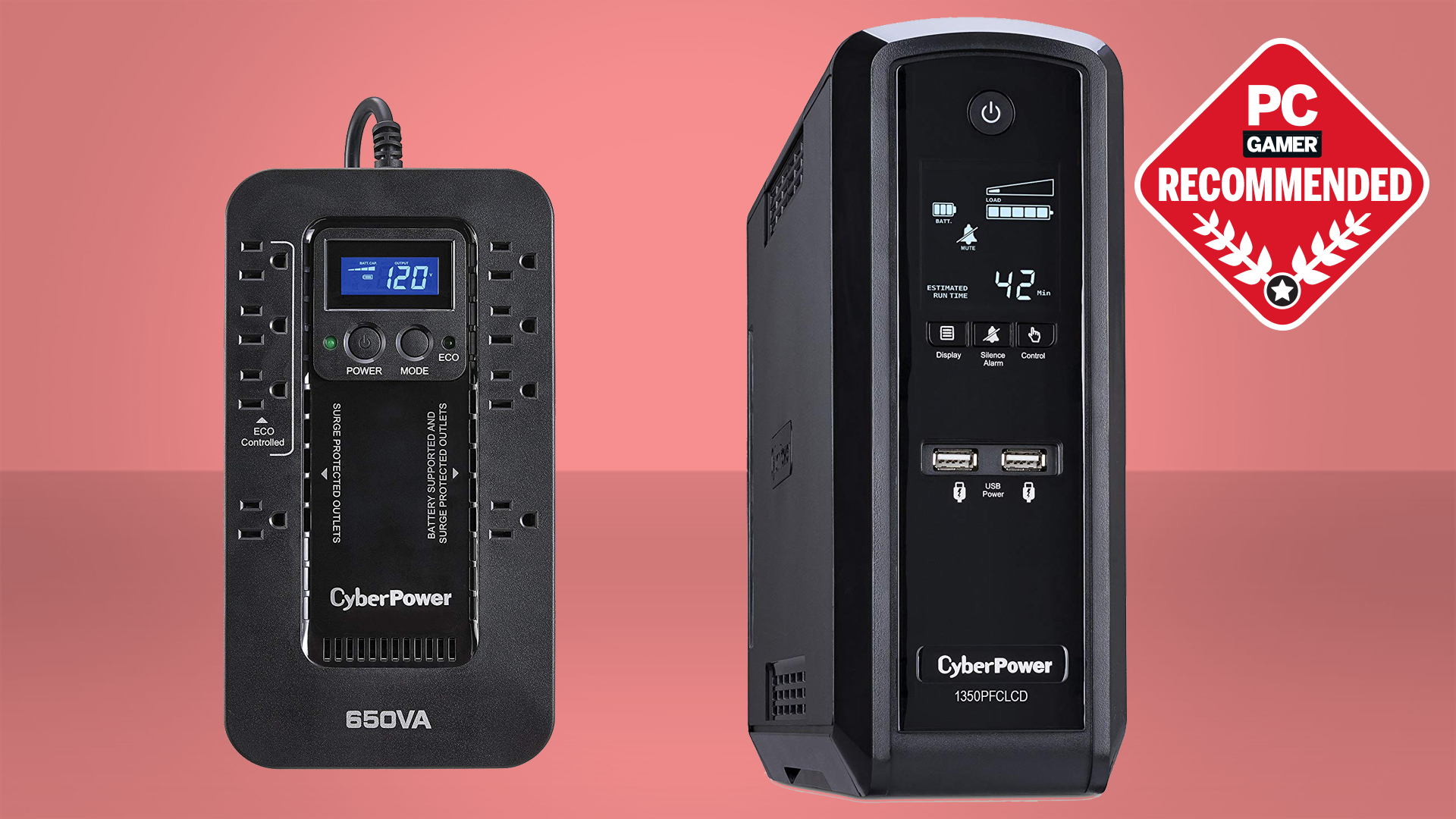

A brief outage can turn into lost work, a corrupted drive, or a router that takes several minutes to reconnect. The right UPS gives your equipment time to stay online or shut down cleanly, but the differences between a small router backup and a full desktop system are substantial.
Our Best UPS Battery Backup picks range from compact 425VA units for networking equipment to 1500VA models for demanding computers and home offices. The CyberPower CP1500PFCLCD is the strongest all-around choice, with pure sine wave output, a useful display, automatic voltage regulation, and a generous outlet layout.
Comparison table
| # | Product | Award | Capacity | Output | Outlets | Best for |
|---|---|---|---|---|---|---|
| 1 | CyberPower CP1500PFCLCD | Best overall | 1500VA, 1000W | Pure sine wave | 12 | PCs and workstations |
| 2 | APC BE600M1 | Best compact desktop backup | 600VA, 330W | Not specified | 7 | Routers and small desktops |
| 3 | APC BX1500M | Best long-runtime option | 1500VA, 900W | Not specified | 10 | Home offices and NAS devices |
| 4 | CyberPower CP1500AVRLCD3 | Best LCD backup | 1500VA, 900W | Simulated sine wave | 12 | General desktop setups |
| 5 | CyberPower ST425 | Best small standby UPS | 425VA, 260W | Simulated sine wave | 8 | Basic home electronics |
| 6 | GOLDENMATE 1000VA Lithium UPS | Best lithium design | 1000VA, 800W | Pure sine wave | 8 | Long service life |
| 7 | APC BE650G1 | Best mid-size APC | 650VA, 390W | Not specified | 8 | PCs and NAS devices |
| 8 | CyberPower EC850LCD | Best eco-focused model | 850VA, 510W | Simulated sine wave | 12 | Efficient home offices |
| 9 | APC BE425M | Best router backup | 425VA, 255W | Not specified | 6 | Wi-Fi and VoIP equipment |
| 10 | APC BR1500MS2 | Best premium APC | 1500VA, 900W | Pure sine wave | 10 | High-end computers |
1. CyberPower CP1500PFCLCD: Best Overall

Pros
- Pure sine wave output suits active PFC power supplies
- 1000W capacity handles demanding desktop systems
- Clear tilting color LCD
- Automatic voltage regulation preserves battery capacity
- USB-A and USB-C charging ports
Cons
- Heavy at 24.9 pounds
- Only six outlets receive battery backup
- Its mini-tower shape needs deliberate placement
Best for: desktop users who want strong capacity, pure sine wave output, and useful power information in one unit.
The CyberPower CP1500PFCLCD is the UPS we would keep beside a serious desktop because it gets the important decisions right. It has enough output for a workstation, monitor, networking equipment, and a few accessories without making the front of the desk feel like a server room. The full unit is 14 inches long, 11 inches high, and only 3.9 inches wide, though its 24.9-pound weight makes it something to position once rather than move casually.
Its 1500VA and 1000W rating gives it more headroom than the 900W APC BX1500M, while pure sine wave output is a better match for modern computers with active power factor correction. That matters when the UPS switches to battery power. The cleaner waveform is intended to keep demanding computer power supplies operating normally rather than leaving compatibility to chance. Automatic voltage regulation also corrects smaller power fluctuations without repeatedly using the battery.
The 12-outlet layout is well suited to a full workstation. Six outlets combine battery backup and surge protection, while the other six provide surge protection only. That distinction is easy to miss when plugging everything in, so the important devices should go on the battery-backed side. Two charging ports, one USB-A and one USB-C, free up outlets for phones and tablets. The five-foot input cord adds flexibility when the wall outlet is not directly behind the desk.
The color LCD is more useful than a single status light. It shows battery and power conditions and tilts up to 22 degrees, which helps when the UPS sits on the floor. The three-year warranty includes the battery, and the unit includes PowerPanel management software. Its main weakness is physical bulk, and users with a very small desk may prefer the APC BE600M1. It is also more capacity than a router or modem needs.
For a PC, NAS setup, or home office with frequent voltage changes, this is the most complete package here. Readers building a computer-focused setup can also consider how much backup capacity a desktop PC actually needs before deciding whether a 1500VA unit is appropriate.
2. APC BE600M1: Best Compact Desktop Backup
Pros
- Compact 600VA design
- Five battery-backed outlets
- USB charging remains available during an outage
- Replaceable internal battery
- 23 minutes of runtime at a 100W load
Cons
- 330W limit is not suited to powerful desktops
- No display for detailed runtime information
- Only two outlets are surge-only
Best for: a router, modem, small desktop, or modest home office that needs a compact battery-backed hub.
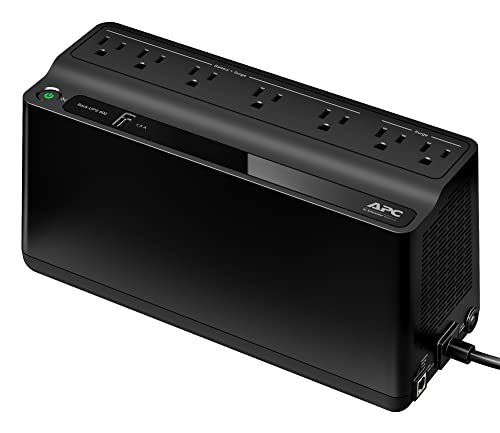
The APC BE600M1 is the easy fit for a small desk. Its 10.79-inch length, 5.47-inch height, and 7.5-pound weight make it much less imposing than the larger 1500VA models. It is still a real UPS rather than a surge strip, with enough capacity for networking equipment and a modest computer that needs time to shut down.
The 600VA, 330W rating sets the boundary. It is suitable for a router, modem, monitor, small desktop, NAS, or similar equipment, but a gaming PC and large display could push it too close to its limit. APC states that it can provide 23 minutes at a 100W load, which is a useful reference for a lightly loaded network or office setup. Heavier loads will reduce that time.
Five of the seven outlets provide both battery backup and surge protection. Two more are surge-only, so the arrangement supports a small collection of essential and nonessential devices without wasting battery capacity on a speaker or lamp. The built-in 1.5A USB port works during outages, giving a phone a charging option while the router stays connected.
There is no LCD, so status information is less detailed than on the CyberPower CP1500PFCLCD or CP1500AVRLCD3. That is the trade-off for the simpler, smaller design. The internal battery can be replaced in minutes with the appropriate APC replacement battery, which is useful for keeping the unit in service rather than discarding the complete UPS.
The APC BE600M1 makes more sense than the CyberPower ST425 when five battery-backed outlets and USB charging matter. The ST425 is smaller and lighter, but its 260W capacity leaves less room for a desktop. Choose the BE600M1 for a compact workstation or network closet, and skip it if your computer routinely draws near 330W.
3. APC BX1500M: Best Long-Runtime Option

Pros
- 1500VA and 900W capacity
- Up to 68 minutes at a 100W load
- Automatic voltage regulation
- Ten protected outlets
- Replaceable battery
Cons
- Large and heavy
- Only five outlets have battery backup
- No detailed LCD listed
Best for: a home office, NAS, or networking stack that needs extended runtime at a moderate load.
The APC BX1500M is built around endurance rather than a flashy interface. At 24.25 pounds and roughly 15 inches long, it is substantial equipment. That mass is easy to justify when several devices need protection, but it will not disappear behind a shallow desk. Its 1500VA and 900W rating is enough for a sizeable home office or a group of networking devices.
APC quotes up to 68 minutes at a 100W load. That figure describes a light load, not a fully running desktop, but it shows where this model shines. A lightly loaded router, modem, NAS, and external drive can stay available through short interruptions, while a computer can have more time to save work and shut down. The 900W ceiling is lower than the CyberPower CP1500PFCLCD's 1000W, but the difference is unlikely to matter for ordinary office equipment.
There are ten protected outlets, split between five battery-backed connections and five surge-only connections. The model also includes coaxial and Ethernet surge protection, a useful detail for equipment connected to outside cabling. Automatic voltage regulation corrects low voltage at 88V and handles surges without immediately draining the battery. APC also identifies it as compatible with active PFC power supplies.
The replaceable battery makes this a practical long-term installation. Its ENERGY STAR certification and stated efficiency of more than 92 percent address the fact that a UPS remains connected all day, not just during a storm. The main limitation is the lack of the live runtime and load readout found on the APC BR1500MS2. Users who want an LCD should move up to that model or across to CyberPower's LCD options.
Compared with the APC BE650G1, the BX1500M is a different class of device, with much more capacity and a larger physical footprint. Compared with the BR1500MS2, it gives up pure sine wave output and a more informative display. It is the better fit for moderate loads where runtime and replaceable-battery service matter most.
4. CyberPower CP1500AVRLCD3: Best LCD Backup
Pros
- 1500VA and 900W capacity
- Color LCD shows power conditions
- 12 outlets with six battery-backed connections
- USB-A and USB-C charging
- Automatic voltage regulation
Cons
- Simulated sine wave output
- Nearly 24 pounds
- No runtime figure supplied for comparison
Best for: users who want a large-capacity UPS with a readable display and broad outlet coverage.
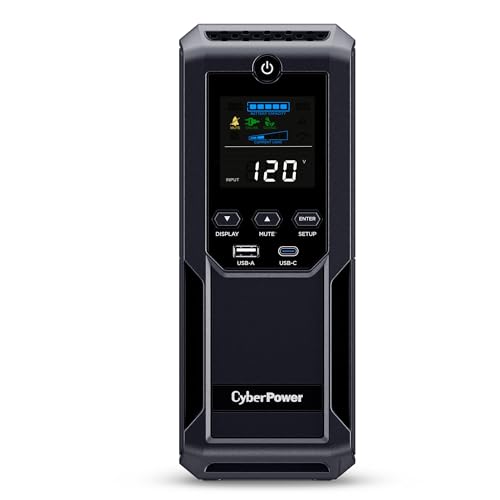
The CyberPower CP1500AVRLCD3 is the practical choice when a front-panel display matters but the system does not require pure sine wave output. It has the same broad 1500VA class as the APC BX1500M and the CyberPower CP1500PFCLCD, yet its 13.78-inch length is slightly easier to accommodate. It still weighs 23.8 pounds, so it belongs on a stable floor or shelf.
Its 900W capacity can handle a desktop, display, router, and peripherals when the load is managed sensibly. The output is simulated sine wave, unlike the pure sine wave CyberPower CP1500PFCLCD and APC BR1500MS2. That distinction makes those models the safer recommendation for especially sensitive equipment or a computer whose power supply is known to be fussy. For a conventional office computer and networking gear, this model offers a sensible feature set.
The 12 outlets are split evenly. Six provide battery backup and surge protection, while six offer surge protection only. This is enough for a multi-device desk, though only the critical gear should occupy the battery-backed sockets. A USB-A port and a USB-C port charge mobile devices without consuming those outlets. Automatic voltage regulation handles minor fluctuations without switching to battery power.
The color LCD shows detailed battery and power conditions and can alert the user before a problem affects connected equipment. PowerPanel Personal software provides another way to manage the UPS. The three-year warranty includes the battery, and the unit carries UL safety certification. Those details make it easier to monitor a setup that is tucked beneath a desk.
The display is its clearest advantage over the APC BX1500M, while the pure sine wave output of the CP1500PFCLCD is the more important difference for some desktop computers. Pick the CP1500AVRLCD3 when you want information at a glance and know that simulated sine wave output suits your equipment. Skip it for a high-end active PFC workstation if you want the simplest waveform match.
5. CyberPower ST425: Best Small Standby UPS

Pros
- Very compact and light
- Eight outlets with four battery-backed connections
- Transformer-spaced outlets
- Simple LED status indicator
- Five-foot power cord
Cons
- 260W output limit
- Simulated sine wave output
- No USB charging or LCD
Best for: a router, game console, small computer, or basic home entertainment setup with modest power needs.
The CyberPower ST425 is the least complicated UPS in this group. Its 8.3-inch width, 4.5-inch height, 3.2-inch depth, and 3.8-pound weight make it easy to place behind a monitor or entertainment unit. It supplies enough emergency power for small electronics without the bulk associated with a 1500VA tower.
The 425VA and 260W rating suits a broadband router, modem, game console, or small computer. It is not intended for a power-hungry desktop, and there is no reason to attach one simply because the plugs fit. Four of its eight outlets provide battery backup and surge protection, while four are surge-only. Transformer-spaced outlets help larger power adapters avoid blocking neighboring sockets.
This is a standby UPS with simulated sine wave output. It does not include automatic voltage regulation, so it is more basic than the APC BE425M in that respect. A five-foot power cord gives reasonable placement flexibility, and the right-angle plug is helpful behind furniture. A simple LED indicates power and wiring fault status rather than showing detailed runtime or load information.
The GreenPower design aims to reduce power consumption through a compact charger and inverter. CyberPower includes a three-year warranty covering the battery, UL safety certification, and connected-equipment protection. The omissions are clear: there is no display, no USB port, and no battery runtime figure in the supplied information.
Against the APC BE425M, the ST425 offers two more outlets and a lighter body, while the APC provides automatic voltage regulation and a wall-mountable design. The APC BE600M1 is the better match for a small desktop because its 330W capacity and USB charging add useful headroom. Choose the ST425 for simple, low-power protection where compact placement matters more than monitoring.
6. GOLDENMATE 1000VA Lithium UPS: Best Lithium Design

Pros
- Lithium iron phosphate battery
- 1000VA and 800W pure sine wave output
- Eight battery-backed outlets
- LCD information panel
- Battery management system
Cons
- Cooling fan can activate during heavy battery use
- Requires careful ventilation
- Input range and cable guidance need attention
Best for: users who want a lithium battery, pure sine wave output, and a long stated service life.
The GOLDENMATE 1000VA Lithium UPS takes a different approach from the lead-acid models around it. Its LiFePO4 battery is rated for more than 10 years and more than 5, 000 charge cycles, according to the supplied product information. That makes it interesting for an installation where the UPS is expected to remain in service for years, not a device that is replaced after a single battery cycle.
Its 1000VA and 800W capacity sits below the 1500VA models but above the smaller APC and CyberPower units. Pure sine wave output supports computers, workstations, network devices, and telecom equipment. Eight outlets provide both surge protection and battery backup, so there is less need to decide which sockets should receive emergency power. The built-in battery management system monitors the battery and supports safe operation.
The LCD panel provides real-time battery and power information. An automatic safety mechanism stops charging and discharging when limits are exceeded, with the stated aim of reducing overload and overheating risks. A cooling fan operates below 50 dB when running, though it can activate when the battery management system detects heavy battery use. That behavior is worth considering if the UPS will sit in a quiet office or bedroom.
The unit weighs about 13 pounds and measures 12.99 inches long, 9.84 inches high, and 4.13 inches wide. It accepts 90V to 140V AC input and is intended for standard 110V household power. The supplied guidance says not to use it in a high-temperature or enclosed environment and to use the original or fully compatible power cable. Those are not minor setup details, especially with an active cooling system and lithium battery.
The APC BR1500MS2 provides higher capacity and a more established feature set for a large computer system, while the GOLDENMATE is the more distinctive choice for lithium battery longevity in a smaller package. The fan and ventilation requirements are its real drawbacks. Choose it when long battery service life and pure sine wave output matter more than silent operation and maximum capacity.
7. APC BE650G1: Best Mid-Size APC

Pros
- 650VA and 390W capacity
- Up to 29 minutes at a 100W load
- Eight well-spaced outlets
- Replaceable battery
- Mutable audible alerts
Cons
- No USB charging port listed
- No LCD
- Only four outlets have battery backup
Best for: a modest PC, NAS, router, and external drives that need more capacity than a compact router UPS.
The APC BE650G1 occupies a useful middle ground. It is larger and more capable than the APC BE425M, but it avoids the size and weight of the 1500VA models. Its 11.18-inch width, 7.09-inch length, and 3.39-inch height give it a broad, low profile, while the 13.64-pound weight keeps it manageable under a desk.
At 650VA and 390W, it can support a modest computer, NAS, router, modem, and external drive when the combined load is kept under control. APC states up to 29 minutes at a 100W load. That is enough time for a network stack to ride through a brief outage or for a computer to save work and shut down. It is not intended to keep a powerful workstation running through a prolonged interruption.
The eight outlets are split between four battery-backed and surge-protected sockets and four surge-only sockets. They are well spaced, which helps with bulky adapters. Clear indicators show UPS status, and the audible alerts can be muted. The battery is user-replaceable with the specified APC RBC17 replacement, so routine battery aging does not require replacing the entire unit.
The BE650G1 does not list a USB charging port or an LCD. That leaves it behind the APC BE600M1 for phone charging and behind the CyberPower EC850LCD for detailed power information. It does, however, provide more output than both compact 425VA choices and a useful outlet layout for a small NAS or office system.
For a buyer comparing it with the APC BE600M1, the BE650G1 gives more capacity and longer stated runtime at a 100W load, while the BE600M1 is smaller and includes USB charging. The BE650G1 is the better fit for a modest computer and storage setup. Skip it when your equipment needs pure sine wave output or more than 390W.
8. CyberPower EC850LCD: Best Eco-Focused Model

Pros
- 850VA and 510W capacity
- 12 outlets
- LCD power information
- Three ECO-controlled outlets
- Automatic peripheral shutdown feature
Cons
- Simulated sine wave output
- No USB charging listed
- ECO mode needs careful outlet planning
Best for: a home office with several peripherals that should switch off automatically when the computer sleeps.
The CyberPower EC850LCD is designed for a desk where the computer is only one part of the electrical setup. Its 850VA and 510W capacity gives it more room than the APC BE650G1, while its 12 outlets make it easier to connect displays, speakers, drives, and networking equipment. The unit measures 12.2 inches long, 7 inches wide, and 3.1 inches high, with a 7.7-pound weight.
Six outlets provide battery backup and surge protection. Six more are surge-only, with three of those assigned to ECO mode. When the UPS detects that the connected computer is off or asleep, it can automatically cut power to peripherals on those ECO outlets. That can stop accessories from drawing power when they are not needed, though the connections must be planned so that a peripheral does not need to stay active independently.
The LCD shows battery and power conditions without requiring management software. Simulated sine wave output is appropriate for many ordinary office and home entertainment systems, but the pure sine wave output of the CyberPower CP1500PFCLCD and APC BR1500MS2 is preferable for sensitive active PFC computers. Automatic voltage regulation helps correct smaller fluctuations without switching to battery power.
CyberPower includes a five-foot right-angle power cord, a three-year warranty that includes the battery, PowerPanel Personal Edition software, and connected-equipment protection. The ECO feature is the reason to choose this model over the APC BE650G1, not simply the additional outlets. It makes the most sense when the computer and its accessories tend to follow the same sleep and wake schedule.
The EC850LCD is more informative than the basic CyberPower ST425 and more efficient in its peripheral management than the APC BE600M1. Its weakness is that simulated sine wave output and ECO controls may not suit every setup. Choose it for a multi-device office where automatic peripheral shutdown solves a real problem.
9. APC BE425M: Best Router Backup

Pros
- Compact wall-mountable design
- Automatic voltage regulation
- Six outlets
- Up to 15 minutes at a 100W load
- Audible alerts and LED indicators
Cons
- 225W output limit
- No USB charging listed
- Only four outlets have battery backup
Best for: a Wi-Fi router, modem, VoIP phone, or other low-power networking equipment.
The APC BE425M is the right size for equipment that needs to stay connected rather than a computer that needs to keep rendering. Its 10-inch length, 5.5-inch width, and 4.1-inch height allow it to fit beneath a desk or mount on a wall. At 5.72 pounds, it is easy to position near a router and modem without reorganizing an entire workspace.
The 425VA and 255W rating is aimed at low-power devices. APC states up to 15 minutes at a 100W load, which gives a router and modem time to remain online during a short interruption. Four of the six outlets provide battery backup and surge protection, while two are surge-only. That is enough for a basic network stack, though it leaves little reason to attach a computer or display.
Automatic voltage regulation is a notable advantage over the CyberPower ST425. It corrects minor power fluctuations without switching to battery, helping reserve the battery for an actual outage. LED indicators and audible alarms identify on-battery operation, low battery, and overload conditions. The unit does not list a USB charging port or detailed LCD, so its status system is deliberately simple.
APC includes a three-year warranty and connected-equipment protection. The wall-mountable design is particularly useful in apartments, dorm rooms, and small workspaces where floor space is scarce. Its principal limitation is the 225W output ceiling. A larger desktop should use the APC BE600M1 or APC BE650G1 instead.
Compared with the CyberPower ST425, the BE425M has fewer outlets but adds automatic voltage regulation and a more space-conscious mounting option. It is also a better choice for a router than the larger APC BX1500M, which brings capacity the network equipment cannot use. Select the BE425M when keeping internet access alive is the central goal.
10. APC BR1500MS2: Best Premium APC

Pros
- Pure sine wave output
- 1500VA and 900W capacity
- Live runtime, load, and battery health display
- USB-C and USB-A charging
- Coaxial and Ethernet surge protection
Cons
- Heaviest model here at 27.55 pounds
- Large footprint
- Only six of ten outlets have battery backup
Best for: a high-end PC, NAS, and home office that need pure sine wave power and detailed monitoring.
The APC BR1500MS2 is the most feature-rich APC in this group, and it feels designed for a system that should not be left to guesswork. Its 1500VA and 900W rating supports a full desktop setup, while pure sine wave output is intended for modern computers, NAS drives, and other sensitive electronics. At 27.55 pounds, it is also the heaviest model here, so plan its location before connecting the equipment.
APC states up to 73 minutes at a 100W load. As with any runtime figure, the actual time depends on the connected load, but the rating shows that this model can keep a lightly loaded network and office setup running for a meaningful interruption. Automatic voltage regulation corrects high and low voltage without moving to battery, reducing unnecessary battery use during routine fluctuations.
The ten outlets include six with battery backup and four that are surge-only. Coaxial and Ethernet surge protection cover additional paths that can otherwise bring a power event into connected equipment. USB-C and USB-A charging ports handle mobile devices separately from the protected outlets. The battery is user-replaceable with the specified APC replacement battery.
The angled LCD is one of the strongest reasons to choose this model. It shows remaining runtime, current watt draw, and battery health live, while a silenceable alarm prevents an outage from turning into a constant audible interruption. Active PFC compatibility further suits current computer power supplies. The three-year warranty adds a defined support period, but the physical size remains a genuine drawback.
The CyberPower CP1500PFCLCD is the better alternative when 1000W capacity, USB-C charging, and a tilting color display matter more. The APC BR1500MS2 wins on its live runtime information and data-line protection, while the APC BX1500M can provide substantial runtime without the same level of display detail. Choose the BR1500MS2 for a premium computer or NAS setup where monitoring is worth the extra bulk.
How to choose best ups battery backup
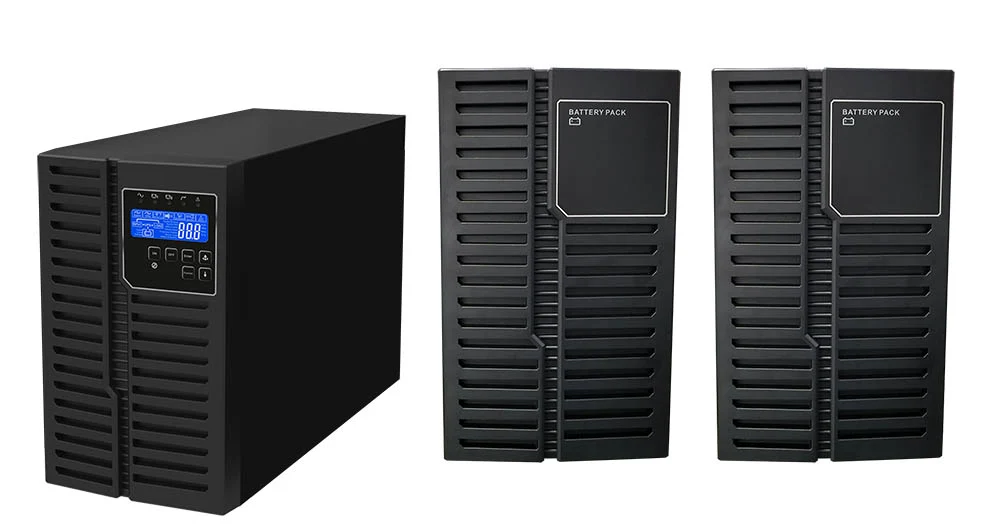
The right UPS is determined by the equipment attached to it, the amount of time needed during an outage, and how much information you want from the unit.
Capacity and load
VA describes the apparent power a UPS can handle, while watts are the more direct limit for most computers and electronics. A router and modem can work with a 225W or 260W model, but a desktop with a monitor needs more headroom. Compare the combined wattage of the equipment with the UPS watt limit, and leave room for startup and load changes.
Sine wave output
Pure sine wave output is the safer match for modern computers with active power factor correction, NAS devices, and sensitive electronics. Simulated sine wave models can work well with ordinary office and home entertainment equipment, but they offer less waveform compatibility. The CyberPower CP1500PFCLCD, GOLDENMATE 1000VA Lithium UPS, and APC BR1500MS2 use pure sine wave output.
Choose pure sine wave when the computer is important enough that an output compatibility question is unacceptable.
Runtime
Runtime depends heavily on the connected load. The APC BE425M lists up to 15 minutes at 100W, while the APC BE600M1 lists 23 minutes at that same load. The larger APC BX1500M and BR1500MS2 list up to 68 and 73 minutes respectively at 100W. Those figures are useful comparisons, but a desktop drawing substantially more power will run for less time.
Battery type and replacement
Most of these UPS units use replaceable batteries, which helps extend the useful life of the hardware. The GOLDENMATE model uses a LiFePO4 battery rated for more than 10 years and more than 5, 000 charge cycles. Lead-acid models remain practical when a replaceable battery and familiar support ecosystem matter more than lithium longevity.
Outlets and monitoring
Count battery-backed outlets separately from surge-only outlets. A 12-outlet UPS may still have only six connections for equipment that must stay on during an outage. An LCD can show load, battery status, and remaining runtime, while a basic LED system keeps the unit simpler. If the UPS will sit under a desk, a display and muteable alarm can make everyday use much less frustrating.
For a broader look at the category, compare the features that separate a standby UPS from a line-interactive model before choosing a capacity.
Frequently asked questions
What size UPS does a desktop computer need?
Measure or estimate the combined wattage of the computer, monitor, and essential accessories, then choose a UPS with additional headroom. The 330W APC BE600M1 suits a modest system, while a workstation is better matched with a 900W or 1000W model.
Is pure sine wave output necessary for a PC?
It is not necessary for every PC, but it is the safer choice for modern computers with active power factor correction. Pure sine wave models such as the CyberPower CP1500PFCLCD and APC BR1500MS2 reduce the chance of compatibility problems when the UPS switches to battery power.
Can a UPS keep my Wi-Fi working during an outage?
Yes, if the router and modem are connected to battery-backed outlets and the UPS has enough capacity. The APC BE425M and APC BE600M1 are designed for this type of low-power networking setup.
How long should a UPS battery last?
Battery life depends on battery chemistry, temperature, usage, and charging conditions. The GOLDENMATE model states more than 10 years and more than 5, 000 charge cycles for its LiFePO4 battery, while other models use replaceable batteries that can be swapped when they age.
Can every outlet on a UPS provide battery backup?
No. Many units divide outlets between battery backup with surge protection and surge-only protection. Check the labels before connecting a computer, NAS, or router, since a surge-only outlet will not keep that equipment running during an outage.
Does a UPS protect Ethernet and coaxial cables?
Some models do. The APC BX1500M provides coaxial and Ethernet surge protection, as does the APC BR1500MS2. A UPS without those connections protects the power cable but does not necessarily protect a surge entering through a data line.
The bottom line
The CyberPower CP1500PFCLCD is the Best UPS Battery Backup pick for most desktop users because it combines 1000W capacity, pure sine wave output, automatic voltage regulation, 12 outlets, and an informative color LCD. Its heavy body and mini-tower footprint are the compromises, but they are easier to accept than inadequate capacity or unclear battery status.
Choose the APC BE600M1 for a compact computer and networking setup, the APC BE425M for a router and modem, or the APC BR1500MS2 for a high-end computer and NAS arrangement that benefits from detailed monitoring. The GOLDENMATE 1000VA Lithium UPS is the specialist choice when long stated battery service life is the priority.
If you are undecided, match the UPS watt limit to your equipment first, then choose pure sine wave output if your computer or NAS is especially important.
As an Amazon Associate we earn from qualifying purchases.