

A power cut can turn a harmless router reboot into a lost video call, corrupted file, or freezer problem. The right backup depends on what you need to keep alive: a home office needs clean, continuous power, while a refrigerator or several appliances need a portable power station with a much larger battery.
We compared compact router UPS units, full-size computer backups, lithium UPS models, and portable power stations. The Best home battery backup for most demanding home offices is the CyberPower CP1500PFCLCD, while the EcoFlow DELTA 2 and Anker SOLIX S2000 make more sense when an outage affects appliances rather than just electronics.
Comparison table
| # | Product | Award | Capacity | Outlets or output | Best for |
|---|---|---|---|---|---|
| 1 | CyberPower CP1500PFCLCD | Best overall | 1500VA/1000W | 12 outlets, USB-A and USB-C | PCs and network equipment |
| 2 | GOLDENMATE 1000VA Lithium UPS | Best long-life UPS | 1000VA/800W | 8 outlets | Long-term home-office protection |
| 3 | APC BE600M1 | Best compact desktop UPS | 600VA/330W | 7 outlets, USB-A | Routers and small desktops |
| 4 | APC BX1500M | Best APC high-capacity UPS | 1500VA/900W | 10 outlets | Larger computer setups |
| 5 | CyberPower CP1500AVRLCD3 | Best feature-rich simulated sine wave UPS | 1500VA/900W | 12 outlets, USB-A and USB-C | Home offices and entertainment systems |
| 6 | EcoFlow DELTA 2 | Best portable power station | 1024Wh/1800W | 15 outlets | Appliances and extended outages |
| 7 | CyberPower ST425 | Best small standby UPS | 425VA/260W | 8 outlets | Basic desktop and router backup |
| 8 | APC BE425M | Best wall-mountable UPS | 425VA/255W | 6 outlets | Routers and compact spaces |
| 9 | Anker SOLIX S2000 | Best large-capacity backup | 2010Wh/1500W | 8 outlets | Refrigerators and home essentials |
| 10 | GOLDENMATE 1500VA Lithium UPS | Best lithium UPS for heavy loads | 1500VA/1000W | 8 outlets, USB-A and USB-C | High-load computers and NAS devices |
1. CyberPower CP1500PFCLCD: Best Overall

Pros
- Pure sine wave output supports active PFC power supplies
- 12 total outlets and two USB charging ports
- Automatic voltage regulation reduces unnecessary battery use
- Tilting color LCD gives useful status information
- Three-year warranty includes the battery
Cons
- Heavy at 24.9 pounds
- The slim tower needs more vertical clearance than a compact UPS
- It uses a traditional battery rather than a long-life lithium pack
Best for: a home office, workstation, or network setup that needs clean power and generous connection options.
The CyberPower CP1500PFCLCD is the one we'd keep beside a serious home office. It has enough output for a computer and several network devices, but its strongest advantage is the way it handles the less dramatic power problems that happen between full outages. Automatic voltage regulation corrects minor fluctuations without switching to battery, so the battery is reserved for the moments when the mains actually fails.
Its 1500VA and 1000W capacity gives it useful headroom for a desktop workstation, monitor, storage device, and router. The pure sine wave output is particularly relevant to computers with active power factor correction, where a basic simulated sine wave UPS can be a less comfortable match. Six of the 12 NEMA 5-15R outlets provide battery backup and surge protection, while the other six provide surge protection only. That arrangement makes it easy to reserve battery capacity for the equipment that truly needs uninterrupted power.
The display is more than decoration. Its color LCD shows battery and power conditions at a glance and tilts by up to 22 degrees, which helps when the UPS sits under a desk. Two USB charging ports, one Type-A and one Type-C, handle phones and tablets without consuming an AC outlet. The five-foot power cord and right-angle plug also make placement easier in a crowded office.
The weakness is its weight and conventional battery design. At 24.9 pounds, it is not something to move casually, and buyers seeking a decade-long lithium battery should look at the GOLDENMATE 1000VA Lithium UPS instead. The CyberPower wins on sine wave output, outlet count, and monitoring, though, which is why it leads this list. If you are weighing a UPS against a larger appliance backup, our guide to keeping essential household circuits running during an outage covers the larger category distinction.
2. GOLDENMATE 1000VA Lithium UPS: Best Long-Life UPS

Pros
- LiFePO4 battery rated for more than 5, 000 charge cycles
- Pure sine wave output
- Eight battery-backed, surge-protected outlets
- LCD panel and built-in battery management system
- Cooling fan operates below 50 dB
Cons
- Fan can activate during heavy battery use
- The eight outlets offer less expansion than CyberPower's 12-outlet models
- Requires standard 110V household power
Best for: a home office owner who prioritizes battery longevity and pure sine wave output.
The GOLDENMATE 1000VA Lithium UPS takes a different approach from most traditional computer UPS units. Its LiFePO4 battery is rated for more than 10 years and more than 5, 000 charge cycles, so it is aimed at someone who wants a UPS to remain part of the setup for the long haul rather than treating the battery as a replaceable consumable.
With 1000VA and 800W of capacity, it is a sensible match for a computer, monitor, router, and storage hardware, provided the combined load stays within that limit. Pure sine wave output makes it suitable for computers and other equipment that can be particular about the shape of incoming power. All eight NEMA 5-15P outlets provide both battery backup and surge protection, which is simpler than sorting essential devices between battery and surge-only banks.
The LCD panel reports battery and power conditions, while the battery management system monitors charging, discharging, temperature, and overload conditions. A cooling fan remains below 50 dB according to the product information, although it can turn on when the battery management system detects heavy use. That is a practical trade-off for a lithium UPS with this output class.
It is not as generously equipped as the CyberPower CP1500PFCLCD. You get fewer outlets, no stated USB charging ports, and less total output. The GOLDENMATE is the more interesting choice for a user who cares about long battery life, while the CyberPower is easier to recommend for a larger workstation. Skip this one if you need a compact router-only unit or a portable power station for appliances.
3. APC BE600M1: Best Compact Desktop UPS
Pros
- Compact 600VA/330W design
- Five battery-backed outlets and two surge-only outlets
- Built-in 1.5A USB charging port
- Replaceable internal battery
- Up to 23 minutes at a 100W load
Cons
- Not intended for high-powered desktop systems
- Fewer battery-backed outlets than larger models
- No automatic voltage regulation listed
Best for: a router, modem, NAS, or small home-office setup that needs a compact backup.
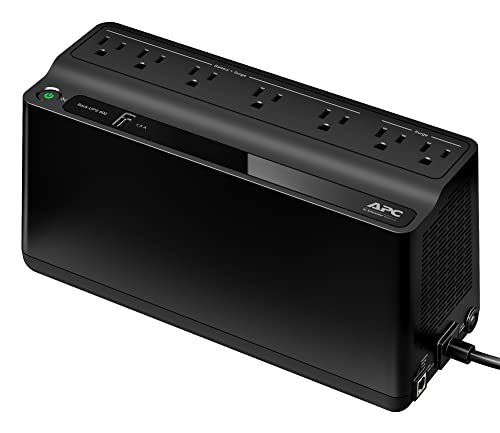
The APC BE600M1 is a classic small UPS for the equipment people actually worry about first: the router, modem, NAS, and a modest computer. Its 600VA and 330W rating keeps expectations clear. This is not the unit for a powerful gaming desktop and multiple displays, but it has enough capacity to bridge a short interruption or give a computer time to shut down safely.
Five of its seven outlets provide battery backup and surge protection, with two additional surge-only outlets for peripherals that do not need to stay powered. The built-in 1.5A USB port remains useful during an outage, especially if the UPS is sitting near a phone or small charging cable. APC also makes the internal battery replaceable, so the whole unit does not have to be discarded when the battery reaches the end of its service life.
APC cites up to 23 minutes of runtime at a 100W load. That figure describes a relatively light setup, not a fully loaded desktop, but it shows why this model works well for networking equipment. Its 10.79-inch length, 5.47-inch height, and 7.5-pound weight also make it easier to place than the large 1500VA units.
The limitation is straightforward: 330W leaves little room for a demanding computer and display combination. The APC BE425M takes up less room and suits a router-only setup, while the CyberPower CP1500PFCLCD is much better for a workstation. Choose the BE600M1 when your goal is keeping connectivity alive and protecting a handful of smaller electronics, not running a whole room.
4. APC BX1500M: Best APC High-Capacity UPS

Pros
- 1500VA/900W output
- Up to 68 minutes at a 100W load
- Automatic voltage regulation
- Ten outlets plus coaxial and Ethernet surge protection
- User-replaceable battery
Cons
- Weighs 24.25 pounds
- Only five outlets provide battery backup
- No USB charging ports listed
Best for: a larger home office, NAS, entertainment setup, or network rack that needs APC's high-capacity format.
The APC BX1500M is built around capacity rather than a long list of modern extras. Its 1500VA and 900W rating puts it in the same broad class as the CyberPower 1500VA units, making it a reasonable choice for a desktop, monitor, router, external drives, and other office electronics. It is also listed as compatible with active PFC systems, an important detail for many newer computers.
There are 10 protected outlets in total. Five offer battery backup and surge protection, while five are surge-only. That split is conservative, but it prevents low-priority equipment from consuming battery capacity during an outage. APC also includes coaxial and Ethernet surge protection, which is useful for connected home-office equipment where a power outlet is not the only route for a surge.
The stated runtime can reach 68 minutes at a 100W load. As with all UPS runtime claims, the load matters enormously, but the figure makes the BX1500M particularly interesting for networking equipment, storage, and lightly loaded office systems. Automatic voltage regulation corrects low voltage above 88V and trims surges around the stated operating range without draining the battery. Its 92% or higher efficiency certification is another sensible fit for a UPS that stays on continuously.
This model is less convenient than the CyberPower CP1500AVRLCD3 if you want USB charging and a color LCD. It is also nearly 25 pounds, so it belongs in a planned location rather than on a shelf you frequently rearrange. Pick it for the replaceable battery, network surge protection, and APC's clear high-capacity design. For a broader look at the distinction between short-term electronics protection and appliance operation, see how portable backup power differs from a traditional UPS.
5. CyberPower CP1500AVRLCD3: Best Feature-Rich Simulated Sine Wave UPS
Pros
- 1500VA/900W capacity
- 12 outlets with six battery-backed outlets
- USB-A and USB-C charging ports
- Color LCD and automatic voltage regulation
- Three-year warranty includes the battery
Cons
- Simulated sine wave output is less flexible than pure sine wave
- Heavy at 23.8 pounds
- No lithium battery
Best for: a home office or entertainment center that wants strong monitoring and many outlets without moving to a pure sine wave model.
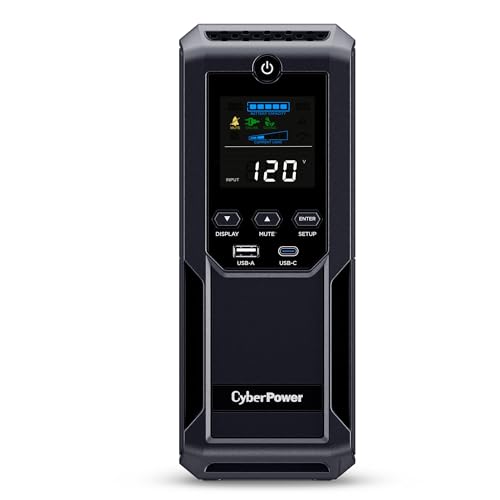
The CyberPower CP1500AVRLCD3 looks like a practical middle ground in CyberPower's range. It has the same 12-outlet layout that makes the CP1500PFCLCD easy to organize, but uses simulated sine wave output and a 1500VA/900W capacity. For ordinary workstations, networking gear, and home entertainment equipment, that combination covers a lot of ground.
Six outlets provide battery backup and surge protection, with six more reserved for surge protection. The USB-A and USB-C ports are useful for charging small devices, and the color LCD gives immediate information about battery and power conditions. Automatic voltage regulation handles minor power fluctuations without repeatedly putting the battery through a cycle.
The six-foot power cord gives more placement freedom than a short lead, particularly when the UPS sits beside a desk rather than directly behind it. The published dimensions of 13.78 inches long, 10.2 inches high, and 3.94 inches wide describe a tall, narrow unit, though its 23.8-pound weight still makes it a permanent fixture once installed.
The key decision is output type. The CyberPower CP1500PFCLCD uses pure sine wave output and is the safer pick for a computer with an active PFC power supply. The CP1500AVRLCD3 makes more sense when outlet count, USB charging, and the LCD matter more than maximum power compatibility. Buyers with a lithium battery priority should move to either GOLDENMATE model instead.
6. EcoFlow DELTA 2: Best Portable Power Station

Pros
- 1024Wh battery and 1800W output
- LiFePO4 battery rated for 3000 or more cycles
- Charges from zero to 80% in 50 minutes using AC input
- Expandable capacity up to 3kWh
- Up to 500W solar input
Cons
- Weighs 27 pounds
- Larger than a conventional UPS
- Battery capacity and appliance runtime vary with load
Best for: powering appliances, communication equipment, and essential devices during longer outages.
The EcoFlow DELTA 2 is not simply a larger desktop UPS. It is a portable power station for the moment when a power cut affects more than a computer and router. Its 1024Wh battery and 1800W output give it the ability to run many household appliances, while the 15-outlet layout makes it useful in a kitchen, living room, workshop, or temporary off-grid setup.
Its LiFePO4 chemistry is rated for 3000 or more cycles, a useful durability advantage for a device that may be charged and used repeatedly. AC charging reaches 80 percent in 50 minutes and full charge in 80 minutes according to the product information. It also accepts up to 500W of solar input, and its capacity can expand from 1kWh to as much as 3kWh with extra batteries.
That extra flexibility changes how you plan for an outage. A conventional UPS is designed to keep electronics alive long enough to ride out a brief interruption or shut them down safely. The DELTA 2 can support a refrigerator, communications equipment, or several lower-power devices for much longer, although actual runtime depends on the appliance and its operating pattern. It measures 15.7 inches long, 11.3 inches high, and 8.3 inches wide, and weighs 27 pounds, so portability is real but not effortless.
The Anker SOLIX S2000 offers a larger 2010Wh battery and a more compact footprint for its capacity, while the DELTA 2 charges faster from AC and supports expansion. Neither is the right answer if you only need to protect a desktop PC from a sudden outage. Choose the EcoFlow when appliance support, solar charging, and a broad output capability matter more than the always-installed format of a UPS.
7. CyberPower ST425: Best Small Standby UPS

Pros
- Compact 425VA/260W capacity
- Eight outlets with four battery-backed outlets
- Transformer-spaced outlets
- LED status and wiring-fault indicator
- Three-year warranty includes the battery
Cons
- Simulated sine wave output
- No USB charging port
- Limited capacity for desktop computers
Best for: a router, small computer, game console, or basic home-office setup.
The CyberPower ST425 is a small standby UPS that does not pretend to be a whole-home system. Its 425VA and 260W output is suited to a broadband router, small computer, game console, or a few low-draw devices. When the power fails, simulated sine wave output provides short-term battery power so connected equipment can stay on or shut down safely.
Four of the eight NEMA 5-15R outlets have battery backup and surge protection. The other four are surge-only, which is enough for peripherals that do not need uninterrupted power. Transformer-spaced outlets help accommodate larger plugs without blocking every neighboring socket, a detail that matters more on a compact UPS than the outlet count alone suggests.
The status light shows power and wiring-fault information, giving this model a simpler interface than the color-screen units higher in the list. Its 8.3-inch width, 4.5-inch height, and 3.2-inch length make it easy to tuck beneath a desk or behind a media console, and the 3.8-pound weight is genuinely easy to manage.
The APC BE425M is a close alternative with automatic voltage regulation and a wall-mountable shape, while the ST425 offers more total outlets and a 260W rating. Neither has the headroom of the APC BE600M1. Select this CyberPower when you want a basic, compact buffer for modest electronics and do not need USB charging or a detailed display.
8. APC BE425M: Best Wall-Mountable UPS

Pros
- Compact 425VA/255W capacity
- Wall-mountable design
- Automatic voltage regulation
- Six well-spaced outlets
- Audible alarms and LED indicators
Cons
- Only four outlets provide battery backup
- No USB charging port
- Intended for low-power electronics
Best for: a Wi-Fi router, modem, VoIP phone, or small device in a tight space.
The APC BE425M is the easiest UPS here to place out of the way. Its compact design can sit under a desk or mount on a wall, which is helpful for apartments, dorm rooms, and small workspaces where a tower UPS would create clutter. The 425VA and 255W rating puts it firmly in the router and small-electronics class.
Four of its six outlets provide battery backup and surge protection, with two surge-only outlets for less critical devices. APC cites up to 15 minutes of runtime at a 100W load, enough to keep a network connection alive through a short interruption or give a small system time to shut down. Automatic voltage regulation corrects minor fluctuations without using the battery, which is a welcome feature at this size.
The unit also provides audible notifications and LED indicators for on-battery operation, low battery, and overload conditions. Its 10-inch length, 5.5-inch width, 4.1-inch height, and 5.72-pound weight make it compact without being too awkward to handle. The three-year warranty and equipment protection add reassurance, but they do not change its modest output ceiling.
Compared with the CyberPower ST425, the APC has slightly lower output and fewer outlets, but it adds automatic voltage regulation and a more flexible mounting design. The APC BE600M1 is the better fit for a small desktop or NAS. Choose the BE425M when the main goal is keeping connectivity alive in a cramped location.
9. Anker SOLIX S2000: Best Large-Capacity Backup
Pros
- 2010Wh LiFePO4 battery
- 1500W continuous and 3000W peak output
- Rated for 10, 000 cycles
- Six recharge methods
- Less than 36 pounds for its capacity
Cons
- No 12V DC port
- Fewer outlets than the EcoFlow DELTA 2
- Too large for a simple router backup
Best for: refrigerators, essential appliances, and long household outages.
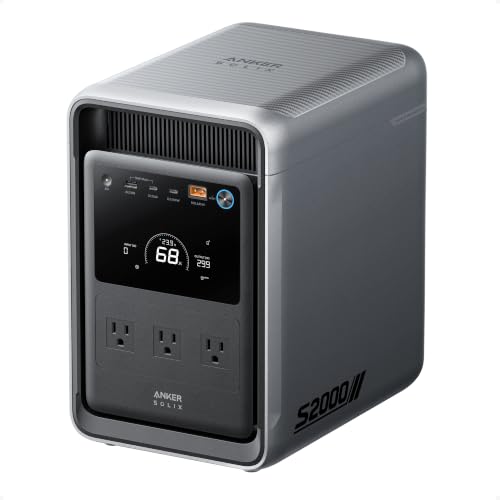
The Anker SOLIX S2000 is the serious appliance backup in this group. Its 2010Wh battery is nearly twice the capacity of the EcoFlow DELTA 2, and the 1500W continuous output with 3000W peak output gives it room for many essential household devices. It is a portable station rather than a traditional desktop UPS, so the useful question is not how many minutes it can keep a monitor alive, but how long it can support the equipment that matters during an outage.
Anker uses LFP cells rated for 10, 000 cycles and describes a 15-year lifespan. The product information also cites up to 35 hours of refrigerator backup, though actual runtime varies with the refrigerator, usage pattern, and ambient temperature. That qualification matters because compressor loads are very different from the steady draw of a laptop or router.
The S2000 supports six recharge methods, including AC, solar input up to 400W, a generator, an alternator charger, and a car outlet. Its eight outlets are arranged across the front and rear to separate everyday devices from appliances that stay connected. A sub-10-millisecond UPS switchover makes it more suitable for a home office than many portable stations, though it lacks a 12V DC port.
At 35.7 pounds and 8.2 by 11.1 by 12.7 inches, it is not lightweight, but Anker claims it is smaller and lighter than the typical 2kWh power station. The EcoFlow DELTA 2 is easier to recharge quickly and offers 15 outlets plus expandable capacity. Choose the S2000 when battery capacity and refrigerator support are the priority, and skip it if a small UPS is all your router or computer needs.
10. GOLDENMATE 1500VA Lithium UPS: Best Lithium UPS for Heavy Loads

Pros
- 1500VA/1000W output
- Pure sine wave power
- LiFePO4 battery rated for 3000 or more cycles
- USB-A and USB-C charging ports
- Communication port supports automatic shutdown
- LCD and independent alarm controls
Cons
- Only eight AC outlets
- Fan activates during heavy battery use
- Generator compatibility may be limited
Best for: a high-load home office, NAS, or workstation that needs lithium endurance and pure sine wave output.
The GOLDENMATE 1500VA Lithium UPS combines the long-life battery idea of the smaller GOLDENMATE with enough output for a demanding computer setup. Its 1500VA and 1000W rating, paired with pure sine wave output, makes it a credible match for workstations, network devices, telecom equipment, and storage hardware.
The LiFePO4 battery is rated for more than 10 years of use and 3000 or more charge cycles. That is less than the cycle rating claimed for the 1000VA GOLDENMATE, but this model provides more output for heavier equipment. Its eight NEMA 5-15P outlets all provide battery backup and surge protection, which avoids the need to decide which sockets receive the important power.
A communication port and included USB cable allow a connected Windows PC, Mac, or NAS to initiate a safe shutdown when configured correctly. That feature can prevent data loss and file corruption when an outage lasts longer than the battery can cover. The LCD reports real-time battery and power status, while independent controls let you mute the alarm and manage the display. USB-A and USB-C ports provide a combined 10W for smaller devices.
The unit measures 12.99 inches long, 9.84 inches high, and 4.13 inches wide, and weighs about 11 pounds. Its cooling fan operates below 50 dB according to the product information, but it can activate under heavy battery use. The CyberPower CP1500PFCLCD offers more outlets and a three-year battery-included warranty, while this GOLDENMATE is the more appealing pick for a buyer focused on lithium longevity. Be cautious about pairing it with generator power, since the product notes that some generator output may not meet its input requirements.
How to choose best home battery backup
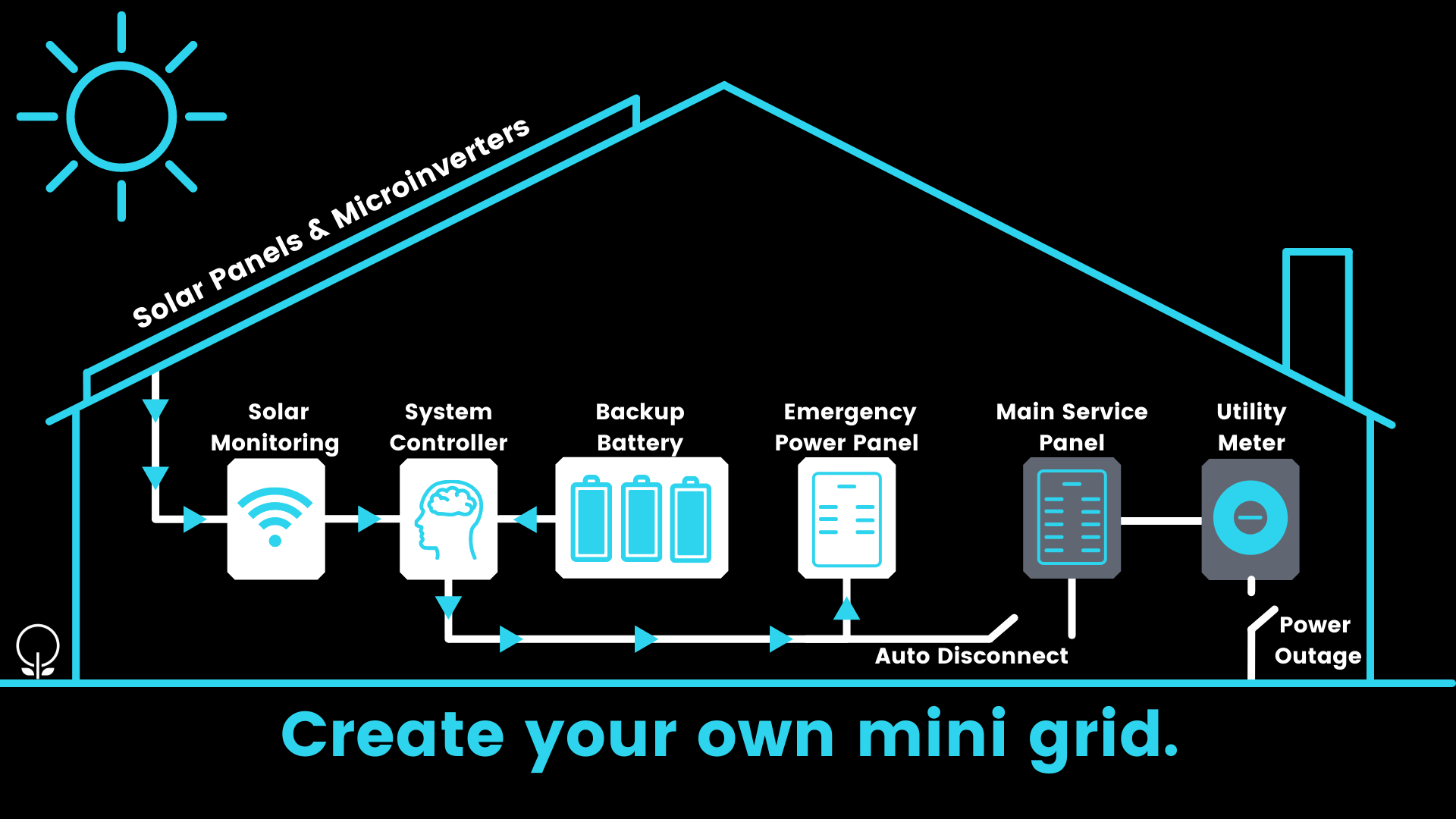
Start by deciding whether you need a UPS for electronics or a portable power station for appliances. The right capacity, output waveform, battery chemistry, and connection layout then become much easier to judge.
Capacity and load
VA and watts describe how much equipment a UPS can support at once. Watts are the practical limit for computers and appliances, while VA describes the electrical capacity of the unit. A 425VA model is appropriate for a router or small electronics, but a workstation with multiple accessories needs considerably more headroom.
Do not size a UPS right at the combined maximum of your devices. Leave room for startup demand and for adding a monitor, storage device, or network component later. The 1500VA models here are intended for larger computer setups, while the EcoFlow and Anker stations are aimed at much larger household loads.
Output waveform
Pure sine wave output is the safer choice for computers with active PFC power supplies and other equipment that can be sensitive to power quality. Simulated sine wave output can work well for ordinary computers, routers, consoles, and entertainment devices, but it gives you less flexibility when the connected hardware is unknown.
The CyberPower CP1500PFCLCD and both GOLDENMATE lithium models use pure sine wave output. The CyberPower CP1500AVRLCD3 and CyberPower ST425 use simulated sine wave output, so match them to less demanding equipment or check the requirements of your computer first.
Battery chemistry and lifespan
Traditional UPS units generally use replaceable lead-acid batteries, while lithium models use LiFePO4 cells designed for substantially more cycles. A replaceable battery is still useful because it lets a UPS remain in service after the first battery ages out.
The GOLDENMATE models emphasize long cycle life, while the EcoFlow DELTA 2 and Anker SOLIX S2000 use LiFePO4 batteries in portable power station designs. If the device will sit quietly beside a computer for occasional outages, replaceability may matter more than cycle count. If you expect frequent charging and discharging, lithium chemistry deserves closer attention.
A UPS protects electronics for a short interruption. A power station supplies a larger battery for a longer interruption. Do not confuse those jobs.
Runtime and recharge
Runtime depends on the load, not just the capacity printed on the box. A router may run for many minutes on a small UPS, while a desktop computer and monitor can use the same battery much faster. Look for published runtime at a stated load and treat it as a guide rather than a guarantee.
Portable power stations add recharge options that conventional UPS units do not have. The EcoFlow DELTA 2 supports solar input up to 500W and fast AC charging, while the Anker SOLIX S2000 supports solar input up to 400W and several other charging methods. Those features matter when an outage lasts long enough that the original battery charge is not sufficient.
Outlets and monitoring
Count the outlets that provide battery backup, not just the total number on the rear panel. Surge-only outlets are useful for printers, speakers, and other peripherals, but they will not stay powered when the mains fails.
A screen can show battery status, load, and power conditions without opening software. USB ports are convenient for phones, while a communication port can let a computer or NAS shut down automatically. The more important the connected data, the more useful those monitoring and shutdown features become.
Frequently asked questions
What is the best home battery backup for a computer?
The CyberPower CP1500PFCLCD is the strongest all-around option here for a computer because it combines 1500VA/1000W capacity, pure sine wave output, automatic voltage regulation, and 12 outlets. The GOLDENMATE 1500VA Lithium UPS is a strong alternative when long battery life is more important than outlet count.
Can a UPS run a refrigerator?
Small computer UPS units are not intended to run a refrigerator for an extended period. A portable power station such as the Anker SOLIX S2000 is better suited to refrigerator backup because it has a 2010Wh battery and 1500W continuous output, though actual runtime depends on the refrigerator's cycling and startup demand.
Is a pure sine wave UPS necessary?
Pure sine wave output is the safer choice for active PFC computer power supplies and equipment with stricter power requirements. Simulated sine wave models can be suitable for routers, basic computers, game consoles, and many home entertainment devices, but check the requirements of sensitive equipment before choosing one.
How large should a UPS be for a Wi-Fi router?
A 425VA model is usually the appropriate starting point for a router, modem, or VoIP phone because these devices use relatively little power. The APC BE425M and CyberPower ST425 are designed for that role, while the APC BE600M1 adds more capacity for a small NAS or desktop.
Do portable power stations work as UPS devices?
Some portable power stations include UPS functionality, but their switching behavior and operating modes vary. The Anker SOLIX S2000 lists a switchover of less than 10 milliseconds, making it more suitable for home-office use than a station without a stated UPS mode. A conventional UPS remains the simpler choice for a computer that must stay continuously connected.
Can a UPS protect against brownouts?
A UPS with automatic voltage regulation can correct some low-voltage and high-voltage fluctuations without switching to battery power. The APC BX1500M, APC BE425M, and CyberPower models with AVR include this capability. AVR does not replace surge protection or guarantee protection from every electrical event.
How long do UPS batteries last?
Battery life depends on chemistry, temperature, charging conditions, and how often the UPS runs on battery. Traditional UPS units may need a replacement battery after several years, while the lithium models here are designed for much longer service and thousands of charge cycles. Follow the manufacturer's safety guidance and replace a battery that shows swelling, unusual noise, or other abnormalities.
The bottom line
The Best home battery backup for a computer-heavy household is the CyberPower CP1500PFCLCD. Its pure sine wave output, AVR, 1000W capacity, 12 outlets, useful LCD, and USB charging make it the most complete fit for a serious home office, even though its traditional battery and heavy chassis are real drawbacks.
For appliances and longer outages, choose the EcoFlow DELTA 2 for fast charging and expandable capacity, or the Anker SOLIX S2000 when refrigerator runtime and a 2010Wh battery matter most. Smaller needs are better served by the APC BE600M1, APC BE425M, or CyberPower ST425, which avoid the size and excess capacity of a large tower.
If you are undecided, measure the wattage of the devices you need to keep running first, then choose the smallest unit that leaves comfortable headroom.
As an Amazon Associate we earn from qualifying purchases.