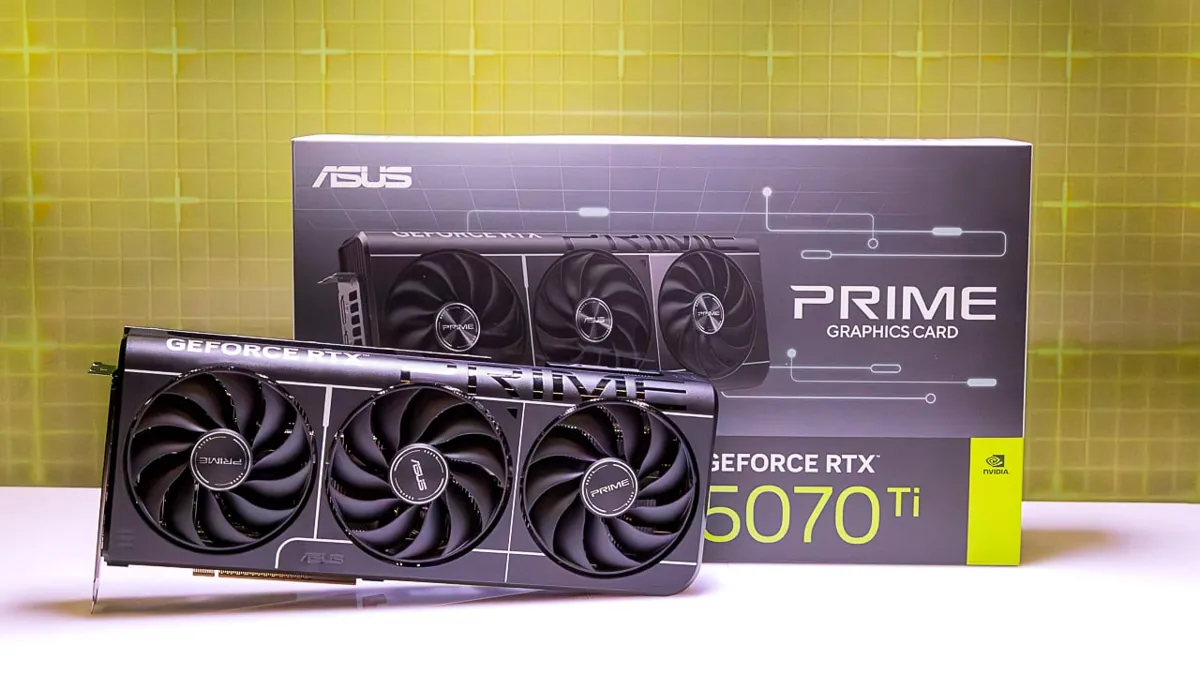

A graphics card upgrade can turn into a compatibility problem quickly. Large triple-fan coolers may not fit your case, compact models can give up cooling headroom, and a desktop with the GPU already installed is a very different purchase from a card alone. We compared the Best 5070 Ti options with those trade-offs in mind.
The list includes full-size cards, SFF-ready designs, a slim dual-slot model, and the ZOTAC MEK desktop. Gigabyte RTX 5070 Ti Gaming OC is our top pick, with the strongest balance of memory, cooling design, and practical fit for a conventional gaming PC. The rest of the range covers small cases, RGB builds, creator systems, and shoppers who want a complete computer instead of a component.
Comparison of the Best 5070 Ti Graphics Cards
| # | Product | Award | Memory | Interface or cooling | Best for |
|---|---|---|---|---|---|
| 1 | Gigabyte RTX 5070 Ti Gaming OC | Best overall | 16GB GDDR7 | PCIe 5.0, WINDFORCE | Standard ATX gaming PCs |
| 2 | PNY RTX 5070 Ti OC Triple Fan | Best for creators | Not specified | Triple fan | Gaming and creative apps |
| 3 | Gigabyte RTX 5070 Ti Eagle OC ICE | Best SFF design | 16GB GDDR7 | PCIe 5.0, SFF ready | Compact white builds |
| 4 | PNY RTX 5070 Ti Epic-X RGB | Best RGB card | Not specified | Triple fan | RGB gaming PCs |
| 5 | ZOTAC MEK RTX 5070 Ti Desktop | Best complete PC | 16GB GDDR7 | 360mm liquid cooling | Ready-to-use systems |
| 6 | MSI RTX 5070 Ti FRIEREN | Best thermal design | 16GB GDDR7 | TRI FROZR 4 | Quiet high-load use |
| 7 | Gigabyte RTX 5070 Ti AERO OC | Best for clean builds | 16GB GDDR7 | PCIe 5.0, WINDFORCE | Light-colored PCs |
| 8 | Gigabyte RTX 5070 Ti Eagle OC SFF | Best compact black card | 16GB GDDR7 | PCIe 5.0, SFF ready | Small form factor PCs |
| 9 | PNY RTX 5070 Ti Slim | Best dual-slot card | Not specified | Dual fan, dual slot | Tight expansion layouts |
| 10 | Coal2ToalPW RTX 5070 Ti OC | Best reference-style alternative | 16GB GDDR7 | PCIe 5.0, triple fan | Buyers seeking a listed OC model |
1. Gigabyte RTX 5070 Ti Gaming OC: Best Overall

Pros
- 16GB of GDDR7 memory
- PCIe 5.0 support
- WINDFORCE cooling system
- Strong fit for conventional full-size builds
Cons
- Large 13.46-inch card
- Nearly 4 pounds
- Not intended for small form factor cases
Best for: someone building a conventional gaming PC who wants a well-rounded RTX 5070 Ti card.
Gigabyte RTX 5070 Ti Gaming OC is the card we would start with for a normal ATX or roomy microATX build. It does not chase a narrow specialty. Instead, it combines the RTX 5070 Ti platform with 16GB of GDDR7, PCIe 5.0, and Gigabyte's WINDFORCE cooling system. That makes it easier to recommend than a model whose main appeal is a particular color, lighting system, or case size.
The 16GB memory capacity matters for demanding games and creative applications because it gives the GPU room to handle large textures and complex scenes. PCIe 5.0 provides the current interface listed for the card, while NVIDIA Blackwell architecture and DLSS 4 are called out among its features. Those technologies are more meaningful than a small clock difference when a game supports them, especially in demanding ray-traced workloads.
This is a physically substantial card. Its listed length is 13.46 inches, its height is 2.76 inches, and its width is 5.59 inches. The listed weight is 3.92 pounds, so the case needs enough clearance and the build should support the card properly. That size is the main reason the shorter Gigabyte Eagle OC ICE and Eagle OC SFF models may be better for compact cases.
The weakness is straightforward: this is not a compact component, and the product information does not list display outputs or a power requirement. Check those details against your case, power supply, and monitor setup before ordering. It is also less visually distinctive than the PNY Epic-X RGB. For the broadest group of buyers, though, the combination of memory, PCIe 5.0, and WINDFORCE makes it the most sensible starting point.
2. PNY RTX 5070 Ti OC Triple Fan: Best for Creators

Pros
- Triple-fan cooler
- NVIDIA Blackwell architecture
- DLSS support
- NVIDIA Studio driver support is highlighted
Cons
- Dimensions are not specified
- Memory capacity is not stated in the feature list
- Triple-fan design may not suit compact cases
Best for: gamers and creators who want a PNY triple-fan card with NVIDIA software features.
The PNY RTX 5070 Ti OC Triple Fan takes a more software-focused approach than Gigabyte's plainly specified Gaming OC. Its listing highlights DLSS, fifth-generation Tensor Cores, new Streaming Multiprocessors, fourth-generation Ray Tracing Cores, Reflex technologies, and NVIDIA Studio drivers. That collection makes it particularly relevant to someone who plays games but also spends time in accelerated creative applications.
A triple-fan cooler is the visual clue to its intended role. Three fans generally provide more cooling surface and airflow options than a small dual-fan arrangement, though the product listing does not provide the card's dimensions. That missing information matters for installation. A triple-fan model should be treated as a full-size card until the seller's current specification confirms otherwise.
PNY also emphasizes Reflex for faster target acquisition and reduced pipeline latency in competitive games. DLSS is positioned as a way to raise frame rates and improve image quality through neural rendering. These are not substitutes for raw GPU capability, but they can change how the card behaves in supported games. The NVIDIA Studio driver support is the more useful distinction for video, 3D, and other creative workloads.
The real limitation is incomplete hardware detail in the supplied listing. Unlike Gigabyte RTX 5070 Ti Gaming OC, it does not state memory capacity or PCIe interface in its feature list. That makes the PNY model harder to evaluate on paper, even though its architecture and software support are clearly described. Choose it when those NVIDIA gaming and creator features matter most, and confirm the physical fit before buying.
3. Gigabyte RTX 5070 Ti Eagle OC ICE: Best SFF Design

Pros
- SFF-ready design
- 16GB GDDR7 memory
- PCIe 5.0
- Shorter and lighter than Gigabyte's full-size cards
Cons
- Compact cooler may have less thermal headroom
- Listed dimensions still need case clearance
- Product condition should be checked before purchase
Best for: someone building a compact PC who wants an SFF-ready RTX 5070 Ti in a light-colored design.
Gigabyte RTX 5070 Ti Eagle OC ICE solves the most common problem with powerful graphics cards: they can be difficult to fit. The card is explicitly described as NVIDIA SFF ready, and its listed length is 11.97 inches. That is meaningfully shorter than the 13.46-inch Gigabyte Gaming OC and AERO OC models.
The card still carries the core specification most buyers want from this class. It has 16GB of GDDR7 on a 256-bit memory interface, PCIe 5.0 support, and NVIDIA Blackwell architecture with DLSS 4. The lower listed height of 1.97 inches and width of 4.96 inches also make it easier to consider for a compact chassis, though you should compare those measurements with the case's exact GPU clearance.
The listed weight is 2.66 pounds, which is substantially lighter than the full-size Gigabyte cards in this roundup. That can make installation simpler and puts less strain on the slot. The ICE styling also gives it a distinct appearance in a light-colored build, while the black Eagle OC SFF serves the same compact goal with a more subdued finish.
The compromise is the usual one for a smaller card. A compact cooler has less physical room for heatsink mass and airflow than a larger triple-fan design, so buyers focused on sustained heavy workloads should think carefully about case ventilation. Compared with Gigabyte RTX 5070 Ti Gaming OC, this model wins on fit and weight, not on sheer cooler size. It is the more intelligent pick for a small case that cannot accommodate a long card.
4. PNY RTX 5070 Ti Epic-X RGB: Best RGB Card

Pros
- Epic-X RGB styling
- Triple-fan design
- DLSS and Reflex support
- NVIDIA Studio driver support
Cons
- Dimensions are not supplied
- Memory capacity is not stated in the listing features
- RGB adds visual complexity without changing GPU capability
Best for: someone who wants a triple-fan RTX 5070 Ti that stands out in a windowed gaming PC.
The PNY RTX 5070 Ti Epic-X RGB is the choice for a build where the graphics card is part of the presentation. Its Epic-X RGB name separates it from PNY's otherwise similar OC Triple Fan model, while the triple-fan design keeps the card aimed at sustained gaming rather than minimal case volume.
Its feature list describes the same useful NVIDIA platform benefits found on the other PNY card. DLSS uses neural rendering technologies to improve frame rates and image quality in supported games, Reflex focuses on responsiveness, and the card includes access to NVIDIA Studio drivers for creative applications. The fifth-generation Tensor Cores and fourth-generation Ray Tracing Cores are also identified.
There is a practical benefit to choosing a triple-fan design in a spacious case. More fan hardware can support the airflow needed during extended gaming or rendering, although the listing does not give a detailed thermal specification. The card's dimensions are also absent, so do not assume it will fit simply because another RTX 5070 Ti does. Confirm the clearance around the motherboard, front fans, and side panel.
The weakness is that the RGB identity is more visible in the name than in the supplied technical information. No lighting controls or connector details are listed, and the memory capacity is not stated in the feature list. PNY RTX 5070 Ti OC Triple Fan is the less decorative alternative, while Gigabyte RTX 5070 Ti Eagle OC ICE is the better direction for a compact build. Pick the Epic-X RGB when appearance is a genuine part of the build plan, not when you are trying to minimize size.
5. ZOTAC MEK RTX 5070 Ti Desktop: Best Complete PC

Pros
- RTX 5070 Ti included
- Ryzen 7 9700X processor
- 32GB DDR5-6000 memory
- 1TB NVMe M.2 SSD
- 360mm AIO liquid cooling
Cons
- Large 19.09-inch-tall tower
- Heavier than a graphics card upgrade
- Component-level upgrades offer more control
Best for: someone who wants an entire Windows 11 Pro gaming desktop built around an RTX 5070 Ti.
The ZOTAC MEK RTX 5070 Ti Desktop is not a graphics card purchase in the usual sense. It is a complete tower for someone who does not already have a suitable case, motherboard, processor, power supply, and storage. The system arrives with Windows 11 Pro installed and includes an RTX 5070 Ti with 16GB of GDDR7.
The surrounding hardware is unusually clear in the listing. An AMD Ryzen 7 9700X provides eight cores and 16 threads, with a listed boost speed of up to 5.5GHz and 32MB of L3 cache. The system also includes 32GB of DDR5-6000 memory, a 1TB NVMe M.2 SSD, and a 750W 80+ Gold power supply. That gives the GPU a balanced platform for games, multitasking, and content creation without requiring a separate component selection process.
Cooling is a major part of the MEK design. It uses a 360mm AIO liquid cooler, an ultra-quiet three-phase motor, and six 120mm ARGB fans. The tower has three tempered-glass panels, easy-clean filters, and cable management. Connectivity includes HDMI 2.1b, DisplayPort 2.1b with support for up to four displays, USB 3.2 Gen 2 at 10Gbps, Wi-Fi 6E, Bluetooth 5.3, and 7.1-channel HD audio.
The drawback is scale and flexibility. At 19.09 inches tall, 18.9 inches long, and 8.27 inches wide, with a listed weight of 28.2 pounds, it needs a dedicated space. A custom build around Gigabyte RTX 5070 Ti Gaming OC gives an experienced builder more control over every component, while the MEK removes much of that work. Choose the ZOTAC when a complete, ready-to-use desktop is the point.
6. MSI RTX 5070 Ti FRIEREN: Best Thermal Design

Pros
- TRI FROZR 4 thermal design
- Stormforce fan design
- Nickel-plated copper baseplate
- Three DisplayPort 2.1a outputs and HDMI 2.1b listed
Cons
- Dimensions are not supplied
- No physical weight is listed
- Cooling hardware may be excessive for a small case
Best for: someone who prioritizes a detailed cooler design for extended gaming or rendering loads.
The MSI RTX 5070 Ti FRIEREN is the most explicit cooling-focused design in this group. MSI describes its TRI FROZR 4 system as an upgraded thermal design with airflow control and quieter operation. That is backed by a Stormforce fan with seven blades, claw texturing, and a circular arc intended to improve airflow while limiting noise.
The heat path is described in more detail than on most of these cards. A nickel-plated copper baseplate captures heat from the GPU and memory, while square Core Pipes are designed to maximize contact with the GPU baseplate. Those details do not guarantee a particular temperature, but they show that MSI is addressing both the graphics processor and its memory rather than treating the cooler as a simple fan assembly.
The card uses NVIDIA Blackwell architecture and supports DLSS 4. Its listing also names an extreme clock of 2572 MHz, 16GB of GDDR7 on a 256-bit interface, three DisplayPort 2.1a connections, and one HDMI 2.1b connection. That output selection is useful for multi-monitor users and modern high-refresh displays, although the listing does not state the exact maximum resolution or refresh combinations.
The main issue is missing physical information. MSI does not provide dimensions or weight in the supplied product details, so buyers cannot make a reliable case-fit judgment from the listing alone. The cooler is likely a better match for a well-ventilated tower than a compact enclosure. Compared with PNY RTX 5070 Ti Slim, this is the more cooling-oriented design, while the PNY is easier to consider when expansion space is tight.
7. Gigabyte RTX 5070 Ti AERO OC: Best for Clean Builds

Pros
- 16GB GDDR7 memory
- PCIe 5.0 support
- WINDFORCE cooling system
- Distinct AERO design
Cons
- 13.46-inch length
- Heavier than the Gaming OC version
- Not suitable for compact cases
Best for: someone building a spacious PC where the AERO design and full-size cooling system fit the visual plan.
Gigabyte RTX 5070 Ti AERO OC shares much of its hardware foundation with the Gaming OC. It uses 16GB of GDDR7 on a 256-bit interface, PCIe 5.0, NVIDIA Blackwell architecture, DLSS 4, and a WINDFORCE cooling system. The reason to choose it is less about a different GPU class and more about the AERO identity within a carefully styled build.
Its listed dimensions are 13.46 inches long, 2.76 inches high, and 5.59 inches wide. That puts it in the same large case category as the Gaming OC. The listed weight is 4.03 pounds, slightly more than the Gaming OC, so the card deserves proper support once installed. A full-size case with clear front-to-back airflow is the natural home.
For gaming, the important capacity remains the 16GB GDDR7 memory and the Blackwell feature set. The card can also make sense in creator systems where GPU memory and NVIDIA's current software ecosystem matter. Readers comparing graphics hardware across brands may find how different GPU platforms handle modern game workloads useful before settling on a larger card.
The weakness is overlap. Gigabyte RTX 5070 Ti Gaming OC provides nearly the same listed memory, interface, and cooling fundamentals, while the AERO is heavier. The AERO makes sense when its appearance is part of the build, but it is not the compact choice and the supplied information does not list its display outputs or power requirement. Buy it for the design and full-size format, not because its core specification is radically different.
8. Gigabyte RTX 5070 Ti Eagle OC SFF: Best Compact Black Card

Pros
- NVIDIA SFF ready
- 16GB GDDR7 memory
- PCIe 5.0
- 11.97-inch length
- Lower 2.66-pound listed weight
Cons
- Compact design has less cooler volume
- No display outputs listed
- Less distinctive than the ICE version
Best for: someone who needs a compact black RTX 5070 Ti for a small form factor case.
The Gigabyte RTX 5070 Ti Eagle OC SFF is the black counterpart to the Eagle OC ICE. Its most important feature is not a lighting effect or a minor clock claim. It is the explicit NVIDIA SFF-ready designation, backed by a listed length of 11.97 inches, height of 1.97 inches, and width of 4.96 inches.
Underneath that smaller body, the card retains the key platform details. It has 16GB of GDDR7 on a 256-bit interface, PCIe 5.0, and NVIDIA Blackwell architecture with DLSS 4. Those specifications make it a genuine alternative to the full-size cards rather than a lower-capacity compact product. The listed 2.66-pound weight is also easier on a small motherboard and case bracket.
Case compatibility still needs careful checking. SFF-ready does not mean universal, and the case must have enough room for the card, its power cable, and the surrounding airflow. Compact cases can also recirculate warm air more quickly, so the system's intake and exhaust layout matters more than it would with a roomy tower.
This model gives up the light-colored look of Gigabyte RTX 5070 Ti Eagle OC ICE, but that is its advantage for a black or understated build. It also gives up some cooler volume compared with Gigabyte RTX 5070 Ti Gaming OC. Choose it when the case dictates the decision. If the card has plenty of room around it, the larger Gaming OC remains the more relaxed fit for sustained loads.
9. PNY RTX 5070 Ti Slim: Best Dual-Slot Card

Pros
- Dual-slot form factor
- Dual 120mm fans
- Vapor chamber cooling
- Metal backplate
- Reference-based firmware and vBIOS
Cons
- Dual-fan cooler has less airflow hardware than triple-fan models
- Dimensions are not listed
- Memory capacity is not stated in the feature list
Best for: someone who needs a slim dual-slot card with a compact expansion footprint.
The PNY RTX 5070 Ti Slim is the most useful choice when slot thickness matters more than appearance. PNY describes it as a slim form-factor card in a dual-slot design, which can preserve room for another expansion card or make installation easier in a narrower chassis.
Its cooling system is more serious than the word Slim might suggest. The listing calls out two large 120mm fans, a massive vapor chamber, and a metal backplate. Those components give the card a more substantial thermal approach than a basic thin cooler. The trade-off is that two fans provide less airflow hardware than the triple-fan PNY models, so case ventilation becomes important during long workloads.
PNY also says the design is fully based on the NVIDIA Reference Design, with firmware and vBIOS sourced directly from NVIDIA. That is a useful distinction for buyers who prefer a reference-oriented implementation rather than an aggressively customized board. Blackwell architecture and NVIDIA Studio support extend its appeal beyond gaming.
The supplied listing does not state memory capacity, card dimensions, or display outputs. That makes it essential to verify the current technical details before ordering, especially when the entire reason to choose this card is fit. Gigabyte RTX 5070 Ti Eagle OC SFF is the stronger alternative when you need a clearly listed compact size and 16GB GDDR7. The PNY Slim is the better fit for a buyer whose priority is specifically the dual-slot layout.
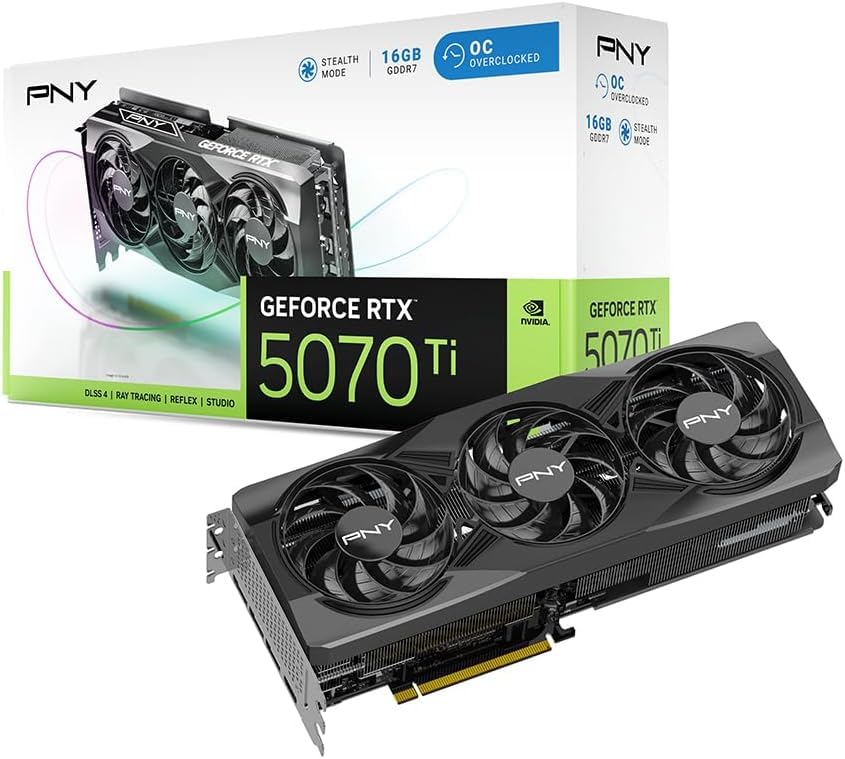
10. Coal2ToalPW RTX 5070 Ti OC: Best Reference-Style Alternative
Pros
- 16GB GDDR7 memory
- 256-bit interface
- PCIe 5.0
- Triple-fan design
- DLSS 4 and Blackwell architecture listed
Cons
- 2.98-slot thickness
- Dimensions are not supplied
- The brand and support details require extra checking
Best for: someone specifically seeking a listed triple-fan OC model with the full RTX 5070 Ti memory configuration.
The Coal2ToalPW RTX 5070 Ti OC is the least conventional entry here, but its stated hardware is clear in several important areas. It lists 16GB of GDDR7, a 256-bit interface, PCIe 5.0, a triple-fan cooler, and a boost speed of 2572 MHz. It also identifies Blackwell architecture and DLSS 4.
That specification makes it look similar on paper to the PNY triple-fan cards. The feature list also mentions fifth-generation Tensor Cores, new Streaming Multiprocessors, fourth-generation Ray Tracing Cores, Reflex, and NVIDIA Studio acceleration. Those features support gaming, competitive responsiveness, and creative software, assuming the listed implementation matches the buyer's requirements.
The card is listed as 2.98 slots thick. That is not a small detail. A card of this thickness can block adjacent expansion space even if its length happens to fit, and the actual length is not supplied in the product information. The HDMI and DisplayPort 2.1 listing suggests modern display connectivity, but exact port counts are not provided.
This is where the model's weakness becomes decisive. Compared with Gigabyte RTX 5070 Ti Gaming OC, it provides fewer verified physical details and less established product context in the supplied information. Buyers should confirm support, dimensions, power connections, and return terms before committing. It belongs at the end of the list because the stated specifications are attractive, but the surrounding information is not as complete as the leading choices.

How to choose best 5070 ti
The right RTX 5070 Ti depends less on a small clock difference than on memory, cooler size, case clearance, and the kind of system you are building.
Memory capacity
The cards that explicitly list 16GB of GDDR7 include the Gigabyte models, MSI FRIEREN, the ZOTAC desktop, and Coal2ToalPW card. Memory capacity affects how comfortably a GPU handles large textures, ray tracing data, creative projects, and high-resolution output. A listing that does not state capacity should not be assumed to match one that does.
The 256-bit interface appears on the Gigabyte cards, MSI FRIEREN, and Coal2ToalPW model. It describes the width of the memory connection, but it is not a complete performance prediction by itself. Look at capacity and the wider platform together.
Case clearance
Length, height, width, and slot thickness all matter. The Gigabyte full-size cards are listed at 13.46 inches long, while the Eagle SFF models are listed at 11.97 inches. The PNY Slim is specifically dual-slot, while the Coal2ToalPW card is listed as 2.98 slots thick.
Measure from the rear expansion bracket to the first obstruction in the case. Leave room for the power cable and do not forget that front fans, radiators, and drive cages can reduce usable clearance.
A card that fits the motherboard can still fail to fit the case once its power cable and side-panel space are included.
Cooling design
Full-size triple-fan cards generally have more room for heatsinks and airflow than compact designs, but the cooler still has to work with the case. MSI's FRIEREN provides the most detailed thermal design in this group, with TRI FROZR 4, a Stormforce fan, a copper baseplate, and Core Pipes. PNY's Slim uses two 120mm fans, a vapor chamber, and a metal backplate.
Compact cards are not automatically poor performers. They simply leave less room for a large cooler, making case airflow more important. A small enclosure with restricted intake should favor careful thermal planning over a card chosen only for its nominal size.
Interface and display connections
PCIe 5.0 is explicitly listed on the Gigabyte cards and the Coal2ToalPW model. MSI lists three DisplayPort 2.1a outputs and HDMI 2.1b, while the ZOTAC desktop lists DisplayPort 2.1b, HDMI 2.1b, and support for up to four displays.
Check the output requirements of the monitors before purchase. The supplied listings do not provide complete port information for every card, so do not infer an identical layout across brands.
Complete system or component
A graphics card upgrade assumes you already have a compatible motherboard, power supply, case, processor, storage, and operating system. The ZOTAC MEK takes the opposite approach, combining the RTX 5070 Ti with a Ryzen 7 9700X, 32GB of DDR5-6000 memory, a 1TB NVMe SSD, and Windows 11 Pro.
That complete system is easier for a first-time buyer, while a standalone card is the better route for an existing PC that only needs a GPU change. If you are comparing platforms rather than individual models, the differences between current NVIDIA GPU choices can help frame the decision.

Frequently asked questions
Is an RTX 5070 Ti suitable for 4K gaming?
The ZOTAC MEK listing specifically describes its RTX 5070 Ti system as suitable for 4K, 1440p, and 1080p gaming. Actual results depend on the game, settings, ray tracing features, and DLSS support. The card's 16GB memory on models where it is specified gives demanding games useful headroom.
How much memory should an RTX 5070 Ti have?
Several cards in this roundup explicitly list 16GB of GDDR7. That capacity is useful for large textures, demanding games, and GPU-accelerated creative applications. Do not assume that a card has 16GB when the listing does not state it.
Will an RTX 5070 Ti fit in a small form factor PC?
The Gigabyte Eagle OC ICE and Eagle OC SFF models are explicitly described as NVIDIA SFF ready and list a length of 11.97 inches. The PNY Slim is described as a dual-slot design, but its dimensions are not supplied. Always compare the card's measurements with the case's GPU clearance and power cable space.
Is a triple-fan graphics card better than a dual-fan model?
A triple-fan card has more fan hardware and can suit a spacious case with sustained high loads. A dual-fan card can be the better fit when the case is narrow or when another expansion slot must remain available. Cooler quality, case airflow, and card dimensions matter as much as the fan count.
Does PCIe 5.0 matter for these cards?
PCIe 5.0 is explicitly listed on the Gigabyte cards and the Coal2ToalPW model. It identifies the connection standard supported by the card. Compatibility still depends on the motherboard and the rest of the system, so check the complete platform rather than judging the GPU in isolation.
Can these cards run multiple monitors?
The ZOTAC MEK listing states support for up to four displays, with HDMI 2.1b and DisplayPort 2.1b connections. MSI lists three DisplayPort 2.1a outputs and HDMI 2.1b. Port counts are not supplied for every model, so verify the exact card before planning a multi-monitor setup.
The bottom line
The Best 5070 Ti choice for a conventional gaming PC is Gigabyte RTX 5070 Ti Gaming OC. Its 16GB GDDR7 memory, PCIe 5.0 support, WINDFORCE cooling, and clearly listed full-size dimensions make it the most balanced recommendation. Choose Gigabyte RTX 5070 Ti Eagle OC SFF instead when case clearance is the deciding factor.
For buyers who want an entire computer, ZOTAC MEK RTX 5070 Ti Desktop is the clear alternative, with a Ryzen 7 9700X, 32GB of DDR5-6000 memory, 1TB NVMe storage, and substantial liquid cooling already installed. If you are undecided, measure your case first, then choose the largest cooler that fits without compromising airflow.
As an Amazon Associate we earn from qualifying purchases.