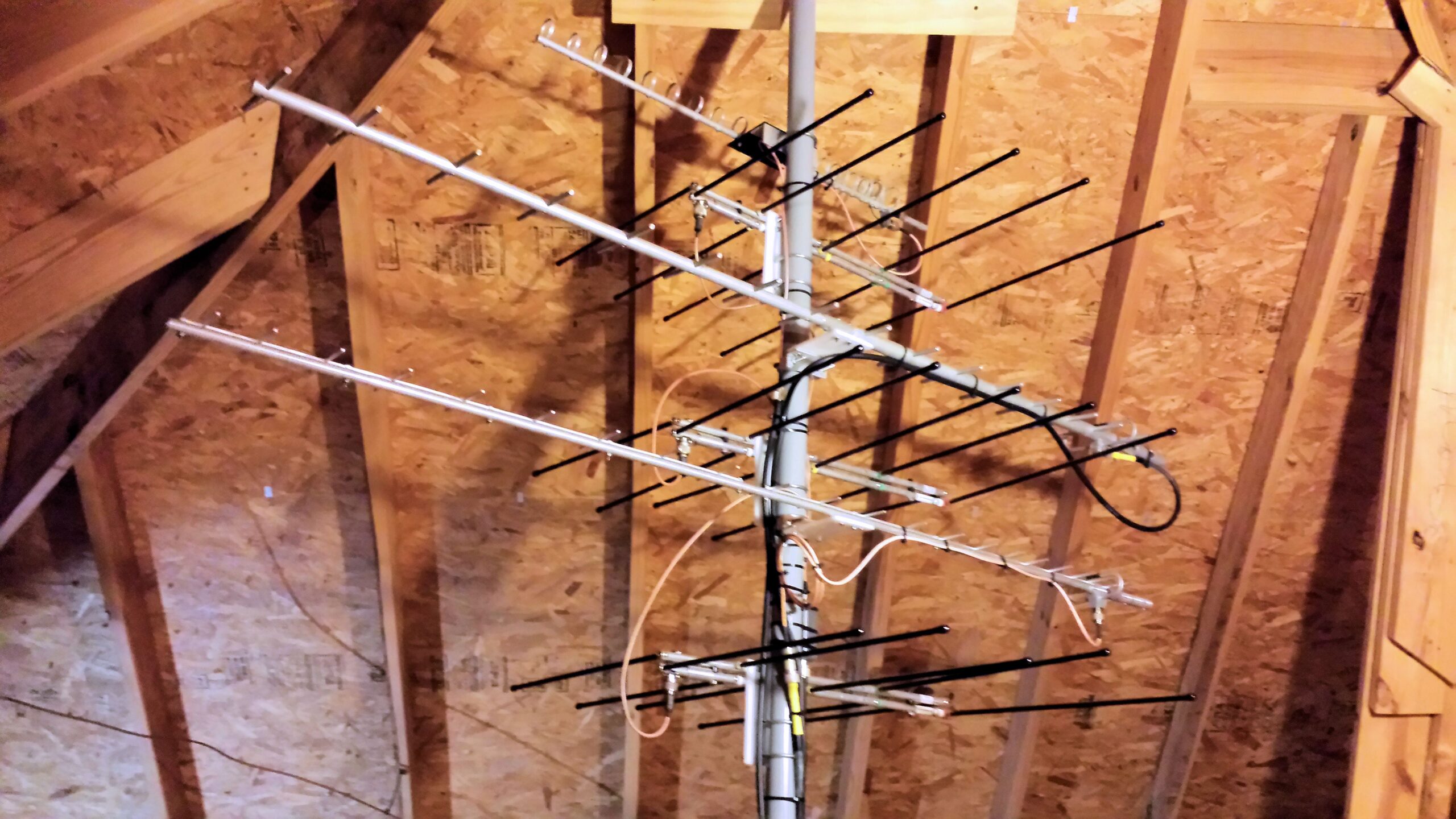

An attic antenna has to work through roofing materials, walls, insulation, and whatever trees or buildings sit between your home and the broadcast towers. The wrong model can find channels during setup, then lose them when weather changes or the TV signal has to travel through a long coaxial run. This guide to the Best best attic antenna options focuses on the hardware that matters: VHF and UHF reception, directional behavior, mounting flexibility, amplification, and support for newer broadcasts.
The GE 29884 is the easiest recommendation for most attic installations because it combines a 70-plus-mile reception claim, VHF and UHF support, an included J mount, weather resistance, and ATSC 3.0 compatibility without adding a motor or complicated controls. The list also includes larger Yagi antennas, rotating amplified models, and the more substantial ClearStream designs.
GE 29884 is the best pick for most attic installations, with options ranging from compact fixed antennas to motorized models for homes that need to aim toward more than one tower.
Comparison table
| # | Product | Award | Reception | Size or range | Best for |
|---|---|---|---|---|---|
| 1 | GE 29884 | Best overall | VHF and UHF | 70+ miles | Straightforward attic installations |
| 2 | Five Star Yagi 4-TV Kit | Best multi-TV kit | VHF and UHF | Up to 200 miles | Four-TV distribution |
| 3 | ClearStream 4V | Best signal focus | UHF and VHF | 70+ miles | Difficult suburban reception |
| 4 | Five Star ATSC 3.0 Kit | Best complete install kit | VHF and UHF | Up to 200 miles | Attic or roof mounting |
| 5 | PIBIDI Rotating Antenna | Best remote aiming | VHF and UHF | Up to 200 miles | Towers in different directions |
| 6 | UltraPro 65000 | Best compact 70-mile model | VHF and UHF | 70 miles | Basic attic setups |
| 7 | PBD Rotating Antenna | Best dual-TV motorized model | VHF and UHF | Up to 150 miles | Two TVs without a splitter |
| 8 | ClearStream 2V | Best reflector design | UHF and Hi-VHF | 60+ miles | Focused suburban reception |
| 9 | Five Star Yagi Pole | Best simple Yagi | VHF and UHF | Up to 200 miles | Attic or roof placement |
| 10 | Five Star ATSC 3.0 Pole | Best minimal ATSC 3.0 kit | VHF and UHF | Up to 200 miles | Installations needing a pole |
1. GE 29884: Best Overall

Pros
- Covers both VHF and UHF broadcasts
- Includes a J mount for attic or outdoor placement
- Weather-resistant construction
- ATSC 3.0 compatible
Cons
- Fixed design cannot be aimed remotely
- The 70-plus-mile claim depends on tower distance and obstructions
- Splitter and coax cables for multiple TVs are not included
Best for: most households that want a simple, fixed attic antenna with broad TV compatibility.
The GE 29884 is the antenna we would start with for a normal attic. It does not ask you to choose between VHF and UHF coverage, and its included J mount gives you a clear path to a fixed installation without hunting for separate mounting hardware. The weather-resistant design also leaves outdoor mounting on the table if the attic proves too restrictive.
Its advertised reception distance is 70-plus miles, but that figure needs sensible interpretation. Broadcast reception depends on tower distance, roofing materials, trees, and the height of the antenna. The useful part here is the combination of VHF and UHF support, rather than the headline number alone. It is also listed as compatible with ATSC 3.0 broadcasts where available, as well as 4K and 8K televisions. The antenna itself does not create 4K programming, but it can feed compatible over-the-air broadcasts to a suitable TV.
The 16.6-inch width and 3-pound weight make the GE easier to position than the much wider ClearStream 4V or ClearStream 2V. It works with TV brands and converter boxes using a standard coax connection, which is helpful if the attic feed goes to an older television or a separate tuner. GE also lists a limited lifetime replacement pledge and U.S.-based technical support, useful when an installation problem turns out to be cable routing rather than the antenna.
The weakness is its fixed direction. If your strongest towers sit in sharply different directions, the PIBIDI Rotating Antenna or PBD Rotating Antenna gives you a way to change aim from the room below. The GE also does not include a splitter or extra coax for a whole-home setup. For a single TV or a straightforward distribution system, though, those omissions keep the installation uncomplicated.
Readers still deciding between attic and exterior placement may want to consider how roofing materials and tower distance affect reception before drilling or running cable. The GE 29884 is the right first choice for anyone who wants a broad-coverage antenna with a conventional mount and no motor to maintain.
2. Five Star Yagi 4-TV Kit: Best Multi-TV Kit

Pros
- Supports VHF and UHF channels
- Includes a 40-foot coax cable
- Includes a four-way splitter
- Comes with a 20-inch J-pole and cable clips
- Supports radio and FM reception
Cons
- Requires assembly
- The large range claim varies with local conditions
- A directional Yagi may need careful positioning
Best for: households that want to distribute one attic antenna to several televisions.
The Five Star Yagi 4-TV Kit makes the most sense when the antenna is only one part of a larger installation. The box includes a 40-foot coax cable, a four-way splitter, 15 cable clips, and a 20-inch J-pole. That saves the reader from assembling a separate list of mounting and distribution parts before getting into the attic.
Five Star says the antenna receives VHF and UHF signals and can reach as far as 200 miles under favorable conditions. The smart-chip booster is intended to reduce signal noise, but no amplifier can overcome every obstruction or turn an unfavorable tower angle into a reliable signal. The extended Yagi structure is designed to stabilize reception, which favors a deliberate attic placement rather than a casually dropped antenna near the nearest rafter.
The installation flexibility is strong. The included pole can be used in an attic, on a roof, at a chimney, on an eave, or on a mast. The antenna is described as weatherproof and lightning protected, so it is not limited to indoor use. Its 17-inch length and 8-inch width are manageable, though the fully assembled system still needs enough room for the pole and cable route.
Compared with the GE 29884, this Five Star model is better equipped for four televisions but more involved to install. The ClearStream 4V has a more substantial reflector-based design for focusing incoming signals, while the Five Star kit wins on included distribution hardware. Its real limitation is that the four-way splitter creates more cabling and can make a weak signal harder to distribute cleanly. Start with one TV, run a channel scan, then add the other feeds.
The kit is a good fit for a family room, bedroom, and guest-room setup that shares one antenna feed. It is less appealing for a single television where the extra splitter and clips add clutter without solving a reception problem.
3. ClearStream 4V: Best Signal Focus

Pros
- Four patented loops for UHF and VHF reception
- Reflectors focus the antenna toward incoming signals
- Supports 4K, 8K UHD, and NEXTGEN TV
- Pivoting 20-inch mast works on vertical or horizontal surfaces
- Suitable for indoor, attic, or outdoor installation
Cons
- Broad 27.8-inch width needs attic space
- Weighs 4.1 pounds
- More antenna than a simple close-to-tower installation may need
Best for: suburban or rural homes dealing with interference and a demanding attic placement.
The ClearStream 4V is the serious reception-focused option in this group. Its four patented loops and reflectors give it a different physical approach from the long, narrow Yagi antennas. The reflectors focus the antenna's power forward, which is intended to protect the incoming signal from interference that can show up as pixelation or a complete loss of picture.
The antenna measures 17.4 inches high, 27.8 inches wide, and 6 inches deep. That width is the first thing to check in an attic. It needs room to sit clear of structural obstacles, and its 4.1-pound weight makes a secure mounting point more important than it would be with the GE 29884. The supplied 20-inch mast has a pivoting base, so it can be mounted on a vertical or horizontal surface rather than forcing the installer into one orientation.
Antennas Direct lists a 70-plus-mile range and support for UHF and VHF broadcasts. It is also compatible with NEXTGEN TV, 4K, 8K UHD, and Full HD 1080p sources. Those compatibility labels describe what the antenna can pass to a suitable tuner, not a guarantee that every local broadcast will use those formats. Tower distance, trees, and building materials remain the deciding factors.
The ClearStream 4V beats the GE 29884 when the installation needs stronger signal focus and the attic has enough width. The GE is easier to place and lighter, while the ClearStream 2V is the smaller sibling with two loops and a 60-plus-mile claim. The 4V's weakness is physical bulk. It is a poor fit for a cramped attic or for anyone who wants to hide a small antenna behind a television.
For a home with multiple obstructions between the attic and the towers, the larger design is easier to justify. The 4V is also a sensible choice when an exterior installation is possible but the owner would rather keep the antenna under cover.
4. Five Star ATSC 3.0 Kit: Best Complete Install Kit

Pros
- VHF and UHF coverage
- ATSC 3.0 ready
- Includes antenna, bracket, J-pole, and splitter
- Supports up to four TVs according to the listing
- Suitable for attic or roof placement
Cons
- Requires a channel scan after installation
- The 200-mile claim depends heavily on local conditions
- Larger than a compact fixed antenna
Best for: a new attic installation that needs mounting hardware and multi-TV distribution in one package.
The Five Star ATSC 3.0 Kit is built around the practical details of getting an antenna installed. The package includes a mounting bracket, J-pole, TV splitter, and instructions, so it is aimed at a household that wants one antenna feeding several rooms. It can be mounted in an attic, on a roof, at a chimney, on an eave, or on a mast.
Its stated reception distance reaches up to 200 miles, with VHF and UHF coverage and support for 1080p and 4K broadcasts. Five Star also identifies it as ATSC 3.0 ready. That makes it a reasonable forward-looking choice, though local tower placement and attic obstructions still matter far more than a large distance figure printed in a listing.
The antenna's listed dimensions are 17.5 inches long, 11.3 inches wide, and 6.3 inches high. It is more substantial than the GE 29884, but it should be easier to accommodate than the 27.8-inch-wide ClearStream 4V. The extended elements are intended to provide a stronger and more stable signal, while the included J-pole gives the installer room to experiment with height and orientation.
The biggest distinction from the Five Star Yagi 4-TV Kit is the package detail. Both are positioned for multi-TV setups, but the Yagi 4-TV Kit includes a 40-foot coax cable and cable clips, while this model's listed kit emphasizes the antenna, mounting hardware, J-pole, and splitter. The PBD Rotating Antenna is more flexible when towers are spread around the compass, but it adds a motor and remote to the system.
A channel scan is required after setup, and Five Star recommends scanning again when the lineup changes or a channel disappears. That is normal antenna ownership, not a fault. Choose this model when a clean, complete mounting package matters more than remote aiming.
5. PIBIDI Rotating Antenna: Best Remote Aiming

Pros
- Motorized 360-degree rotation
- Wireless remote control
- VHF and UHF support
- Includes a 40-foot RG6 coax cable
- Built-in amplifier and LTE filter
Cons
- Motor and power adapter add installation complexity
- Rotation does not guarantee a clear signal through obstructions
- Remote aiming is unnecessary when towers are in one direction
Best for: homes where broadcast towers sit in different directions and manual repositioning would be awkward.
The PIBIDI Rotating Antenna solves a specific attic problem: the best orientation for one group of channels may not be the best orientation for another. Its built-in rotor turns through 360 degrees, and the wireless remote lets you change direction without climbing back into the attic. That is a meaningful convenience in a house with towers spread across different headings.
PIBIDI lists VHF coverage from 170 to 230 MHz and UHF coverage from 470 to 860 MHz. It also includes a smart chip, automatic gain control, a high-gain low-noise amplifier, and an LTE filter intended to reduce interference from 4G and 5G signals. The listing identifies support for 720p, 1080i, 1080p, and 4K broadcasts, though the antenna cannot guarantee those formats in every location.
The package includes a wireless remote, power supply adapter, 40-foot RG6 coaxial cable, and mounting pole. That cable length can simplify a long route from the attic to the television, but the amplifier and rotor mean there are more connections to manage than with the GE 29884. The weather-resistant, lightning-protected design supports outdoor use as well as attic placement.
The PBD Rotating Antenna also offers motorized movement, but its standout difference is dual-TV output rather than the PIBIDI's listed LTE filtering and automatic gain control. The ClearStream 4V remains a better choice when the signal needs forward focus and the antenna can stay fixed. A rotor is most useful when orientation is genuinely the problem, not when the attic blocks the signal in every direction.
Skip this one if all nearby towers lie in the same direction or if you want a passive, low-maintenance setup. For a rural or irregular tower layout, the remote is the feature that separates it from almost every fixed model here.
6. UltraPro 65000: Best Compact 70-Mile Model

Pros
- 70-mile VHF and UHF reception claim
- Includes a J mount, mast clamp, and mounting bracket
- Weather-resistant attic or outdoor design
- ATSC 3.0 compatible
- Limited lifetime replacement pledge listed
Cons
- Splitter and coax cables are sold separately
- Fixed orientation
- Less suitable for towers in different directions
Best for: a compact, uncomplicated attic installation with room for separate cabling choices.
The UltraPro 65000 is a compact alternative to the GE 29884, with a similar 70-mile reception claim and the same broad VHF and UHF focus. Its included mounting bracket, mast clamp, and J mount make it ready for attic, roof, or wall placement. The design is weather resistant, so the antenna is not restricted to sheltered indoor use.
The published dimensions are 17 inches high, 7.9 inches wide, and 2.75 inches long. That narrow profile is easier to work around than the broad ClearStream antennas, especially in an attic where trusses and ductwork limit positioning. It supports 4K and 8K televisions and is listed as compatible with ATSC 3.0 broadcasts, but the actual channel lineup still depends on the local broadcast environment.
UltraPro positions this as a whole-home antenna when paired with a splitter and coax cables, which are sold separately. That is an important practical distinction from the Five Star Yagi 4-TV Kit, whose package includes a four-way splitter and 40-foot cable. The UltraPro gives you more freedom to choose cable lengths and distribution hardware, but it requires more planning before installation.
The fixed design is the main compromise. It cannot turn toward another tower like the PIBIDI Rotating Antenna, and it does not have the ClearStream 4V's reflector-based signal focus. It is also not the right pick for someone expecting the antenna alone to solve a weak signal caused by heavy roofing or dense trees.
For a straightforward attic with towers generally located in one direction, the UltraPro 65000 keeps the hardware simple. It is especially appealing when the installer already has a coax distribution plan and wants to avoid a motor, remote, or oversized antenna frame.
7. PBD Rotating Antenna: Best Dual-TV Motorized Model

Pros
- 360-degree motorized rotation
- Wireless remote control
- Dual TV outputs without a splitter
- Includes a 40-foot RG6 cable and mounting hardware
- Supports VHF, UHF, 4K, and 1080p broadcasts
Cons
- Motorized hardware needs power and more connections
- The listing's range claim varies with local reception conditions
- Direction changes may not suit simultaneous viewing of different tower groups
Best for: two-TV homes that need remote aiming and do not want a separate splitter.
The PBD Rotating Antenna combines two useful features that rarely appear together in a basic fixed model: remote aiming and dual TV outputs. The motor rotates through 360 degrees, while the wireless remote lets the owner adjust direction from inside the house. Two televisions can connect simultaneously without an additional splitter.
PBD describes the antenna as amplified, with a built-in high-gain, low-noise amplifier. It supports UHF and VHF reception and is listed for 4K and 1080p televisions, including smart and older TVs. The advertised reception distance reaches up to 150 miles, but the same practical limits apply here as with every antenna in this list. Trees, walls, roof materials, and tower location decide whether a signal is usable.
The installation package includes a mounting pole, 40 feet of RG6 coaxial cable, mounting hardware, and a guide. The weatherproof design is intended for outdoor use, which also makes it suitable for an attic. Its listed dimensions are 17.5 inches long, 13 inches wide, and 4.5 inches high. The footprint is not tiny, but it is easier to accommodate than the 31.4-inch-wide ClearStream 2V.
The dual outputs are the reason to choose this over the PIBIDI Rotating Antenna. If the second TV is the priority, PBD avoids a separate splitter. The catch is that both TVs share the antenna's current direction. If one viewer needs a station from one tower group while another wants a station from another, rotating the antenna can help one set while hurting the other.
The motor, power connection, and remote also create more points to troubleshoot than the GE 29884 or UltraPro 65000. Choose the PBD when remote direction control and two direct TV connections solve a real problem. Skip it when every desired station is already aligned in one direction.
8. ClearStream 2V: Best Reflector Design

Pros
- Double-loop design handles UHF and Hi-VHF
- Reflector focuses incoming signals
- Includes a pivoting 20-inch mast
- Supports 4K, 8K UHD, and NEXTGEN TV
- Lifetime antenna warranty listed
Cons
- 31.4-inch width needs significant attic space
- 60-plus-mile range claim is lower than some competitors
- Fixed design has no remote rotation
Best for: viewers who want a reflector-focused antenna and have enough attic width for it.
The ClearStream 2V takes the same broad design approach as the ClearStream 4V but uses a double-loop antenna. Its reflector is meant to focus the antenna's power forward and protect the incoming signal from interference. That makes the model interesting for suburban homes where the main tower direction is known but signal quality suffers from competing obstructions.
The antenna measures 18 inches high, 31.4 inches wide, and 6.5 inches deep. It weighs 2 pounds, which is lighter than the ClearStream 4V, but its wide frame still needs a deliberate mounting location. The 20-inch mast has a pivoting base for vertical or horizontal surfaces, and the supplied hardware supports indoor, attic, or outdoor installation.
The listed reception range is 60-plus miles, with UHF and Hi-VHF coverage. It supports NEXTGEN TV, 4K, 8K UHD, and Full HD 1080p sources without an internet connection. Those capabilities make it compatible with modern tuners, but they do not replace a clear signal path. The antenna cannot provide cable channels, and local tower placement remains central.
The ClearStream 4V is the stronger choice when the installation needs the larger four-loop design and has enough space. The GE 29884 is narrower and easier to position, while the ClearStream 2V offers a more focused reflector design for a known tower direction. Its broad frame is the main reason to pass on it. Measure between attic supports before choosing it.
For readers comparing indoor placement with attic mounting, the trade-off between a hidden antenna and a clearer signal path is worth considering. The ClearStream 2V suits an installer who values the reflector and mast system more than compact dimensions.
9. Five Star Yagi Pole: Best Simple Yagi

Pros
- VHF and UHF reception
- Includes a 20-inch mounting pole
- Supports radio and FM reception
- Weatherproof design
- Suitable for attic, roof, chimney, or eave mounting
Cons
- Fully assembled installation may take time
- No included four-way splitter
- Fixed design cannot be rotated from the living room
Best for: a simple Yagi installation where the included pole matters more than multi-TV accessories.
The Five Star Yagi Pole is the simpler of the two closely related Yagi options in this list. It includes a 20-inch mounting pole and a 40-foot coax cable, making it a practical choice for an attic or roof installation that needs a long cable run. The antenna is also compatible with radio and FM reception, a useful extra for households that want one rooftop or attic antenna to handle more than television.
Five Star lists VHF and UHF reception, along with support for 4K, 1080p, 1080i, and 720p local broadcasts. Its claimed range reaches up to 200 miles, subject to tower distance and obstructions. The extended receiving elements are designed to provide stable reception, but a Yagi's directional behavior still makes placement important.
The antenna measures 17 inches long, 8 inches wide, and 6 inches high. It is described as weatherproof and lightning protected, so attic mounting is only one option. The included pole can be used on a roof, chimney, eave, mast, or outside wall. Some parts are preassembled, but the listing says full assembly is required, so allow time to put the structure together and route the coax cleanly.
Compared with the Five Star Yagi 4-TV Kit, this version omits the listed four-way splitter and cable clips. That makes it less ready for a whole-home distribution system, but it also keeps the bundle focused on the antenna, pole, and cable. The Five Star ATSC 3.0 Pole is the closer alternative if ATSC 3.0 readiness is the deciding feature.
The fixed Yagi format is not ideal when towers sit in different directions. A motorized model such as the PBD Rotating Antenna handles that situation more gracefully, though with more hardware to power and maintain. Choose the Five Star Yagi Pole when a known tower direction and included pole simplify the installation.
10. Five Star ATSC 3.0 Pole: Best Minimal ATSC 3.0 Kit

Pros
- VHF and UHF support
- ATSC 3.0 ready
- Includes a mounting bracket and J-pole
- Suitable for attic or roof installation
- Supports 4K and 1080p broadcasts
Cons
- No listed splitter or coax cable
- Fixed orientation
- Requires assembly and a channel scan
Best for: an installer who wants ATSC 3.0 support and a mounting pole without a larger accessory bundle.
The Five Star ATSC 3.0 Pole is the pared-back companion to the Five Star ATSC 3.0 Kit. It is built for attic, roof, chimney, eave, mast, or exterior placement and includes a mounting bracket and J-pole. That makes it a reasonable fit for an installer who already has the coax and distribution parts needed for the rest of the house.
Five Star lists support for both VHF and UHF broadcasts, 4K and 1080p reception, and ATSC 3.0 readiness. The headline reception distance is up to 200 miles, but that figure should not determine placement by itself. The antenna's position relative to the towers, along with trees and building materials, will have a greater effect on the channel scan.
The antenna measures 17.5 inches long, 11.3 inches wide, and 6.3 inches high. Its dimensions are close to the Five Star ATSC 3.0 Kit, and both use an extended design intended to make reception more stable. The difference is the included equipment. The kit version includes a splitter, while this model's listed package centers on the antenna, mounting bracket, J-pole, and instructions.
That difference puts it behind the GE 29884 for a simple single-TV installation, since the GE has a more direct, conventional package and a 70-plus-mile claim that is easier to frame realistically. The Five Star ATSC 3.0 Pole is more attractive when the owner wants the included pole and a long-range Yagi format. It is not a good choice for someone who expects remote aiming or a ready-made multi-TV setup.
Run a channel scan after mounting and repeat it if the lineup changes. This model is best for a hands-on installer who understands that the pole height and orientation are part of the reception system, not just accessories in the box.
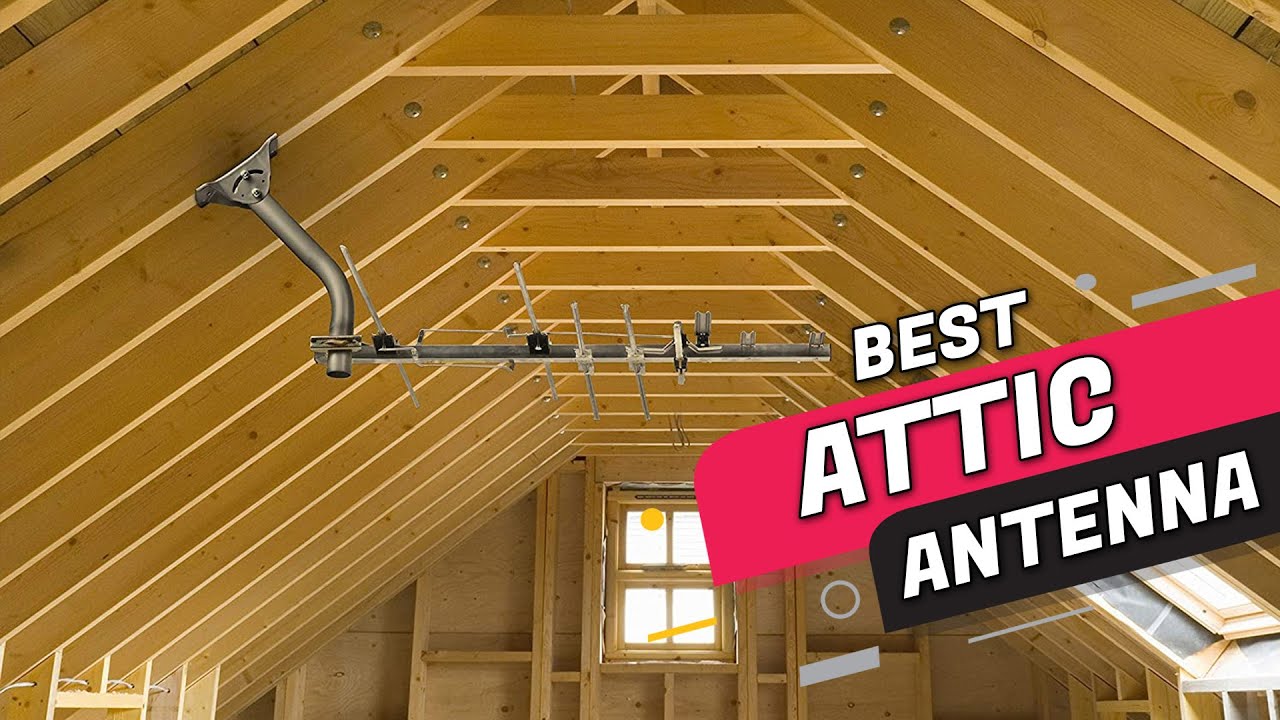
How to choose best attic antenna
The right attic antenna depends less on a headline distance claim than on the broadcast bands, tower direction, attic construction, and number of televisions it must serve.
VHF and UHF coverage
VHF and UHF are different broadcast bands, and an antenna needs to support the bands used by the stations in your area. Every model in this roundup lists VHF and UHF reception, while the ClearStream 2V specifically identifies UHF and Hi-VHF elements. A model that covers both gives you more flexibility than one optimized for only one band.
Check local tower information before installing. If important stations use different bands, broad coverage matters more than a single impressive range claim.
Direction and signal focus
A fixed antenna is easiest when the broadcast towers are grouped in one direction. The ClearStream 4V and ClearStream 2V use reflectors to focus incoming signals forward, while the Yagi models use extended elements designed for directional reception. The PIBIDI and PBD models add motorized 360-degree rotation for homes where tower groups are separated.
A rotor can change the antenna's direction, but it cannot remove a roof, tree, or wall blocking every direction.
Attic space and mounting
Measure the available space before choosing a large frame. The ClearStream 4V is 27.8 inches wide, and the ClearStream 2V is 31.4 inches wide. The GE 29884 and UltraPro 65000 are easier to fit when trusses or ductwork leave limited room.
A pivoting mast can make the difference between a workable installation and an awkward one. J mounts and poles also give you more options for raising the antenna above nearby obstructions.
Amplification and filtering
Amplifiers can help compensate for signal loss through long coax runs or a distribution system, but they do not manufacture a usable broadcast signal. PIBIDI lists automatic gain control, a high-gain low-noise amplifier, and an LTE filter. PBD lists a built-in high-gain, low-noise amplifier.
If the signal is already strong at the antenna, extra amplification may not be necessary. If the signal weakens after a long cable run or splitter, an amplified model may be more useful than a passive antenna.
Multi-TV connections
A single antenna can feed more than one TV, but the distribution hardware matters. The Five Star Yagi 4-TV Kit includes a four-way splitter, 40 feet of coax, and cable clips. The Five Star ATSC 3.0 Kit includes a splitter, while the PBD Rotating Antenna lists two TV outputs without a separate splitter.
For more advice on planning coax runs across several rooms, consider the number of TVs before mounting the antenna. Every extra connection and cable length can affect the signal reaching the tuner.

Frequently asked questions
Can an attic antenna receive 4K channels?
An antenna does not create a particular picture resolution. The models here are listed as compatible with 4K broadcasts and modern televisions, but the available format depends on local stations and the TV or tuner connected to the coax cable.
Is a 200-mile antenna really able to receive stations 200 miles away?
That distance is a product claim, not a guarantee for every installation. Broadcast curvature, terrain, tower height, trees, roofing materials, and interference all affect reception. A nearby tower blocked by a roof can be harder to receive than a more distant tower with a clear path.
Should an attic antenna be amplified?
Amplification can help with signal loss from long coax runs or a splitter. It cannot fix a poor antenna position or a tower blocked by dense materials. Models such as the PIBIDI and PBD include amplified designs, while other picks rely on the antenna and cable system without a listed amplifier.
Do attic antennas need to point toward the towers?
Many fixed antennas work best when aimed toward the main broadcast towers. The ClearStream models use reflectors for forward signal focus, and the Yagi models use directional receiving elements. Motorized models can change direction when towers are spread across different headings.
Can one antenna feed several televisions?
Yes, with suitable distribution hardware and coax cabling. The Five Star Yagi 4-TV Kit includes a four-way splitter, and the PBD Rotating Antenna lists dual TV outputs. Splitting a weak signal can reduce reliability, so establish a good antenna position before connecting every room.
Does ATSC 3.0 support mean the antenna is future proof?
ATSC 3.0 readiness means the antenna is listed as compatible with that broadcast standard where it is available. You also need a compatible tuner or television, and local broadcasters must transmit ATSC 3.0 programming. It does not guarantee that every channel in your area uses the standard.
The bottom line
The Best best attic antenna for most homes is the GE 29884. It covers VHF and UHF, includes a J mount, supports ATSC 3.0, and has a manageable fixed design that suits a broad range of attic installations. The ClearStream 4V is the stronger specialist pick when the attic has room for its wide frame and signal interference is the central concern.
Choose the Five Star Yagi 4-TV Kit when one antenna needs to serve several televisions and the included splitter and cable simplify the project. Pick the PIBIDI Rotating Antenna or PBD Rotating Antenna when tower direction changes are more important than keeping the setup passive.
If you are undecided, start by checking the tower directions and measuring the attic space, then choose the simplest antenna that covers both VHF and UHF.
As an Amazon Associate we earn from qualifying purchases.