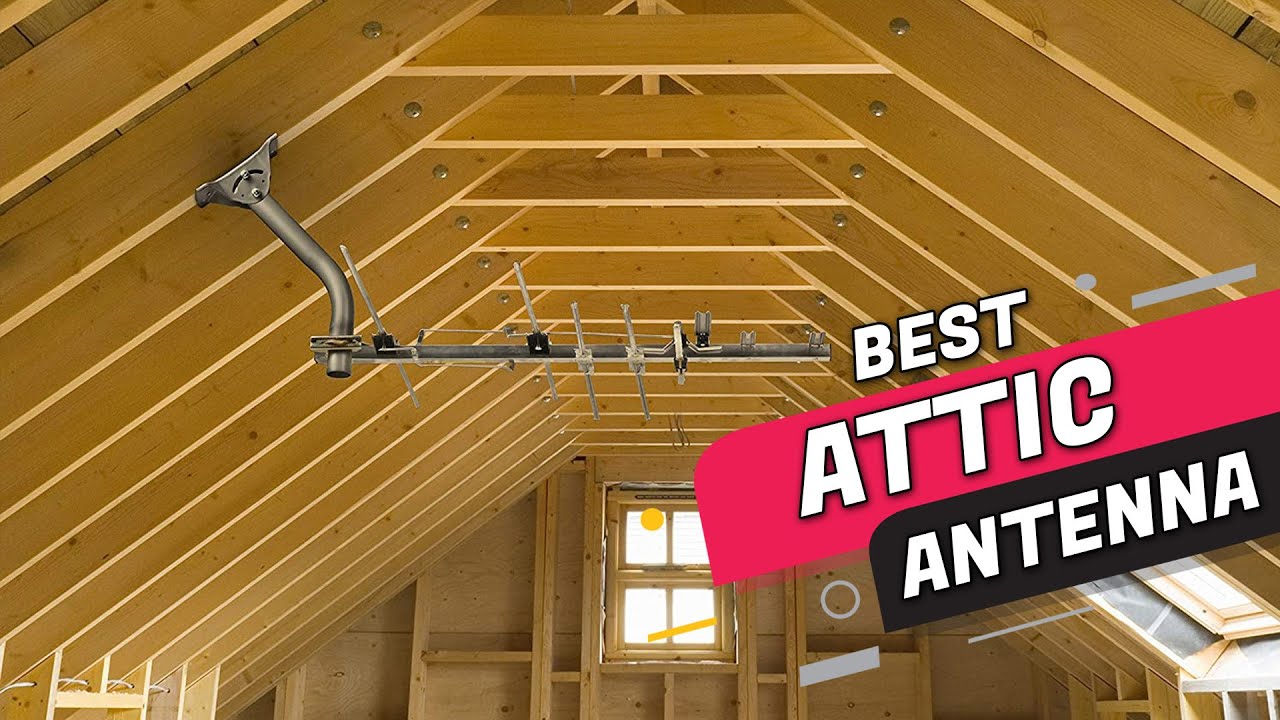

An attic antenna has to work through roofing materials, walls, insulation, and whatever trees or buildings sit between your home and the broadcast towers. A model that looks powerful on paper can still produce pixelation if its design does not suit the direction and strength of local signals.
We compared 10 outdoor-capable antennas that can be installed in an attic, including directional Yagi designs, motorized models, and multi-directional antennas. The GE Outdoor HD Digital TV Antenna is the best attic tv antenna for most homes, while the other picks solve more specific reception and installation problems.
Comparison table
| # | Product | Award | Reception | Installation or connection | Best for |
|---|---|---|---|---|---|
| 1 | GE Outdoor HD Digital TV Antenna | Best overall | VHF and UHF, 70+ miles | J mount, attic or outdoor | Most attic installations |
| 2 | Five Star Yagi 200 Mile Antenna | Best complete kit | VHF and UHF, up to 200 miles | 40-foot cable, J-pole, four-way splitter | Multiple TVs |
| 3 | PIBIDI Rotating HD Antenna | Best motorized | VHF and UHF, up to 200 miles | 360-degree rotation, remote | Towers in different directions |
| 4 | Five Star ATSC 3.0 Antenna | Best for newer broadcasts | VHF and UHF, up to 200 miles | J-pole, splitter, mounting bracket | Future broadcast standards |
| 5 | ClearStream 4V | Best high-gain design | UHF and VHF, 70+ miles | 20-inch pivoting mast | Difficult suburban reception |
| 6 | PBD Motorized Outdoor Antenna | Best for two TVs | UHF and VHF, up to 150 miles | 360-degree rotation, dual outputs | Two-screen setups |
| 7 | UltraPro Outdoor HD Antenna | Best compact mount | VHF and UHF, up to 70 miles | J mount, attic or outdoor | Simple attic installs |
| 8 | Five Star Indoor Outdoor Yagi | Best Yagi alternative | VHF and UHF, up to 200 miles | 20-inch pole, 40-foot cable | Directional reception |
| 9 | 1byone Omni-Directional Antenna | Best no-aiming design | UHF and VHF, 100+ miles | 360-degree reception, 32-foot cable | Multiple tower directions |
| 10 | ClearStream 2V | Best reflector antenna | UHF and VHF, 60+ miles | Reflector, 20-inch pivoting mast | Focused suburban reception |
1. GE Outdoor HD Digital TV Antenna: Best Overall

Pros
- Covers both VHF and UHF broadcasts
- Includes a J mount for attic or outdoor placement
- Weather-resistant construction
- Supports ATSC 3.0 broadcasts where available
- Works with TVs and converter boxes using coaxial input
Cons
- No cable, splitter, or amplifier is listed
- Its 70+ mile range is not a guarantee through heavy obstructions
- The body is broader than compact indoor antennas
Best for: most households that want a straightforward attic or outdoor installation.
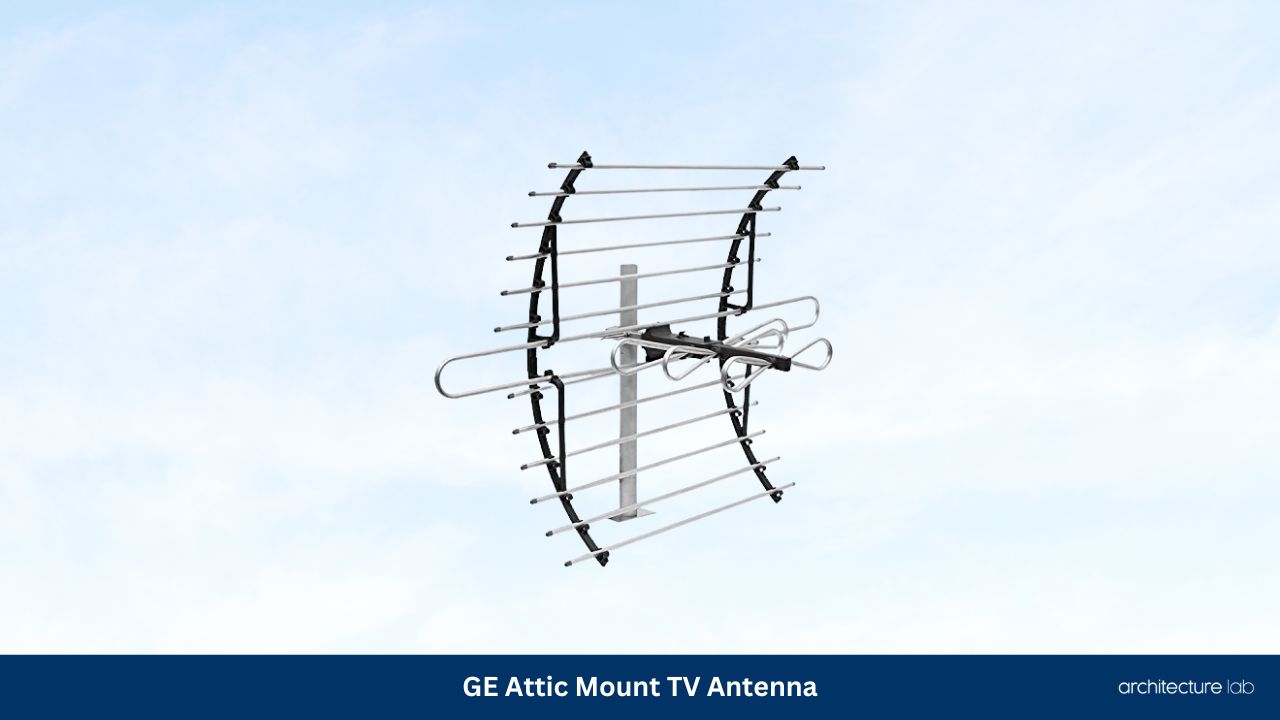
The GE Outdoor HD Digital TV Antenna is the easiest recommendation in this group because it avoids the two problems that make attic antenna shopping frustrating: unclear installation options and narrow channel compatibility. It handles both VHF and UHF signals, comes with a J mount, and is designed for an attic or outdoor position. That makes it a practical fit for a homeowner who wants to put the antenna above the living space without immediately committing to a roof installation.
Its stated reception range is 70+ miles, though the useful distance depends heavily on tower location, roofing material, trees, and nearby structures. The important part is that GE does not limit this model to one band. VHF and UHF broadcasts behave differently, so dual-band coverage gives it a better chance of finding the local stations people actually want. The antenna supports 1080p and is described as compatible with 4K and 8K televisions, but the antenna itself does not create higher-resolution broadcasts. It passes along whatever the station transmits.
The GE also supports ATSC 3.0 where that broadcast standard is available. That is a useful bit of forward compatibility, although it does not mean every television can decode those broadcasts without the necessary tuner. The universal coaxial compatibility is more immediately useful, since it lets the antenna work with TV brands and converter boxes that use a standard coax connection.
Compared with the UltraPro Outdoor HD Antenna, the GE has a very similar basic role and reception claim, but its support language and established mounting arrangement make it the safer all-purpose pick. It does not offer the Five Star Yagi 200 Mile Antenna's included multi-TV accessories, and it lacks the motorized aiming found on the PIBIDI Rotating HD Antenna. Those are meaningful omissions for larger or unusually shaped homes.
The real weakness is the absence of a listed amplifier and distribution kit. If the signal must travel a long distance through coaxial cable to several televisions, an antenna with a suitable distribution setup may be easier to configure. Choose the GE when you want a conventional, weather-resistant antenna with a clear attic mounting path and broad broadcast compatibility.
2. Five Star Yagi 200 Mile Antenna: Best Complete Kit

Pros
- Covers VHF and UHF signals
- Includes a 40-foot coaxial cable
- Includes J-pole, four-way splitter, and cable clips
- Designed for attic, roof, chimney, eave, or mast mounting
- Includes FM radio compatibility
Cons
- Full assembly is required
- Large claimed range depends on local signal conditions
- The directional Yagi shape may need careful positioning
Best for: households that want one kit for an attic antenna feeding several TVs.
The Five Star Yagi 200 Mile Antenna stands out because the box covers much more of the installation than most basic antenna packages. It includes the antenna, a 20-inch J-pole, 40 feet of coaxial cable, a four-way splitter, and cable clips. That is useful when the antenna will live in the attic and the signal has to reach more than one television.
This is a Yagi design with extended receiving elements for VHF and UHF reception. A directional antenna can be a strong fit when the local towers are concentrated in one part of the horizon. The trade-off is that placement matters more than it does with an omni-directional model. Before mounting it permanently, it makes sense to identify the tower direction and try a few positions in the attic.
Five Star claims reception up to 200 miles, but that figure should be treated as a best-case signal-distance statement rather than a promise. Broadcast reception is limited by terrain, buildings, trees, roofing materials, and the actual power and height of nearby towers. The antenna is weather resistant and described as lightning protected, so it can also be used outside if the attic does not provide a clean signal path.
The included four-way splitter is the key difference between this model and the GE Outdoor HD Digital TV Antenna. The GE is simpler, but this Five Star kit is better prepared for a home with several coaxial runs. It also includes FM radio support, which broadens its use beyond television.
Assembly is the drawback. The product information says some parts are pre-assembled, but full assembly is still required. Buyers who want a quick, minimal setup should consider the 1byone Omni-Directional Antenna instead. Those who need a more complete installation package and have a reasonably clear tower direction should choose this model.
If you are still deciding between attic and exterior placement, the reception trade-offs between indoor and outdoor mounting are worth considering before drilling or routing cable. The Five Star Yagi is most compelling when you plan the cable runs at the same time as the antenna location.
3. PIBIDI Rotating HD Antenna: Best Motorized

Pros
- Motorized 360-degree rotation
- Wireless remote for changing antenna direction
- Built-in high-gain and low-noise amplifier
- LTE filter for reducing 4G and 5G interference
- Includes power adapter, 40-foot cable, and mounting pole
Cons
- Motorized hardware adds complexity
- Rotation is less useful if all towers are in one direction
- No multi-TV output feature is listed
Best for: attic installations where stations come from noticeably different directions.
The PIBIDI Rotating HD Antenna solves a problem that fixed antennas cannot: changing direction without climbing into the attic. Its built-in rotor turns through 360 degrees, and the wireless remote includes a rotation button. That makes it a logical choice for a home receiving towers from different directions or for an attic where repositioning the antenna by hand would be awkward.
The antenna covers VHF frequencies from 170 to 230 MHz and UHF frequencies from 470 to 860 MHz. It supports 720p, 1080i, 1080p, and 4K broadcasts, although the received picture still depends on the source channel and the television's tuner. The built-in amplifier uses automatic gain control, while the low-noise design is intended to strengthen a weak signal without simply adding as much noise.
The LTE filter is a useful detail for urban and suburban locations. Nearby 4G and 5G signals can interfere with some antenna setups, especially when cable runs and amplification are involved. The included 40-foot RG6 coaxial cable gives some freedom to move the antenna higher or farther from electrical equipment, and the mounting pole supports attic or outdoor installation.
Compared with the PBD Motorized Outdoor Antenna, the PIBIDI emphasizes a similar rotation feature but offers a 200-mile claim rather than PBD's 150-mile claim. Those figures should not determine the purchase by themselves. The more important distinction is that both are motorized, while the GE Outdoor HD Digital TV Antenna and ClearStream 4V are fixed designs that may be better when the towers are clustered in one direction.
The weakness is mechanical complexity. A rotating antenna requires power and introduces another component that has to remain reliable over time. It can also be unnecessary if your local stations all transmit from the same area. Skip this model if you want the fewest parts possible. Pick it when remote aiming solves a real attic access problem.
4. Five Star ATSC 3.0 Antenna: Best for Newer Broadcasts

Pros
- Supports VHF and UHF reception
- ATSC 3.0 ready
- Includes mounting bracket and J-pole
- Includes a TV splitter
- Suitable for attic, roof, chimney, eave, or mast mounting
Cons
- Assembly is still part of the installation
- Claimed 200-mile range depends on local conditions
- No coaxial cable length is specified
Best for: buyers who want a multi-TV antenna with explicit ATSC 3.0 compatibility.
The Five Star ATSC 3.0 Antenna is a capable alternative to the older Five Star Yagi design, especially for households thinking about newer over-the-air broadcasts. It is described as multi-directional and supports both VHF and UHF signals. The package includes a mounting bracket, J-pole, TV splitter, and assembly instructions, so it is built around a whole-home installation rather than a single television on a nearby wall.
Its stated range reaches up to 200 miles, but the antenna's physical position will matter more than the headline number in most attic installations. Trees, roofing materials, and the angle toward the transmitters can decide whether a distant channel stays locked. A channel scan is required after setup, and the listing recommends scanning again monthly and whenever a channel disappears.
ATSC 3.0 readiness gives this model a useful advantage over antennas that only describe traditional digital reception. The antenna can receive the signal, but the television or external tuner still needs to support the newer standard. That distinction matters because an antenna cannot upgrade an older TV's tuner by itself.
The Five Star ATSC 3.0 Antenna is more complete than the UltraPro Outdoor HD Antenna because it includes a splitter and a broader mounting kit. The ClearStream 4V has a more distinctive reflector-based design for focusing incoming signals, while this Five Star model makes more sense when installation accessories and multi-TV distribution are the priority.
The main limitation is that the listing does not specify a coaxial cable length. If your attic-to-TV route is long, check the cable requirements before starting. This model suits buyers who want to distribute reception around the house and would rather prepare for ATSC 3.0 than choose the simplest possible antenna.
5. ClearStream 4V: Best High-Gain Design

Pros
- Four patented loops for UHF and VHF reception
- Reflectors focus the incoming signal
- Supports 4K, 8K UHD, and NEXTGEN TV
- Includes a pivoting 20-inch mast
- Works indoors, in an attic, or outdoors
Cons
- Broad 27.8-inch design needs more attic space
- Heavier than the ClearStream 2V
- The mast does not solve every tower-direction problem
Best for: challenging suburban or rural reception where signal focus matters.
The ClearStream 4V is the most substantial antenna in this list, and its size is part of the reason. It measures 17.4 inches high, 27.8 inches wide, and 6 inches deep, with a listed weight of 4.1 pounds. That is not a hidden little attic accessory, but the larger four-loop structure gives it more receiving area than compact designs.
The four patented loops handle UHF and VHF signals, while the reflectors focus the antenna's power toward incoming broadcasts and help protect against interference that can cause pixelation or a complete picture loss. The design is multi-directional, so it does not require the same narrow aiming approach as a conventional Yagi. It still benefits from thoughtful placement, particularly in an attic with foil-backed insulation or dense roofing materials.
The antenna is rated for 70+ miles and supports NEXTGEN TV, 4K, 8K UHD, and Full HD 1080p broadcasts. Those labels describe compatibility rather than guaranteed picture quality. The antenna receives the broadcast signal, and the station's transmission plus the television's tuner determine the final format.
The included 20-inch mast has a pivoting base, allowing vertical or horizontal mounting. That flexibility is more useful than it sounds in an attic, where rafters and joists often dictate the available angle. Compared with the ClearStream 2V, the 4V is wider and heavier, but it also uses four loops instead of two and reaches farther on paper. The GE Outdoor HD Digital TV Antenna is easier to place, while the ClearStream 4V is the more serious signal-focused design.
The drawback is physical space. Measure the route into the attic and the intended mounting area before ordering. Buyers with a small attic or strong nearby signals should choose a smaller antenna. For a difficult suburban location with enough room, the ClearStream 4V is the model we would examine first.
For a more general look at how tower distance and building materials affect reception, check the local signal map before deciding whether this larger design is necessary.
6. PBD Motorized Outdoor Antenna: Best for Two TVs

Pros
- Motorized 360-degree rotation
- Dual TV outputs
- Includes 40-foot RG6 cable
- Includes mounting pole and installation hardware
- Supports ATSC 3.0 broadcasts where available
Cons
- The 150-mile reception claim varies with local conditions
- Rotation and amplification require additional powered hardware
- Dual outputs are limited to two televisions
Best for: homes that need direct connections to two TVs without a separate splitter.
The PBD Motorized Outdoor Antenna is the most practical pick here for a two-TV setup. Its dual outputs let two televisions connect at the same time without a separate splitter, and the included 40-foot RG6 cable helps with an attic location where the antenna may need to sit away from the nearest cable entry point.
Its 360-degree motorized rotation is controlled remotely. That makes it possible to adjust reception from the living room rather than returning to the attic each time a station needs a different orientation. The feature is most useful when the local towers are separated across the horizon. If every desired channel comes from one direction, a fixed antenna such as the GE Outdoor HD Digital TV Antenna is less complicated.
PBD lists UHF and VHF reception up to 150 miles and includes a built-in high-gain, low-noise amplifier. The amplifier is intended to help with weak signals and long cable routes, while the antenna's weatherproof construction supports exterior use. ATSC 3.0 readiness is also included, though compatible programming and a compatible tuner are still required.
The physical dimensions are 17.5 inches long, 13 inches wide, and 4.5 inches high. That is a meaningful amount of attic hardware, but it is more manageable than the ClearStream 4V's broad 27.8-inch width. The PBD is also more flexible than the 1byone Omni-Directional Antenna for homes with two TVs, since the 1byone listing specifically describes a one-TV output.
The weakness is that motorized rotation and amplification add setup steps. The unit needs power for those functions, and the second output does not make it a whole-home distribution system. Choose it when two-screen connectivity is the central requirement. Skip it if you have one TV and a single clear tower direction.
7. UltraPro Outdoor HD Antenna: Best Compact Mount

Pros
- Compact 17-inch by 7.9-inch body
- Includes J mount, mast clamp, and mounting bracket
- Covers VHF and UHF signals
- Weather resistant for attic or outdoor use
- Supports ATSC 3.0 broadcasts where available
Cons
- Splitter and coaxial cables are sold separately
- No motorized aiming
- Its 70-mile claim depends on local obstructions
Best for: straightforward attic installations with one planned cable route.
The UltraPro Outdoor HD Antenna is a no-nonsense choice for an attic that does not have room for a large loop or Yagi antenna. Its listed dimensions are 17 inches high, 2.75 inches long, and 7.9 inches wide, and the package includes a mounting bracket, mast clamp, and J mount. The compact mounting hardware makes it easier to position around rafters and roof supports.
UltraPro describes the antenna as covering VHF and UHF signals up to 70 miles. That is the same stated range as the GE Outdoor HD Digital TV Antenna, so the important distinction is not the number. It is the installation format. Both are designed for attic or outdoor use, but the UltraPro is particularly appealing when the antenna must fit into a tight space.
The antenna supports 4K and 8K televisions and is compatible with ATSC 3.0 broadcasts where available. It is still receiving over-the-air signals, not generating those formats. For a single television, the setup can remain fairly simple. For a larger household, UltraPro says a splitter and coax cables can distribute the signal, but those accessories are not included.
That separates it from the Five Star Yagi 200 Mile Antenna and the Five Star ATSC 3.0 Antenna, both of which include more whole-home installation hardware. The 1byone Omni-Directional Antenna is also easy to install, but its body and one-TV output make it a different kind of solution. UltraPro sits between a basic compact antenna and a large multi-TV package.
The weakness is the lack of a cable and splitter in the package. Budgeting the installation hardware is not the only concern, since longer cable runs can also reduce signal strength. Pick this antenna when the attic has a reasonably clear path toward the towers and you want a small, fixed installation. Buyers in a multi-TV home should look at a kit with distribution accessories already included.
8. Five Star Indoor Outdoor Yagi: Best Yagi Alternative

Pros
- Extended Yagi design for VHF and UHF reception
- Includes 20-inch mounting pole
- Includes 40-foot coaxial cable
- Supports FM radio
- Can be installed in an attic or outdoors
Cons
- Full assembly is required
- Directional placement takes more care
- No splitter is listed in the package
Best for: directional attic installations that need a long cable run.
The Five Star Indoor Outdoor Yagi is closely related in purpose to the Five Star Yagi 200 Mile Antenna, but the package is simpler. It includes the antenna, a 20-inch mounting pole, and 40 feet of coaxial cable. That combination works well when the antenna belongs in the attic and the television is several rooms or floors away.
The extended elements are designed for VHF and UHF reception, and the antenna is described as capable of receiving 4K, 1080p, 1080i, and 720p local broadcasts. It also supports FM radio. As with every antenna here, the stated 200-mile range depends on the distance to the broadcast towers and the obstructions between them and the home.
A Yagi design rewards careful orientation. It is a better match for a location where the towers are grouped together than for one where stations surround the house. The listing describes the antenna as weatherproof and lightning protected, so it can be installed outdoors if the attic blocks too much signal. In an attic, the 20-inch pole can help raise the elements above some obstructions.
The main comparison is with the PIBIDI Rotating HD Antenna. PIBIDI can change direction by remote, while this Five Star model is simpler once installed and does not require a rotor. The ClearStream 2V is a more compact-looking alternative in concept, but its reflector and multi-directional loop design approach signal focus differently. The Five Star is the more traditional directional antenna.
Its weakness is the lack of a listed splitter. If you need several televisions, the Five Star Yagi 200 Mile Antenna has the more complete package. Choose this version for a single TV, a long cable route, and a clear idea of where the towers are located. Skip it if you do not want to spend time aiming and assembling a directional antenna.
9. 1byone Omni-Directional Antenna: Best No-Aiming Design

Pros
- Receives from all directions
- No manual rotation or remote aiming
- Built-in pre-amplifier and 4G LTE filter
- Includes 32-foot RG6U coaxial cable
- Moisture-proof and flame-retardant materials
Cons
- Designed for one TV output
- Splitting the signal can reduce available strength
- No mounting pole dimensions are specified
Best for: one-TV homes where broadcast towers are spread across different directions.
The 1byone Omni-Directional Antenna takes a different approach from the large Yagi models. Its 360-degree reception means there is no need to rotate the antenna or aim it toward a particular tower. That is useful in an attic where the station map is complicated or where access is too awkward for repeated adjustments.
The antenna uses a built-in pre-amplifier and a 4G LTE filter. The amplifier is positioned at the antenna to help with signal loss from long cables, while the filter is intended to reduce interference from mobile signals. It includes 32 feet of RG6U coaxial cable, giving the installer a reasonable amount of flexibility when choosing a higher or cleaner attic position.
The listing describes reception of UHF and VHF signals and clear 4K pictures. It also says the housing uses moisture-proof and flame-retardant materials, which suits attic or outdoor installation. There is no need for a remote control because the antenna does not rotate. That removes a power and control component found on the PIBIDI Rotating HD Antenna and the PBD Motorized Outdoor Antenna.
The key limitation is connectivity. This model is designed to support one TV, and the listing warns that adding a splitter can divide the received signal strength and reduce the available channels. That makes it a poor fit for a whole-home distribution plan, where the Five Star Yagi 200 Mile Antenna is better equipped.
The 1byone is also not the first choice for a very weak, highly directional signal. A focused antenna can sometimes perform better when the towers are far away in one known direction. Pick this model when convenience and tower coverage from multiple directions matter more than installing the largest possible antenna. It is a sensible route to a single attic TV without a rotor.
If you are comparing this design with a smaller indoor unit, the reasons an attic location can improve signal stability will help clarify why the extra installation effort can be worthwhile.
10. ClearStream 2V: Best Reflector Antenna

Pros
- Double-loop VHF and UHF design
- Reflector focuses reception toward broadcast towers
- Includes 20-inch pivoting mast
- Supports NEXTGEN TV, 4K, and 8K UHD
- Includes all-weather mounting hardware
Cons
- Broad 31.4-inch body needs careful attic placement
- Rated range is lower than several competing models
- No coaxial cable or amplifier is listed
Best for: buyers who want a focused, multi-directional design with flexible mounting.
The ClearStream 2V uses two loops and a reflector to focus incoming signals. It is a more compact version of the ClearStream 4V concept, but compact is relative here. The antenna measures 18 inches high, 31.4 inches wide, and 6.5 inches deep, so the attic still needs a clear area for installation.
The double-loop design handles UHF and high-VHF signals, while the reflector is intended to protect the incoming signal from interference that can cause pixelation or a complete loss of picture. The antenna has a stated range of 60+ miles and supports NEXTGEN TV, 4K, 8K UHD, and Full HD 1080p broadcasts. As always, the physical environment matters more than the headline format labels.
Its 20-inch mast has a pivoting base for vertical or horizontal mounting. That is useful when the best attic surface is not a flat wall. The included all-weather mounting hardware, adjustable mast clamp, and instructions also make it more prepared for exterior placement than a simple indoor antenna.
Compared with the ClearStream 4V, the ClearStream 2V uses two loops instead of four and has a lower stated range. It is the better fit when the 4V's larger receiving structure would be excessive or difficult to mount. The GE Outdoor HD Digital TV Antenna is narrower in its installation demands, while the ClearStream 2V offers a more deliberate reflector design for areas where interference is the problem.
The weakness is the missing cable and amplifier in the listed package. Those omissions matter if the antenna will feed a distant television or several rooms. Choose the ClearStream 2V when you want reflector-focused reception and flexible mast placement, especially in a suburban attic with enough width. Buyers seeking the simplest installation should choose the GE or UltraPro instead.
How to choose best attic tv antenna
The best attic tv antenna depends less on the largest range claim than on tower direction, signal bands, attic obstructions, and the number of televisions you need to connect.
VHF and UHF coverage
VHF and UHF broadcasts use different frequency ranges, so an antenna should support both when you want the broadest chance of receiving local stations. Every model in this roundup lists VHF and UHF reception, but the physical design still affects how well it handles your location.
A Yagi antenna uses extended elements and tends to suit a known tower direction. Loop designs with reflectors can focus reception while handling signals from a wider spread of directions. Check the actual channel map for your address rather than assuming the longest advertised range will produce the most stations.
Tower direction
A directional antenna can be effective when most towers are grouped together. The Five Star Yagi models are natural fits for that situation, while the PIBIDI and PBD models let you change direction remotely.
Multi-directional and omni-directional models are more forgiving when stations are scattered around the horizon. The 1byone requires no aiming, while the ClearStream models use reflectors and multi-directional loop designs to manage incoming signals.
A 200-mile claim cannot overcome an attic full of foil-backed insulation or a roof facing away from the towers.
Attic obstructions
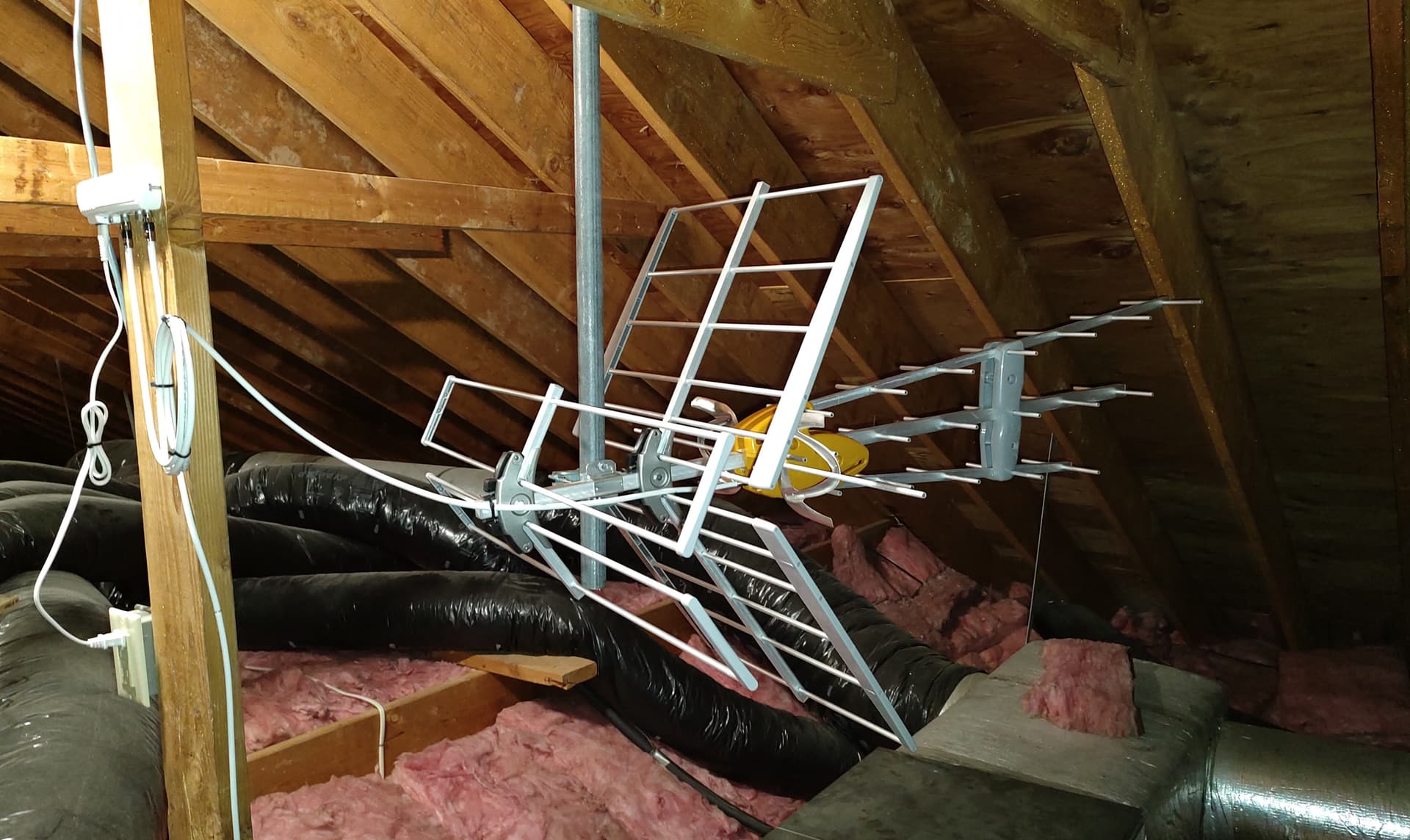
Roofing materials, insulation, metal ductwork, brick, and nearby buildings can weaken or distort an over-the-air signal. Wood framing is usually less troublesome than metal or foil, but the only dependable answer is to try positions and rescan channels.
An attic antenna should be placed as high and as clear of metal objects as practical. The GE Outdoor HD Digital TV Antenna and UltraPro Outdoor HD Antenna include mounting hardware suited to this kind of placement. The pivoting mast on the ClearStream models gives more flexibility when the available mounting surface is awkward.
Amplification and cable length
An amplifier can help compensate for signal loss through a long coaxial run or a splitter, but it cannot create a missing broadcast signal. The PIBIDI, PBD, and 1byone models include amplification features. The other antennas may need a separate signal distribution solution if the cable route is long.
Cable length matters because the signal can weaken as it travels. The Five Star Yagi models include 40-foot cables, the PIBIDI and PBD include 40-foot cables, and the 1byone includes a 32-foot cable. The GE, UltraPro, and ClearStream listings do not specify an included coaxial cable.
Single TV or whole-home setup
A single television gives you more flexibility because the antenna can connect directly without dividing the signal. For multiple TVs, look for a splitter in the kit or a clear output arrangement. The Five Star Yagi 200 Mile Antenna includes a four-way splitter, the Five Star ATSC 3.0 Antenna includes a TV splitter, and the PBD includes dual TV outputs.
The 1byone is explicitly designed for one TV, and its listing warns that adding a splitter can reduce signal strength. It is better suited to one screen than a house-wide cable run.

Frequently asked questions
Can an attic antenna receive local HD channels?
Yes. An attic antenna can receive local over-the-air broadcasts when it supports the relevant VHF or UHF band and has a sufficiently clear path toward the transmitters. Picture quality depends on signal strength and stability, not on whether the antenna is installed indoors or outdoors.
Does a 4K-ready antenna create 4K channels?
No. An antenna passes along the broadcast signal it receives. A channel must transmit in 4K, and the television or external tuner must support that format for 4K video to appear.
Is a directional or omni-directional antenna better for an attic?
A directional antenna is often better when the broadcast towers are grouped in one direction. An omni-directional model is more convenient when towers are spread around the home or when you cannot easily aim the antenna.
Do attic TV antennas need an amplifier?
Not always. An amplifier can help with a weak signal, a long coaxial cable, or a split signal, but it is not automatically beneficial in a strong-signal area. An overly amplified signal can create its own reception problems.
Can one attic antenna serve several TVs?
Yes, but the signal must be divided with a splitter or a suitable distribution system. Every split and long cable run can reduce signal strength, so a multi-TV kit such as the Five Star Yagi 200 Mile Antenna may be easier to configure.
Does ATSC 3.0 support come from the antenna?
An antenna can be compatible with ATSC 3.0 broadcasts, but the tuner also matters. A television or external tuner needs ATSC 3.0 support to decode those broadcasts.
How should I position an attic antenna?
Start by identifying the direction of the local broadcast towers, then place the antenna as high and unobstructed as possible. Keep it away from metal ductwork, foil-backed insulation, and other large conductive objects. Run a channel scan after every meaningful position change.
The bottom line
The GE Outdoor HD Digital TV Antenna is the best attic tv antenna for most people because it covers VHF and UHF, includes a J mount, supports ATSC 3.0 broadcasts where available, and works in either an attic or outdoor installation. It is simple enough for a typical single-TV setup without giving up the flexibility to move outside later.
Choose the Five Star Yagi 200 Mile Antenna when you need a more complete multi-TV kit, or the PIBIDI Rotating HD Antenna when the towers point in different directions and remote aiming would save repeated trips into the attic. The ClearStream 4V is the strongest specialist choice for difficult reception when you have room for its wide reflector-based design.
If you are undecided, start with your tower direction and attic obstructions, then choose the simplest antenna that matches those conditions.