

A bass amp has one job that a guitar amp cannot fake: it must make low notes feel full without turning them into a loose, indistinct rumble. That gets harder in a bedroom, where too much power is wasted, and harder again onstage, where a small speaker can run out of authority.
The Best bass amp for most players here is the Fender Rumble 40, because its 40 watts, 10-inch speaker, usable overdrive, and contour control cover practice, rehearsal, and small performance spaces without the bulk of a larger combo. The list also includes compact recording tools, battery-powered practice amps, a headphone unit, and serious 100-watt options.
| # | Product | Award | Power | Speaker or format | Best for |
|---|---|---|---|---|---|
| 1 | Fender Rumble 40 | Best overall | 40 watts | 10-inch speaker | Practice and rehearsal |
| 2 | Fender Rumble 100 | Best for bigger rooms | 100 watts | 12-inch speaker | Bands and small gigs |
| 3 | Fender Rumble 25 | Best compact combo | 25 watts | 8-inch speaker | Home practice |
| 4 | Orange Crush 50 Bass | Best tone shaping | 50 watts | 1x12 speaker | Players who use pedals |
| 5 | Peavey Max 100 | Best control range | Not specified | Combo amp | Flexible tonal setups |
| 6 | JOYO Vibe Cube BA-30 Black | Best for recording | 30 watts | 4-inch speaker | Livestreaming and demos |
| 7 | Fender Rumble 25 | Best simple practice amp | 25 watts | 8-inch speaker | Players who want easy controls |
| 8 | VOX amPlug 3 Bass | Best headphone amp | Headphone format | Built-in speaker emulation | Silent practice |
| 9 | JOYO Vibe Cube BA-30 White | Best portable feature set | 30 watts | 4-inch speaker | Travel and content creation |
| 10 | JOYO MA-10B | Best battery practice amp | 10 watts | Compact combo | Outdoor practice |
1. Fender Rumble 40: Best Overall

Pros
- 40 watts with a useful 10-inch speaker
- Overdrive and contour controls add character
- Ported enclosure supports a fuller low end
- Removable grille and two-year limited warranty
Cons
- Larger than the Rumble 25
- Not designed for battery-powered use
- Limited compared with the Orange Crush 50 Bass for elaborate signal shaping
Best for: players who want one straightforward combo for home practice, rehearsal, and smaller rooms.
The Fender Rumble 40 is the amp we would keep when we wanted one bass combo to handle the widest range of ordinary playing. It has enough physical presence to sound like a bass amp rather than a small speaker trying to reproduce bass, but it does not become an awkward piece of furniture in a practice room. Its 10-inch Fender Special Design speaker gives the 40-watt output a sensible partner, and the ported enclosure helps the cabinet produce a more convincing low end.
The control set is deliberately approachable. The overdrive circuit adds grit without requiring a separate pedal, while the switchable contour control can shift the character toward a more scooped, modern sound. That makes it more versatile than the simpler Rumble 15, and the larger speaker gives it more authority than the Rumble 25 when you turn up. It is not as deep in its tone options as the Orange Crush 50 Bass, which adds a parametric mid control, blend and gain controls, an effects loop, and a chromatic tuner.
The enclosure is listed at 20.25 by 20.25 by 16 inches in the product features, while the product information lists a weight of 20.85 pounds. That is a manageable carry for a combo with this much usable output. The removable grille is a practical touch for maintenance, and the two-year limited warranty gives the amp a clear ownership safeguard.
The weakness is its scope. There is no battery operation, and the controls are not aimed at players who want to build a complex preamp-style rig around the combo. Players who mainly practice with headphones should choose the VOX amPlug 3 Bass instead. For everyone else, the Fender Rumble 40 is the most balanced Best bass amp in this group.
2. Fender Rumble 100: Best for Bigger Rooms

Pros
- 100 watts for rehearsal and small performance spaces
- 12-inch Eminence Special Design speaker
- Overdrive and contour controls
- Ported plywood enclosure
Cons
- More amp than many bedroom players need
- Larger footprint than the Rumble 40
- No listed battery operation or recording interface
Best for: bassists who need a stronger clean foundation for a band or larger rehearsal room.
The Fender Rumble 100 is the obvious step up when the Rumble 40 starts to feel outmatched by a drummer. Its 100 watts and 12-inch Eminence Special Design speaker give it the headroom and low-frequency scale that a band setting demands. It is still a combo rather than a separate head and cabinet, so the setup remains simple, but this is clearly intended for players who need to project beyond a quiet room.
The 12-inch speaker matters as much as the wattage. A larger driver can move more air and gives the bass line a broader, less boxed-in presentation. The ported plywood enclosure reinforces that sense of scale. The product features describe the cabinet as compact and lightweight for its class, while the product information lists a weight of 23.31 pounds and dimensions of 23.31 inches high, 20.7 inches long, and 18.1 inches wide.
Its tonal controls follow the Rumble formula. The three-band shaping is joined by a contour switch and a built-in overdrive circuit, so a clean, direct sound can become more aggressive without an external effects board. The Rumble 40 remains the easier room-to-room choice, but the Rumble 100 is the better answer when volume and low-end authority take priority.
That extra capability comes with a real compromise: it is excessive for many apartment players and less convenient to store than the Rumble 25 or the tiny JOYO units. It also lacks the Orange Crush 50 Bass's effects loop and parametric mid control. Choose the Rumble 100 if you rehearse with a full band, play small gigs, or want clean headroom first.
3. Fender Rumble 25: Best Compact Combo

Pros
- 25 watts from an 8-inch speaker
- Three-band EQ
- Built-in overdrive and contour controls
- Auxiliary input and headphone output
Cons
- Less low-end authority than the Rumble 40
- Not suitable for loud band work
- Heavier and larger than the VOX headphone option
Best for: home players who want real speaker output and a useful practice feature set.
The Fender Rumble 25 is the sensible middle ground in Fender's smaller range. It sounds more substantial than the Rumble 15 without taking the physical and sonic jump to the Rumble 40. For a bedroom or lesson space, 25 watts through an 8-inch Fender Special Design speaker is enough to make the bass feel present while keeping the controls and cabinet approachable.
Fender gives this version more than basic volume and tone. The three-band EQ handles the major tonal adjustments, while the overdrive circuit adds a rougher edge and the contour control changes the emphasis of the sound. The 1/8-inch auxiliary input is useful for playing along with a phone or another audio source, and the 1/4-inch headphone output makes quieter sessions possible.
The cabinet is listed at 19.7 inches high, 19.1 inches long, and 15.1 inches wide, with a product-information weight of 23.85 pounds. That makes it a substantial object for a compact practice amp. The top-mounted control panel and soft-touch radio-style knobs should be easy to reach when the combo is on the floor, and the two-year limited warranty matches the other Fender Rumble models here.
Its limitation is headroom. The Rumble 25 is not the one to buy for a loud drummer, and its 8-inch speaker cannot give bass the same sense of scale as the Rumble 40's 10-inch driver. It also lacks the JOYO Vibe Cube's Bluetooth and OTG recording features. Pick the Rumble 25 when a physical speaker matters more than wireless tools.
4. Orange Crush 50 Bass: Best Tone Shaping

Pros
- 50-watt output and 1x12 speaker
- Active three-band EQ
- Parametric mid control
- Effects loop and chromatic tuner
- Blend and gain controls are footswitchable
Cons
- Heaviest combo in this roundup
- More controls to learn
- No listed headphone, auxiliary, or recording features
Best for: players who want a flexible bass voice and plan to use pedals or external effects.
The Orange Crush 50 Bass takes a more hands-on approach than the Fender Rumble models. Its 50 watts feed a 1x12 configuration, giving it the speaker size and output to sit comfortably between the Rumble 40 and Rumble 100 in a rehearsal setup. The important distinction is not just volume. This combo is built around shaping the signal, so it suits a player who wants to work on a specific bass sound rather than simply dial in a clean tone.
The active three-band EQ is joined by a parametric mid control, which lets you target a particular area of the bass spectrum instead of only raising or lowering broad bass, middle, or treble bands. The blend and gain controls are footswitchable, giving the player a way to move between cleaner and more driven sounds during a song. That is a meaningful step beyond the Rumble 40's simpler overdrive and contour arrangement.
The effects loop is useful for putting modulation, delay, or other pedals in a more suitable position in the signal path. A chromatic tuner is built in, which keeps basic setup duties inside the amp. Those features make the Orange a stronger platform for a growing pedalboard than the Fender Rumble 25, even though the Fender is easier to operate at first glance.
The cost of that flexibility is physical weight. The product information lists the combo at 41.2 pounds, with dimensions of 21 inches high, 22 inches long, and 14 inches wide. It also has fewer lifestyle-oriented features listed than the JOYO Vibe Cube, with no stated Bluetooth, OTG, or headphone function. Choose it when tonal control and pedal integration matter more than easy carrying.
5. Peavey Max 100: Best Control Range

Pros
- Three-band EQ with several voicing switches
- Overdrive and TransTube gain boost
- Auxiliary input and headphone output
- High-frequency dispersion cabinet design
Cons
- Product data does not specify output wattage
- Listed dimensions are not useful for planning storage
- Heavier than the small practice-focused choices
Best for: players who want many ways to alter the amp's character from the front panel.
The Peavey Max 100 is the most feature-heavy control panel among the traditional combos here. Its three-band EQ is supported by overdrive, contour, mid-shift, bright, and Kosmos-C switches, so it gives a player plenty of routes to a more focused, brighter, thicker, or more aggressive sound. That makes it interesting for someone who finds a basic bass, middle, and treble layout too limiting.
Peavey also includes a pre-gain control with TransTube gain boost. This is a different approach from the Fender Rumble's single built-in overdrive circuit. It lets the player work with gain as part of the sound rather than treating drive as a simple effect to switch on. The 1/8-inch auxiliary input and 1/8-inch headphone output keep it practical for playing along with external audio and practicing privately.
The cabinet design is described as supporting superior high-frequency dispersion in tight spaces. That should help the sound remain more evenly distributed when the amp is placed in a cramped rehearsal room, though the available product information does not provide a reliable speaker size or output wattage. We will not assign it a wattage based on the model name. Its listed weight is 29.1 pounds, but the supplied dimensions are all shown as one inch, so they should not be used as a storage guide.
That incomplete physical information is the main drawback in this comparison. The Fender Rumble 40 is easier to place, and the Orange Crush 50 Bass gives more clearly documented tone-shaping hardware, including a parametric mid control and effects loop. The Peavey makes sense for a player who wants many front-panel voicing options and does not mind a less straightforward buying decision.
6. JOYO Vibe Cube BA-30 Black: Best for Recording

Pros
- 30 watts with a 4-inch full-range speaker
- Bluetooth 5.1 and USB-C OTG recording
- Three-band EQ plus mid-frequency control
- Built-in compression and headphone output
- Weighs about 5.95 pounds
Cons
- Requires continuous external power
- Small speaker cannot match a 10-inch or 12-inch combo
- Outdoor battery operation requires a suitable 65-watt or higher PD power bank
Best for: creators and traveling players who need direct phone or computer recording.
The JOYO Vibe Cube BA-30 Black is less like a conventional rehearsal combo and more like a compact bass workstation. Its 4-inch full-range speaker is backed by a 113 by 113 millimeter low-frequency radiator, and the amp is rated for 30 watts of dynamic power. That is a clever way to make a small cabinet more useful, but it cannot create the same room-filling low end as the Fender Rumble 40.
The feature set is the reason to consider it. Along with bass, middle, and treble controls, it has a mid-frequency control covering 200Hz to 2000Hz. That range lets a player target the area where the bass is sounding muddy or too thin. Built-in compression can smooth the attack and bring quieter notes forward, which is particularly useful when recording a demo or streaming rather than simply playing in a room.
Bluetooth 5.1 handles backing tracks, while OTG direct recording connects to a phone or computer through USB-C. The product features specify independent volume control for the recording connection, a detail that should make it easier to balance the instrument and the backing material. A 3.5mm headphone jack also allows silent practice. For players making short videos, lessons, or rough demos, these features are more useful than the Rumble 25's larger physical speaker.
The important catch is power. This amp has no internal battery. It runs from the included adapter indoors, or from a 65-watt or higher PD power bank with a suitable high-current USB-C cable for cordless use. At about 5.95 pounds, it is far easier to carry than the Orange Crush 50 Bass, but players needing full rehearsal volume should choose the Fender Rumble 40. For a recording-minded bassist, this is one of the most practical alternatives to a standard amp.
7. Fender Rumble 15: Best Simple Practice Amp

Pros
- 15 watts for home playing
- 8-inch Fender Special Design speaker
- Compact sealed enclosure
- Top-mounted control panel
- Two-year limited warranty
Cons
- Fewer features than the Rumble 25
- No listed auxiliary or headphone connection
- Limited headroom for group playing
Best for: beginners who want a conventional Fender combo for quiet home practice.
The Fender Rumble 15 is the least complicated traditional bass amp in this lineup. It gives a new player a real 8-inch Fender Special Design speaker, a physical control panel, and 15 watts in a compact sealed enclosure. There are no recording menus or complicated signal-routing decisions to slow down the first few weeks of playing.
The product features list dimensions of 11.61 by 17.91 by 17.13 inches, while the product information lists a weight of 18.6 pounds and a width of 12.3 inches. Those figures describe a small combo that can sit in a bedroom without demanding much floor space. The top-mounted soft-touch knobs are easy to reach, and the removable grille adds a practical maintenance detail.
The 8-inch driver is a sensible fit for practice, but it is also the reason this amp belongs at home rather than on a bandstand. It cannot push the same amount of air as the Rumble 25's similarly sized speaker at higher output, and it lacks the Rumble 25's listed overdrive circuit, contour control, auxiliary input, and headphone output. The JOYO MA-10B is smaller and can run on batteries, while the Rumble 15 has the more familiar conventional combo format.
The weakness is not a hidden defect. It is simply a narrow brief. The Rumble 15 is best for a player who wants to plug in and play without needing Bluetooth, recording, or a long list of effects. If silent practice is important, the VOX amPlug 3 Bass is a better fit. If the amp must keep up with other musicians, step up to the Rumble 40.
8. VOX amPlug 3 Bass: Best Headphone Amp

Pros
- Extremely light at 40 grams excluding batteries
- Three bass modes: Classic, Smooth, and Funk
- Nine built-in rhythm tracks
- Compressor and speaker emulation
- Up to 17 hours from two AAA batteries
Cons
- Headphone format cannot drive a room speaker
- Requires AAA batteries
- Controls and connection options are more limited than a combo amp
Best for: bassists who need quiet practice with rhythm tracks anywhere.
The VOX amPlug 3 Bass solves a different problem from every combo in this roundup. It does not attempt to fill a room. Instead, it plugs into the bass, sends its sound to headphones, and gives the player a compact way to practice without setting up an amplifier. At 40 grams excluding batteries, it is light enough to leave in a gig bag.
VOX provides three modes called Classic, Smooth, and Funk. Those presets give the player a faster route to a useful bass character than starting with a blank EQ. An integrated compressor helps keep the sound punchy and consistent, while speaker emulation makes the headphone output feel more like a processed amplifier sound than a bare instrument signal.
The built-in practice tools are unusually strong for such a small device. It includes nine rhythm tracks covering styles such as rock, funk, and blues, plus an auxiliary input for external audio. Two AAA batteries are rated for up to 17 hours of playtime, and the foldable plug rotates 180 degrees for storage and positioning. If you are deciding how to practice bass quietly without losing the feel of a real amp, this kind of headphone setup deserves attention.
The limitation is absolute: there is no speaker cabinet, so it cannot replace the Rumble 25 for playing with another person in the room. It also does not offer the JOYO Vibe Cube's Bluetooth 5.1 or OTG connection. Choose the amPlug 3 Bass for commuting, late-night practice, and rhythm-focused work, not for rehearsal volume.
9. JOYO Vibe Cube BA-30 White: Best Portable Feature Set

Pros
- 30 watts of dynamic power
- Bluetooth 5.1 and USB-C OTG recording
- 200Hz to 2000Hz mid-frequency control
- Compression and headphone output
- Top handle and 5.95-pound weight
Cons
- No internal battery
- 4-inch speaker has limited physical low-end scale
- Requires a compatible power bank for cordless outdoor use
Best for: mobile players who want a small amp for practice, backing tracks, and social content.
The white JOYO Vibe Cube BA-30 has the same core design as the black version, so the choice between them is mainly about finish rather than capability. It is a compact 30-watt unit with a 4-inch full-range speaker and a 113 by 113 millimeter low-frequency radiator. The top handle and 5.95-pound weight make it much easier to carry than a traditional 12-inch combo.
Its sound controls are unusually precise for a portable amp. Bass, mid, and treble knobs handle broad changes, while the mid-frequency control spans 200Hz to 2000Hz. That lets a player find a problem area rather than repeatedly turning the entire midrange up or down. The compressor can smooth uneven picking and keep quieter notes from disappearing, especially when the amp is being used for casual recording.
Bluetooth 5.1 lets it play backing tracks, and the USB-C OTG connection can send audio directly to a phone or computer for recording. The separate volume control for that connection is useful when the backing track needs to sit under the bass. The 3.5mm headphone jack makes it suitable for quiet sessions, too. Players comparing the gear needed to build a bass setup around recording and playback will find more practical connectivity here than on the Fender Rumble models.
The catch remains power. There is no internal battery, and outdoor cordless use requires a 65-watt or higher PD power bank, plus a high-current USB-C cable. The Fender Rumble 40 is far more convincing as a standalone rehearsal amp, while the VOX amPlug 3 Bass is lighter and simpler for headphones. Choose the white Vibe Cube when portability and direct recording matter more than speaker size.
10. JOYO MA-10B: Best Battery Practice Amp
Pros
- 10 watts in a small combo
- Normal and Drive channels
- Auxiliary input and headphone connection
- Adapter or battery operation
- Less than 3 pounds
Cons
- Battery operation lasts up to three hours
- Basic tone control
- Not intended for band-level volume
Best for: players who want an uncomplicated bass amp for home or outdoor practice.
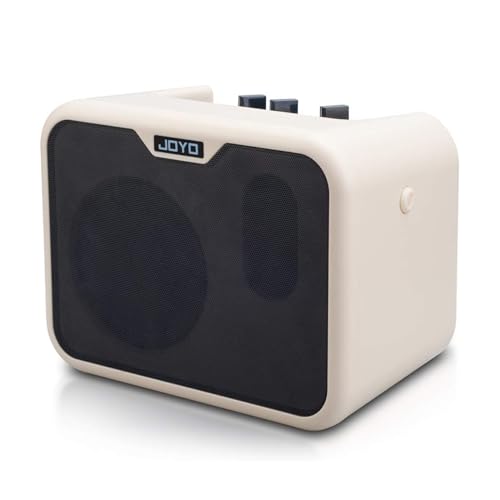
The JOYO MA-10B is the most straightforward portable speaker amp here. It provides 10 watts, a normal channel, and a drive channel in a package weighing less than 3 pounds. That makes it much easier to take outside than the Fender Rumble 15, and it does not need the specialized power-bank setup required by the Vibe Cube.
The control scheme is intentionally basic. A tone control moves the sound brighter or darker, while the drive channel adds gain for a rougher character. There is no three-band EQ, compressor, Bluetooth, or recording connection. That is a limitation for serious sound design, but it also means a beginner can understand the amp quickly.
The MA-10B includes an auxiliary input for a phone or other external source and a headphone connection for quieter playing. It can run from a power adapter or batteries, with the battery mode listed for up to three hours of outdoor use. That is enough for a focused session, but not a full day away from an outlet. The small dimensions, roughly 9.45 inches long, 6.69 inches high, and 5.91 inches wide, make it easy to fit in a backpack.
The weakness is its modest range. The Rumble 25 has a larger 8-inch speaker and more useful tone controls, while the VOX amPlug 3 Bass is dramatically lighter for headphone-only practice. The MA-10B earns its place by combining a physical speaker, a drive channel, and true battery operation. It is the right pick for casual practice in places where a wall outlet is not guaranteed.
How to choose best bass amp
The right bass amp depends less on a headline wattage than on where you will play, how much low end you need, and whether you want a simple speaker or a recording tool.
Power and headroom
Wattage indicates how much electrical output the amp can provide, but it does not tell the whole story. A 15-watt practice amp can be entirely suitable at home, while a 100-watt combo gives a band more clean headroom before the sound starts to compress or distort. Match the output to the drummer, room, and playing situation rather than buying the largest number by default.
Speaker size
Bass needs a speaker that can move air. The 4-inch drivers in the JOYO Vibe Cube units keep the cabinets portable, but the 10-inch Rumble 40 and 12-inch Rumble 100 have a larger physical voice. An 8-inch speaker is a practical compromise for home use. A 1x12 design, such as the Orange Crush 50 Bass, gives a fuller foundation without reaching the scale of a larger rig.
For bass, speaker area often matters as much as amplifier wattage because low notes need physical air movement.
Tone controls
A basic tone knob is easy to use, but it cannot make targeted corrections. Three-band EQ gives more control over bass, middle, and treble, while a parametric or sweepable mid control lets you focus on a specific frequency range. The JOYO Vibe Cube's 200Hz to 2000Hz mid-frequency control and the Orange's parametric mid control are the strongest options for precise shaping.
Practice and recording connections
Auxiliary inputs let you play along with music, and headphone outputs keep practice private. Bluetooth makes backing tracks more convenient, while OTG recording can connect an amp directly to a phone or computer. The VOX amPlug 3 Bass is the most focused silent-practice tool, and the JOYO Vibe Cube is the more capable choice for demos and livestreams.
Portability and power
A traditional combo usually needs a wall outlet, while the JOYO MA-10B can run on batteries. The Vibe Cube is portable but has no internal battery, so cordless use depends on a compatible 65-watt or higher PD power bank. Check the total weight and the power method before choosing an amp for outdoor sessions or frequent transport.

Frequently asked questions
How many watts does a bass amp need for home practice?
There is no single required wattage for home practice. The Fender Rumble 15 and JOYO MA-10B provide 15 watts and 10 watts respectively, while the VOX amPlug 3 Bass avoids speaker output entirely for silent sessions. A larger amp is only useful if you need more headroom or plan to play with other musicians.
Is an 8-inch speaker enough for bass?
An 8-inch speaker can work well for bedroom practice and lessons. It will not move as much air as a 10-inch or 12-inch speaker, so the sound may feel smaller at higher volume. The Fender Rumble 25 uses an 8-inch speaker for a practical home setup, while the Rumble 40 is the stronger choice when you need more low-end authority.
Can a bass amp be used with headphones?
Some bass amps include a headphone output, and headphone amplifiers are designed specifically for that use. The Fender Rumble 25, Peavey Max 100, and JOYO Vibe Cube models list headphone connections. The VOX amPlug 3 Bass is the most compact option because it is built around headphone practice rather than a room speaker.
What is the advantage of a compressor on a bass amp?
Compression reduces the difference between louder and quieter notes. That can make the bass line feel more even and can help a recording or livestream sit more consistently in a mix. The JOYO Vibe Cube and VOX amPlug 3 Bass include compression, while the other models here focus more on EQ, overdrive, and voicing controls.
Are portable bass amps battery powered?
Some are, but not all. The JOYO MA-10B can operate on batteries for up to three hours, while the JOYO Vibe Cube units require external power and need a suitable PD power bank for cordless use. The Fender Rumble and Orange models are conventional mains-powered combos.
Do I need an effects loop on a bass amp?
You do not need one for basic practice, but an effects loop can be useful when you use pedals that work better after the preamp stage. The Orange Crush 50 Bass includes a buffered effects loop. Players who mainly use the amp's own clean, drive, or EQ controls can choose a Fender Rumble or JOYO model without treating the missing loop as a problem.
The bottom line
The Best bass amp here is the Fender Rumble 40 for most players. Its 40 watts, 10-inch speaker, overdrive, contour control, and manageable cabinet make it more adaptable than the Rumble 25 while avoiding the extra size of the Rumble 100. The Fender Rumble 100 is the better choice for a full band or a room where clean low-end headroom matters more than compact storage.
Choose the Orange Crush 50 Bass if detailed tone shaping, an effects loop, and a built-in tuner are central to your setup. For recording, livestreaming, and portable playback, the JOYO Vibe Cube BA-30 has the most useful modern connections. For silent practice, the VOX amPlug 3 Bass is the clear specialist.
If you are undecided, buy the Fender Rumble 40 unless your main need is headphones, battery operation, or direct recording.
As an Amazon Associate we earn from qualifying purchases.