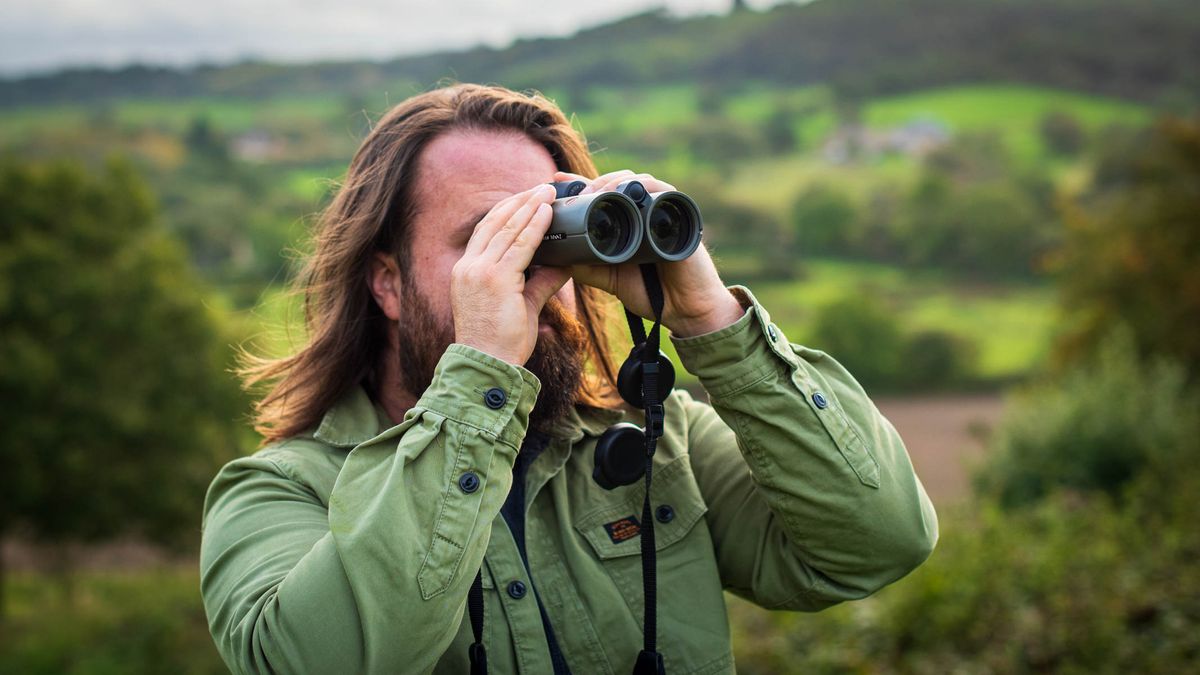

A bird can appear for seconds, vanish into a hedge, and leave you trying to remember whether that flash of color was a wing or a leaf. The right binoculars make those brief sightings easier to follow, focus, and identify. The Best binoculars for birdwatching balance magnification with a wide, steady view, while keeping enough light for shaded woodland and early morning walks.
We ranked these 10 models by the optical features that matter most to birders: the usefulness of the magnification, objective-lens size, field of view, coatings, focusing controls, weather protection, and carrying weight. Some are sensible compact pairs for casual use, while others are serious full-size binoculars for regular wildlife observation.
For most birdwatchers, the Nikon Monarch M5 is the best pick, with the Vortex Triumph HD close behind for a lighter, more accessible alternative. The list also includes phone-ready models, high-magnification binoculars, and compact options for travel.
Comparison table
| # | Product | Award | Magnification | Objective lens | Field of view | Best for |
|---|---|---|---|---|---|---|
| 1 | Nikon Monarch M5 | Best overall | 8x | 42mm | Broad field of view | Serious birdwatching |
| 2 | Vortex Triumph HD | Best lightweight full-size pair | 10x | 42mm | Not specified | Hiking and general wildlife |
| 3 | Athlon Midas UHD | Best optical detail | 8x | 42mm | 144m at 1, 000m | Color-critical viewing |
| 4 | Celestron Nature DX | Best for tracking birds | 8x | 42mm | 7.4 degrees | Birds in flight |
| 5 | Adasion 8x42 | Best phone-ready option | 8x | 42mm | 375 feet at 1, 000 yards | Digiscoping beginners |
| 6 | GIGAPENGUIN 15x52 | Best long-distance detail | 15x | 52mm | Not specified | Distant birds and open country |
| 7 | Adasion 12x42 | Best high-power bundle | 12x | 42mm | 367 feet at 1, 000 yards | Distant views with a phone |
| 8 | Occer 12x25 | Best compact pair | 12x | 25mm | 273 feet at 1, 000 yards | Travel and family use |
| 9 | FLYANT 20x50 | Best high-magnification compact design | 20x | 50mm | 168 yards at 1, 000 yards | Stationary observation |
| 10 | WOZEL 20x70 | Best for fixed viewing | 20x | 70mm | Not specified | Very distant subjects |
1. Nikon Monarch M5: Best Overall

Pros
- ED glass minimizes color fringing
- Dielectric prism coating supports bright, natural views
- Broad view helps track moving birds
- Close focus reaches 8.2 feet
- Waterproof and fogproof body
Cons
- Heavier than compact travel binoculars
- No phone adapter or tripod listed
Best for: birders who want a dependable optical instrument for regular outdoor use.
The Nikon Monarch M5 is the pair we would hand to a birder who wants to stop thinking about equipment and concentrate on the bird. Its 8x42 configuration is a strong fit for woodland trails and garden watching because 8x magnification is easier to hold steady than higher-power designs, while the 42mm objective lenses gather the light needed in shade and overcast conditions.
The ED glass is the important part of the optical package. It is designed to minimize chromatic aberration and color fringing, so fine edges such as a bird's bill, feather bars, or a branch against a bright sky should look cleaner. Nikon also uses dielectric high-reflective multilayer prism coatings, which support brighter images and natural color reproduction when light is less generous.
This model is more useful at close range than many long-distance binoculars. Its close-focus capability reaches as near as 8.2 feet, making it suitable for a bird perched close to a trail as well as one across a field. The large central focus knob is designed for smooth adjustment, and turn-and-slide eyecups give eyeglass wearers a way to set a comfortable viewing position.
The Monarch M5 also has the outdoor protection expected from a serious birding pair. Its nitrogen-purged, O-ring-sealed housing is waterproof and fogproof, and the rubber armor adds grip and shock resistance. At 1.3875 pounds, it is not the lightest option here. The Vortex Triumph HD is lighter, while the Celestron Nature DX offers a wider stated angular field of view, but the Nikon is the more complete optical choice for detail and natural color.
Skip it if you mainly need a tiny pair for travel or want a phone adapter in the box. For someone building a regular birdwatching kit, though, the Monarch M5 is the most balanced choice in this group.
2. Vortex Triumph HD: Best Lightweight Full-Size Pair

Pros
- HD optical system controls chromatic aberration
- Fully multi-coated lenses
- Waterproof, fogproof, and shockproof construction
- Weighs about 0.99 pounds
- Includes a GlassPak harness
Cons
- 10x magnification is less forgiving of hand shake
- Field-of-view measurement is not provided
Best for: hikers and wildlife watchers who want a full-size pair without carrying a heavy optical load.
The Vortex Triumph HD feels like the practical choice for someone who carries binoculars for hours and does not want them to dominate the daypack. It uses the familiar 10x42 format, giving more reach than the Nikon Monarch M5 while retaining the light-gathering benefit of 42mm objective lenses. Its stated weight is about 0.99 pounds, a meaningful advantage on long walks.
The HD optical system is built around optimized glass elements, fully multi-coated lenses, and control of chromatic aberration. Those features are aimed at resolution, color fidelity, edge-to-edge sharpness, and light transmission rather than simply producing a large image. The result should be a useful general-purpose view for birds, trails, and distant wildlife.
The trade-off is the 10x magnification. It can reveal more detail at distance than an 8x pair, but every small movement is also magnified. That makes the Triumph HD better for scanning open habitats or watching a perched bird than for quickly following a fast bird through dense branches. Adjustable eyecups and an adjustable diopter help with fit and individual focus, and the binoculars are tripod adaptable for longer stationary sessions.
The build is reassuring for outdoor use. Nitrogen purging provides waterproof and fogproof protection, while the polycarbonate chassis and full rubber armor are intended to resist shocks and improve grip. Vortex includes a neck strap and GlassPak harness, which makes the carrying system more useful than a basic strap alone. Its transferable lifetime VIP Warranty is another reason this model suits people who expect to keep their binoculars for years.
The Athlon Midas UHD offers a more explicitly optical-focused design with ED glass and dielectric coating, while the Triumph HD wins on weight and carrying convenience. Choose the Vortex if a lighter full-size pair matters more than maximum field-of-view detail.
3. Athlon Midas UHD: Best Optical Detail

Pros
- ED glass reduces chromatic fringe
- ESP dielectric coating reflects over 99 percent of light
- Fully multi-coated lenses
- Argon purged for waterproofing and thermal stability
- 144m field of view at 1, 000m
Cons
- Weighs 1.56 pounds
- No phone adapter listed
Best for: birders who prioritize clean color and detailed views over the lightest carry.
The Athlon Midas UHD is an optical specialist among these binoculars. Its 8x42 format is naturally steady and bright enough for many outdoor conditions, but the more compelling reason to choose it is the combination of ED glass, advanced fully multi-coated lenses, and ESP dielectric prism coating.
ED glass is used to reduce color fringing, a problem that can show up around high-contrast edges such as a bird against a pale sky. Athlon says the ESP coating reflects over 99 percent of the light to the eye, while the fully multi-coated lenses are intended to improve transmission and preserve true color across the light spectrum. Those are useful traits when identification depends on subtle plumage differences.
The stated field of view is 144 meters at 1, 000 meters, with an 8.1-degree angular field. That gives the Midas UHD a useful balance for finding birds and then studying them. Long eye relief also matters for glasses wearers because it lets them see more of the available image without pressing their glasses against the eyecups.
The compromise is its 1.56-pound weight. The Vortex Triumph HD is substantially lighter, and the Adasion 8x42 adds a phone adapter and tripod to its kit. The Athlon instead focuses on the view through the binoculars themselves. Argon purging supports waterproofing and thermal stability, so this is not a fragile indoor-only instrument, but its weight will be noticeable on a long hike.
The Midas UHD is the pick for a birder who notices color and edge clarity and is willing to carry more. If you want a lighter pair for spontaneous walks, the Nikon Monarch M5 or Vortex Triumph HD makes more sense.
4. Celestron Nature DX: Best for Tracking Birds

Pros
- Wide 7.4-degree angular field of view
- Phase-coated BaK-4 prisms
- Waterproof and nitrogen purged
- Rubber-armored polycarbonate housing
- Tripod adaptable
Cons
- Tripod adapter is not included
- Weighs 1.75 pounds
Best for: birdwatchers who spend time scanning open spaces and following birds in flight.
The Celestron Nature DX gets the central birdwatching problem right: finding a moving bird quickly is often more important than having the highest magnification. Its 8x42 configuration is steady in the hands, and the 7.4-degree angular field of view makes it easier to scan a landscape or keep a bird in view as it moves.
The 42mm objective lenses balance portability with brightness. Celestron pairs them with fully multi-coated lenses and phase-coated BaK-4 prisms, which are intended to improve light transmission, contrast, resolution, and color accuracy. This combination makes sense for woodland edges, wetlands, and other places where birds move between bright sky and darker foliage.
The body is built for regular outdoor use rather than careful indoor storage. A rubber-armored polycarbonate housing protects against bumps, and the binoculars are waterproof and nitrogen purged to resist fogging in rain, snow, or humidity. At 1.75 pounds, they are the heaviest of the conventional 8x42 options here, so a strap or harness will matter on extended walks.
Celestron includes a built-in tripod adapter socket, though the adapter itself is not included. That is useful for long observation sessions when holding any binoculars becomes tiring. The Nikon Monarch M5 is better for close focus and ED-glass color control, while the Celestron gives the stronger stated field-of-view advantage for tracking motion.
The Nature DX is not the lightest or most refined model in this roundup. It is a sensible choice for birders who value a broad, easy-to-scan view and need a weather-ready body.
5. Adasion 8x42: Best Phone-Ready Option

Pros
- 375-foot field of view at 1, 000 yards
- Includes phone adapter and tripod
- IPX7 waterproof and fogproof design
- Eye relief ranges from 13.6mm to 19.6mm
- Weighs 1 pound
Cons
- Included tripod is only 2.2 inches
- Phone photography adds setup time in the field
Best for: casual birders who want to view birds and capture occasional phone photos.
The Adasion 8x42 is the most approachable kit for someone who wants binoculars and a simple way to record what they see. The 8x magnification keeps the view steady, while the 42mm objective lenses support bright views in ordinary outdoor light. Its stated field of view is 375 feet at 1, 000 yards, which should help when scanning for birds rather than staring at one fixed detail.
The optical system uses BAK4 prisms and fully multi-coated lenses. Adasion says the design improves color accuracy, reduces dark edges, and maximizes light transmission in dim conditions. That gives this model a useful role for garden watching, walks, and travel, although the Nikon Monarch M5 and Athlon Midas UHD are more compelling choices when the optical view itself is the priority.
The included universal phone adapter fits all smartphones according to the product information, and its 360-degree swivel is intended to help align the camera. The 2.2-inch extendable tripod can steady the setup for photos and video, but it is a very small support. Treat it as a convenience for a phone rather than a replacement for a full-size tripod.
This model also has practical weather protection. Its IPX7 waterproof and fogproof design is paired with a non-slip rubber grip, a crossbody case with a phone pocket, and padded shoulder-strap options. Eye relief from 13.6mm to 19.6mm and twist-up eyecups make the fit more flexible for glasses wearers.
The Adasion is a strong starter kit, but people who want the cleanest image should choose a dedicated optical upgrade such as the Vortex Triumph HD. Pick this one when sharing photographs is part of the hobby.
6. GIGAPENGUIN 15x52: Best Long-Distance Detail

Pros
- 15x magnification for distant subjects
- 52mm objective lenses support low-light viewing
- 22mm eyepieces
- Fully multi-coated optics and phase-corrected BAK4 prisms
- Adjustable eyecups for glasses wearers
Cons
- High magnification is harder to hold steady
- Larger body is less convenient for active birding
- Field of view is not specified
Best for: watching distant birds across open country, shorelines, and broad fields.
The GIGAPENGUIN 15x52 is designed around reach. Its 15x magnification can reveal more detail on a distant bird than the 8x and 10x models, while the 52mm objective lenses are intended to preserve brightness in overcast conditions, tree cover, dawn, and the last light of day.
The large 22mm eyepieces are a notable part of the design. They give the eye a generous viewing area and are meant to make the high magnification more comfortable. The optical package also includes fully multi-coated lenses and phase-corrected BAK4 roof prisms, with an emphasis on contrast and color fidelity.
That reach comes with a handling penalty. At 15x, hand movement is more obvious, and a bird that is moving through branches can be harder to keep centered. The Nikon Monarch M5 is far easier for quick target acquisition and close-to-medium-distance viewing. The GIGAPENGUIN makes more sense when the subject is far away and the observer has time to settle into a position.
The adjustable twist-down eyecups accommodate glasses and non-glasses wearers, and the product includes an upgraded universal phone adapter. That makes it possible to attempt long-distance photos and video, though aligning a phone through a high-power pair demands patience. The 52mm lenses and larger body also make this a less casual carry than the Adasion 8x42.
Choose the GIGAPENGUIN for open habitats where distance is the problem. It is not the model we would choose for a fast woodland walk, but it has a clear purpose for patient observation.
7. Adasion 12x42: Best High-Power Bundle

Pros
- 12x magnification with 42mm lenses
- 367-foot field of view at 1, 000 yards
- Includes phone adapter and tripod
- IPX7 waterproof and fogproof design
- Eye relief ranges from 13.6mm to 19.6mm
Cons
- Heavier than the Adasion 8x42
- Higher magnification can make tracking difficult
- Small included tripod limits support use
Best for: birders who want extra reach and phone capture in one kit.
The Adasion 12x42 takes the phone-ready format of the Adasion 8x42 and adds more magnification. Its 12x power can help separate distant details, and the 42mm objective lenses retain the familiar full-size balance between light gathering and portability. The stated field of view is 367 feet at 1, 000 yards.
Its BAK4 prisms and fully multi-coated lenses are intended to support color accuracy and reduce dark edges. This is a useful combination for distant birds in moderate light, but the jump from 8x to 12x changes how the binoculars behave. Small hand movements become more visible, and following a bird in flight takes more coordination.
The included universal phone adapter, 360-degree swivel, and 2.2-inch tripod give the set a clear identity. The tripod can steady a phone and binocular combination on a table or other stable surface, but it is not a substitute for a full-height support. If you want a simpler viewing experience, the Vortex Triumph HD avoids the extra setup and has a much lighter stated weight.
Adasion gives this model IPX7 waterproof and fogproof protection, a non-slip rubber grip, and a crossbody case with a phone pocket. Twist-up eyecups and 13.6mm to 19.6mm eye relief make the viewing position adaptable, including for glasses wearers. The stated weight is about 1.25 pounds, heavier than the 8x42 version.
The 12x42 is a reasonable middle ground for people who regularly watch across fields or water. For most moving-bird situations, the steadier 8x models remain easier to use.
8. Occer 12x25: Best Compact Pair
Pros
- Small 12x25 configuration
- Weighs about 0.55 pounds
- Adjustable eyecups for glasses wearers
- FMC coatings and BAK4 prism
- Rubber armor improves grip
Cons
- 25mm objective lenses are less suited to dim conditions
- Narrower stated field of view than full-size models
- Not intended for completely dark conditions
Best for: travel, cruises, family outings, and occasional daytime birdwatching.
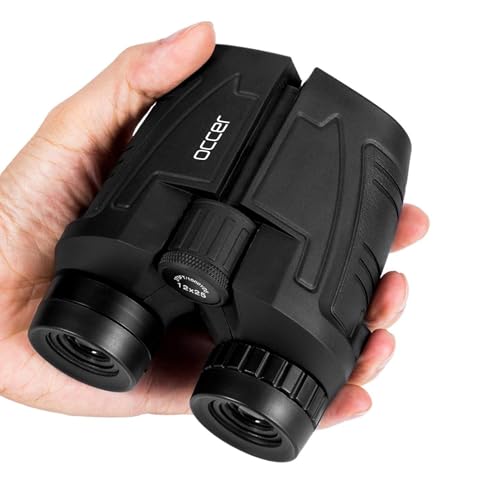
The Occer 12x25 is the pair to keep in a coat pocket or travel bag. It weighs about 0.55 pounds and has a compact body that can be managed with one hand. That convenience matters on a cruise, at a sporting event, or during a family outing when carrying full-size binoculars would be unnecessary.
The 12x magnification provides reach, but the 25mm objective lenses tell you where this model fits. They collect less light than the 42mm and 52mm lenses elsewhere in this roundup, so the Occer is better for bright daytime viewing than shaded woodland or dawn. Its stated field of view is 273 feet at 1, 000 yards, and the design uses FMC broadband coatings with a BAK4 prism.
The adjustable rubber eyecups can be pulled down for glasses wearers or raised for people who view without glasses. Occer also lists 15mm eyepieces and long eye relief, which should make the small binoculars less tiring during short viewing sessions. The rubber-armored body gives a secure grip, and the compact shape is approachable for children as well as adults.
The weakness is not subtle: this is a portability-first design. The Nikon Monarch M5, Celestron Nature DX, and Vortex Triumph HD are far better suited to serious bird identification in changing light. The Occer also describes its low-light capability as not being for complete darkness, so it should not be treated as night vision equipment.
Choose it when the alternative is leaving binoculars at home. If you plan dedicated birding walks, the larger optics of the mid-ranked models will show more in the view.
9. FLYANT 20x50: Best High-Magnification Compact Design

Pros
- 20x magnification
- 50mm objective lenses
- 168-yard field of view at 1, 000 yards
- BAK4 Porro prism and multilayer-coated lenses
- Waterproof rubber-armored body
Cons
- Nearly 2 pounds
- 20x magnification is difficult to hold steady
- Waterproofing is not intended for immersion
Best for: stationary viewing of distant birds, landscapes, and wildlife.
The FLYANT 20x50 is for the birder who wants a large image of a distant subject and is prepared to stay in one place. Its 20x magnification gives it considerably more reach than the Nikon Monarch M5 or Celestron Nature DX, while the 50mm lenses provide a larger light-gathering opening than ordinary compact binoculars.
The optical design uses multilayer-coated aspherical lens elements and a BAK4 Porro prism. FLYANT says the prism reaches 99.8 percent light transmission, while the green FMC coating reduces reflected light. Those features are aimed at brightness, contrast, and color accuracy, though the practical benefit depends heavily on keeping the binoculars steady and finding a well-defined target.
A 20x view magnifies every tremor. The product has a rubber-covered center focus wheel designed for one-finger adjustment, but no tripod is listed. That makes this a better choice for resting against a rail, sitting at a viewing point, or using another stable position than for following a warbler through branches. Its 168-yard field of view at 1, 000 yards is useful for a high-power design, but it remains less forgiving than the broad-view 8x models.
The body is rubber coated for grip and impact resistance, and the product describes it as daily waterproof. The instructions specifically say not to immerse it in water. At about 1.96 pounds, it is also substantially heavier than the Occer 12x25 and Vortex Triumph HD.
The FLYANT belongs in the hands of someone who understands the limits of high magnification. For a wider look at the hobby, ways to compare distant wildlife without carrying full-size optics can help clarify whether this format suits your routine.
10. WOZEL 20x70: Best for Fixed Viewing
Pros
- 20x magnification
- Large 70mm objective lenses
- 26mm eyepiece
- FMC optics and BAK4 prisms
- Rubber-coated impact-resistant body
Cons
- Weighs about 2.8 pounds
- Not a natural handheld choice
- Field of view is not specified
Best for: observing distant subjects from a stable position with time to focus.
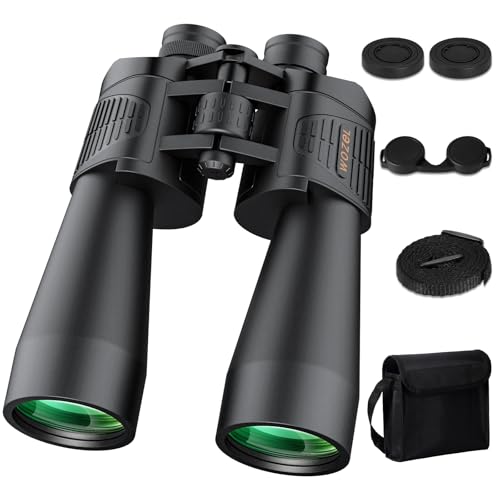
The WOZEL 20x70 is the most specialized binocular here. Its 20x magnification is paired with very large 70mm objective lenses, a combination aimed at pulling in light and detail when the subject is far away. That can be appealing for open fields, distant shorelines, and other fixed observation points.
The 26mm eyepiece is intended to provide a larger image and a more comprehensive view. WOZEL also uses BAK4 prisms and fully multi-coated optics, with the stated goals of realistic color reproduction, reduced glare, and improved clarity. The focus mechanism is described as smooth and precise, which matters when high magnification makes small adjustments obvious.
The main issue is handling. The product package weighs about 2.8 pounds, and there is no phone adapter or tripod listed in the supplied information. At 20x, holding the binoculars steady while following a moving bird will be difficult for many people. The FLYANT 20x50 is lighter and more compact, while the GIGAPENGUIN 15x52 is a more manageable long-distance option.
A rubber-coated body provides grip and impact resistance, and the binoculars come with a neck strap. The design is described for birdwatching, hunting, hiking, travel, and stargazing, but its size makes those uses more realistic when the observation itself is the destination rather than one activity during a walk.
This is not the pair to choose for quick garden sightings. It makes sense only when maximum reach and a bright large objective lens matter more than mobility.
How to choose best binoculars for birdwatching
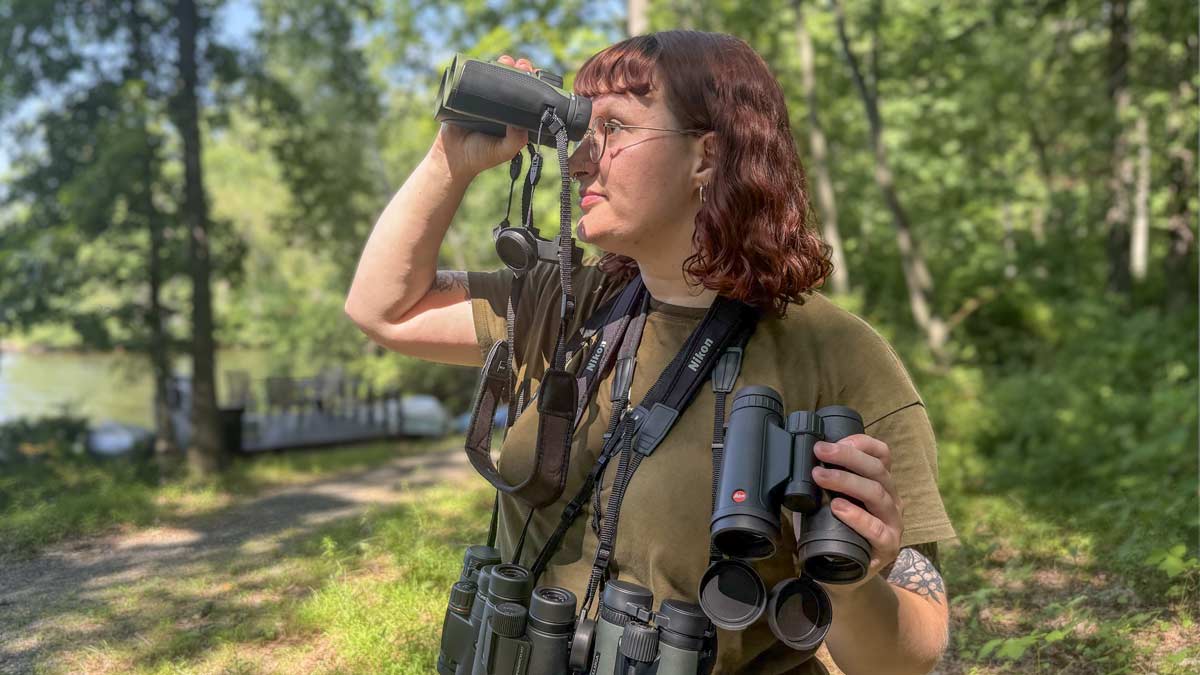
The right binoculars depend on where you watch, how long you carry them, and how quickly birds move through the frame.
Magnification and steadiness
Magnification tells you how much closer a subject appears. An 8x model is usually easier to hold steady and quicker for locating birds, while 10x adds reach without becoming as demanding as 12x, 15x, or 20x. High-power models can work well from a stable position, but they are harder to use for birds in flight.
For active birding, a steady view that finds the bird quickly is usually more useful than maximum magnification.
Objective lens size
The second number in a binocular specification is the objective-lens diameter. A 42mm lens is a common balance for birding because it supports useful brightness without the bulk of a 50mm or 70mm design. Smaller 25mm lenses make a pair easier to carry but are less suited to dim woodland, dawn, or dusk.
Field of view
A wide field of view helps you locate a bird and keep it centered as it moves. This matters most in woodland, wetlands, and open skies where birds may change direction quickly. The Celestron Nature DX lists a 7.4-degree angular field, while several other models provide measurements at 1, 000 yards or meters. Compare like with like, since those figures are not always expressed in the same format.
Lens and prism coatings
Fully multi-coated lenses are intended to improve light transmission and reduce reflections. Phase correction, dielectric prism coatings, and ED glass address different parts of image quality, including contrast, brightness, color fidelity, and chromatic aberration. The Athlon Midas UHD and Nikon Monarch M5 stand out here with ED glass, while the Celestron and Adasion models emphasize coated BAK4 prisms.
Weather protection and fit
Waterproofing and fogproofing matter when binoculars move between cool air, humid woods, and wet trails. Nitrogen or argon purging can help resist internal fogging, while rubber armor improves grip and protection from bumps. Eyecup adjustment and eye relief are equally important for glasses wearers. A pair that cannot give you the full field comfortably will waste its optical advantages.

Frequently asked questions
What magnification is best for birdwatching?
Eight-power binoculars are the easiest starting point for many birders because they offer a steady view and a wide scanning experience. Ten-power models show more distant detail, but they can be harder to hold steady. Magnifications above 12x are better suited to stable viewing positions than fast-moving trail walks.
Are 8x42 binoculars good for birdwatching?
Yes. The 8x42 format is popular because 8x magnification is manageable while 42mm objective lenses support useful brightness. The Nikon Monarch M5, Athlon Midas UHD, Celestron Nature DX, and Adasion 8x42 all use this format with different optical and carrying priorities.
Do birdwatching binoculars need to be waterproof?
Waterproofing is useful for outdoor birding because rain, humidity, and temperature changes can affect equipment. Fogproof construction helps prevent internal condensation. It does not mean every pair should be submerged, so check the manufacturer's specific protection claims.
Are compact binoculars suitable for birdwatching?
Compact binoculars can work well in bright daylight, travel, and casual garden use. Their smaller objective lenses usually provide less light than full-size designs, and very high magnification can make them difficult to steady. The Occer 12x25 is best viewed as a portable option rather than a dedicated low-light birding tool.
Can a phone adapter take useful bird photos?
A phone adapter can align a smartphone camera with the binocular eyepiece and make occasional photos possible. Results depend on steady support, careful alignment, focus, and the phone itself. The Adasion 8x42 and Adasion 12x42 include adapters and small tripods for this purpose.
Do glasses wearers need special binoculars?
Glasses wearers should look for adjustable eyecups and sufficient eye relief. Twist-down or twist-up eyecups can help position the eyes at the correct distance from the lenses. The GIGAPENGUIN, Adasion models, Occer, and Nikon Monarch M5 all include features intended to accommodate glasses wearers.
Can high-magnification binoculars replace a spotting scope?
High-magnification binoculars can show distant detail, but they are still difficult to steady and may not provide the same controlled viewing experience as a spotting scope. The WOZEL 20x70 and FLYANT 20x50 make the most sense from a fixed position. For moving birds, an 8x or 10x pair is generally easier to use.
The bottom line
The Best binoculars for birdwatching in this group are the Nikon Monarch M5 for its ED glass, bright prism coating, close focus, weather protection, and balanced 8x42 design. The Vortex Triumph HD is the better fit for hikers who want a lighter full-size pair with a rugged body and useful carrying harness.
Choose the Athlon Midas UHD when optical detail and color control matter most, or the Celestron Nature DX when tracking birds across a broad field is your priority. For phone photography, the Adasion 8x42 is the simplest complete kit. An undecided reader should start with a steady 8x42 model and move to higher magnification only if distant viewing is the main activity.
As an Amazon Associate we earn from qualifying purchases.