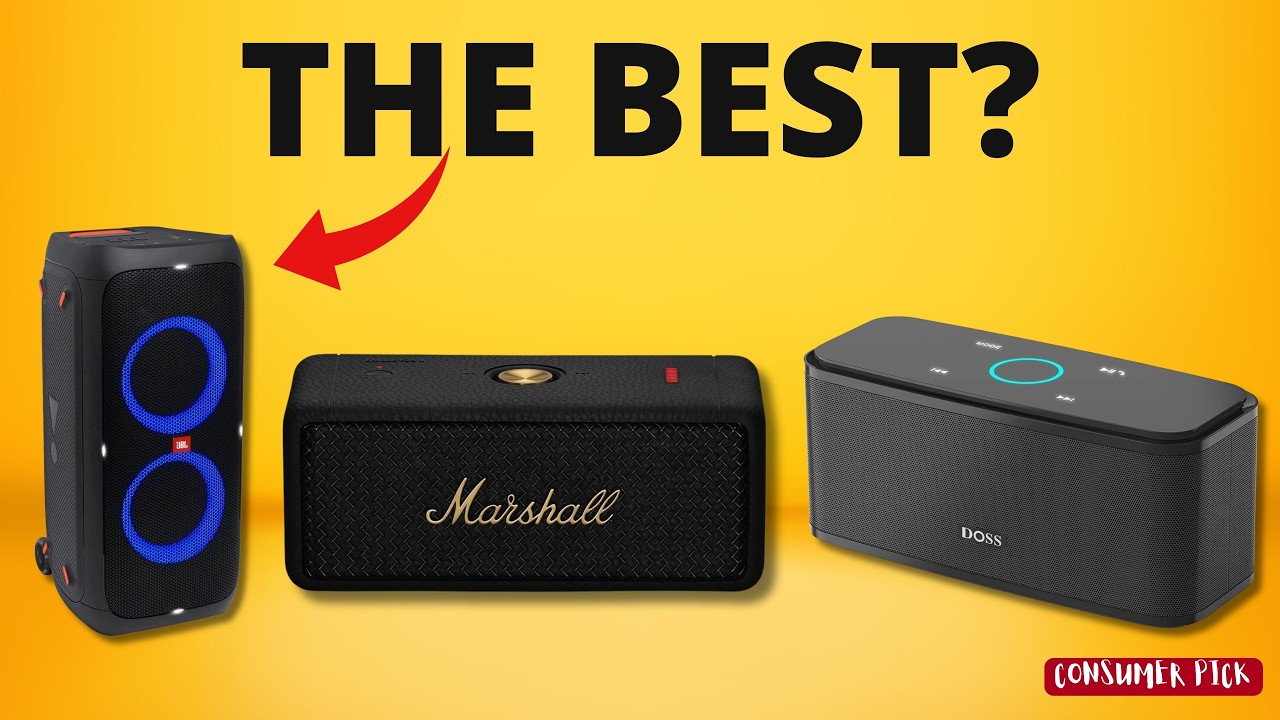

A speaker can be loud without making bass feel substantial. Small cabinets often emphasize upper bass while losing the weight in kick drums, electronic tracks, and movie soundtracks that makes music feel alive. The right portable speaker needs enough driver support, enclosure volume, and tuning to produce low end without turning vocals muddy.
We compared ten portable models with very different priorities, from the compact JBL Go 4 to large outdoor speakers with dedicated bass controls. The Best Bluetooth Speakers for Bass for most people are the Soundcore Boom 2, while the Ortizan X10 is the most practical lightweight alternative.
Comparison table
| # | Product | Award | Power | Battery | Water rating | Best for |
|---|---|---|---|---|---|---|
| 1 | Soundcore Boom 2 | Best overall | 80W | Up to 24 hours | IPX7 | Outdoor bass and flexible tuning |
| 2 | Ortizan X10 | Best compact stereo | 24W | Up to 30 hours | IPX7 | Portable listening with strong battery life |
| 3 | Monster S620 | Best for pairing | 60W | Not stated | IPX8 | Two-speaker stereo setups |
| 4 | BassBloom Roar 3 | Best small bass boost | 20W driver, 30W peak | Up to 24 hours | IPX6 | Desk and campsite listening |
| 5 | dbsono 100W Speaker | Best controlled power | 60W RMS, 100W peak | Not stated | IPX5 | Large spaces and adjustable bass |
| 6 | JBL Go 4 | Best ultra-portable | Not stated | Up to 7 hours | IP67 | Pocketable everyday audio |
| 7 | Anker Soundcore 2 | Best simple bass | 12W | Up to 24 hours | IPX7 | Straightforward home and outdoor use |
| 8 | JBL Flip 5 | Best dependable JBL sound | Not stated | Up to 12 hours | IPX7 | Familiar portable sound |
| 9 | OHAYO 35W Speaker | Best party features | 35W | Up to 24 hours | IPX7 | Lights, bass boost, and TWS |
| 10 | Heavy Bass Speaker | Best manual EQ | 120W peak | Up to 28 hours | Not stated | Users who want treble and bass controls |
1. Soundcore Boom 2: Best Overall

Pros
- Dedicated subwoofer gives the bass real weight
- BassUp 2.0 adds extra low-end impact
- Up to 24 hours of playtime
- IPX7 protection and a floatable design
- App-based Pro EQ and RGB lighting
Cons
- Larger and heavier than the compact picks
- Some battery claims vary with volume and content
- The lighting is unnecessary for listeners who want a discreet speaker
Best for: someone who wants powerful outdoor bass with room to customize the sound.
The Soundcore Boom 2 is the one that makes the most sense when bass is the reason you are buying a portable speaker. It has the physical size to move more air than the JBL Go 4, Anker Soundcore 2, or BassBloom Roar 3, and its dedicated subwoofer gives kick drums and bass guitar more authority. It sounds like an outdoor speaker rather than a small speaker trying to imitate one.
Soundcore combines the subwoofer with BassUp 2.0, a processing mode designed to push the low end harder. The feature matters most outside, where open space can make a compact speaker sound thin. The Boom 2 also promises crisp highs and detailed mids, so the bass is not the only thing getting attention. That balance makes it more useful for mixed playlists than a speaker tuned only for thump.
The battery is rated for up to 24 hours, though the supplied claim notes that playtime varies by volume and audio content. A built-in power bank can top up a phone, which is a genuinely useful extra during a long day away from an outlet. IPX7 waterproofing, a floatable design, and the roughly 3.66-pound body make it well suited to pools, patios, and campsites, but less appealing as a speaker you carry around the house constantly.
The Soundcore app adds Pro EQ controls, allowing you to pull back the bass when vocals need more space or push it further for dance music. Built-in RGB lights are fun at a gathering but will not appeal to everyone. Compared with the dbsono 100W Speaker, the Boom 2 gives up some explicit output detail, yet it offers a clearer tuning story and a more useful water-ready design. Choose it over the Ortizan X10 when scale and low-end authority matter more than a lighter carry.
Its weakness is straightforward: this is not the smallest or most subtle speaker in the group. Someone who wants a compact kitchen companion should look at the JBL Go 4 or Anker Soundcore 2 instead. For outdoor listeners who want bass that remains convincing away from a wall, the Boom 2 is the safest first recommendation.
2. Ortizan X10: Best Compact Stereo

Pros
- 24W stereo driver system
- Two passive radiators support outdoor bass
- Up to 30 hours of playtime
- IPX7 waterproof protection
- AUX and TF card playback
Cons
- Bass cannot be customized as extensively as the Boom 2
- The light show adds visual clutter
- Stereo pairing requires a second speaker
Best for: listeners who want a light, waterproof speaker with unusually long battery life.
The Ortizan X10 is a convincing second-place pick because it keeps the package small without treating bass as an afterthought. Its 24W output comes from two 12W stereo drivers, and two passive radiators help reinforce the low end. The result should have more body than a single tiny driver, especially when the speaker is placed on a solid surface.
Its digital signal processor is intended to keep treble, mids, and bass coherent at different volume levels. That is useful for a speaker that may move between a desk, a shower, and a campsite. The X10 is only about 1.15 pounds and measures roughly 6.69 inches high, 3.11 inches long, and 3.11 inches wide, so it is much easier to drop into a bag than the Soundcore Boom 2.
Battery life is one of its strongest claims. Ortizan rates it for up to 30 hours at around 65dB, with actual endurance dependent on use. IPX7 protection allows the speaker to handle immersion up to the stated conditions, while Bluetooth 5.3 is specified for connections up to 66 unobstructed feet. AUX and TF card inputs give it more playback flexibility than many modern compact speakers.
The X10 can also pair with another unit for a wider stereo presentation. That makes sense for movies or a larger room, but buying two speakers is a different proposition from choosing one. The built-in microphone supports hands-free calls, and the RGB themes can run as a light without music. Those extras are less important than the dual-driver layout, but they make the X10 more versatile at a gathering.
It cannot match the Boom 2's dedicated subwoofer or app-based Pro EQ, and its bass enhancement is less specifically adjustable. The JBL Flip 5 has a more established sound signature, but the X10 offers longer stated battery life and more connection options. The X10 is the better fit for anyone who wants bass with a genuinely portable footprint.
3. Monster S620: Best for Pairing

Pros
- 60W stated audio output
- Bluetooth 5.4
- IPX8 waterproof protection
- Two-speaker pairing can create 120W stereo
- Indoor and outdoor EQ modes
Cons
- Battery life is not stated
- Its large body is longer than the lightest picks
- Deep bass mode and outdoor mode trade different qualities
Best for: buyers planning to build a two-speaker stereo system for parties or home listening.
The Monster S620 stands out less as a solo travel speaker and more as the foundation for a pair. Its stated 60W output and 360-degree sound design give it a bigger brief than the JBL Go 4 or Soundcore 2. The useful detail is not just the headline wattage. Monster includes separate indoor and outdoor EQ modes, with indoor mode intended to emphasize richer bass and outdoor mode designed around more dynamic treble.
Bluetooth 5.4 handles wireless playback, and the speaker includes a TF card input for local files. Hands-free calling is supported through the built-in microphone. Those inputs make the S620 feel more like a flexible portable audio box than a single-purpose Bluetooth cylinder, although the data does not specify a wired AUX input.
The headline feature is true wireless stereo pairing. Two S620 speakers can be connected to produce the stated 120W of stereo sound, with left and right separation that a single portable enclosure cannot reproduce. That is the clearest reason to choose it over the Ortizan X10. The Monster option is aimed at listeners who may want to expand, while the X10 makes more sense if one compact speaker is the end goal.
At roughly 8.59 inches in its listed height dimension and 1.62 pounds, the S620 is still manageable, and a braided lanyard gives it several carrying options. It can stand vertically or lie sideways, which helps when space is limited. IPX8 protection is the strongest water rating in this group, though water resistance does not automatically make a speaker indestructible.
The missing battery-life figure is the main reason it does not rank higher. We cannot tell readers how long it will run from the supplied information, and that matters for a speaker aimed at outdoor use. The S620 is a strong pick for someone who values pairing, EQ modes, and water protection more than a documented all-day battery claim.
4. BassBloom Roar 3: Best Small Bass Boost

Pros
- 20W driver with 30W peak output
- Two passive radiators
- Two EQ modes
- Up to 24 hours of playtime
- Battery percentage display
Cons
- IPX6 does not support submersion
- Smaller driver has limited physical scale
- RGB lighting reduces endurance when active
Best for: someone who wants a very light speaker with a bass-focused listening mode.
BassBloom Roar 3 is a small speaker with a very specific goal: make low frequencies feel bigger than the enclosure suggests. Its 20W driver is paired with passive radiators on the top and bottom, while the company claims 30W peak power and an 80 percent bass improvement from its enhancement algorithm. Those claims are not a substitute for a large woofer, but the architecture is sensible for a compact design.
The two EQ modes let you choose between clearer vocals and enhanced bass. That is a more useful control than a permanent bass-heavy tuning because spoken audio and acoustic music can become congested when the low end is always pushed. A front-facing battery percentage display also answers a small but persistent annoyance with portable speakers: not knowing whether a charge is nearly finished.
At 480 grams, the Roar 3 is one of the easiest speakers here to carry. Its listed dimensions are 7 inches long, 3 inches wide, and 3 inches high, and a carry strap adds flexibility. Battery life is rated at up to 24 hours when tested at 50 percent volume with the lights off. RGB lighting and TWS pairing are included, so two units can create left and right stereo.
The IPX6 rating protects against powerful water jets, splashes, and rain, but the supplied details specifically say it is not intended for submersion. That separates it from the IPX7 JBL Flip 5 and Soundcore Boom 2. For a desk, picnic table, or covered patio, this may be enough. For a poolside speaker that could fall into the water, it is not the right choice.
Compared with the Anker Soundcore 2, the Roar 3 offers more modern controls, a battery display, and dedicated EQ modes. Compared with the Ortizan X10, it is lighter but has less stated output and shorter stated battery life. Pick it when carrying comfort matters as much as bass presence, and skip it if you expect room-filling low end from one small enclosure.
5. dbsono 100W Speaker: Best Controlled Power

Pros
- 60W RMS and 100W peak output
- Dual woofers and a dedicated tweeter
- Dedicated bass boost button
- Bluetooth 6.0 with stated 96-foot range
- USB-C audio and TWS support
Cons
- IPX5 handles splashes but not immersion
- Weighs 4.6 pounds
- Battery life is not stated
Best for: listeners who want a powerful speaker with direct control over bass impact.
The dbsono 100W Speaker is built around output and control. It specifies 60W RMS, 100W peak power, two 20W RMS woofers, and a 20W RMS tweeter. That split tells you more than the peak figure alone. The woofers handle the low end while the tweeter is assigned to higher frequencies, a layout that should give the speaker more composure than a single full-range driver when the volume rises.
A dedicated BASS Boost button offers an immediate way to increase low-frequency impact. The speaker also uses a custom racetrack woofer, according to the supplied features, and the control layout includes lighting and playback adjustments. If you like switching from a restrained setting to a party-oriented one without opening an app, this is one of the more direct options in the lineup.
Bluetooth 6.0 is specified for a connection up to 96 feet, though walls and interference will affect any wireless range. USB-C audio provides wired playback for compatible devices, and TWS can create left and right stereo with two speakers. The 4.6-pound body measures about 10.41 inches long, 5.12 inches wide, and 4.74 inches high, so it is portable in the literal sense but not effortless to carry all day.
Its construction uses shock-resistant ABS, silicone grip material, and nylon fabric. IPX5 protection covers splashes and light rain, but it is less water-ready than the IPX7 Soundcore Boom 2 or IPX8 Monster S620. That distinction matters if the speaker will be used near a pool or exposed to heavy rain rather than under a covered patio.
The lack of a stated battery figure is a real omission for a large outdoor model. The Boom 2 is easier to recommend for long trips because its endurance is documented and it adds a power bank. Choose the dbsono instead when a separate bass button, dual woofers, USB-C audio, and high stated output are more important than floatability or published battery life.
6. JBL Go 4: Best Ultra-Portable

Pros
- Extremely small and light
- IP67 waterproof and dustproof protection
- Punchy bass for its size
- Up to 7 hours of playtime
- Auracast multi-speaker connection
Cons
- Limited low-end scale compared with larger speakers
- Shortest stated battery life here
- No dedicated bass control
Best for: people who want bass with the smallest practical speaker footprint.
The JBL Go 4 is not a bass giant, and it does not pretend to be one. Its appeal is that it produces a surprisingly punchy presentation from a body measuring about 3.7 inches long, 1.7 inches wide, and 3 inches high. At roughly 0.42 pounds, it is dramatically easier to carry than every larger model in this roundup.
JBL rates it for up to seven hours of playtime, with Playtime Boost adding up to two more hours. That is enough for an afternoon but not the all-day endurance promised by the Ortizan X10, Soundcore Boom 2, or Heavy Bass Speaker. The trade-off is obvious: the Go 4 is the speaker you can keep in a bag without thinking about it, not the one you use to anchor a backyard party.
IP67 protection makes it unusually resilient for its size. It is waterproof and dustproof, so it is better suited to sandy beaches and messy outdoor use than the IPX5 dbsono model. JBL also supports pairing two Go 4 speakers for stereo and connecting multiple Auracast-enabled speakers, giving the tiny unit a way to grow when one speaker is not enough.
There is no bass button, app EQ, or stated power figure in the supplied product information. That keeps operation simple, but it also means you cannot tailor the sound as extensively as with the Boom 2 or Heavy Bass Speaker. The Go 4's bass is best described as lively and punchy rather than deep and room-filling.
Choose it over the JBL Flip 5 when portability is the deciding factor. Choose the Flip 5 when you want a longer stated battery run and a larger enclosure. The Go 4 is the right answer for travel, a bathroom shelf, a small desk, or anyone who values having a speaker nearby more than making bass physically move the room.
7. Anker Soundcore 2: Best Simple Bass

Pros
- BassUp processing and a spiral bass port
- Dual neodymium drivers
- Up to 24 hours of playtime
- IPX7 waterproof protection
- Simple, easy-to-use controls
Cons
- Only 12W stated output
- Older design lacks newer connection features
- Bass cannot be adjusted manually
Best for: buyers who want uncomplicated portable sound with dependable battery life.
The Anker Soundcore 2 is an older, simpler design, but its bass strategy remains clear. Two neodymium drivers provide the 12W output, while BassUp processing and a patented spiral bass port are used to strengthen the low end. It is not built to compete with the Soundcore Boom 2 for scale, yet it gives casual listening more warmth than a basic single-driver mini speaker.
Anker claims the digital signal processor maintains bass without distortion at any volume. The useful part of the design is that it does not require an app or a collection of sound modes. Press the controls, start playback, and the speaker gets out of the way. That simplicity is a virtue for kitchens, bedrooms, and family trips where a speaker may be used by several people.
The 5, 200mAh battery is rated for up to 24 hours, giving it the same stated endurance as the Boom 2 despite its smaller output. IPX7 protection covers splashes and water exposure, so it is suitable for a beach bag or a rainy campsite. Its listed dimensions are about 6.5 inches high, 1.77 inches long, and 2.13 inches wide, with a weight of 0.91 pounds.
What it does not have is just as important. There is no stated stereo pairing feature, lighting, USB-C audio, or manual EQ in the supplied information. The JBL Flip 5 sounds more substantial, and the Ortizan X10 adds stereo drivers, a TF card input, and a microphone. The Soundcore 2 wins by keeping the feature set focused and the operating experience uncomplicated.
The weakness is limited headroom. At 12W, it will not fill an open yard like the Boom 2 or dbsono speaker, and BassUp cannot create the physical depth of a larger woofer. It remains a good fit for listeners who want a small, waterproof speaker that can run all day and deliver a noticeable low-end lift without setup work.
8. JBL Flip 5: Best Dependable JBL Sound

Pros
- Recognizable JBL sound tuning
- Up to 12 hours of playtime
- IPX7 waterproof protection
- PartyBoost pairing
- Useful cylindrical portable shape
Cons
- Older model with fewer connection options
- Battery life trails the longest-lasting picks
- No dedicated bass adjustment
Best for: listeners who prefer a proven compact JBL format for everyday use.
The JBL Flip 5 is a straightforward portable speaker with a familiar balance of size, durability, and energetic sound. Its listed body measures about 7.1 inches long, 2.7 inches wide, and 2.9 inches high, while the 1.2-pound weight keeps it manageable in a backpack. It is larger than the Go 4, which gives the sound more physical presence, though it still belongs to the compact class.
JBL specifies up to 12 hours of playtime and IPX7 waterproofing. The latter makes the Flip 5 comfortable around pools, rain, and wet outdoor surfaces. Its battery claim is shorter than the Ortizan X10, Soundcore 2, and Boom 2, but it remains enough for a day trip or several sessions between charges.
PartyBoost allows multiple compatible speakers to connect, which is useful when one Flip 5 does not provide enough coverage. The supplied information does not list a bass boost button, app EQ, or wired audio input. That simplicity keeps the speaker easy to operate, but it gives bass-focused listeners less control than the dbsono 100W Speaker or Heavy Bass Speaker.
The Flip 5 is a better choice than the JBL Go 4 when you want more body and longer stated endurance. The Go 4 is far easier to carry and has IP67 dust protection, while the Flip 5 has the larger acoustic presentation. Against the Anker Soundcore 2, the JBL offers a more substantial compact speaker format, while Anker answers with longer stated battery life and BassUp processing.
Its main weakness is age in a rapidly changing category. Newer models add USB-C audio, updated wireless standards, display panels, and more elaborate EQ features. Pick the Flip 5 if you want an uncomplicated JBL speaker with waterproofing and PartyBoost, not if you want the deepest bass or the broadest feature set.
9. OHAYO 35W Speaker: Best Party Features

Pros
- 35W stated output
- Bass Boost processing
- Up to 24 hours of playtime
- RGB lighting
- TWS pairing and USB audio
Cons
- Product features refer to the X10 MAX name
- No separate treble and bass controls
- Water rating is not dust rated in the supplied data
Best for: party hosts who want lights, bass processing, and two-speaker pairing.
The OHAYO 35W Speaker is built around a party-friendly mix of loudness, lights, and bass processing. Its supplied features claim 35W output, a tweeter dome designed to improve high frequencies, and Bass Boost processing intended to increase impact while limiting distortion. That combination gives it a more energetic brief than the neutral, simple operation of the Anker Soundcore 2.
OHAYO rates it for up to 24 hours, with a power-saving mode that can add up to two more hours when the RGB lights are turned off. The distinction is practical. Lights are fun for a gathering, but they consume battery, so the option to disable them makes the speaker more useful outside party mode.
TWS pairing lets two compatible speakers create a wider left and right presentation. The supplied information also lists USB-A lossless audio playback, which is unusual among the compact models here. That feature depends on using compatible files or services and a suitable device, but it gives listeners a wired digital option when Bluetooth compression is not wanted.
The speaker is rated IPX7 for water protection, and the features also claim resistance to drops from up to one meter. Its listed dimensions are about 7.28 inches high, 2.95 inches long, and 2.95 inches wide, with a weight just under one pound. That makes it much easier to move than the dbsono speaker or Heavy Bass Speaker, though the supplied product copy refers to it as the X10 MAX, which creates some naming uncertainty.
Compared with the BassBloom Roar 3, the OHAYO offers more stated output and a lossless USB option, while BassBloom provides a battery percentage display and clearly defined dual EQ modes. The JBL Flip 5 has a simpler, more established feature set, but OHAYO is more entertaining for a party. Skip it if you want refined manual sound shaping or a clearly documented model identity.
10. Heavy Bass Speaker: Best Manual EQ

Pros
- 120W peak output claim
- Separate treble and bass controls
- Up to 28 hours of playtime
- Carry strap and top controls
- Intended for home and outdoor listening
Cons
- Water rating is not stated
- No RMS output figure is supplied
- Larger body takes more room in a bag
Best for: listeners who want direct control over bass and treble without relying on an app.
The Heavy Bass Speaker takes the most literal approach to its name. Its features claim 120W peak power, loud stereo sound, and deep bass for home, patio, and outdoor use. The peak figure should not be compared directly with the dbsono model's 60W RMS specification, because the two products do not describe output in the same way. Still, the intended role is clear: this is a larger speaker for listeners who want more scale than a compact cylinder can provide.
Its best feature is not the headline output. Separate treble and bass controls let you shape vocals, podcasts, acoustic music, and bass-heavy playlists directly from the speaker. That is useful when the listening environment changes. A room with reflective walls may need less bass, while an open patio may benefit from more low-end emphasis.
Battery life is rated for up to 28 hours, the longest stated figure in this roundup. As with other playtime claims, actual endurance will depend on volume and content. The carry strap and top controls make it easier to move between rooms, patios, picnics, and tailgates, but the body is about 12.6 inches long, 6.5 inches wide, and 5.11 inches high, with a weight of roughly 2.15 pounds.
The supplied information does not state a water rating, so this is not the speaker to place beside a pool without protection. The Soundcore Boom 2 is safer for wet outdoor use because it specifies IPX7 and a floatable design. The dbsono speaker is a closer rival for power, but it specifies RMS output, dual woofers, a tweeter, and IPX5 splash resistance, while Heavy Bass gives you direct treble and bass adjustment.
The missing water protection and RMS figure make this a less certain recommendation than the top picks. It is also too large for anyone who wants a speaker that disappears into a small bag. Choose it when manual EQ matters most and the speaker will live in a relatively controlled environment.
How to choose best bluetooth speakers for bass
The right bass speaker depends on more than the largest wattage claim. Focus on the driver arrangement, tuning controls, enclosure size, battery, and protection that match where you will actually listen.
Driver layout and enclosure size
Bass needs air movement, so larger speakers generally have an easier time producing weight and volume without strain. A dedicated woofer, such as the arrangement in the dbsono 100W Speaker, gives low frequencies a clearer job than a single tiny full-range driver. Passive radiators, used by the Ortizan X10 and BassBloom Roar 3, can add low-end presence without requiring a ported cabinet.
Compact speakers can still sound punchy, but they cannot create the same physical depth as the Soundcore Boom 2. Treat small-speaker bass claims as a request for stronger impact within a limited scale, not as a promise of subwoofer-like extension.
Output ratings
Wattage can help compare products from the same range, but peak and RMS figures are not interchangeable. The dbsono speaker lists 60W RMS and 100W peak, while the Heavy Bass Speaker lists 120W peak without an RMS figure. RMS is more useful for describing sustained output, while peak figures describe short bursts.
Look for a speaker with enough physical size and a driver layout suited to the listening space. A compact unit can work well beside a chair or on a desk, while an open yard needs more headroom and directional coverage.
EQ and bass controls
A bass boost mode is useful when you want more impact quickly, but manual controls are more flexible. The Heavy Bass Speaker separates treble and bass adjustment, and the Soundcore Boom 2 provides Pro EQ through its app. The Monster S620 takes a simpler approach with indoor and outdoor modes.
Strong bass is useful only when kick drums stay defined and vocals remain easy to follow.
A speaker that permanently boosts the low end can make podcasts and acoustic music sound thick. Choose adjustable EQ if you listen to several genres or move the speaker between rooms and outdoor spaces.
Battery endurance
Portable speaker playtime is usually stated under specific conditions. The Ortizan X10's up to 30 hours is given at around 65dB, while the BassBloom Roar 3's up to 24 hours is based on 50 percent volume with lights off. Louder playback and active lighting will reduce endurance.
For long trips, prioritize a documented battery claim and consider useful extras such as the Boom 2's built-in power bank. The JBL Go 4's up to seven hours is more suitable for short outings than for an all-day gathering.
Water and dust protection
IPX7 and IPX8 indicate strong water protection, but they do not describe dust resistance. The JBL Go 4's IP67 rating covers both water and dust, making it especially suitable for beaches and dusty trails. IPX5, used by the dbsono speaker, is aimed at splashes and light rain rather than immersion.
If the speaker might fall into a pool, choose a model with an immersion-rated specification. If it will stay under a covered patio, splash resistance may be enough, but do not assume an unspecified rating means the speaker is safe around water.
Stereo pairing and connections
TWS pairing can create genuine left and right separation when you use two compatible speakers. The Monster S620, BassBloom Roar 3, OHAYO speaker, and dbsono model all provide pairing features in the supplied information. Some products also support TF cards, AUX, or USB audio.
Pairing is most useful for a room or gathering where one speaker cannot cover the space. For casual listening, a single speaker with better bass and battery life is usually simpler than managing two units.
Frequently asked questions
Which speaker has the strongest bass?
The Soundcore Boom 2 is the strongest all-around bass pick in this group because it combines a dedicated subwoofer with BassUp 2.0 and a larger outdoor-oriented enclosure. The dbsono 100W Speaker and Heavy Bass Speaker are also aimed at high-output listening, but their power specifications are presented differently.
Is a small Bluetooth speaker good for bass?
A small speaker can produce punchy bass, but it has less physical ability to move air than a larger model. The JBL Go 4 is a good example of compact impact, while the BassBloom Roar 3 uses passive radiators and a bass mode to make its low end more noticeable.
What is the difference between IPX7 and IPX8?
Both ratings indicate protection against immersion under defined testing conditions. IPX8 represents a higher immersion protection level than IPX7, but the exact depth and duration depend on the product specification. The Monster S620 lists IPX8, while the Soundcore Boom 2, Ortizan X10, JBL Go 4, Anker Soundcore 2, JBL Flip 5, and OHAYO speaker list IPX7.
Does more wattage always mean deeper bass?
No. Wattage describes electrical output, but bass also depends on driver size, enclosure design, tuning, and digital processing. The dbsono speaker's separate woofers and tweeter tell you more about its design than its 100W peak figure alone.
Should I buy two speakers for stereo bass?
Two speakers can create a wider stereo image and cover a larger area, but pairing does not automatically make each unit produce deeper bass. It is most useful for movies, stereo music, and gatherings where left and right separation matters. The Monster S620 is particularly suited to this approach because its supplied features emphasize two-speaker pairing.
How long do portable speaker batteries last?
The products in this roundup list playtime from up to seven hours for the JBL Go 4 to up to 30 hours for the Ortizan X10. Actual results depend on volume, audio content, wireless use, and lighting. The Heavy Bass Speaker lists up to 28 hours, while the Monster S620 and dbsono speaker do not include a battery-life figure in the supplied data.

The bottom line
The Best Bluetooth Speakers for Bass here is the Soundcore Boom 2. Its dedicated subwoofer, BassUp 2.0, IPX7 protection, floatable design, 24-hour claim, and app-based EQ make it the most complete option for patios, campsites, and backyard listening. The Ortizan X10 is the better alternative when you want a lighter speaker, longer stated battery life, stereo drivers, and extra playback inputs.
Choose the dbsono 100W Speaker for separate bass control and a dual-woofer layout, or the JBL Go 4 when carrying convenience matters more than deep low end. For an undecided reader, start with the Soundcore Boom 2 unless its larger body is the reason you wanted a compact speaker in the first place.
As an Amazon Associate we earn from qualifying purchases.