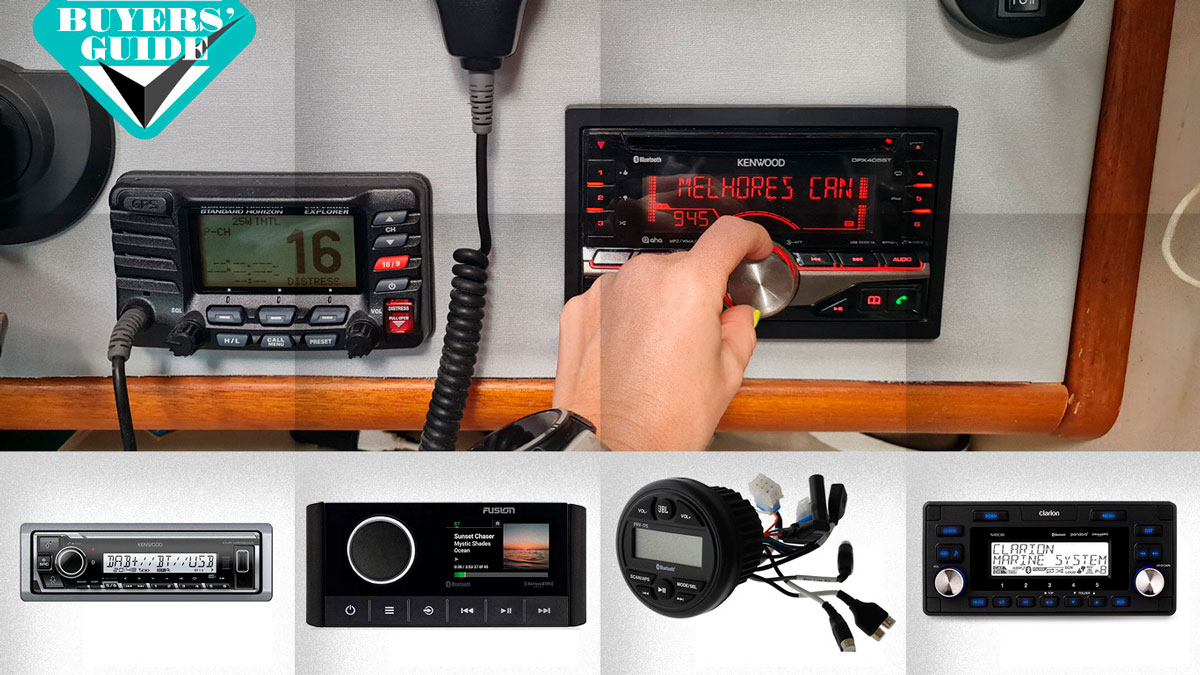

A boat stereo has to cope with spray, glare, cramped dashboards, and music that competes with wind and engine noise. A household receiver is not built for that combination, and replacing a failed unit at the dock is an unpleasant job. The Best best boat stereo system choices here cover single receivers, gauge-style installations, and complete packages with marine speakers.
The Pioneer MVH-MS512BS is our top pick for most boat owners because its corrosion-resistant construction, Bluetooth controls, three 4V RCA pre-outs, and practical USB switching leave room to build a better system later. The rest of the list ranges from complete BOSS kits to compact Pyle receivers and the feature-rich Kenwood KMR-D382BT.
Comparison table
| # | Product | Award | Power | Speakers | Connectivity | Best for |
|---|---|---|---|---|---|---|
| 1 | Pioneer MVH-MS512BS | Best overall | Built-in amplifier, three 4V RCA pre-outs | Receiver only | Bluetooth, USB, AM/FM, Alexa through app | Expandable boat audio |
| 2 | BOSS MCKG634B.6 | Best complete kit | 50W x 4 | Pair of 6.5-inch dual-cone speakers | Bluetooth, USB, auxiliary, AM/FM | Straightforward replacement |
| 3 | BOSS MCKGB350W.6 | Best weather protection | Not stated | Pair of 6.5-inch speakers | Bluetooth, USB, auxiliary, AM/FM, NOAA weather | Boats needing weather band |
| 4 | BOSS MCK632WB.6 | Best illuminated kit | 50W x 4 | Pair of 6.5-inch dual-cone speakers | USB, auxiliary, radio | Color-matched dashboards |
| 5 | BOSS MGR350B | Best gauge receiver | 60W x 4 | Receiver only | Bluetooth, USB, auxiliary, AM/FM | Tight console cutouts |
| 6 | Pyle PLMRKT36WT | Best compact kit | 300W peak | Pair of 5.25-inch speakers | Bluetooth, USB, SD, auxiliary, AM/FM | Small boats and basic installs |
| 7 | Kenwood KMR-D382BT | Best for audio control | 50W x 4 peak, 22W x 4 RMS | Receiver only | Bluetooth, USB, AUX, CD, AM/FM, SiriusXM ready | Detailed tuning and expansion |
| 8 | BOSS MCKGB450B.6 | Best subwoofer-ready kit | 60W x 4 | Pair of 6.5-inch dual-cone speakers | Bluetooth, USB, auxiliary, AM/FM | Adding bass later |
| 9 | BOSS MCK508WB.64S | Best hands-free kit | 50W x 4 | Pair of 6.5-inch speakers | Bluetooth, USB, auxiliary, AM/FM | Voice control on the water |
| 10 | Pyle PLMRB29B | Best simple receiver | 300W peak, 75W x 4 peak | Receiver only | Bluetooth, USB, SD, auxiliary, AM/FM | Basic single-DIN upgrades |
1. Pioneer MVH-MS512BS: Best Overall

Pros
- Conformal-coated circuit board resists corrosion
- Bluetooth supports streaming, calls, and device control
- Three 4V RCA pre-outs simplify system expansion
- USB Auto Switch can separate charging from audio playback
Cons
- Speakers are not included
- Alexa requires the Pioneer Smart Sync app
- Display is a basic two-line VA LCD
Best for: boat owners who want a dependable receiver with room for amplifiers, subwoofers, or additional speakers.
The Pioneer MVH-MS512BS is the receiver we'd choose when the stereo is only the first part of a larger boat audio project. It does not arrive with speakers, but that omission is useful for owners who already have suitable marine speakers or want to select them separately. The conformal-coated PCB is designed to resist corrosion in marine, powersport, and open-air environments, which is more relevant on a boat than a long list of entertainment features.
Bluetooth handles wireless audio, hands-free calls, and device control, while USB provides another source and can charge a connected phone. The USB Auto Switch is a thoughtful detail. It lets the owner decide whether a phone should act as the audio source or simply charge, avoiding the annoyance of a device taking over playback whenever it is plugged in. The receiver also supports WMA and WAV formats.
The strongest reason to choose the Pioneer over the BOSS MCKG634B.6 is its expansion potential. Three RCA pre-outs rated at 4V give an amplifier or powered subwoofer a stronger connection point than a basic receiver, and the built-in amplifier can drive a simple speaker setup by itself. Owners planning a larger system should also consider how dedicated marine speakers handle open-air listening, since speaker placement matters as much as the head unit.
Its weakness is equally clear. You must source speakers separately, and the two-line VA LCD is functional rather than luxurious. The Alexa feature depends on the Pioneer Smart Sync app, so it is not a standalone voice assistant built into the receiver. Skip it if you want one box containing everything needed for a quick replacement.
For a boat owner who cares about corrosion resistance now and upgrades later, the MVH-MS512BS is the most complete foundation here. It is the pick for a clean receiver-first installation rather than a bundled speaker swap.
2. BOSS MCKG634B.6: Best Complete Kit

Pros
- Includes a receiver and two 6.5-inch speakers
- Bluetooth, USB, auxiliary, and AM/FM sources
- Front and rear pre-amp outputs
- Detachable front panel and wireless remote
Cons
- No CD or DVD player
- Speakers need 2.18 inches of mounting depth
- No subwoofer output listed
Best for: replacing an older boat stereo and speakers in one coordinated installation.
The BOSS MCKG634B.6 makes sense for the common repair where both the head unit and the original speakers have seen too many seasons. The receiver and pair of 6.5-inch dual-cone speakers arrive as a matched package, so there is less guesswork about compatibility. The receiver is weatherproofed against splashing water, and its detachable front panel gives the installation a little more flexibility when the boat is stored.
Its 50W x 4 amplifier is suitable for a conventional four-channel layout, while the front and rear pre-amp outputs leave an option to connect external amplification. The speakers use a 4-ohm impedance and cover a stated 80 Hz to 20 kHz frequency range. Their 5.75-inch mounting hole and 2.18-inch mounting depth are the measurements to check before cutting anything. The dual-cone design is intended to cover a broad range without requiring a separate tweeter.
Bluetooth is the easiest daily source, but USB, auxiliary input, and AM/FM radio are available when a phone is inconvenient or reception is preferable. The wireless remote is useful when the helm is not the only listening position. Compared with the Pioneer MVH-MS512BS, this BOSS kit is less attractive for a custom system because the speakers and simpler output arrangement limit your choice of components. Compared with the BOSS MCK632WB.6, it is the more conventional package, without the latter's multicolor panel illumination.
The main limitation is the lack of a CD or DVD player, although that is unlikely to matter to owners streaming from a phone. The speakers are also not small, and their mounting dimensions may not suit a compact console. Anyone expecting deep low bass from two dual-cone speakers should plan on a subwoofer or a different speaker arrangement.
Choose this kit when the goal is a practical, all-at-once replacement. It is especially well suited to a boat with standard speaker locations and no immediate plan for a complex multi-zone system.
3. BOSS MCKGB350W.6: Best Weather Protection

Pros
- IPX6-rated receiver
- Includes NOAA weather band
- USB charging and audio playback
- Front, rear, and subwoofer outputs
Cons
- No CD player
- White speaker finish may not suit every dashboard
- Speaker dimensions require careful planning
Best for: boaters who want weather information and an expandable receiver with bundled speakers.
The BOSS MCKGB350W.6 stands out because it treats the receiver as more than a Bluetooth box. Its IPX6 rating is specified for protection against splashing water, and the included pair of 6.5-inch speakers has weatherproof construction. That makes the package a natural fit for open boats where spray is part of normal use rather than an occasional accident.
The source selection is broad for a bundled system. Bluetooth supports wireless control from a phone, while USB, auxiliary input, and AM/FM radio cover the less dependent options. The NOAA weather band is the meaningful difference here. It gives the receiver a practical job when music is not playing, particularly for owners who want marine information without using a phone. USB charging also helps keep that phone available.
The receiver provides front, rear, and subwoofer outputs, so this kit has more expansion potential than the BOSS MCKG634B.6. The receiver is listed at 2.1 pounds with dimensions of 3.3 by 4.5 by 4.5 inches, while the speakers measure 7.5 by 7.5 by 3.4 inches. Those speaker cabinets are substantial, but they also offer a more suitable starting point for an open-air installation than the smaller Pyle PLMRKT36WT speakers.
The weather protection does not remove the need for sensible installation. The receiver and speakers are protected against the stated water exposure, but mounting, wiring, and connector placement still matter. The kit also lacks a CD player, and the white speakers are a visual choice that may not blend into every cockpit.
This is the BOSS package to pick when NOAA weather access and future subwoofer support matter. It is less compelling for a sheltered boat with tight speaker cutouts, where the smaller Pyle kit may fit more easily.
4. BOSS MCK632WB.6: Best Illuminated Kit

Pros
- Multicolor illumination for the receiver panel
- Includes two dual-cone speakers
- 50W x 4 receiver amplifier
- Detachable front panel and pre-amp outputs
Cons
- No AM/FM or Bluetooth feature is listed
- Older receiver design
- No dedicated subwoofer output listed
Best for: owners who want a coordinated speaker kit and customizable dashboard lighting.
The BOSS MCK632WB.6 is the visual alternative in this group. Its receiver panel can be set to different colors, which helps when a boat is used after sunset or when the owner wants the controls to match existing lighting. The package includes two dual-cone speakers, so it is aimed at a replacement rather than a receiver-only upgrade.
The receiver has a 50W x 4 amplifier, a detachable front panel, and front and rear pre-amp outputs. Each speaker is rated at 90 watts in the supplied specifications and measures 7.5 by 7.5 by 3.3 inches, with a pair weight of 3.4 pounds. The 3.94 by 7.4 by 2.28-inch receiver fits the familiar single-DIN style of installation, though the available cutout and rear clearance should be checked first.
USB and auxiliary inputs are explicitly listed, and the included 36-inch male-to-male 3.5mm cable makes a wired phone connection simple. The feature data for this model does not list AM/FM radio or Bluetooth, so we would not choose it for a phone-first or radio-heavy boat setup without confirming the exact configuration. That is the key distinction from the MCKG634B.6 and MCKGB450B.6, both of which clearly list Bluetooth.
The illumination is useful, but it is not a substitute for current wireless features. The speakers also need room, and a dual-cone pair will not produce the same low-end scale as a system built around a subwoofer output. Buyers who want the simplest modern streaming setup should skip this model in favor of the Pioneer or another BOSS unit with Bluetooth clearly specified.
Pick it when panel lighting and a basic USB or auxiliary installation are the priorities. It is a more specialized choice than its bundled appearance first suggests.
5. BOSS MGR350B: Best Gauge Receiver

Pros
- Compact gauge-style receiver
- 60W x 4 channel amplification
- IPX6 splash protection
- Front, rear, and subwoofer pre-amp outputs
Cons
- Speakers are not included
- Small form factor may require a different installation cutout
- No display size or radio band details beyond the listed features
Best for: boats with limited dashboard space and owners adding their own speakers.
The BOSS MGR350B is the unusual fit in the lineup. Instead of using a conventional rectangular receiver face, it is a compact gauge-style unit measuring 3.5 by 3.5 by 3.8 inches. That can make it easier to place in a crowded console, although it also means the existing opening must be compatible with this form factor.
The receiver includes Bluetooth, USB, auxiliary input, and USB charging. Its IPX6 rating is intended to protect against splashing water, while a conformal-coated circuit board and UV-coated front panel address two common marine concerns. The 60W x 4 amplifier is the highest stated channel output among the BOSS receiver kits here, and the receiver has front, rear, and subwoofer pre-amp outputs.
Unlike the MCKGB350W.6, it does not include speakers. That is a drawback for anyone hoping to replace an entire system in one purchase, but an advantage for an owner who already has suitable marine speakers or wants to install a custom pair. The subwoofer output also gives it a clearer path to stronger bass than the MCK632WB.6. For speaker selection, it helps to understand how low-frequency output changes the shape of an open boat system before choosing the rest of the components.
The compact case brings compromises. Controls and display space are necessarily more limited than on a conventional single-DIN receiver, and the supplied information does not give a display measurement. Owners should confirm the gauge opening, wiring access, and viewing angle before ordering. It is also an older-style design compared with the more app-oriented Pioneer and Kenwood units.
Choose the MGR350B when the dashboard is the problem to solve. It is a capable receiver for a tight helm, especially if the speaker system is already in place and a subwoofer may be added later.
6. Pyle PLMRKT36WT: Best Compact Kit

Pros
- Receiver and two waterproof speakers included
- USB and SD card readers
- ID3 song and artist display
- Integrated microphone and remote control
Cons
- Smaller 5.25-inch speakers
- USB and SD support is limited to 32GB
- Lower stated speaker frequency range than the 6.5-inch kits
Best for: small boats that need a complete, compact system with several local media options.
The Pyle PLMRKT36WT is built around convenience. It includes the receiver, two 5.25-inch waterproof speakers, wiring harness, and remote control, so it avoids the component matching required by the Pioneer and Kenwood. The smaller speakers are easier to place on a compact boat, where a pair of 6.5-inch enclosures may interfere with storage or seating.
Its media selection is unusually broad for a small kit. Along with Bluetooth, AM/FM, and a 3.5mm auxiliary input, the receiver has USB and SD card readers that support memory up to 32GB. The LCD uses ID3 tagging to show an artist or song title, making locally stored music easier to navigate than a receiver with only a basic source indicator. Rear RCA outputs and illuminated front controls round out the installation features.
The included two-way speakers use a 4-ohm impedance, a 20-ounce circuit magnet, a 0.75-inch aluminum voice coil, and a stated frequency response of 100 Hz to 18 kHz. Those figures explain the kit's character. It is designed for clear general listening in a small space, not for producing the lower bass that a larger 6.5-inch pair or dedicated subwoofer can manage. The head unit uses a single-DIN chassis measuring 178 by 108 by 50 millimeters.
The compact format has limits. A 5.25-inch speaker pair will not move as much air as the speakers in the BOSS MCKGB450B.6, and the 300W figure is peak power rather than a directly comparable continuous rating. The white speaker finish may also be a poor match for a dark cockpit.
This is the sensible choice for a small boat where installation size and included accessories matter more than expansion. Pick it over the Pyle PLMRB29B when you need speakers in the same package.
7. Kenwood KMR-D382BT: Best for Audio Control
Pros
- 13-band equalizer and digital time alignment
- Bluetooth can connect two phones
- CD, USB, AUX, AM/FM, and SiriusXM-ready support
- Conformal-coated PCB and theft-deterrent faceplate
Cons
- Speakers are not included
- SiriusXM requires a tuner and subscription
- External microphone and marine remote are separate additions
Best for: boat owners who want detailed sound adjustment and many source options.
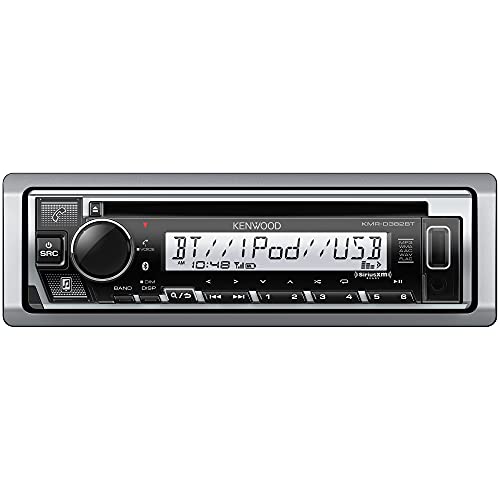
The Kenwood KMR-D382BT is the enthusiast's receiver in this comparison. It is still a single-DIN unit, but its feature set goes well beyond simple Bluetooth playback. A 13-band equalizer, digital time alignment, and Sound Reconstruction technology give the owner more control over how the system behaves in a reflective, open environment where speaker placement is rarely symmetrical.
Its built-in MOSFET amplifier is rated at 50W peak per channel and 22W RMS per channel across four channels. That RMS figure is useful when matching the receiver to speakers, since it describes the more sustained output specification rather than the larger peak number. RCA outputs also support an upgrade to a six-channel speaker setup or the addition of a subwoofer. SiriusXM readiness adds another source, although a tuner and subscription are required.
Kenwood also covers older and newer listening habits. It plays CDs, accepts USB and AUX sources, supports AM/FM, and can connect two phones over Bluetooth for hands-free calling and source switching. The 1.5-line glare-resistant display with variable color illumination should be easier to read in bright conditions than a dim, low-contrast panel. A theft-deterrent faceplate, front USB charging, and conformal-coated PCBs add practical boat-friendly touches.
The weakness is that this is a head unit only. There are no speakers in the box, and the external microphone plus compatible IPX7 marine remote are separate additions. The menus and tuning controls also require more attention than the simpler BOSS kits. Buyers who only want play and pause from a phone may not use what makes this receiver distinctive.
Choose it when sound adjustment, source flexibility, and future system expansion are worth the extra installation planning. It is more capable than the Pioneer in tuning features, while the Pioneer is the cleaner choice for a simpler corrosion-conscious setup.
8. BOSS MCKGB450B.6: Best Subwoofer-Ready Kit

Pros
- Includes receiver and two 6.5-inch speakers
- 60W x 4 receiver amplifier
- Dedicated subwoofer output
- IPX6-rated receiver and weatherproof speakers
Cons
- Speaker mounting depth is 2.18 inches
- No CD player
- Basic receiver interface
Best for: owners who want a complete kit now and a subwoofer later.
The BOSS MCKGB450B.6 is a useful middle ground between a basic replacement and a more ambitious build. It includes the receiver and two 6.5-inch dual-cone speakers, but its output layout makes it easier to grow. The receiver has front, rear, and subwoofer outputs, so adding a low-frequency channel later does not require replacing the head unit.
The receiver is rated at 60W x 4 and has an IPX6 rating for protection against splashing water. The speakers use a 4-ohm impedance and are specified for 80 Hz to 20 kHz response. Their 7.52-inch square dimensions, 5.75-inch mounting hole, and 2.18-inch mounting depth are important installation measurements. The pair weighs 2.76 pounds, which may help when planning mounting locations on a lighter boat.
Bluetooth, USB, and auxiliary input cover the main modern sources, while the front and rear outputs support the included speakers or a more involved arrangement. Compared with the MCKG634B.6, the MCKGB450B.6 has the stronger stated amplifier and adds a subwoofer output. Compared with the MGR350B, it is far easier for a buyer who needs speakers included, but it sacrifices the compact gauge form.
There is no CD player, and the controls are not as sophisticated as those on the Kenwood KMR-D382BT. The 6.5-inch speakers also need enough flat mounting area, so this kit is not a good match for a cramped console. The weatherproofing is helpful, but installation still needs protected wiring and sensible placement.
Pick this kit when you want a complete stereo replacement without closing off the possibility of stronger bass. It is the most natural BOSS choice for an owner who expects the system to grow.
9. BOSS MCK508WB.64S: Best Hands-Free Kit

Pros
- Built-in microphone for hands-free calls
- Push-to-talk smartphone assistant access
- Backlit controls for night use
- Includes two 6.5-inch speakers
Cons
- Heavier bundled speaker package
- No subwoofer output listed
- Older 50W x 4 receiver platform
Best for: boaters who want hands-free calling and voice assistant access from the helm.
The BOSS MCK508WB.64S focuses on control from the driver's seat. Its built-in microphone supports hands-free calls, and a push-to-talk feature connects to a smartphone assistant. That is useful when the helm is busy and reaching for a phone is inconvenient. Backlit controls also make the panel easier to operate after sunset.
The receiver is rated at 50W x 4 and includes Bluetooth, USB, and auxiliary inputs. The weatherproofed receiver and speakers are intended to withstand splashing water. The pair of speakers uses a 4-ohm impedance, has a stated 80 Hz to 20 kHz frequency range, and lists 89 dB sensitivity. Their 7.5-inch square dimensions, 5.75-inch mounting hole, and 2.18-inch mounting depth are nearly as important as the electrical specifications because they determine whether the package fits the boat.
Compared with the BOSS MCKGB450B.6, the MCK508WB.64S is more focused on voice interaction but does not list a subwoofer output. Compared with the Pioneer MVH-MS512BS, it provides speakers in the box but has fewer clearly stated expansion features. The front and rear pre-amp outputs can support the included speaker layout, but this is not the kit we'd choose for a large multi-zone system.
The supplied product information lists a 3.2-pound receiver and a speaker pair weighing 3.75 pounds, so the installation is not the lightest among these options. The receiver is also an older design, and buyers seeking more advanced equalization should look at the Kenwood. Anyone who never uses hands-free calls or voice assistants can get more relevant features elsewhere.
This kit fits a boat where phone control matters and the stereo needs to be usable at night. It is a practical choice for the helm, not the strongest foundation for a future bass-heavy system.
10. Pyle PLMRB29B: Best Simple Receiver

Pros
- Universal single-DIN design
- Bluetooth, USB, SD, auxiliary, and AM/FM
- Built-in microphone and remote control
- Bass, treble, balance, and fader controls
Cons
- Speakers are not included
- 300W figure is peak output
- Marine protection details are less specific than some competitors
Best for: replacing a basic single-DIN receiver while keeping the existing speakers.
The Pyle PLMRB29B is a straightforward receiver for a boat that already has usable speakers. Its universal single-DIN format is familiar to installers, and the black front panel keeps the appearance discreet. It includes a remote control, which is helpful when the receiver is mounted away from the main seating area.
Bluetooth handles streaming from phones and tablets, while USB, SD, auxiliary input, and AM/FM provide alternatives. The built-in microphone supports hands-free calls, and the LCD shows telephone numbers during calls. The front panel contains the USB and SD slots along with the display and physical controls, while RCA line outputs sit at the rear.
Pyle lists 300 watts of peak power, described as 75W x 4 peak, and provides controls for bass, treble, balance, and fader. Those controls are useful for adjusting a basic system, but the peak specification should not be compared directly with the 22W RMS per channel listed for the Kenwood KMR-D382BT. The Pyle is best thought of as a simple source and control upgrade rather than a high-control audio platform.
Its biggest limitation is the absence of speakers. It also has less specific corrosion protection information than the Pioneer MVH-MS512BS or BOSS MGR350B, so the installation environment deserves extra attention. Buyers replacing both a receiver and worn speakers should choose the PLMRKT36WT instead, since that kit includes two waterproof speakers.
The PLMRB29B is right for a simple single-DIN swap where the existing speakers remain. It gives an older boat Bluetooth and several local media sources without adding the complexity of the Kenwood.
How to choose best boat stereo system
The right receiver depends on the boat's exposure, available cutout, speaker locations, and how much system control you want from the helm.
Marine protection
Spray resistance is not a decorative feature on a boat. Look for explicit weatherproofing, conformal-coated circuit boards, UV-resistant panels, or a stated IP rating. The BOSS MGR350B and MCKGB450B.6 list IPX6 protection, while the Pioneer and Kenwood describe conformal-coated boards.
A marine receiver should be chosen for the water around it, not just the music source inside it.
A protected receiver still needs careful installation. Keep wiring and connectors away from standing water, and confirm that the speaker construction is suitable for the mounting location.
Speaker size and mounting depth
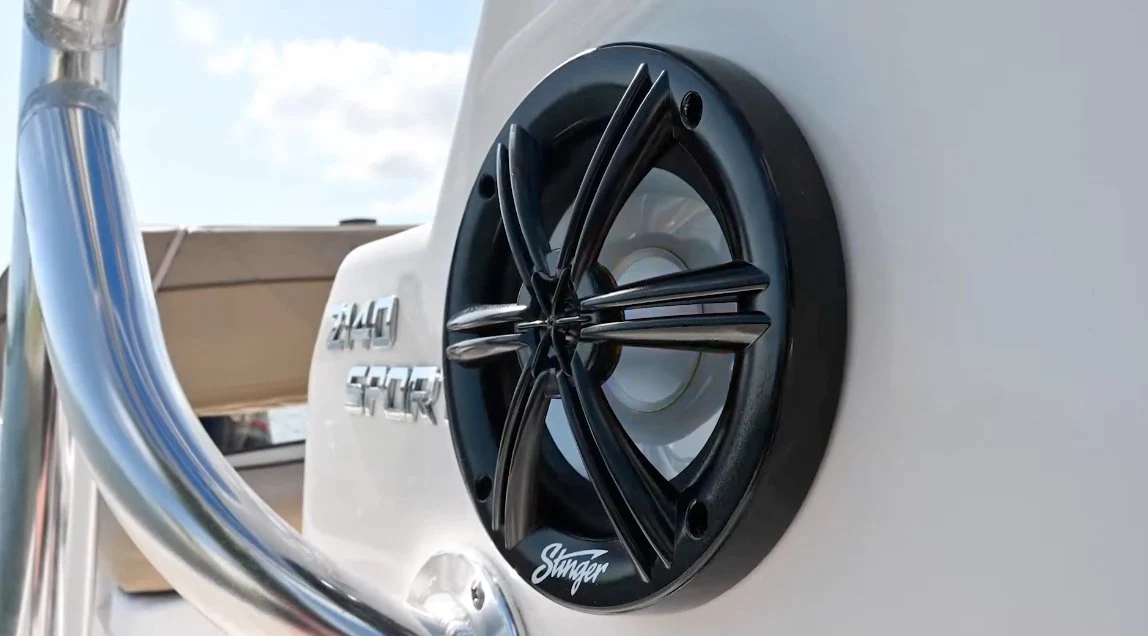
The 6.5-inch BOSS speakers require a 5.75-inch mounting hole and 2.18 inches of depth in several kits. Those measurements should be compared with the existing cutout before selecting a package. The Pyle PLMRKT36WT uses smaller 5.25-inch speakers, which can be easier to place on a compact boat.
Speaker size affects how much air the system can move, but it is only one part of the result. Placement, enclosure space, and exposure to engine and wind noise also matter. Owners looking for a receiver-only product should choose speakers separately rather than assuming every marine speaker pair performs the same way.
Power and outputs
A four-channel amplifier can support a conventional left and right speaker layout at the front and rear. Pay attention to whether the listing gives peak or RMS power, since those figures describe different things. The Kenwood lists 50W peak and 22W RMS per channel, while several BOSS receivers list 50W or 60W across four channels.
Pre-amp outputs are important when adding an external amplifier or subwoofer. The Pioneer has three 4V RCA pre-outs, and the BOSS MCKGB350W.6, MGR350B, and MCKGB450B.6 list subwoofer outputs. If bass is a priority, select the receiver with the output layout you will need later.
Sources and controls
Bluetooth is convenient, but USB, auxiliary, AM/FM, SD, CD, and SiriusXM-ready support each serve different owners. The Pyle receivers are useful for USB and SD card playback, while the Kenwood is the only pick here with a CD player and SiriusXM-ready capability. The Pioneer adds USB Auto Switch behavior and Alexa access through its app.
Hands-free microphones, wireless remotes, backlit buttons, and glare-resistant displays can matter more on the water than an extra playback format. For a second listening area or a distant helm, how separate listening zones change a boat audio layout can help clarify whether a basic receiver is enough.
Installation format
Most conventional units use a single-DIN style, but the BOSS MGR350B uses a compact gauge-style form. Measure the opening, depth behind the panel, and space for wiring before ordering. A receiver that fits the dashboard but leaves no room for connectors will create a difficult installation.
Complete kits simplify speaker matching, while receiver-only models offer more freedom over speaker size and placement. If the old speakers are still in good condition, the Pioneer, Kenwood, MGR350B, or PLMRB29B can serve as a focused head-unit replacement.
Frequently asked questions
Do marine boat stereos need special protection?
Yes. Boat receivers face spray, humidity, sunlight, and condensation that a typical indoor or car-only unit may not handle well. Look for stated marine weatherproofing, conformal-coated boards, UV-resistant panels, or an IP rating.
Are speakers included with every boat stereo system?
No. The Pioneer MVH-MS512BS, BOSS MGR350B, Kenwood KMR-D382BT, and Pyle PLMRB29B are receiver-only products. The BOSS MCKG634B.6, MCKGB350W.6, MCK632WB.6, MCKGB450B.6, MCK508WB.64S, and Pyle PLMRKT36WT include speaker pairs.
What speaker size is easiest to install?
That depends on the existing cutout. The BOSS kits use 6.5-inch speakers with a listed 5.75-inch mounting hole, while the Pyle PLMRKT36WT includes smaller 5.25-inch speakers. Measure the hole and available depth before choosing a replacement.
Can these receivers run a subwoofer?
Some can. The Pioneer has three RCA pre-outs, and the BOSS MCKGB350W.6, MGR350B, and MCKGB450B.6 list subwoofer outputs. The other products should not be assumed to support a subwoofer without checking the exact wiring and output configuration.
Is Bluetooth enough for a boat stereo?
Bluetooth is convenient for streaming and phone control, but it is not the only useful source. USB, auxiliary input, AM/FM, SD, CD, and SiriusXM-ready support can be valuable when reception, phone battery, or guest-device access becomes an issue.
What does peak power mean?
Peak power describes a short-duration maximum rather than sustained output. RMS power is a more useful figure when matching a receiver to speakers for continuous listening. Compare like with like, and do not treat a larger peak number as proof that one receiver will play louder in every installation.
Do I need a remote control?
A remote is useful when the receiver is mounted at the helm but listeners sit elsewhere, or when the unit is difficult to reach safely. Several BOSS and Pyle products include remotes, while the Kenwood can work with compatible marine remotes that are sold separately.
The bottom line
The Best best boat stereo system for most owners is the Pioneer MVH-MS512BS. Its marine-minded circuit protection, Bluetooth, USB control, built-in amplifier, and three 4V RCA pre-outs make it the strongest receiver-first foundation in this group. If you need speakers included, the BOSS MCKG450B.6 is the better complete kit for a future subwoofer, while the BOSS MCKGB350W.6 is the more useful choice when NOAA weather band matters.
For a compact installation, choose the BOSS MGR350B. For a small boat needing speakers and several local media sources, the Pyle PLMRKT36WT is the more suitable package. An undecided buyer should measure the speaker cutouts first, then choose between a receiver-only upgrade and a complete marine kit.
As an Amazon Associate we earn from qualifying purchases.