

A camera bag has one job before anything else: keep expensive gear protected while making it reachable quickly. The wrong backpack turns a camera, lenses, batteries, and tripod into a badly balanced load that is awkward to unpack.
The Best camera bags in this roundup range from compact slings to large backpacks with laptop storage, rain covers, hard shells, and removable dividers. Our top pick is the MOSISO Modular Camera Backpack, with the other eight covering lighter, tougher, more organized, and more travel-friendly designs.
Comparison of the best camera bags
| # | Product | Award | Size | Weight | Laptop fit | Best for |
|---|---|---|---|---|---|---|
| 1 | MOSISO Modular Camera Backpack | Best overall | 17.32 x 11.8 x 7.5 inches | 3.2 pounds | Up to 16 inches | General photography and travel |
| 2 | K&F Hardshell Camera Backpack | Best hardshell design | 17.3 x 11 x 7 inches | 2.8 pounds | Up to 15.6 inches | Extra front protection |
| 3 | K&F Lightweight Camera Backpack | Best lightweight | 10.6 x 5.1 x 15.2 inches | 1.96 pounds | Up to 14 inches | Daily carry |
| 4 | CADeN D6 Camera Backpack | Best compact capacity | 11 x 5.9 x 15 inches | 1.74 pounds | iPad compartment | Several lenses in a small pack |
| 5 | RAINSMORE Camera Backpack | Best for outdoor organization | 17.7 x 7.87 x 12.79 inches | Not listed | Up to 15.6 inches | Hiking and fieldwork |
| 6 | MOSISO Tactical Camera Backpack | Best tactical layout | 17.13 x 11.81 x 8.27 inches | 3.25 pounds | Up to 16 inches | Outdoor gear expansion |
| 7 | K&F Hardshell Camera Backpack Green | Best large hardshell option | 17.3 x 11 x 7 inches | 4.03 pounds | Up to 15.6 inches | Maximum shell protection |
| 8 | MOSISO 17.3-inch Camera Backpack | Best for large laptops | 17.3 x 11.9 x 6.5 inches | 3.2 pounds | Up to 17.3 inches | Camera and computer transport |
| 9 | K&F Camera Sling Bag | Best compact sling | 13 x 8.6 x 5.9 inches | 1.32 pounds | Not listed | One camera and two lenses |
1. MOSISO Modular Camera Backpack: Best Overall

Pros
- Two-compartment layout separates gear from personal items
- Removable dividers allow a flexible camera interior
- Holds a laptop up to 16 inches
- Trolley belt and tripod strap help on trips
Cons
- Heavier than the compact K&F and CADeN options
- The large body may feel excessive for a single-camera kit
- No dedicated rain cover is listed
Best for: photographers who want one adaptable backpack for camera gear, a laptop, and travel essentials.
The first thing that makes the MOSISO Modular Camera Backpack work is its separation. The bag is 17.32 x 11.8 x 7.5 inches, with an upper camera compartment and a separate laptop compartment. That gives it a more useful shape for a full day out than a bag that treats every item as part of one large equipment cavity.
The upper padded insert measures 16.54 x 11.42 x 5.5 inches and uses removable dividers. You can build a narrow space for a camera body and lens, or divide it for flashes, extra lenses, and a drone. The second compartment measures 16.93 x 10.63 x 1.58 inches and accepts a laptop up to 16 inches. Those dimensions make the bag particularly practical for photographers who move between a studio, an office, and a location shoot.
Protection comes from a waterproof PU leather hardshell front and a foam-padded layer intended to buffer the contents from shocks and drops. The high-elasticity back cushion is a welcome detail on a backpack this size. A tripod or monopod can attach to one side, while the other side holds an umbrella or water bottle up to 2.5 inches in diameter. There are also rear accessory pockets and an anti-theft pocket for smaller valuables.
Compared with the K&F Lightweight Camera Backpack, this MOSISO gives you more physical room and a larger laptop compartment, but it is less appealing when every ounce matters. The K&F Hardshell Camera Backpack has a more explicit EVA shell, while the MOSISO is easier to adapt to mixed camera and personal loads. Photographers carrying only one body and one lens should skip this larger format. For a flexible everyday kit, though, this is the backpack we'd keep.
2. K&F Hardshell Camera Backpack: Best Hardshell Design

Pros
- One-piece EVA hardshell front
- 22-liter capacity with removable inserts
- Dedicated laptop compartment
- Breathable back panel and trolley belt
Cons
- Front shell gives it a less flexible feel
- Large footprint for small camera kits
- Water bottle pocket is limited to one side
Best for: photographers who prioritize a rigid protective front and organized travel carry.
The K&F Hardshell Camera Backpack is built around its front panel. Rather than relying only on soft fabric and padding, it uses an EVA hardshell in one piece across the front. That design gives the bag a more structured feel and helps keep the front from collapsing against the camera compartment when the backpack is set down.
Its external dimensions are 17.3 x 11 x 7 inches, and the stated capacity is 22 liters. Inside, removable modular inserts let you arrange spaces for a DSLR, mirrorless body, lenses, flashes, or a drone. The rear laptop compartment accommodates a computer up to 15.6 inches. The result is a fairly serious travel backpack, particularly for someone who carries both camera equipment and a computer.
The front flap opens fully, revealing two internal accessory pockets for items such as cables, memory cards, and a power bank. A hidden rear zipper pocket takes a phone or wallet. The side layout adds a tripod strap and a separate pocket for an umbrella or water bottle. Its shoulder straps adjust from 20 to 38.9 inches, and the breathable padded mesh back is designed to spread the load rather than concentrate it at the shoulders.
The K&F Hardshell Camera Backpack Green has the same broad dimensions and core layout, but its listed weight is much higher. The lighter version is therefore the more sensible choice for most travelers, while the MOSISO Modular Camera Backpack is better if you want a separate upper compartment for clothing and other personal items. The hard shell also means less give when you overfill it. Choose this one when front impact protection and a structured opening matter more than compressibility.
A camera backpack is only part of a travel kit. If the camera itself is still undecided, the features that make a camera easier to carry all day can help you match the bag to the equipment.
3. K&F Lightweight Camera Backpack: Best Lightweight

Pros
- Light 1.96-pound construction
- Five adjustable dividers
- Included rain cover
- Converts to an everyday backpack
Cons
- Smaller interior than the larger backpacks
- Laptop compartment fits up to 14 inches
- Fabric protection is less rigid than a hardshell
Best for: daily photographers who want protected camera storage without carrying a bulky pack.
The K&F Lightweight Camera Backpack is the easiest recommendation for photographers who dislike camera bags that feel like equipment cases. It weighs 1.96 pounds and measures 10.6 x 5.1 x 15.2 inches, so its tall, narrow shape is noticeably more restrained than the big MOSISO and RAINSMORE designs.
Its equipment compartment measures 9.8 x 4.9 x 14.1 inches. Five customized dividers provide enough flexibility for a DSLR or mirrorless camera, lenses, a flash, or a compact drone, but this is not the pack for a sprawling professional kit. The separate padded laptop sleeve accommodates up to a 14-inch laptop, which suits a smaller work setup and keeps the backpack from becoming too wide.
The large front-opening compartment is useful when access matters. Two front zipper pockets take batteries, cables, memory cards, gloves, or other small items, while side pockets hold a bottle or umbrella. A side strap carries a lightweight tripod, monopod, or selfie stick. The 600D fabric is described as splash-proof and scratch-resistant, and the included rain cover gives it a stronger weather plan than the fabric alone would suggest.
The clever feature is the removable interior. Take out the dividers and the bag becomes a regular backpack for a commute or short trip. That makes it more versatile than the CADeN D6 Camera Backpack, which is also light but is more overtly arranged around a camera kit. The K&F Hardshell Camera Backpack offers a stronger front barrier, but it carries more visual and physical bulk.
The compromise is capacity. A photographer carrying several large lenses may quickly run out of usable space, and the 14-inch laptop limit is firm compared with the 16-inch and 17.3-inch options here. For a compact mirrorless setup, a small drone, or a camera and two lenses, this is the most comfortable everyday choice.
4. CADeN D6 Camera Backpack: Best Compact Capacity

Pros
- Light 1.74-pound body
- Designed for one body, four lenses, and a flash
- Seven-layer PE foam and PP board padding
- Dedicated tablet storage and tripod space
Cons
- Small 5.9-inch depth limits bulky equipment
- No full laptop size is specified
- Compact layout may require careful packing
Best for: photographers who need substantial camera organization in a narrow, lightweight backpack.
The CADeN D6 Camera Backpack makes a strong case for carrying a surprisingly complete kit in a compact frame. It measures 11 x 5.9 x 15 inches and weighs 1.74 pounds, making it the lightest full backpack in this group. Its narrow depth is useful in crowded spaces, though it also means larger equipment needs more careful consideration.
CADeN says the interior can hold one camera body, four lenses, a flash, an iPad, a tripod, and other accessories, or a DJI drone. The padding uses seven-layer PE foam and a PP board, giving the camera compartment a more substantial protective structure than its low weight suggests. The bag also includes an adjustable interior arrangement rather than forcing every photographer into the same layout.
The exterior has scratch-resistant and waterproof material, a hidden front zipper pocket, a high-elasticity mesh pocket for a bottle or umbrella, and a side location for a tripod or trekking pole. The shoulder straps use memory foam, and the handle provides another carrying option. An iPad sleeve with an internal fastening strip is more specific than the laptop compartments on many of the larger bags, which makes this a natural fit for tablet-based workflows.
The K&F Lightweight Camera Backpack is better if you want a rain cover and a compartment that converts into general daily storage. The CADeN is the more focused camera carrier, and its listed 1.74-pound weight is appealing when a long walk is involved. Its main weakness is that the 5.9-inch depth does not leave much room for unusually large lenses or a lot of non-camera gear.
The bag suits someone building a compact but varied kit, especially a photographer who uses an iPad rather than a full laptop. If your equipment list is genuinely large, the RAINSMORE Camera Backpack or MOSISO Modular Camera Backpack gives you more room to work.
5. RAINSMORE Camera Backpack: Best for Outdoor Organization

Pros
- Six adjustable dividers and three elastic security straps
- Dedicated 15.6-inch laptop compartment
- Full-coverage rain cover
- MOLLE exterior expansion system
Cons
- Large 17.7-inch length
- Weight is not listed
- More organization than a small kit needs
Best for: outdoor photographers who carry camera gear, a laptop, and many small field accessories.
The RAINSMORE Camera Backpack is the most elaborate organizer in the group. It measures 17.7 x 7.87 x 12.79 inches and is built for photographers who need more than a padded camera cavity. The layout includes dedicated spaces for equipment, a computer, small accessories, and personal items, so it is well suited to fieldwork and travel days that involve a lot of gear.
Inside, six adjustable dividers create the main padded arrangement, including an orange quick-grab panel. Three elastic security straps help keep equipment from shifting inside those sections. That is a meaningful difference from a basic divider system: the dividers shape the space, while the straps help stabilize items that do not fill it perfectly.
The bag has a dedicated compartment for a 15.6-inch laptop, two front slip pockets, two front zipper pockets, two internal mesh pockets, and a hidden rear anti-theft pocket. The MOLLE system adds a way to expand the exterior setup, while the side elastic pocket can hold a water bottle or tripod. A quick-access opening is intended to make the camera, memory cards, and batteries easier to reach without fully opening the main bag.
Weather protection is unusually complete on paper. The fabric is described as waterproof, and a full-coverage rain cover is included for rain or snow. A padded back panel, breathable straps, and a luggage strap help with long carries and airport transfers. Readers planning a trip should also think about how much camera gear a travel setup really needs, since a well-organized large bag can still become cumbersome when filled.
The drawback is simple: this is a lot of backpack. The K&F Lightweight Camera Backpack is easier for everyday use, and the CADeN D6 Camera Backpack is lighter for compact kits. Pick RAINSMORE when the extra pockets, expansion points, quick access, and weather coverage solve real problems rather than just adding unused compartments.
6. MOSISO Tactical Camera Backpack: Best Tactical Layout

Pros
- Three-compartment design with a separate upper storage area
- Fits laptops up to 16 inches
- Webbing supports extra outdoor gear
- Side and front camera access
Cons
- Heaviest backpack in the group
- Tactical styling is not for every setting
- Lower camera compartment is smaller than the full exterior
Best for: outdoor photographers who want expandable storage alongside protected camera compartments.
The MOSISO Tactical Camera Backpack is less like a traditional camera case and more like a camera-ready outdoor daypack. Its dimensions are 17.13 x 11.81 x 8.27 inches, and it weighs 3.25 pounds. That is a substantial starting load, but the design gives you a separate place for clothing, food, or other daily necessities rather than forcing those items around the camera dividers.
The upper compartment is for personal storage, while the lower 11.41 x 10.24 x 6.29-inch compartment holds cameras, flashes, lenses, or a drone. Removable modular inserts allow the lower area to be rearranged. The rear laptop compartment fits computers up to 16 inches. This division makes more sense for a day outdoors than a single large camera compartment, especially when the camera is only one part of the load.
The polyester exterior has webbing across the bag for attaching additional pouches or outdoor gear, and a removable USA flag patch is included on the front. Foam padding, reinforced edges and bottom, and a side-load compression system are intended for rougher environments. Access is available from the side or front, so the bag does not always need to be fully opened to reach the camera.
A tripod or monopod can attach at the bottom, and one side pocket holds an umbrella or water bottle. The anti-theft rear zipper pocket is useful for valuables, while the trolley belt helps during travel. The breathable shaped shoulder straps and back panel are designed to release heat, although the 3.25-pound empty weight is still a real burden compared with the K&F Lightweight Camera Backpack and CADeN D6 Camera Backpack.
The webbing and larger personal compartment distinguish it from the MOSISO Modular Camera Backpack, which is better for a conventional travel and laptop setup. Skip the Tactical Camera Backpack if you want a discreet urban bag or carry a minimal kit. It makes more sense for hiking, outdoor shoots, and photographers who genuinely use the attachment points.
7. K&F Hardshell Camera Backpack Green: Best Large Hardshell Option

Pros
- EVA hardshell front
- 22-liter capacity
- Removable camera dividers
- Laptop storage up to 15.6 inches
Cons
- Listed weight is 4.03 pounds
- The shell limits flexibility when packed
- No rain cover is listed
Best for: photographers who want the structured K&F hardshell layout and do not mind a heavier pack.
The K&F Hardshell Camera Backpack Green is the larger-weight sibling to the other K&F hardshell entry. Its listed exterior dimensions are the same at 17.3 x 11 x 7 inches, and it retains the 22-liter capacity, removable modular inserts, and laptop compartment for computers up to 15.6 inches.
The EVA shell covers the front in one piece and is designed to protect the equipment from strikes, scratches, shocks, and drops. The internal foam layer adds another barrier around the camera gear. This is the kind of structure that makes sense when the bag will be placed in busy transit areas or packed alongside other items, although the product information cautions against excessive force and leaving heavy objects on the shell for long periods.
The fully opening front flap gives access to two internal accessory pockets. A concealed rear zipper pocket handles smaller personal items, while the side layout includes a tripod strap and a pocket for an umbrella or water bottle. Shoulder straps adjust from 20 to 38.9 inches, and the breathable mesh back panel is intended to distribute the load.
The issue is weight. At 4.03 pounds, it is substantially heavier than the 2.8-pound version listed earlier and more than twice the weight of the CADeN D6 Camera Backpack. The hard front is also less accommodating when you want to carry a jacket or other irregularly shaped item. If protection is the priority, that trade-off may be acceptable. If comfort over a full day matters more, the MOSISO Modular Camera Backpack is easier to justify.
This version is a specialized pick rather than the default. It is for a photographer who wants the K&F hard-shell format, prefers this listed color, and expects the bag to face more knocks than a soft-sided backpack. Everyone else should consider the lighter K&F hardshell or a padded backpack with more flexible storage.
8. MOSISO 17.3-inch Camera Backpack: Best for Large Laptops

Pros
- Laptop compartment supports up to 17.3 inches
- Separate upper and lower storage areas
- PU hardshell front and top pouch
- Included waterproof rain cover
Cons
- Too large for a minimal camera kit
- Lower camera compartment is more compact
- Empty weight is about 3.2 pounds
Best for: photographers who carry a large laptop with a camera, lenses, and personal accessories.
The defining feature of the MOSISO 17.3-inch Camera Backpack is the computer compartment. It fits laptops up to 17.3 inches, a capability that immediately separates it from the 14-inch K&F Lightweight Camera Backpack and the 15.6-inch options. For photographers who edit on a large laptop, that can matter more than having the deepest camera compartment.
The backpack measures 17.3 x 11.9 x 6.5 inches and weighs about 3.2 pounds. Its lower front and side-opening camera compartment measures 11.5 x 8.8 x 5.9 inches and uses removable modular inserts for a body, flashes, and lenses. The upper 10.2 x 6.3 x 5.2-inch pouch has a PU hardshell and is intended for a flash or other accessories, while also adding a separate place for items that should not be mixed with the camera body.
The fully opening front flap uses PU hardshell protection to help prevent strikes and scratches. The polyester fabric has reinforcement at the edges and bottom, and a waterproof rain cover is included. A side zippered pocket can carry a monopod or tripod, and other pockets handle cards, phones, wallets, keys, and similar small items. The laptop sleeve sits at the back, keeping the computer separate from the padded camera area.
Compared with the MOSISO Modular Camera Backpack, this model gives the laptop more room but has a more constrained lower camera compartment. The RAINSMORE Camera Backpack offers more elaborate accessory organization and external expansion, while this MOSISO is simpler and better suited to a large computer. Its 6.5-inch depth also makes it less bulky than some of the deeper backpacks.
The obvious audience is someone carrying a large laptop. If you use a compact computer or tablet, the extra laptop capacity is wasted and the smaller CADeN D6 Camera Backpack will be easier to carry. For large-screen editing on location, this is the MOSISO to choose.
9. K&F Camera Sling Bag: Best Compact Sling

Pros
- Light 1.32-pound crossbody design
- Holds one camera and two lenses
- Adjustable FlexFold divider
- Weatherproof double PU-coated shell
Cons
- Less capacity than every backpack here
- Does not include a tripod
- Not designed for a laptop
Best for: photographers who want quick access to one camera body and a small lens kit.
The K&F Camera Sling Bag is the right answer when a backpack feels like too much equipment for the outing. It measures 13 x 8.6 x 5.9 inches and weighs 1.32 pounds. The crossbody shape keeps the camera close and makes it easier to swing the bag around for access than a conventional two-strap backpack.
The internal dimensions are 10.6 x 6.7 x 4.1 inches. One FlexFold divider lets you create a protected space for one camera and two lenses, or remove the divider to make room for a drone. Ten-millimeter high-density EPE shock-proof cotton surrounds the interior, while the abrasion-resistant recycled nylon canvas shell has a double PU coating for weather resistance.
The shoulder strap adjusts from 34.25 to 55.1 inches, giving the bag enough range to sit across the chest, shoulder, back, or hip. External straps on the bottom can carry a small tripod with a maximum diameter of 2.99 inches. Front, rear, internal zipper, side, and open pockets provide useful organization for small accessories without making the bag tall or rigid.
This is much more convenient than the K&F Lightweight Camera Backpack when you are carrying a single setup and need fast access. The backpack wins for comfort with heavier equipment and for laptop storage, while the CADeN D6 Camera Backpack carries a much broader kit without becoming especially heavy. The sling's shoulder load can become tiring when filled with dense lenses, and it has no laptop compartment.
Photographers who work with one body and two lenses should start here. Anyone carrying a flash, several large lenses, or personal clothing should move up to a backpack instead.

How to choose best camera bags
The right camera bag should match the equipment you actually carry, the protection your surroundings demand, and the way you move through a day of shooting.
Interior capacity
Capacity is more than the outside dimensions. Look at the size and shape of the padded camera compartment, then account for the camera body, attached lens, spare lenses, flash, batteries, cards, and any drone or tablet. Removable dividers are preferable because they let you change the layout as your kit changes.
Large backpacks such as the MOSISO Modular Camera Backpack and RAINSMORE Camera Backpack leave room for personal items. The K&F Camera Sling Bag is better when the load is deliberately limited to one body and two lenses.
Divider system
Dividers should be thick enough to keep equipment from touching and flexible enough to create useful shapes. A bag with many dividers is not automatically better if the compartment is too narrow for your lens sizes. Elastic security straps, such as those in the RAINSMORE, add stability when a section is not completely full.
The best divider layout is the one that lets you reach the camera without unpacking everything else.
Protection and weather coverage
Hard shells offer a more rigid barrier against front strikes, while padded fabric is usually easier to compress and adapt. The K&F hardshell models use an EVA front, and several MOSISO designs use a PU hardshell panel. Soft-sided bags can still be well protected when they use thick inserts and reinforced bases.
Do not confuse water-resistant fabric with complete weather coverage. The K&F Lightweight Camera Backpack and MOSISO 17.3-inch Camera Backpack include rain covers, while other designs rely on their exterior materials and panel construction.
Laptop and tablet storage
A computer compartment can turn a camera bag into a practical work bag, but its stated maximum matters. The K&F Lightweight Camera Backpack supports up to 14 inches, the K&F hardshell models support up to 15.6 inches, and the MOSISO 17.3-inch Camera Backpack supports the largest laptop in this group.
The CADeN D6 has an iPad compartment rather than a clearly specified full laptop limit. Choose the smallest compartment that fits your device securely, since oversized empty space can make the bag less stable.
Carry comfort and access
Weight, strap adjustment, back ventilation, and access position all affect how usable a bag feels. The CADeN and K&F Lightweight models are the easiest to carry when the kit is compact. Larger bags such as the MOSISO Tactical Camera Backpack and RAINSMORE add capacity and organization but start heavier.
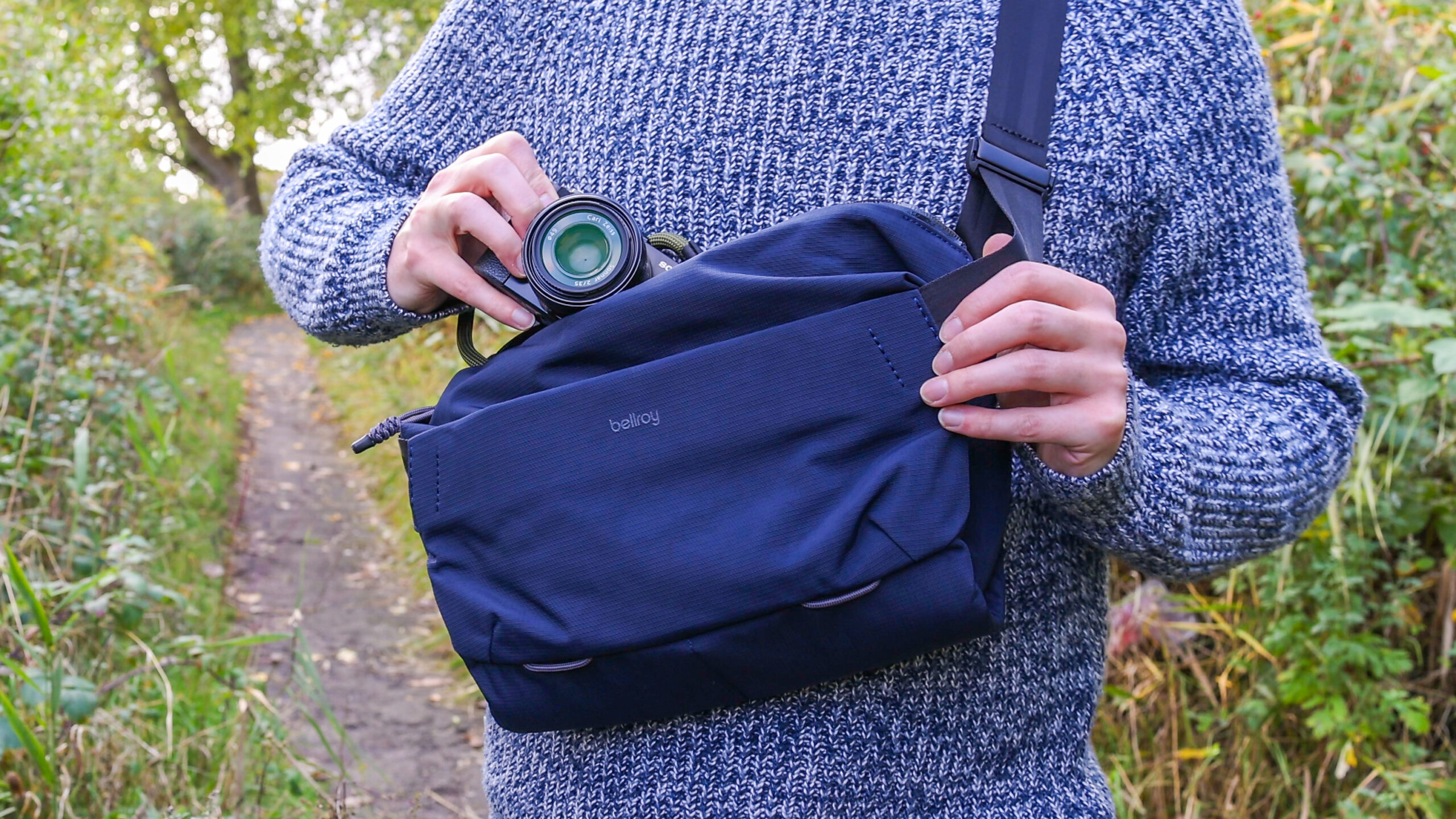
Quick side or front access is helpful for changing lenses or grabbing a battery. A sling offers the fastest access, while a backpack usually distributes a heavier load more comfortably across both shoulders.
Frequently asked questions
What size camera bag do I need?
Start with the camera body, largest lens, other lenses, flash, batteries, memory cards, and any tablet or laptop you carry. Add space for a jacket or personal items only if you expect to use the bag as a daypack. A sling suits one body and two lenses, while the larger backpacks are better for several lenses and computers.
Are hard-shell camera backpacks safer?
A hard shell adds a rigid barrier that can help protect against front strikes and pressure. It also makes the bag more structured, which can be useful in transit. Soft padded bags are often easier to reshape and may be more comfortable when carrying irregular personal items.
Can these bags hold a drone?
Several can. The MOSISO Modular Camera Backpack, MOSISO Tactical Camera Backpack, CADeN D6 Camera Backpack, and K&F hardshell models mention drone storage or compatibility. Check the padded compartment dimensions against the specific drone before ordering.
Which bag is best for a laptop and camera?
The MOSISO 17.3-inch Camera Backpack is the strongest fit for a large laptop. The MOSISO Modular Camera Backpack supports up to a 16-inch laptop, while both K&F hardshell models support up to 15.6 inches. For a tablet, the CADeN D6 has a dedicated iPad compartment.
Do camera bags keep equipment dry?
Protection varies by construction. The K&F Lightweight Camera Backpack and MOSISO 17.3-inch Camera Backpack include rain covers, while the RAINSMORE includes a full-coverage rain cover and describes its fabric as waterproof. A weather-resistant exterior is useful, but it should not be treated as a guarantee against prolonged heavy rain.
Is a sling or backpack better for camera access?
A sling is faster for quick access because it can be rotated around the body without being removed. A backpack is generally better for heavier equipment, longer walks, and carrying a laptop or personal items. The K&F Camera Sling Bag is designed for one camera and two lenses, not a full multi-lens kit.
Can camera dividers be removed?
Yes, removable dividers are listed for the MOSISO Modular Camera Backpack, MOSISO Tactical Camera Backpack, MOSISO 17.3-inch Camera Backpack, both K&F hardshell models, the K&F Lightweight Camera Backpack, the CADeN D6, the RAINSMORE, and the K&F sling. Removing them can turn some of the backpacks into more general daypacks.

The bottom line
The Best camera bags here cover very different shooting habits, but the MOSISO Modular Camera Backpack is the most complete all-purpose pick. Its separate upper and lower storage, adjustable camera insert, 16-inch laptop compartment, tripod attachment, and travel-focused trolley belt make it more adaptable than the narrower compact designs.
Choose the K&F Lightweight Camera Backpack when carrying comfort and a smaller daily kit matter most. Choose the K&F Camera Sling Bag for one body and two lenses, or the RAINSMORE Camera Backpack when outdoor organization, weather coverage, and expansion points are more important than a light load.
If you are undecided, choose the smallest bag that fits your complete camera kit without forcing the dividers to do impossible work.
As an Amazon Associate we earn from qualifying purchases.