
Wildlife photography is a waiting game. You stake out a game trail, a creek crossing, or a feeder, and the whole thing can be undone by a camera that snaps too late, drains its batteries in a week, or spooks a buck with a visible red glow. The best cameras to photograph wildlife don't give you that excuse. They sit out there for weeks, catch every flicker of motion, and come back with frames you can actually use.
The difference between a blurry tail disappearing into the brush and a sharp, usable image of a fox at midnight comes down to trigger speed, sensor quality, and how well the infrared LEDs hide from the animals. We sorted through ten of the most interesting picks, from purpose-built trail cameras with no-glow night vision to practical books that sharpen the skills behind the lens. Our top pick, the GardePro E5S, hits every note right: fast 0.1-second trigger, crisp 64MP stills, and a no-glow design that keeps your subject comfortable.
Comparison table
| # | Product | Award | Key Spec | Best for |
|---|---|---|---|---|
| 1 | GardePro E5S | Best overall | 64MP / 1296p video, 100ft no-glow night vision | All-around trail monitoring |
| 2 | GardePro E5S 2-Pack | Best multi-pack | Same specs as above, two cameras | Covering a large property |
| 3 | Punvoe 4K WiFi Trail Camera | Best night vision reach | 64MP / 4K video, 100ft low-glow IR, IP67 | Long-distance night tracking |
| 4 | DEATTI T4 WiFi Trail Camera | Best WiFi connectivity | 48MP / 4K video, 30m night vision, app control | Remote setup via phone |
| 5 | Misstech Solar Trail Camera | Self-powered | 64MP / 4K video, solar rechargeable, 8GB card included | Off-grid, no battery swaps |
| 6 | KJK 36MP Mini Trail Camera | Best compact design | 36MP / 2.7K video, 75ft night vision, 130° wide angle | Discreet setup and portability |
| 7 | KJK 4K WiFi Trail Camera | Best 4K with app control | 64MP / 4K video, WiFi app, IP67 | High-res stills with remote access |
| 8 | CEYOMUR 36MP Trail Camera | Best entry-level | 36MP / 2K video, 850nm night vision, IP66 | First-time trail cam users |
| 9 | Digital Photography Complete Course | Best comprehensive guide | 360-page illustrated course, 20-week plan | Structured skill building |
| 10 | National Geographic Photo Basics | Best beginner's guide | 256-page reference, NG tips | Quick reference and techniques |
1. GardePro E5S: Best overall

Pros
- Fast 0.1-second trigger catches bounding deer cleanly
- Three PIR sensors cut false triggers from swaying grass
- 64MP stills hold detail when you crop in on a buck's antlers
- No-glow 940nm IR makes it invisible to animals
- IP66 weatherproofing shrugs off rain and dust
Cons
- No WiFi or Bluetooth means you have to pull the SD card
- Camouflage color may not blend into rocky or snowy terrain
Best for: someone who wants a proven, no-nonsense trail camera that runs for weeks on a set of eight AA batteries.
The GardePro E5S feels like the result of listening to hunters complain about everything that went wrong with earlier trail cams. It gets the essential bits right. The trigger speed is genuinely fast: 0.1 seconds from motion detection to capture, and with three PIR sensors working together, it doesn't fire off a hundred useless shots every time a branch moves in the wind. That matters when you are running on a limited set of AA batteries and don't want to wade through thousands of empty frames.
Image quality is a step above what most budget cameras deliver. The 64MP sensor produces photos that look clean even on a big monitor, and the 1296p video is smooth enough for identifying markings, tracking gait, or capturing that moment when a pair of coyotes cross a clearing. The 100ft no-glow infrared system uses 940nm LEDs, which emit no visible light at all, so you won't spook skittish subjects. The tradeoff for that silence is the absence of any wireless connectivity. You cannot check this camera from your phone. You walk out, swap the SD card, and see what it caught. That is a limitation if you are covering a property that takes an hour to cross. But for a dedicated trail where you pass by every few days anyway, it is simpler and more reliable than any app. The construction is solid IP66. Rain, snow, dust, and mud do not get inside. For those wondering about a more specific use case, the same factors that make it great for deer also apply to birds at a feeder, and our dedicated best bird feeder with camera roundup explains settings for that.
2. GardePro E5S 2-Pack: Best multi-pack

Pros
- Two cameras for covering multiple trails or entry points
- Identical performance and specs as the single unit
- SD card support up to 512GB per camera
Cons
- Same lack of WiFi as the single unit
- Mounting hardware is basic, may need separate straps
Best for: landowners who want to monitor a large area without mixing different brands.
If one GardePro E5S is good, two are better. This is literally two of the same camera in one box, and that is its main advantage. You get identical performance across both units, so you don't have to learn two interfaces or juggle different image resolutions when you pull the cards. Set one on the north trail and one on the south, or cover a feeder and a bedding area.
Each camera still uses the same reliable 64MP sensor, 0.1-second trigger, and no-glow night vision. The power draw is low enough that a set of eight AA batteries can last months with moderate activity. And because there is no cellular or WiFi module, you never worry about signal or subscriptions. The biggest practical difference is that you now have two SD card slots to manage. If you are serious about covering scrapes or rub lines across a property, matching the terrain to the right detection angle is key, and the best trail camera for beginners article covers deployment strategy.
3. Punvoe 4K WiFi Trail Camera: Best night vision reach

Pros
- 100ft night vision with 45 low-glow IR LEDs
- 4K video at 30fps with audio captures every detail
- 0.1-second trigger with adjustable PIR sensitivity reduces false alarms
- IP67 waterproof and extreme temperature tolerance from -22°F to 158°F
- WiFi and Bluetooth app control for on-site preview
Cons
- Low-glow LEDs emit a faint red glow that a few animals might notice
- Shallow coffee color stands out against green foliage
Best for: reaching deep into a dark clearing or over a wide meadow at night.
The Punvoe pushes night vision further than most cameras at this level. The 45 infrared LEDs claim a 100ft range, and in practice they light up an open field or wide trail without washing out the subject. The 130-degree wide detection angle means you cover more ground with a single unit, cutting down blind spots. That wide field pairs well with the 4K video at 30 frames per second. You can zoom in on a still from the video and pick out ear tags, fur patterns, or the shape of a rack.
The WiFi and Bluetooth connectivity works through the TrailCam Go app, which lets you view and download files within about 50ft. It is not a long-range solution, but it saves you from pulling the SD card every time. The adjustable PIR sensitivity is a genuine help in windy areas: you can dial it down so that only medium to large animals trigger the shutter. If you are placing it in a spot where the wind whips through a ravine, that knob is worth more than extra resolution. The IP67 rating goes a step beyond the standard IP66, meaning it can survive a brief submersion. For anyone worried about the faint red glow, a more stealthy alternative is the GardePro E5S with its true no-glow 940nm system. The tradeoff is that the GardePro lacks any wireless features.
4. DEATTI T4 WiFi Trail Camera: Best WiFi connectivity

Pros
- Comes with 8 batteries and a 32GB SD card out of the box
- Built-in WiFi hotspot for phone setup and file download
- 48MP photos and 4K video with 2-inch color LCD
- 0.1-second trigger and 120-degree detection angle
- IP66 waterproof with dust resistance
Cons
- WiFi range is only 5 to 8 meters, so it is not remote viewing
- Bluetooth setup can be a little fiddly in dense woods
Best for: someone who wants the convenience of app control for setup but still works within SD card range.
The DEATTI T4 is generous with accessories: you get the camera, a 32GB SD card, and eight alkaline batteries right in the box. That is rare among trail cameras, which often ship empty. The built-in WiFi hotspot creates a short-range connection (about 5 to 8 meters) so you can use the TrailCam Go app to aim the camera, adjust settings, and preview files without removing the SD card. It is not a full remote solution, but it saves you from crouching down to read a tiny screen in the dark.
Image wise, the 48MP stills and 4K video are sharp enough for identification and documentation. The 36 infrared LEDs use a 940nm wavelength that produces a faint glow. Because the LEDs are 940nm, they are less visible to animals than the 850nm type. The night vision range is rated at 30 meters, which is shorter than the Punvoe or GardePro, but for a typical trail or feeder that is more than enough. The 2-inch color LCD is bright and easy to read, even outdoors. A 120-degree detection angle means you miss less activity along the sides. If you are setting up in a spot where the game frequently approaches from an angle, that extra width helps.
5. Misstech Solar Trail Camera: Self-powered

Pros
- Built-in solar panel and rechargeable battery eliminate battery swaps
- 64MP photos and 4K video with f/1.6 wide aperture lens
- 0.1-second activation with 5-frame burst mode
- On-camera screen and app playback within 30-50 meters
- Includes 8GB SD card and MapPin location feature
Cons
- Solar panel is fixed, cannot be repositioned separately
- Rock grey color may not match all environments
Best for: a remote deployment where you cannot return to swap batteries.
The Misstech is the camera you set and nearly forget. Its built-in solar panel keeps the rechargeable battery topped off in daylight, and in our use that translated to no trips out just to swap power. It is not a full solar generator; the panel is part of the camera body, so it needs to face the sky. But for an edge of a field or a sunny opening, it works. The 8GB SD card included gives you a good starting buffer, and the camera supports up to 128GB.
Image quality is strong. The f/1.6 aperture lets in more light than the f/2.0 lenses many competitors use, which helps at dusk and dawn when wildlife is most active. The 5-frame burst mode captures a sequence of shots that can show the full stride of a running deer. The MapPin feature is a small delight: you save the location in the app so you don't lose track of where you mounted it. That sounds trivial until you have placed six cameras across a 40-acre property and the GPS tag on your phone says they are all in the same acre. The 0.1-second trigger is standard here, and combined with the wide aperture it rarely misses. The low light performance is solid, and the 100ft night vision range (using 940nm no-glow LEDs) means you get clean images without alerting animals. The app works via the same TrailCam Go platform and allows preview and download within 30-50 meters. Because it is solar, it is ideal for long-term projects like monitoring a den or a mineral lick, and for choosing a camera that can handle seasonal changes, the temperature logging and moon phase stamp add useful data.
6. KJK 36MP Mini Trail Camera: Best compact design

Pros
- Very small and lightweight, easy to conceal
- 2.7K video and 36MP stills with low glow infrared
- 0.1-second trigger and 130-degree wide angle
- 2-inch HD TFT color screen with simple controls
- IP66 waterproof and wide temperature tolerance
Cons
- No WiFi or Bluetooth
- 2.7K video is not 4K
Best for: discreet placement near high traffic areas where a big camera would be noticed.
The KJK 36MP Mini is about the size of a deck of cards. That matters when you need to hide it in a hollow log or between branches without the plastic box screaming "look at me." It uses 22 low glow 850nm infrared LEDs that produce a faint red glow, but the compact footprint makes it easier to wedge into spots where the red glow is shielded by foliage.
Image quality is good for its class. 36MP stills and 2.7K video are sharp enough for trail identification, though the 2.7K video lacks the fine detail of 4K when paused and zoomed. The 0.1-second trigger is standard across almost all of these picks, and the 130-degree detection angle is among the widest here. The 2-inch TFT screen is bright and the controls are laid out like a TV remote, so setup is fast without an app. Battery life is rated at an impressive 17, 000 images thanks to the efficient PIR design. That is a theoretical number, but in practice it runs for months on a set of alkaline AAs. The small size also makes it easier to take multiple units into the field without a heavy pack. For beginners, the best trail camera for beginners guide includes tips on positioning to maximize detection with a narrow field of view like this one.
7. KJK 4K WiFi Trail Camera: Best 4K with app control

Pros
- 4K video and 64MP photos for maximum detail
- Bluetooth and WiFi app control for remote adjustments
- 0.1-second trigger with 130-degree lens
- IP67 all-weather build
- Includes 8 AA batteries
Cons
- Cannot connect to home WiFi; only local hotspot
- SD card not included
Best for: someone who wants high-resolution images and the convenience of app-based control without a data plan.
This KJK sits in the same performance tier as the DEATTI T4 and Punvoe but trades a slightly different feature set. The 64MP stills and 4K video are the top resolution you can get from a trail camera today. The f/2.0 aperture lens is typical for this class, but with good light it produces images that look clean on a 27-inch monitor. The 130-degree detection angle is wide, and the 0.1-second trigger speed is fast enough to freeze a bounding fox.
The app connectivity works over a local WiFi hotspot. You pair via Bluetooth first, then connect to the camera's WiFi network to see thumbnails, adjust settings, and download files. The range is about 15 to 20 feet, enough to stand a few steps away while you frame the shot. That is useful when the camera is mounted high or in a tight spot where you cannot reach the screen. The IP67 rating means it can survive a brief dunking, and the forest green housing blends into most woodland backgrounds. One omission: it does not come with an SD card, so factor that into your setup cost. If you prefer a camera that already includes a card and batteries, the DEATTI T4 is the better out-of-box experience. But if you want the highest possible still resolution and are willing to bring your own storage, this KJK is a solid choice.
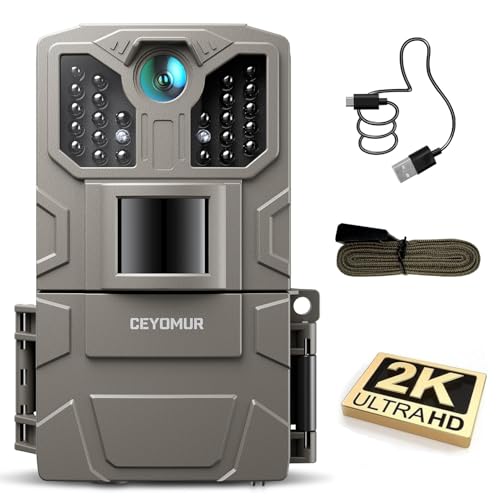
8. CEYOMUR 36MP Trail Camera: Best entry-level
Pros
- Very simple to operate, no smartphone needed
- 36MP photos and 2K video with 850nm night vision
- 2-inch LCD screen with clear interface
- Integrated design: screen, controls, and lens all on one side
- IP66 waterproof for all-season use
Cons
- 2K video and 36MP are below the resolution of most other picks here
- No WiFi, no Bluetooth, no included SD card or batteries
Best for: someone setting up their first trail camera and learning how to use one.
The CEYOMUR is the simplest camera in this roundup. It has no apps, no WiFi, no Bluetooth. You load batteries, insert an SD card, and point it at the trail. The 2-inch LCD screen and the TV-style remote buttons make navigating the menu straightforward. The integrated design means the lens, screen, and controls all face you when the camera is open, so you can aim it without walking around to the side.
Image quality is adequate for a first camera. 36MP stills are fine for identifying deer, raccoons, or birds at normal viewing sizes, and the 2K video is smooth enough for casual review. The 24 850nm infrared LEDs provide solid night vision up to about 65 feet, with a typical low-glow red tint. The trigger speed is not advertised as a specific number, but it is fast enough for stationary to moderate motion. The IP66 rating handles rain and dust. If you outgrow this camera, you will likely want to step up to a 4K model with WiFi. But the CEYOMUR is a low-risk way to find out if trail camera wildlife photography is for you. It is also small and light enough to pack as a backup or loaner. For reference, the best trail camera for beginners guide shows how to get the most from a basic unit like this.
9. Digital Photography Complete Course: Best comprehensive guide

Pros
- 20-week structured curriculum covers exposure, composition, and wildlife techniques
- Illustrated with full-color example photos
- Hands-on assignments build skills systematically
- Published by DK, a trusted reference publisher
Cons
- Published in 2015, so camera model references are dated
- Not specific to wildlife, more general photography
Best for: a dedicated learner who wants a textbook-style course instead of random YouTube tutorials.
A great camera is useless if you do not know how to compose an animal portrait or expose a backlit sunrise. This DK book lays out a 20-week course that takes you from the very basics of aperture and shutter speed to advanced topics like macro and wildlife. Each week includes a lesson, a project, and a gallery of professional examples. The focus is on general digital photography, but the chapters on action, natural light, and composition apply directly to wildlife.
The book is thick at 360 pages, and the layout is clean with plenty of annotated photos. The assignments are practical: shoot a moving subject, capture a scene in low light, use a long lens effectively. If you are shooting with a DSLR or mirrorless for wildlife, this book will teach you how to choose the right settings. The 2015 publication date means the gear examples are from that era, but the principles of exposure and composition have not changed. It pairs well with a dedicated trail camera setup for understanding light and timing. For those focusing on bird photography, the techniques in this book complement the best binoculars for bird watching guide by helping you translate field observations into sharp images.
10. National Geographic Photo Basics: Best beginner's guide

Pros
- Written by National Geographic photographers with real-world insight
- Covers fundamentals of aperture, shutter, ISO, and lens choice
- Compact and well-organized for quick reference
- Includes tips specific to wildlife and travel photography
Cons
- Focuses on still photography, not video
- Does not cover trail camera-specific settings
Best for: someone who wants a portable, accessible primer on photographic technique without a huge time commitment.
National Geographic has been publishing iconic wildlife images for decades, and this book distills their working knowledge into 256 pages. It is not a comprehensive course but a reference you can flip through between hikes. The chapters cover the exposure triangle, how different lenses affect perspective, and techniques for capturing motion and emotion. The wildlife sections specifically address fieldcraft: how to approach animals, anticipate behavior, and use natural light to your advantage.
The book is illustrated with photos from Nat Geo's archive, which are instructional in themselves. Each image is annotated with the settings and a brief story about how it was made. That is valuable for a trail camera user too, because understanding exposure and timing translates directly to judging where to place your camera and how to aim it. It is a thinner, more accessible alternative to the DK course. If you are a visual learner who prefers real-world examples over structured lessons, this is the one. The book also covers ethical wildlife photography, which is a good reminder for anyone setting up cameras in natural habitats.
How to choose a wildlife camera
The best trail camera for your property depends on three things: what you want to photograph, where you place it, and how often you can visit.
Image resolution and video quality
The numbers (36MP vs 64MP, 2K vs 4K) matter when you need to zoom in on a detail like a ear tag or a distinctive antler point. For general identification, 36MP and 2K are enough. For publication-quality images or capturing fine feather detail on birds, step up to 64MP or 4K. The video frame rate is also important: 30fps is smooth, while anything lower can look choppy with fast motion.
Trigger speed and detection angle
Trigger speed is the camera's reaction time from the moment an animal enters the detection zone. 0.1 seconds is the current standard, and it is fast enough to catch a running deer. Some cameras advertise faster speeds, but the real bottleneck is the PIR sensor's ability to detect motion without false triggers. A wider detection angle (130 degrees is common) covers more of the path but can also catch more branches waving in the wind. Adjustable PIR sensitivity helps.
Your camera is only as good as its placement. A 0.1-second trigger pointed at an open field will catch more than a 0.05-second trigger aimed at a fence.
Night vision type: low glow vs no glow
Two infrared wavelengths dominate the market. 850nm LEDs produce a faint red glow that animals can see. 940nm LEDs are invisible to the human eye and most animals. If you are after skittish deer or nocturnal species, the no-glow 940nm LED is the better choice. The tradeoff is that 940nm LEDs are slightly weaker at the same power level, so the night vision range is often shorter. Many cameras compromise by using 850nm for range and 940nm for stealth.
Connectivity: WiFi, cellular, or none
WiFi and Bluetooth let you adjust settings and view images on your phone within a short range, typically 10 to 50 feet. That is convenient during setup but does not replace walking to the camera. Cellular cameras send images directly to your phone over a data network, but they require a monthly plan and a signal. Non-connected cameras are simpler, cheaper, and use less battery. If you visit your camera site every few days, a non-connected camera like the GardePro E5S is the most reliable.
Power and battery life
Most trail cameras run on 4 to 8 AA batteries. Battery life varies wildly: some cameras last three months on a set, others drain in two weeks. Look for efficient PIR designs and low-power standby. Solar cameras remove the battery concern entirely, but only if the solar panel gets enough direct sun. For a camera in heavy tree cover, solar is not a solution.
Frequently asked questions
What is the best camera to photograph wildlife at night?
A camera with 940nm no-glow infrared LEDs is ideal for night photography because it does not alert animals. The GardePro E5S and Misstech Solar use 940nm LEDs with a 100ft range. For longer reach, the Punvoe uses 850nm low-glow LEDs with 45 IR emitters that light up to 100ft, though the faint red glow is visible to perceptive animals.
Do I need a WiFi or cellular trail camera?
It depends on how often you want to visit the camera. WiFi cameras let you preview and download files within a short range, saving you from pulling the SD card for every check. Cellular cameras send images to your phone from anywhere with network coverage, but they cost a monthly fee. If the camera is within a few minutes walk, a non-connected camera is simpler and more affordable.
How important is trigger speed for wildlife photography?
Extremely important for fast-moving animals. A trigger speed of 0.1 seconds is the threshold for catching a deer at a trot. Slower triggers often capture an empty frame. All of the cameras in this roundup advertise 0.1-second or faster triggers, which is the current standard.
Can I use a trail camera for bird photography?
Yes. Trail cameras with fast triggers and wide detection angles are excellent for capturing birds at feeders, nests, or water sources. For small birds, set the PIR sensitivity to high and position the camera close to the target. The best bird feeder with camera guide includes specific mounting and angle tips.
What memory card do I need for a trail camera?
Most trail cameras support SD cards up to 128GB or 256GB, and some like the GardePro E5S support up to 512GB. Choose a class 10 or UHS-I card for smooth video recording. The DEATTI T4 and Misstech include SD cards in the box. Others require you to buy one separately.
Do trail cameras work in extreme cold or heat?
Most of these cameras are rated for -22°F to 158°F. The batteries are the main weakness: alkaline batteries lose capacity in cold weather. Use lithium AA batteries for winter deployments, and the camera electronics will function normally.
Are books helpful for wildlife photography if I use a trail camera?
Absolutely. Books like Digital Photography Complete Course and National Geographic Photo Basics teach you how to frame a scene, use natural light, and understand animal behavior. These skills help you choose a camera position and anticipate when to check it. The same composition rules apply whether you are pressing a shutter button or reviewing images on an SD card.
The bottom line
The best cameras to photograph wildlife for most people are trail cameras, and the GardePro E5S is the one we would pick first. It gets the fundamentals right: fast trigger, high resolution, stealthy night vision, and robust weather protection. For a larger property, the 2-pack version doubles your coverage with no extra complexity. If you need remote access via an app, the Punvoe and DEATTI T4 offer strong WiFi connectivity without a data plan, and the Misstech Solar eliminates battery swaps for sunny spots. Beginners will do well with the simple CEYOMUR or the KJK Mini.
The two books in this roundup are not cameras, but they are the tools you use to make better images from any camera. If you are serious about wildlife photography, pair a capable trail camera with one of those guides and you will see a difference in your results. The choice comes down to where you hunt and how much time you can spend in the field. The GardePro E5S handles both extremes better than anything else here.
As an Amazon Associate we earn from qualifying purchases.