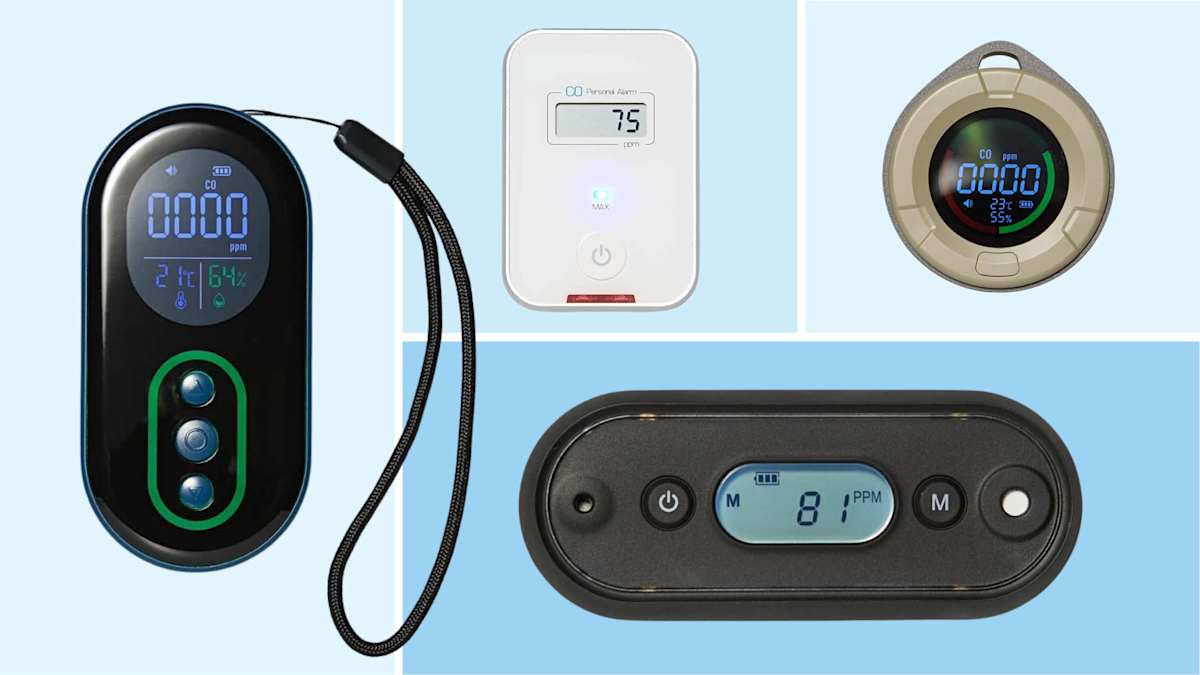

A carbon dioxide monitor can tell you when a closed bedroom, office, or classroom needs fresh air, but a carbon monoxide alarm performs a different safety job. That distinction matters here because this list includes both types of device. The Best CO2 detector for home should measure carbon dioxide directly, while a CO alarm is for detecting a dangerous combustion gas.
Our top pick is the Dienmern 5-in-1 CO2 Monitor, which combines a real-time CO2 reading, a portable design, and a 1600mAh battery. The rest of the list ranges from smart connected monitors and long-running wireless meters to plug-in and battery-powered carbon monoxide alarms that should not be treated as substitutes for a CO2 monitor.
Comparison table
| # | Product | Award | CO2 range or sensor | Power | Best for |
|---|---|---|---|---|---|
| 1 | Dienmern 5-in-1 CO2 Monitor | Best overall | 400 to 5000 ppm, ±50 ppm | 1600mAh battery, up to 72 hours | Portable home monitoring |
| 2 | Kidde AA Battery CO Alarm | Best portable CO alarm | Electrochemical CO sensor | 2 AA batteries | Power outage protection |
| 3 | GoveeLife H5140 | Best smart monitor | SCD4x sensor, ±(40 ppm + 5%) | AC power | Connected, continuous monitoring |
| 4 | Blizonte Plug-In Air Monitor | Best customizable alarm | 400 to 4999 ppm, claimed ±5 ppm | Plug-in, 110 to 220V | Custom thresholds |
| 5 | SwitchBot Meter Pro CO2 | Best large display | 400 to 9000 ppm, ±50 ppm | Built-in battery, up to 12 months | Room-to-room monitoring |
| 6 | Kidde Plug-In CO Alarm with 9V Backup | Best digital CO alarm | Carbon monoxide sensor | 120V plus 9V backup | Seeing peak CO levels |
| 7 | Kidde Plug-In CO Alarm with AA Backup | Best simple plug-in CO alarm | Carbon monoxide sensor | 120V plus 2 AA backup | Straightforward fixed placement |
| 8 | Aranet4 Home | Best battery life | NDIR CO2 sensor | Batteries, up to 4 years | Long-term wireless tracking |
| 9 | First Alert CO400 2-Pack | Best multi-room CO coverage | Electrochemical CO sensor | Battery powered | Multiple levels or bedrooms |
| 10 | ZEMEOLLO 10-in-1 Air Monitor | Best broad air screening | CO2, HCHO, TVOC, benzene, PM2.5 and PM10 | 2000mAh battery, up to 20 hours | Portable multi-pollutant checks |
1. Dienmern 5-in-1 CO2 Monitor: Best Overall

Pros
- Measures CO2, AQI, temperature, and humidity
- Portable design with a 1600mAh battery
- Clear LED display
- Swiss-made CO2 sensor
- Useful for home, office, travel, and grow tents
Cons
- Battery life is limited to up to 72 hours
- No app or remote notifications
- The display may be more information than some buyers need
Best for: someone who wants one portable screen for everyday CO2 and comfort readings.
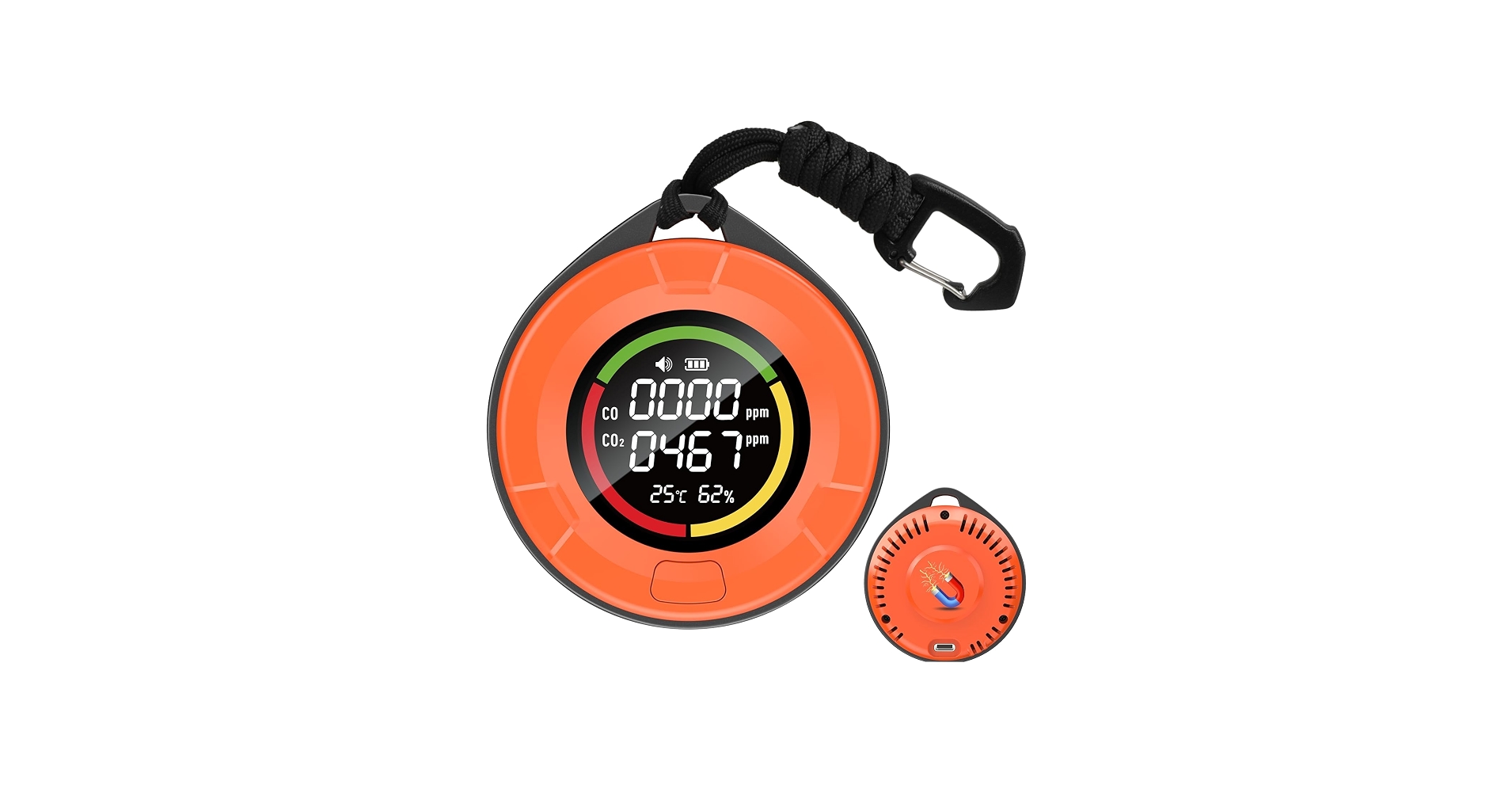
The Dienmern is the easiest recommendation for most people who specifically want a CO2 monitor rather than a carbon monoxide alarm. It is compact enough to move between a bedroom, home office, and living room, yet its screen shows enough information to make ventilation decisions without opening an app. The display reports CO2, AQI, temperature, and humidity in real time.
Its stated CO2 range runs from 400 to 5000 ppm, with claimed accuracy of ±50 ppm. That gives it useful headroom for ordinary homes, where the main question is usually whether a closed room is accumulating exhaled carbon dioxide. The monitor updates every second, so opening a window or door should show up as a changing reading rather than a delayed snapshot. Temperature and humidity readings add useful context, especially in bedrooms and nurseries.
The built-in 1600mAh battery is rated for up to 72 hours on a charge. That is enough for a weekend of moving the unit around the house, but it is not a set-and-forget wireless monitor. The GoveeLife H5140 is stronger for continuous plugged-in use, while the Aranet4 Home is far better when replacing batteries as rarely as possible matters most.
Dienmern also avoids the common confusion between CO2 and CO by presenting itself as an air quality monitor. It does not replace a certified carbon monoxide alarm near fuel-burning appliances. The lack of app history and remote alerts is the real limitation, and buyers who want long-term graphs should choose GoveeLife or Aranet4 instead.
For a reader who wants a visible, portable reading of room air without building a smart home around it, this is the most balanced choice. It is the Best CO2 detector for home when portability and a straightforward display matter more than automation.
2. Kidde AA Battery CO Alarm: Best Portable CO Alarm

Pros
- Electrochemical carbon monoxide sensor
- Runs on 2 AA batteries
- Works during a power failure
- Can sit on a table or mount on a wall
- Peak level memory and test-hush button
Cons
- Detects CO, not CO2
- No digital concentration display
- Battery replacement remains part of ownership
Best for: homes, travel spaces, or rooms that need a portable carbon monoxide alarm.
The Kidde AA Battery CO Alarm belongs on this list only with a clear warning: it detects carbon monoxide, not carbon dioxide. Carbon monoxide is a poisonous combustion gas that can come from faulty heaters, fireplaces, furnaces, or generators. Carbon dioxide rises when people occupy a poorly ventilated room. The two gases are different, and this alarm cannot tell you when a bedroom needs fresh air.
As a CO alarm, its design is practical. It uses an electrochemical sensor, runs on two AA batteries, and can be mounted on a wall or placed on a tabletop. Battery operation means it continues monitoring through a power outage, which is an important advantage for a safety device. A green LED indicates power, while a red LED accompanies the 85-decibel alarm when CO is detected.
Kidde includes peak level memory, which records the last detected carbon monoxide event or the last time the unit was tested. The Test-Hush button handles both routine testing and temporary silencing of a low-battery chirp. Those controls are more useful than a complicated interface because the job here is to remain ready and make a serious warning unmistakable.
Compared with the plug-in Kidde models below, this version is easier to relocate and does not depend on an outlet. It lacks the digital display found on the Kidde 9V model, so it cannot show a sensed level on a screen. The stated 10-year limited manufacturer warranty applies to the alarm, not to battery performance, and the unit should be replaced when its service life calls for it.
Choose this one as a companion safety product, not as a CO2 monitor. If your concern is stale air, look at Dienmern, GoveeLife, Blizonte, SwitchBot, Aranet4, or ZEMEOLLO instead.
3. GoveeLife H5140: Best Smart Monitor
Pros
- SCD4x CO2 sensor with pressure compensation
- Five-second refresh rate
- Customizable buzzer, app, and email alerts
- Tracks up to two years of history
- Works with Alexa and Google Assistant
Cons
- Requires continuous AC power
- App connection is needed for some features
- Not a carbon monoxide alarm
Best for: families and smart-home users who want continuous monitoring and historical data.
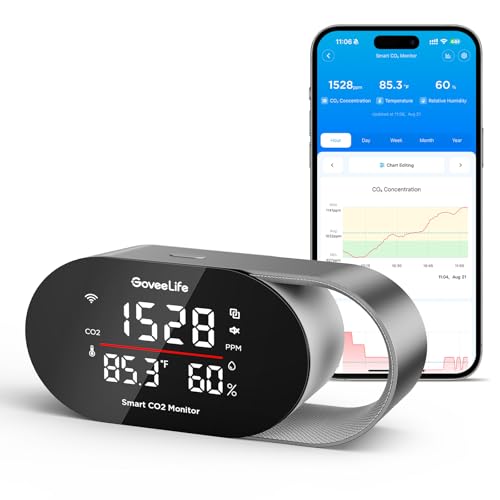
The GoveeLife H5140 is the most capable connected monitor in this group. It is designed to stay plugged in, watch the room continuously, and tell you about a problem even when you are not standing in front of the display. That makes it a stronger fit for a nursery, bedroom, or home office than a battery monitor that may eventually need charging.
Its SCD4x CO2 sensor uses a photoacoustic NDIR principle and is specified at ±(40 ppm + 5%) accuracy. The device refreshes every five seconds and includes pressure compensation for altitude. Those details matter because CO2 monitoring is about trends as much as individual readings. A faster refresh can show the effect of ventilation, while pressure compensation is intended to keep readings more consistent in different locations.
The four-in-one display shows CO2, temperature, humidity, and a clock. A tri-color light bar and programmable brightness schedule make it more suitable for a bedroom than a constantly bright alarm panel. The alert system is unusually broad: the monitor can use a built-in buzzer, app notifications, and email reports when CO2, temperature, or humidity crosses a customized threshold.
The app is where GoveeLife separates itself from Dienmern and SwitchBot without a hub. It can store up to two years of historical data, display charts, and export CSV reports. Alexa and Google Assistant support lets you query CO2 by voice, while compatible humidifiers and tower fans can be linked for environmental routines. The listing specifically notes that air purifiers cannot reduce CO2, so they cannot be linked for that purpose.
The catch is dependence on AC power and the app. This is not the monitor to carry from room to room, and it does not replace a CO alarm. For a broader look at devices that address particles and other indoor pollutants, how filtration differs from ventilation for household air is a useful distinction.
4. Blizonte Plug-In Air Monitor: Best Customizable Alarm

Pros
- Manual calibration process
- Custom CO2 threshold
- 85-decibel sound and light reminder
- Two-second data acquisition
- Large color screen
Cons
- Must remain plugged in
- Calibration requires careful setup
- No app or remote alert system
Best for: someone who wants a fixed monitor with a personally chosen CO2 alarm threshold.
Blizonte takes a more hands-on approach than GoveeLife. It plugs directly into a wall outlet, starts when powered, and avoids battery management entirely. The result is a small fixed monitor that suits a bedroom, office, or RV when you want a visible reading in one location rather than a device that travels around the house.
The 3-in-1 screen shows CO2, temperature, and humidity. Its stated measurement range is 400 to 4999 ppm, with claimed ±5 ppm accuracy and data acquisition every two seconds. The range covers normal home conditions and more elevated readings, while the quick acquisition is useful when checking whether ventilation is changing the room. The color screen uses green, yellow, and red indicators to make the status readable from a glance.
Calibration is a central part of this model. After first startup, the listing says to let the unit sit for two to three minutes, then begin a 200-second calibration in a well-ventilated area with no one nearby. Manual calibration can be repeated every two to three months and adjusted for different environments. That flexibility may appeal to experienced users, but it also means the device rewards careful setup more than a monitor that simply runs out of the box.
The custom threshold is the other standout feature. A four-digit value can be set manually, and exceeding it triggers an 85-decibel sound, a flashing red bar, and a light reminder. The buzzer can be turned off, which is helpful when you want a visual warning without a recurring disturbance. Unlike GoveeLife, there is no app, data export, or remote notification.
Blizonte is a better fit than Dienmern for a fixed wall outlet and a user who wants direct control over calibration and alerts. It is less flexible than SwitchBot, and buyers who dislike manual setup should choose a simpler portable monitor. Its plug-in design also makes it a poor choice for checking several rooms in rotation.
5. SwitchBot Meter Pro CO2: Best Large Display

Pros
- Large 92-millimeter screen
- Measures CO2, temperature, humidity, time, date, and comfort
- One-second CO2 monitoring
- Built-in battery rated for up to 12 months
- Wall-mount holes and adjustable bracket
Cons
- App alerts require a SwitchBot Hub
- Accuracy is specified at ±50 ppm
- Not a carbon monoxide detector
Best for: households that want a readable monitor they can move or mount.
The SwitchBot Meter Pro CO2 is built around visibility. Its 92-millimeter screen displays CO2, temperature, humidity, time, date, and a comfort level together, so you do not need to cycle between pages or reach for a phone. That makes it particularly useful in a living room or shared office where several people need to understand the room condition.
SwitchBot specifies a Swiss-made NDIR sensor with a 400 to 9000 ppm range and ±50 ppm accuracy. It checks CO2 every second, which gives the screen a responsive feel as occupants enter, leave, or ventilate the room. The wide range is more than most homes need, but it leaves room for use in a greenhouse, classroom, gym, or other space where levels may rise substantially.
The built-in battery is rated for up to 12 months and includes a low-battery warning. At 92 by 79 by 25 millimeters and 154 grams, the unit is still easy to relocate. Wall-mount holes and an adjustable bracket give it more placement flexibility than the basic Dienmern, while the clean design is less industrial than the Blizonte.
Alerts can be customized for CO2, temperature, and humidity. The monitor provides sound and visual warnings on its own, but app notifications require a SwitchBot Hub. That makes the connected system more expandable than Dienmern, though less self-contained than GoveeLife, which offers app and email functions with its own setup.
SwitchBot is the pick when the display needs to be readable from across a room and the monitor may move between locations. Its weakness is the additional hardware needed for remote alerts. For readers comparing screen size with portability, how placement affects the usefulness of an indoor air monitor is worth considering before choosing a permanent location.
6. Kidde Plug-In CO Alarm with 9V Backup: Best Digital CO Alarm

Pros
- Simple 120V plug-in installation
- 9V battery backup
- Digital display shows sensed CO level
- 85-decibel alarm
- Peak level memory
Cons
- Detects CO, not CO2
- Fixed outlet placement
- No app or remote notifications
Best for: a home that needs a plug-in carbon monoxide alarm with a numeric display.
This Kidde is a carbon monoxide safety alarm, not a carbon dioxide monitor. It appears in the roundup because the terms are often confused, but it should be installed for CO protection near appropriate household areas, not used to decide when a crowded room needs ventilation.
The hardware is straightforward. It plugs into a standard 120V outlet and uses a 9V battery backup during an outage. An 85-decibel alarm announces detected carbon monoxide, and LED status indicators show the unit's condition. The digital display is the feature that distinguishes it from the AA-backup Kidde below: it can show the level of CO the alarm is sensing instead of offering only a warning sound.
Peak level memory records the last time carbon monoxide was detected or the last test. That can help identify whether an event occurred while nobody was watching the unit. The plug-in format also avoids wall installation, although outlet position determines where the alarm can go.
The main compromise is that its screen does not transform it into an air quality monitor. It does not measure CO2, temperature, humidity, or ventilation. GoveeLife and Aranet4 are the better choices for those jobs, while this Kidde is the more appropriate tool when the concern is combustion-related CO.
Choose it alongside a real CO2 monitor if your home needs both kinds of protection. Choosing it instead of a CO2 meter would leave the ventilation question unanswered.
7. Kidde Plug-In CO Alarm with AA Backup: Best Simple Plug-In CO Alarm

Pros
- Plugs into a standard 120V outlet
- Two AA batteries provide backup
- 85-decibel alarm
- Test-hush button
- Peak level memory
Cons
- Detects carbon monoxide rather than carbon dioxide
- No digital display
- Fixed placement
Best for: buyers who want a basic plug-in CO alarm with battery backup.
The AA-backup Kidde is the uncomplicated alternative to the digital-display model. It plugs into a standard 120V outlet, uses two AA batteries during an outage, and sounds an 85-decibel alarm when carbon monoxide is detected. There is no screen to interpret and no app to configure, which keeps the focus on a clear emergency warning.
Its Test-Hush button handles routine checks and temporary silencing of false alarms. Peak level memory records the last detected CO event or the last test, adding a small amount of useful history without requiring a connected account. LED status indicators provide the basic visual information expected from a fixed alarm.
The key difference from the older Kidde AA Battery CO Alarm is the power arrangement. This model normally uses wall power, while the portable Kidde relies on AA batteries as its primary source. The portable version is easier to place on a table or move between rooms, but this plug-in model is better for a permanent location where an outlet is available.
It has no CO2 sensor, no temperature reading, and no humidity reading. If the goal is to know whether sleeping occupants are raising CO2 overnight, Dienmern, SwitchBot, or Aranet4 is the correct category. For broader household protection, a CO alarm and a CO2 monitor can serve separate roles.
The simple design makes this a sensible CO safety purchase, but it is not a contender for the Best CO2 detector for home. Treat the gas name on the front of the box as the deciding detail.
8. Aranet4 Home: Best Battery Life

Pros
- Wireless E-Ink display
- Battery life rated for up to four years
- NDIR CO2 sensor
- Measures temperature, humidity, and pressure
- App supports 90 days of history
Cons
- No mains power option listed
- App history is limited to 90 days
- More information is available through the app than on the small display
Best for: long-term wireless CO2 monitoring with minimal battery attention.
The Aranet4 Home is the most convincing set-and-forget monitor here. Its E-Ink screen stays readable without the glow of a conventional display, and the battery-powered design avoids a cable across a desk or nightstand. The stated battery life is up to four years, which changes how often the device needs attention compared with Dienmern or ZEMEOLLO.
It uses NDIR technology to measure CO2 and also reports temperature, relative humidity, and atmospheric pressure. The display uses color coding and gives the main CO2 number visual prominence. An optional buzzer can alert you when concentration becomes too high, so the device remains useful even when nobody is checking the screen every few minutes.
The companion app adds configuration and history. It can show interactive graphs covering up to 90 days, giving you a way to identify recurring overnight rises or patterns linked to cooking, meetings, or closed windows. That is shorter than GoveeLife's stated two-year history, but Aranet4's strength is not deep smart-home integration. It is quiet, wireless observation.
At 70 by 70 by 24 millimeters and about 0.23 pounds, it is smaller and lighter than SwitchBot. The E-Ink display is calmer in a bedroom, though it may not be as immediately vivid as the LED screens on Dienmern or Blizonte. It also lacks the latter's customizable audible threshold controls and GoveeLife's email reporting.
Aranet4 is the specialist choice for a reader who wants a reliable-looking wireless monitor that can remain in place for years. It is not a CO alarm, and it does not measure formaldehyde, particles, or other pollutants. For a wider understanding of which household air contaminants require filtration rather than ventilation, the distinction is important.
9. First Alert CO400 2-Pack: Best Multi-Room CO Coverage

Pros
- Two battery-operated CO alarms
- Electrochemical sensor
- 85-decibel alarm
- End-of-life signal chirp
- Meets UL standards according to the listing
Cons
- Detects CO, not CO2
- No digital display
- No connectivity or app history
Best for: placing carbon monoxide alarms on multiple levels or in separate bedrooms.
The First Alert CO400 solves a coverage problem rather than a monitoring-detail problem. The package includes two battery-operated carbon monoxide alarms, making it practical for homes that need protection on more than one level or in more than one sleeping area. It does not measure carbon dioxide, so it cannot replace any of the six actual CO2 monitors in this roundup.
Each alarm uses an electrochemical CO sensor and continues operating during a power failure because it is battery powered. The 85-decibel alarm is intended to make a dangerous event hard to miss. First Alert also includes an end-of-life signal chirp, giving the homeowner a warning that the alarm itself needs replacement.
The listing recommends placing an alarm on each level of the home and in each bedroom. That placement guidance is more important than having one sophisticated monitor in a single room. CO can come from combustion equipment elsewhere in the house, so coverage and location are central to the product's job.
Compared with Kidde's plug-in alarms, the CO400 is easier to place exactly where needed and does not depend on an outlet. It gives up the digital display and peak-level memory of the Kidde 9V model. Compared with a CO2 monitor, it provides emergency carbon monoxide protection but no information about ventilation, humidity, temperature, or stale air.
Buy this as a multi-room CO safety set. If the shopping list says carbon dioxide, choose Dienmern, GoveeLife, SwitchBot, Blizonte, Aranet4, or ZEMEOLLO instead.
10. ZEMEOLLO 10-in-1 Air Monitor: Best Broad Air Screening

Pros
- Measures several air quality indicators
- Includes CO2, HCHO, TVOC, benzene, PM2.5, and PM10
- Color screen highlights abnormal readings
- 2000mAh rechargeable battery
- Portable design
Cons
- Battery life is rated for up to 20 hours
- More measurements can make interpretation harder
- No stated app or remote alert feature
Best for: portable checks across several categories of indoor air quality.
ZEMEOLLO is the broadest air monitor in the group. It is aimed at people who want more than a CO2 reading and would rather carry one device that screens several possible pollutants. Its stated measurements include CO2, formaldehyde, TVOC, benzene, PM2.5, and PM10, among other readings described as part of its 10-in-1 system.
The high-definition color screen presents live data and changes color when readings exceed the stated safety threshold. That visual approach is useful when checking a room quickly, although a long list of measurements can also create more questions than answers. CO2 is the most directly useful reading for deciding when to ventilate, while particle and chemical readings relate to different sources and responses.
ZEMEOLLO uses a smart chip and sensor array, with dedicated CO2 sensing and electrochemical sensors for HCHO and TVOC monitoring. The listing claims an error margin of less than ±5% and describes smart calibration. Those claims cover a wide range of sensor types, so buyers should treat the device as a broad screening tool rather than a replacement for specialized professional measurement.
The 2000mAh rechargeable battery is rated for up to 20 hours of continuous detection. That is more practical for a day of checking rooms, vehicles, plant areas, or pet areas than for permanent unattended monitoring. Dienmern lasts longer between charges, while Aranet4 is the obvious choice for multi-year wireless placement.
ZEMEOLLO beats the dedicated monitors on breadth, but the dedicated models are easier to interpret when the only question is CO2. Pick it when formaldehyde, TVOC, and particulate readings are part of the reason for buying. Skip it if you want simple long-term CO2 history, remote alerts, or a dedicated emergency CO alarm.
How to choose best co2 detector for home
Start by deciding whether you need a carbon dioxide monitor, a carbon monoxide alarm, or both. Then compare the sensing method, display, power source, alert controls, and data features that fit the room.
Gas type
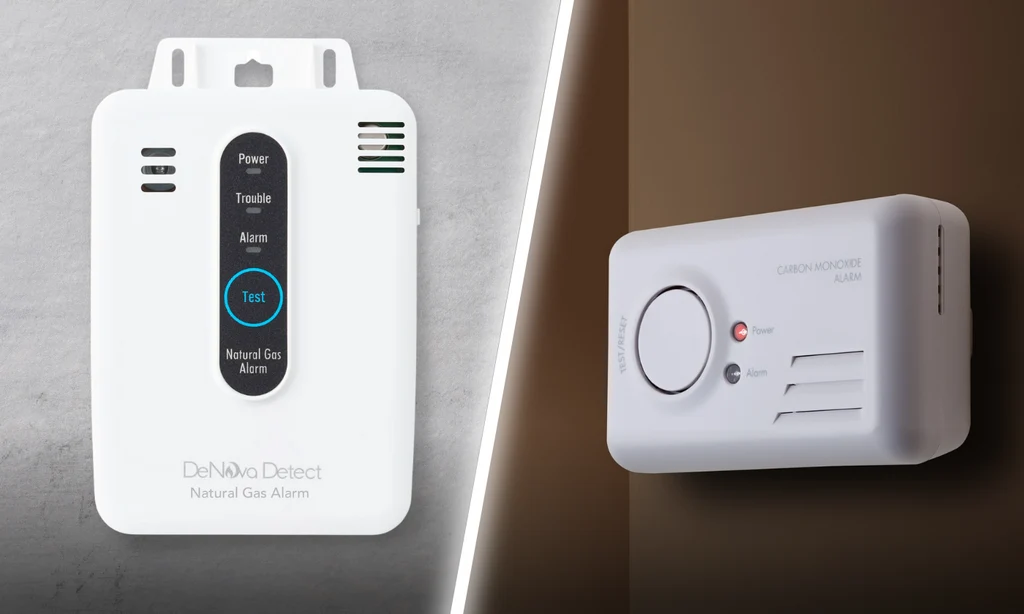
Carbon dioxide and carbon monoxide are different gases with different risks. CO2 is primarily useful for understanding ventilation and occupancy, while CO is a poisonous combustion gas that requires a dedicated alarm. A Kidde or First Alert CO alarm cannot answer a question about stale air, and a CO2 monitor should not be treated as an emergency CO alarm.
Buy the device for the gas you need to detect, not for the similar abbreviation on the product page.
Sensor and measurement range
A CO2 monitor should state a CO2 range and explain its sensor technology. NDIR sensors appear in the Aranet4 and SwitchBot, while Dienmern identifies a Swiss-made sensor and GoveeLife lists an SCD4x sensor using a photoacoustic NDIR principle. A wider range is useful in unusually occupied or poorly ventilated spaces, but accuracy around normal household readings is more important for everyday use.
Display and readability
A visible display is useful when the monitor sits in a bedroom or office and you want to decide whether to open a window without using a phone. SwitchBot has the largest stated screen, Aranet4 uses a low-power E-Ink display, and Dienmern, Blizonte, GoveeLife, and ZEMEOLLO use color or LED screens. Consider viewing distance, nighttime brightness, and whether temperature and humidity should appear alongside CO2.
Power and placement
Battery monitors are easier to move, but they eventually need charging or battery replacement. Dienmern is rated for up to 72 hours, ZEMEOLLO for up to 20 hours, SwitchBot for up to 12 months, and Aranet4 for up to four years. GoveeLife and Blizonte avoid battery management through continuous plug-in power, though they are less convenient for checking several rooms.
Alerts and history
A buzzer or color change can prompt immediate ventilation, while app notifications help when nobody is looking at the screen. GoveeLife offers customizable buzzer, app, and email alerts plus up to two years of history. Aranet4 provides an optional buzzer and up to 90 days of app history, while SwitchBot's app alerts require a Hub. If you only need an at-a-glance number, Dienmern may be enough.
Frequently asked questions
Is a CO2 detector the same as a carbon monoxide detector?
No. A CO2 detector measures carbon dioxide, which commonly rises as people occupy an enclosed room. A carbon monoxide detector measures CO, a poisonous gas associated with combustion. The sensors and safety purposes are different.
Which monitor is the best CO2 detector for home use?
The Dienmern 5-in-1 CO2 Monitor is the strongest general-purpose pick because it combines a portable battery, a visible display, and readings for CO2, AQI, temperature, and humidity. Choose GoveeLife H5140 instead if app history and remote alerts matter more than portability.
Do I need both a CO2 monitor and a CO alarm?
Many homes benefit from both because they monitor different risks. A CO2 monitor can show when ventilation is poor, while a CO alarm warns about dangerous carbon monoxide from combustion sources. One device should not be used as a substitute for the other.
Where should a CO2 monitor go?
Place it in the room where you want to understand ventilation, such as a bedroom, home office, or frequently occupied living area. Keep it away from direct drafts, open windows, cooking fumes, and immediate breath contact, since those can distort the local reading. A portable model can be moved between rooms to compare patterns.
How often should a CO2 monitor be calibrated?
Follow the product's instructions. Blizonte recommends a 200-second manual calibration after startup and repeating calibration every two to three months. Other monitors may use automatic calibration or provide outdoor calibration through an app, as GoveeLife does.
Can an air purifier lower CO2?
An ordinary air purifier is not a solution for rising CO2. Ventilation with outdoor air is the usual response to elevated carbon dioxide, while an air purifier addresses different airborne particles or pollutants. GoveeLife specifically notes that its system cannot link an air purifier to reduce CO2.
How long do portable CO2 monitors run?
It varies widely. Dienmern is rated for up to 72 hours, ZEMEOLLO for up to 20 hours, SwitchBot for up to 12 months, and Aranet4 for up to four years on its stated battery setup. Continuous plug-in monitors such as GoveeLife and Blizonte do not require battery charging while powered.
The bottom line
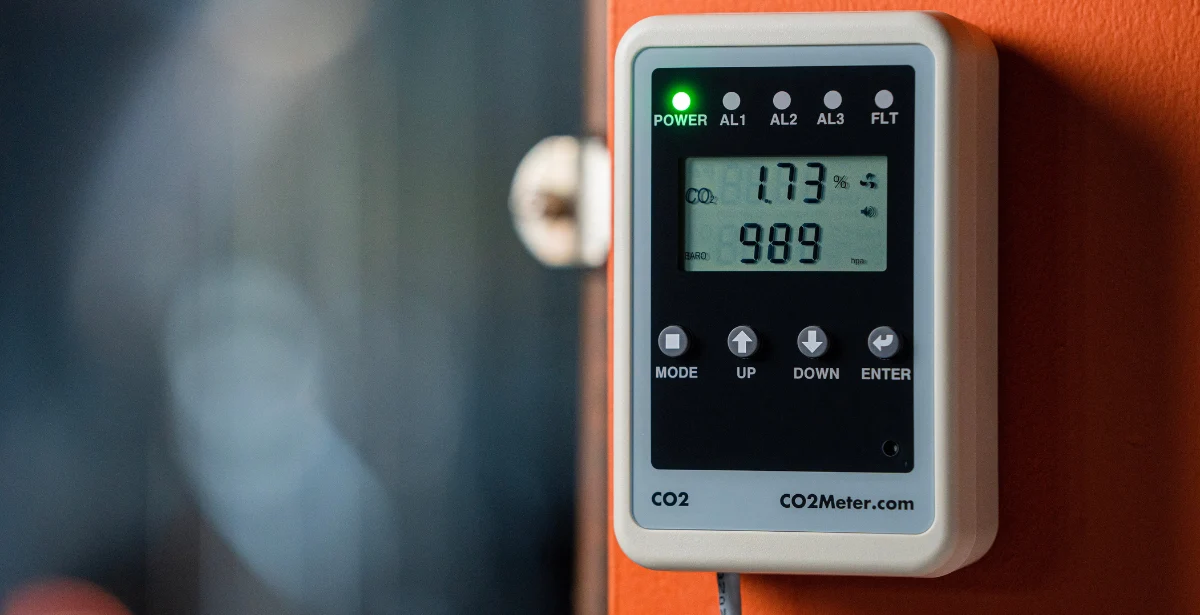
The Best CO2 detector for home is the Dienmern 5-in-1 CO2 Monitor for most buyers because it offers a clear real-time display, portable operation, and useful temperature and humidity context. Choose the GoveeLife H5140 for continuous smart-home monitoring, historical charts, and remote alerts, or the Aranet4 Home when long battery life and quiet wireless operation matter most.
The Kidde and First Alert products are worthwhile carbon monoxide alarms, but they are not alternatives to the CO2 monitors. An undecided reader should first identify the gas they need to detect, then choose between portable readings, connected history, and permanent safety coverage.
As an Amazon Associate we earn from qualifying purchases.