
A coaxial cable can look perfectly fine while hiding an open conductor, short, or mislabeled run behind a wall. The right tester turns that troubleshooting job from guesswork into a quick pass, open, or short reading. The Best coaxial cable tester tools also help identify several runs at once, which matters when a wiring closet has more cables than anyone remembers installing.
This group ranges from complete installation kits to pocket-size toners and multi-location mapping systems. Some are made for F-connectors and home video wiring, while others add BNC, RJ45, or RJ11 support. Our top pick is Klein Tools VDV512-101 Explorer 2, with the six options covering simple continuity checks, cable identification, connector work, and broader low-voltage service.
Comparison table
| # | Product | Award | Test capability | Included remotes / connectors | Best for |
|---|---|---|---|---|---|
| 1 | Klein Tools Explorer 2 | Best overall | Coax continuity and mapping | 4 color-coded remotes, F adapter | Home cable mapping |
| 2 | Klein Tools VDV002-818 | Best installation kit | Coax verification and F-connector crimping | 6 universal sleeve compression F-connectors | Cutting and terminating coax |
| 3 | Klein Tools Scout Pro 3 | Best for mixed cable | Coax, Ethernet, and phone testing | 5 coax and 5 LanMap remotes | Technicians handling several cable types |
| 4 | Skywalker 8-Way Tester | Best for many runs | Coax continuity, open, and short detection | 8 color-coded terminators, F to BNC adapter | Testing a wiring panel |
| 5 | CIMPLE CO Pocket Tracer | Best pocket tester | Continuity and toner tracing | Coax barrel connector and battery | Finding an unknown coax run |
| 6 | Gaobige BNC Tool Kit | Best BNC kit | BNC coax and RJ45 testing | Crimper, stripper, tester, connectors, tubing | BNC cable assembly |
1. Klein Tools Explorer 2: Best Overall

Pros
- Maps up to four coax locations
- Clear PASS, OPEN, and SHORT indicators
- Four color-coded push-on remotes
- Compact body with removable remote holder
Cons
- Limited to coax testing
- Uses replaceable AAA batteries
- Does not provide cable length measurement
Best for: homeowners and installers who need clear coax testing and location mapping.
The Klein Tools Explorer 2 gets the central job right without burying it under extra modes. Connect the tester, attach one of the color-coded remotes at the far end, and the LED panel tells you whether the cable passes, is open, or is shorted. That simplicity is a major advantage when you are standing in front of an unlabeled group of wall plates and need an answer quickly.
Its four push-on remotes let you map up to four cable locations in one session. The color coding matters more than it sounds. Instead of repeatedly moving one terminator and keeping a handwritten note, you can place different remotes on separate runs and identify each location from the tester. The included F adapter makes the kit suitable for common coax connections, and the removable snap-on holder keeps the remotes and adapter together when the tool is not in use.
The Explorer 2 is also notably small. It measures 5.75 inches long, 2.38 inches wide, and 1 inch high, and weighs 0.3 pounds. That makes it easier to keep in a tool pouch than the broader installation kits. Two replaceable AAA batteries power it, so there is no special charging routine to remember.
Compared with the CIMPLE CO Pocket Tracer, the Explorer 2 gives a more direct fault display and handles multiple identified locations. Compared with the Skywalker 8-Way Tester, it maps fewer runs, but the smaller body is easier to carry and the status display is more immediately readable. The weakness is scope: it does not measure cable length, test Ethernet or phone wiring, or replace a toner when you need to follow a cable through a building. Choose it when coax mapping is the main task, not when you need a general cable analyzer.
2. Klein Tools VDV002-818: Best Installation Kit
Pros
- Combines preparation, crimping, and testing
- Two-level radial stripper prepares coax in one operation
- Includes six universal sleeve compression F-connectors
- Compact kit for DIY and service work
Cons
- Intended around RG6 and RG6 Quad F-connectors
- No multi-location mapping
- Heavier than a tester-only tool
Best for: anyone terminating new RG6 coax and checking the finished connection.
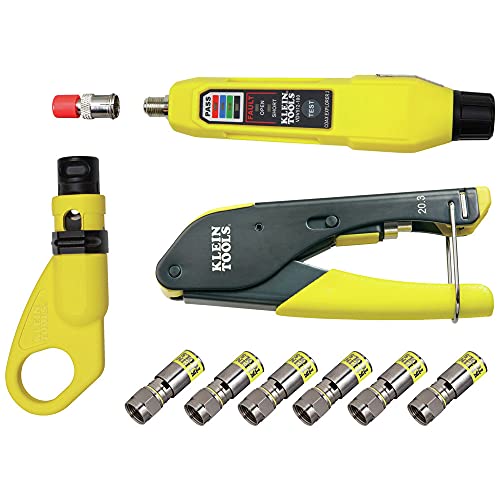
The Klein Tools VDV002-818 is the pick for a different kind of coax problem. It is not just a diagnostic tester. It is a small install kit that takes a cable from an unprepared end to a verified F-connector. That makes it especially useful when the fault is not in the cable run itself, but in a badly fitted connector.
The two-level radial stripper is designed for single-operation coax preparation. In practical terms, it handles the layered cable jacket and conductor preparation in one tool rather than requiring separate trimming steps. The included compact crimper is built for compression F-connectors, and the kit supplies six universal sleeve connectors for RG6 and RG6 Quad cable. The manufacturer describes those connectors as enabling faster installation than a conventional process, but the more important benefit is consistency when several ends need to be redone.
Once the connector is fitted, the Coax Explorer 2 tester checks the connection and indicates good, open, or short conditions. That basic confirmation closes the loop nicely. You can prepare the cable, install the connector, and verify the result without adding a separate tester to the kit. At 9.6 inches long, 3.75 inches wide, and 1.5 inches high, it remains manageable in a service bag, although its 1.1-pound weight is more noticeable than the Explorer 2's 0.3 pounds.
The Klein Tools Explorer 2 is a better choice if your existing cables are already terminated and you mainly need to map rooms. The VDV002-818 wins when you are replacing connectors or making fresh runs. Its limitation is compatibility and focus. The supplied connectors and crimping setup center on RG6 and RG6 Quad F-connectors, so it is not the right answer for a BNC-focused bench or a mixed Ethernet installation. For satellite, antenna, and cable-TV wiring that needs new ends, it is the more complete tool.
If you are rebuilding a coax run, connector selection matters as much as the tester. The differences between connector styles, cable compatibility, and termination methods are covered in the connector choices that suit different coax installations.
3. Klein Tools Scout Pro 3: Best for Mixed Cable

Pros
- Tests coax, RJ45, and RJ11/12 cables
- Measures cable length up to 2, 000 feet
- Detects open, short, miswire, and split-pair faults
- Backlit LCD shows wiremap and cable ID
- Supports multi-cable location mapping
Cons
- PoE testing is not supported by this model
- Analog probe for tracing is sold separately
- Larger and more involved than a coax-only tester
Best for: low-voltage technicians who move between video, data, and phone wiring.
The Klein Tools Scout Pro 3 is the most capable tester here, provided coax is only one part of the job. Its backlit LCD gives you more information than the simple LED units: cable length, wiremap, cable ID, and the detected result appear on the screen. That turns a basic pass or fail into a more useful diagnosis.
For coax work, the Scout Pro 3 supports F-connector video cables. It also tests RJ45 data cables and RJ11/12 voice cables, which is the key reason to choose it over the Explorer 2. It can detect opens and shorts, along with miswires and split pairs on applicable data wiring. Cable length measurement reaches 2, 000 feet, or 610 meters, giving technicians a way to distinguish a long run from a short patch connection when a cable disappears into a wall.
The included LanMap and CoaxMap location remotes support multi-run identification, with five of each type supplied. That is a more substantial mapping setup than the four coax remotes included with the Klein Tools Explorer 2. The Scout Pro 3 can also generate tones for tracing cable, wire pairs, and individual conductor wires, but an analog probe is required and is sold separately. The distinction is important: the tester has tone capability, but the complete tracing setup requires another tool.
This model is about 6.9 inches long, 3.2 inches wide, and 1.5 inches high, with a listed weight of about 1 pound. It is therefore less pocketable than the CIMPLE CO Pocket Tracer, but it gives a much richer view of a fault. It is not designed to test PoE, so network installers working specifically with powered Ethernet should not treat this as a PoE verifier. The Scout Pro 3 is the right step up for a mixed-cable service kit, while the Klein Tools VDV002-818 remains better when the job includes installing F-connectors.
The display is most useful when you need to diagnose wiring, not merely identify it. For electrical troubleshooting beyond cable continuity, the right continuity functions for broader meter work can help define where a cable tester stops being sufficient.
4. Skywalker 8-Way Tester: Best for Many Runs

Pros
- Tests up to eight cable leads at once
- Detects open and short conditions
- Includes F-connector to BNC adapter
- Built-in storage for terminators
- Mesh case supports transport
Cons
- Larger than the Klein handheld testers
- Does not measure cable length
- Terminators need to be tracked by color
Best for: organizing and checking a larger group of coax runs in one location.
The Skywalker 8-Way Tester is built around quantity. Its eight color-coded terminators let you check eight cable leads at once, making it a strong fit for a distribution panel, structured wiring cabinet, or room-by-room cable identification project. The tester displays PASS for a successful connection and detects OPEN or SHORT conditions with visual and audible alerts.
That eight-run capacity is the headline feature, but the small organizational details make the kit more usable. The terminators have distinct colors, from red and blue through orange, green, yellow, purple, brown, and grey. The main unit includes a storage compartment for them, and the supplied mesh case protects the kit during transport. There is also an adapter for testing coax cables with F-connectors or BNC connectors, giving it broader connector coverage than an F-only tester.
The unit measures 9.5 inches long, 7.1 inches wide, and 2.6 inches high. Those dimensions make it much less discreet than the Klein Tools Explorer 2, which is the better carry-around option. The trade-off is a work surface designed for simultaneous testing. A 9-volt battery is included and required for operation, so it is ready to use without a separate battery purchase.
The Skywalker does not measure cable length or show the detailed fault information available from the Klein Tools Scout Pro 3. It is also more dependent on keeping the color-coded terminators matched to the correct cable labels. Still, if the question is simply which of eight coax leads goes where and whether each one is electrically intact, it is more efficient than moving a single remote from cable to cable. Pick it for a concentrated wiring job, not for a compact everyday pouch.
5. CIMPLE CO Pocket Tracer: Best Pocket Tester

Pros
- Very small and light
- Combines continuity testing with toner tracing
- Detects open and short circuits
- Works across several coax and RF applications
- Includes a coax barrel connector and battery
Cons
- Does not map several cable runs at once
- Results are less detailed than an LCD tester
- No connector installation tools
Best for: locating an individual coax line and checking basic continuity.
The CIMPLE CO Pocket Tracer is the tool to grab when the immediate problem is identification. It combines a cable toner and tester in a body that measures 4 inches long, 0.5 inches wide, and 0.5 inches high, with a listed weight of 0.05 pounds. That is small enough to disappear into a pocket or a compact troubleshooting pouch.
Its process is straightforward. Connect the transmitting end to the desired connector, wall plate, cable, or adapter, then use the speaker at the other end to find the signal. The unit can check continuity and identify open or short circuits, so it handles both cable discovery and a basic electrical check. The included coax barrel connector and battery make it a ready-to-use little kit rather than a bare instrument.
Compatibility is broad in the description, covering cable modems, satellite receivers, radio systems, wireless extenders, CCTV, security equipment, audio, HD televisions, antennas, and other RCA, BNC, SMA, F-pin, and RF systems. That list describes the connector and signal environments it is intended to work around, not advanced performance measurements. It will help locate and check a run, but it will not provide the cable length, wiremap, or multi-location reporting of the Klein Tools Scout Pro 3.
The limitation is just as clear as the advantage. There is one tester, one barrel connector, and no set of color-coded remotes, so it is not the right choice for mapping a bank of cables in one pass. The Skywalker 8-Way Tester is much more efficient for that job, while the CIMPLE CO Pocket Tracer wins for a single mysterious cable or a quick service call. Choose it when portability and tracing matter more than a detailed display.
6. Gaobige BNC Tool Kit: Best BNC Kit

Pros
- Includes a ratcheting BNC crimp tool
- Supports RG58, RG59, RG62, and RG174 cable
- Tests BNC coax and RJ45 network cables
- Includes stripper, cutter, connectors, and heat shrink
- Covers cable assembly and continuity checks
Cons
- 9-volt battery is not included
- Heavier than tester-only options
- Connector bundle centers on RG58 BNC work
Best for: building or repairing BNC cables while checking continuity at the bench.
The Gaobige BNC Tool Kit is less of a dedicated diagnostic instrument and more of a cable-making bundle that happens to include a tester. Its heavy-duty ratchet crimper is designed for BNC, TNC, and SMA crimp connectors, and the stated cable support includes RG58, RG59, RG62, and RG174. That makes it the most relevant option here for BNC-oriented repair work.
The kit includes a coax stripper, wire cutter, pin, crimping tube, heat shrink tubing, and connectors. The connector bundle contains 20 RG58 BNC male crimp connectors and 10 BNC female-to-female connectors. The female-to-female pieces can join two cables, while the crimp connectors support making new terminations. The stripper has an adjustable blade depth through its built-in hex wrench, which is useful because different coax constructions need controlled preparation.
Its tester checks BNC coax and RJ45 network cable for continuity, miswiring, opens, shorts, straight-through connections, or cross-pinning. It runs on one 9-volt battery, which is not included. That combination makes it useful after a cable has been cut and reterminated, but the tester is not presented as a replacement for the more informative LCD-based Klein Tools Scout Pro 3.
At about 2.67 pounds, the kit is the heaviest option in this group, and the broad bundle takes more room than the Klein Tools VDV002-818. Its strength is not portability. It is having the crimper, stripper, consumables, and a continuity tester together when a BNC cable needs to be made or repaired. Skip it if your wiring uses standard RG6 F-connectors, where the Klein installation kit is a closer fit. Choose it for hands-on BNC assembly, especially when the included connector types match the cable already on the bench.
How to choose the Best coaxial cable tester tools
The Best coaxial cable tester tools differ mainly in how much they tell you, how many runs they can identify, and whether they also help build the cable.
Fault indications
A basic coax tester should distinguish a passing connection from an open or short. That is enough to catch a broken conductor, an incomplete termination, or an unintended connection between conductors. More advanced models, such as the Scout Pro 3, add fault categories and a wiremap for applicable cable types, giving you more direction when a run fails.
Location mapping
Mapping is different from continuity testing. A tester can tell you that a cable is intact, but a remote at the far end tells you where that cable goes. Four remotes suit a small home wiring project, while eight color-coded terminators make more sense at a larger panel. Choose a toner instead when you need to follow one unknown cable through a wall rather than compare several known locations.
A pass tells you the cable is connected. A labeled remote tells you where it goes.
Connector compatibility
Check the connector before choosing the tool. The Klein coax kits focus on F-connectors, the Skywalker includes an adapter for F and BNC, and the Gaobige kit is built around BNC crimp work. A tester that supports the wrong connector family may require adapters or may not fit the installation cleanly.
Display and diagnosis
LED indicators are quick and easy to read for pass, open, and short results. An LCD is more useful when cable length, wiremap, cable ID, or a more specific fault matters. A toner adds another kind of information by helping locate a cable, but it does not replace a detailed fault display.
Installation tools
If the cable needs a new end, a tester alone will only confirm the problem. A stripper and crimper let you correct it, then test the repair. The VDV002-818 is aimed at RG6 and RG6 Quad F-connectors, while the Gaobige kit supports several coax sizes and BNC connector work. Match the termination hardware to the cable rather than choosing by the number of accessories in the box.
Frequently asked questions
What does a coaxial cable tester check?
A coaxial cable tester commonly checks continuity and identifies open or short conditions. Some models also map cable locations, trace a signal, measure cable length, or report more detailed wiring faults. The exact result depends on the tester and the connector type being used.
Can these testers identify which coax cable goes to a room?
Yes, models with remotes can identify cable locations. The Explorer 2 includes four color-coded remotes, while the Skywalker tester includes eight color-coded terminators. A pocket toner can also help locate one run by sending a tone through the cable.
Do coaxial cable testers work with BNC connectors?
Some do. The Skywalker includes an adapter for F-connectors and BNC connectors, and the Gaobige kit includes a BNC-focused tester and crimping equipment. F-connector testers may need a suitable adapter, so check the supplied accessories before starting the job.
Can a coax tester measure signal strength?
The products in this group are primarily continuity, mapping, and tracing tools. The CIMPLE CO description refers to checking continuity and strength on inputs and outputs, but these testers should not be treated as full signal analyzers for measuring channel levels or broadband performance. A pass result confirms an electrical path, not the quality of every transmitted signal.
Can I use a coax tester on Ethernet cable?
Some models support both cable types. The Scout Pro 3 tests coax, RJ45 data, and RJ11/12 phone cables, while the Gaobige tester supports BNC coax and RJ45 network cable. The Explorer 2 and Skywalker are more focused on coax connections.
Do these testers detect damaged connectors?
They can reveal the electrical result of a damaged or poorly fitted connector, such as an open or short. They do not usually identify the physical cause, so you may need to inspect the connector, strip the cable again, or terminate a new end. An installation kit is more useful when repair is part of the job.
The bottom line
The Best coaxial cable tester tools start with the Klein Tools Explorer 2 for most home coax mapping and fault checks. It is compact, clear, and includes four location remotes. Choose the Klein Tools VDV002-818 instead when the project includes stripping cable and fitting new RG6 or RG6 Quad F-connectors.
For technicians handling Ethernet, phone, and coax, the Klein Tools Scout Pro 3 is the more capable instrument, while the Skywalker 8-Way Tester makes sense for a larger group of coax runs. The CIMPLE CO is the easy pocket choice for tracing one line, and the Gaobige belongs on a BNC cable assembly bench.
If you are undecided, choose the Explorer 2 for testing and mapping, or the VDV002-818 if you also need to make the connection.
As an Amazon Associate we earn from qualifying purchases.