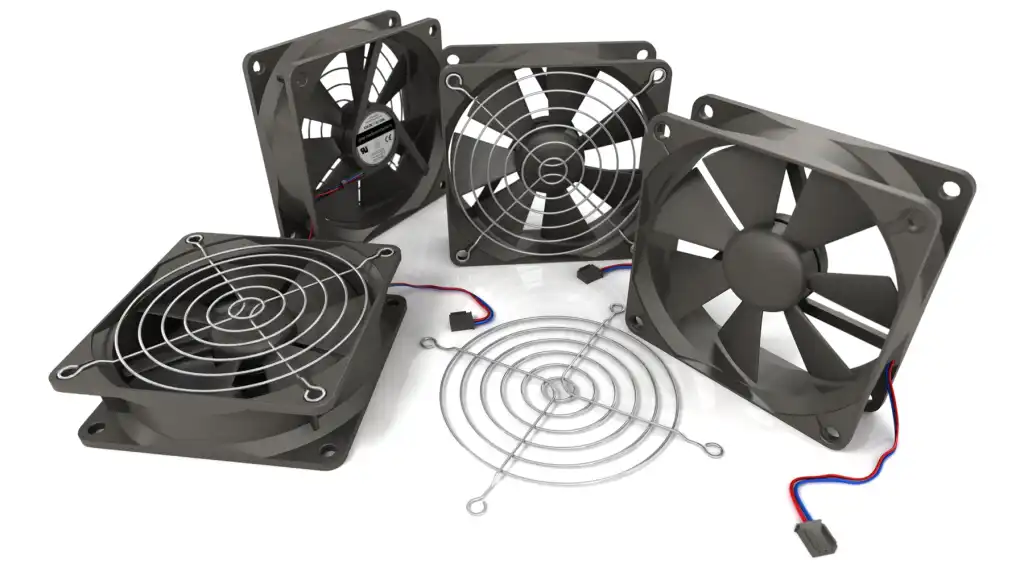

A fan controller has one job that sounds simple until a PC starts running hot or noisy: give you useful control without forcing an awkward wiring project. The trouble is that these products are not interchangeable. Some convert wall power for standalone fans, some manage motherboard-style PWM fans, and others control lighting while doing little for fan speed.
Our Best computer fan controller picks include AC-powered 120mm fans, multi-fan hubs, USB adapters, and 5V ARGB controllers. The Tokatuker 12V Fan Controller is the strongest all-purpose choice, while the rest target more specific setups, from six-fan PWM builds to compact USB cooling.
Comparison of the 10 best computer fan controller picks
| # | Product | Award | Output or compatibility | Key feature | Best for |
|---|---|---|---|---|---|
| 1 | Tokatuker 12V Fan Controller | Best overall | 3V to 12V DC, 36W | Four-way 3-pin or 4-pin splitter | Most standalone fan setups |
| 2 | FENGZUNJING 120mm AC Fan | Best plug and play fan | 110V to 240V AC input | 120mm fan, dial control | Simple wall-powered cooling |
| 3 | Easy Cloud AC Fan | Best single fan | 700 to 2800 RPM | 95.8 CFM claimed airflow | Adjustable equipment cooling |
| 4 | Fyntave ARGB Controller | Best compact ARGB control | 5V 3-pin ARGB | SATA power, onboard controls | Older PCs without ARGB support |
| 5 | OwlTree USB Fan Adapters | Best USB option | 5V to 12V, 8W maximum | Two adapters, speed dials | Low-power fans and flexible placement |
| 6 | Wathai Dual 120mm AC Fan | Best dual-fan unit | 3V to 12V DC output | Two 120mm fans | Cabinets and enclosed spaces |
| 7 | Easy Cloud Dual AC Fans | Best two-fan package | 700 to 2800 RPM | Two variable-speed fans | Broad airflow coverage |
| 8 | OwlTree Six Fan PWM Controller | Best six-fan PWM hub | 12V, 60W maximum | 1% to 99% PWM duty cycle | Larger 4-pin fan arrays |
| 9 | JAZZCOOLING ARGB Controller | Best remote lighting control | 5V 3-pin ARGB | 14-key remote, 215 modes | Remote-controlled case lighting |
| 10 | OwlTree 4-Way PWM Hub | Best simple splitter | 3V to 12V DC, 36W | Four-way splitter | Mixed 3-pin and 4-pin fans |
1. Tokatuker 12V Fan Controller: Best Overall

Pros
- Handles up to four fans together
- Works with 3-pin and 4-pin connectors
- Adjustable 3V to 12V output
- Universal 100V to 240V AC input
Cons
- It is an external controller, not a motherboard header
- The fan splitter limits independent fan adjustment
- Does not provide ARGB lighting control
Best for: someone who wants one physical dial for several standalone PC fans.
The Tokatuker 12V Fan Controller is the easiest recommendation when the goal is straightforward fan-speed control rather than software integration. It takes power from a 100V to 240V AC source and turns it into adjustable 3V to 12V DC, so it can run fans without depending on a motherboard header. That makes it useful for external case cooling, an AV cabinet, a console enclosure, or a PC whose internal headers are already occupied.
The practical advantage is the included four-way splitter. The controller supports four 3-pin or 4-pin fans, and its maximum output is 36W, with output listed up to 3A. The dial changes the voltage reaching the connected fans, giving you a simple way to trade airflow for noise. It is not the same as true PWM control, but it is more broadly compatible than the six-port OwlTree PWM unit, which only accepts 4-pin 12V fans.
Cable length is generous enough for a controller that may sit outside the chassis. The package has a 1.3-foot AC input cable, a 3-foot DC output cable, and a 1.3-foot splitter cable, for 5.5 feet of extendable cable length in total. The controller itself measures 3.4 by 2 by 1.2 inches, so it needs a little room beside the equipment rather than disappearing entirely into a tight case.
The weakness is shared control. Four fans connected through the splitter respond to the same adjustment, and there is no motherboard monitoring, temperature curve, or lighting connection. If your build already has 4-pin headers and you want automatic speed changes, the OwlTree Six Fan PWM Controller is more capable. Choose Tokatuker when compatibility and an uncomplicated physical dial matter more than software control.
2. FENGZUNJING 120mm AC Fan: Best Plug and Play Fan
Pros
- Plugs directly into a wall outlet
- Built-in speed controller
- Protective metal finger guard
- Slim 25mm fan profile
Cons
- Includes one fan only
- No motherboard connection
- The AC cable limits internal cable management
Best for: anyone cooling a router, receiver, cabinet, or external PC enclosure without extra wiring.
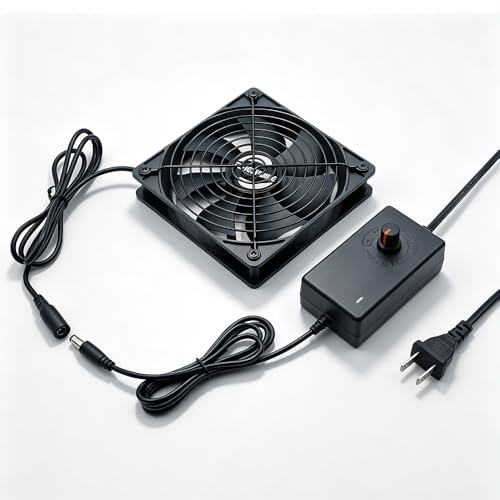
The FENGZUNJING 120mm AC Fan makes the controller part almost invisible. Instead of pairing a separate adapter and fan, you get a 120mm by 25mm cooling fan with a built-in dial and a 5-foot power cord. Plug it into a standard 110V to 240V outlet, set the speed, and place or mount it where warm air is collecting.
That design suits equipment that was never built around PC fan headers. The product is aimed at PC cases, routers, gaming console cabinets, receivers, greenhouse panels, and DIY enclosures. Its 25mm thickness is the familiar slim 120mm format, and the included metal guard makes it more suitable for exposed placement than an unprotected internal case fan.
The brushless motor is described as quiet, and the dial lets you reduce airflow for a living room, bedroom, or office installation. It can also be turned up when heat exhaust matters more than acoustic comfort. Mounting options include screws, zip ties, a flat surface, or a panel, though the data does not specify a mounting kit beyond the fan and guard.
This is a fan with control, not a general-purpose fan hub. It cannot manage other fans, and it lacks the broader 3-pin and 4-pin splitter flexibility of the Tokatuker 12V Fan Controller. Its 0.77-pound body is manageable, but the wall plug and exposed format make it a poor fit for a clean internal desktop build. For a single external cooling point, it is the least complicated option here.
3. Easy Cloud AC Fan: Best Single Fan

Pros
- Wide 700 to 2800 RPM range
- Claimed airflow of 95.8 CFM
- Dual-ball bearings
- Works from an AC outlet
Cons
- One fan does not cover a large enclosure
- Maximum stated noise is below 41dB, not silent
- No automatic temperature control
Best for: a single router, receiver, cabinet, or PC enclosure that needs adjustable airflow.
The Easy Cloud AC Fan is a more specified single-fan package than the FENGZUNJING model. It uses the familiar 120mm by 25mm axial format, but the manufacturer gives a clear operating range of 700 to 2800 RPM and claims 95.8 CFM of airflow with a plus or minus 10 percent tolerance. That range gives it enough flexibility for quiet circulation as well as more forceful heat removal.
Its controller adjusts the fan from a wall-powered setup, with the fan itself rated at 12V and 3.3W. The dual-ball bearings are rated for a 50, 000-hour lifespan, and the fan is listed at 0.3A. Those details make it a sensible candidate for equipment that stays on for long periods, such as a server cabinet, DVR, receiver, or network device enclosure.
The AC plug is the reason to choose this over a normal internal case fan. There is no need to find a spare motherboard header or install a separate power converter. The tradeoff is that the fan remains an external accessory, with a cable and controller that need somewhere to go. If two airflow points are needed, the Easy Cloud Dual AC Fans cover that need more directly.
The stated noise figure is below 41dB, so “quiet” should be understood as adjustable rather than silent at maximum speed. There is also no temperature sensor or automatic curve. Skip it if you want motherboard software to manage RPM. Pick it when you need one compact 120mm fan, a useful speed range, and a wall outlet.
4. Fyntave ARGB Controller: Best Compact ARGB Control

Pros
- Works without motherboard ARGB support
- SATA-powered
- Multiple lighting modes
- Compact controller body
Cons
- Controls lighting, not fan motor speed
- Only for 5V 3-pin ARGB devices
- No remote control listed
Best for: adding basic ARGB control to a PC that lacks a compatible motherboard header.
The Fyntave ARGB Controller belongs in this roundup because “fan controller” can mean lighting control in a modern PC build. This small unit connects to a power supply SATA interface and accepts 5V 3-pin ARGB equipment. It does not change fan speed, but it can give older hardware control over the lighting attached to its fans, strips, or light plates.
Its onboard controls cover the basics without requiring motherboard software. The M button changes modes, S adjusts effect speed through eight levels, and C cycles colors with six brightness levels. The listed modes include single color, cycling, and rainbow effects. Holding the control for four seconds turns the lights on or off.
Cable reach is reasonable for a compact case accessory. The ARGB cable is listed at 160 plus or minus 10mm, while the SATA cable is 500 plus or minus 10mm. The body measures about 1.97 by 0.87 by 0.33 inches, making it easy to tuck behind a motherboard tray or alongside a power supply cable.
Compatibility requires care. A 5V 3-pin ARGB plug is not the same as a 12V 4-pin RGB connector, and this controller should not be treated as a motor-speed hub. The JAZZCOOLING ARGB Controller offers remote control and many more lighting modes, but Fyntave is smaller and simpler. Choose it for basic lighting on a motherboard that lacks ARGB support, not for cooling management.
5. OwlTree USB Fan Adapters: Best USB Option

Pros
- Runs from a USB 5V source
- Two adapters included
- Physical speed dial
- 11.8-inch cable length
Cons
- Limited to 8W maximum output
- Designed for low-power fans
- The four-pin plug uses only two connected wires
Best for: low-power 12V fans that need USB power and simple manual adjustment.
The OwlTree USB Fan Adapters solve a different problem from the AC-powered units. They let a compatible fan draw power from a USB port, then provide a switch and dial for speed adjustment. That is useful for a desk, small electronics enclosure, shelf, or temporary cooling setup where a wall-powered adapter would be inconvenient.
The input is USB 5V, with output from 5V to 12V and a maximum output of 8W. The intended fan is a 4-pin 12V model below that 8W limit. Although the connector has four positions, the product explains that only two wires are connected because USB power needs only two lines. It should not be mistaken for a full PWM control signal.
The 11.8-inch cable gives some placement freedom, and the two-adapter package can serve two separate fans. The wire uses 24AWG tinned copper, which is a useful construction detail for a cable that may be moved around. Operation is simple: connect USB power, attach the fan, switch it on, and turn the dial.
The output ceiling makes this a poor match for a powerful multi-fan PC cooling system. The Tokatuker 12V Fan Controller handles four fans and 36W, while OwlTree is better suited to modest loads and USB-first setups. Check the fan's wattage before connecting it, and choose this adapter when portability and easy USB power are more important than high output.
For a wider look at airflow choices outside a desktop case, the right airflow approach for cooling a room can help separate equipment cooling from general comfort.
6. Wathai Dual 120mm AC Fan: Best Dual-Fan Unit

Pros
- Two 120mm fans in one unit
- Adjustable 3V to 12V output
- Intake or exhaust placement
- Dual metal protective guards
Cons
- Larger footprint than a single fan
- No independent fan-speed control
- Stated airflow is 85 CFM per fan
Best for: ventilating a cabinet, chassis, greenhouse, or other larger enclosed space.
The Wathai Dual 120mm AC Fan is the most purpose-built option here for moving air through an enclosure. It places two 120mm fans side by side in a unit measuring about 9.45 by 4.72 by 1 inch. That broad face can cover a cabinet opening more effectively than a single 120mm fan, especially when the fans are arranged to push air through rather than simply stir it.
The controller accepts 100V to 240V, 50/60Hz AC and provides adjustable 3V to 12V DC output at 200mA to 2000mA. The listed fan specification is 12V, 0.5A, 2500 RPM, and 85 CFM per fan. Those figures point to a setup designed for noticeable air movement, not just gentle circulation.
A useful detail is the reversible airflow arrangement. The fans can be positioned for intake or exhaust, making the unit suitable for a window, cabinet, kitchen exhaust point, greenhouse, mushroom-growing tent, or RV refrigerator setup. Dual-ball bearings are rated for 50, 000 hours and permit flat or upright placement. Metal guards protect both sides from accidental contact and loose objects.
The size and shared control are the main limitations. It is not as neat inside a conventional PC as a hub connected to the motherboard, and both fans follow the same speed adjustment. The Easy Cloud Dual AC Fans offer a similar two-fan approach with a stated 700 to 2800 RPM range, but Wathai is the stronger fit when intake, exhaust, and protective grilles are central to the installation.
7. Easy Cloud Dual AC Fans: Best Two-Fan Package

Pros
- Two 120mm by 25mm fans
- 700 to 2800 RPM range
- Claimed 95.8 CFM airflow per fan
- Dual-ball bearings
Cons
- Requires an AC outlet
- No independent fan controls
- One package weighs 1.5 pounds
Best for: cooling two points in a cabinet or enclosure with one adjustable setup.
The Easy Cloud Dual AC Fans take the single-fan design from the Easy Cloud AC Fan and make it a two-fan package. Each fan measures 120 by 120 by 25mm, so the pair can be placed at separate intake and exhaust points or used together to move more air across a larger enclosure.
Each fan is rated at 12V, 0.3A, and 3.3W. The claimed airflow is 95.8 plus or minus 10 percent CFM, with a speed range from 700 to 2800 RPM. That gives the pair a wide adjustment window, from low-speed circulation in a room or office to stronger ventilation when an enclosed device is generating heat.
The dual-ball bearings are rated for 50, 000 hours, and the stated noise figure is below 41dB. Those numbers are useful context, but they do not turn the set into a temperature-managed system. The controller is manual, so someone must choose the speed and adjust it when the surrounding conditions change.
Compared with the Wathai Dual 120mm AC Fan, this set emphasizes the same adjustable 120mm fan format as the single Easy Cloud model, while Wathai is more explicitly designed around a joined cabinet or window installation. Easy Cloud is the better choice when two fans need to be positioned flexibly. Skip it for a compact desktop build that already has available motherboard headers.
For planning intake and exhaust rather than simply adding another fan, how to balance airflow inside a PC case is a useful next step.
8. OwlTree Six Fan PWM Controller: Best Six-Fan PWM Hub

Pros
- Supports six 4-pin PWM fans
- 1% to 99% duty-cycle adjustment
- SATA or DC 5.5 by 2.5mm input
- 60W maximum total output
Cons
- Does not support 3-pin or 2-pin fans
- Fans are not included
- Per-port current must stay within the stated limits
Best for: a larger array of 4-pin 12V fans needing one manual PWM control.
The OwlTree Six Fan PWM Controller is the specialist pick for a real 4-pin fan array. It has six fan ports and uses PWM duty-cycle adjustment from 1% to 99%, which is more appropriate for PWM-compatible motors than simply reducing voltage. The controller is designed for 12V 4-pin fans and does not include the fans themselves.
Power input is flexible. It can use a SATA 12V connection or a DC 5.5 by 2.5mm, also called 5525, 12V input. The maximum combined output is 60W, listed as 5A at 12V, while each port can support up to 2A. Those limits are substantial for a multi-fan setup, but the total combined current still cannot exceed 5A.
The controller measures about 2.7 by 1.6 by 0.7 inches, so it can fit in a case without taking over the build. Its six-port design is a major step up from the four-way splitters in the Tokatuker 12V Fan Controller and OwlTree 4-Way PWM Hub. It is the right architecture when every connected fan is a compatible 4-pin PWM model.
Compatibility is also its central weakness. A 3-pin fan will not work, and the listing specifically excludes 2-pin models. There is no mention of temperature sensing, motherboard synchronization, or per-fan adjustment, so all connected fans share the controller's setting. Choose this for six matching PWM fans and a strong output ceiling. Choose Tokatuker instead when connector types are mixed.
9. JAZZCOOLING ARGB Controller: Best Remote Lighting Control

Pros
- 14-key remote control
- 215 dynamic lighting modes
- Supports static colors and effects
- SATA-powered 5V 3-pin design
Cons
- Controls lighting rather than fan speed
- Requires 5V 3-pin ARGB equipment
- Remote adds another device to keep track of
Best for: changing case lighting effects without opening the PC or using motherboard software.
The JAZZCOOLING ARGB Controller is the most convenient lighting-focused product in the group. It connects to a power supply SATA interface and accepts 5V 3-pin ARGB equipment, including compatible fans, LED strips, GPU support lighting, power-supply cables, and cooler lighting. Its purpose is visual control, not motor control.
The included 14-key remote gives access to 215 dynamic lighting modes and four static color modes according to the product details. The effects include monochrome, rainbow, running, and jumping patterns. That is a much broader control set than the onboard buttons on the Fyntave ARGB Controller, particularly for a PC that sits under a desk or in a position where reaching inside the case is inconvenient.
The small body is easy to hide, measuring about 20.8 inches in listed length for the cable-oriented product dimensions, with a compact 0.31-inch height and 0.87-inch width. The internal cable uses copper wire for current stability and insulation, and the tool-free connection is meant to be plug and play.
The same 5V 3-pin warning applies here as with Fyntave. Do not connect it to a 12V 4-pin RGB header, and do not expect it to alter fan RPM. If the goal is cooling, the OwlTree Six Fan PWM Controller is the relevant choice. If the goal is remote lighting changes across ARGB accessories, JAZZCOOLING is the more complete controller.
10. OwlTree 4-Way PWM Hub: Best Simple Splitter

Pros
- Four-way fan splitter included
- Works with 3-pin and 4-pin connectors
- 3V to 12V adjustable output
- Universal AC input
Cons
- Limited to 36W total output
- No automatic temperature control
- Less suitable for large PWM arrays
Best for: a small group of mixed 3-pin and 4-pin fans needing one manual speed dial.
The OwlTree 4-Way PWM Hub is a compact, broadly compatible alternative to a motherboard fan header. Its four-way splitter accepts 3-pin and 4-pin computer cooling fans, while the controller adjusts output from 3V to 12V DC. That makes it useful when a PC or enclosure has several fans but no convenient header arrangement.
The included power adapter accepts 100V to 240V AC and provides a 36W supply with 3A output. The controller itself measures about 2 by 1.5 by 0.71 inches, keeping the hardware fairly unobtrusive beside a case or inside a cabinet. Installation is simply a matter of connecting the adapter, attaching the splitter, and turning the dial.
The important distinction is that this is variable-voltage control, despite PWM appearing in the product title. It does not offer the 1% to 99% PWM duty-cycle specification of the OwlTree Six Fan PWM Controller, and it has no indication of automatic fan curves or software control. Its advantage is connector flexibility, since the six-fan model is limited to 4-pin 12V PWM fans.
The 36W limit is enough for a modest cluster of fans but not a license to connect anything without checking its draw. The Tokatuker 12V Fan Controller offers nearly the same broad approach and also includes a four-way 3-pin or 4-pin splitter. Pick OwlTree when its smaller controller body suits the installation. Pick Tokatuker when cable reach and a more explicitly described 3A output are more important.
How to choose best computer fan controller
The right controller depends first on the fan connector and power source, then on how much control you actually need.
Connector type
A 3-pin fan generally changes speed through voltage, while a 4-pin PWM fan expects a control signal in addition to power. The Tokatuker and OwlTree 4-Way units accept both connector styles, but their adjustable output is voltage-based. The OwlTree Six Fan PWM Controller is specifically for 4-pin 12V PWM fans.
ARGB is separate from motor control. A 5V 3-pin ARGB plug manages lighting, while a 12V 4-pin RGB connector is a different standard. Never choose an ARGB controller as a substitute for a fan-speed hub.
Power source
AC-powered controllers and fans are convenient for cabinets, routers, receivers, and external cooling because they do not consume a motherboard header. USB adapters are easier to place but have a much lower 8W maximum output. Internal hubs usually draw from SATA or a dedicated DC input.
Check where the equipment will sit before choosing. A wall-powered fan is practical near an outlet, while a USB adapter makes more sense for a desk or small enclosure. For broader equipment cooling ideas, where airflow matters most around home electronics is a helpful distinction.
Output capacity
Add the wattage or current requirements of every connected fan before using a splitter. The Tokatuker and OwlTree 4-Way hubs provide 36W and up to 3A, while the OwlTree Six Fan PWM Controller raises the total to 60W and 5A. The OwlTree USB adapters are limited to 8W.
A six-port hub is only useful if the connector standard and combined current both match your fans.
Fan count and control style
A four-way splitter suits a small group of fans that can share one setting. Six ports provide more room for a larger array, but the listed controller still applies one PWM adjustment rather than separate settings for every port. Dual AC fan units are simpler when the fans are being installed as external intake or exhaust equipment.
Lighting control
Choose an ARGB controller only when lighting is part of the goal. Fyntave uses onboard controls and SATA power, while JAZZCOOLING adds a 14-key remote and 215 dynamic modes. Neither product is a cooling controller, so a fan motor still needs a compatible motherboard header, hub, or power adapter.
Frequently asked questions
Can a fan controller run both 3-pin and 4-pin fans?
The Tokatuker 12V Fan Controller and OwlTree 4-Way PWM Hub are listed as compatible with 3-pin and 4-pin fans. Their adjustable 3V to 12V output indicates voltage-based control rather than full motherboard-style PWM management. Always verify the fan's voltage and connector before connecting it.
Is an ARGB controller the same as a fan-speed controller?
No. ARGB controllers change lighting effects, colors, brightness, and effect speed. They do not control the fan motor unless a separate motor-control circuit is included, which is not specified for the Fyntave or JAZZCOOLING products.
Can these controllers adjust fan speed automatically?
The listed products use manual controls such as dials, buttons, or a remote. The data does not describe temperature sensors, motherboard software integration, or automatic fan curves. They are best for a speed setting you choose yourself.
How many fans can the OwlTree Six Fan PWM Controller handle?
It supports six 4-pin 12V PWM fans. The total output is listed as 60W or 5A at 12V, with each port supporting up to 2A, but the combined current must remain within 5A. Fans are not included.
Can I use a 5V ARGB controller with a 12V RGB connector?
No. The Fyntave and JAZZCOOLING controllers are designed for 5V 3-pin ARGB devices. A 12V 4-pin RGB connector uses a different electrical standard and should not be connected to a 5V ARGB controller.
Are AC-powered 120mm fans suitable inside a desktop PC?
They can cool an enclosure, but they are less tidy than an internal fan connected to a motherboard or dedicated hub. Their wall plugs and external controllers are better suited to cabinets, routers, receivers, console storage, and other equipment that lacks standard fan headers.
The bottom line
The Tokatuker 12V Fan Controller is the strongest all-purpose answer for the Best computer fan controller search because it accepts both 3-pin and 4-pin fans, powers up to four through its splitter, and offers a useful 3V to 12V adjustment range. For a six-fan 4-pin PWM array, the OwlTree Six Fan PWM Controller is the better technical fit because it supports six ports and a 60W total output.
Choose the FENGZUNJING 120mm AC Fan or Easy Cloud AC Fan for a single wall-powered cooling point, and choose the Wathai or Easy Cloud dual-fan products for larger cabinets. For lighting, Fyntave is the compact option and JAZZCOOLING is the remote-control pick.
If you are undecided, identify the fan connector first, then match the controller's voltage, output limit, and power source before buying.
As an Amazon Associate we earn from qualifying purchases.