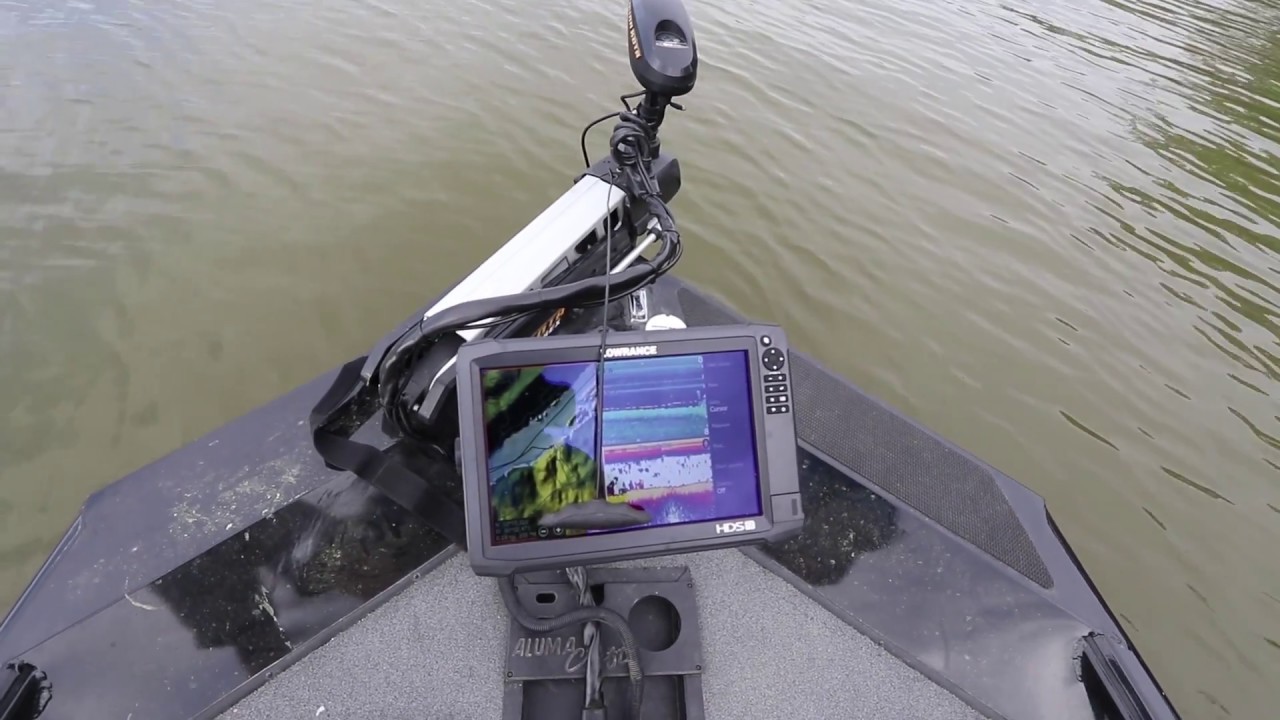

A fish finder has one job that matters: turn featureless water into useful information before you waste another drift. The right unit can show depth, bottom contours, vegetation, fish targets, and a route home. The wrong one leaves you squinting at a cluttered screen or wrestling with controls while the boat is moving.
We compared ten genuine boat and portable sonar options, ranging from simple dual-beam displays to large-screen GPS units with side imaging, mapping, and networking. The Best Fish Finders for Boats are not all the same kind of tool, so the right choice depends on your hull, fishing style, and tolerance for installation.
Our top pick is the Humminbird Helix 5 G3 GPS, while the range below includes a more detailed Helix variant, premium XPLORE and Helix 7 models, portable LUCKY units, the Lowrance HOOK Reveal 5, Phiradar's compact display, and the castable Deeper MAX.
Comparison table
| # | Product | Award | Sonar | Display or range | Best for |
|---|---|---|---|---|---|
| 1 | Humminbird Helix 5 G3 GPS | Best overall | Dual Spectrum CHIRP | 5-inch display | All-around boat fishing |
| 2 | Humminbird PiranhaMAX 4 | Best simple boat finder | Dual Beam Sonar | Tilt and swivel mount | Straightforward depth readings |
| 3 | Humminbird Helix 5 G3 Down Imaging | Best 5-inch imaging | Dual Spectrum CHIRP, Down Imaging | 5-inch display | Structure-focused anglers |
| 4 | Lowrance HOOK Reveal 5 | Best for inland mapping | CHIRP, DownScan, FishReveal | 5-inch SolarMAX display | Lake anglers |
| 5 | Humminbird XPLORE 9 | Best premium display | MEGA Side Imaging+, MEGA Down Imaging+, CHIRP | 9-inch HD touchscreen | Advanced boat setups |
| 6 | Humminbird Helix 7 G4 | Best side imaging value | MEGA Side and Down Imaging, CHIRP | 7-inch display | Wide structure scanning |
| 7 | LUCKY MT-202 | Best wireless portable | Wireless sonar, 90-degree beam | 3.5-inch LCD, 853-foot operating distance | Portable boat and kayak use |
| 8 | LUCKY FFC1108 | Best handheld starter | Castable sonar | 3 to 328 feet detection range | Basic portable depth finding |
| 9 | Phiradar FF688C | Best control flexibility | 200 kHz and 83 kHz dual beam | 3.5-inch color LCD, 2 to 240 feet | Manual sonar tuning |
| 10 | Deeper MAX | Best castable mapping | CHIRP sonar | 330-foot scanning depth, 400-foot GPS range | App-based mapping |
1. Humminbird Helix 5 G3 GPS: Best Overall

Pros
- Dual Spectrum CHIRP offers wide and narrow search modes
- Built-in mapping covers more than 10, 000 lakes and US coastlines
- AutoChart Live records contours, bottom hardness, and vegetation
- Keypad controls remain practical in changing weather
Cons
- 5-inch display gives less room for split-screen views
- No Down Imaging listed for this version
Best for: boat anglers who want dependable sonar, GPS, and mapping in one manageable unit.
The Humminbird Helix 5 G3 GPS is the sensible center of this group. It does not try to be a giant chartplotter, but it gives a small boat the functions that most anglers use repeatedly: clear sonar, navigation, and a way to build a better picture of familiar water. The keypad-driven interface is especially appealing if you would rather press a physical button than poke at a touchscreen with wet fingers.
Its Dual Spectrum CHIRP sonar has two useful personalities. Wide Mode covers more water when you are searching, while Narrow Mode concentrates on detail when you have found likely structure. The Low-Q transducer supports precise 2D target separation, which should make fish arches and fish-holding structure easier to distinguish than a basic single-beam display. Humminbird's Basemap adds coverage for more than 10, 000 lakes and continental US coastlines, and the unit can work with LakeMaster, CoastMaster, and Navionics charts.
AutoChart Live is the feature that gives this unit staying power. It can create maps showing depth contours, bottom hardness, and vegetation while you move, with eight hours of built-in recording time. That matters on lakes where the supplied map is useful but not detailed enough for a specific cove or channel. If navigation is part of your setup, the question of how much location data a boat really needs is a useful distinction, since a fish finder chartplotter and a tracking device solve different problems.
The limitation is the five-inch screen. It is large enough for ordinary sonar and GPS work, but a side-by-side view will feel tight compared with the XPLORE 9 or Helix 7 G4. It also lacks the Down Imaging feature included with the third pick. Choose the Humminbird Helix 5 G3 GPS if you want a balanced, button-controlled unit for a fishing boat and do not need the widest imaging view.
2. Humminbird PiranhaMAX 4: Best Simple Boat Finder

Pros
- Simple dual-beam sonar
- Tilt and swivel mount makes viewing angle easy to adjust
- Includes a transom-mount transducer
- Compact two-pound design
Cons
- No GPS or mapping features listed
- Less imaging detail than the Helix models
Best for: anglers who mainly need depth, fish, and bottom information without chartplotter features.
The Humminbird PiranhaMAX 4 is the uncomplicated pick. It is aimed at the boat owner who wants to know how deep the water is and whether fish or structure are below, not someone building a networked marine electronics station. That narrow purpose is a strength. There are fewer settings to learn and fewer mapping features competing for attention.
Its Dual Beam Sonar lets you choose between a narrow beam for more detail and a wider beam for broader coverage. That is the basic sonar decision in a useful form. A narrow view helps when you are trying to inspect a promising area, while a wider view is more useful when moving around and looking for a change in depth or a likely holding area. The included tilt and swivel mount lets you adjust the viewing angle quickly from the helm.
The compact enclosure weighs two pounds and measures 6.8 inches high, 3.6 inches long, and 3.9 inches wide according to the product information. It comes with the PiranhaMAX 4, its mount, and an XNT 9 28 T transom-mount transducer. Those details make it a practical fit for a smaller boat where a larger display would consume valuable console space.
The trade-off is obvious next to the Humminbird Helix 5 G3 GPS. The PiranhaMAX 4 does not list GPS, built-in maps, AutoChart Live, or CHIRP imaging, so it cannot compete as a navigation or structure-mapping system. It is the one to choose when those omissions are acceptable. For basic depth and fish readings with physical mounting hardware included, it avoids unnecessary complexity.
3. Humminbird Helix 5 G3 Down Imaging: Best 5-Inch Imaging

Pros
- Adds CHIRP Down Imaging to the Helix 5 platform
- Dual Spectrum CHIRP supports wide and narrow scanning
- GPS and Humminbird Basemap are built in
- AutoChart Live maps changing water
Cons
- Still limited by a 5-inch display
- Keypad controls are less immediate for some users than a touchscreen
Best for: anglers who want a compact GPS unit with extra detail directly beneath the boat.
The Humminbird Helix 5 G3 Down Imaging is the more informative sibling to our top pick. It keeps the same compact five-inch format and keypad operation, then adds CHIRP Down Imaging for a clearer view beneath the boat. That distinction matters when the screen shows a confusing mix of marks. Down Imaging is intended to filter visual clutter and make structure easier to interpret, while traditional sonar remains useful for fish arches and target separation.
The core sonar system is still Dual Spectrum CHIRP, with Wide Mode for coverage and Narrow Mode for detail. Its Low-Q transducer supports precise 2D target separation, and the Down Imaging view complements that by showing a more photographic representation of what lies below. These are different views rather than redundant ones. The CHIRP display helps answer whether a target is present, while Down Imaging can help explain the shape of the surrounding structure.
GPS features keep this from being a sonar-only unit. Humminbird Basemap covers more than 10, 000 lakes and continental US coastlines, with compatibility for LakeMaster, CoastMaster, and Navionics charts. AutoChart Live records depth contours, bottom hardness, and vegetation, and has eight hours of built-in recording time. That combination makes it useful for returning to a productive area, not just finding a mark once.
Compared with the standard Humminbird Helix 5 G3 GPS, this model is the better fit for structure-oriented fishing because of Down Imaging. Compared with the Lowrance HOOK Reveal 5, it offers a similar compact footprint but takes a different approach to mapping and controls. The weakness is screen real estate. Down Imaging, GPS, and conventional sonar can feel crowded on five inches, so anglers who frequently run split views should step up to a larger unit.
4. Lowrance HOOK Reveal 5: Best for Inland Mapping

Pros
- FishReveal combines CHIRP and DownScan views
- Preloaded maps cover almost 4, 000 US inland lakes
- Genesis Live creates custom contour maps
- SolarMAX display is designed for daylight visibility
- Autotuning adjusts sonar settings as conditions change
Cons
- Smaller display than the premium Humminbird units
- Mapping emphasis is strongest for inland anglers
Best for: freshwater boat owners who want readable maps and less manual sonar adjustment.
The Lowrance HOOK Reveal 5 makes a strong case for letting the unit handle more of the setup work. Its autotuning sonar adjusts settings as fishing conditions change, which is useful when you would rather keep moving than repeatedly refine sensitivity and other controls. FishReveal combines the target separation of Lowrance CHIRP sonar with the structure detail of DownScan Imaging, so fish marks are easier to find against the bottom image.
Mapping is its defining feature. The unit comes with high-detail maps for almost 4, 000 US inland lakes and can create custom contour maps with Genesis Live. That is a more targeted approach than simply displaying a broad basemap. If you fish the same lake repeatedly, building a contour record as you move can turn familiar water into a more useful set of reference points.
The five-inch SolarMAX display is designed for clarity in direct sunlight, an important trait at an exposed helm. The product information lists a 5 Inch SplitShot configuration, and the included SplitShot transducer combines wide-angle high CHIRP sonar with DownScan Imaging. The supplied hardware is therefore matched to the unit's central purpose: finding fish while also examining the structure beneath the boat.
Against the Humminbird Helix 5 G3 Down Imaging, the Lowrance offers a compelling alternative for anglers who prefer FishReveal, autotuning, and inland lake mapping. It does not have the larger viewing area of the Humminbird XPLORE 9, and its map coverage is specifically framed around US inland lakes. Skip it if you need a broader marine navigation setup. For freshwater anglers who want a readable display and minimal sonar fiddling, it is one of the most approachable choices here.
5. Humminbird XPLORE 9: Best Premium Display

Pros
- Large 9-inch HD display with 1280 by 720 resolution
- MEGA Side Imaging+ reaches 200 feet on each side
- MEGA Down Imaging+ reaches 200 feet below
- Touchscreen and keypad control options
- Ethernet, Bluetooth, and NMEA 2000 compatibility
Cons
- Larger and heavier than the compact models
- More features and connections require a more deliberate setup
Best for: serious boat anglers who want broad imaging, a large screen, and marine-system integration.
The Humminbird XPLORE 9 is the clear step into premium boat electronics. Its nine-inch HD screen gives sonar, mapping, and navigation more breathing room than every five-inch unit here. The 1280 by 720 resolution should make a dense side-imaging view easier to parse, while the dual control system gives you both touchscreen interaction and physical keypad control. That combination is more useful than a touchscreen alone when the boat is moving or conditions are wet.
Its MEGA Side Imaging+ has a stated range of 200 feet on each side, and MEGA Down Imaging+ reaches 200 feet directly below. Those ranges make the XPLORE 9 a serious search tool. Side imaging is particularly useful for covering water beside the boat rather than relying only on the narrow area directly underneath. Dual Spectrum CHIRP remains available with Wide and Narrow modes when you need conventional fish detection and target separation.
Navigation is equally well developed. The built-in GPS uses Humminbird Basemap coverage for more than 10, 000 lakes, and the unit includes a LakeMaster and CoastMaster VX map card for US and Canadian regions. AutoChart Live can record contours, bottom hardness, and vegetation for eight hours without added recording capacity. Compatibility with Navionics charts gives experienced anglers room to tailor the mapping system.
Connectivity separates this model from the Humminbird Helix 7 G4. High-speed Ethernet, Bluetooth, and NMEA 2000 compatibility make the XPLORE 9 a better foundation for a boat with connected marine equipment. It also integrates with Minn Kota and Cannon products. The downside is physical and operational: at 4.28 pounds and 11.69 inches long, it asks for more console space and a more serious installation. Anglers with a small boat or a basic sonar need should not buy around features they will never use.
6. Humminbird Helix 7 G4: Best Side Imaging

Pros
- MEGA Side and Down Imaging reach 125 feet
- Dual Spectrum CHIRP adds conventional sonar detail
- 7-inch display is easier to read than a 5-inch unit
- GPS, Basemap, and AutoChart Live are included
- Keypad control works in wet conditions
Cons
- No touchscreen is listed
- Side-imaging range is shorter than the XPLORE 9
Best for: anglers who want a larger Humminbird display and side imaging without moving to the XPLORE platform.
The Humminbird Helix 7 G4 is the balanced imaging upgrade. Its seven-inch display provides noticeably more room for side-imaging detail and map views than the Helix 5 models, yet its interface remains keypad-based and familiar. That makes it a good fit for anglers who want more visual information without changing to a touchscreen-heavy system.
MEGA Side and Down Imaging cover 125 feet on either side of the boat and 125 feet directly beneath it. Humminbird says the imaging provides three times more detail than standard imaging sonar. Those views are useful for finding contours, fish, and structure away from the boat, while Dual Spectrum CHIRP handles wide searching and narrower, more detailed inspection. The included transducer means the unit's core imaging functions are supported from the start.
The GPS and mapping functions are strong for this class. Humminbird Basemap covers more than 10, 000 lakes and continental US coastlines, with compatibility for LakeMaster, CoastMaster, and Navionics charts. AutoChart Live records bottom contours, hardness, and vegetation, with eight hours of built-in recording. For an angler who spends time learning a particular lake, those mapping tools can matter as much as the sonar image.
The Humminbird XPLORE 9 beats it on display size, imaging range, touchscreen control, and connectivity. The Helix 7 G4 answers with a simpler physical interface and a smaller footprint. Its lack of a listed touchscreen is a genuine weakness for anyone who expects phone-like navigation through menus. Choose it when side imaging is the priority and a seven-inch keypad-controlled display fits your boat better than a larger premium chartplotter.
7. LUCKY MT-202: Best Wireless Portable

Pros
- Wireless operation with an 853-foot stated distance
- Castable floating sensor
- 3.5-inch horizontal LCD with fish depth icons
- Rechargeable handheld design
- Works for boat, kayak, shore, and ice fishing
Cons
- Not a fixed GPS chartplotter
- Small screen is less suitable for detailed navigation
Best for: anglers who move between boats, kayaks, shorelines, and ice holes.
The LUCKY MT-202 solves a different problem from the mounted Humminbird and Lowrance units. Instead of installing a transducer on the hull, you cast or tether a floating sensor to the area you want to inspect. The handheld display then gives you information without drilling, brackets, or permanent wiring. That flexibility is its main appeal for anglers who fish from more than one platform.
The wireless operating distance is listed as 853 feet, and the sonar uses a wide 90-degree beam across a stated depth area of 3 to 147 feet. The broad beam is useful when you are checking unfamiliar water from a kayak or the edge of a boat. The display uses fish icons with depth numbers and scrolls from right to left, creating a short history of what the sensor has passed over.
The 3.5-inch horizontal LCD is compact but focused. It is designed to show fish location, depth, and movement rather than maps or elaborate imaging. The handheld display and floating sensor together weigh less than a 1-liter water bottle according to the product description, while the product information lists the unit weight at about 1.54 pounds. A rechargeable design also suits trips where carrying a separate battery setup would be inconvenient.
The Deeper MAX is a better choice if you want GPS, CHIRP, and app-based maps. The LUCKY MT-202 is easier to think of as a portable sonar probe. Its weakness is that it cannot replace a fixed console unit for navigation or detailed side imaging. Pick it for a flexible, castable setup that can follow you from a boat to a kayak, rather than as the main electronics system on a large fishing boat.
8. LUCKY FFC1108: Best Handheld Starter

Pros
- Detects water depth from 3 to 328 feet
- Shows fish, weeds, sand, and rocks
- Five sensitivity levels
- Fish and fish-school alarms
- Neck strap supports one-hand use
Cons
- Operates on replaceable batteries
- Less detailed than CHIRP and imaging units
Best for: casual boat and kayak anglers who want a basic handheld depth and fish indicator.
The LUCKY FFC1108 is the simplest portable unit in this roundup, but it covers the practical basics well. Its transducer can be attached to the hull of a kayak or boat, or used as a portable sensor, so it can show changing depth as you move. A neck strap keeps the handheld display close when both hands are busy, which is a small feature that makes sense on a compact craft.
Its stated detection range runs from 3 feet to 328 feet when the transducer is fully immersed. The display can show approximate fish location and water depth, along with short and tall weeds and bottom types such as sand and rocks. That information is not a replacement for high-resolution imaging, but it can identify a drop, weed bed, or rocky bottom that would otherwise be invisible.
Five sensitivity levels let you adapt the finder to clear or turbid water. The unit also offers feet or meters, a backlight for darkness, and fish or fish-school alarms. Battery life is listed as at least four to five hours with new batteries, with a battery-save mode for longer use. Those controls make it approachable for a first portable finder, especially when a fixed installation is not practical.
The LUCKY MT-202 is the more capable portable choice when wireless operation, a rechargeable design, and a wider 90-degree beam matter. The FFC1108 counters with a broader stated depth range and a straightforward handheld format. It does not offer GPS, mapping, or Down Imaging, and the screen will not satisfy anglers who want detailed structure views. Choose it for basic depth checks and fish alerts on a small boat, kayak, shore, or ice-fishing trip.
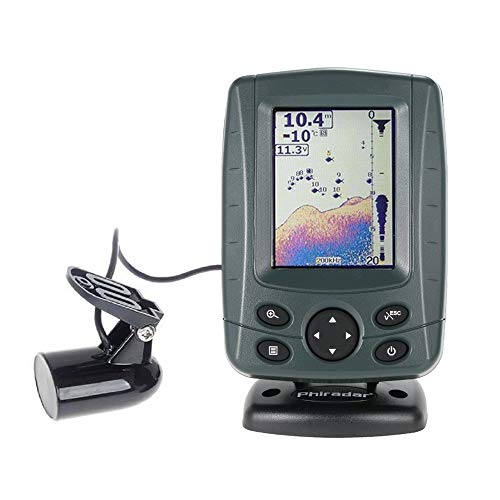
9. Phiradar FF688C: Best Control Flexibility
Pros
- Dual 200 kHz and 83 kHz sonar frequencies
- 100 sensitivity levels
- Auto zoom and manual zoom options
- Sunlight-readable color display
- Bottom contour, temperature, and alarm information
Cons
- Buttons are not waterproof
- No GPS or mapping features listed
Best for: anglers who want unusually fine manual control over a compact dual-beam sonar.
The Phiradar FF688C stands out through control rather than connected features. Its 3.5-inch color LCD is small, but the unit gives the operator many ways to tune the display. That can appeal to experienced anglers who prefer to adjust sonar behavior themselves instead of relying on a limited automatic mode.
The dual-beam system uses 200 kHz and 83 kHz frequencies. The higher frequency is suited to a more focused view, while the lower frequency can cover a broader area. The finder supports 100 sensitivity levels, multilevel depth ranges, auto zoom with bottom tracking, and quick manual zoom. It can also stop the chart at any time, which is useful when you want to examine a recent section of the sonar history.
The display reads depths from 2 to 240 feet with stated precision to one tenth, and it shows bottom contour and water temperature. Fish icons, fish depth indicators, audible fish and depth alarms, and selectable feet or meter readings round out the practical features. The menu supports multiple languages, including English, French, Spanish, German, Italian, and several others. Its stated output is 800 watts maximum and 100 watts RMS.
The limitation is important: the buttons are not waterproof. That makes installation and handling more demanding than the sealed, weather-oriented feel of the Humminbird Helix 5 G3 GPS. The FF688C also has no listed GPS or mapping, so it is a sonar display rather than a navigation tool. It suits an angler who values manual adjustment and dual-frequency operation, provided the controls can be kept protected from spray.
10. Deeper MAX: Best Castable Mapping

Pros
- Castable CHIRP sonar with GPS mapping
- Scans to a stated depth of 330 feet
- GPS range reaches up to 400 feet
- 15-hour battery life
- Fish Deeper app supports personal maps and cloud storage
Cons
- Requires a compatible Android or iOS device
- A phone or tablet screen is not included
Best for: boat, shore, kayak, and ice anglers who want portable sonar with app-based maps.
The Deeper MAX is the most interesting portable alternative to a mounted finder. It uses a castable sonar unit and sends the experience to the Fish Deeper app, rather than putting a dedicated display at the helm. That makes it easy to move between boat fishing, shore fishing, and ice fishing, especially for anglers who already carry a phone.
CHIRP sonar is paired with GPS for personal 3D depth maps. The product information lists a scanning depth of 330 feet and a GPS range of up to 400 feet. It also claims a 15-hour battery life, which gives it more endurance than the FFC1108's listed four to five hours with new batteries. Those numbers matter because mapping is only useful when the device can stay in the water long enough to build a meaningful record.
The Fish Deeper app is available for Android and iOS. It provides fish location, bottom depth, contours, and vegetation information, along with unlimited cloud storage according to the product description. The app can help you plan and log fishing trips, so the unit becomes a record-keeping tool as well as a live sonar. Anglers who want to understand how underwater visibility changes what a camera can show may also appreciate the distinction here: sonar maps shape and depth, while an underwater camera provides a visual view only when water clarity and lighting cooperate.
The catch is that the Deeper MAX does not include its own dedicated screen. You depend on a compatible mobile device, wireless connection, and the app interface. The LUCKY MT-202 is more self-contained, while the Humminbird Helix 5 G3 GPS is better for a permanent boat installation. Choose the Deeper MAX when portability and personal mapping are more important than a fixed helm display.
How to choose best fish finders for boats
The right finder depends on how you fish, how much room is available at the helm, and whether you need navigation as well as sonar. These are the capabilities that separate the Best Fish Finders for Boats from merely functional depth displays.
Sonar type
Traditional dual-beam sonar gives you a broad view and a more focused view, which is enough for basic depth, fish, and bottom readings. CHIRP sonar sends a wider range of frequencies and can improve target separation and structure interpretation. Down Imaging adds a more detailed view directly beneath the boat, while side imaging scans to the left and right.
Choose dual beam for straightforward depth finding. Choose CHIRP when distinguishing fish from clutter matters. Choose Down Imaging or side imaging when you spend time locating cover, ledges, and structure rather than simply checking the depth.
A larger sonar range is useful only when the screen can show the extra information clearly.
Screen size and control
A five-inch display keeps a console compact and works well for one sonar view or a simple map. Seven inches gives split views more room, while the nine-inch XPLORE 9 is easier to read when several types of information are visible at once. Screen resolution and daylight visibility matter too, particularly on an open boat.
Controls deserve equal attention. Keypads are predictable with wet hands and in rough conditions. Touchscreens make maps and menus quicker to navigate, but they can be less comfortable when the screen is wet or you are wearing gloves.
GPS and mapping
GPS changes a fish finder from a depth display into a navigation and location tool. Built-in maps can show lakes, coastlines, and contours, while real-time mapping systems record the water you are currently exploring. AutoChart Live and Genesis Live are useful when local contours are missing or too general.
Think about where you fish. Inland lake coverage is particularly important for freshwater anglers, while broader chart compatibility matters for coastal trips. A portable castable unit with app mapping can make sense if you do not want to permanently install electronics.
Transducer installation
A transom-mounted transducer is designed for a permanent boat setup. It gives the finder a consistent position beneath the hull, but installation needs room, cable routing, and a suitable mounting surface. The Humminbird and Lowrance units in this list are built around that type of arrangement.
Portable and castable transducers remove installation work. They are better for kayaks, rental boats, shore fishing, and anglers who move between several craft. The compromise is less integrated operation and, in some cases, a smaller screen or dependence on a phone.
Battery and portability
Fixed boat finders depend on the boat's electrical system, so battery life is less central than installation and cable management. Handheld units need replaceable or rechargeable batteries, and a castable device needs enough endurance to scan and map the water you care about.
The LUCKY FFC1108 lists at least four to five hours with new batteries, the Deeper MAX lists 15 hours, and the LUCKY MT-202 uses a rechargeable design. Those details make a difference on long trips. Weight also matters when carrying equipment between a vehicle, shoreline, and boat.
Frequently asked questions
Do fish finders work on any boat?
A mounted finder can work on many boats if there is a suitable place for the display and transducer. Transom-mounted systems are generally intended for boats where the transducer can sit in clean water behind the hull. Portable and castable units are more flexible for kayaks, rental boats, and small craft.
Is CHIRP sonar better than dual-beam sonar?
CHIRP sonar can provide more precise target separation and clearer structure detail, but dual-beam sonar is still useful for basic depth and fish detection. The difference is most meaningful when you need to interpret several marks or identify fish near cover. A simple dual-beam finder may be all that is needed for casual depth checks.
Do I need GPS on a boat fish finder?
GPS is not required to see depth or fish, but it helps you mark productive spots, follow mapped water, and build a record of contours. The Humminbird and Lowrance models here combine sonar with navigation features. The PiranhaMAX 4 and the portable LUCKY units focus more narrowly on sonar.
What is the benefit of side imaging?
Side imaging scans water to the sides of the boat rather than only the area directly underneath. It can help locate submerged structure, drop-offs, vegetation, and fish-holding areas while you move. The Humminbird Helix 7 G4 reaches 125 feet on each side, while the XPLORE 9 lists a 200-foot range on each side.
Are castable fish finders useful from a boat?
Yes, particularly when you want to inspect water away from the boat or use the same finder from shore and a kayak. They are less integrated than a fixed console unit and may rely on a phone or handheld display. The Deeper MAX adds GPS mapping, while the LUCKY MT-202 uses a dedicated handheld LCD.
Can a fish finder show the type of bottom?
Several models in this roundup can identify or map bottom characteristics. The LUCKY FFC1108 displays sand and rocks, while the Phiradar FF688C shows bottom contour and distinguishes grass, sand, and rock. Humminbird AutoChart Live can record bottom hardness and vegetation as you move.
The bottom line
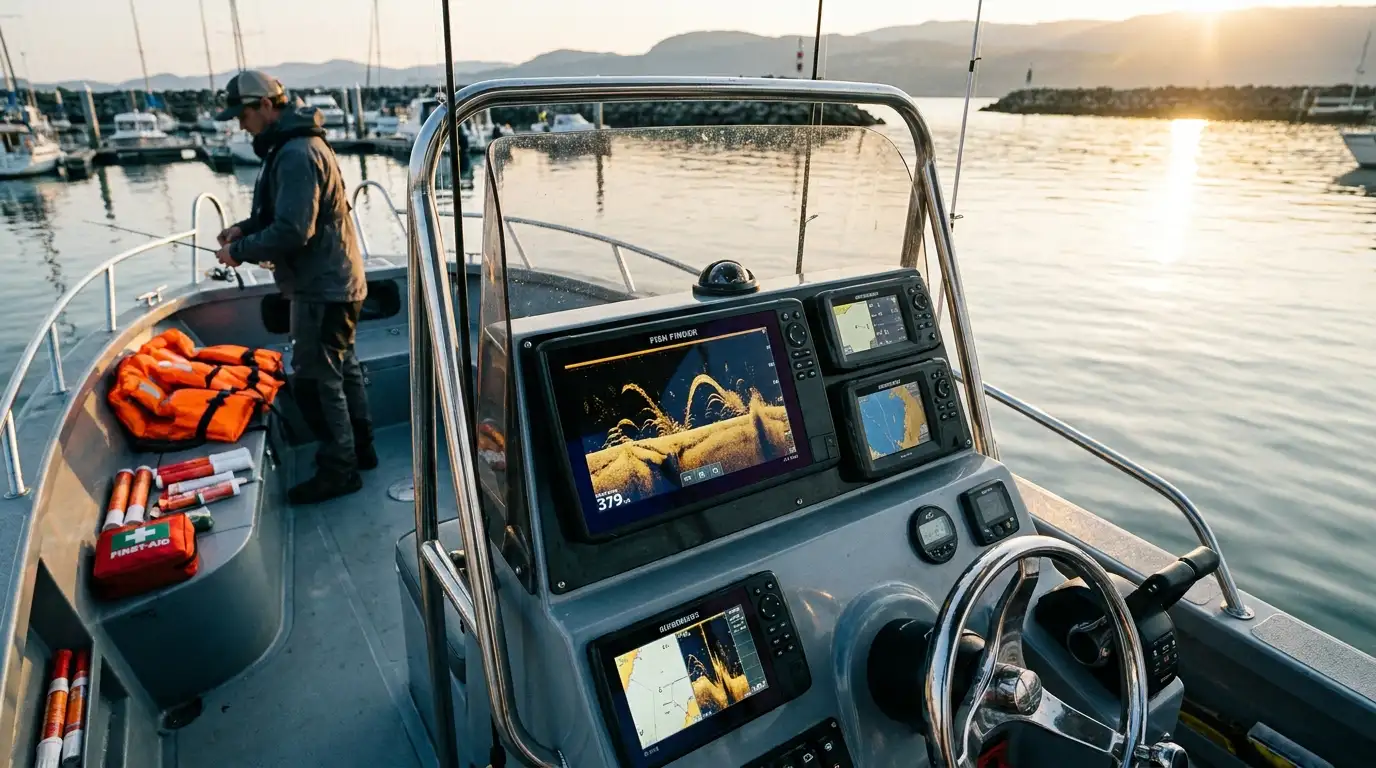
The Best Fish Finders for Boats start with the Humminbird Helix 5 G3 GPS because it combines Dual Spectrum CHIRP, GPS, built-in map coverage, AutoChart Live, and dependable keypad control in a compact format. It lacks Down Imaging and has a small screen, but its balance makes it the easiest recommendation for most boat anglers.
Choose the Humminbird XPLORE 9 if you have room for a serious helm display and want 200-foot side and Down Imaging ranges, a 9-inch HD touchscreen, keypad control, and network compatibility. For portable fishing, the Deeper MAX is the standout because CHIRP sonar, GPS, 3D mapping, and a 15-hour battery make it more capable than a basic handheld finder.
If you are undecided, choose the fixed Humminbird Helix 5 for a conventional boat setup, or the Deeper MAX if portability matters more than a dedicated console screen.
As an Amazon Associate we earn from qualifying purchases.