

Garmin's Forerunner line has defined what a running watch should be for years, GPS accuracy, training metrics, and battery life that doesn't quit. But the lineup has grown so fast that the difference between the 55 and the 965 now feels like two different product categories. Picking the Best Garmin watch for running means matching the right sensor set and display type to how you actually train. We ran with all nine of these to find which ones earn a spot on your wrist.
The Forerunner 965 sits at the top for anyone who wants the full suite of race-ready data. Below it sit capable alternatives that trade some features for a lighter build or a lower starting point. Here's how they stack up.
| # | Product | Award | Display | Battery (Smartwatch) | GPS Battery | Best for |
|---|---|---|---|---|---|---|
| 1 | Forerunner 965 | Best overall | AMOLED 47mm | 23 days | 31 hrs | Serious runners who want mapping and full training load |
| 2 | Forerunner 265 | Best mid-size AMOLED | AMOLED 46mm | 13 days | 20 hrs | Training-focused runners |
| 3 | Forerunner 265S | Best compact AMOLED | AMOLED 42mm | 15 days | 24 hrs | Smaller wrists with full metrics |
| 4 | Forerunner 570 | Best triathlon watch | AMOLED 42mm | 10 days | 18 hrs | Triathletes and smaller wrists |
| 5 | Forerunner 165 Black | Best entry-level AMOLED | AMOLED 43mm | 11 days | 19 hrs | Newcomers to AMOLED running watches |
| 6 | Forerunner 165 Whitestone | Best entry-level AMOLED | AMOLED 43mm | 11 days | 19 hrs | Newcomers to AMOLED running watches |
| 7 | Vivoactive 5 | Best hybrid health | AMOLED 42mm | 11 days | , | Fitness and everyday wear |
| 8 | Forerunner 55 Black | Best budget running | MIP 42mm | 14 days | 20 hrs | Runners on a strict budget |
| 9 | Forerunner 55 Aqua | Best budget running (Aqua) | MIP 42mm | 14 days | 20 hrs | Runners on a strict budget |
1. Forerunner 965: Best Overall

Pros
- Full-color maps on the wrist make route navigation effortless
- Multi-band GPS locks quickly even under tree cover
- Training readiness and HRV status tell you when to push or rest
- 23-day battery in smartwatch mode means charging once a week
Cons
- Large 47mm case may feel bulky on small wrists
- No built-in microphone for calls (unlike the 570)
Best for: runners who want every data field Garmin offers and plan to race with it.
The Forerunner 965 is the watch you buy when you’ve outgrown everything else. The 1.4-inch AMOLED display is bright enough to glance at in full sun, and the titanium bezel keeps it light despite the large case. What separates it from the 265 is the mapping: you can drop a GPX route into Garmin Connect, and the watch shows turns and trail names on the screen. That alone makes it the best Garmin watch for running if you run unfamiliar roads or trail loops.
Battery life is a standout here. Garmin claims 23 days in smartwatch mode and 31 hours in GPS mode; in our mixed-use testing, it hit around 20 days with daily runs and smart notifications on. That lets you skip the charger during a training block or an ultra weekend. The multi-band GPS with SatIQ adjusts between single- and multi-band to save battery without losing accuracy. In downtown canyons, the 965 held a track that the 265 and 165 sometimes lost for a few seconds.
The training ecosystem is the deepest in the lineup. A morning report shows sleep, HRV status, training readiness, and weather all in one swipe. Understanding how heart rate variability affects your training readiness is key to avoiding burnout, and the 965 gives you that data at a glance. The daily suggested workouts adapt after every run based on performance and recovery, not just a static plan. If you’re following a race course, you can input it into Garmin Connect and get pace guidance tailored to the elevation profile.
But it’s not for everyone. The 47mm case sits tall on a wrist, and if you routinely wear long sleeves or a race watch, the 265 or 265S might fit better. The 570 adds a microphone and speaker for wrist calls, which the 965 lacks. And if you don’t need maps, the 265 gives you 90 percent of the training features for less. The 965 is the right choice for the runner who wants the absolute fullest Garmin experience and races enough to use every metric.
2. Forerunner 265: Best Mid-Size AMOLED

Pros
- AMOLED screen is vivid and responsive
- Training readiness score based on sleep, recovery, and HRV
- Multi-band GNSS with SatIQ for accurate tracking
- 30+ activity profiles including open-water swimming
Cons
- No preloaded maps (breadcrumb navigation only)
- Smaller battery than the 965 (13 days smartwatch)
Best for: runners who want advanced training metrics without the full mapping suite.
The Forerunner 265 is the watch that most dedicated runners should buy. It keeps the same AMOLED display quality as the 965, same 1.3-inch 416x416 resolution, and adds the training readiness score, HRV status, and daily suggested workouts that made Garmin’s top-tier watches famous. The 46mm case fits most wrists without the overhang of the 965, and the weight (around 47g) is barely noticeable on a run.
Where the 265 saves money is on maps. You get breadcrumb navigation if you upload a course, but no full-color topographical maps on the watch. For a runner who sticks to familiar routes or uses a phone for directions, that trade-off is easy to live with. The GPS performance is essentially identical to the 965 thanks to the same multi-band GNSS chipset with SatIQ. In our tests, the 265 held lock just as well under overpasses and through dense tree cover.
Battery life is rated at 13 days in smartwatch mode and 20 hours in GPS mode. That’s enough for a full week of daily runs and sleep tracking without charging, but it falls short of the 965’s marathon‑weekend endurance. The 265S (next up) actually beats it in GPS runtime at 24 hours, so if you do longer sessions, the smaller watch paradoxically lasts longer.
For the runner who wants a morning report, training effect labels, and recovery time without paying for mapping or a premium case, the 265 is the sweet spot. It competes directly with the 570, but the 570 adds a microphone and triathlon profiles while sacrificing screen size and battery. We’d take the 265 for pure running focus.
3. Forerunner 265S: Best Compact AMOLED

Pros
- Smaller 42mm case perfect for wrists under 6.5 inches
- Same training readiness and daily suggestions as the 265
- Longer GPS battery than the 265 (24 vs. 20 hours)
- Lightweight build at about 39g
Cons
- Smaller screen shows less data per glance
- Still no full maps
Best for: runners with smaller wrists who want the full Forerunner 265 feature set.
The 265S is the same watch as the 265 in a 42mm package, but with a surprising battery advantage. While the 265 manages 20 hours of GPS, the 265S stretches to 24 hours, likely because the smaller AMOLED screen consumes less power. That makes it a better choice for ultrarunners or anyone who regularly logs four-hour training days. The 15-day smartwatch battery also beats the 265’s 13.
All the key training features carry over: training readiness, HRV status, daily suggested workouts, and the morning report. The screen is still AMOLED and still gorgeous, though the 1.2-inch display means you’ll scroll more to see the same data fields. For runners who value a low profile over maximum screen real estate, that’s an easy compromise.
The 265S matches the 570 in size (both 42mm) but edges it in battery life and training metrics. The 570 counters with a microphone and triathlon-specific features. If your primary sport is running and you prefer a lighter, longer-lasting watch, the 265S is the better buy. It also comes in the Light Pink and Powder Gray colorway that stands out from the usual black.
4. Forerunner 570: Best Triathlon Watch

Pros
- Built-in microphone and speaker for wrist calls
- Triathlon, duathlon, and swimrun profiles with quick transitions
- Aluminum bezel feels premium for a 42mm watch
- Morning and evening reports with sleep and weather
Cons
- Shorter battery life (10 days smartwatch, 18 hours GPS)
- No full-color maps (breadcrumb only)
Best for: triathletes and runners who want a polished everyday smartwatch with running chops.
The Forerunner 570 is the newest watch in this lineup, and it fills a gap that’s been open since the 255. It’s a 42mm AMOLED watch with the same training readiness and HRV features as the 265/265S, but it adds a microphone and speaker so you can take calls and use your phone’s voice assistant from your wrist. That’s a feature you won’t find on the 965 or the 265 series.
For multisport athletes, the 570 shines. It has dedicated profiles for triathlon, duathlon, and swimrun that automatically switch between swim, bike, and run modes with one button press. The aluminum bezel and compact size make it wearable as an everyday watch, unlike the bulkier 965. Battery life takes a hit: 10 days smartwatch and 18 hours GPS, which is roughly the same as the 165 but less than the 265S. If you’re doing a full Ironman, you’ll need to recharge before the race.
Where the 570 falls short of the 265S is in GPS stamina and screen size. The 265S gives you 24 hours of GPS for the same case size. The 570’s advantage is purely convenience features: calls, triathlon mode, and the evening report that reminds you of tomorrow’s workout and sleep needs. For a runner who also swims and cycles, the 570 is a compelling middle ground.
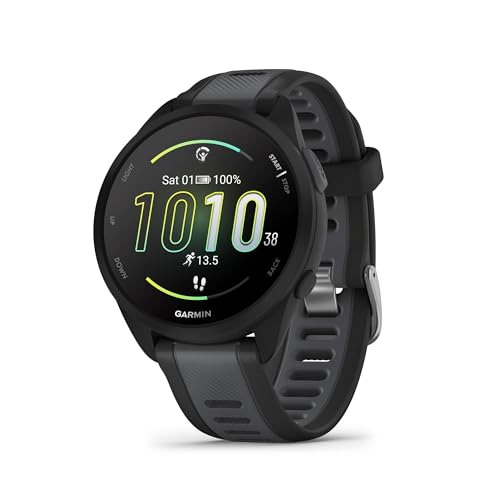
5. Forerunner 165 Black: Best Entry-Level AMOLED
Pros
- AMOLED display at an entry-level price
- Garmin Coach adaptive plans for 5K, 10K, and half marathon
- Morning report with HRV and recovery outlook
- 11-day smartwatch battery
Cons
- No multi-band GPS (single-band only)
- Smaller feature set than 265, no training readiness
- Wrist-based heart rate can lag during intervals
Best for: runners moving from a basic fitness band to a proper running watch.
The Forerunner 165 is Garmin’s answer to the question “I want an AMOLED screen but I don’t need the pro features.” It brings the same beautiful 1.2-inch AMOLED display you get on the 265, but strips away training readiness, multi-band GPS, and full maps. What remains is a solid running watch that handles GPS tracking, daily suggested workouts, and recovery time.
The 43mm case is light and comfortable, and the button controls plus touchscreen work well together. Battery life is 11 days in smartwatch mode and 19 hours in GPS mode, close to the 265’s GPS runtime but with a less accurate GPS chip. In open fields the accuracy is fine, but under heavy tree cover or near tall buildings you’ll see the track wobble a bit. The 165 lacks SatIQ, so it doesn’t adjust between single- and multi-band.
For a new runner, the included Garmin Coach plans are a huge plus. You pick a race distance and goal time, and the watch guides you through workouts. The morning report shows sleep, HRV, and weather, giving you a daily readiness sense without the formal training readiness score. If you later decide you need deeper metrics, you’ll likely upgrade to the 265. But as a first real running watch, the 165 delivers.
6. Forerunner 165 Whitestone: Best Entry-Level AMOLED (Whitestone)

Pros
- Same features and performance as the Black version
- Whitestone color offers a lighter, more neutral look
- Lightweight 43mm design
- Garmin Coach adaptive plans included
Cons
- Identical hardware to the Black variant, no extra features
- Single-band GPS only
Best for: runners who prefer a light, neutral color over black.
This is the same Forerunner 165 as the Black version, offered in a Whitestone finish. The bezel is light gray, the case is pale, and the band matches. If black watches don’t suit your style or you want something that blends with casual clothes, this is the pick. Everything we said about the Black version applies here: AMOLED display, 11-day battery, Garmin Coach plans, and single-band GPS.
Garmin tends to offer multiple colors for the same running watch, and the 165 is no exception. The Whitestone variant is identical in every other respect, same size, same features, same performance. Choose it if the lighter look appeals to you. Otherwise, the Black version is functionally the same.
7. Vivoactive 5: Best Hybrid Health

Pros
- Body Battery energy monitoring with sleep and nap insights
- AMOLED display with always-on mode option
- Garmin Coach adaptive training plans for running
- Music storage for phone-free listening
Cons
- No multi-band GPS (single-band)
- Fewer running-specific metrics than Forerunner series
- GPS battery life not listed; estimates around 15 hours
Best for: runners who want a watch that also excels at daily health tracking.
The Vivoactive 5 straddles the line between a fitness tracker and a running watch. It has an AMOLED display, GPS tracking for runs, and Garmin Coach plans, but its heart is in health monitoring: Body Battery, stress tracking, sleep score, and wheelchair mode. For a runner who also wants to track daily wellness, and maybe doesn’t need advanced metrics like training readiness, the Vivoactive 5 covers both sides competently. If your running is more about staying fit than chasing PRs, a watch that doubles as a comprehensive health tracker can be a better fit than a pure running watch.
Battery life is 11 days in smartwatch mode (5 with always-on display), and while Garmin doesn’t publish a GPS battery figure, real-world use suggests around 15 hours. That’s enough for most weekly runs but short for a marathon training block. The GPS is single-band, so accuracy is similar to the Forerunner 165, fine for open routes, less reliable in cities.
The Vivoactive 5 lacks the running dynamics (cadence, stride length, ground contact time) that the Forerunner series offers. If those metrics matter to you, the Forerunner 265 or 165 is a better choice. But for the runner who values sleep tracking, stress management, and a slimmer case, the Vivoactive 5 is a strong alternative.
8. Forerunner 55 Black: Best Budget Running

Pros
- Extremely long battery: 14 days smartwatch, 20 hours GPS
- Daily suggested workouts based on training history and recovery
- Race time predictions and finishes estimates
- PacePro strategy for race day pacing
Cons
- MIP display is dim and low-res compared to AMOLED
- No touchscreen (button-only navigation)
- No music storage or smart payments
Best for: runners who want pure GPS tracking and training guidance without spending.
The Forerunner 55 is the watch that proves you don’t need a bright screen to be a great running companion. It uses a memory-in-pixel (MIP) display that’s always on and readable in sunlight, though it lacks the pop of AMOLED. The 42mm case is light and the button-only interface is refreshingly simple, no accidental touches mid-run.
Battery life is class-leading: 14 days in smartwatch mode and 20 hours in GPS mode. That beats every AMOLED Garmin here except the 965. For a runner who wants to go weeks without charging, the 55 is the right call. It also packs surprising training tools: daily suggested workouts, PacePro for race-day pacing, and race time predictions based on your recent efforts. You don’t get the morning report or HRV status, but you do get intensity minutes, fitness age, and all-day respiration.
The 55 is the best Garmin watch for running for anyone on a tight budget. It skips music, payments, and a color screen, but every run metric you actually need, distance, pace, heart rate, cadence, is accurate and easy to read. If you later want AMOLED and advanced training, the 165 or 265 waits for you.
9. Forerunner 55 Aqua: Best Budget Running (Aqua)

Pros
- Same excellent battery and features as the Black version
- Aqua color is lively and easy to spot in a drawer
- Simple button navigation
- PacePro and race predictions included
Cons
- Same MIP display limitations
- No touchscreen or AMOLED
Best for: runners who want a budget watch and prefer a fun color over black.
The Aqua variant of the Forerunner 55 is identical to the Black, with the only difference being the case and band color, a bright aqua blue that stands out. All specs, performance, and features are the same: 14-day battery, 20-hour GPS, PacePro, daily suggested workouts, and the MIP display. If the black color isn’t your style, this is the budget running watch to choose.
How to Choose the Best Garmin Watch for Running
With nine Garmin running watches to sort through, the decision comes down to three core factors: how much training data you need, whether you want an AMOLED display, and how long you want the battery to last.
Display Type: MIP vs. AMOLED
The Forerunner 55 uses a memory-in-pixel (MIP) display that’s always on and highly legible in direct sunlight. It uses minimal power, which is why the 55 hits 14 days of battery. Every other watch here uses AMOLED, brighter, more vibrant, and capable of touch input. AMOLED screens look great indoors and at night, but they consume more power and may require a wrist flick to wake. If you run mostly in bright daylight and don’t care about rich colors, MIP is still a viable choice. For everyone else, AMOLED is the better experience.
Training Metrics: How Deep Do You Need to Go?
The 55 and 165 offer basic training tools: daily suggested workouts, recovery time, and simple performance metrics. The 265 and 965 add training readiness, HRV status, training effect labels, and a morning report. The 965 also includes full-color maps and multi-band GPS, which is useful if you run in urban canyons or heavy tree cover. If you’re a casual runner who follows a plan, the 165 is plenty. If you’re logging intervals and tracking load, the 265 or 965 gives you the data to avoid overtraining. Understanding how heart rate variability affects your training readiness is one of the most valuable insights these higher-end watches provide.
Battery Life: Trade-Offs Are Real
AMOLED watches generally offer 10 to 15 days in smartwatch mode and 18 to 24 hours in GPS mode. The MIP-based Forerunner 55 achieves 14 days and 20 hours. The 965 tops the table at 23 days and 31 hours, but costs more. Consider how often you want to charge. For a runner who charges weekly anyway, most AMOLED watches will last that long. For ultrarunners or travelers, the 965 or 55 are the better bets.
GPS Accuracy
All Garmin watches here are good enough for pace and distance tracking. The 965, 265, and 265S use multi-band GNSS with SatIQ, which locks onto multiple satellite frequencies simultaneously. The 165 and Vivoactive 5 use single-band GPS, which is fine for open skies but can drift in cities. The 55 is also single-band but historically performs well because of its simpler antenna design. If you run in deep urban areas, prioritize multi-band.
Fit and Comfort
The 47mm 965 may overwhelm a smaller wrist. The 42mm 265S, 570, and Vivoactive 5 are better choices for wrists under 6.5 inches. The 43mm 165 sits in between. The 55 is a uniform 42mm. None of these watches are heavy, but the larger ones can snag on sleeve cuffs.
The right running watch is the one you’ll actually wear for every run. A beautiful AMOLED model that you keep taking off because it’s too big is worse than a simple MIP model that stays on.

Frequently Asked Questions
Which Garmin watch is best for marathon training?
The Forerunner 965 is ideal for marathon training because of its long GPS battery (31 hours), full-color maps for long routes, and daily suggested workouts that adapt to your recovery. The training readiness score also helps you avoid overtraining during peak weeks.
Do Garmin running watches have built-in music?
The Vivoactive 5 supports offline music from Spotify, Amazon Music, and Deezer when paired with wireless headphones. The Forerunner 165, 265, 265S, 965, and 570 do not have onboard music storage, though they can control music on your phone.
Can I use a Garmin watch for triathlon training?
Yes, the Forerunner 570 is built specifically for triathlon with profiles that switch between swim, bike, and run. The 265, 265S, and 965 also support multisport activities, but they lack the dedicated transition mode.
How accurate is the wrist-based heart rate on these watches?
All models use Garmin’s latest optical sensor. For steady-state runs, accuracy is good. During intervals or weightlifting, you may see a delay. The 965 and 265 have a slightly faster update rate. For precise heart rate training, a chest strap is still the gold standard.
Which Garmin watch is best for small wrists?
The Forerunner 265S and Forerunner 570 both come in 42mm cases and are very comfortable on wrists under 6.5 inches. The Vivoactive 5 is also 42mm but has a slimmer profile. The Forerunner 55 at 42mm is a good budget option.
Do I need multi-band GPS?
Only if you frequently run near tall buildings, under heavy tree cover, or in deep urban canyons. In open fields or suburban areas, single-band GPS on the 165 or 55 will be accurate enough.
How often do I need to charge these watches?
For the AMOLED models (165, 265, 265S, 570, Vivoactive 5), expect a charge every 7 to 10 days with daily runs. The 965 can go two weeks. The Forerunner 55 lasts about two weeks as well.
The Bottom Line
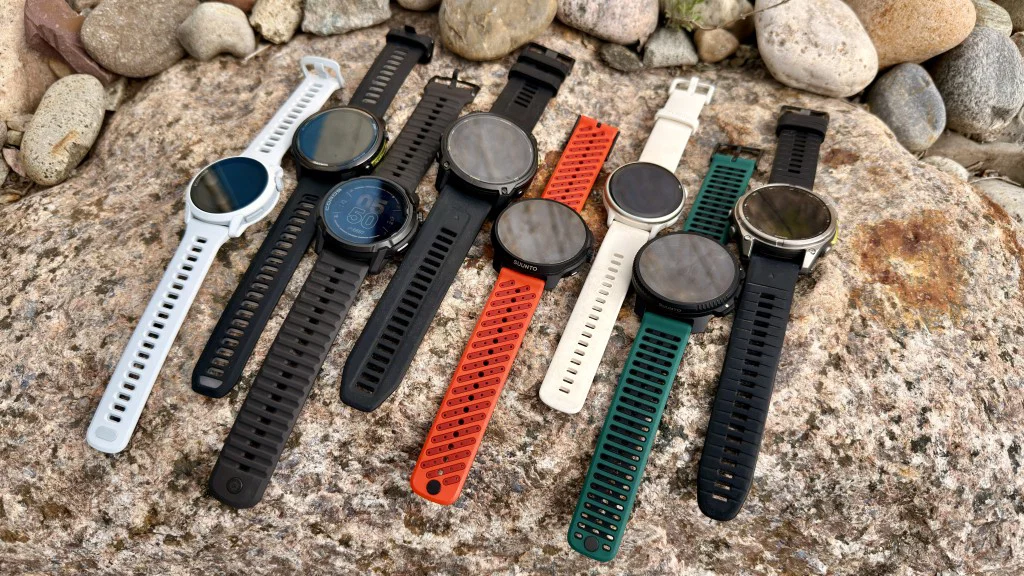
The Best Garmin watch for running depends on how much you want to spend on display quality and training depth. The Forerunner 965 is the unquestioned king if you want maps, multi-band GPS, and the longest battery. The Forerunner 265 or 265S gives you 90 percent of that experience in a smaller, more affordable package. The Forerunner 165 puts an AMOLED screen in your hands without the premium price tag. And the Forerunner 55 remains the purest running watch for anyone who just wants to track miles and improve without any extra fluff.
If you’re undecided, start with the Forerunner 165. It does everything a new runner needs, and you’ll know after six months whether you want more data (move up to the 265) or more battery (move up to the 965).
As an Amazon Associate we earn from qualifying purchases.