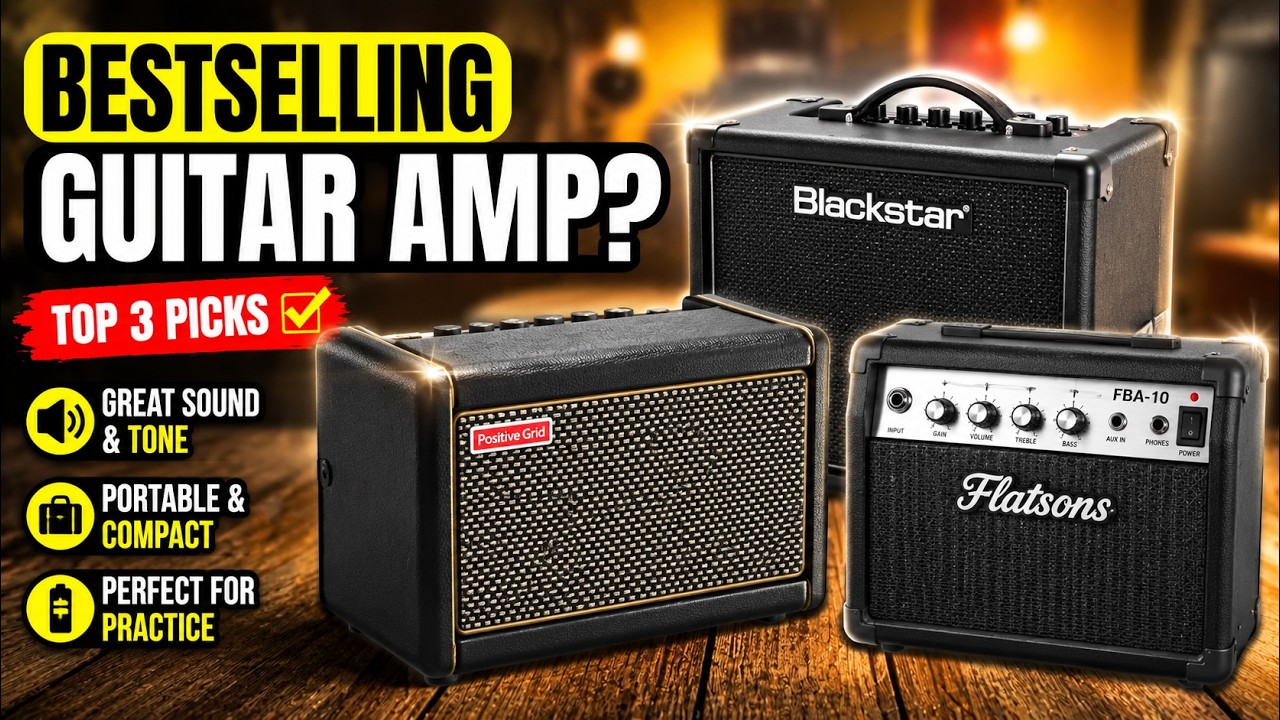

A good practice amp should make you want to pick up the guitar, not make you fight a maze of menus or settle for a thin, lifeless sound. The Best guitar amps under 200 include simple solid-state combos, modeling amps with presets, portable rechargeable units, and a few bass-specific options that need careful consideration before you buy.
The Fender Mustang LT25 is the most balanced choice for electric guitarists who want useful sounds without a steep learning curve. The list also includes the Orange Crush 20 for direct, high-gain character, the Fender Champion II 50 for fuller room-filling sound, and compact amps from Flatsons and LEKATO for playing away from a power outlet.
The Fender Mustang LT25 is our top pick, with options ranging from pocket-sized practice amps to more capable rehearsal combos.
Comparison table
| # | Product | Award | Power | Speaker or key feature | Best for |
|---|---|---|---|---|---|
| 1 | Fender Mustang LT25 | Best overall | 25 watts | 8-inch speaker, 30 presets | Beginners and home practice |
| 2 | Orange Crush 20 | Best for rock | 20 watts | 8-inch speaker, two channels | Players who want strong overdrive |
| 3 | Fender Champion II 50 | Best for rehearsals | 50 watts | 12-inch speaker, effects | Band practice and larger rooms |
| 4 | Fender Mustang GTX100 | Best for modeling | 100 watts | 12-inch Celestion speaker, WiFi | Players needing many tones |
| 5 | Flatsons FBA-10 | Best portable practice amp | 10 watts | Rechargeable, wireless audio | Travel and casual practice |
| 6 | Fender Frontman 10G | Best simple practice amp | 10 watts | 6-inch speaker, overdrive switch | First-time electric guitarists |
| 7 | Fender Rumble 15 V3 | Best compact bass amp | 15 watts | 8-inch bass speaker | Bass practice at home |
| 8 | LEKATO JA-05G | Best wearable mini amp | 5 watts | Four effects, rechargeable | Ultra-portable guitar practice |
| 9 | Fender Rumble 200 V3 | Best powerful bass amp | 200 watts | Ported enclosure, overdrive | Bassists needing serious output |
| 10 | Fender Tone Master Twin Reverb | Best classic-style platform | 100-watt digital power amp | Jensen neodymium speaker | Players chasing Twin Reverb feel |
1. Fender Mustang LT25: Best Overall

Pros
- Easy interface for new players
- 30 built-in presets cover many styles
- 25 watts gives useful room volume
- Color display makes editing less intimidating
Cons
- The 8-inch speaker is not as full as larger combos
- More menu-driven than the Orange Crush 20
- Not the right choice for a bassist
Best for: beginners and home players who want a broad selection of usable guitar tones.
The Fender Mustang LT25 is the amp we would hand to a new electric guitarist who wants room to grow. It is small enough for a bedroom or teaching space, yet it does not lock the player into one narrow sound. The interface is straightforward, and the 1.8-inch color display gives the presets and adjustments enough visual context that you are not guessing which setting you changed.
Its 25-watt amplifier section is well suited to home playing and small informal sessions. The 8-inch Fender special design speaker keeps the cabinet compact, though it cannot move as much air as the 12-inch speaker in the Fender Champion II 50. That difference matters when you want a broad clean sound or need the amp to hold its shape in a room with other instruments. For solo practice, the LT25 has ample headroom.
The 30 preloaded presets are the main reason to choose it over the Fender Frontman 10G. The Frontman is simpler, but the LT25 lets a beginner explore different styles without immediately buying pedals. It is also more flexible than the Orange Crush 20, whose strength is a focused, convincing drive sound rather than a large library of modeled tones. Players who want to understand how gain, modulation, delay, and other effects interact will get more from the Mustang.
The limitation is that preset-based amps can slow down players who prefer turning a few knobs and playing. The LT25 also remains a home combo rather than a serious band amp. If you need a simple starting point for choosing an amp as a new guitarist, this is the most approachable option here. Choose it if variety and a gentle learning curve matter more than maximum speaker size.
2. Orange Crush 20: Best for Rock

Pros
- Strong high-gain preamp character
- Two-channel design is quick to operate
- Three-band EQ gives useful control
- Headphone output includes cabinet simulation
Cons
- Fewer built-in effects than the Mustang amps
- The 8-inch speaker limits low-end scale
- Less versatile for players who want many genres
Best for: electric guitarists who want immediate rock and hard-rock sounds without navigating presets.
The Orange Crush 20 has a stronger personality than the Fender Mustang LT25. Plug in, select the channel, adjust the gain, and the amp points you toward a thick, assertive guitar sound. It does not try to imitate an entire catalog of amplifiers. That focus is a benefit for players who would rather spend time practicing than scrolling through patches.
This is a 20-watt combo with an 8-inch speaker, a high-gain preamp, and two channels. Its three-band EQ gives you the core controls needed to push the sound brighter, darker, tighter, or fuller. The two-channel layout also makes clean-to-driven changes easier during a session than switching through a modeling menu. The amp is a natural fit for riffs, power chords, and lead parts that need more edge.
The Mustang LT25 beats it on breadth. Fender gives you 30 presets and a color display, so it is better for a player exploring blues, clean pop, ambient sounds, and effects-heavy styles. The Orange Crush 20 wins when the desired result is a convincing driven voice with minimal setup. Its auxiliary input is useful for playing along with another source, while the cabinet simulation on the phones output makes quiet practice more satisfying than an unfiltered headphone signal.
The weakness is its limited range compared with the Fender Mustang GTX100 or Fender Champion II 50. It also lacks the larger speaker presence those amps bring to a room. Beginners who want to experiment with many genres may outgrow its focused design, while rock players may never miss the extra options. Pick the Crush 20 when the amp's character matters more than its feature count.
3. Fender Champion II 50: Best for Rehearsals

Pros
- 50 watts and a 12-inch speaker provide strong projection
- Two channels offer useful tonal separation
- Built-in effects include reverb, delay, chorus, and tremolo
- Headphone, auxiliary, and USB connections add flexibility
Cons
- Heavier and larger than the home-focused options
- Less preset-oriented than the Mustang LT25
- Effects selection may take time to learn
Best for: guitarists who need one conventional combo for home use and band rehearsals.
The Fender Champion II 50 is the practical step up when a small practice amp no longer has enough authority in the room. Its 50-watt amplifier and 12-inch Fender special design speaker give it a much larger voice than the Fender Frontman 10G, Fender Mustang LT25, or Orange Crush 20. That does not automatically make it better for a bedroom, but it does make it more credible for rehearsals and shared playing.
The two-channel design keeps the core operation familiar. Fender includes clean and overdrive tones, along with British and modern distortion voicings. The tap button synchronizes delay and tremolo to the song tempo, a small detail that makes those effects more useful in actual playing rather than leaving them as occasional decorations. Reverb, delay or echo, chorus, tremolo, and Vibratone broaden the palette without requiring a pedalboard.
The Champion II also has a headphone output, auxiliary input, and USB recording connection. Those ports make it more useful as a central practice and recording amp than the Orange Crush 20, especially for a player who wants to capture ideas directly. The Fender Mustang GTX100 remains more powerful as a modeling system, with its 200 presets and wireless editing, but the Champion II is quicker to understand and feels more like a traditional amplifier.
Its main drawback is physical scale. At 22.95 pounds, with a cabinet measuring 19.8 inches in both depth and width, it is not the combo to carry casually from room to room. Players who mainly practice quietly should choose the Mustang LT25 instead. For a guitarist who wants a real 12-inch speaker, useful effects, and enough output for rehearsal, the Champion II 50 is the more durable long-term choice.
4. Fender Mustang GTX100: Best for Modeling

Pros
- 200 onboard user presets
- 100 watts with a 12-inch Celestion speaker
- WiFi and Bluetooth support wireless editing and streaming
- Included footswitch has tap tempo and a 60-second looper
Cons
- Feature set can overwhelm beginners
- Larger cabinet than the LT25
- More equipment than a simple practice setup requires
Best for: guitarists who want a broad modeling system that can cover practice, recording, and live performance.
The Fender Mustang GTX100 is a very different proposition from the compact practice combos. It is built around variety, control, and stage use. The 100-watt amplifier drives a specially designed 12-inch Celestion speaker, giving it the physical presence that a small 8-inch combo cannot match. It is also relatively manageable for its size at 28.5 pounds.
Fender provides 200 onboard user presets and a modular signal path, so effects can be moved within the chain instead of being locked into a single sequence. The amp models include Fender designs such as Blues Jr and Vibro King, along with JC Clean and Silver Jubilee voices. The modeled overdrive, fuzz, delay, and pitch shift effects make this the most expansive tonal system in the main guitar section of this roundup.
The included seven-button footswitch changes the GTX100 from a desktop amp into a more serious performance tool. It supports tap tempo and a 60-second looper, while the Bluetooth connection works with the Fender TONE app for deeper editing, preset browsing, and wireless audio streaming. Stereo XLR line outputs and a stereo effects loop also make it more suitable for integrating with recording or PA equipment than the Champion II 50.
That flexibility brings the obvious compromise: the GTX100 takes longer to learn. A player who wants to plug in and turn gain, treble, and volume may prefer the Orange Crush 20. It is also more amp than many bedroom players need. For musicians who want one unit to explore sounds now and support more involved live or recording work later, the GTX100 is the most capable modeling choice.
5. Flatsons FBA-10: Best Portable Practice Amp

Pros
- Very small and light at 580 grams
- Rechargeable battery supports up to 6 hours
- Clean and drive modes are easy to switch
- Bluetooth audio, auxiliary input, and headphones
Cons
- Drive mode can produce noticeable hiss
- Small cabinet cannot match a conventional combo
- Battery should be charged before extended storage
Best for: guitarists who want a lightweight rechargeable amp for travel, casual practice, or street playing.
The Flatsons FBA-10 is appealing because it removes the usual friction from practice. At 152 by 75 by 99 millimeters and 580 grams, it can disappear into a bag where the Fender Champion II 50 would be inconvenient. Its 10-watt output is designed for home practice, travel, and street improvisation, and the rechargeable battery supports up to six hours of playtime.
The sound controls are intentionally simple. There are clean and drive modes, plus gain and tone controls for shaping the guitar signal. The listed frequency response is 100Hz to 20kHz at plus or minus 3dB, which indicates a broad stated range for a compact analog unit, though the small enclosure still cannot produce the scale of a larger speaker. It is best viewed as a convenient personal amp rather than a substitute for a rehearsal combo.
Wireless audio lets you stream from a phone, tablet, or laptop, and the auxiliary volume knob gives separate control over an external source. A 3.5mm headphone jack supports quiet practice. Those features make it more self-contained than the Fender Frontman 10G, while its rechargeable design gives it an advantage over every conventional powered combo in this list.
The FBA-10 is not flawless. The manufacturer says some hiss is normal on the drive channel and that low battery operation can make it more noticeable. The battery may also discharge during long storage, so it should be fully charged before use. Players who want a reliable full-range rehearsal sound should skip it. For travel, quick practice, and guitarists who value portability above volume, it is a thoughtful little amp.
6. Fender Frontman 10G: Best Simple Practice Amp

Pros
- Straightforward controls
- Compact closed-back cabinet
- Overdrive switch adds a second core sound
- Six-inch speaker is suitable for quiet practice
Cons
- Limited output for playing with others
- No built-in effects or wireless audio
- Less versatile than the Mustang LT25
Best for: first-time electric guitarists who want a familiar control layout and a small home amp.
The Fender Frontman 10G is the antidote to overcomplicated practice gear. Its controls cover gain, volume, treble, and bass, and an overdrive select switch adds a more aggressive voice. There is no preset library, app, or display to learn. For a player who is still learning chord shapes and basic amp adjustment, that directness can be more useful than a long list of modeled sounds.
The 10-watt amplifier feeds a 6-inch Fender special design speaker. That combination is intended for personal practice rather than a full room or band rehearsal. Its closed-back design helps give the compact cabinet a stronger bass response than its size might suggest, but it still cannot match the depth or projection of the 8-inch Mustang LT25, much less the 12-inch Fender Champion II 50.
The Frontman is also compact enough to sit comfortably in a bedroom or teaching area. It weighs 11.7 pounds according to the feature listing, while the product information gives a listed weight of 8.377565956 pounds, so the published data is inconsistent. Either way, this is a small conventional combo, not a heavy stage amp. The two-year limited warranty is a useful part of the ownership picture.
Its narrow feature set is both its strength and its weakness. The Fender Mustang LT25 is a better learning platform for someone who wants to explore effects and genres, and the Flatsons FBA-10 is more convenient for cordless playing. Choose the Frontman 10G if your priority is a simple, recognizable amp that lets you focus on playing without distractions.
7. Fender Rumble 15 V3: Best Compact Bass Amp

Pros
- Designed specifically for bass
- 15 watts with an 8-inch speaker
- Compact sealed enclosure
- Removable grille and top-mounted controls
Cons
- Not an electric guitar amp
- Limited output for band rehearsal
- No listed effects or auxiliary input
Best for: bassists who need a small dedicated practice combo for home use.
The Fender Rumble 15 V3 deserves a place here only for readers who use bass. It is not a sensible substitute for the Fender Mustang LT25, Orange Crush 20, or Fender Champion II 50 because its design is aimed at reproducing bass frequencies. The 15-watt output and 8-inch Fender special design speaker make it a compact practice companion rather than a general guitar combo.
Its sealed enclosure keeps the footprint manageable, and the top-mounted controls are easy to reach when the amp is placed on the floor. Fender also gives the grille a removable design, which makes the cabinet feel less disposable than many basic practice amps. The product features describe it as 11.61 inches deep, 17.91 inches wide, and 17.13 inches high, while the separate product information lists slightly different dimensions, so buyers should allow a little extra room.
The Rumble 15 V3 is a more appropriate bass choice than trying to force a guitar amp to handle the instrument's lower range. It is also more substantial than the Flatsons FBA-10 for bass practice, though it gives up that amp's rechargeable battery, wireless audio, and headphone or auxiliary features. The Fender Rumble 200 V3 is dramatically more powerful and better equipped, but most home players will not need that level of output.
The limitation is obvious: this is a small bass amp with no listed effects or auxiliary input. It is not intended for rehearsing with a loud drummer. Bassists who want a dedicated home combo with uncomplicated controls should choose it, while guitarists should look elsewhere.
8. LEKATO JA-05G: Best Wearable Mini Amp

Pros
- Extremely compact at about 0.49 pounds
- Built-in clean, distortion, overdrive, and reverb
- Rechargeable battery supports about 6 hours
- Bluetooth audio for playing along with music
Cons
- Five-watt speaker is intended for personal practice
- Bluetooth does not support Bluetooth headphones or speakers
- Small format limits fullness and projection
Best for: players who want an amp that can travel with the guitar and start playing quickly.
The LEKATO JA-05G takes portability even further than the Flatsons FBA-10. It weighs about 0.49 pounds and measures 4.7 inches high, 2 inches long, and 4.7 inches wide according to the product information. The built-in 6.35mm plug is intended to connect directly to an electric guitar, so there is less cable to pack and less setup before a short practice session.
Its four built-in effects cover clean, distortion, overdrive, and reverb. That is a more generous selection than the Frontman 10G, although the LEKATO's 5-watt speaker and very small cabinet cannot create the same sense of size. It is best for hearing your playing clearly and adding character, not for producing a convincing room-filling amp sound.
The rechargeable battery runs for about six hours after a full charge. Bluetooth audio allows music from a phone or another Bluetooth device to play through the amp, which is handy for practicing along with backing tracks. The limitation is important: the Bluetooth function is for audio playback and does not apply to Bluetooth headphones or Bluetooth speakers. That makes the headphone question different from the Flatsons, whose feature list specifically includes a headphone jack.
The JA-05G is also more specialized than the Fender Mustang LT25. The Mustang is the better teaching and tone exploration tool, while the LEKATO is the better grab-and-go accessory for a guitarist who already knows what they want to practice. Choose it for convenience, not for volume or deep editing.
9. Fender Rumble 200 V3: Best Powerful Bass Amp

Pros
- 200-watt Class D power amp
- Ported enclosure supports deeper bass response
- Overdrive circuit adds gritty and modern tones
- Headphone and auxiliary inputs support private practice
Cons
- Bass amp, not a general electric guitar combo
- Much larger than the compact Rumble 15 V3
- Published weight details are inconsistent
Best for: bassists who need substantial output and more tonal range than a small practice amp provides.
The Fender Rumble 200 V3 is included as a bass-specific option, and its 200-watt Class D power amp places it in a different class from the Rumble 15 V3. The ported speaker enclosure is designed to produce deeper bass response while keeping the amplifier relatively light for its power. Fender lists the amp at 34.5 pounds in its features, while the product information lists 27.8 pounds, so the two published figures do not agree.
The tonal controls are more interesting than those on the smaller Rumble. The overdrive circuit can move from a classic gritty growl toward a more modern punch, while switchable contour controls let the player shape the response for a more pronounced scoop or a more direct sound. Those adjustments matter when a bassist needs to move between fingerstyle lines, slap playing, and heavier parts without adding external pedals.
The headphone output mutes the speaker for private playing, and the auxiliary input accepts an MP3 player or other source for playing along with tracks. That gives it a more complete practice setup than the Rumble 15 V3. It is also much more forceful than any guitar combo here, but that extra headroom is useful only if you are playing bass and have a room or rehearsal setting that can take advantage of it.
This is not a sensible pick for an electric guitarist searching for a general-purpose amp. The Fender Mustang GTX100 provides a far broader guitar sound palette, and the Champion II 50 is a more conventional guitar combo for rehearsals. Bassists who want a serious, flexible combo with private practice features should consider the Rumble 200 V3, while home-only players may be better served by the smaller Rumble 15 V3.
10. Fender Tone Master Twin Reverb: Best Classic-Style Platform

Pros
- Digital modeling of a Twin Reverb circuit
- 100-watt digital power amp
- Jensen N-12K neodymium speaker
- Resonant pine cabinet and familiar front-panel layout
Cons
- Very large and heavy at 45.25 pounds
- Overkill for quiet bedroom practice
- More platform-oriented than effect-packed
Best for: guitarists who want a loud, clean Fender-style foundation for pedals and live playing.
The Fender Tone Master Twin Reverb is the least practical choice here for a strict small-room practice setup, but it is also the most distinctive classic-style platform. Fender uses digital processing to model the circuitry and 22-watt power output of an original Twin Reverb amplifier, then pairs that modeling with a 100-watt digital power amp. The result is intended to provide the headroom and dynamic response associated with the vintage design without using the original tube power section.
A Jensen N-12K neodymium speaker and resonant pine cabinet are central to the design. The speaker choice keeps the amp from becoming even heavier, though the finished combo still weighs 45.25 pounds and measures 31.7 inches long, 26.3 inches wide, and 15.9 inches high. This is furniture-sized compared with the Fender Mustang LT25 or LEKATO JA-05G.
The Tone Master Twin Reverb makes most sense as a clean foundation. Its front-panel controls are designed to give players an experience similar to the tube version, and the substantial power section provides plenty of headroom for pedals and strong playing dynamics. The Fender Champion II 50 is more versatile if you want built-in delay, chorus, tremolo, and other effects, while the Mustang GTX100 offers far more modeled voices.
The weakness is not subtle. It is heavy, large, and excessive for many home players. It also does not offer the compact convenience of the Flatsons or the preset flexibility of the LT25. A guitarist who already knows that a loud, clean Fender-style platform is the goal may appreciate its focused design. Everyone else should start with a smaller and more adaptable combo.
How to choose best guitar amps under 200
The right amp depends on how you play, where you play, and whether you need one convincing sound or a collection of different voices.
Power and speaker size
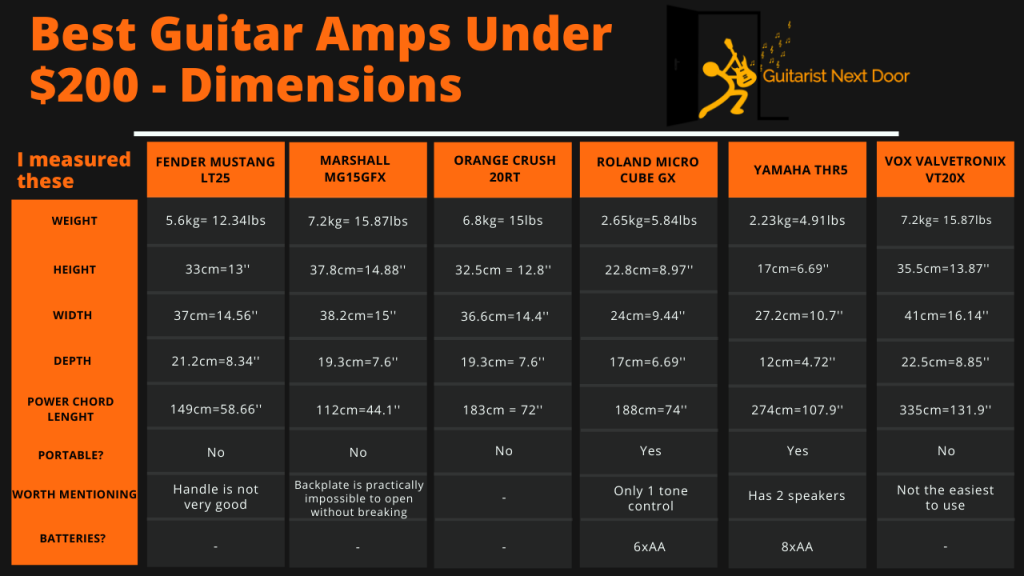
Wattage gives a rough idea of available output, but the speaker size and cabinet design matter just as much. A 25-watt amp with an 8-inch speaker, such as the Fender Mustang LT25, is mainly a home and small-room unit. The Fender Champion II 50 combines more power with a 12-inch speaker, which helps it project a broader sound during rehearsal.
Small rechargeable amps are useful for personal playing, but their 5-watt or 10-watt output should not be confused with the scale of a conventional combo. For band use, look for enough power and a speaker that can keep clean notes from sounding compressed or thin.
Clean and overdrive character
A simple amp may be better if you already know the sound you want. The Orange Crush 20 has a high-gain preamp and two channels, making it a natural fit for driven guitar parts. The Fender Frontman 10G offers gain and an overdrive switch but keeps the control panel uncomplicated.
Modeling amps take a different approach. The Mustang LT25, Mustang GTX100, and Champion II 50 can cover more styles, although each does so with a different interface. Listen for whether you want one strong amp identity or several modeled voices that can be saved and recalled.
Effects and preset control
Built-in effects can replace a basic pedal collection while you learn what sounds you use most. The Champion II 50 includes reverb, delay or echo, chorus, tremolo, and Vibratone. The GTX100 goes much deeper with 200 user presets, movable effects in the signal path, app editing, and a looper.
The trade-off is complexity. A player who wants immediate control may prefer the Orange Crush 20. A beginner who wants to experiment without buying multiple pedals will probably find the Mustang LT25 more rewarding.
Choose the amp whose controls match the way you want to practice, not the one with the longest feature list.
Headphone and playback connections
Headphone output is valuable in apartments, shared homes, and late-night practice spaces. The Orange Crush 20 adds cabinet simulation to its phones output, while the Flatsons FBA-10 includes a 3.5mm headphone jack and an auxiliary input. The Fender Champion II 50 also provides headphone and auxiliary connections, plus USB recording.
Bluetooth is useful for backing tracks, but check what it actually supports. The LEKATO JA-05G plays audio from a phone through its speaker, but its Bluetooth feature does not support Bluetooth headphones or Bluetooth speakers.
Portability and power
Conventional combos need a wall outlet and vary widely in size. The Frontman 10G is easy to place in a small room, while the Tone Master Twin Reverb is much harder to move. Rechargeable models such as the Flatsons FBA-10 and LEKATO JA-05G make sense for travel, outdoor practice, and quick playing sessions.
Battery life is only useful if the amp is maintained. The Flatsons feature list says its battery can run for up to six hours, but it also warns that long storage can leave the battery depleted. Charge portable amps before the session rather than assuming they will be ready.
Frequently asked questions
Are these amps suitable for electric guitar?
Most of the list is designed for electric guitar, including the Mustang LT25, Orange Crush 20, Frontman 10G, Champion II 50, Mustang GTX100, Flatsons FBA-10, LEKATO JA-05G, and Tone Master Twin Reverb. The Fender Rumble 15 V3 and Rumble 200 V3 are bass amplifiers and should be chosen only for bass.
Is a 10-watt guitar amp loud enough for practice?
A 10-watt amp is generally suited to home practice, especially with a small speaker. The Fender Frontman 10G and Flatsons FBA-10 are designed around that use. They will not provide the same clean headroom or room coverage as the 50-watt Champion II 50.
Which amp is easiest for a beginner?
The Fender Mustang LT25 is the most versatile beginner option because its 1.8-inch color display and 30 presets make it easy to explore sounds. The Frontman 10G is even simpler, but it offers fewer ways to learn about effects and different amp voices.
Can these amps be used with headphones?
The Orange Crush 20, Flatsons FBA-10, and Fender Champion II 50 list headphone outputs or phones connections. The Fender Rumble 200 V3 also has a headphone output that mutes its speaker. The LEKATO JA-05G has Bluetooth audio, but its listing does not say that it supports Bluetooth headphones.
What is the difference between a modeling amp and a traditional combo?
A traditional combo generally centers on one core amplifier design, with controls for gain, equalization, and volume. A modeling amp uses digital processing to provide several amp voices and effects. The Mustang GTX100 is the most expansive modeling option here, while the Orange Crush 20 offers a more focused two-channel design.
Is a bass amp suitable for an electric guitar?
A bass amp can reproduce an electric guitar signal, but it is not designed around the same tonal priorities as a guitar amplifier. The Rumble 15 V3 and Rumble 200 V3 are better choices for bass. Guitarists should choose a guitar combo such as the Mustang LT25, Crush 20, or Champion II 50.
The bottom line
The Best guitar amps under 200 start with the Fender Mustang LT25 because it combines a manageable size, 25 watts, an 8-inch speaker, a clear display, and 30 presets. It is the most useful choice for a beginner or home player who wants to try multiple styles without immediately building a pedalboard.
Choose the Orange Crush 20 if your priority is a direct, high-gain rock sound, or the Fender Champion II 50 if you need a 12-inch speaker and enough output for rehearsal. Bassists should ignore the guitar-focused picks and choose between the compact Fender Rumble 15 V3 and the much more powerful Rumble 200 V3.
If you are undecided, choose the Mustang LT25 for flexibility, or the Orange Crush 20 for a simpler and more immediate playing experience.
As an Amazon Associate we earn from qualifying purchases.