
A headphone list can hide several very different jobs. A headset for late-night TV needs easy pairing and low delay, while a swimmer needs onboard music because Bluetooth does not work reliably underwater. A classroom buyer may need hundreds of simple wired sets instead.
This guide to the Best headphones under 300 separates those use cases instead of pretending one design suits everyone. The Monster TVlink 300 is our top pick for most individual buyers, while the list also covers gaming, swimming, earbuds, basic wired listening, bulk deployments, and a replacement accessory.
Comparison table
| # | Product | Award | Connection | Battery or memory | Best for |
|---|---|---|---|---|---|
| 1 | Monster TVlink 300 | Best overall | Bluetooth 5.3, optical, AUX, RCA | Up to 45 hours | Private TV listening |
| 2 | Oraolo Mission 300 | Best wireless gaming headset | 2.4GHz, Bluetooth, 3.5mm | Up to 48 hours | Multi-platform gaming |
| 3 | JBL Quantum 300 | Best wired gaming headset | 3.5mm, USB adapter | Wired | PC and console gaming |
| 4 | KESIEME Swim Headphones | Best for swimming | Bluetooth 5.4, MP3 | 32GB, up to 10 hours | Pool workouts |
| 5 | Koss KPH7 | Best simple wired pick | Wired 3.5mm connection | No battery | Casual listening |
| 6 | SOULWIT GSP Earpads | Best replacement earpads | Replacement accessory | Not applicable | Sennheiser GSP owners |
| 7 | JBL LIVE 300 | Best compact earbuds | True wireless Bluetooth | Up to 20 hours | Portable listening |
| 8 | Maeline 300 Pack Multicolor | Best bulk color assortment | Wired 3.5mm | No battery | Classrooms and events |
| 9 | Maeline 300 Pack Black | Best bulk black set | Wired 3.5mm | No battery | Standardized deployments |
| 10 | ECO-BUDDY Swim Headphones | Best secure swim design | Bluetooth 5.4, MP3 | 32GB, up to 10 hours | Intense water workouts |
1. Monster TVlink 300: Best Overall

Pros
- Optical, AUX, and RCA setup options
- Audio latency under 40ms
- Charging base makes storage simple
- Up to 45 hours of playback
- Foldable over-ear design
Cons
- Built mainly for TV rather than gaming
- No listed noise cancellation
- Requires space for the transmitter base
Best for: someone who wants private TV audio without pairing hassles.
The Monster TVlink 300 solves the problem that most wireless headphones make unnecessarily complicated: getting sound from a television to your ears. The transmitter connects through optical, AUX, or RCA cables, so it can work with a broad range of TVs without forcing you to hunt through Bluetooth menus. That plug and play approach matters most for shared living rooms, late-night viewing, and anyone buying headphones for a parent or senior.
The Bluetooth 5.3 connection is rated for latency under 40ms. That is the figure to care about when dialogue must stay aligned with a person's mouth and when sports commentary cannot trail behind the action. The headphones are over-ear, with soft protein cushions and an adjustable headband. They fold for storage, but the more useful feature is the transmitter base: placing the headphones on it after watching automatically recharges them. With up to 45 hours of playback, a full charge should cover many viewing sessions.
The Monster is a more focused product than the Oraolo Mission 300 or JBL Quantum 300. The Oraolo is the stronger gaming choice because it adds 2.4GHz wireless and a microphone-oriented gaming design. The JBL is better for a wired console or PC setup. For TV, though, the Monster's multiple input options and charging dock are more convenient than either gaming headset's connection strategy.
There are limits. The data does not list a microphone, active noise cancellation, or a detailed sound profile, so this is not the headset to choose for calls or immersive music listening. The base also needs a permanent place near the television. Those omissions are easy to accept if the goal is private, synchronized TV audio, but they are reasons to skip it for general-purpose wireless listening.
For a living room, the TVlink 300 is the clearest recommendation here. It turns a potentially frustrating setup into a routine: connect the base, put on the headphones, and return them to the dock when the program ends.
2. Oraolo Mission 300: Best Wireless Gaming Headset

Pros
- Under 20ms latency in 2.4GHz mode
- 2.4GHz, Bluetooth, and wired modes
- Advertised 7.1 surround sound
- Up to 48 hours of battery life
- Lightweight listed weight of 0.55 pounds
Cons
- RGB lighting adds little to performance
- Product information does not detail microphone behavior
- Wireless features depend on the correct connection mode
Best for: gamers who want one headset for fast play across several platforms.
The Oraolo Mission 300 is the most flexible gaming headset in this group. Its useful distinction is not the RGB lighting. It is the choice between 2.4GHz wireless, Bluetooth, and a 3.5mm wired connection. That gives a player a low-delay mode for games, a convenient mode for compatible mobile devices, and a fallback when wireless is not appropriate.
In 2.4GHz mode, Oraolo states latency under 20ms. That is a meaningful advantage for competitive play, where a footstep or weapon sound needs to arrive promptly. The advertised 7.1 surround sound is intended to make positional cues such as footsteps and gunfire easier to place. The headset also lists a weight of about 0.55 pounds, which is a useful sign for long sessions, though the provided information does not give detailed clamp force, cushion material, or microphone specifications.
The advertised battery life reaches 48 hours, giving the Mission 300 more endurance than the Monster TVlink 300's 45 hours. The comparison is not quite direct because the Monster is a TV specialist, while the Oraolo is designed around gaming connections. Against the JBL Quantum 300, the Oraolo wins on wireless freedom and battery convenience. The JBL counters with a straightforward wired design, a boom microphone with echo cancellation, and broad compatibility through its 3.5mm and USB adapter connections.
The weakness is a lack of detail around the microphone and physical controls. RGB effects may look good in a streaming setup, but they do not tell us how well teammates will hear the wearer. Bluetooth is also not the mode to choose when the lowest possible delay matters. Use 2.4GHz for fast games and wired mode when consistent compatibility takes priority.
The Mission 300 is the right pick for a player who moves between PS5, PC, PS4, and other devices and does not want to own separate headsets. PC users who care most about a clearly described boom microphone should look harder at the JBL Quantum 300.
3. JBL Quantum 300: Best Wired Gaming Headset
Pros
- JBL Quantum Surround sound technology
- Boom microphone with echo cancellation
- Memory foam cushions
- 3.5mm and USB adapter connections
- Works across PC, consoles, mobile, and VR
Cons
- Wired connection limits movement
- No battery-free wireless option
- Released design is less flexible than the Oraolo
Best for: players who prefer dependable wired audio and a dedicated boom mic.
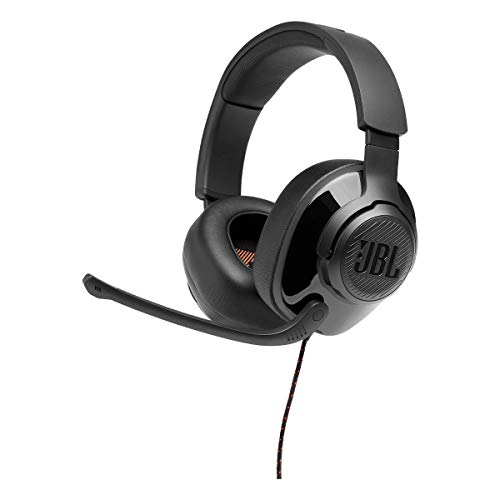
The JBL Quantum 300 is the sensible counterpoint to the Oraolo Mission 300. It does not ask you to manage a battery, a wireless dongle, or multiple wireless modes. Connect its cable, use the 3.5mm connection or USB adapter as appropriate, and start playing. That simplicity remains appealing for PC desks and consoles where the player is already sitting close to the device.
JBL's Quantum Surround technology is designed to make competitive game audio more immersive and positional. The headset pairs that with a boom microphone using echo-cancelling technology, which is a more concrete communication feature than the Oraolo listing provides. Memory foam ear cushions covered in soft PU leather are intended to stay comfortable through long sessions. The listed weight is about 0.54 pounds, close to the Oraolo's stated weight.
Compatibility is a strong point. The supplied information names PC, Mac, Xbox, PlayStation, Nintendo Switch, mobile devices, and VR. The 3.5mm connection is the broadest option, while the USB adapter adds another route for computer use. If your setup includes several platforms but you do not need wireless, the Quantum 300 is easier to recommend than a headset built around one proprietary transmitter.
The cord is the obvious compromise. It can catch on a chair or restrict movement, and there is no battery to carry you away from the console. The JBL also lacks the Mission 300's under-20ms 2.4GHz mode and 48-hour battery claim. Choose the JBL instead when microphone clarity, direct connection, and predictable operation matter more than cable-free convenience.
Gamers seeking a plug-in headset with a proper boom mic should choose the Quantum 300. It is less versatile than Oraolo, but its strengths are easier to understand and easier to use.
4. KESIEME Swim Headphones: Best for Swimming

Pros
- IPX8 waterproof design
- Built-in 32GB MP3 memory
- Bluetooth 5.4 for dry-land listening
- Up to 10 hours of playback
- Flexible memory titanium alloy frame
Cons
- Bluetooth is not the main solution underwater
- Bone conduction sounds different from sealed earbuds
- No listed phone-free call function
Best for: swimmers who want stored music for pool sessions and open ears on land.
The KESIEME is not a conventional pair of headphones adapted for exercise. It is an open-ear bone conduction design with a built-in MP3 player, which is exactly the combination needed for swimming. The 32GB memory lets it play stored music without a phone nearby. That matters because a Bluetooth signal from a phone does not travel reliably through water.
The IPX8 rating is the headline feature, and the listing says the headphones are designed for depths up to 99 feet underwater. The frame uses memory titanium alloy and is described as 360-degree bendable, compression-resistant, and flexible. On land, the open-ear layout lets surrounding sound remain audible. In a pool, it avoids the sealed ear canal feeling associated with ordinary in-ear models.
The built-in LED display shows remaining power and whether the headphones are in Bluetooth or MP3 mode. That is a small but practical detail because switching modes before a swim is easier when the device confirms what it is doing. Battery life is listed at up to 10 hours, with a two-hour full charge through a magnetic waterproof charging interface. Bluetooth 5.4 is useful for syncing with a phone during runs or cycling, but the MP3 mode is the reason to buy this model for water use.
The compromise is sound presentation. Bone conduction headphones do not create the same sealed, bass-heavy effect as over-ear headphones such as the Monster TVlink 300, and the listing's claims about fidelity should not be read as a promise of conventional headphone sound. The device also requires the user to load music onto its memory before swimming. Someone who wants instant streaming should skip it.
Among the swimming options here, the KESIEME is the more practical all-rounder because its display and flexible frame are clearly described. It is a good match for swimmers who also run or cycle and want one open-ear device for both.
5. Koss KPH7: Best Simple Wired Pick

Pros
- Straightforward corded connection
- Listed frequency range of 80Hz to 18kHz
- Lightweight on-ear format
- No battery to recharge
- Simple fit for casual use
Cons
- No wireless connection
- No microphone or inline controls listed
- Basic on-ear construction
Best for: listeners who need uncomplicated wired headphones for everyday devices.
The Koss KPH7 is the antidote to feature-heavy headsets. It connects by cord, puts its on-ear pads in place, and plays audio without pairing or charging. That makes it suitable for a spare drawer, a simple music player, or a device where wireless support is unavailable.
Koss lists a frequency range from 80Hz to 18kHz. That range points to a basic listening design rather than a specialist studio product. It should cover ordinary vocals and much of the audible musical range, but the listing does not provide sensitivity, impedance, microphone details, or a fuller description of the drivers. The sharp-looking over-head design is described as comfortable, though there is no detailed fit information.
The KPH7 is much simpler than the JBL Quantum 300. The JBL adds memory foam cushions, Quantum Surround processing, a boom mic, and a USB adapter for gaming. It is also more appropriate when communication and positional game audio matter. The Koss is the better fit when those features would go unused and the buyer wants a lightweight wired headset without software.
That simplicity brings real limits. There is no listed Bluetooth connection, no battery, and no microphone or inline controls. The on-ear construction also provides less physical isolation than the Monster's over-ear design. Skip it for travel in noisy environments, gaming chat, or private TV watching.
The KPH7 makes sense as a basic wired spare. It is not trying to compete with the wireless, gaming, or swimming designs, and that narrow purpose is exactly why some buyers will prefer it.
6. SOULWIT GSP Earpads: Best Replacement Earpads

Pros
- Fits several Sennheiser GSP models
- Cooling gel and breathable Ice Silk fabric
- Memory foam construction
- Designed for installation within minutes
- Reinforced inner seams
Cons
- Not a complete pair of headphones
- Compatibility must be checked carefully
- Only useful for specified Sennheiser GSP models
Best for: owners of compatible Sennheiser GSP headsets replacing worn cushions.
The SOULWIT product is the outlier in this list, and it should be treated as an upgrade part rather than a listening device. It replaces the ear cushions on Sennheiser GSP 370, 350, 303, 302, 301, and 300 headsets. If the original pads have flattened, split, or become uncomfortable, changing the cushions can be more sensible than abandoning a working headset.
Its construction is aimed at long sessions. SOULWIT places cooling gel beneath breathable Ice Silk fabric and uses memory foam to create the seal around the ear. The company says the design is intended to absorb sweat and keep ears cooler in warm conditions. It also says the modeled shape should preserve the headset's sound performance rather than alter it substantially.
Installation is described as a process that can be completed within a few minutes. The internal seams use stitching and adhesive to resist splitting. Those details matter more here than wireless standards or battery capacity because the part's job is physical renewal. A fresh cushion can restore comfort and help maintain the isolation a gaming headset was designed to provide.
The biggest risk is choosing the wrong model. These pads are not a universal replacement for the JBL Quantum 300, Oraolo Mission 300, or any other headset in this guide. Buyers should confirm the exact GSP model before ordering. They should also remember that new pads cannot repair a damaged headband, cable, microphone, or driver.
Choose SOULWIT only if you already own one of the listed Sennheiser headsets. For everyone else, it is not an alternative to headphones, but for a compatible GSP owner it is the most targeted way to improve worn-out comfort.
7. JBL LIVE 300: Best Compact Earbuds

Pros
- Completely wire-free design
- Ambient Aware mode
- TalkThru for conversations
- Up to 20 hours with the charging case
- Stereo calls and touch controls
Cons
- Renewed product condition requires attention
- Six hours of playback per charge
- Not designed for swimming
Best for: listeners who want compact true wireless earbuds with awareness features.
The JBL LIVE 300 is the smallest and most portable listening option in the roundup. These are true wireless earbuds, so there is no headband, cable, or transmitter to carry. The appeal is strongest for commuting, walking, and everyday phone use where a full over-ear headset would be unnecessary.
JBL's Ambient Aware mode lets outside sound back in, while TalkThru is intended for speaking with someone without removing the earbuds. Both features address a common problem with in-ear listening: having to take an earbud out whenever the environment changes. The listing also names stereo calls and touch controls, giving the LIVE 300 a more complete everyday feature set than the Koss KPH7.
Battery life is listed at up to six hours from the earbuds, with another 14 hours available through the charging case. A 10-minute charge can provide a one-hour boost. That is enough for many daily outings, but it is not the same endurance as the Monster TVlink 300 or Oraolo Mission 300. The product is also listed as renewed, so buyers who specifically want a new unit should consider that condition before choosing it.
The LIVE 300 is not a gaming headset and has no stated waterproof rating for swimming. It also offers less physical isolation than over-ear headphones, and the supplied information does not detail fit options or active noise cancellation. For more help weighing open sound against sealed earcups, the trade-offs between compact earbuds and larger headphones are worth considering.
Choose the JBL LIVE 300 when portability and awareness modes matter more than long single-charge endurance. It is the convenient everyday option in a list otherwise dominated by headsets, swim gear, and bulk supplies.
8. Maeline 300 Pack Multicolor: Best Bulk Color Assortment

Pros
- 300 individually packaged headphones
- Ten colors in the assortment
- 4-foot cords with right-angle 3.5mm plugs
- Retractable headbands
- 90-degree swivel earcups
Cons
- Intended for bulk distribution, not audiophile listening
- Wired only
- Large quantity is unsuitable for individual buyers
Best for: schools, libraries, events, and other large groups that need color-coded sets.
The Maeline 300 Pack Multicolor is not a personal headphone recommendation. It is an inventory solution for a classroom, testing center, library, travel group, or event where handing out individual headphones is easier than sharing one pair. Each unit is individually packaged, and the assortment includes 10 colors, which can help separate groups or make distribution less confusing.
Each headset uses an adjustable retractable headband and soft ear cushions. The 90-degree swiveling earcups allow the headphones to rest around the neck and make storage more compact. Those are sensible choices for equipment that will be passed between users, put into bags, and used by people with different head sizes.
The audio connection is a 4-foot cord ending in a right-angle 3.5mm plug. Maeline lists compatibility with iPhone, iPad, Chromebook, laptops, PCs, Android tablets, MP3 players, CD players, and fitness equipment. It also lists an 80Hz to 18, 000Hz frequency range and 91dB SPL sensitivity. These details make the set appropriate for spoken instruction, language learning, testing, and ordinary media playback.
A 300-unit package creates practical issues. It takes storage space, and wired sets require devices with standard audio jacks or suitable adapters. The listing does not describe microphones, active noise cancellation, wireless operation, or advanced durability testing. Individual buyers should skip it, while organizations should focus on handling, storage, hygiene, and replacement procedures before ordering.
The multicolor version is the more useful choice when groups need visible separation. It offers the same basic connection and fit approach as the black Maeline set, but the color assortment makes distribution easier in busy settings.
9. Maeline 300 Pack Black: Best Bulk Black Set

Pros
- 300 individually packaged black headphones
- Adjustable retractable headbands
- 90-degree swivel earcups
- 4-foot cords with right-angle plugs
- Compatible with standard 3.5mm audio jacks
Cons
- Not intended for individual listening
- No wireless features
- Black units cannot provide color-coded group separation
Best for: organizations that need a uniform supply of wired headphones.
The black Maeline set serves the same institutional purpose as the multicolor version, but with a uniform appearance. That can be preferable in classrooms, offices, testing environments, and healthcare settings where a consistent kit matters more than assigning colors. The 300 headphones are individually packaged, which simplifies handing out sealed units.
The fit is designed for broad use. The retractable headband adjusts to different head sizes, and the soft cushions are intended to reduce leakage and improve comfort. The earcups swivel 90 degrees, allowing a headset to sit around the neck when it is not playing and making it easier to pack or store.
Like the multicolor model, this set uses a 4-foot cable and right-angle 3.5mm plug. Maeline lists an 80Hz to 18, 000Hz frequency range and 91dB SPL sensitivity, along with compatibility across computers, tablets, phones, MP3 players, CD players, and fitness equipment. It is a straightforward fit for spoken audio and standard media playback, provided the source has a compatible jack.
The black finish loses the multicolor set's organizational advantage. There is also no wireless option, no battery, and no listed microphone. An individual shopper should choose something like the Koss KPH7 instead, while a large organization should choose this model when all units need to look the same.
Between the two Maeline packages, the decision is operational rather than acoustic. Pick the black set for a consistent appearance, or choose the multicolor set when visible group assignment will save time.
10. ECO-BUDDY Swim Headphones: Best Secure Swim Design

Pros
- IPX8 protection for submersion
- 32GB built-in MP3 memory
- Wraparound titanium frame
- Up to 10 hours of playback
- Bluetooth 5.4 for out-of-water use
Cons
- Bluetooth streaming is not the main underwater mode
- Heavier listed weight than some open-ear designs
- No detailed control or sound profile provided
Best for: swimmers and athletes who need a secure open-ear frame during vigorous movement.
The ECO-BUDDY is built around the same core idea as the KESIEME, but its standout feature is the wraparound titanium frame. The listing says the frame is designed to stay in place during flip turns, sprints, and vigorous movement. That makes it particularly relevant to swimmers who find ordinary open-ear designs shift during exercise.
It uses bone conduction, keeping the ears open while sending audio through the cheekbones. That allows awareness of surroundings and avoids the pressure of an ear canal seal. The IPX8 rating is described as protection for submersion up to two meters for 30 minutes, including lap swimming and flip turns. Buyers should still follow the stated limits rather than treating the rating as permission for unrestricted diving.
The 32GB built-in MP3 memory is the important underwater feature. It can store up to 10, 000 songs according to the listing, allowing phone-free listening in the pool. Bluetooth 5.4 provides a stated 33-foot range for land-based use, and the listing also mentions HD calling and noise reduction. Battery life reaches up to 10 hours, with a 300-hour standby claim.
Compared with the KESIEME, ECO-BUDDY gives more attention to the secure titanium frame and states a specific two-meter, 30-minute submersion condition. KESIEME counters with an LED display that shows battery and listening mode, plus a frame described as 360-degree bendable. Neither should be chosen for conventional sealed-headphone sound, and neither removes the need to load music before a swim.
Choose ECO-BUDDY when a stable fit is the priority. Choose KESIEME when the display and flexible frame are more useful. For anyone comparing water resistance claims, how stored music changes swimming headphone design is a more useful question than simply looking for the latest Bluetooth number.
How to choose best headphones under 300
The right choice depends less on the word “headphones” than on where the audio will come from, how the headset connects, and what the listener needs to hear around them.
Connection type
Wired headphones avoid battery management and usually work as soon as the plug is inserted. A 3.5mm connection is useful for laptops, consoles, tablets, music players, and classroom equipment, but newer devices may need an adapter. Bluetooth is convenient for phones and general listening, while 2.4GHz wireless is better suited to gaming when low delay matters.
TV headphones add another connection question. Optical, AUX, and RCA inputs make a transmitter easier to integrate with different televisions. A headset with only ordinary Bluetooth may not be as simple to set up, especially when the TV's Bluetooth menu is difficult to access.
For swimming, built-in memory matters more than Bluetooth because the water is between the headset and the phone.
Battery and charging
Wireless battery claims should be read alongside the charging method. A long runtime reduces interruptions, but a charging dock can be more convenient than a USB cable if the headphones live beside a television. Earbuds divide their battery figure between the earbuds and the case, so six hours per charge and 20 hours total describe different parts of the experience.
Swim headphones should last through a workout and recharge through a water-conscious connector. A battery figure around 10 hours is useful for repeated sessions, but only if the controls and charging process remain practical after use.
Fit and wearing style
Over-ear models surround the ears and generally create a more private listening space. On-ear designs are lighter and more compact but can let in more environmental sound. Open-ear bone conduction models keep the ear canal clear, which helps awareness during outdoor exercise and swimming, but their sound will not feel like a sealed over-ear headset.
For gaming, cushion material, headband adjustment, and overall weight affect comfort during extended sessions. For bulk purchases, retractable headbands and swiveling earcups matter because many different people will use the same model.
Water protection and onboard memory
A waterproof rating is essential for swimming, but the specific rating and stated submersion limit still matter. Bluetooth alone does not make headphones suitable for underwater listening. Choose a model with onboard MP3 storage, then load music before entering the pool.
The KESIEME and ECO-BUDDY both list 32GB memory. That feature separates them from every other product here and is more important for pool use than surround sound, touch controls, or a long wireless range.
Microphone and gaming features
A dedicated boom microphone is generally easier to position for team chat than a generic call microphone. Surround processing can help create positional cues, but software support and connection mode also affect the experience. The JBL Quantum 300 emphasizes a boom mic and Quantum Surround, while the Oraolo Mission 300 emphasizes 2.4GHz latency and multiple connection modes.
If gaming is not the main use, those features add complexity without solving a real problem. A TV listener should prioritize setup and charging, and a classroom buyer should prioritize fit, compatibility, packaging, and easy distribution.
Frequently asked questions
Can these headphones be used for swimming?
The KESIEME and ECO-BUDDY models are the swimming choices in this roundup. Both list IPX8 protection, bone conduction, and 32GB onboard MP3 memory. Bluetooth streaming should not be treated as the primary underwater listening method.
Which model is easiest to use with a television?
The Monster TVlink 300 is the clearest fit for TV use. Its transmitter accepts optical, AUX, or RCA cables, and the headphones return to the base for automatic charging. The listing also gives a latency figure under 40ms to help keep dialogue synchronized.
Which headset is better for gaming, Oraolo or JBL?
Choose the Oraolo Mission 300 for wireless play, especially when its 2.4GHz mode and under-20ms latency are priorities. Choose the JBL Quantum 300 for a wired setup with a boom microphone, Quantum Surround processing, and a USB adapter. The better choice depends on whether wireless freedom or direct wired communication matters more.
Are the Maeline products meant for individual buyers?
No. Each Maeline listing is a 300-unit bulk package intended for schools, classrooms, testing centers, offices, libraries, and events. An individual shopper should choose a single headset such as the Koss KPH7 or JBL LIVE 300 instead.
Do the SOULWIT earpads include headphones?
No. SOULWIT sells replacement cushions for specified Sennheiser GSP models. Confirm that your headset is a GSP 370, 350, 303, 302, 301, or 300 before ordering.
How long does the JBL LIVE 300 battery last?
The earbuds are listed for up to six hours of playback on one charge. The charging case adds up to 14 hours, for a claimed total of up to 20 hours. A 10-minute charge is listed as providing a one-hour boost.
Are bone conduction headphones good for music?
They can be useful when awareness and an open ear are more important than sealed, full-bodied sound. The KESIEME and ECO-BUDDY are especially practical for swimming because they combine bone conduction with onboard MP3 storage. Listeners who want a more conventional sound presentation should consider an over-ear or standard earbud design instead.
The bottom line
The Monster TVlink 300 is the strongest general recommendation in the Best headphones under 300 lineup because its optical, AUX, and RCA transmitter setup solves the hardest part of private TV listening. Gamers should choose the Oraolo Mission 300 for wireless flexibility or the JBL Quantum 300 for a wired boom mic and dependable console or PC connection.
Swimmers should narrow the decision to KESIEME and ECO-BUDDY, while schools and organizations should choose between the two Maeline bulk packages based on color coordination. The Koss KPH7, JBL LIVE 300, and SOULWIT earpads each serve narrower needs rather than competing directly with the main headset picks.
If you are still undecided, start with the device you will use most often, then choose the connection that creates the fewest daily complications.
As an Amazon Associate we earn from qualifying purchases.