

A receiver has to do more than make a movie loud. It needs enough channels for the speakers you actually plan to install, HDMI connections that will not hold back a modern TV or game console, and setup tools that can tame the acoustics of a real living room.
The best home theater receiver for most people is the Yamaha RX300A, thanks to its Dolby Atmos support, 4K120 and 8K60 video handling, room correction, and unusually straightforward setup. The rest of this list ranges from compact stereo receivers to full-featured 9.2-channel equipment for serious theater rooms.
Comparison table
| # | Product | Award | Channels | HDMI and video | Best for |
|---|---|---|---|---|---|
| 1 | Yamaha RX300A | Best overall | 5.2 | 4K120, 8K60, Dolby Vision, HDR10+ | Most home theaters |
| 2 | Denon AVR-S570BT | Best for 8K simplicity | 5.2 | Four HDMI 2.1 8K inputs | Straightforward 5.1 systems |
| 3 | Denon AVR-X1700H | Best for streaming | 7.2 | 8K60, 4K120, six HDMI inputs | Multi-room audio |
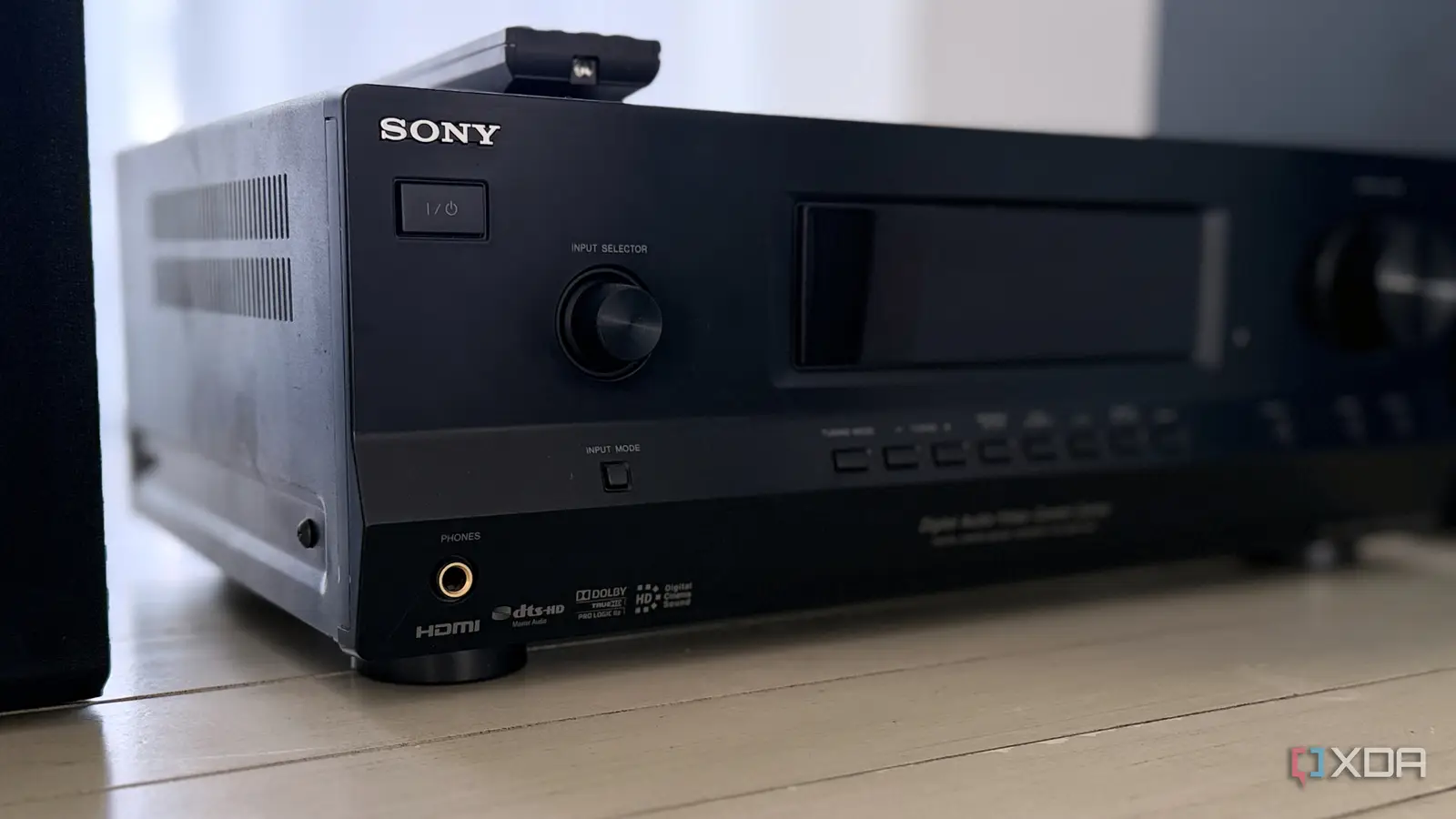
| 4 | Sony STRDH590 | Best simple surround receiver | 5.2 | 4K HDR, four HDMI inputs | Basic surround setups |
| 5 | Donner 4-Channel Receiver | Best for karaoke | 4 | Optical, coaxial, RCA, USB | Karaoke and flexible speaker zones |
| 6 | Yamaha RX-V385 | Best entry-level Yamaha | 5.1 | 4K, HDR10, Dolby Vision | Traditional 5.1 rooms |
| 7 | Onkyo TX-RZ50 | Best for advanced theaters | 9.2 processing | 8K60, 4K120, HDMI 2.1 | Large Atmos installations |
| 8 | Yamaha RX-V6A | Best for MusicCast homes | 7.2 | 4K120, 8K60, Dolby Vision | Music streaming and surround |
| 9 | Sony STRDH190 | Best stereo receiver | 2 | No HDMI, Bluetooth | Music and vinyl |
| 10 | Denon AVR-S770H | Best for 7.2 Atmos | 7.2 | 8K60, 4K120, HDMI 2.1 | Expandable living-room theaters |
1. Yamaha RX300A: Best Overall

Pros
- Dolby Atmos and DTS Virtual:X support
- 4K120 and 8K60 video passthrough
- Room correction with included microphone
- Bluetooth Multipoint for two source devices
- Clear setup guide and four Scene presets
Cons
- Limited to 5.2 channels
- Not the choice for a large 7.2.4 theater
Best for: someone building a modern five-channel theater with a TV, game console, and height speakers.
The Yamaha RX300A gets the important decisions right without turning setup into an electronics project. It is a 5.2-channel receiver, but it can also run a 3.1.2 layout with up-firing or in-ceiling height speakers. That makes it a sensible starting point for Dolby Atmos in a living room where a full surround array is not practical.
Its 70W of power is aimed at normal home theater rooms rather than huge dedicated spaces. Dolby Atmos and DTS Virtual:X give soundtracks a sense of height and movement, while the receiver's dialogue-focused processing is useful when voices disappear beneath music and effects. The two subwoofer outputs also give you more flexibility when placing bass around the room.
This is one of the more forward-looking receivers here for video. It handles 4K at 120Hz and 8K at 60Hz, along with Dolby Vision and HDR10+, and it includes gaming features such as ALLM and VRR. HDMI eARC can carry audio from a compatible TV over one cable. The Denon AVR-S570BT offers a similar channel count and 8K focus, but the Yamaha is more compelling if you want height channels and room calibration.
Yamaha includes a setup microphone that measures room acoustics and speaker characteristics, then adjusts the system automatically. The Quick Guide and on-screen menu should make the first connection less intimidating, and four Scene buttons let you save preferred setups for activities such as movie watching or gaming. Bluetooth Multipoint is a small but useful touch because two source devices can remain paired.
The limitation is expansion. The Onkyo TX-RZ50 is far better suited to a large Atmos installation, and the Denon AVR-X1700H gives you seven powered channels. Choose the RX300A if your goal is a modern, manageable five-channel theater with current video support and minimal fuss.
2. Denon AVR-S570BT: Best for 8K Simplicity

Pros
- Four HDMI 2.1 8K inputs
- 4K120 passthrough for gaming
- Dolby Vision, HDR10+, and Dynamic HDR
- Clear on-screen setup assistant
- Bluetooth and app control
Cons
- Limited to 5.2 channels
- No built-in Wi-Fi streaming platform
Best for: a listener who wants modern HDMI features without moving beyond a straightforward 5.1 or 5.2 setup.
The Denon AVR-S570BT is deliberately uncomplicated. Its five amplifier channels suit a conventional center, left, right, and surround arrangement, with two subwoofer outputs available for bass management. It is a good fit for the person replacing an older receiver who wants current TV and console compatibility without planning a much larger speaker system.
The headline feature is its HDMI section. Four HDMI 2.1 inputs support 8K video, while 4K120 passthrough is useful for current consoles and compatible gaming PCs. The single HDMI output supports eARC, so a smart TV can send app audio back to the receiver. HDR, HLG, Dolby Vision, HDR10+, and Dynamic HDR cover the major high-dynamic-range formats listed for the unit.
Denon rates the amplifier at 70W across five channels. That is a sensible specification for a normal room and a reasonably efficient speaker package, though it does not give this receiver the headroom of a larger model. The Yamaha RX300A adds Dolby Atmos and DTS Virtual:X, so it is the more interesting choice if overhead sound is part of the plan.
Bluetooth handles wireless music, and the receiver can work with services including Spotify, TIDAL, and Pandora through compatible connected devices. The on-screen HD setup assistant is the real convenience here. It walks through TV, speaker, and source connections, while the Denon remote app provides another way to change inputs and sound settings.
The compromise is its limited ecosystem and channel count. It does not offer the built-in Wi-Fi and multi-room range of the Denon AVR-X1700H, and it cannot grow into a seven-channel theater. Buy it for a clean, current 5.1 installation, especially when four HDMI 2.1 inputs matter more than Atmos expansion.
3. Denon AVR-X1700H: Best for Streaming

Pros
- Seven-channel amplifier
- Dolby Atmos, DTS:X, and height virtualization
- Wi-Fi, AirPlay 2, Bluetooth, and HEOS
- Six HDMI inputs
- Phono input and multi-room audio
Cons
- Older platform than some newer HDMI receivers
- Larger and heavier than basic five-channel models
Best for: households that want one receiver for surround sound, turntable playback, and multi-room streaming.
The Denon AVR-X1700H is the most balanced choice for a home that treats the receiver as an entertainment hub. Seven powered channels let you build a 7.2 layout or use a 5.2.2 Atmos arrangement with two height channels. Its 80W-per-channel rating gives it a little more authority than Denon's entry-level AVR-S570BT.
The audio format list is broad. Dolby Atmos and DTS:X handle object-based movie soundtracks, while Dolby Atmos Height Virtualization can create height effects without physical height speakers. That will not replace speakers in the ceiling, but it gives smaller installations another way to create a more enveloping presentation.
Video support includes three dedicated 8K inputs, 8K60 and 4K120 passthrough, and 8K upscaling on all six inputs. HDR10, HDR10+, Dolby Vision, HLG, and 4:4:4 color support make it a flexible switcher for a modern display. The six-input layout is especially useful if you have several consoles, a disc player, and a streaming box connected at once.
The built-in HEOS platform is the reason to choose this Denon over the Yamaha RX300A. Wi-Fi, AirPlay 2, and Bluetooth support streaming in more ways, while compatible services include Spotify, Pandora, Amazon Music HD, and others. Denon also includes a phono input, two analog inputs, coaxial and digital connections, and two subwoofer pre-outs. If you are choosing speakers at the same time, how speaker placement changes a room's surround effect is worth considering before running cable.
This receiver is not the newest or simplest model in the group. Its chassis is rated at 19 pounds, and the wealth of inputs may feel excessive in a small room. The Denon AVR-S770H offers a newer-feeling alternative with similar seven-channel ambitions, but the AVR-X1700H remains the better pick when HEOS and broad source support matter most.
4. Sony STRDH590: Best Simple Surround Receiver

Pros
- 5.2-channel surround support
- 4K HDR passthrough
- Bluetooth Standby
- FM tuner and headphone output
- Virtual surround from two speakers
Cons
- No Dolby Atmos support listed
- Four HDMI inputs and one output
- Older HDMI feature set
Best for: a conventional surround system that does not need height channels or advanced network streaming.
The Sony STRDH590 is easy to understand. It powers a 5.2-channel system, accepts four HDMI sources, and sends video to one display. For someone assembling a traditional left, center, right, and surround setup, that basic layout remains perfectly serviceable.
Sony includes 4K passthrough with HDR and HDCP 2.2 support. This is enough for a 4K television and compatible sources, but it lacks the 4K120 and 8K capabilities found on the Yamaha RX300A and both newer Denon models. Buyers with a current console should check the console-to-TV connection plan carefully before committing to this older HDMI design.
The receiver supports Sony's S-Force PRO virtual surround mode, which attempts to create a wider surround impression from two speakers. It also has a multi-channel stereo mode, an FM tuner, and a 1/4-inch headphone jack. Four stereo RCA inputs, one optical input, and one coaxial input provide useful connections for older audio equipment.
Bluetooth Standby allows the receiver to wake when a paired phone connects, which makes casual music playback less tedious. The 5.2-channel amplifier is rated at 725W under the stated test conditions, though that figure is not directly comparable to the per-channel ratings used by other models. The chassis measures 5.25 inches tall, making it easier to fit into a crowded cabinet.
The central weakness is its age. The Yamaha RX-V385 adds YPAO calibration, while the RX300A brings Atmos, modern gaming support, and more advanced HDR handling. Skip the STRDH590 if you are building around 8K, 4K120, or ceiling speakers. It still makes sense for a simple 4K living-room theater with familiar Sony controls.
5. Donner 4-Channel Receiver: Best for Karaoke

Pros
- Four independently controlled channels
- Bluetooth 5.3, USB, FM, RCA, optical, and coaxial inputs
- Two microphone inputs
- Echo and Talk Over controls
- Compact chassis
Cons
- No HDMI input
- Not a Dolby Atmos AV receiver
- Lower 25W per channel RMS specification
Best for: karaoke, announcements, casual home audio, and systems that need several independently controlled speaker groups.
The Donner 4-Channel Receiver is not a direct rival to the Yamaha or Denon home theater models. It is a compact home audio amplifier with a different purpose. Four channels can be controlled independently and support up to four groups of speakers, making it more flexible for parties, background music, and karaoke than for a cinematic surround layout.
Its connection panel is the attraction. Bluetooth 5.3, USB support for drives up to 64GB, two pairs of RCA inputs, AUX, FM radio, optical, and coaxial inputs cover an unusually wide range of sources. Optical and coaxial connections can accept audio from many televisions, but there is no HDMI input, so it cannot switch video or handle eARC.
The power specification needs careful reading. Donner lists 1000W peak power, but the RMS figure is 25W by four channels. That makes it better suited to efficient speakers and moderate listening levels than to driving a large theater with demanding speakers. Treble, midrange, and bass controls let you shape the output without a separate equalizer.
Two 1/4-inch microphone inputs, echo control, and Talk Over mode give it capabilities none of the conventional AV receivers here provide. Talk Over lowers background music for announcements or hosting. That is exactly why this model can make sense in a family room that doubles as a party space, even though it is the wrong tool for a Dolby Atmos film room. For a more conventional music setup, the practical difference between stereo and surround components can help clarify what you actually need.
The Donner is also much smaller than the full-size AV receivers, measuring 3.9 inches tall, 13.7 inches long, and 9.8 inches wide. Its weakness is not hidden: no HDMI means no video switching, no HDMI control, and no Atmos soundtrack support. Choose it for microphones, flexible speaker zones, and simple audio, not as a conventional home theater receiver.
6. Yamaha RX-V385: Best Entry-Level Yamaha

Pros
- Straightforward 5.1-channel design
- 4K video and HDR10 support
- Dolby Vision and HLG compatibility
- YPAO automatic calibration
- Bluetooth connectivity
Cons
- No Atmos support listed
- Four HDMI inputs and one output
- Older 4K-focused platform
Best for: a first traditional 5.1 system with automatic speaker calibration.
The Yamaha RX-V385 is a sensible receiver for a straightforward five-speaker system. It avoids the feature sprawl of larger models and concentrates on the connections most people need for a TV, disc player, and a couple of other sources.
Its HDMI section has four inputs and one output, with HDCP 2.2 and support for 4K Ultra HD. HDR10, Dolby Vision, Hybrid Log-Gamma, and BT.2020 support keep the video side relevant for a standard 4K display. There is no listed 8K or 4K120 support, so it is not the model to buy around a high-refresh-rate gaming setup.
Yamaha's YPAO calibration is the important audio feature. The system measures the room and adjusts the receiver for the speaker placement, helping compensate for the fact that few living rooms are acoustically symmetrical. It will not fix poor speaker placement or a wildly unsuitable room, but it is more useful than relying entirely on manual settings.
Bluetooth adds easy phone playback, and HDMI CEC helps compatible devices work together with fewer remote controls. The receiver is 6.34 inches tall and about 16.3 pounds, so it needs a normal component shelf rather than a slim media console. The newer Yamaha RX300A is the clear step up if you need Atmos, 8K, or advanced gaming features.
The RX-V385's weakness is its limited future expansion. It cannot become a height-channel system, and its HDMI section is behind the Denon AVR-S570BT. Still, for a conventional 5.1 room with a 4K TV, YPAO and Yamaha's clean control layout make it a reasonable uncomplicated choice.
7. Onkyo TX-RZ50: Best for Advanced Theaters

Pros
- Up to 11.2 channels of processing
- 7.2.4 pre-out support
- Dirac Live room correction
- THX certification
- 8K60 and 4K120 HDMI support
Cons
- Large and heavy
- More complicated than needed for small rooms
- USB microphone needed for some Dirac Live setups
Best for: a dedicated theater where multiple height channels, serious calibration, and expansion matter.
The Onkyo TX-RZ50 is the enthusiast pick because it gives a serious theater room room to grow. It has 9.2 channels in its core configuration and up to 11.2 channels of processing, with pre-outs supporting a 7.2.4 layout. That is a substantial step beyond the five-channel receivers in this roundup.
Dirac Live is the feature that separates it from most of the list. Using the included wired microphone, a smartphone, or the Dirac Live computer application with a compatible third-party USB microphone, it measures the room and adjusts the system. Proper calibration can improve balance between speakers and make bass integration less uneven, especially in a room with difficult reflections.
The TX-RZ50 supports Dolby Atmos and DTS:X, as well as Dolby Atmos Height Virtualizer for systems without physical height speakers. Its HDMI 2.1 section handles 4K120 and 8K60, with eARC for TV audio. It can also perform discrete Zone 2 HDMI switching, allowing different high-definition content in two rooms.
THX certification, Klipsch Optimize Mode, and support for services including Spotify, TIDAL, Deezer, TuneIn, and Pandora round out the feature set. Bluetooth can receive audio and transmit the receiver's output to compatible wireless headphones, including support for aptX and aptX HD. The receiver is 7.94 inches tall and weighs 36.05 pounds, so ventilation and a sturdy shelf are essential.
This is too much receiver for a small 5.1 room. The Yamaha RX-V6A is easier to live with, and the Denon AVR-X1700H covers most family-room needs with fewer controls to learn. Pick the Onkyo when you already have, or plan to install, a large speaker system and want calibration that can keep the whole array coherent.
8. Yamaha RX-V6A: Best for MusicCast Homes

Pros
- Seven-channel Dolby Atmos support
- MusicCast multi-room audio
- Wi-Fi, AirPlay 2, and Bluetooth
- 4K120 and 8K60 HDMI support
- YPAO R.S.C. multipoint calibration
Cons
- Large physical footprint
- Platform details vary by source and service
- Not as expandable as the Onkyo TX-RZ50
Best for: a Yamaha-based home with several rooms that need shared music and a capable surround system.
The Yamaha RX-V6A makes the most sense when music throughout the home matters as much as movie sound. Its seven-channel design can handle a 7.2 setup or a five-channel system with two height speakers. Dolby Atmos, Dolby Atmos Height Virtualization, and DTS:X cover the main immersive formats.
Video connectivity is strong. Yamaha lists 4K60, 4K120, and 8K60 HDMI support, along with HDCP 2.3 and eARC. Dolby Vision, HLG, and BT.2020 support keep it compatible with current displays, while seven HDMI inputs give it room for a crowded equipment rack.
The network feature set is broad. Wi-Fi, AirPlay 2, Spotify Connect, Bluetooth, voice control, and MusicCast multi-room audio let the receiver serve more than the main theater. Supported services include Pandora, Spotify, Napster, SiriusXM, TIDAL, Deezer, Qobuz, and Amazon Music HD. That is a more complete connected-audio approach than the Yamaha RX300A's Bluetooth-focused design.
YPAO R.S.C. with multipoint calibration helps account for more than one listening position. That is useful when a sofa, rather than one dedicated chair, is the center of the room. The trade-off is physical size: the listed dimensions are 11 inches tall, 20 inches long, and 18 inches wide, so this receiver needs generous ventilation and shelf depth.
The Denon AVR-X1700H is the stronger alternative for HEOS users, while the Onkyo TX-RZ50 wins for large theaters and advanced processing. The RX-V6A is the Yamaha to choose when MusicCast, network playback, and a seven-channel Atmos system need to coexist.
9. Sony STRDH190: Best Stereo Receiver

Pros
- Two-channel amplifier rated at 100W per channel
- Dedicated phono input
- Four stereo RCA inputs
- Bluetooth and FM radio
- A and B speaker switching
Cons
- No HDMI or surround decoding
- No room correction
- Not suitable for a Dolby Atmos theater
Best for: music listeners using two speakers, a turntable, and several analog sources.
The Sony STRDH190 is included because many people searching for a home theater receiver really need a stereo receiver instead. It drives two channels at 100W per channel into 8-ohm speakers under the stated conditions, and it concentrates on music rather than surround processing or video switching.
The phono input is the key. A turntable can connect directly, while four stereo RCA inputs accommodate other analog sources. There is also a 3.5mm input, an RCA output, Bluetooth for wireless playback, and an FM tuner with 30 station presets. That collection is more useful to a vinyl and two-channel listener than a stack of unused HDMI inputs.
Speaker A and B switching lets you connect up to four speakers and play them together or in separate zones, subject to the receiver's speaker requirements. The full-size 1/4-inch headphone jack is convenient for late listening. Sony also describes a large-capacity power transformer intended to support clarity in the audio chain.
Its low-profile 5.2-inch height helps it fit into a conventional cabinet, though the 17.1-pound chassis is still substantial. The receiver has no HDMI, no center-channel output, no surround decoding, and no subwoofer management designed for an Atmos system. For guidance on matching a two-channel receiver to other components, how separate music systems handle sources and speakers is a useful next step.
Do not buy the STRDH190 for a movie theater with surround speakers. The Sony STRDH590 is the minimum Sony here for HDMI-based surround, and the Yamaha RX300A is much better for modern video. Choose this model when the system is fundamentally about stereo music, especially vinyl.
10. Denon AVR-S770H: Best for 7.2 Atmos

Pros
- Seven-channel amplification
- 75W per channel specification
- 8K60 and 4K120 passthrough
- Dolby Atmos and DTS:X
- HEOS, Wi-Fi, and voice control
Cons
- No room correction detail listed
- Larger and heavier than five-channel models
- Less expandable than the Onkyo TX-RZ50
Best for: a 7.2 or 5.2.2 system that needs modern HDMI, streaming, and voice control.
The Denon AVR-S770H is a strong middle ground between a basic five-channel receiver and a dedicated theater component. Its seven channels can power a 7.2 arrangement or a 5.2.2 system with two height speakers. Denon specifies 75W per channel, giving it a sensible fit for a typical living room with a complete surround package.
The video section handles 8K at 60Hz and 4K at 120Hz, with support for HDR10+, HLG, HDR, Dolby Vision, and Dynamic HDR. VRR, ALLM, and QFT are useful for gaming because they address refresh-rate matching and latency. HDMI 2.1 support keeps the receiver from becoming an obvious bottleneck for a modern TV and console.
Dolby Atmos and DTS:X provide object-based surround, while Dolby Height Virtualization and DTS Virtual:X can create a more spacious effect without physical height speakers. That flexibility makes the S770H useful during a gradual upgrade. You can begin with a conventional 5.1 system and add height speakers later, provided the room and speaker layout allow it.
The network side includes built-in HEOS, Wi-Fi, and Bluetooth, with services such as Pandora, Spotify, and TIDAL. Voice control works with Alexa and other major voice assistants, allowing input changes, track skips, and volume adjustments. At 22.8 pounds, it is considerably more substantial than the Sony STRDH590, and its 17.1-inch width is typical of a full-size component.
The Denon AVR-X1700H offers a similar seven-channel concept and adds a phono input, while the Onkyo TX-RZ50 is the obvious choice for 11.2-channel processing and a 7.2.4 layout. The S770H is the better fit for a family-room buyer who wants Atmos, gaming-friendly HDMI, and streaming without stepping into the largest class of receiver.

How to choose best home theater receiver
The right receiver starts with the speakers and sources you plan to use, not with the biggest feature list. These are the specifications that make the largest difference in an actual room.
Channel count
Channel count determines how many speakers the receiver can power and which layouts are possible. A 5.1 receiver suits left, center, right, and two surround speakers, while seven channels can support rear surrounds or two height speakers in a 5.2.2 Atmos layout.
Nine or more channels matter mainly in a dedicated theater. The Onkyo TX-RZ50 goes further with up to 11.2 channels of processing and pre-outs for 7.2.4. Do not pay in complexity for channels your room cannot accommodate.
HDMI bandwidth
HDMI bandwidth controls the video signals that can pass through the receiver. Standard 4K60 support is enough for many movies and television shows, but 4K120 matters for compatible game consoles and high-refresh-rate sources. 8K support is useful for future displays, though it should not outweigh more immediate needs such as input count and eARC.
Look for HDMI 2.1 features such as 4K120, VRR, ALLM, and eARC when gaming or using a recent television. The Yamaha RX300A, Denon AVR-S570BT, and Denon AVR-S770H are among the clearest fits for that use.
Buy enough HDMI inputs for the devices you own now, plus at least one source you expect to add.
Immersive audio
Dolby Atmos and DTS:X place sound effects around and above the listener when the speaker layout supports them. Height virtualization can create a simulated sense of elevation from fewer speakers, but physical ceiling or up-firing speakers remain the more direct route to overhead effects.
A five-channel receiver with 3.1.2 support can be a useful compromise in a smaller room. Seven channels give you more options, while the Onkyo TX-RZ50 is designed for a much larger array.
Room correction
Room correction measures speaker distance, level, timing, and room response, then applies adjustments. Yamaha uses YPAO on several models, Denon includes guided setup on its receivers, and Onkyo's Dirac Live offers more detailed room measurement on the TX-RZ50.
Calibration cannot fix a speaker hidden in a cabinet or a subwoofer placed in a severe bass null. It can, however, make an uneven room easier to manage. Multipoint measurement is especially helpful when several seats need to sound balanced.
Streaming and multi-room audio
Bluetooth is enough for occasional phone playback, but Wi-Fi platforms are more convenient for regular listening. HEOS, MusicCast, AirPlay 2, Spotify Connect, and services such as TIDAL or Qobuz let the receiver work as a network audio component rather than just an HDMI switch.
If your system extends into other rooms, compare ecosystems before buying. The Denon AVR-X1700H and AVR-S770H use HEOS, while the Yamaha RX-V6A uses MusicCast. A stereo receiver such as the Sony STRDH190 is better for direct analog sources and vinyl than for networked surround audio.
Frequently asked questions
How many channels do I need for a home theater receiver?
Five channels are enough for a conventional 5.1 system. Choose seven channels if you want rear surrounds in a 7.1 layout or two height speakers in a 5.2.2 Atmos layout. Larger rooms and dedicated theaters may benefit from nine or more channels.
Is an 8K receiver necessary?
An 8K receiver is not necessary for a 4K television unless you want additional future flexibility. HDMI features such as 4K120, VRR, ALLM, and eARC can matter more immediately for gaming and modern television sources.
Can a 5.2 receiver run Dolby Atmos?
Some five-channel models can run a 3.1.2 Atmos layout with two height speakers. The Yamaha RX300A supports that type of configuration. A seven-channel receiver gives you more speaker layout options.
What does eARC do?
eARC sends high-quality audio from a compatible television back to the receiver over HDMI. It is useful when using streaming apps built into the TV because it can carry formats that standard ARC may not handle as well.
Do I need room correction?
Room correction is useful in most living rooms because speaker distance, furniture, walls, and seating positions affect what you hear. It cannot replace sensible speaker placement, but it can improve timing, levels, and tonal balance.
Can a stereo receiver work for home theater?
A stereo receiver such as the Sony STRDH190 can power two speakers for music or a simple TV setup. It cannot decode surround formats, power a center speaker, switch HDMI video, or create a Dolby Atmos system.
Should I choose Wi-Fi or Bluetooth?
Bluetooth is convenient for occasional playback from a phone. Wi-Fi provides a stronger foundation for multi-room audio, network streaming, AirPlay, Spotify Connect, and voice control. Choose Wi-Fi when the receiver will be a regular music source.

The bottom line
The Yamaha RX300A is the best home theater receiver here for most people because it combines a manageable 5.2-channel design with Dolby Atmos, room correction, 4K120, 8K60, and easy setup. It is modern without demanding the space, wiring, or configuration of the Onkyo TX-RZ50.
Choose the Denon AVR-X1700H if seven channels, HEOS streaming, a phono input, and multi-room audio matter more than the Yamaha's simpler design. For a large dedicated theater, the Onkyo TX-RZ50 is the clear specialist choice. If you only need two-channel music and vinyl, the Sony STRDH190 is a better match than any surround receiver.
If you are still undecided, choose the Best home theater receiver by counting your speakers first, then checking HDMI requirements and room size.
As an Amazon Associate we earn from qualifying purchases.