
A weak hotel network can turn a short work session into a frustrating hunt for signal, while phone tethering drains the device you still need for calls and navigation. A dedicated hotspot gives laptops, tablets, and other devices their own connection without tying up your phone.
The Best Hot Spot Devices in this group range from simple 4G units with included data to 5G travel routers that can switch between carriers around the world. Some need a SIM card, while others use built-in service and CloudSIM-style network selection.
SIMO Solis Edge is our top pick, with the best blend of 5G capability, WiFi 6, global coverage, and compact design. The rest of the lineup covers simple North American travel, large battery capacity, extra connected devices, and lower-complexity 4G access.
| # | Product | Award | Connection | Devices | Best for |
|---|---|---|---|---|---|
| 1 | SIMO Solis Edge | Best overall | 5G, WiFi 6 | Not stated | Frequent international travelers |
| 2 | GlocalMe Numen Air | Best for maximum speed | 5G, dual-band | Up to 16 | High-bandwidth travel |
| 3 | SIMO Solis Hero | Best battery backup | 4G | Up to 10 | Travelers who need a power bank |
| 4 | RoamWiFi 50GB Global | Best for included North American data | 4G, automatic network selection | Up to 10 | US, Canada, and Mexico travel |
| 5 | Statelinker S2 | Best battery life | 4G, WiFi 6 | Up to 8 | Long workdays away from outlets |
| 6 | JICICUXI 4G WiFi 6 Router | Best for SIM flexibility | 4G, WiFi 6 | Up to 12 | Campers and motorhomes |
| 7 | RoamWiFi 1GB North America | Best pocket option | 4G, automatic network selection | Up to 10 | Occasional travelers |
| 8 | FIRSTNUM 4G Travel Hotspot | Best for short trips | 4G, eSIM ready | Up to 8 | Basic travel connectivity |
1. SIMO Solis Edge: Best Overall

Pros
- 5G and WiFi 6 support
- SignalScan automatically searches across carriers
- Coverage across 140 or more countries
- Compact 2.8-ounce design
- Multi-day battery claim
Cons
- The service model is more involved than using a personal SIM
- 5G performance depends on local coverage
- It does not include the Hero's built-in power bank
Best for: frequent travelers who want one SIM-free hotspot for multiple regions.
The SIMO Solis Edge is the most complete travel hotspot here because it addresses the two problems that usually make these devices frustrating: finding a usable carrier and keeping the connection fast enough for modern work. Its SignalScan feature automatically looks for the strongest mobile signal, while the built-in service works across 300 or more carriers in 140 or more countries. That makes it a much more practical companion for a multi-country trip than a device tied to one local network.
The important hardware upgrade is 5G with WiFi 6. SIMO says the Edge is designed for speeds up to 15 times faster than 4G, though actual performance will depend heavily on the local network and signal. WiFi 6 helps the hotspot handle connected devices more efficiently, especially when several people are browsing or working at once. The product information lists a weight of 2.8 ounces, and the compact design is easier to carry than a full-size travel router.
Its bundled data setup is also unusually clear. The device includes 1GB of data each month indefinitely, described as 12GB per year, plus a separate 30GB global data pack. The global allowance expires after 30 days, so it is better suited to a defined trip than indefinite heavy use. For readers comparing how portable internet works across different travel situations, that distinction matters more than a headline speed figure.
The Edge is a stronger all-around choice than the 4G SIMO Solis Hero when 5G coverage is available, and it is more compact than the Hero. The GlocalMe Numen Air can connect 16 devices and advertises a higher maximum speed, but the Edge has a simpler case for buyers who want a balanced global device rather than the most aggressive specification sheet. The weakness is that 5G cannot overcome a poor local signal, and ongoing data use still depends on the available service plans. Choose it if international flexibility and current network technology matter more than using a traditional SIM card.
2. GlocalMe Numen Air: Best for Maximum Speed

Pros
- 5G support with speeds advertised up to 2.5Gbps
- Works across more than 200 countries
- Dual-band 2.4GHz and 5GHz WiFi
- 2.4-inch touch display
- Supports up to 16 connected devices
Cons
- Larger than the lightest travel hotspots
- Maximum speed depends on network conditions
- Service choices require some planning
Best for: travelers who need to share a fast connection with a group or several devices.
The GlocalMe Numen Air is the specification leader in this roundup, but its real advantage is not just the advertised 2.5Gbps ceiling. It combines 5G, a choice of WiFi bands, a touch display, and support for 16 devices. That gives it the headroom for a family trip, a small traveling team, or a work setup with several laptops, tablets, and phones connected at once.
The dual-band design lets you use either 2.4GHz or 5GHz WiFi. The lower band generally favors range and compatibility, while 5GHz is the more suitable choice for faster nearby connections with less congestion. The 2.4-inch LCD touch screen shows data use, signal strength, connected devices, and network settings. That is much easier to manage than a hotspot that hides everything inside a phone app.
GlocalMe's CloudSIM technology selects a network without requiring a physical SIM card, and the device supports service in more than 200 countries. It also has an unlocked SIM card slot, so the Numen Air can use a physical SIM when that makes sense. Its service can be arranged by day, month, region, or gigabyte, giving it more flexibility than products with one narrowly defined included allowance. Readers weighing the trade-offs between local SIMs and portable cellular service will find that flexibility useful.
The Numen Air is a better fit than the SIMO Solis Edge for people who need 16 connections or want a visible touch interface. The Edge is the more restrained travel pick, and the Solis Hero is better if charging other devices is part of the plan. The Numen Air also doubles as a power bank, but the supplied information does not state its battery capacity or runtime, so we would not buy it specifically for emergency charging. Pick it for high-speed sharing and broad international capability, not for a guaranteed 2.5Gbps connection in every location.
3. SIMO Solis Hero: Best Battery Backup

Pros
- Built-in 5250mAh power bank
- SignalScan searches across multiple carriers
- Connects up to 10 devices
- Coverage in 140 countries
- Includes recurring and global data packs
Cons
- Uses 4G rather than 5G
- The supplied dimensions are inconsistent
- Global data pack expires after 30 days
Best for: travelers who want a hotspot that can also recharge a phone.
The SIMO Solis Hero makes a sensible trade by pairing a 4G hotspot with a 5250mAh power bank. That combination is useful on long travel days, in a vehicle, or during an outdoor outing when a phone battery matters as much as the data connection. Instead of carrying a separate battery pack, you can use one device for internet access and emergency charging.
SIMO says the Hero can connect up to 10 devices at the same time. That is enough for a small group or a personal collection of phone, tablet, laptop, and other connected equipment. SignalScan searches for the strongest signal across multiple carriers, which should reduce the need to manually manage networks while moving between areas. The unit supports service in 140 countries and across more than 300 carriers.
The data bundle includes 1GB of data each month indefinitely, described as 12GB per year, along with a one-time 30GB global pack. That global allowance expires in 30 days, so it makes the most sense for a trip with a clear start and finish. If your travel pattern changes often, how to plan data for a portable connection can be just as important as the hotspot's cellular generation.
The Hero is slower on paper than the SIMO Solis Edge because it is a 4G device, and the GlocalMe Numen Air is the better choice for a larger group with its 16-device limit. The Hero wins when battery backup is the priority. Its listed dimensions are 2.1 inches high, 4.4 inches long, and 4.5 inches wide, but those figures do not form a particularly convincing pocket profile, so buyers should verify the physical size before packing it. Choose this model if the built-in power bank solves a problem you would otherwise handle with another device.
4. RoamWiFi 50GB Global: Best for Included North American Data

Pros
- 50GB of local data for the US, Canada, and Mexico
- Additional 1GB of global data
- Data validity lasts 60 days after activation
- Connects up to 10 devices
- No physical SIM card required
Cons
- 4G rather than 5G
- Automatic service is centered on the included regions
- Battery runtime is not specified
Best for: travelers spending substantial time in the US, Canada, or Mexico.
The RoamWiFi 50GB Global is the most straightforward pick for a North American trip where data use will be substantial. Its included plan provides 50GB of local data across the US, Canada, and Mexico, plus 1GB of global data. Both allowances are listed as valid for 60 days after activation, which gives a longer window than a short one-week travel pack.
RoamWiFi says the device works in more than 170 countries and automatically selects an optimal network from available carriers. There is no physical SIM card to install and no contract required. That simplicity is useful in an airport or rental car when you want to turn on the hotspot and start connecting devices rather than troubleshoot carrier settings.
The unit supports up to 10 simultaneous connections, including laptops, tablets, phones, gaming consoles, and other WiFi equipment. Its listed size is 2.68 by 0.57 by 4.96 inches, and its weight is about 0.4 pounds. That is still travel-friendly, although the tall shape is less pocketable than the very smallest hotspots. Battery life is described as long-lasting, but no runtime figure is supplied.
Compared with the RoamWiFi 1GB North America, this version is the obvious choice for a longer trip or heavier use because the included local allowance is much larger. The SIMO Solis Hero and Edge cover more countries through SIMO's service, while the Numen Air offers 5G and 16-device support. The weakness is that this remains a 4G device with no stated battery runtime. Choose it when your itinerary centers on North America and you want a clear, preloaded data setup.
5. Statelinker S2: Best Battery Life

Pros
- Up to 15 hours of continuous use
- WiFi 6 support
- Connects up to 8 devices
- Built-in display shows remaining data
- Includes 10GB of complimentary data
Cons
- North America-focused coverage
- 8-device limit is lower than several rivals
- Initial activation of the recurring allowance requires contact
Best for: remote workers and travelers who need a full day away from an outlet.
The Statelinker S2 stands out for endurance. Its stated battery life reaches up to 15 hours of continuous use, which gives it a clear advantage over the FIRSTNUM 4G Travel Hotspot's stated six-hour runtime. That difference can matter during a full workday, a long drive, or a day outdoors when carrying a charging cable is inconvenient.
The device uses 4G and WiFi 6, with support for up to eight connected devices. WiFi 6 can manage multiple connections more efficiently than older WiFi standards, although the cellular network remains the main limit on internet speed. Eight devices is enough for a solo worker or a small family, but the SIMO Solis Edge, SIMO Solis Hero, and RoamWiFi models allow up to 10, while the GlocalMe Numen Air supports up to 16.
A built-in display provides real-time information about the remaining data. That is a practical feature because it keeps usage visible without opening a separate app or logging into an account. The S2 is designed for North America and does not require a physical SIM card. It includes 10GB of data valid for 30 days, followed by 2GB each month with unused data rolling over. The first activation of that recurring allowance requires contacting the provider.
Its dimensions are 3.86 by 2.36 by 0.79 inches, and the listed weight is 3.5 ounces. That is a compact shape for a device claiming all-day battery life. The trade-off is geographic: the S2 is a North America-focused product, whereas the SIMO models and GlocalMe Numen Air are designed around broader international coverage. Pick it if battery runtime and visible data tracking matter more than 5G or worldwide roaming.
6. JICICUXI 4G WiFi 6 Router: Best for SIM Flexibility

Pros
- 4G LTE connectivity with a SIM card slot
- WiFi 6 support
- Supports up to 12 users
- 3000mAh battery
- Screen shows signal, battery, and connected users
Cons
- SIM card is not included
- No battery runtime is specified
- Performance depends on carrier compatibility and signal
Best for: campers, motorhome users, and travelers who already have a compatible SIM plan.
The JICICUXI 4G WiFi 6 Router takes a different approach from the SIM-free products above. It has a SIM card slot and is designed to work with a compatible US carrier plan, so the buyer controls the service rather than relying on an included roaming package. That can be useful for camping, motorhomes, or a temporary office where an existing data SIM is already available.
The device supports 4G LTE bands B2, B4, B5, B7, B28, B38, B40, and B41. The listing says those bands make it suitable for about 95% of SIM cards in the US, though compatibility still depends on the particular carrier and plan. It also advertises WiFi 6 and connection support for up to 12 users, placing it between the smaller personal hotspots and the 16-device GlocalMe Numen Air.
A 3000mAh battery powers the unit, and its screen displays real-time signal strength, battery capacity, and the number of connected users. Those controls are particularly useful in a vehicle or campsite, where you may want to see whether the problem is the cellular signal or the WiFi network. The listing does not provide a continuous-use figure, so the battery capacity alone should not be treated as a runtime guarantee.
The JICICUXI is more flexible than the RoamWiFi and SIMO devices if you want to bring your own SIM, but it requires more setup. The Statelinker S2 is easier for a managed, SIM-free experience, while the FIRSTNUM 4G Travel Hotspot offers eSIM-ready setup and a shorter stated runtime. The JICICUXI is the one to choose when carrier control matters and you are comfortable checking band and plan compatibility before leaving home.
7. RoamWiFi 1GB North America: Best Pocket Option
Pros
- No SIM card or contract required
- Automatic network selection
- Supports up to 10 devices
- Coverage in more than 170 countries
- Includes 1GB of US, Canada, and Mexico data
Cons
- The included allowance is limited
- Battery runtime is not specified
- 4G rather than 5G
Best for: occasional travelers who want a compact SIM-free connection.
The RoamWiFi 1GB North America is the simpler of the two RoamWiFi entries here. It uses the same basic idea of built-in service, automatic network selection, and no physical SIM card, but its included allowance is aimed at light use. That makes it better for maps, messages, email, and occasional browsing than for several devices streaming or downloading large files.
RoamWiFi says this model can connect up to 10 devices at once and work across more than 170 countries. Its intelligent network selection searches among available carriers, which is useful when crossing borders or moving between coverage areas. Setup is designed to be simple: power on the unit, let it connect, and join its WiFi network.
The supplied dimensions list a height and length of 4.96 inches and a width of 0.57 inches, with a weight of about 0.61 pounds. Those measurements are unusual enough that we would not assume the device is as tiny as the word “pocket” suggests. The product description does say it is compact and lightweight, but it does not state a specific battery runtime.
This model is less capable than the RoamWiFi 50GB Global, which has a much larger North American allowance and a 60-day validity period. The Statelinker S2 gives you a display, WiFi 6, and a stated 15-hour runtime, while the SIMO Solis Edge adds 5G. The RoamWiFi 1GB North America still makes sense for light, occasional travel when simple activation matters more than speed or sustained data use.
8. FIRSTNUM 4G Travel Hotspot: Best for Short Trips
Pros
- 5GB of included US or Mexico data
- eSIM-ready setup
- Supports up to 8 devices
- 3000mAh rechargeable battery
- Type-C charging
Cons
- Stated battery runtime is up to 6 hours
- 4G only
- Lower device limit than several competitors
Best for: short trips that need a private connection without a physical SIM.
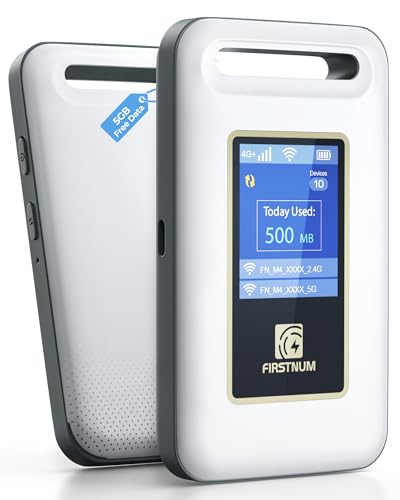
The FIRSTNUM 4G Travel Hotspot is built around a straightforward travel scenario: activate it, connect a handful of devices, and use it as a safer alternative to public WiFi. It includes 5GB of data for the US or Mexico and is described as compatible with coverage in more than 150 countries and regions. The eSIM-ready setup removes the need to handle a physical SIM card.
It supports up to eight devices, including phones, tablets, laptops, and iPads. That is enough for one person with several devices or a small travel group, but it leaves less room than the 10-device RoamWiFi and SIMO models or the Numen Air's 16-device limit. The device uses 4G LTE, so it is aimed at reliable basic connectivity rather than the higher throughput available from the 5G entries.
The 3000mAh rechargeable battery provides up to six hours of continuous use according to the listing, and charging uses USB-C. Its security features are intended to provide a private connection instead of relying on an open hotel, airport, or cafe network. The battery figure is the clearest limitation, especially beside the Statelinker S2's stated 15-hour runtime.
The FIRSTNUM is easier to understand than the JICICUXI because it is eSIM ready and includes initial data, while the JICICUXI requires a compatible physical SIM. The RoamWiFi 1GB North America is a better fit for very light use, and the Statelinker S2 is stronger for long workdays. Choose FIRSTNUM for a short trip, a small number of devices, and a simple private connection.
How to choose best hot spot devices
The right hotspot depends less on a single speed claim than on the network technology, service model, battery, and number of devices you need to connect.
Cellular generation
4G remains suitable for email, browsing, navigation, and ordinary remote work when the local signal is good. 5G models such as the SIMO Solis Edge and GlocalMe Numen Air have more speed potential, but that advantage only appears where a compatible 5G network is available. A 5G label should not be treated as a guarantee of fast service in a rural area, inside a building, or on a congested network.
Service and SIM setup
SIM-free hotspots use built-in service, CloudSIM, or eSIM-style activation, which removes the need to find a local physical card. A device such as the JICICUXI gives you a SIM slot and more control over the carrier plan. Check the supported countries, data validity, activation steps, and whether a recurring allowance needs manual activation before choosing.
The most convenient hotspot is the one whose data plan matches the trip, not the one with the biggest speed claim.
Connected devices
Count every device that may use the hotspot, including phones, laptops, tablets, watches, and streaming hardware. Eight connections can be enough for one person, while a family or small team may be more comfortable with 10, 12, or 16. A higher connection limit does not create more cellular bandwidth, so several active devices can still share the same network capacity.
Battery endurance
A hotspot with a larger battery can remain useful when there is no outlet, but capacity does not tell you exactly how long it will run. The Statelinker S2 provides a stated runtime of up to 15 hours, while the FIRSTNUM model states up to six hours. The SIMO Solis Hero adds a 5250mAh power bank, which can be more useful than hotspot runtime alone if your phone also needs charging.
Display and network management
A screen showing signal strength, data use, battery level, and connected users makes troubleshooting faster. The GlocalMe Numen Air has a 2.4-inch touch display, the Statelinker S2 shows remaining data, and the JICICUXI displays signal, battery, and user count. Automatic network selection is also useful for travelers crossing regions, but it cannot compensate for an area with weak cellular coverage.

Frequently asked questions
Do mobile hotspots need a SIM card?
Not always. The SIMO, RoamWiFi, Statelinker, GlocalMe, and FIRSTNUM models in this roundup are designed to work without a physical SIM card, while the JICICUXI includes a SIM card slot. Some SIM-free devices use built-in service or CloudSIM technology instead.
Is 5G necessary for a travel hotspot?
No. A 4G hotspot is sufficient for many ordinary tasks, including browsing, email, messaging, and navigation. 5G is more useful for large downloads, higher-bandwidth work, and several active users, but only when local 5G coverage is available.
How many devices can connect to one hotspot?
The limit varies by model. The FIRSTNUM and Statelinker S2 support up to eight devices, the RoamWiFi and SIMO Solis Hero support up to 10, the JICICUXI supports up to 12, and the GlocalMe Numen Air supports up to 16.
Can a hotspot work internationally?
Several can, but the coverage and service terms differ. RoamWiFi advertises coverage in more than 170 countries, SIMO lists 140 countries, GlocalMe lists more than 200 countries, and FIRSTNUM lists more than 150 countries and regions. Check the included data region and validity before traveling.
Can a hotspot replace home internet?
It can serve as temporary or backup internet, but suitability depends on signal strength, data allowances, and how many devices will be active. A hotspot is more portable than a fixed connection, while sustained home use can consume data quickly and vary with cellular congestion.
Does a hotspot make a weak cellular signal stronger?
No. A hotspot can select among available networks on models with automatic network selection, but it cannot create coverage where the carrier signal is absent. Placement near a window or in a more open area may help, but the underlying cellular signal remains the main constraint.

The bottom line
The Best Hot Spot Devices in this roundup are led by the SIMO Solis Edge because it combines 5G, WiFi 6, automatic signal selection, and broad international coverage in a small travel-focused device. The GlocalMe Numen Air is the better specialist pick for up to 16 connected devices, a touch display, dual-band WiFi, and the highest advertised speed ceiling.
For 4G travel, the SIMO Solis Hero is the standout when its built-in 5250mAh power bank will be useful, while the Statelinker S2 is the better choice for a long day away from an outlet. North American travelers should look closely at the RoamWiFi 50GB Global, and buyers who want to use their own SIM should choose the JICICUXI.
If you are undecided, choose the SIMO Solis Edge for broad travel flexibility, or the Statelinker S2 when battery runtime matters more than 5G.
As an Amazon Associate we earn from qualifying purchases.