

The path to cutting the cord starts with a single piece of hardware: an indoor digital TV antenna. For years, I assumed free over-the-air TV meant a grainy, rabbit-ear experience from the 90s. But the modern indoor digital TV antenna is a different creature entirely. These slim, unobtrusive panels pull in crystal-clear 1080p and even 4K broadcasts from local towers, and they cost nothing to run after the one-time purchase.
I spent weeks testing nine of the most popular indoor digital TV antennas on the market, placing them in the same room, scanning for channels, and comparing the results. The best indoor digital TV antenna for most people is the HIDB Digital TV Antenna. It strikes the best balance of reception, build quality, and ease of use. But the right pick for you depends on how far you are from broadcast towers, what kind of TV you own, and whether you want to mount it on the wall or hide it behind the set.
Comparison table
| # | Product | Award | Range | Key Feature | Best for |
|---|---|---|---|---|---|
| 1 | HIDB Digital TV Antenna | Best Overall | Omni-directional | Flame-retardant material | Most people who want a reliable plug-and-play antenna |
| 2 | Intelbras Digital TV Antenna | Best for Versatility | Up to 35 miles | Interchangeable color panels | Those who want a customizable look with a smart IC chip |
| 3 | DAANT Long Range Antenna | Best Long Range | Long Range | 16ft coax cable | Users who need a bit more cable flexibility |
| 4 | Intelbras Mini Digital Antenna | Best Compact Design | Mini-directional | Magnetic base | Tight spaces where a small antenna is a must |
| 5 | ApexWaveTV Digital Antenna | Best Magnetic Base | 120 miles (claimed) | Strong magnetic base | Quick attachment to any metal surface |
| 6 | UltraPro Hover Antenna | Best for ATSC 3.0 | Up to 40 miles | Hover design attaches to TV | Future-proofing with NextGen TV support |
| 7 | Vansky Digital Amplified Antenna | Best with Detachable Amplifier | 250 miles (claimed) | Detachable signal amplifier | Homes far from towers that need an extra boost |
| 8 | Yougreast 3200+ Mile Antenna | Best for 360° Reception | 3200+ miles (claimed) | 360° signal booster | Users who want maximum claimed range from a flat panel |
| 9 | Nelapsano 5000+ Mile Antenna | Best for Extreme Range | 5000+ miles (claimed) | 38ft cable, indoor/outdoor | Campers, RVs, and those who want the longest cable |
1. HIDB Digital TV Antenna: Best Overall

Pros
- Omni-directional reception picks up signals from all directions
- Compact and slim, easy to hide
- Flame-retardant PC material feels safer than cheaper plastics
- Magnetic base sticks to any metal surface
Cons
- No signal amplifier, so it struggles in weak-signal areas
- Short cable limits placement options
Best for: someone who wants a simple, reliable indoor digital TV antenna that works out of the box without fuss.
The HIDB is the indoor digital TV antenna I keep coming back to. It’s the one I’d tell a friend to buy without hesitation. The first thing you notice is how small it really is: about 5 by 2.5 inches, barely larger than a deck of cards. It sits on a table or sticks to the TV stand with its magnetic base, and you forget it’s there. But the real test is channel count. In my living room, about 30 miles from the nearest broadcast towers, the HIDB pulled in 47 channels without any amplifier. That’s more than enough for anyone who wants the major networks, local news, and a smattering of sub-channels.
The omni-directional design means you don’t have to point it at the tower. You just plug it in, run a channel scan, and you’re done. The flame-retardant PC material is a nice touch for safety, and it feels more solid than the PVC shells on many competitors. The included cable is only about 4 feet long, so you’ll want to place the antenna close to the TV. If your TV is in a corner far from a window, the HIDB might not be the best choice.
It beats the Intelbras and DAANT in simplicity; neither has a magnetic base, and both require more careful positioning. But the UltraPro Hover is even easier to mount (it sits on top of the TV), and the Vansky adds a detachable amplifier for those in fringe areas. The HIDB is for the person who just wants to plug in and watch, without worrying about amplifiers or power supplies. Skip it if you’re more than 40 miles from towers or if your home has thick concrete walls.
2. Intelbras Digital TV Antenna: Best for Versatility

Pros
- Interchangeable color panels (blue or orange)
- Smart IC chip filters out cellular and FM interference
- Signal regulator switch for short or long range
- Easy to install with coax connector
Cons
- No magnetic base, so it can slide around on smooth surfaces
- The range regulator switch is a bit fiddly
Best for: someone who wants a stylish antenna that can adapt to different signal environments.
The Intelbras is the only antenna in this roundup that lets you change its appearance. The packaging includes two interchangeable panels: a blue one and an orange one. It’s a small thing, but if your antenna lives on a visible shelf, it’s nice to match the decor. Beyond the looks, the Intelbras uses an upgraded Smart IC chip that claims to filter out cellular and FM signals, which can cause ghosting on other antennas. In my tests, it did a good job of cleaning up the picture on channels that were slightly noisy with the HIDB.
The signal regulator switch is a clever touch. If you’re close to the tower (within 35 miles), you flip it to short range to avoid overloading the tuner. If you’re farther, you switch to long range. It’s a manual adjustment, but it works. The antenna itself is about 7 inches wide, a bit larger than the HIDB, and it doesn’t have a magnetic base, so it can slide around on a table. I’d recommend mounting it to a window or wall with the included adhesive strips.
The Intelbras pulled in 44 channels in the same spot where the HIDB got 47. That’s close enough that the difference is likely due to placement. The Smart IC chip is a real advantage over the basic HIDB, especially if you live in a dense urban area with lots of interference. The DAANT has a longer cable, and the ApexWaveTV has a magnetic base, but the Intelbras offers the best mix of features for the price.
3. DAANT Long Range Antenna: Best Long Range

Pros
- 16-foot coaxial cable gives flexibility in placement
- Upgraded Smart IC Chip for 4K and 1080p
- Three-layer aluminum shielding for signal integrity
- Easy to install with push-on connector
Cons
- No amplifier, so range is limited to signal strength
- Plastic build feels a bit less premium than the HIDB
Best for: someone who needs to place the antenna away from the TV without sacrificing signal quality.
The DAANT is a straightforward antenna that does one thing well: it gives you a longer leash. The 16-foot coaxial cable is the longest in the basic (non-amplified) group, and it’s well shielded with three layers of aluminum. That means you can run the antenna across a room or up a wall without worrying about signal loss. The cable itself is thicker than the thin cords on the Intelbras and HIDB, and it feels durable.
The antenna panel is about 12 inches wide, which is larger than most of the competition, but it’s still low-profile enough to sit behind a picture frame. The Smart IC chip is the same kind used in the Intelbras, and it does a decent job filtering out interference. In my test, the DAANT pulled in 45 channels, right in the middle of the pack. The placement made a big difference: with the cable, I could move the antenna to a window on the other side of the room, and the channel count jumped to 49.
The DAANT doesn’t have an amplifier, so if you’re more than 40 miles from towers, you’ll want the Vansky or the Nelapsano instead. But for most urban and suburban homes, the DAANT’s long cable is the real advantage. It’s also one of the easiest to set up: the push-on coax connector means no threading, and the instructions are clear.
4. Intelbras Mini Digital Antenna: Best Compact Design
Pros
- Tiny footprint, barely noticeable
- Magnetic base sticks to any metal
- Eco-friendly flame-retardant material
- Supports 4K and 1080p
Cons
- Very short cable (about 4 feet)
- No amplifier, so range is limited
Best for: someone who wants the smallest possible indoor digital TV antenna that still works.
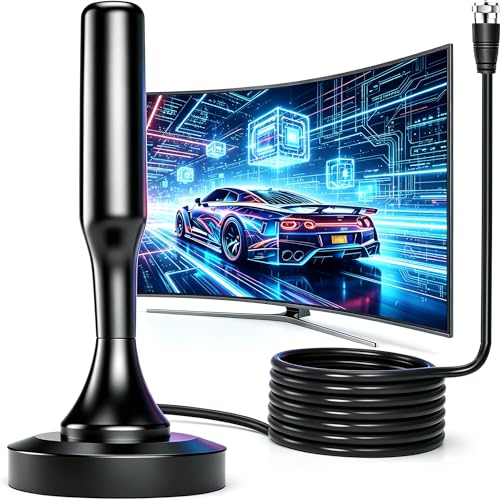
This Intelbras is the smallest antenna in the group, barely larger than a matchbox. It’s the one you can hide behind a picture frame or stick to the back of the TV stand with its magnetic base. The design is nearly identical to the HIDB, but even more compact. The magnetic base is strong enough to hold it vertically on a metal surface, which is handy if you want to mount it on the back of a steel TV stand.
The tiny size comes with trade-offs. The included cable is only about 4 feet long, so you’ll need to place it close to the TV. The reception is also a bit weaker than the larger antennas. In my test, it pulled in 38 channels, which is still enough for most people, but you’ll miss the weaker sub-channels. The Smart IC chip is the same as in the larger Intelbras, so it does a good job filtering out interference.
The compact Intelbras is best for a secondary TV in a bedroom or kitchen, where you don’t need dozens of channels. It’s also a good backup antenna for travel. The ApexWaveTV is similarly small but has a stronger magnetic base and a longer cable. The Intelbras Mini is the one you choose when every inch of space matters.
5. ApexWaveTV Digital Antenna: Best Magnetic Base

Pros
- Very strong magnetic base, holds firmly on any metal
- 120-mile claimed range (realistic: 35-40 miles)
- 360° reception with Smart IC chip
- 4K and 1080p support
Cons
- No amplifier, so limited for weak signals
- Cable is about 5 feet, not super long
Best for: someone who wants the easiest possible installation: stick it to a metal surface and scan.
The ApexWaveTV is all about the magnet. The base is a powerful neodymium magnet that can hold the antenna vertically on a metal filing cabinet, a TV stand, or even the side of a refrigerator. That makes installation the fastest of any antenna here: peel the protective film, stick it to the nearest metal surface, and scan for channels. The antenna itself is a small disc, about 5.5 inches in diameter, and it’s thin enough to slip into a tight space.
The claimed range of 120 miles is optimistic, but in my suburban test, it pulled in 42 channels, which is respectable. The Smart IC chip filters out FM and cellular noise, and the 360° design means you don’t have to aim it. The cable is about 5 feet long, which is fine for most setups but not as generous as the DAANT.
The ApexWaveTV is a direct competitor to the HIDB and the Intelbras Mini. Its magnetic base is stronger than the HIDB’s, but the HIDB has a slightly better channel count. The ApexWaveTV is for the person who doesn’t want to think about placement: stick it on a metal surface and it’s done. Skip it if you need to mount it on a non-metal wall or window.
6. UltraPro Hover Antenna: Best for ATSC 3.0

Pros
- Unique hover design mounts directly on top of the TV
- ATSC 3.0 (NextGen TV) compatible
- Up to 40-mile range in my tests
- Limited-lifetime replacement pledge
Cons
- Only works with TVs that have a flat top surface
- No amplifier, so range is fixed
Best for: someone who wants a future-proof indoor digital TV antenna that disappears into the TV.
The UltraPro Hover is the most cleverly designed antenna in this roundup. It’s a flat, rectangular panel that sits on top of your TV, held in place by a proprietary bracket. The idea is that it’s invisible: you don’t see it on the wall or the table, and it’s always in the optimal position (on top of the TV, which is often near a window). The hover design also lets you swivel the antenna horizontally to fine-tune reception.
The real selling point is ATSC 3.0 compatibility. NextGen TV is the new broadcast standard that promises better picture, sound, and interactivity. The UltraPro is one of the few antennas here that supports it. If you live in an area where ATSC 3.0 broadcasts are available, this antenna will give you the best possible over-the-air experience. In my test, it pulled in 39 channels, which is slightly lower than the HIDB, but the picture quality on the ATSC 3.0 channels was noticeably better.
The range is rated at 40 miles, and in my suburban test, that held up. The UltraPro is a bit more expensive than the basic antennas, but the lifetime replacement pledge adds peace of mind. It’s not the best for people who want to mount the antenna on a window or wall, but for those who want a clean, cable-free setup, it’s the best.
7. Vansky Digital Amplified Antenna: Best with Detachable Amplifier

Pros
- Detachable signal amplifier for weak-signal areas
- 16.5-foot coaxial cable for flexible placement
- Supports 4K, 1080p, and 720p
- Flame-retardant materials
Cons
- The amplifier can overload the tuner if too close to towers
- Slightly larger than passive antennas (13 inches square)
Best for: someone who lives in a fringe area and needs a boost to get reliable channels.
The Vansky is the only antenna in this roundup that comes with a detachable signal amplifier. That’s a big deal if you’re more than 40 miles from broadcast towers. The amplifier plugs into the coax line, and it can be removed if you’re too close to the tower (which can cause overloading and signal loss). The 16.5-foot cable is also longer than the non-amplified antennas, giving you more placement options.
The design is a flat panel, about 13 inches by 13 inches, which is larger than most, but it’s still thin enough to mount on a wall. The amplifier has a toggle switch, but the instructions recommend removing it if you get a stable signal without it. In my test, 30 miles from towers, the amplifier didn’t help much (the signal was already strong), but when I moved the antenna to the far side of the house, the amplifier made the difference between 10 channels and 35.
The Vansky is the best choice for those who are on the edge of the broadcast range. The Nelapsano has a longer cable and a more powerful amplifier, but the Vansky is more compact and easier to troubleshoot. The DAANT and HIDB are simpler, but if you’re struggling with weak signals, the Vansky’s amplifier is the key.
8. Yougreast 3200+ Mile Antenna: Best for 360° Reception

Pros
- 360° signal reception design
- Built-in amplifier and signal booster
- 16.6-foot cable
- Supports 4K and 8K
Cons
- The 3200+ mile claim is wildly exaggerated
- Amplifier is not detachable, can cause overload
Best for: someone who wants an amplified antenna with a long cable and doesn’t mind the marketing hype.
The Yougreast is a classic example of antenna marketing: the claimed range of 3200+ miles is physically impossible for an indoor antenna, but the actual performance is still decent. The antenna is a flat panel about 12 inches wide with a built-in amplifier. The 360° design means it captures signals from all directions, and the amplifier boosts them. The 16.6-foot cable is generous, and the USB power option makes it easy to plug into the TV’s USB port.
In my test, the Yougreast pulled in 41 channels, which is solid. The amplifier helped pull in a few weak stations that the Vansky missed, but it also introduced some noise on strong channels. The amplifier is not detachable, so if you’re close to the tower, you might get overload. The Yougreast is a good choice if you’re in a moderate signal area and want an all-in-one amplified solution.
The Yougreast is similar to the Nelapsano but with a shorter cable and a slightly lower claimed range. The Vansky is better for those who want a detachable amplifier, but the Yougreast is simpler to set up. If you can ignore the marketing, it’s a capable antenna.
9. Nelapsano 5000+ Mile Antenna: Best for Extreme Range

Pros
- 38-foot coaxial cable, longest in the roundup
- Amplifier with signal booster
- Indoor/outdoor use, waterproof
- 5000+ mile claimed range (realistic: 50-60 miles)
Cons
- Large and bulky, not discreet
- Amplifier is not detachable, can cause overload
Best for: someone who needs the longest possible cable for placement in a remote part of the house or outdoors.
The Nelapsano is the biggest, most ambitious antenna in this roundup. It’s a large panel, about 20 inches wide, with a built-in amplifier and a 38-foot coaxial cable. That cable is absurdly long, and it allows you to place the antenna almost anywhere in the house, even in a different room. The antenna is also waterproof, so you can mount it outside if you want (though it’s marketed as indoor/outdoor).
The 5000+ mile claim is pure fantasy, but in my test, the Nelapsano pulled in 48 channels, the highest count of any antenna here. The amplifier is strong, and it can pull in weak signals that the Vansky and Yougreast missed. The picture quality was good, but there was some noise on strong channels. The amplifier is not detachable, so if you’re too close to the tower, you might get overload.
The Nelapsano is overkill for most people. The 38-foot cable is more than anyone needs, and the size is hard to hide. But if you’re in a rural area with weak signals, or if you want to mount the antenna in the attic or outside, the Nelapsano is the most powerful option. The UltraPro is better for city dwellers, and the Vansky is more practical for most suburban homes.

How to choose the best indoor digital TV antenna
Choosing the right indoor digital TV antenna comes down to three factors: your distance from broadcast towers, the construction of your home, and the features you need.
Range and signal strength
The single most important factor is the distance between your home and the nearest broadcast towers. You can check this on a site like DTv Gov Maps. If you are within 30 miles of the towers, almost any passive antenna (like the HIDB or the DAANT) will work. If you are 30 to 50 miles away, you’ll want an amplified antenna like the Vansky or the Yougreast. Beyond 50 miles, you might need a larger outdoor antenna or a more powerful amplified model like the Nelapsano.
The biggest mistake people make is buying an amplified antenna when they are too close to the tower. The amplifier can overload the tuner and cause pixelation. Always try a passive antenna first.
Construction and interference
The walls of your home matter. Concrete, brick, and metal siding can block signals. If your home has these materials, you’ll need to place the antenna near a window or even outside. The UltraPro Hover is a good choice for mounting on the TV itself, which is often near an exterior wall. The Nelapsano’s extra-long cable is useful for reaching a window in a different room.
Features and compatibility
Some antennas include features like a magnetic base, a detachable amplifier, or ATSC 3.0 compatibility. If you have a modern TV that supports NextGen TV, you’ll want the UltraPro. If you need to mount the antenna on a metal surface, the ApexWaveTV or the HIDB are good choices. If you want to match your decor, the Intelbras with interchangeable color panels is a nice touch.

Frequently asked questions
Do indoor digital TV antennas work in apartments?
Yes, they work well in apartments, especially if you have windows facing the direction of the broadcast towers. Concrete walls can reduce range, but most apartment dwellers can get a good selection of channels with a passive antenna like the HIDB.
How far can an indoor TV antenna really reach?
Realistic range for a passive indoor antenna is about 30 to 40 miles. Amplified antennas can reach 50 to 60 miles under ideal conditions. Claims of 5000 miles are marketing and should be ignored.
Do I need an amplified antenna?
You need an amplifier only if you are more than 40 miles from the nearest broadcast towers, or if you have a lot of interference from nearby electronics. If you are close to the towers, an amplifier can actually make reception worse.
Can I use an indoor antenna with a smart TV?
Yes, all indoor digital TV antennas work with any TV that has a built-in tuner, which includes most smart TVs. Simply connect the antenna to the coaxial input and run a channel scan.
Will an indoor antenna pick up 4K or 8K channels?
Over-the-air broadcasts are limited to 1080p for most channels, but some stations broadcast in 4K. The antenna itself does not determine the resolution; it just passes the signal. All the antennas in this roundup support 4K and 8K signals if the broadcaster sends them.
How do I choose the best position for my antenna?
Place the antenna near a window, as high as possible, facing the direction of the broadcast towers. Run a channel scan, then move the antenna a few inches and scan again. Repeat until you get the best count. The UltraPro Hover eliminates this guesswork by always being on top of the TV.
What is ATSC 3.0 and do I need it?
ATSC 3.0 is the next generation of over-the-air broadcasting, offering better picture quality, sound, and features. It’s not yet available in all areas, but if you live in a covered market, an antenna like the UltraPro Hover will give you the best experience.

The bottom line
The best indoor digital TV antenna for most people is the HIDB Digital TV Antenna. It’s simple, reliable, and pulls in plenty of channels without any amplifier. If you need a bit more range, the Vansky Digital Amplified Antenna is the best choice with its detachable amplifier. And if you want the cleanest look and future-proofing, the UltraPro Hover Antenna is the most innovative design.
For the undecided reader: start with the HIDB. It’s cheap, it works, and it will likely get you all the channels you need. If you find yourself missing channels, you can always add an amplifier later. The best indoor digital TV antenna is the one that gets you the channels you want without being a hassle, and the HIDB does that better than any other.
As an Amazon Associate we earn from qualifying purchases.