

A dead car battery is rarely convenient, but the right jump box can turn a long wait for roadside assistance into a few minutes beside the vehicle. The catch is that peak amperage tells only part of the story. Cable design, low-voltage behavior, recharge time, size, and protection against a bad connection matter just as much.
We compared compact lithium packs, heavy-duty shop-style starters, and combination units with air compressors to find the Best jump starter for different vehicles and situations. The NOCO Boost GB40 is our top pick for most drivers, while the rest cover larger engines, faster charging, tire inflation, and professional-duty use.
Comparison table
| # | Product | Award | Peak current | Engine coverage | Standout feature | Best for |
|---|---|---|---|---|---|---|
| 1 | NOCO GB40 | Best overall | 1, 000A | Up to 6.0L gas, 3.0L diesel | IP65 housing, 100-lumen light | Most cars and emergency kits |
| 2 | TREKURE 8000A | Best high-output compact pack | 8, 000A | Up to 12.0L diesel | 26, 800mAh battery, 800-lumen light | Large engines and long trips |
| 3 | S ZEVZO ET03 | Best for repeated starts | 4, 000A | Up to 8.0L gas, 7.0L diesel | 74Wh capacity, LCD display | Families and multi-vehicle use |
| 4 | WOLFBOX MV24 | Best fast-charging pack | 4, 000A | Up to 10L gas, 10L diesel | 65W USB-C charging | Drivers who want quick turnaround |
| 5 | NOCO GB70 | Best heavy-duty NOCO | 2, 000A | Up to 8.0L gas, 6.0L diesel | IP65 housing, 400-lumen light | Trucks and larger vehicles |
| 6 | GOOLOO A3 | Best with air compressor | 3, 000A | Up to 9.0L gas, 6.5L diesel | 150 PSI inflator | Roadside emergencies beyond dead batteries |
| 7 | Clore JNC660 | Best shop-style starter | 1, 700A | 12V vehicles | 22Ah battery, 46-inch cables | Garages and service work |
| 8 | NOCO GBX45 | Best quick-charge NOCO | 1, 250A | Up to 6.5L gas, 4.0L diesel | 48-minute USB-C recharge | Drivers who forget to recharge |
| 9 | WOLFBOX MV24A | Best inflator for trucks | 4, 000A | Up to 10L gas, 10L diesel | 160 PSI, 45L per minute | Pickup and SUV owners |
| 10 | NOCO GBX155 | Best for extreme engines | 4, 250A | Up to 10.0L gas, 8.0L diesel | 60W USB-C, 500-lumen light | Very large gas and diesel engines |
1. NOCO GB40: Best Overall
Pros
- Compact 2.4-pound design
- Spark-proof and reverse-polarity protection
- IP65-rated housing
- Up to 20 starts per charge
- Useful 100-lumen emergency light
Cons
- Less engine capacity than the larger packs
- Recharge time is three hours
- No built-in air compressor
Best for: drivers who want a dependable, compact starter for ordinary cars, SUVs, motorcycles, and small diesel vehicles.
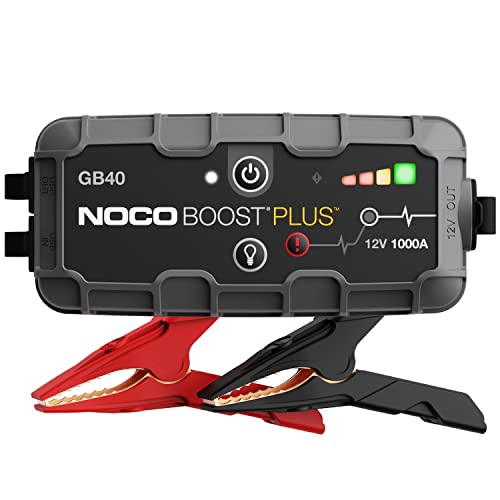
The NOCO GB40 is the one most drivers can store and forget about until they need it. It is small enough for a glove box or emergency kit, yet its 1, 000-amp lithium system is rated for engines up to 6.0L gas and 3.0L diesel. That covers a large share of everyday cars and light trucks without asking you to carry a bulky shop unit.
The design is reassuringly straightforward. Connect the included heavy-duty clamps, use the protection system to confirm the connection, and start the vehicle. NOCO's UltraSafe system is designed to prevent sparks and protect against reverse polarity, which is particularly useful when the battery is dead and the owner is already working in poor light or bad weather. The IP65 housing adds protection against dust and water spray, while the rubberized over-molding should help it survive life in a trunk.
Its 2.4-pound weight is a major advantage over the 5-pound NOCO GB70 and the 18-pound Clore JNC660. The trade-off is starting headroom. The GB40 is not the right tool for a large diesel pickup or a repeatedly drained commercial battery. It also takes three hours to recharge, slower than the NOCO GBX45, which can recharge through USB-C Power Delivery in 48 minutes.
The integrated 100-lumen flashlight has seven modes, including SOS and strobe, so it is more useful than a simple status lamp during a nighttime connection. The unit can also act as a power bank for phones and tablets. NOCO says it can provide up to 20 starts per charge, although the actual number will depend on battery condition, engine size, temperature, and how long the engine needs to crank.
The weakness is specialization. There is no tire inflator, display, or high-output charging system, and the 6.0L gas limit leaves out some larger vehicles. For a typical sedan, crossover, small truck, or motorcycle owner who wants a compact safety net, those omissions are sensible. The GB40 remains the Best jump starter for a simple, well-protected kit that does not take over the cargo area.
2. TREKURE 8000A: Best High-Output Compact Pack

Pros
- 8, 000-amp peak output
- Rated for engines up to 12.0L diesel
- 26, 800mAh battery capacity
- 800-lumen light with SOS and strobe
- Compact 1.41-pound body
Cons
- Claimed engine coverage is broader than most drivers need
- 18W charging is slower than the WOLFBOX units
- Requires a specific connection order
Best for: drivers carrying a small pack for a large truck, diesel vehicle, or extended road trip.
The TREKURE 8000A takes an unusual approach: very high claimed starting output in a body that weighs only 1.41 pounds. It is rated for all gas engines and diesel engines up to 12.0L, which puts it well beyond the needs of a normal commuter car. The appeal is obvious for owners of large trucks, recreational vehicles, or equipment who do not want to carry a lead-acid starter.
Its 26, 800mAh battery also gives it a useful role between jump starts. The 18W USB port can charge phones, tablets, earbuds, and other small devices, and the product claims up to 24 months of standby time and more than 1, 000 recharge cycles. Those claims are not a substitute for checking and recharging the pack periodically, but the capacity is substantial compared with the smaller NOCO GB40.
The built-in 800-lumen light is one of the more practical extras here. It has steady, strobe, and SOS modes and can run for more than 12 hours according to the product information. A built-in handle makes the pack easier to carry, especially when working around a tall engine bay. Ten safety protections cover issues such as short circuits, overheating, overvoltage, overload, overcurrent, and reverse polarity.
The key operational detail is the cable sequence. The instructions say to connect the jumper cable to the unit first, then attach the red and black clamps to the battery. That is easy enough, but it is not a detail to improvise around. The unit also uses 8 AWG cables, which the manufacturer describes as thicker conductors for better transfer.
Compared with the S ZEVZO ET03, TREKURE offers a lighter body and a much higher stated engine limit. The ET03 counters with an LCD display and a claimed ability to start a 0V battery when sufficiently charged. TREKURE is the more compelling choice for maximum stated output in a compact form, but drivers with ordinary cars should not buy around a number they will never use. It is best suited to a large-engine owner who values portability and a bright emergency light.
3. S ZEVZO ET03: Best for Repeated Starts

Pros
- 4, 000-amp peak current
- 74Wh battery capacity
- Claimed support for up to 50 starts
- Force-start function for 0V batteries
- LCD battery and status display
Cons
- USB outputs are limited to 5V and 2A
- Requires a full charge for a completely dead battery
- No air compressor
Best for: households or road users who want a clear display and plenty of reserve starts.
The S ZEVZO ET03 is built around reserve capacity rather than the smallest possible footprint. Its 74Wh battery is rated for up to 50 jump starts, and its 4, 000-amp peak output covers gas engines up to 8.0L and diesel engines up to 7.0L. That makes it a sensible choice for a household with several vehicles or for someone who wants a pack that can help more than one stranded driver.
The force-start function is the ET03's most important capability. The manufacturer says it can start a battery at 0V, provided the pack is fully charged or above 14V. That matters because some automatic safety systems will not activate when they cannot detect enough voltage. The smart clamps provide lights and audible alerts for connection errors, while ten safety protections address reverse polarity, short circuits, overcharging, and related problems.
A small LCD display shows the battery status directly on the unit. That is more useful than relying on a row of vague indicator lights, especially when the jump starter has been sitting in storage. The ET03 also has two 5V/2A USB outputs that can charge two devices at once. They are adequate for phones and smaller electronics, but they are not as versatile or fast as the 65W USB-C system in the WOLFBOX MV24.
The 500-lumen flashlight includes steady, strobe, and SOS modes. Its operating range is listed as 14 to 140 degrees Fahrenheit, and the product claims up to 24 months of standby time. At 1.4 pounds, the unit remains easy to carry, with dimensions that should fit in many glove compartments or storage bins. The included case is a useful touch because it keeps the clamps and USB-C cable from becoming loose cargo.
The ET03 is less polished as a charging hub than the faster WOLFBOX packs, and it does not inflate tires like the GOOLOO A3. Its advantage is the combination of a force-start mode, a readable display, and a large claimed reserve. If repeated starts and clear status information matter more than fast device charging, this is one of the more capable choices in the Best jump starter field.
4. WOLFBOX MV24: Best Fast-Charging Pack

Pros
- 65W USB-C input and output
- Full recharge in about 1.3 hours
- 88.8Wh battery
- LCD status display
- IP64 protection and low-temperature operation
Cons
- Weighs 3 pounds
- No air compressor
- More capacity than many small-car owners need
Best for: drivers who want a powerful pack that can be restored quickly between emergencies.
The WOLFBOX MV24 stands out because it treats recharge time as a core feature rather than an afterthought. Its 88.8Wh battery can be replenished in about 1.3 hours with the included 65W charger, and the same USB-C system can charge phones, tablets, and laptops. That is a meaningful difference after using the unit, because a jump starter that returns to full capacity quickly is easier to keep ready.
The 4, 000-amp system is rated for 12V vehicles with gas or diesel engines under 10L. A one-touch boost function is intended for low-voltage conditions, and the HD LCD screen shows the unit's status without requiring guesswork. The pack weighs 3 pounds, heavier than the TREKURE 8000A and S ZEVZO ET03, but still manageable for trunk storage.
Its ports include one 65W USB-C input and output and one QC3.0 USB-A port. The high-output USB-C port is the reason to choose this model over a basic lithium booster. It can serve as a useful emergency power source while traveling, not merely as equipment that sits unused until a battery fails. The LED flashlight has high-beam, SOS, and strobe modes.
The MV24 is rated to operate from -4 to 140 degrees Fahrenheit and carries an IP64 protection rating. Those figures suggest better resistance to dust and water exposure than an unprotected electronics case, but this is not a reason to leave the unit in standing water. Connection instructions still matter, including avoiding reverse clamp polarity.
The drawback is that the MV24 gives up some portability to provide its large battery and fast charging. It also lacks the tire inflator found in the WOLFBOX MV24A, so owners who want one device for both starting and tire maintenance should look at its sibling. For someone who wants a high-output starter that can quickly return to service, the MV24 is the most practical fast-charging option here.
5. NOCO GB70: Best Heavy-Duty NOCO

Pros
- 2, 000-amp peak output
- Rated for 8.0L gas and 6.0L diesel engines
- Up to 40 starts per charge
- IP65-rated rugged housing
- 400-lumen light
Cons
- Weighs 5 pounds
- Six-hour recharge time
- Larger than the GB40
Best for: owners of trucks and larger vehicles who prefer a rugged NOCO design with substantial starting reserve.
The NOCO GB70 is the natural step up from the GB40 when engine size and reserve matter more than glove-box convenience. Its 2, 000-amp lithium system is rated for engines up to 8.0L gas and 6.0L diesel, and NOCO says it can provide up to 40 starts per charge. That is a useful margin for a truck owner, particularly when a battery has weakened over time rather than simply being drained once.
The GB70 keeps the features that make the GB40 easy to trust. UltraSafe protection is designed to prevent sparks and reverse-polarity mistakes, and the IP65 housing uses rubberized over-molding to help protect against dust, water, and impact. The included heavy-duty clamps are designed for energy transfer, while the USB-C connection lets the unit act as a power bank for phones and tablets.
At 5 pounds, it is more than twice the weight of the GB40. That is not a problem in a truck bed or cargo compartment, but it is noticeable if you are carrying the pack across a parking lot or down a roadside shoulder. The 400-lumen flashlight with seven modes is twice as bright on paper as the GB40's light, making it better for inspecting a larger engine bay.
The recharge time is six hours, which is the GB70's clearest weakness. The NOCO GBX45 is much quicker to recharge through USB-C Power Delivery, though it offers less engine coverage and fewer claimed starts per charge. The NOCO GBX155 goes further for very large engines, but it is substantially larger and heavier again.
The GB70 is not the newest or fastest design in this group, and its size will be unnecessary for a small hatchback. It does, however, make a convincing heavy-duty companion for a truck, boat, or larger gas-powered vehicle. Choose it when you want more reserve and engine coverage than the GB40 without moving all the way to the extreme-output GBX155.
6. GOOLOO A3: Best With Air Compressor

Pros
- 3, 000-amp starting output
- 150 PSI air compressor
- Five inflation modes and five nozzles
- Automatic shutoff and digital pressure display
- Can inflate up to eight car tires per charge
Cons
- Weighs 3.58 pounds
- Combination design is bulkier than a basic booster
- Must be recharged every three months during long storage
Best for: drivers who want one emergency device for dead batteries, low tires, and small inflatables.
The GOOLOO A3 is the most useful multipurpose device in this group. It combines a 3, 000-amp jump starter with a 150 PSI compressor, digital pressure gauge, flashlight, power bank, bike pump, and ball pump. That broad role makes it more than a battery rescue tool. A slow leak or low tire pressure can be a more immediate roadside problem than a dead battery, and the A3 addresses both.
The starter is rated for 12V vehicles with gas engines up to 9.0L and diesel engines up to 6.5L. A boost button supports very low-voltage conditions, and the unit uses ten protections covering reverse connection, short circuit, overcurrent, overheating, and overcharge. The product information says the battery supports more than 1, 000 charge cycles and can operate from -4 to 140 degrees Fahrenheit.
The compressor has five modes for SUVs, cars, bikes, balls, and custom settings. It can switch among PSI, BAR, and KPA, and the automatic shutoff should prevent the user from having to watch the gauge continuously. GOOLOO says a full charge provides up to 45 minutes of wireless inflation, enough for up to eight car tires under its stated conditions. It also gives specific inflation claims for Tesla Model 3 and Model Y tires, though actual times will vary with tire size, starting pressure, temperature, and battery charge.
At 3.58 pounds, the A3 is not especially heavy for what it contains, but it is less compact than the NOCO GB40. The compressor also adds another cable and hose to organize. GOOLOO recommends fully charging the unit before first use and recharging it at least every three months during long-term storage. That maintenance matters more here than with a device that is used only as a dormant battery backup.
The A3 cannot match a dedicated shop inflator for sustained commercial use, and a driver who only needs jump starts is carrying extra hardware. For road trips, family vehicles, and anyone who has dealt with both a weak battery and a soft tire, its combination is compelling. It is the Best jump starter for buyers who want roadside capability in more than one category.
7. Clore JNC660: Best Shop-Style Starter

Pros
- 22Ah Clore Proformer battery
- 1, 700 peak amps
- 46-inch heavy-duty cables
- Built-in voltmeter
- 12V DC outlet
Cons
- Very heavy at 18 pounds
- Bulky dimensions
- Not a compact lithium emergency pack
Best for: garages, workshops, and service vehicles where cable reach and lead-acid reserve matter more than portability.
The Clore JNC660 looks and behaves more like workshop equipment than a modern pocket-sized battery pack. Its 22Ah Clore Proformer battery and 1, 700 peak amps are housed in a large case that weighs 18 pounds. That makes it the least convenient option for a glove box, but the size has a purpose: this is a starter intended to sit in a garage, service bay, or work vehicle and be ready for repeated use.
The 46-inch heavy-duty number 2 AWG cables are the JNC660's biggest practical advantage. Longer cables make it easier to reach battery terminals that are tucked away in a large engine bay, and the heavier conductors suit the unit's shop-oriented design. The built-in voltmeter shows the charge status of the onboard battery, so the operator has a direct indication of whether the pack is ready.
A 12V DC outlet adds power for compatible accessories. This is a much different kind of versatility from the USB-C ports on the WOLFBOX MV24 or NOCO GBX45. The Clore is intended to supply 12V equipment, not to act as a modern laptop and phone power bank. That distinction is important before choosing it for travel.
The JNC660 also lacks the compact lithium packs' modern protection and lighting features in the supplied information. There is no listed IP rating, LED flashlight, USB-C charging system, or force-start mode. Its strength is the conventional battery and cable arrangement, not a menu of electronic extras. It is also not the right answer for someone who may need to carry a jump starter any distance.
The NOCO GB70 is easier to store and still covers larger engines, while the NOCO GB40 is dramatically easier to carry. The JNC660 earns its place for people who actually want a substantial shop-style unit and can keep it near the vehicles they service. If portability is a priority, skip it. If long cables, a voltmeter, and a 12V outlet are the priorities, its old-school design remains useful.
8. NOCO GBX45: Best Quick-Charge NOCO

Pros
- 1, 250-amp peak output
- 48-minute USB-C Power Delivery recharge
- Can gain a start after five minutes of charging
- 60W two-way USB-C power
- Compact 2.65-pound body
Cons
- Rated for smaller engines than the GB70
- Up to six starts per charge
- 100-lumen light is modest beside larger packs
Best for: drivers who want a compact NOCO pack that can be recharged quickly before a trip.
The NOCO GBX45 solves the most frustrating jump-starter problem: discovering that the pack is nearly empty when the car is already dead. Its USB-C Power Delivery system can recharge the unit in 48 minutes, and NOCO says five minutes of charging can provide enough power for a jump start even when the pack is completely depleted. That is a more useful emergency feature than simply having a larger battery that was forgotten in storage.
Its 1, 250-amp output covers gas engines up to 6.5L and diesel engines up to 4.0L. That places it between the GB40 and GB70 for engine coverage. The GBX45 is also light enough to carry easily at 2.65 pounds, though its 8.23-inch height and 4.96-inch width give it a different shape from the smaller GB40.
The 60W USB-C port works in both directions, so the pack can charge phones, tablets, laptops, and other devices. That is a significant upgrade over the GB40's more basic power-bank role. A 100-lumen flashlight has seven modes, including SOS and strobe, and the UltraSafe 2.0 system adds spark-proof and reverse-polarity protection.
The quick recharge system does come with a capacity compromise. The GBX45 is rated for up to six jump starts per charge, far fewer than the GB40's stated 20 or the GB70's stated 40. That is not a problem for a driver who keeps the pack topped up, but it makes the unit less suitable for helping several vehicles in one outing. The WOLFBOX MV24 offers a larger 88.8Wh battery and faster device charging, though it weighs more and is larger.
This is a good choice for someone who drives a normal car or midsize truck and values readiness over maximum reserve. It is also worth considering how a battery backup fits into a broader roadside kit when choosing between a fast-charging pack and a larger unit. Pick the GBX45 if a short charging window is likely to determine whether the jump starter is actually useful.
9. WOLFBOX MV24A: Best Inflator for Trucks

Pros
- 4, 000-amp jump-start output
- 160 PSI compressor
- 45L per minute airflow
- 65W USB-C charging
- Rated for 10L gas and diesel engines
Cons
- Weighs 5.3 pounds
- Charging adapter is not included
- Larger than a standard jump starter
Best for: pickup and SUV owners who want a high-output starter and a serious emergency tire inflator in one pack.
The WOLFBOX MV24A is the more capable sibling to the MV24 because it adds a high-output air compressor without giving up the 4, 000-amp starter. It is rated for 12V vehicles with gas or diesel engines up to 10L, while its 160 PSI, 45L-per-minute pump is designed to handle everything from sedan tires to pickup tires.
The compressor specifications are unusually concrete. WOLFBOX says it can raise a 315/70 R17 pickup tire from 30 PSI to 36 PSI in two minutes and 30 seconds, an SUV tire from 30 PSI to 36 PSI in one minute and 20 seconds, and a sedan tire from 29 PSI to 36 PSI in 40 seconds. Those figures are manufacturer claims under stated conditions, but they explain why this pack is more suited to larger vehicles than many small combination units.
The 88.8Wh battery supports a 65W USB-C port, USB-A outputs rated at 12W and 18W, and a 160W DC continuous output. WOLFBOX describes the unit as a 24, 000mAh power bank and says it can recharge in as little as two hours. The important omission is that a charging adapter is not included, so the owner needs a compatible power source for the fastest recharge.
At 5.3 pounds, the MV24A is nearly twice the weight of the regular MV24. That is a fair trade for the compressor, but it makes the device less attractive if tire inflation is not part of the plan. The 400-lumen light includes distress, strobe, and high-beam modes, and the unit is designed to operate down to -4 degrees Fahrenheit. Ten protection systems address common electrical faults.
Compared with the GOOLOO A3, the MV24A offers higher stated engine coverage, a faster compressor, and a more powerful USB-C system. The GOOLOO is lighter and includes more inflation modes and nozzles, making it friendlier for bikes and balls. The MV24A is the better fit for trucks, SUVs, and road users who care most about tire speed and starting headroom.
10. NOCO GBX155: Best for Extreme Engines

Pros
- 4, 250-amp peak output
- Rated for 10.0L gas and 8.0L diesel engines
- Up to 18 starts per charge
- 60W two-way USB-C Power Delivery
- 500-lumen emergency light
Cons
- Weighs 7.01 pounds
- Large footprint
- Overkill for most passenger vehicles
Best for: owners of very large gas or diesel vehicles who need the highest engine coverage in this group.
The NOCO GBX155 is the specialist pick for engines that make ordinary compact boosters look inadequate. Its 4, 250-amp peak output is rated for gas engines up to 10.0L and diesel engines up to 8.0L. That is the broadest large-engine coverage among the NOCO models here, and it gives truck, commercial, and equipment owners a substantial margin.
The GBX155 uses NOCO's UltraSafe 2.0 protection system, with spark-proof and reverse-polarity safeguards intended to make the connection less error-prone. Its 60-second timer helps control the high-voltage output, and NOCO says the pack can provide up to 18 starts per charge. A five-minute charge can provide enough energy for a jump start, while a full USB-C Power Delivery recharge takes about 2.7 hours.
It also functions as a 60W power bank for phones, tablets, laptops, and other USB-C devices. The 500-lumen LED flashlight is the brightest in NOCO's lineup here and includes seven modes, including SOS and strobe. That is useful around a large engine bay, where a small 100-lumen lamp can leave shadows in the wrong places.
The unit weighs 7.01 pounds and measures 13.51 inches high, 8.18 inches long, and 4.84 inches wide. Those dimensions make it a serious piece of equipment rather than a casual glove-box accessory. It is also much larger than the NOCO GB70, which already covers 8.0L gas and 6.0L diesel engines. For a compact car, the GB40 or GBX45 is easier to live with.
The GBX155's weakness is not capability but fit. Most owners will never need its maximum engine rating, and its size makes it less convenient to carry. If a large diesel pickup, commercial vehicle, or other high-displacement engine is part of your regular routine, the extra headroom is the reason to choose it. Everyone else should start with a smaller model and save the bulk for a capability they will use.

How to choose best jump starter
A reliable jump starter needs enough starting output for the engine, a battery that remains ready in storage, cables that reach the terminals, and protection that helps prevent connection mistakes.
Engine coverage
Manufacturers list separate limits for gas and diesel engines because diesel engines generally demand more starting power. Treat those limits as guidance rather than a promise that every vehicle will start instantly. Engine condition, battery health, oil viscosity, temperature, and cable contact all affect the result.
For a typical sedan or small crossover, a pack rated around the GB40's 6.0L gas and 3.0L diesel limits provides plenty of headroom. Larger diesel trucks need a model such as the GB70, MV24, or GBX155. Avoid choosing solely by the biggest peak-current number, since the rest of the design may be less suitable.
Peak current and battery capacity
Peak current describes the burst of output available during starting. Battery capacity describes how much energy the pack stores and helps explain how many starts or device charges it can provide before recharging. The ET03's 74Wh capacity and the WOLFBOX MV24's 88.8Wh capacity are useful examples of packs built for reserve.
A high peak-current figure does not automatically mean more repeated starts. The GBX45, for example, has more peak output than the GB40 but a lower stated number of starts per charge. If you routinely help several vehicles, prioritize capacity and recharge habits alongside starting output.
The most useful jump starter is the one whose engine rating, battery reserve, and storage size match the vehicle you actually drive.
Cable length and connection protection
Longer cables help when a battery is mounted far from the front of the vehicle or when access around the engine bay is awkward. The Clore JNC660's 46-inch number 2 AWG cables are particularly suited to shop work, while compact lithium packs use shorter leads to keep the package small.
Reverse-polarity protection, spark-proof connection design, audible alerts, and force-start controls can make a stressful roadside repair safer. They do not eliminate the need to identify the positive and negative terminals correctly. Follow the product's connection order and keep the clamps clean.
Recharge speed and storage
A starter that takes hours to recharge can still be reliable if it is checked regularly. A fast USB-C pack such as the GBX45 or MV24 is easier to restore after use, while larger packs may need a longer charging session. Look for a clear battery display or status indicator so you can check readiness before a long drive.
Lithium units should not be treated as maintenance-free. Follow the charging interval in the manual, especially when the pack is stored for months. The GOOLOO A3 specifically recommends recharging every three months during long-term storage.
Extra functions
A flashlight is useful during a nighttime repair, but brightness and modes vary widely. An air compressor can be more valuable than a brighter lamp if your vehicle regularly travels on rough roads or carries heavy loads. The A3 is aimed at general roadside use, while the MV24A's airflow and pressure figures make it more suitable for larger tires.
USB-C charging turns a jump starter into a broader emergency power source. The MV24 and GBX155 support 60W charging, which is more versatile than the basic USB outputs on smaller packs. If your main concern is vehicle recovery, do not let extra ports outweigh engine coverage and connection quality. For a wider look at pack design, the differences between compact and high-capacity roadside units can help narrow the choice.

Frequently asked questions
How many amps should a jump starter have?
The answer depends on the vehicle rather than a universal number. A compact unit such as the NOCO GB40 is rated for engines up to 6.0L gas and 3.0L diesel, while larger vehicles may need the GB70, WOLFBOX MV24, or NOCO GBX155. Diesel engines and cold conditions generally justify more headroom.
Can a jump starter start a completely dead battery?
Some models include a force-start mode for very low-voltage batteries. The S ZEVZO ET03 says it can work with a 0V battery when sufficiently charged, and the GOOLOO A3 has a boost function for extremely low voltage. The clamps must still make clean contact, and the vehicle's battery may need replacement if it repeatedly reaches that condition.
How often should a jump starter be recharged?
Follow the instructions for the specific model and check the battery before long trips. The GOOLOO A3 recommends recharging at least every three months during long storage. Fast-charging models are easier to restore after use, but they still need periodic checks.
Can a jump starter charge a phone?
Most of the models in this roundup can act as power banks. The WOLFBOX MV24 and NOCO GBX155 are especially capable because their USB-C ports support up to 60W, while the ET03 uses two 5V/2A USB outputs. Check the port specifications before connecting a laptop or other higher-draw device.
Is a jump starter with an air compressor worth choosing?
It can be if you want one device for a dead battery and low tire pressure. The GOOLOO A3 provides a 150 PSI compressor with automatic shutoff, while the WOLFBOX MV24A offers a 160 PSI system with higher airflow for larger tires. A basic jump starter is smaller and simpler if tire inflation is not a concern.
Are lithium jump starters safe to leave in a car?
They should be stored according to the manufacturer's temperature and charging instructions. Extreme heat, moisture, and prolonged direct sunlight can harm rechargeable batteries. The products list different operating ranges, so check the specific model rather than assuming every pack tolerates the same conditions.
What else should be in a roadside battery kit?
Keep the jump starter with gloves, a reflective vest or warning device, a tire pressure gauge, and a flashlight if the built-in lamp is limited. It is also sensible to understand how to keep a vehicle battery ready between drives, especially for cars that spend long periods parked. A jump starter is emergency equipment, not a replacement for diagnosing a failing battery or charging system.

The bottom line
The NOCO GB40 is the Best jump starter for most drivers because it is compact, protected, easy to store, and powerful enough for a broad range of ordinary vehicles. Choose the NOCO GB70 instead for a larger truck or diesel engine that needs more reserve, or the NOCO GBX45 if rapid USB-C recharge matters most.
The GOOLOO A3 is the better all-purpose roadside tool when tire inflation matters, while the WOLFBOX MV24A suits larger vehicles that need more compressor speed and starting headroom. For very large engines, the NOCO GBX155 has the clearest capability advantage, and the Clore JNC660 remains the specialist choice for a garage that wants long cables and a conventional heavy-duty format.
If you are undecided, buy the smallest model that comfortably exceeds your engine's gas or diesel rating, then keep it charged and accessible.
As an Amazon Associate we earn from qualifying purchases.