

A speaker that sounds lively in a quiet room can become thin and harsh once it is competing with wind, conversation, and open space. The right outdoor model needs more than loudness. It needs useful battery life, protection from water, controls you can use with wet hands, and enough low end to keep music from sounding hollow outside.
Our picks for the best outdoor bluetooth speakers range from the compact JBL Flip 5 and Bose SoundLink Flex to large party models with dedicated bass hardware. The Soundcore Boom 2 by Anker is our top pick because it combines strong outdoor sound, IPX7 protection, floatability, long playtime, and practical charging features without becoming a full-size party rig.
Comparison table
| # | Product | Award | Power | Protection | Battery | Best for |
|---|---|---|---|---|---|---|
| 1 | Soundcore Boom 2 | Best overall | 80W | IPX7, floatable | Up to 24 hours | Outdoor listening with deep bass |
| 2 | JBL Charge 6 | Best rugged compact speaker | Not stated | IP68, drop-proof | Up to 28 hours | Travel, water, and daily carrying |
| 3 | JBL Flip 5 | Best small JBL | Not stated | IPX7 | Up to 12 hours | Simple portable listening |
| 4 | JBL PartyBox 110 | Best for parties | 160W | IPX4 | Up to 12 hours | Large gatherings and light shows |
| 5 | Soundcore 2 | Best simple speaker | 12W | IPX7 | Up to 24 hours | Casual use and camping |
| 6 | Bose SoundLink Flex | Best sound in a small body | Not stated | IP67 | Up to 12 hours | Personal listening and travel |
| 7 | W-KING D9-1 | Best big bass controls | 100W peak | IPX6, floatable | Up to 40 hours | Loud camping and group listening |
| 8 | JBL Boombox 4 | Best premium boombox | Not stated | IP68 | Up to 34 hours | Maximum portable JBL sound |
| 9 | Houl Zallee Outdoor Speaker | Best high-output alternative | 90W peak, 50W RMS | IPX7, floatable | Up to 32 hours | Poolside and extended outdoor use |
1. Soundcore Boom 2: Best Overall

Pros
- Deep bass from a dedicated subwoofer
- IPX7 waterproof and floatable
- Up to 24 hours of playtime
- Built in power bank
- App based Pro EQ and RGB lighting
Cons
- Larger than compact travel speakers
- Battery life varies with volume and content
- No dust protection rating is listed
Best for: someone who wants a versatile outdoor speaker with convincing bass and useful everyday features.
The Soundcore Boom 2 is the easiest speaker here to recommend to a broad group of outdoor listeners. It has the physical presence to sound full in a backyard, but it remains manageable at about 3.66 pounds and roughly 11.65 inches long. The dedicated subwoofer gives bass notes somewhere to come from, rather than asking a small full-range driver to create low end it cannot physically reproduce. That matters outdoors, where reflections from walls and ceilings are mostly gone.
Soundcore rates the Boom 2 at 80W and describes its BassUp 2.0 processing as a way to add more weight to the presentation. The feature list also calls out crisp highs, detailed mids, and balanced tuning at different volumes. Those claims do not make it a substitute for a home stereo, but they explain why this speaker is more useful for a mixed playlist than a bass-only model. Voices, guitars, and podcasts should retain a clearer place in the sound while the subwoofer handles the impact.
Its outdoor credentials are unusually practical. The IPX7 rating means it is designed to handle temporary submersion, and the floatable body gives it a sensible role around a pool or lake. Up to 24 hours of playtime can cover a full day away from an outlet, while the built in power bank can keep a phone going. Fast charging is also listed, although the product data does not give a charging time. The claimed battery figure will depend on volume and audio content, so listeners who run it hard should not treat 24 hours as a guarantee.
The Soundcore app adds a Pro EQ for people who want to pull back the bass or push it further, and the built in RGB lights make it more of a social speaker than the Bose SoundLink Flex. It is not as small as the JBL Flip 5, and the JBL Charge 6 has a stronger IP68 protection rating plus drop protection. The Boom 2 wins when sound weight, floatability, customization, and charging flexibility matter more than the smallest possible footprint.
The weakness is easy to understand: this is not the speaker to choose when every inch in a day bag counts. It also lists water protection without a dust rating, so the JBL Charge 6 or Bose SoundLink Flex make more sense for especially dusty travel. For pool days, patios, campgrounds, and general outdoor use, the Boom 2 is the one we'd keep.
2. JBL Charge 6: Best Rugged Compact Speaker

Pros
- IP68 waterproof and dustproof protection
- Drop-proof from 1 meter under listed conditions
- Up to 28 hours of playtime
- Built in power bank
- Auracast multi-speaker connection
Cons
- Smaller body cannot match large party speakers
- Playtime Boost changes the listening balance
- Lab protection claims do not remove the need for care
Best for: someone who carries a speaker everywhere and wants strong protection without moving to a boombox.
The JBL Charge 6 is the practical all-rounder for people who are hard on their portable gear. Its body measures about 9 inches wide and weighs about 2.18 pounds, which places it between the small JBL Flip 5 and the larger Soundcore Boom 2. That size is large enough for a more substantial sound than a pocket speaker, yet still reasonable to carry from a kitchen counter to a campsite.
JBL highlights AI Sound Boost, which analyzes music in real time to increase acoustic output while limiting distortion. The supplied features describe bigger bass and crisper highs, not a fixed power rating, so the useful takeaway is that the Charge 6 is designed to stay composed when the volume rises. It is a better fit for a mixed group playlist than a speaker tuned only for heavy bass. The Boom 2 still has the more explicit bass hardware, but the Charge 6 has a more reassuring design for rough travel.
The IP68 rating is the important distinction. The speaker is listed as waterproof and dustproof, with protection against drops from 1 meter and submersion up to 1.5 meters under lab conditions. That combination gives it a wider safety margin than the Boom 2 and the IPX7 models, whose ratings focus on water rather than dust. Its built in power bank also lets the Charge 6 top up a phone, and JBL says a 10 minute charge can provide up to 150 minutes of playtime.
Battery life is listed as up to 24 hours, with four more hours available through Playtime Boost. That is a useful long-day figure, though the extra mode should be treated as a way to stretch a session rather than a replacement for normal listening. Auracast lets you stereo pair two Charge 6 speakers or connect multiple compatible JBL speakers. That gives the model room to grow for a backyard gathering, while the Flip 5 uses JBL PartyBoost for pairing multiple compatible speakers.
The Charge 6 is not the strongest option for very large spaces. The JBL PartyBox 110 and Boombox 4 produce a much bigger presentation, and the W-KING D9-1 offers more direct EQ controls and a larger bass radiator. The Charge 6 is the smarter choice for the person who wants one durable speaker that can handle rain, dust, drops, phones, travel, and ordinary daily use without becoming cumbersome.
3. JBL Flip 5: Best Small JBL

Pros
- Compact 1.2 pound design
- IPX7 waterproof protection
- Up to 12 hours of playtime
- JBL PartyBoost pairing
- Simple wireless streaming
Cons
- Less bass and volume than larger picks
- No dust rating is listed
- Shorter battery life than the newer Charge 6
Best for: someone who wants a small, uncomplicated speaker for day trips, kitchens, and casual outdoor listening.
The JBL Flip 5 remains appealing because it does not try to be a party system. It is about 7.1 inches long, around 2.7 inches wide, and weighs only 1.2 pounds. That makes it easy to put in a tote or carry alongside other equipment. It is a particularly sensible size for a picnic table, a small campsite, or music in a room that happens to open onto a patio.
JBL lists wireless Bluetooth streaming and premium JBL sound, but does not provide a wattage figure in the supplied product information. The important limitation is physical: the Flip 5's small enclosure cannot create the same scale or bass pressure as the Soundcore Boom 2, JBL Charge 6, or W-KING D9-1. It can still provide a lively, enjoyable presentation for voices and everyday music, but it is not designed to fill a noisy yard.
IPX7 waterproofing gives the Flip 5 protection against temporary submersion. That makes it suitable for poolside use and sudden rain, though the absence of a dust rating makes the Charge 6 a stronger choice for beaches or dusty trails. Battery life is up to 12 hours, enough for a day outside if the speaker is not pushed constantly at high volume. It is notably shorter than the 24 hours listed for both Soundcore Boom 2 and Soundcore 2.
The PartyBoost feature allows multiple compatible JBL speakers to be paired. That is useful if a household already has compatible JBL equipment, but it is not the same broad multi-speaker option described for the Charge 6's Auracast system. The Flip 5 also lacks the Boom 2's power bank, app based Pro EQ, and lighting. In exchange, it is easier to understand and easier to carry.
Skip it if you need deep bass across an open yard, a phone charging function, or protection from dust as well as water. The Bose SoundLink Flex gives a similarly compact experience with IP67 protection, orientation sensing, multipoint pairing, and a utility loop. The Flip 5 makes more sense for someone who wants a straightforward JBL speaker and values low weight above advanced features.
4. JBL PartyBox 110: Best for Parties

Pros
- 160W JBL Signature Sound
- Two levels of adjustable bass
- Dynamic customizable light show
- PartyBox app controls
- Built in rechargeable battery
Cons
- About 23.9 pounds
- Only IPX4 splashproof
- Up to 12 hours of playtime
Best for: someone hosting a large outdoor gathering where sound scale and lighting matter more than easy carrying.
The JBL PartyBox 110 is a different kind of outdoor speaker from the compact models above. It stands about 22.4 inches tall, measures 11.8 inches long and 11.6 inches wide, and weighs nearly 23.9 pounds. The built in rechargeable battery makes it portable in the broad sense, but this is a carry-handle party cabinet, not something most people will casually bring on a hike.
Its reason for existing is output. JBL lists 160W of Signature Sound and two levels of adjustable bass. That gives the PartyBox 110 the headroom to make music feel present across a larger yard, especially when several people are talking. The larger enclosure also gives bass more physical authority than the JBL Flip 5 or Bose SoundLink Flex. The Soundcore Boom 2 is much easier to move, but it cannot create the same party-focused scale.
The lights are not a minor decoration. The PartyBox 110 uses colors synchronized to the beat, with customizable strobes and patterns. The PartyBox app controls the music, settings, and light show, making it possible to set the visual mood without reaching behind the speaker. For a birthday gathering, dance area, or evening patio party, this gives it an experience that the otherwise more outdoor-ready Charge 6 and Boom 2 do not offer.
The compromise is weather protection. IPX4 means splash resistance, not the IPX7 temporary-submersion protection found on the Boom 2, Flip 5, Soundcore 2, and Houl Zallee. It should be kept out of standing water and protected from heavy rain. Battery life is up to 12 hours, which is adequate for an event but far behind the 34 hours listed for the JBL Boombox 4 or 40 hours claimed by the W-KING D9-1.
This is the wrong pick for a beach bag, kayak, or rainy campsite. It is also excessive for quiet background music. Choose it when the speaker is the center of the gathering and its lighting, bass adjustment, and 160W output are the point. For a general outdoor speaker, the Boom 2 is more flexible; for a full party setup, the PartyBox 110 is more expressive.
5. Soundcore 2: Best Simple Speaker

Pros
- Lightweight 0.91 pound body
- IPX7 waterproof protection
- Up to 24 hours of playtime
- Dual neodymium drivers
- BassUp processing and spiral bass port
Cons
- 12W output has limited outdoor reach
- No app or lighting features are listed
- Older, basic feature set
Best for: someone who wants an inexpensive-to-carry, uncomplicated speaker for low-key outdoor listening.
The Soundcore 2 is one of the smallest and lightest options in this group. It weighs about 0.91 pounds and has a compact body roughly 6.5 inches high, 2.1 inches wide, and 1.8 inches deep according to the supplied dimensions. That makes it easy to keep in a work bag, take to a campsite, or place on a small outdoor table without giving the speaker its own luggage.
Soundcore lists 12W power from dual neodymium drivers, with a digital signal processor intended to maintain bass without distortion. BassUp processing and a patented spiral bass port push the low frequencies further than the dimensions might suggest. There is a limit, though. The Soundcore 2 can add warmth to casual music, but it does not have the dedicated subwoofer of the Boom 2 or the multiple larger drivers in the Houl Zallee and W-KING models.
IPX7 protection is a strong point for this size. It is designed to withstand splashes, waves, and water vapor, so a sudden shower or a careless poolside moment is less alarming. The claimed 24 hour battery life is also useful for a full day away from an outlet. The supplied information identifies a 5, 200mAh lithium ion battery, which helps explain the endurance, but there is no listed power bank for charging a phone.
The Soundcore 2 has a classic design and simple controls. There is no listed RGB system, custom app EQ, multi-device Bluetooth feature, or advanced speaker networking. That restraint can be an advantage for someone who wants to press play and leave the phone alone. It also means the newer JBL Charge 6 and Bose SoundLink Flex offer more connection and durability features, while the Boom 2 offers a more adjustable and expansive sound.
The main reason to skip it is scale. A noisy backyard or open campsite will expose its 12W ceiling sooner than a compact JBL Charge 6. For quiet music, spoken audio, and general portability, it remains a sensible basic pick. It is the speaker for a buyer who prefers low weight and straightforward operation over dramatic bass or party features.
6. Bose SoundLink Flex: Best Sound in a Small Body

Pros
- Clear, balanced high-fidelity audio
- IP67 waterproof and dustproof design
- PositionIQ adjusts for orientation
- Bluetooth 5.3 and multipoint pairing
- Utility loop for carrying
Cons
- Up to 12 hours of battery life
- Smaller sound than large outdoor models
- No listed power bank
Best for: someone who values balanced sound, compact carrying, and flexible placement more than maximum volume.
The Bose SoundLink Flex has the most refined compact feature set in this roundup. It measures about 8.6 inches long, 3.8 inches wide, and 2.75 inches high, and weighs about 1.3 pounds. The utility loop lets it hang from a bag, while its silicone-wrapped body is designed to withstand drops, shocks, and rust. It feels intended for movement rather than for sitting permanently on a patio shelf.
Bose describes the sound as clear, balanced, high fidelity, and supported by deep bass. There is no output wattage listed, so the Flex should be judged as a small listening speaker rather than a high-output yard system. Its strengths are intelligibility and tonal balance. It is the more natural partner for a podcast, acoustic music, or a playlist where vocals need to remain easy to follow, while the Boom 2 and JBL Boombox 4 are better suited to bass that you want to feel across space.
PositionIQ is a particularly useful feature. The speaker senses whether it is standing, lying back, or hanging and automatically adjusts the sound for that orientation. That reduces the usual placement penalty when a portable speaker is moved from a table to a bag hook or a bathroom shelf. Two compatible Bose speakers can also be linked in Stereo Mode or Party Mode for a wider presentation.
The IP67 rating combines water and dust protection, giving the Flex broader outdoor coverage than the IPX7 models. Bluetooth 5.3 supports a connection from up to 30 feet away, and multipoint pairing allows multiple devices to be connected. Battery life is up to 12 hours, considerably less than the Soundcore Boom 2, JBL Charge 6, and W-KING D9-1. It also does not list a power bank, so it is less useful as a phone charging hub.
The Flex is not the right tool for a large party or a bass-heavy beach gathering. The JBL Flip 5 is a simpler small JBL alternative, while the Charge 6 adds longer battery life and stronger IP68 protection. Bose is the pick for people who care most about how music stays balanced in a small enclosure and who will take advantage of multipoint pairing and orientation-aware placement.
7. W-KING D9-1: Best Big Bass Controls
Pros
- 100W peak output and four drivers
- Large 7.2 inch passive radiator
- Up to 40 hours at low volume
- IPX6 waterproof and floatable
- AUX, TF card, NFC, and EQ controls
Cons
- About 4.4 pounds
- IPX6 is not rated for submersion
- Battery claim depends on low volume use
Best for: someone who wants a loud, bass-forward speaker with physical controls and several playback options.
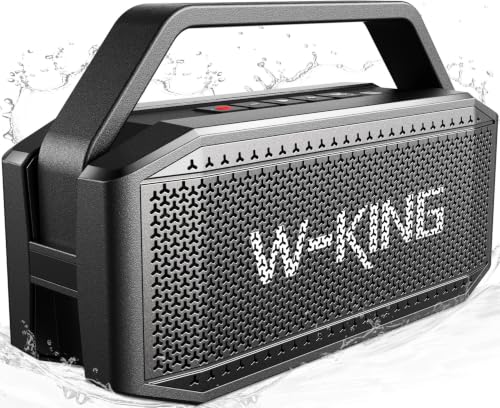
The W-KING D9-1 is built around scale and flexibility. It weighs about 4.4 pounds and measures roughly 13 inches wide, 9 inches high, and 5 inches deep. The built in handle makes that bulk manageable, but this is still a substantial speaker. Its design makes sense for a campsite, garage, dock, or gathering where someone wants to carry one loud box rather than several small speakers.
W-KING lists 100W peak output, four drivers, and a 7.2 inch passive radiator on the rear. The system includes two subwoofers and two tweeters, with a claimed 60W deep bass subwoofer configuration. The passive radiator is the unusual part. It helps the enclosure produce more low-frequency energy without requiring a powered rear driver, giving bass a physical presence that compact speakers cannot match. The product also lists 108dB booming bass, though the supplied information does not define the measurement conditions.
The D9-1 offers more direct sound control than most of the list. A single EQ button switches between bass, middle, and treble-focused modes, and the speaker supports AUX and TF card playback as well as Bluetooth. NFC pairing works with Android devices, and Bluetooth 5.0 is listed with a connection range up to 100 feet. That combination is useful at a camp or worksite where a phone is not always the only source.
W-KING claims up to 40 hours of playtime at low volume and includes a function for charging smart devices. That endurance figure should not be compared directly with a smaller speaker's normal-use claim, because the listing specifically qualifies it with low-volume operation. IPX6 protection handles powerful water jets and rain, and the speaker is described as floatable, but IPX6 is not the same as the IPX7 submersion rating found on the Boom 2, Flip 5, or Soundcore 2.
Two D9-1 speakers can be paired for a claimed 120W stereo setup, but the product notes that D9 and D9-1 models cannot be paired together. The Houl Zallee offers a similar large format and longer stated playtime, while the JBL Boombox 4 has a more polished protection and connection package. Choose the W-KING when bass controls, wired playback, TF cards, NFC, and a long low-volume session matter more than a compact body or dustproof certification.
8. JBL Boombox 4: Best Premium Boombox

Pros
- Two woofers, two tweeters, and three passive radiators
- IP68 waterproof and dustproof build
- Up to 34 hours of playtime
- Deep Bass and Punchy Bass modes
- Bluetooth 5.4
Cons
- About 13 pounds
- Much larger than compact models
- No power output rating is listed
Best for: someone who wants the biggest JBL portable presentation with long battery life and strong environmental protection.
The JBL Boombox 4 is the heavyweight choice for listeners who want a portable speaker to behave more like a party system. It measures about 19.9 inches wide, 10.4 inches high, and 8.4 inches deep, and weighs 13 pounds. The carry handle and redesigned lighter construction help, but it is still a speaker you plan around. It belongs at the center of a beach setup, backyard gathering, or large campsite rather than in a daypack.
JBL gives the Boombox 4 two woofers, two tweeters, and three passive radiators. That driver arrangement is substantially more ambitious than the single-box layouts in the Flip 5 and SoundLink Flex. AI Sound Boost analyzes music in real time to increase output while reducing distortion, and two bass settings let you choose between Deep Bass and Punchy Bass. The first should suit tracks that need weight, while the second is aimed at tighter impact.
Battery life is listed as up to 28 hours, with another six available through Playtime Boost. As with the Charge 6, the extra mode is best understood as an endurance setting rather than a like-for-like replacement for normal playback. The Boombox 4 also uses Bluetooth 5.4, which is a newer connection standard than the Bluetooth 5.0 listed for the W-KING D9-1. The product data does not list a power bank, so the Charge 6 remains more useful when a phone also needs charging.
IP68 waterproof and dustproof protection gives the Boombox 4 a stronger environmental specification than the PartyBox 110. That matters for a speaker this large because moving it in and out of changing weather is less convenient than moving a Flip 5. The Soundcore Boom 2 is easier to handle and floatable, while the Boombox 4 is designed to make a larger area feel filled with sound.
Skip it if portability means carrying a speaker one-handed for long distances or packing it in a small bag. The D9-1 offers a similar big speaker concept with AUX, TF card, NFC, and manual EQ controls, while the JBL has the cleaner modern connection and protection package. The Boombox 4 is for buyers who want the largest, most authoritative JBL presentation in this group and are comfortable with its 13 pound body.
9. Houl Zallee Outdoor Speaker: Best High-Output Alternative

Pros
- 90W peak and 50W RMS output
- Four dedicated drivers and dual passive radiators
- Up to 32 hours of playtime
- IPX7 waterproof and floatable
- Built in carry handle
Cons
- Large 14.9 inch body
- No dust rating is listed
- Playtime varies with volume and content
Best for: someone who wants a large floating speaker with strong output and long stated battery life.
The Houl Zallee Outdoor Speaker takes up more room than its generic name suggests. It measures about 14.9 inches wide, 7.8 inches high, and 3.7 inches deep, with a built in handle for moving it between a pool, garage, and campsite. The shape is more substantial than a JBL Charge 6 or Bose SoundLink Flex, but it is still slimmer than the PartyBox 110 and Boombox 4.
Its listed audio hardware is strong for the category. Houl Zallee specifies 90W peak and 50W RMS output, along with two tweeters, two woofers, four dedicated drivers, and dual passive radiators. The two tweeters are listed at 10W RMS each, while the two woofers are listed at 15W RMS each. Those details point to a speaker designed to keep both vocals and bass active, rather than relying on one small driver to cover everything.
The IPX7 rating and floating design make it a natural poolside option. Houl Zallee says it can withstand submersion in 3.3 feet of water for up to 30 minutes, while the rugged ABS and metal construction is described as shock-resistant. There is no dust protection rating in the supplied information, so the JBL Charge 6 and Boombox 4 are better choices for dusty environments. The built in handle is useful, but the body is too large for effortless small-bag travel.
Up to 32 hours of playtime gives it an advantage over the PartyBox 110 and Bose SoundLink Flex, though the listing says actual playtime varies with volume and audio content. Two Houl Zallee speakers can be paired for stereo sound. The speaker is aimed at listeners who want a large sound source without moving all the way to a party cabinet, and its floatability is more reassuring around water than the PartyBox 110's IPX4 splash protection.
The Boom 2 is a more rounded recommendation because its app EQ, power bank, RGB lighting, and smaller body make it easier to use in more situations. The W-KING D9-1 offers more playback inputs and manual EQ modes. Houl Zallee makes sense for the buyer who prioritizes a high listed output, floating waterproof design, and long sessions, and who does not mind carrying a wide speaker.
How to choose best outdoor bluetooth speakers
The right outdoor speaker depends on where it will sit, how loudly it must play, and how often it will encounter water, dust, or a depleted phone. These are the specifications and design choices that separate a genuinely useful outdoor model from one that is merely loud in a product listing.
Water and dust protection
IP ratings describe how well a device resists intrusion. The first digit covers solids such as dust, while the second covers water. IPX7, used by the Soundcore Boom 2, JBL Flip 5, and Soundcore 2, focuses on water protection without stating a dust rating. IP67 and IP68 add dust protection, making the Bose SoundLink Flex, JBL Charge 6, and JBL Boombox 4 more suitable for beaches and dry, gritty trails.
A floating design adds another layer of practicality around pools and lakes. It does not mean the speaker is indestructible, and water protection should be understood in the context of the manufacturer's conditions. IPX4 on the JBL PartyBox 110 is splash protection, so it should stay away from standing water and heavy rain.
For pool use, choose a floating IPX7 speaker. For beaches and dusty campsites, look for a dust rating as well.
Output and enclosure size
Wattage figures are not a complete measure of sound quality, but they can help separate a small personal speaker from a larger outdoor system. The Soundcore 2 lists 12W, while the Soundcore Boom 2 lists 80W and the JBL PartyBox 110 lists 160W. Houl Zallee provides both peak and RMS figures, with 90W peak and 50W RMS. RMS is generally more useful for understanding sustained output than a peak number.
Enclosure size and driver arrangement matter just as much. Dedicated woofers, tweeters, and passive radiators give the Houl Zallee, W-KING D9-1, and JBL Boombox 4 more physical resources for bass and wide-area sound. A small speaker can sound clear, but it cannot move as much air. For a quiet picnic, the Flip 5 or Bose SoundLink Flex is sufficient. For a noisy yard, move up to the Boom 2 or a larger model.
Battery life and charging
Claimed battery life is usually an upper limit, not a guarantee at maximum volume. The Soundcore Boom 2 and Soundcore 2 list up to 24 hours, while the JBL Charge 6 lists up to 28 hours and the Boombox 4 up to 34 hours with Playtime Boost. The W-KING D9-1 claims up to 40 hours specifically at low volume. Treat these figures as useful comparisons, but expect loud bass-heavy playback to use more power.
A built in power bank can be as useful as another several hours of speaker battery because phones often run low outdoors. The Boom 2, Charge 6, and W-KING D9-1 list phone charging functions. The fast charging feature on the Charge 6 can provide up to 150 minutes of playtime after 10 minutes of charging, according to the supplied product information.
Portability and placement
Weight changes how often a speaker gets used. The Soundcore 2 weighs about 0.91 pounds, the JBL Flip 5 about 1.2 pounds, and the Bose SoundLink Flex about 1.3 pounds. Those models are easy to carry with other gear. The Boom 2 weighs about 3.66 pounds, the W-KING D9-1 about 4.4 pounds, and the Boombox 4 13 pounds. The PartyBox 110 is close to 23.9 pounds, so its portability is mainly about moving it from one fixed location to another.
Placement also affects sound. The Bose SoundLink Flex's PositionIQ system automatically adjusts for whether it is standing, lying down, or hanging. Larger speakers need a stable surface and enough space around them for their drivers and passive radiators to work properly. If your plans involve frequent walking, compare how much speaker size changes everyday portability before choosing a large enclosure.
Sound controls and connections
A basic speaker is easier to operate, but more control can be useful outdoors. The Boom 2 offers Pro EQ through the Soundcore app. The W-KING D9-1 has an EQ button, AUX, TF card playback, and NFC. JBL's Charge 6 supports Auracast connections, while the Flip 5 supports PartyBoost. Bose adds Bluetooth 5.3, multipoint pairing, and the ability to link two compatible speakers in Stereo or Party Mode.
Bass-heavy tuning can be exciting, but it is not always best for speech or acoustic music. Look for a model with a selectable EQ or a companion app if different listeners will use it. If the speaker will stay in one backyard, the features that matter for a fixed outdoor listening setup are different from those needed on a hike.
Frequently asked questions
Can outdoor Bluetooth speakers get wet?
Some can handle substantial water exposure, but the protection depends on the IP rating. IPX7 and IP67 models are designed for temporary submersion under stated conditions, while IPX6 handles powerful water jets and IPX4 is limited to splashes. Always follow the product's care instructions and keep charging ports closed.
Which outdoor speaker has the strongest bass?
The largest models have the best physical advantage for bass. The JBL Boombox 4 uses two woofers and three passive radiators, while the W-KING D9-1 has a large 7.2 inch passive radiator and two subwoofers. The Soundcore Boom 2 is the more manageable bass-focused option because it combines a dedicated subwoofer with an 80W design.
Is IPX7 better than IP68 for outdoor use?
Neither rating is universally better because they emphasize different protections. IPX7 states water protection but does not provide a dust rating, while IP68 includes dust protection and water protection under the manufacturer's specified conditions. For a pool, an IPX7 floating speaker is useful. For a beach or dusty campsite, IP68 or IP67 offers broader protection.
How much battery life do I need for camping?
A speaker with an up to 12 hour claim can cover a day of moderate listening, but longer stated battery life gives more flexibility when charging is difficult. The Soundcore 2 and Boom 2 list up to 24 hours, while the Charge 6 and Boombox 4 list up to 28 and 34 hours with their extended modes. High volume and heavy bass reduce real-world endurance.
Can these speakers charge a phone?
The Soundcore Boom 2, JBL Charge 6, and W-KING D9-1 list power bank or device charging functions. The other products do not list a phone charging feature in the supplied data. A power bank speaker can be helpful outdoors, but using it to charge a phone will reduce the energy available for music.
Are larger speakers always louder outdoors?
Larger speakers usually have more room for bigger drivers and passive radiators, which helps them produce fuller sound and more bass. They are not automatically better for every listener because they weigh more and take up more space. The Bose SoundLink Flex and JBL Flip 5 are easier to place close to listeners, while the PartyBox 110 and JBL Boombox 4 are designed to cover larger gatherings.
Can I pair two outdoor Bluetooth speakers?
Several picks support pairing. The JBL Flip 5 uses PartyBoost, the Charge 6 uses Auracast, the Bose SoundLink Flex can link two compatible Bose speakers, and the W-KING D9-1 can pair two D9-1 units for stereo sound. Compatibility is specific to each system, so speakers from different brands generally cannot be combined into one stereo pair.
The bottom line
The Soundcore Boom 2 is our top pick among the best outdoor bluetooth speakers because it handles the widest range of situations. Its dedicated subwoofer, 80W design, IPX7 floatable body, up to 24 hours of playtime, power bank, and app EQ give it more flexibility than the compact JBL models without the extreme size of the PartyBox 110 or Boombox 4.
Choose the JBL Charge 6 if dustproof protection, drop resistance, Auracast pairing, and a compact body matter more than the Boom 2's dedicated bass hardware. Choose the JBL PartyBox 110 for a large event with music-synchronized lighting, or the Bose SoundLink Flex when balanced sound and easy carrying are the priority.
For an undecided reader, get the Soundcore Boom 2 unless you specifically need the Charge 6's tougher IP68 build or the Bose Flex's smaller, more refined form.
As an Amazon Associate we earn from qualifying purchases.