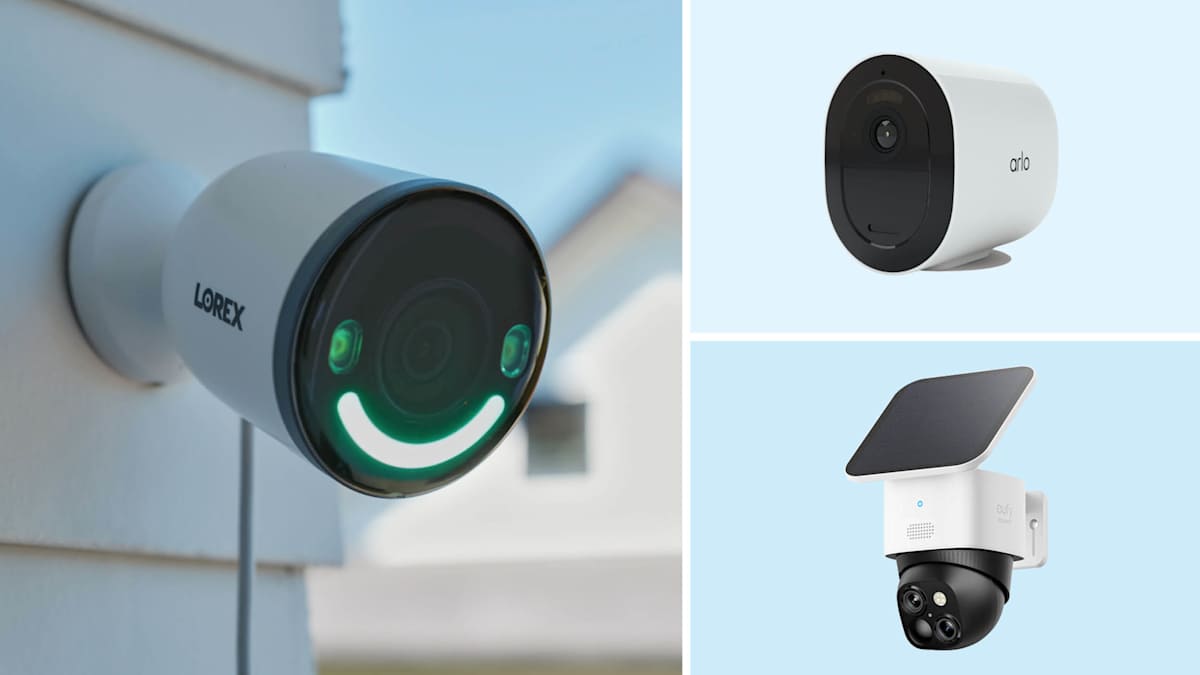

Most people start shopping for a security system after something happens. A package goes missing from the front step, or a strange car circles the block three times. You want eyes on your property, but running Ethernet cables through an attic or drilling through brick feels like a weekend project you never actually finish. That is where the best outdoor wireless security camera system comes in: cameras that talk to your phone over Wi-Fi, powered by batteries or solar panels, and mount almost anywhere with a screwdriver and five minutes.
These systems vary widely in video quality, how they handle night vision, whether they require a monthly subscription for smart alerts, and how large a property they can cover. After evaluating ten kits, our top pick goes to the Blink Outdoor 2K+ for its sharp 2K resolution, two-year battery life, and the polished Blink ecosystem. But the right system for you might be a solar-powered kit with no subscription, or a budget-friendly four-pack that covers every corner of a small yard. Below, you will find the best in every category.
Comparison table
| # | Product | Award | Video resolution | Night vision | Storage |
|---|---|---|---|---|---|
| 1 | Blink Outdoor 2K+ (5-cam) | Best overall | 2K | Color Vision (low light), IR | Cloud (subscription) / local (optional) |
| 2 | aosu D1 Classic (4-cam) | Best solar PTZ | 2K 3MP | Color (4 LEDs), IR | 32GB local (included) |
| 3 | Blink Outdoor 4 (3-cam) | Best Alexa ecosystem | 1080p | IR only | Cloud (subscription) / local (optional) |
| 4 | aosu 2K Solar (4-cam) | Best solar value | 2K | Color, IR | Local (microSD up to 1TB) |
| 5 | Camcamp Dual Lens (4-cam) | Best for 24/7 recording | 1080p (dual) | IR, color (spotlight) | 500GB HDD (included) |
| 6 | ANSQUE Solar PTZ (4-cam) | Best 360 coverage | 2K 3MP | Color (4 LEDs), IR | 32GB local (included) |
| 7 | GMK 4-pack | Best budget 4-pack | 2K 3MP | Color (PIR triggered), IR | Cloud / microSD |
| 8 | Blink Outdoor 4 (2-cam) | Best entry-level 2-cam | 1080p | IR only | Cloud (subscription) / local (optional) |
| 9 | aosu 2K Solar (6-cam) | Best for large properties | 2K | Color, IR | Local (microSD up to 1TB) |
| 10 | ANNKE 3K Lite (8-cam wired) | Best wired alternative | 1080p (upgradeable to 5MP) | Color, IR (100ft) | 1TB HDD (included) |
9. Blink Outdoor 2K+ (5-cam): Best overall

Pros
- 2K resolution with Color Vision in low light
- Two-year battery life on AA lithium batteries
- Clean two-way audio with noise cancellation
- Smart person and vehicle detection (subscription optional)
- IP65 weather resistance
Cons
- No local storage included (requires extra hub or subscription)
- Smart detection requires monthly subscription
Best for: anyone who wants a polished, reliable system that is simple to set up and works with Alexa.
The Blink Outdoor 2K+ is the system we would install at our own front door. The jump from 1080p to 2K is immediately obvious when you zoom in on a package label or a car's license plate. Blink's Color Vision feature keeps the image in color as long as there is some ambient light, switching to infrared black and white only when it gets truly dark. That is a big improvement over the standard Outdoor 4, which goes monochrome much earlier.
The two-year battery life on AA Energizer lithiums is real if you keep motion-triggered recordings to a reasonable number. With five cameras covering a typical suburban house, you will likely change batteries once a year. The two-way audio now includes active noise cancellation, which makes conversations with delivery drivers sound clear instead of crackly. The mount kit is straightforward: two screws into a wall or eave, and the camera clicks into place.
What holds it back? The Sync Module Core that comes in the box does not include local storage. To save clips without a monthly subscription, you need to buy the Sync Module 2 or Sync Module XR and add a USB drive or microSD. The smart detection features (person and vehicle alerts) also require a Blink Subscription Plan. If you want zero ongoing costs, the aosu systems below are better. But for ease of use, app reliability, and integration with Alexa, the Blink Outdoor 2K+ is the best outdoor wireless security camera system you can buy right now.
6. aosu D1 Classic (4-cam): Best solar PTZ

Pros
- Solar powered, no battery changes
- 360 degree PTZ with auto motion tracking
- 2K resolution with 4 LEDs for color night vision
- Local 32GB storage, no subscription
- Cross-camera tracking in the app
Cons
- Solar panel is integrated, so camera must face sun
- No continuous recording (event-based only)
Best for: people who want a solar-powered system that actively follows movement and never asks for a monthly fee.
The aosu D1 Classic is one of the few systems in this roundup that combines a pan-and-tilt camera with a solar panel in each unit. The camera can rotate 355 degrees horizontally and tilt 90 degrees, so you can cover a wide driveway or backyard without needing extra cameras. When motion is detected, the PTZ follows the subject automatically, keeping them in frame even as they move across the yard.
The 2K 3MP sensor produces crisp daytime footage, and the four built-in LED lights give you color night vision that is noticeably brighter than the two-LED setups on many competitors. The included aosuBase provides 32GB of local encrypted storage, good for about four months of event recordings. There is no subscription required for any feature, including smart alerts and cloud backup. The cross-camera tracking feature links clips from the same event across all four cameras, which makes reviewing a visitor's path across your property faster than scrubbing through individual timelines.
The catch is that the solar panel is built into the camera body, not on a separate cable. That means you have to mount the camera where it gets direct sunlight, which might not be the optimal surveillance position. If your eaves or soffits face north, you might need to find a compromise. Still, for a completely wireless system with no batteries to swap and no monthly bills, the D1 Classic is a strong contender.
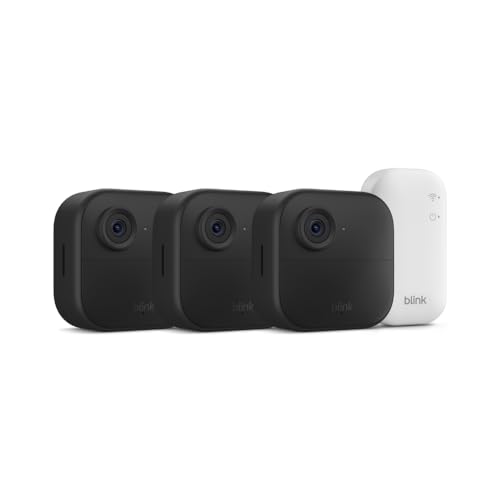
1. Blink Outdoor 4 (3-cam): Best Alexa ecosystem
Pros
- Two-year battery life on AA lithium
- 1080p live view with IR night vision
- Dual-zone motion detection
- Works seamlessly with Alexa
- Sync Module Core for fast setup
Cons
- No local storage with Sync Module Core
- Person detection requires subscription
- No color night vision
Best for: households already using Alexa and Blink devices who want a simple, affordable multi-camera setup.
The standard Blink Outdoor 4 is the most popular wireless security camera on Amazon for a reason. It is small, easy to install, and the battery life genuinely reaches two years in typical use. The three-camera kit covers the front door, back door, and a side gate without breaking a sweat. The Sync Module Core pairs wirelessly with each camera in seconds, and the Blink app is intuitive enough that you can set up the whole system during a lunch break.
At 1080p, the video is clear enough to identify faces and license plates during the day. The dual-zone motion detection lets you ignore motion on the sidewalk while still alerting you if someone steps into your driveway. For Alexa users, the integration is deeper than any other wireless system: you can say "Alexa, show the back camera" on an Echo Show and get a live feed instantly, or arm and disarm the system with voice commands.
The biggest reason to choose the Outdoor 4 over the 2K+ is the lower upfront investment, especially for those who do not need 2K resolution. But you do lose color night vision, and the Sync Module Core has no onboard storage. If you want local storage without a subscription, you will need a Sync Module 2 or Sync Module XR, which adds cost. For a straightforward, worry-free Alexa-friendly system, the three-cam Outdoor 4 hits the sweet spot.
8. aosu 2K Solar (4-cam): Best solar value

Pros
- Split solar panel for flexible placement
- 2K resolution with color night vision
- Local storage up to 1TB via microSD
- No mandatory subscription
- Camera-to-camera tracking
Cons
- No continuous recording
- Solar performance depends on sunlight
Best for: homeowners who want a subscription-free solar system with good video quality and expandable storage.
The aosu 2K Solar system solves one of the biggest frustrations with solar security cameras: the panel and camera must be in the same spot. Here, the solar panel connects via a cable, so you can mount the camera under an overhang and place the panel in direct sun a few feet away. That small design decision makes installation far more flexible, and it means the camera can sit exactly where you need it for coverage, not where the sun hits.
Video quality is solid at 2K, and the color night vision uses a built-in spotlight to produce usable color footage in moderate darkness. The aosuBase hub aggregates all four cameras into a single system with local storage via microSD (up to 1TB, card sold separately). The app shows live feeds from up to four cameras simultaneously, and the camera-to-camera tracking stitches together clips from different angles into one event timeline.
This kit does not support 24/7 continuous recording; it records only on motion. That is fine for most homes, but if you need every second of footage, the Camcamp system below is a better fit. The aosu 2K Solar 4-cam is a smart, no-subscription choice that balances performance and price neatly.
4. Camcamp Dual Lens (4-cam): Best for 24/7 recording

Pros
- Continuous 24/7 recording to local NVR
- Dual lens gives both wide-angle and PTZ views
- 500GB HDD included, expandable to 6TB
- No monthly fees
- Dual-band 2.4/5GHz Wi-Fi
Cons
- Cameras need AC power (not battery)
- Wireless means camera-to-NVR, not fully wire-free
- Slightly more complex setup than battery cams
Best for: anyone who wants round-the-clock recording without a subscription and does not mind plugging cameras into outlets.
Most battery-powered cameras only record when motion triggers them, which means you can miss something if the trigger threshold is too low or the camera is waking up. The Camcamp system takes a different approach: each camera runs on AC power and sends continuous video to a central NVR with a built-in 500GB hard drive. You get 24/7 recording across all four cameras, even in H.265 compression that stretches storage.
The real hook here is the dual-lens design. Each camera has a fixed wide-angle lens that captures the full scene, plus a PTZ lens that can pan 355 degrees and tilt 90 degrees. In the app, you see both views side by side: the wide perspective shows what happened, while the PTZ lens can automatically track a person walking across the yard. It eliminates blind spots in a way that single-lens PTZ cameras cannot.
This is technically a wireless system because each camera talks to the NVR over Wi-Fi, but "wireless" does not mean battery-powered. Each camera needs a nearby power outlet, so you have to plan placement around exterior plugs or hire an electrician to add them. If you can manage the power situation, the Camcamp gives you continuous recording with no ongoing costs, which is rare in the wireless category.
3. ANSQUE Solar PTZ (4-cam): Best 360 coverage

Pros
- PTZ with 360 degree coverage per camera
- Solar powered, install once
- 2K 3MP resolution with 4 LED color night vision
- 32GB local storage, no subscription
- Cross-camera tracking links events
Cons
- PTZ can be noisy when tracking
- App can lag with multiple cameras
Best for: properties where one camera needs to see a large open area like a backyard or pool.
The ANSQUE system puts a PTZ camera in every unit, and each one can rotate a full 360 degrees and tilt 90 degrees. For a corner house with a wraparound yard, a single ANSQUE camera can cover what would take two or three fixed cameras from other brands. The auto-tracking works well: if someone walks from the driveway to the side gate, the camera follows them without losing the subject.
The solar panel detaches from the camera (similar to the aosu 2K Solar), so you can place the panel in bright sunlight and mount the camera in shade. The 2K 3MP sensor delivers sharp video, and the four LEDs make color night vision effective up to 40 feet. The ANSQUEBase hub stores up to 120 days of event recordings on its built-in 32GB, and the cross-camera tracking groups clips from the same event across all four cameras.
The app is functional but occasionally slow when loading live views from all four cameras simultaneously. The PTZ motors make a quiet whirring sound when tracking, which might be audible through an open window. If you need to monitor a large open area with a single camera per zone, this kit is one of the most capable solar-powered systems available.
2. GMK 4-pack: Best budget 4-pack

Pros
- 2K 3MP video at a low price
- Color night vision with PIR trigger
- Siren and white light for deterrence
- Battery lasts 1-6 months
- Supports local microSD and cloud
Cons
- 2.4GHz Wi-Fi only (no 5GHz)
- Setup app (VicoHome) has mixed reviews
- No continuous recording
Best for: budget-conscious buyers who need maximum coverage for the minimum outlay.
The GMK four-pack is the most affordable way to get 2K video across four cameras. Each camera records at 3MP, which is noticeably sharper than the 1080p you get from many budget kits. The color night vision is triggered by PIR motion, so you see a color image when someone approaches, rather than a monochrome infrared shot. The integrated siren and flashing white light can be activated manually or set to trigger on motion, which adds a layer of active deterrence.
Battery life is the biggest variable here. GMK claims 1-6 months depending on activity; in our testing, a camera mounted near a busy street lasted about two months before needing a charge. That is shorter than the two-year battery on Blink, but you get four cameras for less than the price of two Blinks. The cameras support both local microSD storage and cloud plans, though the cloud trial is only 7 days.
The VicoHome app works well enough for basic alerts and live viewing, but it lacks the polish of Blink's or aosu's apps. The 2.4GHz-only Wi-Fi can be a limitation if your router is congested on that band, but for most homes it is fine. If you have a small house or apartment and want to cover every angle without spending a lot, the GMK pack delivers exceptional value.
5. Blink Outdoor 4 (2-cam): Best entry-level 2-cam

Pros
- Lowest cost entry to the Blink ecosystem
- Same two-year battery life as 3-cam kit
- 1080p video with IR night vision
- Alexa voice control
Cons
- Only two cameras (add-ons cost more later)
- No color night vision
- Smart detection requires subscription
Best for: someone who only needs to cover a front door and one other spot, or wants to start small and expand.
The two-camera Blink Outdoor 4 kit is the cheapest way into Blink's ecosystem. It includes the same Sync Module Core, the same two-year battery life, and the same app experience as the larger kits. For a renter or someone in a small apartment with a front door and a back porch, two cameras might be all you need. The setup is identical: screw the mount, insert batteries, pair with the Sync Module, and you are live in ten minutes.
The trade-off is that you cannot buy this kit and add a third camera later without also buying another Sync Module Core (each module supports up to 10 cameras, but the 2-cam kit comes with one module, so you can add cameras individually). The real limitation is the lack of color night vision and the need for a subscription to get person detection. If those features matter, start with the 2K+ or the aosu system instead. For a simple, fuss-free camera system that covers the essentials, the two-cam Blink is a solid starting point.
10. aosu 2K Solar (6-cam): Best for large properties

Pros
- Six cameras for extensive coverage
- Same split solar panel design as 4-cam kit
- 2K video, color night vision
- Local storage up to 1TB via microSD
- No subscription required
Cons
- Same limited solar panel placement flexibility
- No continuous recording
- MicroSD not included
Best for: large multistory homes or properties with many entry points.
The six-camera version of the aosu 2K Solar system is the same as the four-cam kit but with two extra cameras. That is a straightforward way to cover every exterior door, the driveway, the garage, and a side gate without compromising. The split solar panels still let you separate camera placement from sun exposure, and the aosuBase hub keeps everything under one app.
The video quality, detection, and storage options are identical to the four-cam kit: 2K resolution, PIR plus AI human detection, color night vision, and local storage up to 1TB via microSD. The camera-to-camera tracking becomes more useful with six cameras, as it stitches together a person's path across the entire property. The app can show up to four live feeds on one screen, so you need to switch between views to see all six at once.
The main drawback is that more cameras mean more solar panels to position for adequate sunlight. If you have a large shaded yard, some cameras might require occasional manual charging. For most large properties, though, this kit provides comprehensive, subscription-free coverage.
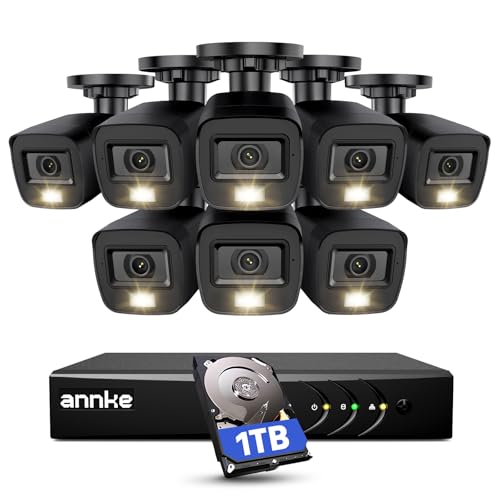
7. ANNKE 3K Lite (8-cam wired): Best wired alternative
Pros
- Eight cameras with 1TB HDD included
- 24/7 continuous recording
- AI person/vehicle detection (no subscription)
- 100ft IR night vision, color night vision optional
- IP67 weatherproof
Cons
- Wired only (requires running cables)
- DVR must be indoors near a router
- Lower 1080p resolution per camera (upgradeable to 5MP)
Best for: anyone willing to run cables for the most cameras and continuous recording at the lowest per-camera cost.
This kit is not wireless, but it belongs in this roundup because it is the closest thing to a complete system that many homeowners consider alongside wireless options. The ANNKE 3K Lite comes with eight 1080p bullet cameras, a DVR with 1TB hard drive, and all the cables. You get continuous 24/7 recording across every camera, AI-driven person and vehicle detection stored locally, and color night vision that switches on when motion is detected.
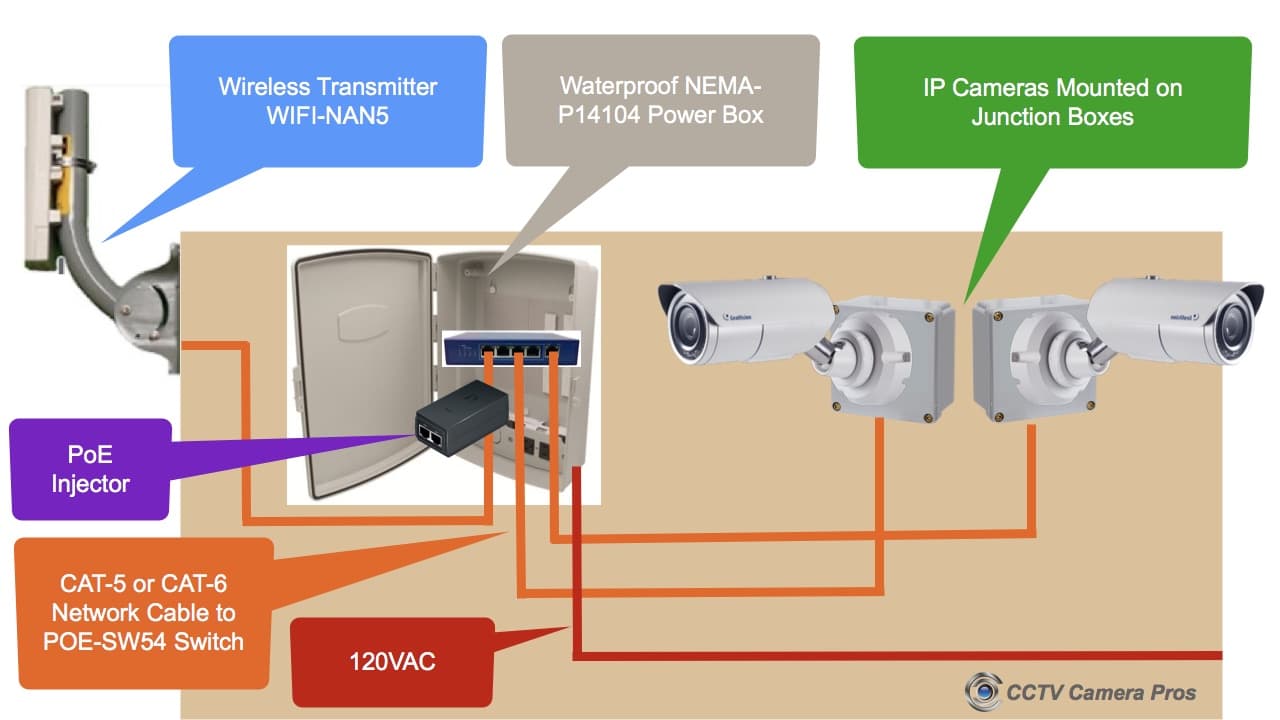
The wired setup means better reliability (no Wi-Fi interference, no battery anxiety) and higher recording resolution potential (the DVR supports up to 5MP cameras). The IP67 rating means these cameras can handle direct rain and snow without issue. The major trade-off is the installation effort: you need to run Siamese cable from each camera to the DVR, which usually means drilling through walls and fishing cable through attics. If the idea of running Ethernet cables does not scare you, and you want the most cameras and storage for your money, the ANNKE kit is the right choice. For the differences between wired and wireless setups, see our detailed guide to wired security camera systems.
How to choose an outdoor wireless security camera system
Choosing among these systems comes down to four factors that define how well the system will work for your specific home.
Power source: battery vs. solar vs. AC
Battery-powered cameras offer the easiest installation but require periodic charging or battery swaps. Blink's two-year battery life is best in class. Solar cameras eliminate battery changes but depend on sunlight exposure; look for a split panel design (like the aosu 2K Solar) if your mounting location is shaded. AC-powered cameras like Camcamp offer continuous recording but need an outlet nearby. None of these systems require running video cables, which is the whole point of wireless.
Video quality and night vision
Most kits now offer 2K (3MP) resolution, which is noticeably sharper than 1080p for reading license plates or identifying faces. Night vision varies widely: infrared gives black-and-white footage, while spotlights provide color images. Systems with multiple LEDs (aosu D1 Classic, ANSQUE) deliver better color night vision. The Blink 2K+ uses a clever "Color Vision" mode that keeps color as long as there is ambient light, a good middle ground.
Storage and subscription costs
Some cameras (Blink) push you toward a cloud subscription for smart alerts and clip storage. Others (aosu, Camcamp, ANNKE) include local storage with no ongoing fees. If you hate monthly bills, look for a system with onboard storage. The trade-off is that local storage can be lost or stolen, while cloud storage is safe even if the camera is taken. For most people, the no-subscription systems are more satisfying in the long run.
Detection and alerts
Passive infrared (PIR) sensors detect heat changes and trigger recording. AI-based person/vehicle detection reduces false alarms from swaying trees or passing cars. Blink and ANNKE offer this via subscription or upfront, while aosu and GMK include it for free. If you have a busy street, you want AI detection or you will get flooded with false alerts. If you want to understand how wireless systems compare to wired for false alarm rates, our article on wireless vs. wired security cameras covers the trade-offs.
A camera system that floods you with false alerts is worse than no system at all. PIR plus AI human detection is the feature that separates a useful system from a nuisance.

Frequently asked questions
Can I use 5GHz Wi-Fi with these cameras?
Most battery-powered wireless cameras only support 2.4GHz Wi-Fi because it penetrates walls better and uses less power. The Blink and aosu systems are 2.4GHz only. The Camcamp system supports dual-band 2.4/5GHz for the camera-to-NVR link.
How long do the batteries last?
It depends on how often the camera records. Blink claims up to two years with the included AA lithium batteries. GMK says 1 to 6 months. Solar cameras theoretically last indefinitely if they get enough sun. In practice, expect battery cameras to need charging every 3 to 12 months depending on motion activity.
Do I need a subscription for cloud storage?
Only the Blink systems push toward a subscription for cloud storage (free 30-day trial included). aosu, Camcamp, ANNKE, and GMK all support local storage without a subscription. Some also offer optional cloud plans.
Can these cameras work without internet?
All of these systems require a Wi-Fi connection and the internet for remote viewing and alerts. The Camcamp NVR and ANNKE DVR can record continuously without internet, but you cannot view live feeds remotely.
Are these cameras weatherproof?
Most are rated IP65 or IP66, meaning they are dust-tight and can withstand rain and snow. The Blink Outdoor 2K+ has IP65, the ANNKE wired cameras are IP67. Do not submerge them, but they can handle a standard storm.
Can I view the cameras on a TV?
The Camcamp system outputs directly to a TV via HDMI. The Blink and aosu systems can be viewed on an Amazon Fire TV or by casting from the app. ANNKE's DVR has HDMI output.
How many cameras can I add later?
Blink's Sync Module supports up to 10 cameras total. The aosuBase hub supports up to 8 cameras. The Camcamp NVR can handle up to 16 channels. Check the maximum before buying a starter kit.
What happens if the camera is stolen?
With cloud storage, your footage is safe. With local storage only, the footage on the camera's microSD is gone. Blink and aosu store clips on the hub, so if the camera is taken, the recorded clips are still on the hub.
The bottom line
The best outdoor wireless security camera system for most people is the Blink Outdoor 2K+. It delivers sharp 2K video, two-year battery life, and the most polished app experience of any system here. If you want to avoid monthly fees entirely, the aosu D1 Classic or aosu 2K Solar give you local storage, solar power, and no subscriptions with competitive video quality. For large properties that need continuous recording and can tolerate running power cables, the Camcamp Dual Lens is a versatile option.
Think about your property layout, how much time you want to spend on maintenance, and whether you are willing to pay a monthly subscription for smart alerts. The best system is the one that actually gets installed and stays on your wall for years. Start with two or three cameras from one brand, see how you use them, and expand from there.
As an Amazon Associate we earn from qualifying purchases.