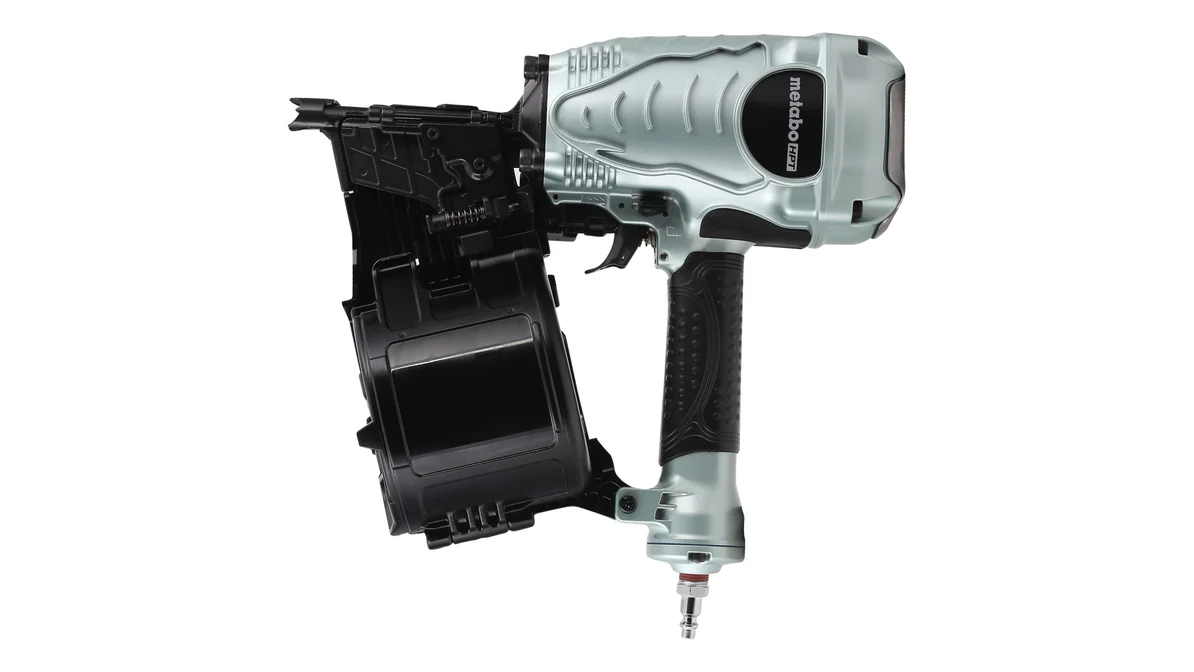

A framing nailer earns its keep when the work involves hundreds of fasteners, overhead sheathing, or long runs of studs. The wrong one makes that work harder: a heavy body tires your arm, a mismatched collation angle limits your nail choices, and a trigger that is awkward to change slows every repetitive task.
The Best pneumatic framing nailer picks here cover full-round-head 21-degree tools, 30-degree paper-collated models, and compact options for remodeling. They differ sharply in weight, nail range, controls, and the kind of work they suit.
Metabo HPT NR90AES1 is our top pick, but the list also includes a particularly light Paslode, flexible BOSTITCH, capable NuMax and Freeman tools, and two VEVOR models with broad nail compatibility.
Comparison table
| # | Product | Award | Nail range | Weight | Best for |
|---|---|---|---|---|---|
| 1 | Metabo HPT NR90AES1 | Best overall | 21°, 2 to 3-1/2 in. plastic collated | 7.5 lb | General framing and decking |
| 2 | VEVOR 21-Degree Framing Nailer | Best nail compatibility | 21°, 2 to 3-1/2 in. | 9 lb | Mixed nail types |
| 3 | NuMax SFR2190 | Best practical features | 21°, 2 to 3-1/2 in. | 8.6 lb | DIY framing and repair work |
| 4 | BOSTITCH F21PL | Best for connector work | 1-1/2 to 3-1/2 in. | 8.15 lb | Framing and metal connectors |
| 5 | NuMax SFR2190WN | Best with starter nails | 21°, 2 to 3-1/2 in. | 8.6 lb | First framing projects |
| 6 | Metabo HPT NR83A5 | Best for jobsite controls | 21°, 2 to 3-1/4 in. | 8.8 lb | Frequent professional use |
| 7 | Metabo HPT NR90ADS1 | Best paper-collated model | 30°, 2 to 3-1/2 in. | 7 lb | Tight framing spaces |
| 8 | VEVOR Pro 21-Degree Nailer | Best for pressure flexibility | 21°, 2 to 3-1/2 in. | 9.3 lb | Framing and roof decking |
| 9 | Freeman PFR2190 | Best with a storage case | 21°, 2 to 3-1/2 in. | 8.5 lb | Organized workshop storage |
| 10 | Paslode F325R | Best lightweight remodeler | 30°, 2 to 3-1/4 in. | 5.9 lb | Overhead and tight-space work |
1. Metabo HPT NR90AES1: Best Overall

Pros
- Manageable 7.5-pound body
- Sequential and contact firing from a selector switch
- Tool-less depth adjustment
- Accepts nails from 2 to 3-1/2 inches
- Five-year professional tool warranty
Cons
- Limited to 21-degree plastic-collated nails
- Heavier than the Paslode F325R for overhead work
Best for: someone who wants one dependable 21-degree nailer for framing, sheathing, decking, and flooring.
The Metabo HPT NR90AES1 is the tool we would hand to most people starting a framing job. It has the familiar full-size shape of a serious pneumatic nailer without turning every wall section into an arm workout. At 7.5 pounds, it is not featherlight, but its balance makes the weight easier to manage when moving from studs to roof decking.
Its 21-degree magazine takes plastic-collated nails from 2 to 3-1/2 inches, which covers the range most general framing tasks demand. That includes flooring, truss assembly, window build-up, subflooring, wall sheathing, and roof decking. The broad length range matters more than a headline power claim because it lets one tool move between structural work and shorter fastening jobs without changing nailer platforms.
The controls are well chosen. A selector changes the tool between sequential and contact actuation, so precision placement and rapid repetitive nailing are both available without swapping parts. The depth wheel lets you set a nail flush or countersunk as the material changes. That adjustment is especially useful when moving from soft framing lumber to denser decking, where a fixed setting can leave heads proud or drive them too far.
Compared with the NuMax SFR2190, the Metabo HPT feels like the more polished all-purpose choice, while the VEVOR 21-Degree Framing Nailer accepts more nail types. The Metabo HPT gives up that flexibility, and users committed to 30-degree paper-collated nails should choose the Metabo HPT NR90ADS1 instead. The NR90AES1 is also not the pick for someone who spends most of the day overhead and wants the lowest possible weight.
For ordinary framing, the balance of nail range, selectable firing, depth control, and manageable handling is hard to beat. Choose it when you want a pneumatic framing nailer that can cover a wide list of wood-construction jobs without making the design complicated.
2. VEVOR 21-Degree Framing Nailer: Best Nail Compatibility

Pros
- Accepts smooth, ring-shank, and threaded nails
- Tool-less depth adjustment
- Sequential and contact firing modes
- Open nose helps with jam removal
- Magazine holds up to 60 nails
Cons
- Nine-pound body is among the heaviest here
- Limited to 21-degree fasteners
Best for: users who need one nailer to handle several compatible full-round-head nail styles.
The VEVOR 21-Degree Framing Nailer stands out because it is not restricted to one shank pattern. It accepts smooth-shank nails from 2 to 3-1/2 inches, ring-shank nails from 2 to 3 inches, and threaded nails from 2 to 3 inches. That makes it a useful option for a workshop where the fastening job changes more often than the tool does.
The 80 to 120 PSI operating range gives the compressor setup room to match the material and nail length. A tool-less depth wheel handles the final adjustment at the nailer, while the dual trigger modes let you choose sequential firing for controlled placement or contact firing for speed. Those two controls address the problems that show up quickly on real framing work: inconsistent depth and a slow rhythm on long runs.
The open nose is a practical touch. When a nail jams, access matters more than decorative design, and the VEVOR is built for quicker extraction. Its aluminum magazine holds up to 60 nails, reducing reload interruptions, although that capacity does not remove the need to monitor the magazine during a long session.
At 9 pounds, it is noticeably more demanding than the Metabo HPT NR90AES1 and far heavier than the Paslode F325R. It also gives up the 30-degree access of the Metabo HPT NR90ADS1. Its advantage is the nail compatibility, not portability. If your work uses only standard smooth-shank 21-degree nails, the lighter Metabo HPT is the easier tool to live with.
This VEVOR makes the most sense for a user who already knows the nail types required for upcoming projects and wants the magazine to accommodate them. It is a broad-capability choice for ground-level framing, decks, fences, and flooring where the extra weight is acceptable.
3. NuMax SFR2190: Best Practical Features

Pros
- Drives 21-degree nails from 2 to 3-1/2 inches
- Anti-dry-fire mechanism
- Single and bump firing modes
- No-mar safety tip
- Adjustable exhaust directs air away from the user
Cons
- Eight-point-six-pound weight is not especially light
- 21-degree plastic collation limits nail selection
Best for: DIY builders and repair users who want useful safeguards and adjustment controls.
The NuMax SFR2190 is built around the everyday annoyances that can make a pneumatic nailer frustrating. Its anti-dry-fire mechanism is intended to prevent empty shots, the no-mar tip helps protect finished surfaces, and the exhaust can be rotated through 360 degrees so expelled air is easier to direct away from your face.
It uses 21-degree plastic-collated full-round-head nails from 2 to 3-1/2 inches, with compatible diameters listed from 0.113 to 0.131 inch. That is a useful general-purpose range for framing, subfloors, roof decking, fencing, pallets, and shipping crates. The tool-less depth adjustment lets you tune how the fastener sits instead of accepting the same drive depth in every material.
The dual-mode trigger is also sensibly implemented. Sequential firing suits accurate placement near edges or corners, while bump firing speeds up repetitive work once the nailer is positioned correctly. An ergonomic comfort grip helps with control, though the 8.6-pound body still makes extended overhead work more tiring than it is with the lighter Metabo HPT NR90ADS1.
The NuMax SFR2190WN is essentially the same kind of tool with 500 3-inch bright framing nails included. Choose the SFR2190 when you already have the right fasteners or want to select them yourself. The Freeman PFR2190 offers a similar feature set with a storage case, while this NuMax keeps the focus on the nailer.
Its weakness is not a missing control. It is the weight and the ordinary 21-degree limitation. For occasional framing, the safeguards and depth control are useful, but someone building all day should look first at the 7-pound Metabo HPT NR90ADS1 or the 5.9-pound Paslode F325R.
4. BOSTITCH F21PL: Best for Connector Work

Pros
- Two quick-change nosepieces
- Designed for framing and metal connector applications
- Push-button depth guide
- Adjustable rafter hook
- Magnesium body
Cons
- Connector-focused nail details are more specialized
- Eight-point-one-five-pound body is not the lightest here
Best for: builders who move between wood framing and metal connector fastening.
The BOSTITCH F21PL earns its place by doing more than standard framing. Its two quick-change nosepieces convert the tool between framing and metal connector applications, so it is aimed at users who need one pneumatic platform for structural wood work and connector hardware.
The push-button depth guide makes adjustment quicker than a wheel that needs several turns, at least when you are changing settings repeatedly. The tool also has an adjustable rafter hook, which is useful when the nailer needs to stay close while you reposition on rafters or joists. Its magnesium construction keeps the body relatively manageable at 8.15 pounds.
The listed framing range runs from 1-1/2 to 3-1/2 inches, while the feature information specifically calls out plastic-collated 1-1/2-inch and 2-1/2-inch metal connector nails with diameters from 0.131 to 0.148 inch. That distinction matters. The F21PL is not simply a generic framing nailer with a different color. Its value is the ability to change nosepieces and work with connector fastening tasks.
Compared with the Metabo HPT NR83A5, the BOSTITCH has the more distinctive nosepiece system. The Metabo HPT counters with an open nose, a two-piece magazine, and a hardened claw tip for angled driving. For straightforward framing, the Metabo HPT NR90AES1 is a simpler recommendation, while the BOSTITCH makes more sense when connector work is part of the plan.
This is not the first pick for someone who only needs to assemble walls and sheathing. The extra flexibility is the reason to choose it, and users should confirm their exact connector nail requirements before starting. For remodelers and framers who regularly switch between applications, the F21PL is the more specialized tool.
5. NuMax SFR2190WN: Best With Starter Nails

Pros
- Includes 500 3-inch bright framing nails
- Dual-mode trigger
- Tool-free depth adjustment
- Anti-dry-fire design
- Comfort grip and easy-load magazine
Cons
- Heavier than the lightest picks
- Included nails do not cover every framing length
Best for: a first framing project where having compatible nails ready matters.
The NuMax SFR2190WN is the straightforward package for someone who wants to begin a framing job without separately sourcing the first fasteners. It includes 500 3-inch bright framing nails, and the nailer itself accepts 21-degree plastic-collated full-round-head nails from 2 to 3-1/2 inches.
The included nails are useful for getting started, but they should not be mistaken for a complete fastener supply. Different stages of a project can call for different lengths, and the nailer supports that broader range even though the package includes one 3-inch size. The easy-load magazine uses a pull-back pusher, which keeps reloads simple.
Its controls match the SFR2190 platform. You can switch between bump and sequential firing, adjust depth without a separate tool, and rely on an anti-dry-fire design intended to reduce empty shots. A comfort grip helps with placement, while the one-piece drive blade is designed for durability. The feature set is sensible rather than elaborate.
The main comparison is with the NuMax SFR2190, which offers the same core nail range and controls without the included nails. The Freeman PFR2190 adds a blow-molded case instead, and the Metabo HPT NR90AES1 is lighter with a longer stated warranty. The NuMax bundle is the one to consider when the included 3-inch nails are useful to your immediate project.
At 8.6 pounds, it is not a good fit for someone whose main concern is overhead fatigue. The Paslode F325R is dramatically lighter, although it takes a different 30-degree nail system and tops out at 3-1/4 inches. Choose the SFR2190WN for a practical start, not for the lightest body or the broadest collation options.
6. Metabo HPT NR83A5: Best for Jobsite Controls

Pros
- Selectable contact and sequential actuation
- Left or right positioning for the rafter hook
- Open nose for jam extraction
- Hardened claw tip for angled driving
- Rear-loading two-piece magazine
Cons
- Nail range ends at 3-1/4 inches
- Eight-point-eight-pound weight is substantial
Best for: frequent framing work where hook placement, jam access, and handling details matter.
The Metabo HPT NR83A5 feels designed around a busy jobsite rather than a single weekend project. Its rafter hook can be positioned on either side, a small detail that becomes important when the tool must hang naturally for left-handed or right-handed work. The open nose also makes a jam easier to reach.
It takes 21-degree plastic-collated nails from 2 to 3-1/4 inches. That covers framing, flooring, roof decking, and sheathing, but the shorter maximum is a real difference from the NR90AES1, VEVOR models, NuMax tools, and Freeman PFR2190, all of which extend to 3-1/2 inches. Check the fastening schedule before choosing it for a project that specifies longer nails.
A switch in the trigger selects contact or single sequential actuation. The cylinder valve drive mechanism is described as providing rapid response and powerful driving, while the hardened claw tip is intended to grip wood when driving at different angles. The rear-loading magazine and two-piece construction are practical maintenance details, especially for users who expect regular use.
The NR83A5 is more jobsite-oriented than the NuMax SFR2190, thanks to its reversible hook and claw tip, but it is not as light as the Metabo HPT NR90ADS1. The NR90ADS1 also handles 3-1/2-inch nails, though it requires 30-degree paper collation. The choice comes down to the nail system your work already uses and whether the NR83A5's controls justify staying with 21 degrees.
Its weakness is the combination of weight and reduced maximum nail length. Skip it if you need 3-1/2-inch fasteners or spend long periods working overhead. For a professional who values serviceable design, adjustable hanging position, and reliable access around the magazine, it remains a thoughtful 21-degree option.
7. Metabo HPT NR90ADS1: Best Paper-Collated Model

Pros
- Light 7-pound body
- Accepts 30-degree paper-collated nails
- Takes nails from 2 to 3-1/2 inches
- Sequential and contact firing
- Five-year warranty
Cons
- Requires the correct 30-degree paper-collated nails
- Not interchangeable with 21-degree plastic-collated fasteners
Best for: framers already committed to 30-degree paper-collated clipped or offset round-head nails.
The Metabo HPT NR90ADS1 is the specialist pick that can also serve as a general framing tool. Its 30-degree magazine accepts paper-collated clipped and offset round-head framing nails from 2 to 3-1/2 inches. The steeper magazine angle helps the nailer work in tight corners, which is the reason to choose it over a conventional 21-degree model.
At 7 pounds, the NR90ADS1 is also one of the easier tools to carry through a framing day. That light body should reduce fatigue when reaching up for sheathing or working between framing members. It is not as light as the Paslode F325R, but it supports 3-1/2-inch nails where the Paslode ends at 3-1/4 inches.
Selective actuation switches between sequential and contact nailing, and the tool-less depth adjustment lets you set the nail head flush or countersunk. The head guard is designed for quicker disassembly during maintenance. A five-year warranty adds reassurance for users who want a tool intended for regular work rather than occasional storage.
The trade-off is the nail system. The Metabo HPT NR90AES1 uses 21-degree plastic collation and is the safer choice if your existing supply is built around that format. The Paslode F325R is lighter and suited to tight remodel spaces, while the NR90ADS1 offers the longer 3-1/2-inch capacity. Before choosing, make sure your compressor, nail supply, and project specifications all line up with 30 degrees.
This is the Metabo HPT to buy when paper-collated nails are already part of your workflow. It is light, adjustable, and versatile within its fastening system. For a user starting from scratch, the 21-degree NR90AES1 is easier to recommend because it matches a more familiar full-size framing setup.
8. VEVOR Pro 21-Degree Nailer: Best for Pressure Flexibility
Pros
- Operates from 80 to 120 PSI
- Cylinder valve drive system
- Dual trigger modes
- Open nose for clearing jams
- Magazine holds up to 60 nails
Cons
- Heaviest VEVOR model at 9.3 pounds
- 21-degree nail system only
Best for: framing, truss building, subflooring, and roof decking with a suitable compressor.
The VEVOR Pro 21-Degree Nailer shares much of its design with the other VEVOR entry, but its feature description puts more emphasis on the cylinder valve drive system and its use for trusses, subflooring, and roof decking. It is a full-size pneumatic tool for users who already have a compressor and want a broad operating range.
It runs from 80 to 120 PSI and accepts smooth-shank nails from 2 to 3-1/2 inches, ring-shank nails from 2 to 3 inches, and threaded nails from 2 to 3 inches. That combination gives it more fastener flexibility than the Metabo HPT 21-degree models, which are specified for plastic-collated nails. The depth wheel lets you adapt the drive to different wood and sheathing materials.
The tool has sequential and contact modes, with a switch that changes between them without changing the trigger. Its open nose supports quicker jam removal, and the aluminum magazine holds up to 60 nails. Those features make sense for repetitive construction work, where reloads and interruptions can break a steady rhythm.
At 9.3 pounds, it is heavier than the VEVOR 21-Degree Framing Nailer and substantially heavier than the Metabo HPT NR90AES1. The two VEVOR products have very similar nail compatibility and controls, so the distinction here is mainly the stated drive system and intended applications, not a dramatically different form factor. For tight spaces, the Metabo HPT NR90ADS1 has the advantage of a 30-degree magazine and a lighter body.
The weakness is straightforward: this is a bulky tool to hold for long overhead sessions. It suits ground-level framing, deck work, and roof decking better than detail-heavy remodeling. Pick it when nail compatibility and compressor-powered framing capability matter more than minimizing hand fatigue.
9. Freeman PFR2190: Best With a Storage Case

Pros
- Blow-molded storage case included
- 21-degree nails from 2 to 3-1/2 inches
- Dual-mode trigger
- Anti-dry-fire mechanism
- No-mar tip can be removed for aggressive toe nailing
Cons
- Eight-and-a-half-pound body
- Case adds convenience but not working versatility
Best for: occasional users who want to protect and organize the nailer between projects.
The Freeman PFR2190 is a familiar full-round-head 21-degree nailer with one useful distinction: it includes a blow-molded case. That matters for an occasional builder who does not leave a framing tool on a jobsite. A dedicated case keeps the tool easier to carry and less likely to be knocked around in a crowded workshop.
Its compatible nails run from 2 to 3-1/2 inches, with listed diameters from 0.113 to 0.131 inch. The nailer is intended for framing, subfloors, roof decking, pallets, shipping crates, and wood fencing. A one-piece hardened steel drive blade, anodized aluminum magazine and cylinder, and anti-dry-fire mechanism give it a practical construction-focused feature set.
Depth adjustment is tool-free, and the dual-mode trigger changes between sequential and bump firing. The no-mar safety tip protects finished surfaces, but it can be removed when aggressive teeth are useful for precision toe nailing. The 360-degree adjustable exhaust is another small usability detail that lets you direct air away from your face.
The PFR2190 is closely related in capability to the NuMax SFR2190. NuMax offers the SFR2190WN package with 500 3-inch nails, while the Freeman adds the case. The Metabo HPT NR90AES1 is lighter and has a stated five-year professional warranty, but the Freeman remains a sensible choice for a workshop where storage and protection are important.
The case does not change the tool's 8.5-pound weight, and this is not the right pick for someone whose main requirement is low-fatigue overhead work. For a homeowner, repair contractor, or occasional framing user who wants the nailer stored neatly with its accessories, the Freeman's package is the stronger fit.
10. Paslode F325R: Best Lightweight Remodeler

Pros
- Light 5.9-pound framing nailer
- Fits between 16-inch on-center studs
- Two-step bypass follower for reloading
- Designed for sheathing, blocking, and interior walls
- 30-degree nail system
Cons
- Nail length ends at 3-1/4 inches
- Requires 30-degree Paslode framing nails
- Less suited to heavy full-size framing than the top picks
Best for: remodelers working overhead, between studs, or in confined interior spaces.
The Paslode F325R is the clear specialist for maneuverability. At 5.9 pounds, it weighs substantially less than every other tool here, and its narrow format is designed to fit between 16-inch on-center studs. That changes how practical it is for blocking, sheathing, and moving interior walls where a full-size nailer can feel cumbersome.
It uses 30-degree Paslode framing nails from 2 to 3-1/4 inches, with listed shank diameters from 0.113 to 0.131 inch. The 30-degree angle suits tight spaces, but the 3-1/4-inch maximum is shorter than the 3-1/2-inch capacity available from the Metabo HPT NR90ADS1 and most of the 21-degree picks. Fastener availability and project requirements should decide whether that limit works for you.
The bypass follower is designed for quick two-step reloading. That is the kind of small mechanism that matters in a remodel, where the user may be shifting position repeatedly instead of standing at a clear framing table. The tool is explicitly aimed at sheathing, blocking, and moving interior walls, so its compact handling is more important than trying to make it a universal heavy framing nailer.
The Metabo HPT NR90ADS1 is the closer comparison. Both use 30-degree nails, but the Paslode is lighter and better suited to tight interior access, while the Metabo HPT accepts nails up to 3-1/2 inches and is shaped more like a general framing tool. The Metabo HPT NR90AES1 is the better all-around choice for users who do not need the compact design.
Skip the F325R if your work regularly calls for 3-1/2-inch framing nails or if your existing fasteners are 21-degree plastic collated. Choose it when arm fatigue and access between studs are the problems you need to solve first. For remodeling, overhead work, and interior framing, its light body is the feature that changes the experience most.
How to choose best pneumatic framing nailer
A pneumatic framing nailer is only as useful as its match with your compressor, fasteners, framing material, and working position. These are the traits that deserve attention before choosing a model.
Collation angle and nail type
The magazine angle determines which nails the tool can accept. The 21-degree models here use plastic-collated full-round-head nails, while the Metabo HPT NR90ADS1 and Paslode F325R use 30-degree paper-collated nails. These systems are not interchangeable, so check the fastening specifications for your project before focusing on any other feature.
The VEVOR models add compatibility with smooth, ring-shank, and threaded nails, but still remain 21-degree tools. A 30-degree nailer can fit more naturally into tight corners, while a 21-degree nailer may be the simpler fit for common framing work.
Nail length and diameter
A tool that accepts 2 to 3-1/2-inch nails covers more structural tasks than one that stops at 3-1/4 inches. That extra quarter inch matters when the project calls for longer fasteners through thicker assemblies. The Paslode F325R is compact and light, but its maximum listed length is 3-1/4 inches.
Diameter is just as important as length. The NuMax and Freeman tools list compatible diameters from 0.113 to 0.131 inch, while the BOSTITCH feature information specifies connector nails from 0.131 to 0.148 inch. Match both measurements to the nail manufacturer and the job requirements.
Weight and balance
Weight matters most when the nailer is carried between work areas or held above shoulder height. The Paslode F325R weighs 5.9 pounds, the Metabo HPT NR90ADS1 weighs 7 pounds, and the Metabo HPT NR90AES1 weighs 7.5 pounds. The VEVOR models weigh 9 and 9.3 pounds, which may be acceptable for ground-level work but tiring overhead.
Balance also affects control. A well-balanced 8-pound nailer can feel easier to place than a poorly balanced lighter tool. Consider how much of the project involves roof decking, wall sheathing, or work between studs rather than judging weight in isolation.
Choose the nail angle and maximum fastener length before choosing the brand, because the wrong magazine cannot be corrected with a better compressor.
Trigger modes and depth adjustment
Sequential firing is useful when each fastener needs deliberate placement. Contact or bump firing helps maintain speed across repeated framing positions, but it requires disciplined handling and secure placement. Most of the picks here offer both modes, although the control layout differs.
Tool-less depth adjustment is valuable when moving between framing lumber, sheathing, flooring, and decking. A setting that works in one material may leave the head proud in another or drive it too deeply. Look for a wheel or guide that can be adjusted without stopping to find another tool.
Compressor requirements
A pneumatic framing nailer needs an air compressor, hose, and fittings suited to repeated shots. The VEVOR models specify an operating range of 80 to 120 PSI. Other products in the list do not provide a PSI range in the supplied details, so do not assume that their requirements are identical.
The compressor must keep up with the rhythm of the job rather than merely reaching a maximum pressure once. For a project with long runs of fasteners, check the nailer's documentation and the compressor's delivery figures. Our air supply selection advice for tool work can help if the compressor is not already chosen.
Access, hooks, and maintenance
A reversible or adjustable rafter hook can keep the tool close while moving along rafters and joists. The Metabo HPT NR83A5 offers left or right hook positioning, while the BOSTITCH F21PL has an adjustable hook. Open noses on several models make jam extraction easier.
For a wider workshop setup, it can help to compare the nailer with other equipment that belongs in a capable tool collection. Storage also matters. The Freeman PFR2190 includes a blow-molded case, while the other products here are not described as including one.

Frequently asked questions
Do pneumatic framing nailers need an air compressor?
Yes. These tools use compressed air rather than an internal battery or fuel cell. The compressor must be connected through an appropriate hose and fittings and must maintain the pressure required by the nailer and fastener combination.
What is the difference between 21-degree and 30-degree framing nailers?
The angle refers to the nail collation and magazine design. The 21-degree products here use plastic-collated nails, while the 30-degree Metabo HPT NR90ADS1 and Paslode F325R use paper-collated nails. The nail types are not interchangeable, so choose the angle that matches the fasteners required for the job.
Can these nailers drive 3-1/2-inch nails?
Most of the 21-degree tools in this list accept nails up to 3-1/2 inches. The Metabo HPT NR83A5 and Paslode F325R have shorter maximum listed lengths of 3-1/4 inches. Check the individual nail range before buying fasteners.
Are contact and bump firing the same thing?
They describe the faster firing mode found on these tools. Sequential firing requires a deliberate trigger sequence for each nail, while contact or bump firing allows faster repeated shots when the nose is placed correctly. Use the mode that matches the control and safety demands of the work.
Which framing nailer is easiest to use overhead?
The Paslode F325R is the lightest option at 5.9 pounds and is designed for overhead and tight-space work. The Metabo HPT NR90ADS1 is another strong choice at 7 pounds, especially when 3-1/2-inch nails are required.
Do framing nailers work for decking and roof sheathing?
Several of these models are specified for decking, roof decking, flooring, or sheathing. The correct nail length, diameter, and collation angle still depend on the project's requirements. Set the depth so the fastener sits correctly without damaging the surface.
What should I do if a nail jams?
Disconnect the air supply before clearing a jam and follow the tool's instructions. An open nose can make access easier, as on the Metabo HPT NR83A5 and the VEVOR models. Never put fingers near the firing area while the tool is connected to compressed air.
The bottom line
The Metabo HPT NR90AES1 is the Best pneumatic framing nailer for most general users because it combines a manageable 7.5-pound body, a 2 to 3-1/2-inch 21-degree nail range, selectable firing, and tool-less depth adjustment. It is the balanced choice for framing, flooring, sheathing, decking, and roof work.
Choose the Paslode F325R when low weight and access between studs matter more than maximum nail length. Choose the Metabo HPT NR90ADS1 when your work uses 30-degree paper-collated nails and you want a light tool that still reaches 3-1/2 inches. For connector applications, the BOSTITCH F21PL is the more specialized option.
If you are undecided, match the nail angle and maximum length to your project first, then choose the lightest tool that covers those requirements.
As an Amazon Associate we earn from qualifying purchases.