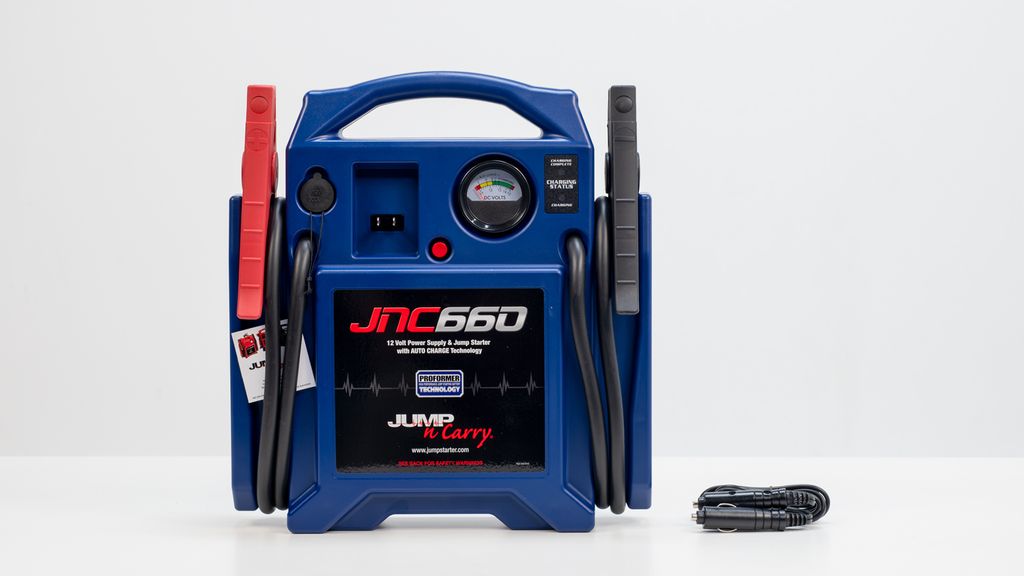

A dead car battery is rarely convenient. It usually happens in a cold driveway, a dark parking lot, or just after you have loaded the car for a trip. A portable booster can remove the need for another vehicle, but the useful differences are not limited to the biggest number on the box.
The best portable car jump starters combine dependable starting power with safe clamps, a battery that holds its charge, and a shape you will actually keep in the vehicle. Some of these models also add a tire inflator, emergency light, or USB charging.
For most drivers, the NOCO Boost GB40 is the best pick. The rest of this list covers compact emergency units, heavy-duty boosters, and combination jump starters with built-in compressors.
Comparison table
| # | Product | Award | Peak current | Engine support | Weight | Best for |
|---|---|---|---|---|---|---|
| 1 | NOCO Boost GB40 | Best overall | 1000A | Up to 6.0L gas, 3.0L diesel | 2.4 lb | Most drivers |
| 2 | S ZEVZO ET03 | Best for repeated starts | 4000A | Up to 8.0L gas, 7.0L diesel | 1.4 lb | Multiple vehicles |
| 3 | GOOLOO A3 | Best with an inflator | 3000A | Up to 9.0L gas, 6.5L diesel | 3.58 lb | Jumping and inflating |
| 4 | JOLTEKON Air Jump Starter | Best roadside light | 4500A | Up to 9L gas, 8L diesel | 2.65 lb | Nighttime emergencies |
| 5 | TREKURE 8000A | Best for large engines | 8000A | Up to 12L diesel | 1.41 lb | Trucks and heavy vehicles |
| 6 | NOCO Boost GB20 | Best compact NOCO | 500A | Up to 4.0L gas | 1 lb | Small cars |
| 7 | NOCO Boost GB70 | Best heavy-duty NOCO | 2000A | Up to 8.0L gas, 6.0L diesel | 5 lb | Large gas and diesel vehicles |
| 8 | AstroAI S8 | Best lightweight design | 1500A | Up to 6.0L gas, 3.0L diesel | 0.95 lb | Glove-box storage |
| 9 | Povasee A30 | Best USB backup | 5000A | Up to 10L gas, 8L diesel | 2.2 lb | Charging several devices |
| 10 | WOLFBOX MV24A | Best fast-charging inflator | 4000A | Up to 10L gas, 10L diesel | 5.3 lb | Pickup tire inflation |
1. NOCO Boost GB40: Best Overall
Pros
- Strong 1000A output for common vehicles
- Spark-proof and reverse-polarity protection
- IP65 housing with rubberized over-molding
- Useful 100-lumen emergency flashlight
Cons
- Not intended for larger diesel engines
- Storage bag is less protective than a hard case
- No built-in air compressor
Best for: drivers who want a compact, well-protected jump starter for an ordinary car, SUV, or light truck.
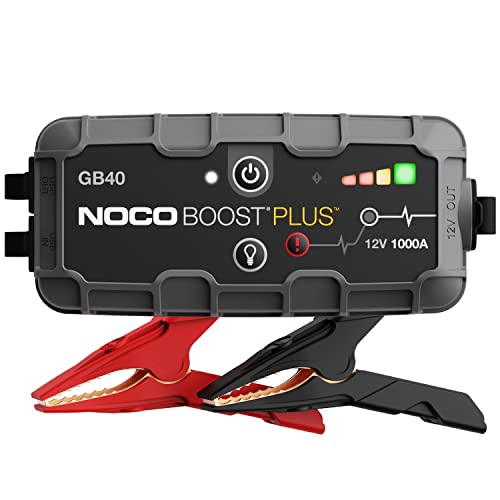
The NOCO Boost GB40 is the one that makes the most sense for a typical emergency kit. It is small enough to leave in a glove box or trunk without taking over the cargo area, yet it has enough starting output for engines up to 6.0L gas and 3.0L diesel. Its 1000A peak rating is not the highest here, but the GB40 is better balanced than many bulkier combination units.
The most important feature is the UltraSafe protection system. Spark-proof connections and reverse-polarity protection reduce the chance of a mistake when the battery is dead and the owner is working under stress. The included high-conductivity clamps connect to the unit, while the rugged IP65 housing and rubberized over-molding help protect it from dust, water spray, and bumps.
NOCO also gives the GB40 a useful second life as a power bank. It recharges in three hours, can provide up to 20 starts per charge on supported engines, and includes a 100-lumen LED with seven modes, including SOS and strobe. Those details matter more than headline output when the unit spends most of its life waiting for an emergency.
The weakness is its scope. The GB40 does not inflate tires, and it is not the right tool for a large diesel pickup. The NOCO Boost GB70 has much more headroom, while the GOOLOO A3 adds a compressor. Choose the GB40 when straightforward battery boosting and compact storage matter more than extra functions.
2. S ZEVZO ET03: Best for Repeated Starts

Pros
- 4000A output for gas and diesel vehicles
- Rated for up to 50 starts per charge
- Force-start function for 0V batteries
- LCD battery display and storage case
Cons
- Two USB outputs are limited to 5V/2A
- Claims require careful attention to charging state
- No compressor for tire emergencies
Best for: households that may need to restart more than one vehicle before recharging the pack.
The S ZEVZO ET03 is built around reserve capacity. Its 4000A peak output supports engines up to 8.0L gas and 7.0L diesel, and the manufacturer rates it for as many as 50 starts on one charge. That makes it a sensible choice for a family with several vehicles, a workshop drawer, or a driver who wants more margin between charging sessions.
The force-start function is particularly useful for a battery that has fallen to 0V. The unit must be sufficiently charged, with the maker specifying more than 14V for that situation, so it is not a substitute for keeping the jump pack maintained. Still, the feature gives the ET03 a capability the smaller NOCO Boost GB20 lacks.
A 74Wh internal battery also lets it charge phones and tablets through two USB outputs at the same time. The LCD display gives a direct view of the remaining charge, and the 500-lumen light has steady, strobe, and SOS modes. Its 1.4-pound weight is surprisingly low for the stated output, and the included storage case makes the cables and charging lead easier to keep together.
The ET03 is less appealing if you want an all-in-one roadside tool. The Povasee A30 has similar power-bank duties and a faster USB output, while the GOOLOO A3 can inflate tires. The ET03 wins for repeated jump starts and a clear display, provided you remember to recharge it every so often.
3. GOOLOO A3: Best With an Inflator

Pros
- 3000A output with force-start mode
- 150 PSI compressor and digital pressure display
- Five inflation modes and five nozzles
- Automatic shutoff prevents over-inflation
Cons
- Heavier than a simple jump starter
- Compressor use reduces available battery reserve
- No USB-C output listed
Best for: drivers who want one device for dead batteries, low tires, bicycles, and sports equipment.
The GOOLOO A3 is the most practical combination unit in this group. It is not merely a booster with a token pump attached. The 150 PSI compressor has a stated airflow of 35L per minute, five selectable modes, a digital pressure display, and automatic shutoff. That turns a low tire from a separate roadside problem into something the same kit can address.
As a jump starter, the A3 provides 3000A and supports engines up to 9.0L gas and 6.5L diesel. Its force-start button is intended for very low battery voltage, and the unit is rated for operation from -4°F to 140°F. Those figures give it broader vehicle coverage than the NOCO Boost GB40, although the A3's 3.58-pound body is less effortless to carry.
The pump's flexibility is a genuine advantage. It includes five nozzles and modes for SUVs, cars, bikes, balls, and custom settings. GOOLOO says a full charge can support up to 45 minutes of wireless inflation, with enough capacity for several types of inflatables. The bright display is designed to remain readable in sunlight, and the unit doubles as a USB power source and LED light.
There is a maintenance trade-off with every compressor model. Pumping tires draws down the same battery needed for starting, so this is not the unit to store for years without checking. The WOLFBOX MV24A inflates faster and supports a larger battery, but it weighs 5.3 pounds. For everyday cars and mixed roadside duties, the A3 is the better balanced choice.
If a separate power bank is also part of your emergency kit, consider how much charging capacity you actually need and how portable battery packs handle travel and daily carry. A jump starter should remain charged for the car first.
4. JOLTEKON Air Jump Starter: Best Roadside Light

Pros
- 4500A output with force-start function
- 150 PSI pump with automatic shutoff
- Bright 500-lumen emergency lighting
- Large display and multiple warning modes
Cons
- Instructions require attention to connection order
- Pump speed is described broadly rather than with airflow
- The long body may not suit every glove box
Best for: drivers who prioritize visibility and tire support during nighttime roadside repairs.
The JOLTEKON Air Jump Starter is a broad-function emergency device with a reassuringly high 4500A peak rating. It supports up to 9L gas and 8L diesel engines, and its force-start function is designed for completely drained or low-voltage batteries. It also claims support for temperatures from -4°F to 140°F, which suits a pack that lives in a vehicle through changing seasons.
Its compressor reaches 150 PSI and uses five inflation modes, four nozzles, three pressure units, and an automatic shutoff. The detachable extended hose should make access easier around a vehicle, while the auto-memory feature reduces setup work after the first use. JOLTEKON says the pump can inflate a tire to 25 PSI in a few minutes, though the listing does not provide an airflow rate for direct comparison with the GOOLOO A3 or WOLFBOX MV24A.
The lighting package is the standout feature. A 500-lumen wide light offers white, SOS, white strobe, and red strobe modes. The red strobe can serve as a warning signal near traffic, while the main beam is useful for finding battery terminals or attaching the hose after dark. A 3.3-inch display shows the remaining battery level and is designed for visibility in bright conditions.
This is a device that rewards reading the instructions. The manufacturer says to keep the battery above 50 percent, connect the cable to the unit first, and start the vehicle within 30 seconds after attaching the clamps. The GOOLOO A3 is a simpler recommendation for routine tire inflation, but JOLTEKON is the better fit when lighting and warning visibility are central.
5. TREKURE 8000A: Best for Large Engines

Pros
- Very high stated peak output
- Supports gas engines and diesel engines up to 12L
- 26800mAh battery with 18W USB output
- 800-lumen light and built-in handle
Cons
- No air compressor
- Peak current alone does not guarantee every start
- Requires regular charging during storage
Best for: owners of large trucks, diesel vehicles, and equipment that need substantial starting headroom.
The TREKURE 8000A is the brute-force option. Its stated output is far above the smaller units here, and the manufacturer rates it for all gas engines and diesel engines up to 12L. That makes it the obvious candidate for a large truck or diesel vehicle where a compact 500A booster would be operating too close to its limit.
The 26800mAh battery is also useful away from the engine bay. An 18W USB port can charge phones, tablets, earbuds, and similar devices, while the smart chip is intended to protect smaller electronics. TREKURE claims up to 24 months of standby and more than 1000 recharge cycles, but those claims do not remove the need to inspect and recharge a jump starter periodically.
Despite its engine coverage, the listed weight is only 1.41 pounds. The built-in handle makes carrying it easier, and the 800-lumen light offers steady, strobe, and SOS modes. The case is described as waterproof, dustproof, and shock-resistant, with ten protections covering problems such as overcurrent, overheating, reverse polarity, and deep discharge.
The missing feature is an inflator. If your main roadside concern is both a dead battery and a soft tire, the WOLFBOX MV24A or GOOLOO A3 is more versatile. TREKURE is the sharper choice for large-engine starting power and device charging, but owners of ordinary cars may be carrying more capability than they need.
The built-in battery is not a reason to stop carrying a separate charger. A dedicated maintainer can be useful for vehicles that sit for long periods, especially when keeping a stored vehicle battery ready between drives is the real problem.
6. NOCO Boost GB20: Best Compact NOCO

Pros
- Very light 1-pound design
- Spark-proof and reverse-polarity protection
- IP65-rated housing
- Seven-mode 100-lumen flashlight
Cons
- Limited to 4.0L gas engines
- Not suitable for diesel coverage listed here
- No screen or compressor
Best for: small-car owners who want the lightest simple emergency booster from NOCO.
The NOCO Boost GB20 is the minimalist pick. At 1 pound, it is easy to forget in a glove box until it is needed, and its narrow 7.7 by 3.2 by 1.7-inch dimensions take up little room. It is rated for up to 4.0L gas engines, so it fits compact cars and many everyday sedans without the extra bulk of a high-output truck booster.
Its 500A peak output is appropriately matched to that smaller engine range. UltraSafe spark-proof and reverse-polarity protection make the connection less intimidating for occasional users, and the high-conductivity clamps are included rather than treated as an optional accessory. The IP65 housing and rubberized over-molding give it a degree of protection against dust, water spray, and knocks.
Like the GB40, the GB20 works as a power bank and includes a 100-lumen LED light with seven modes. It recharges in three hours and is rated for up to 20 starts per charge on supported engines. Those are useful emergency features, although there is no LCD battery display to show the charge as precisely as the S ZEVZO ET03.
The central limitation is engine coverage. The AstroAI S8 weighs slightly less and supports up to 6.0L gas engines, while the GB40 provides more output and diesel support. Choose the GB20 when a small gas-powered car is the known use case and compact storage matters more than flexibility.
7. NOCO Boost GB70: Best Heavy-Duty NOCO

Pros
- 2000A output for large engines
- Supports up to 8.0L gas and 6.0L diesel
- Rated for up to 40 starts per charge
- Bright 400-lumen work light
Cons
- Weighs 5 pounds
- Takes six hours to recharge
- No tire inflator
Best for: large gas vehicles, diesel vehicles, and garages that want a rugged high-output booster.
The NOCO Boost GB70 is the serious version of the GB40. Its 2000A peak output supports engines up to 8.0L gas and 6.0L diesel, making it a better match for large SUVs, work trucks, and diesel equipment. It is also rated for up to 40 starts per charge on supported engines, so it has useful reserve beyond a single emergency.
The UltraSafe system remains the reason to choose it over a generic high-output box. Spark-proof construction and reverse-polarity protection make the clamps more forgiving, while the IP65 housing and rubberized over-molding protect the unit from the rough handling that comes with garage and roadside use. The included clamps are designed for high conductivity.
The GB70 adds a 400-lumen LED flashlight with seven modes, including SOS and strobe. It can charge phones and other USB devices, but its six-hour recharge time is much longer than the GB40's three hours. That is acceptable for a device stored as a heavy-duty backup, less so if it is used frequently as a general power bank.
At 5 pounds and roughly 8.8 inches tall, the GB70 is not a glove-box accessory. The TREKURE 8000A claims support for larger diesel engines in a lighter body, while the GB70 offers a more conservative and established feature set. Pick the GB70 for a large vehicle when rugged protection and simple operation matter more than an air compressor.
8. AstroAI S8: Best Lightweight Design

Pros
- Light 0.95-pound body
- 1500A output for its size
- Supports up to 6.0L gas engines
- Eight built-in safety protections
Cons
- Cold-weather use needs extra care
- No air compressor
- No precise battery percentage display listed
Best for: drivers who want a small backup for a car, SUV, motorcycle, or lawnmower.
The AstroAI S8 is one of the easiest units here to store and carry. Its listed weight is 0.95 pounds, and the compact body is intended for a glove box or travel bag. That makes it a good fit for drivers who are more likely to carry a smaller booster consistently than a larger model that stays at home.
The 1500A peak output supports up to 6.0L gas and 3.0L diesel engines. Its smart boost mode detects battery voltage, and the boost button becomes available when the voltage is below 9V. That gives the S8 a way to address a fully drained battery, although the owner still needs to follow the connection instructions carefully.
AstroAI uses metal clamps and lists eight protections, including reverse polarity, overcurrent, overvoltage, overload, overcharge, over-discharge, and short circuit protection. The device also serves as a power bank and a three-mode flashlight with flashlight, strobe, and SOS settings. It is a focused emergency tool rather than a full roadside workstation.
Cold weather is the main caveat. The listing advises storing the S8 at a proper temperature and avoiding charging or use in extreme cold. The NOCO Boost GB20 has a similarly compact role and a tougher IP65-rated enclosure, while the S8 offers more stated starting output at a very low weight. It suits small vehicles and careful storage.
9. Povasee A30: Best USB Backup

Pros
- 5000A output with low-voltage reset function
- 74Wh battery and dual USB outputs
- QC3.0 output for compatible devices
- 400-lumen light with three modes
Cons
- AC adapter is not included
- Reset operation requires careful connection
- No built-in tire pump
Best for: drivers who want a jump starter that can also charge two USB devices at once.
The Povasee A30 places unusual emphasis on device charging. Its 74Wh battery has two USB outputs, and one supports QC3.0 with output modes up to 12V and 1.5A. That gives it more flexibility than a basic booster when the emergency also involves a dead phone, tablet, camera, or other USB device.
For starting vehicles, the A30 claims 5000A and support for up to 10L gas or 8L diesel engines. A reset button is intended to help with batteries below 9V, and the manufacturer states that the unit can provide about 60 quick starts on a charge. Those are generous figures, but the smart clamps do not provide output until they detect a correct connection, so the owner must follow the setup process rather than treating the pack like a passive cable.
The 400-lumen LED has flashlight, strobe, and SOS modes. The unit weighs 2.2 pounds and measures 6.61 by 3.37 by 1.7 inches according to the listing, making it portable without being as tiny as the AstroAI S8. Ten protection systems cover reverse polarity, overcharge, overheat, short circuit, and related faults.
The notable omission is a charging adapter. The box includes a USB-A to USB-C cable, but not an AC adapter, so owners need a compatible source already available. The S ZEVZO ET03 offers a display and case, while the A30 is more compelling for simultaneous USB charging. It is a good choice for road trips where electronics matter almost as much as the car battery.
10. WOLFBOX MV24A: Best Fast-Charging Inflator

Pros
- 4000A starting output
- 160 PSI compressor with 45L per minute airflow
- 65W USB-C charging
- Supports engines up to 10L gas and diesel
Cons
- Heaviest model in the roundup
- Charging adapter is not included
- Large body is less convenient for glove-box storage
Best for: pickup and SUV owners who want a powerful booster and fast tire inflation in one unit.
The WOLFBOX MV24A is the most capable inflator here. Its 45L per minute motor reaches 160 PSI, and the listing gives specific inflation times for sedan, SUV, and pickup tires. A pickup tire moving from 30 PSI to 36 PSI is stated to take two minutes and 30 seconds, while a sedan tire takes 40 seconds for the same six-PSI increase. Those numbers make the MV24A more than an occasional ball pump.
The jump starter uses a 4000A peak current and supports 12V vehicles with engines up to 10L gas or 10L diesel. Its 88.8Wh battery also acts as a 24, 000mAh power bank. The USB-C port supports 65W fast charging, USB-A outputs provide 12W and 18W, and the listing says the unit can fully recharge in as little as two hours.
That combination comes with physical bulk. The MV24A weighs 5.3 pounds and is listed at about 9.37 inches tall, 5.28 inches wide, and 2.17 inches deep. It includes a 400-lumen light with high beam, strobe, and distress modes, and it has ten safety protections. The unit is rated to operate down to -4°F, which is useful for a vehicle-mounted emergency kit.
The trade-off is clear when compared with the GOOLOO A3. GOOLOO is lighter and easier to carry, while WOLFBOX inflates faster, supports a larger battery, and offers stronger charging output. The MV24A is too much equipment for a small sedan that only needs occasional battery help, but it is the better single-device kit for a pickup or SUV.
How to choose best portable car jump starters
The right booster depends on the vehicle's engine, the battery's condition, and how much roadside equipment you want to combine into one unit.
Starting current and engine coverage
Peak current is a useful indicator of starting headroom, but it should be read alongside the manufacturer's engine guidance. A compact gas-powered car does not need the same coverage as a large diesel truck. The GB20 is limited to 4.0L gas engines, while the TREKURE 8000A and WOLFBOX MV24A are designed for much larger engines.
A unit with a force-start mode can be useful when the battery voltage is extremely low. That feature usually requires a deliberate button press, so it should not be confused with automatic operation.
Clamp safety
Reverse-polarity and spark-proof protection reduce the consequences of connecting the clamps incorrectly. Smart clamps may also prevent power from reaching the cable until they detect a suitable connection. Look for clear indicators, audible alerts, and cables long enough to reach the battery terminals without straining.
The biggest booster is not the safest choice if its clamps and instructions are confusing beside a dark roadside.
Battery reserve and charging
A jump starter should be maintained even when it is not being used. Battery capacity affects how many starts and USB charges are available, while recharge time determines how quickly the pack is ready again. The NOCO GB40 lists a three-hour recharge, the GB70 lists six hours, and the WOLFBOX MV24A claims as little as two hours with its 65W USB-C input.
Check what charging equipment is included. The WOLFBOX MV24A and Povasee A30 do not include an AC adapter, so the cable alone may not be enough for a wall recharge.
Air compressor performance
An inflator is useful for a slow leak or seasonal pressure adjustment, not for repairing a damaged tire. Maximum PSI is only part of the story. Airflow and real inflation times are more helpful when comparing models. The WOLFBOX MV24A lists 45L per minute, while the GOOLOO A3 lists 35L per minute.
Automatic shutoff, preset modes, a readable pressure display, and a hose that reaches the valve without awkward positioning make a bigger difference in use than a high maximum-pressure figure.
Size, weight, and storage
A jump starter that stays in the garage cannot help much at a trailhead or parking lot. The AstroAI S8 weighs less than a pound, the NOCO GB20 weighs 1 pound, and the NOCO GB70 and WOLFBOX MV24A weigh 5 pounds or more. Consider where it will live and whether the cables, hose, and adapters fit in the included storage solution.
For more charging gear in the vehicle, it also helps to understand which portable charging features matter away from a wall outlet. A jump starter's USB ports are useful, but they do not replace every kind of travel charger.
Frequently asked questions
Can a portable jump starter start a completely dead battery?
Some can, but only when they include a force-start or boost function. The S ZEVZO ET03, GOOLOO A3, JOLTEKON unit, TREKURE 8000A, AstroAI S8, and Povasee A30 list features for very low-voltage batteries. Read the instructions carefully, charge the pack first, and never bypass the safety steps.
How often should a jump starter be recharged?
The answer varies by model, but periodic charging is essential. GOOLOO recommends recharging at least every three months during long-term storage, while JOLTEKON recommends charging every two to three months. Checking the battery before winter and before a long trip is a sensible habit.
Can these jump starters charge a phone?
Yes. Every model in this roundup lists power-bank functionality or USB charging. Output types differ, though. The Povasee A30 includes dual USB outputs and QC3.0, while the WOLFBOX MV24A includes a 65W USB-C port.
Do air-compressor jump starters replace a tire inflator?
They can handle pressure adjustment and some roadside inflation, but they are not a repair for a puncture or damaged sidewall. The GOOLOO A3, JOLTEKON unit, and WOLFBOX MV24A include automatic shutoff and pressure settings that help with routine inflation.
Can a jump starter remain in a car during winter?
Storage conditions matter. Several models list operation down to -4°F, but the AstroAI S8 specifically advises avoiding charging or use in extreme cold. Keep the pack out of prolonged heat, inspect it periodically, and follow the storage limits in the manual.
What size jump starter does a diesel truck need?
Start with the engine size and the manufacturer's diesel rating, not just the peak-current number. The NOCO GB70 supports up to 6.0L diesel, the S ZEVZO ET03 supports up to 7.0L, and the TREKURE 8000A and WOLFBOX MV24A list coverage for engines up to 12L and 10L respectively.
The bottom line
The NOCO Boost GB40 is the safest recommendation for most drivers because it combines useful starting coverage, compact storage, strong clamp protection, and a practical emergency light without turning into a bulky multi-tool. The GOOLOO A3 is the better fit when low tires are as likely as a dead battery, thanks to its 150 PSI compressor and automatic shutoff.
For large diesel vehicles, the TREKURE 8000A offers the widest stated engine coverage, while the WOLFBOX MV24A is the more complete pickup and SUV kit because its compressor and fast USB-C charging are unusually capable. The NOCO Boost GB20 remains the simple choice for a small gas car.
If you are undecided, choose the smallest model that comfortably covers your engine and keep it charged, because the best portable car jump starters are useful only when they are ready in the vehicle.
As an Amazon Associate we earn from qualifying purchases.