

A phone can stream lossless music and still leave demanding headphones sounding flat, quiet, or oddly thin. The missing piece is often a portable DAC and headphone amplifier that can turn a digital signal into something your wired headphones can use properly.
The Best portable dac options range from tiny USB-C dongles to battery-powered Bluetooth receivers and full-size portable amps. We ranked these 10 models by their output options, decoding support, power, portability, and useful controls rather than treating headline numbers as the whole story.
For most listeners, the Qudelix-5K is the one to buy. The rest of this list covers wired dongles, tube warmth, high-power desktop-style amplification, and the convenience of wireless listening.
Comparison table
| # | Product | Award | Outputs | Key capability | Best for |
|---|---|---|---|---|---|
| 1 | Qudelix-5K | Best overall | 3.5mm, 2.5mm balanced | Bluetooth and USB DAC | Flexible wireless listening |
| 2 | Fosi Audio DS2 | Best USB-C dongle | 3.5mm, 4.4mm balanced | DSD256, 170mW per channel | Phones and tablets |
| 3 | iFi hip-dac 3 | Best feature-rich amp | 3.5mm, 4.4mm balanced | 400mW, XBass, iEMatch | Tunable wired headphone rigs |
| 4 | CrinEar Protocol Max | Best for EQ | 3.5mm, 4.4mm balanced | 10-band parametric EQ | Custom sound profiles |
| 5 | FiiO BTR7 | Best Bluetooth display amp | 3.5mm, 4.4mm balanced | Bluetooth 5.1, MQA | Wireless and USB use |
| 6 | HiFiGo M3 Ultra | Best tube sound | 3.5mm, 4.4mm balanced | JAN6418 tube, 480mW balanced | Warm, spacious listening |
| 7 | MOONDROP Dawn PRO 2 | Best DSP dongle | 3.5mm, 4.4mm balanced | App EQ, 100-step volume | Wired listeners who tune |
| 8 | FiiO QX13 | Best high-power option | Not specified | 900mW per channel, display | Difficult-to-drive headphones |
| 9 | Linsoul Kiwi Ears Allegro Mini | Best compact IEM amp | 3.5mm, 4.4mm balanced | PCM 384kHz, DSD128 | IEM owners |
| 10 | iFi hip-dac 3 Stealth | Best stealth design | 3.5mm, 4.4mm balanced | MQA, PowerMatch, XBass | Portable wired setups |
1. Qudelix-5K: Best Overall

Pros
- Bluetooth and USB DAC modes
- LDAC, aptX Adaptive, aptX HD, and AAC support
- Tiny 25g body with an aluminum clip
- Strong 2.5mm balanced output
- Built-in equalizer
Cons
- No 4.4mm balanced connection
- Plastic body is less substantial than metal rivals
- It cannot transmit to Bluetooth headphones
Best for: listeners who want one small DAC amp for phones, computers, and wireless sources.
The Qudelix-5K is the most useful everyday device here because it does not force you to choose between a cable and Bluetooth. Clip it to a shirt or bag, connect wired headphones, and leave the phone in your pocket. It can also work as a USB DAC, so it remains useful at a desk rather than becoming a single-purpose wireless receiver.
Its dual ES9219 DAC design feeds a 3.5mm unbalanced output rated at 80mW and a 2.5mm balanced output rated at 240mW. That distinction matters more than the chip names. Efficient IEMs will work from the regular jack, while the balanced connection gives compatible headphones more headroom. The Bluetooth side supports LDAC, aptX Adaptive, aptX HD, and AAC, and USB DAC mode reaches 96kHz/24-bit.
The Qudelix is also unusually small. Its listed 25g weight and dimensions of 52.8 by 26.7 by 15.6mm make it easy to forget on a commute, while the aluminum clip gives it a practical way to stay attached. Battery life is listed at 6 to 20 hours depending on use, so the range is broad, but it is still a self-contained device rather than a dongle drawing power from the phone.
The weakness is the connector choice. The 2.5mm balanced output is less common now than 4.4mm, and the plastic body does not feel as substantial as the Fosi Audio DS2 or MOONDROP Dawn PRO 2. The Qudelix also works with wired headphones, not Bluetooth headphones. Choose it over the FiiO BTR7 for its smaller body and broad codec support; choose the FiiO if a 4.4mm output and screen matter more.
2. Fosi Audio DS2: Best USB-C Dongle

Pros
- 3.5mm and 4.4mm balanced outputs
- DSD256 and PCM 32-bit/384kHz support
- 170mW per channel at 32 ohms
- Independent 60-step volume buttons
- Solid CNC-machined metal housing
Cons
- Wired USB operation only
- No battery for use without a source connection
- The 4.4mm output needs compatible headphones
Best for: phone and tablet users who want a compact wired DAC with both common output styles.
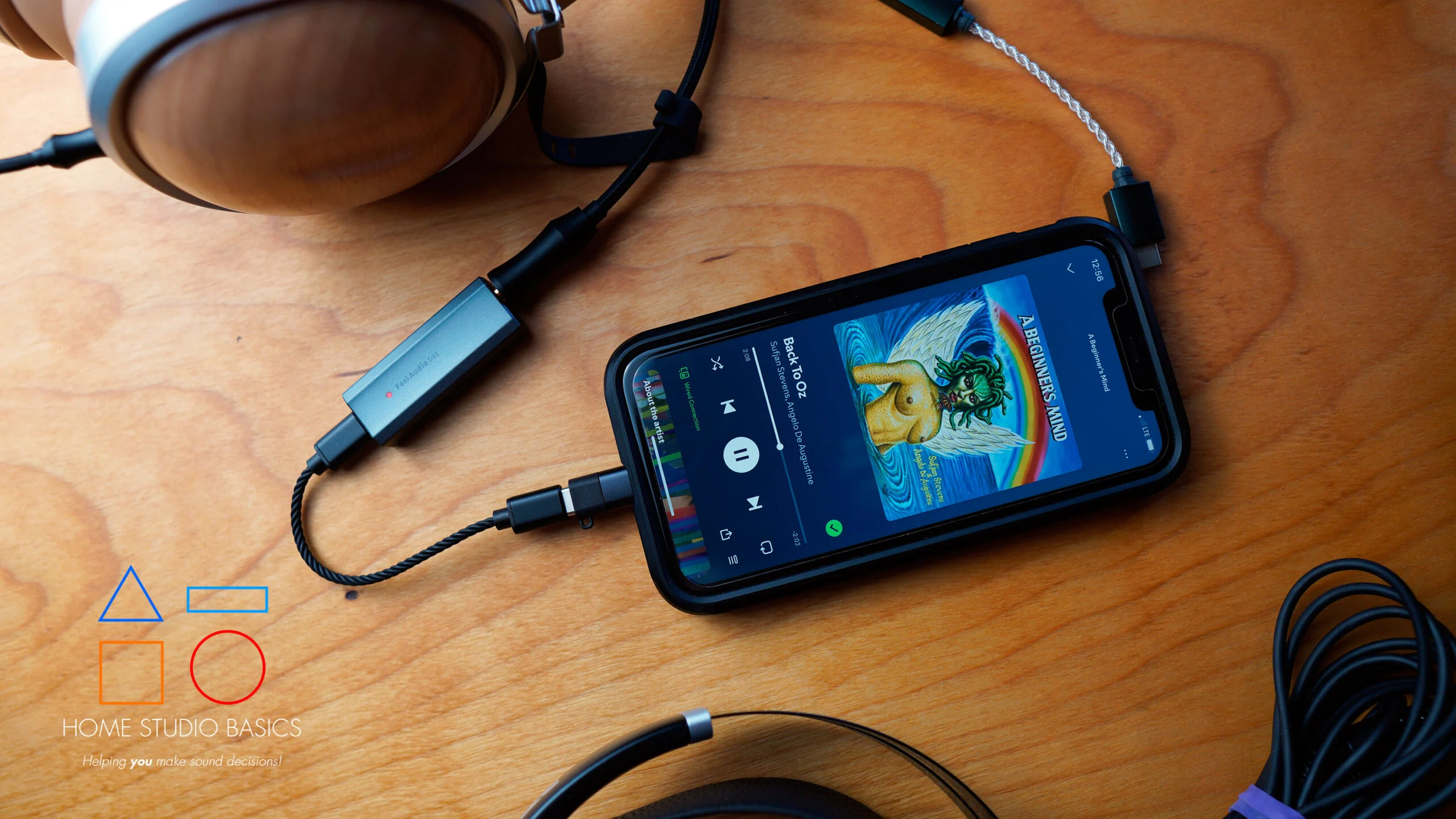
The Fosi Audio DS2 is the straightforward dongle pick. Plug it into a compatible USB-C source, connect headphones, and use its physical buttons instead of fumbling with a phone's volume slider. It has the kind of small metal body that feels comfortable attached to a phone or tucked beside a tablet, and it does not require a separate battery charge.
Inside are two Cirrus Logic CS43131 DAC chips. Fosi lists support for PCM up to 32-bit/384kHz and DSD256, but the more practical number is its 170mW per channel at 32 ohms. That gives the DS2 enough authority for many portable headphones while remaining sensible with IEMs. The 3.5mm single-ended and 4.4mm balanced outputs also let it follow a listener's cable collection instead of locking the device to one connector.
Its 60-step independent volume control is a welcome detail. Small volume adjustments are easier to make on the device, and the volume memory feature avoids having to reset the level every time it is connected. Fosi also claims a 1μV noise floor, 0.0001% THD, and a 130dB signal-to-noise ratio. Those figures describe a clean design, although the actual benefit depends heavily on the headphones and source.
The DS2 loses to the Qudelix-5K on wireless convenience and battery independence, but it beats that model if a 4.4mm connector is essential. It is also less feature-heavy than the CrinEar Protocol Max, which has configurable parametric EQ. Skip the DS2 if you need Bluetooth, but choose it when a simple wired connection, physical controls, and dual outputs are the priority.
3. iFi hip-dac 3: Best Feature-Rich Amp

Pros
- True balanced circuit
- Up to 400mW into a 32-ohm load
- XBass and PowerMatch controls
- iEMatch for sensitive IEMs
- Separate USB-C audio and charging ports
Cons
- Larger and heavier than a dongle
- Wired USB source connection
- Controls and ports take more space in a pocket
Best for: listeners who want a battery-powered wired amp with meaningful analog controls.
The iFi hip-dac 3 feels like a portable amp in the traditional sense. It has a rechargeable battery, a metal enclosure, gain control, bass adjustment, and separate connectors for audio and charging. That makes it less tidy than the Fosi Audio DS2, but it is much more adaptable when you switch between sensitive IEMs and headphones that need extra drive.
The true balanced circuit can provide up to 400mW into a 32-ohm load. Its 4.4mm output is therefore the serious listening connection, while the S-Balanced 3.5mm output remains useful for ordinary headphones. PowerMatch adjusts gain for more demanding loads, and iEMatch is designed to reduce the problems that can appear with sensitive in-ear monitors, such as hiss or an overly abrupt volume range.
XBass is the feature that most directly changes listening. It is an analog bass enhancement rather than a phone app setting, so it can add low-end weight without requiring a software profile. The DAC supports PCM and DXD up to 384kHz, DSD through DSD256, and full MQA decoding. Its 2, 200mAh battery is listed for 7 to 10 hours, depending on how it is used.
This is a better fit for a deliberate wired setup than for someone who wants the smallest possible adapter. The MOONDROP Dawn PRO 2 offers app-based EQ in a smaller dongle format, while the iFi hip-dac 3 offers physical tuning and more of an amplifier feel. If you mainly use efficient IEMs, its extra size may be unnecessary. If you rotate between several headphone types, the controls earn their space.
4. CrinEar Protocol Max: Best for EQ

Pros
- 10-band parametric equalizer
- EQ profiles saved through a browser
- 600mW balanced output
- 3.5mm and 4.4mm connections
- Eco and Boost power modes
Cons
- Browser-based setup is less immediate than physical controls
- Full power requires a balanced connection
- Compact size still means another device to carry
Best for: headphone enthusiasts who want serious EQ without relying on a phone app.
The standout reason to buy the CrinEar Protocol Max is its equalizer. A 10-band parametric EQ gives you control over frequency, gain, and bandwidth in a way that ordinary bass and treble sliders cannot match. Profiles can be saved directly to the device through a PC browser, which is useful if you move between a phone and computer and do not want the sound to depend on one app.
The hardware is built around dual Cirrus Logic CS43198 DAC chips and dual SG Micro SGM8262-2 amplifier chips. Its balanced 4.4mm connection can provide up to 600mW, while the 3.5mm output is available for standard headphones. That combination makes it suitable for both sensitive IEMs and more demanding full-size headphones, though the strongest case for it is the control over sound rather than power alone.
Eco and Boost modes provide a practical compromise. Eco should make more sense for casual listening and longer sessions, while Boost reserves the highest output for headphones that need it. The low output impedance is also intended to preserve compatibility with a broad range of headphones, particularly multi-driver IEMs that can react poorly to an unsuitable amplifier.
The browser-based EQ is powerful but not as frictionless as the MOONDROP Dawn PRO 2 and its companion app. The Protocol Max also lacks the Qudelix-5K's wireless mode. Pick the CrinEar when shaping the frequency response is central to the purchase. Skip it if you want to connect wirelessly or never plan to adjust anything beyond volume.
5. FiiO BTR7: Best Bluetooth Display Amp

Pros
- Bluetooth 5.1 with LDAC and aptX Adaptive
- 3.5mm and 4.4mm outputs
- USB DAC support up to PCM 384kHz and DSD256
- Built-in microphone support
- Works as a wireless receiver or USB DAC
Cons
- Larger than the Qudelix-5K
- Older Bluetooth receiver design than the newest options
- Bluetooth mode is not a transmitter for wireless headphones
Best for: listeners who want a wireless receiver with broad codec support and dual headphone outputs.
The FiiO BTR7 is a flexible bridge between a phone and wired headphones. In Bluetooth mode, it stays attached to the listener while the phone remains free. In USB DAC mode, it becomes a wired computer or phone audio device. The 3.5mm and 4.4mm outputs cover both conventional cables and balanced headphone connections.
Bluetooth 5.1 supports LDAC, aptX Adaptive, aptX Low Latency, aptX HD, aptX, AAC, and SBC. That list gives Android listeners room to choose a suitable codec, while the USB side handles PCM up to 384kHz, native DSD256, and MQA rendering up to 8x with a compatible player. The BTR7 uses an XMOS XUF208 receiver chip and ES9219C DACs for its left and right channels.
The built-in microphone and cVc 8.0 support make it more useful for calls than many wired dongles. It can work with earphones that have CTIA in-line controls, so it is not limited to music playback. Its body is still more substantial than the Qudelix-5K, and that extra size is noticeable when the unit is clipped to clothing or carried with a phone.
The Qudelix remains the better choice for maximum compactness and its 2.5mm balanced option, while the BTR7 is the more natural choice for people who want 4.4mm and a broader physical feature set. It is not a Bluetooth transmitter, so it will not send audio to Bluetooth headphones. Choose it for wired headphones, wireless phone connection, and call support in one unit.
6. HiFiGo M3 Ultra: Best Tube Sound
Pros
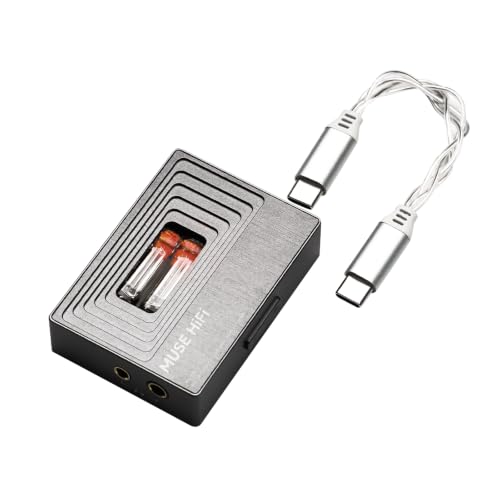
- Genuine JAN6418 vacuum tube
- 3.5mm and 4.4mm outputs
- Up to 480mW balanced output
- PCM 32-bit/384kHz and DSD256 support
- Claimed microphonics reduction system
Cons
- Tube hardware is less conventional than a solid-state dongle
- No wireless mode
- Tube character is not ideal for every headphone
Best for: listeners who specifically want a warmer tube presentation from a portable amp.
The HiFiGo M3 Ultra is the unusual pick here. Its JAN6418 vacuum tube is intended to add richer harmonics, smoother mids, and a softer sense of decay than a conventional solid-state design. That does not make it universally better, but it gives this amp a distinct reason to exist for listeners who find some digital setups too stark.
Power is not an afterthought. HiFiGo lists 460mW from the 3.5mm output and 480mW from the 4.4mm balanced output, which is enough headroom for many IEMs and a wide selection of full-size headphones. PCM support reaches 32-bit/384kHz and DSD256, with an ES9028Q2M DAC handling conversion. The two output types keep it compatible with both ordinary and balanced cables.
Portable tubes can raise concerns about vibration and ringing. HiFiGo says the M3 Ultra uses circuit-level balanced design, algorithmic microphonics cancellation, and physical shock absorption to address that issue. It also claims THD+N as low as 0.0003% through the 4.4mm output. Those details suggest an attempt to keep the tube flavor from turning into a noisy novelty.
The iFi hip-dac 3 is the more adjustable solid-state alternative, with PowerMatch, iEMatch, and XBass. The M3 Ultra is the better choice when the tube character itself is the point. Listeners who prefer a neutral, highly configurable presentation should skip it. For everyone else, it is a portable way to add a different texture without moving to a desktop amplifier.
7. MOONDROP Dawn PRO 2: Best DSP Dongle

Pros
- Dual CS43198 DAC chips
- App-based parametric EQ
- 3.5mm and 4.4mm outputs
- 100-level volume control
- Aluminum alloy housing with heat vents
Cons
- Wired USB operation only
- App-based tuning takes setup
- Output power is lower than the largest amps here
Best for: wired listeners who want detailed digital tuning in a compact device.
The MOONDROP Dawn PRO 2 is a small DAC for people who care about changing the sound rather than simply making it louder. Its updated MOONDROP app offers a parametric equalizer with filter type, frequency, gain, and Q value controls. That is a much deeper toolkit than a basic bass slider, especially for listeners who want to correct a headphone's response or create separate profiles.
Dual Cirrus Logic CS43198 chips and three independent low-dropout regulators form the core of the design. The device provides a 4Vrms output and 124mW plus 124mW output, with MOONDROP emphasizing balanced tonal performance and efficient operation over maximum wattage. It supports 3.5mm and 4.4mm headphones, so the connection options are broad even though the power ceiling is more modest than the FiiO QX13.
The 100-level volume control is independent of the phone's volume management. That allows finer adjustments and is intended to reduce the signal compression that can occur when relying only on the source device. The aluminum housing uses vents over the warmer chips to improve heat dissipation, a sensible touch for a compact device handling sustained audio playback.
The CrinEar Protocol Max offers another serious EQ route, but its browser-based system is aimed at users comfortable configuring profiles on a computer. The Dawn PRO 2 is more approachable if you prefer an app, while the Fosi Audio DS2 is simpler if you want no tuning at all. Choose the MOONDROP for wired DSP control, and skip it if you need Bluetooth or the strongest possible amplifier output.
8. FiiO QX13: Best High-Power Option

Pros
- 900mW per channel output
- ES9027PRO 8-channel DAC
- 10-band EQ
- 1.99-inch color touchscreen
- Multiple op-amps for high-current amplification
Cons
- Heavier and larger than dongle-style models
- The highest output is more than many IEMs need
- Travel power accessories are separate
Best for: owners of hard-to-drive headphones who want near-desktop power in a portable format.
The FiiO QX13 is portable in the broad sense, but it is not a tiny phone accessory. Its purpose is to bring unusually high amplification to a mobile setup. The headline figure is 900mW per channel, a level intended for headphones that need real current and voltage rather than efficient IEMs that already play loudly from almost anything.
Its ES9027PRO DAC uses an eight-channel parallel design, paired with dual ES9312 regulators. FiiO also specifies six TI op-amps, including four INA1620 units and two OPA1692 units. The important practical point is that the QX13 is designed around a substantial amplification stage, not just a small conversion chip attached to a USB cable.
A 1.99-inch color touchscreen gives the device a different feel from the button-driven Fosi Audio DS2 or screen-free CrinEar Protocol Max. The 10-band EQ provides another way to shape the sound, and the display can make settings easier to inspect. The magnetic ecosystem includes a leather case and compatibility with an E-Stick power bank sold separately, which makes it more plausible as the center of a travel rig.
The trade-off is bulk. The QX13 weighs about 0.529 pounds according to the listed product information, far more than the 25g Qudelix-5K. It is overkill for many IEMs and lightweight headphones, but it makes sense for difficult full-size models. Buy it when amplifier headroom is the main problem, not simply because a large output number sounds impressive.
9. Linsoul Kiwi Ears Allegro Mini: Best Compact IEM Amp

Pros
- Compact all-aluminum body
- 3.5mm and 4.4mm outputs
- PCM 32-bit/384kHz support
- DSD128 support
- USB-C plug-and-play connection
Cons
- Designed more for IEMs than demanding headphones
- USB-C wired operation only
- No battery or wireless mode
Best for: IEM owners who want dual output options in a small USB-C device.
The Linsoul Kiwi Ears Allegro Mini keeps the formula simple: USB-C input, a compact aluminum body, and two headphone outputs. It is aimed squarely at IEM users who want a cleaner portable source without carrying a battery-powered receiver. The all-aluminum construction gives it a more finished feel than the typical basic adapter.
Both 3.5mm single-ended and 4.4mm outputs are provided. That covers the common cable types used with IEMs, though a balanced cable should only be used with the corresponding balanced output. The device supports PCM up to 32-bit/384kHz and DSD128, which is more than enough for a broad lossless music library.
Kiwi Ears lists THD+N of 0.004% at 32 ohms. That figure, along with the emphasis on a custom chip and clean output, points toward a low-noise design for sensitive earphones. Its USB-C interface is intended to work with modern Android devices, including Android 5.1 and later, and the unit can also serve as a compact computer audio accessory.
The Allegro Mini does not compete with the FiiO QX13 on power or the Qudelix-5K on wireless flexibility. Its appeal is its small footprint and straightforward connection. Choose it for IEMs, especially when both 3.5mm and 4.4mm cables are in rotation. For full-size headphones that need strong amplification, the Fosi Audio DS2 or CrinEar Protocol Max is a safer direction.
10. iFi hip-dac 3 Stealth: Best Stealth Design

Pros
- Matte black aluminum enclosure
- True balanced circuit
- PowerMatch and iEMatch controls
- XBass analog enhancement
- Separate USB-C audio and charging ports
Cons
- Larger than a USB-C dongle
- Wired source connection only
- Listed playtime is 7 to 10 hours
Best for: listeners who want iFi's portable controls in a discreet black enclosure.
The iFi hip-dac 3 Stealth is a distinct product in this list despite sharing its core family with the standard hip-dac 3. Its matte black aluminum enclosure and matching hardware make it the quiet-looking option for a portable rig, while the internal design keeps the features that make the hip-dac line useful.
It supports PCM up to 32-bit/384kHz, DSD256, and full MQA decoding. More important for daily use are the true balanced circuit, 4.4mm output, S-Balanced 3.5mm output, and up to 400mW into a 32-ohm load. PowerMatch helps with headphones that need extra gain, while iEMatch is intended to make sensitive in-ear monitors easier to use without excessive hiss or an awkward volume range.
XBass provides an analog way to add low-frequency weight. That is handy when switching between headphones with different tonal balances, and it avoids making the listening setup dependent on a software equalizer. The two USB-C ports separate audio data from charging, so the charging cable does not have to be moved every time the device is connected to a source.
The Stealth version remains a fairly substantial device at roughly 4 inches long and about 0.3 pounds from the listed dimensions and weight. The Fosi Audio DS2 is much easier to carry, while the Qudelix-5K offers wireless listening and a clip. Choose the iFi when its physical gain, bass, and IEM controls matter more than minimum size, and skip it if you want a cable-free source.
How to choose best portable dac
The right portable DAC depends less on the largest decoding number and more on how your headphones connect, how much amplification they need, and whether you want a wired or wireless setup.
Connection type
USB-C dongles such as the Fosi Audio DS2 and Kiwi Ears Allegro Mini draw power from the source and keep the system small. Battery-powered models such as the iFi hip-dac 3 add more output and controls, while Bluetooth receivers such as the Qudelix-5K and FiiO BTR7 let the phone stay in a pocket.
Check the source device first. A USB-C phone, tablet, computer, or Mac may work directly, but compatibility and cable requirements can vary. Bluetooth is convenient, but remember that the Qudelix-5K and FiiO BTR7 receive audio for wired headphones. They do not transmit audio to Bluetooth headphones.
Headphone output
A 3.5mm single-ended output is the most widely compatible option. A 4.4mm or 2.5mm balanced output can provide more power, but it requires headphones with a correctly wired balanced cable. Never connect a balanced output to a cable or adapter that is not designed for it.
The Fosi Audio DS2, CrinEar Protocol Max, and iFi hip-dac 3 use 4.4mm balanced connections. The Qudelix-5K uses 2.5mm balanced, while the FiiO BTR7 and MOONDROP Dawn PRO 2 also offer 4.4mm. Choose based on the cables you actually own rather than assuming balanced automatically means better sound.
The best output is the one that matches your headphones, not the one with the most impressive label.
Amplifier power
Efficient IEMs do not need the 900mW per channel offered by the FiiO QX13. Excess power can make volume adjustment more difficult, and a sensitive earphone may reveal amplifier noise. The iFi hip-dac 3's iEMatch and the CrinEar Protocol Max's low output impedance address this kind of use more directly.
Harder-to-drive full-size headphones need more headroom. The FiiO QX13 is the obvious high-power model, while the CrinEar Protocol Max, HiFiGo M3 Ultra, and iFi hip-dac 3 offer substantial output in smaller formats. Look at the connection used as well, since balanced figures are often higher than single-ended ones.
Sound shaping
If you want a quick tonal adjustment, the iFi hip-dac 3 uses XBass and the QX13 includes a 10-band EQ. The MOONDROP Dawn PRO 2 and CrinEar Protocol Max go further with more detailed parametric equalization.
A parametric EQ is most useful when you are willing to spend time making and saving profiles for different headphones. For a broader look at portable listening setups, the right source for carrying a personal music library can also change which DAC features matter most.
Size and battery
A dongle is the easiest option to carry, but it uses the phone or computer as its power source. A battery-powered amp adds another device to charge, yet it can provide stronger amplification without draining the phone as quickly. The Qudelix-5K lists 6 to 20 hours of streaming, while the iFi hip-dac 3 lists 7 to 10 hours.
The FiiO QX13 is closer to a portable desktop component than a pocket adapter. If your listening setup includes a demanding headphone, that trade-off may be sensible. If you mainly use IEMs on a phone, the compact Fosi Audio DS2 or Kiwi Ears Allegro Mini is easier to live with.
Frequently asked questions
Do I need a portable DAC for a phone?
Not every listener needs one. A portable DAC is useful when a phone lacks a headphone jack, when its built-in output cannot drive your headphones well, or when you want a different set of controls and connections.
Is a balanced output better than a 3.5mm output?
Balanced outputs can provide more power and may suit headphones designed for balanced cables. They are not automatically better, and the cable must be wired correctly for the output. A good 3.5mm connection remains sufficient for many IEMs and portable headphones.
Can these DACs work with Bluetooth headphones?
The Qudelix-5K and FiiO BTR7 are Bluetooth receivers for wired headphones. They do not transmit audio to Bluetooth headphones. The USB dongles and wired amps in this list also require wired headphones.
Which portable DAC is best for IEMs?
The Kiwi Ears Allegro Mini is a compact IEM-focused option with 3.5mm and 4.4mm outputs. The iFi hip-dac 3 adds iEMatch for sensitive earphones, while the CrinEar Protocol Max offers low output impedance and adjustable power modes.
What does a DAC actually do?
A DAC converts digital audio data into an analog signal that a headphone amplifier can use. In a portable DAC amp, the amplifier then raises that signal to a level suitable for headphones. The quality of the result also depends on the source, headphones, recording, and connection.
Do higher sample-rate numbers mean better sound?
Not by themselves. Support for PCM 384kHz or DSD256 can show that a device handles high-resolution formats, but it does not guarantee that every recording will sound better. Output power, noise control, compatibility, and useful controls often matter more in daily listening.
Can a portable DAC drive full-size headphones?
Some can. The FiiO QX13 is the strongest option for difficult loads, while the iFi hip-dac 3, CrinEar Protocol Max, and HiFiGo M3 Ultra offer substantial output in smaller designs. Efficient full-size headphones may work well with a smaller dongle, but demanding models need more headroom.
The bottom line
The Qudelix-5K is our top pick for the Best portable dac because it combines USB operation, broad Bluetooth codec support, a tiny 25g body, useful battery life, and both regular and balanced headphone connections. The Fosi Audio DS2 is the better choice for a simple wired USB-C setup with a 4.4mm output, while the iFi hip-dac 3 suits listeners who want physical gain, bass, and IEM controls.
For high-power headphones, choose the FiiO QX13. For serious sound shaping, choose the CrinEar Protocol Max or MOONDROP Dawn PRO 2, depending on whether you prefer browser-based or app-based EQ. The HiFiGo M3 Ultra is the specialist option for tube character, and the Kiwi Ears Allegro Mini keeps an IEM setup especially compact.
If you are undecided, buy the Qudelix-5K for flexibility, or the Fosi Audio DS2 if you know you only want a wired USB-C connection.
As an Amazon Associate we earn from qualifying purchases.