

A small fan has one job: move enough air to make a hot seat, crowded train, tent, or desk tolerable. The trouble is that many handheld models feel powerful only at the outlet, while larger camping fans trade pocketability for battery endurance and useful positioning.
The best portable fan picks below cover both ends of that divide. We chose the Bearwind Portable Turbo Fan as our top pick for its strong claimed airflow, five speed settings, foldable 3-in-1 design, and compact body. The rest of the lineup ranges from discreet commuter fans to a remote-controlled camping model with a built-in light.
Comparison table
| # | Product | Award | Airflow | Battery and charging | Design | Best for |
|---|---|---|---|---|---|---|
| 1 | Bearwind Portable Turbo Fan | Best overall | Up to 9 m/s, 5 speeds | 4, 000mAh, up to 12 hours, USB-C | 180-degree foldable, handheld, desk, neck | Most travelers |
| 2 | PlayHot Turbo Fan, Black | Best high-output handheld | Up to 10 m/s, 5 speeds | Up to 12 hours, USB-C | 180-degree foldable, handheld, desk, neck | Strong airflow in a small body |
| 3 | FRIZCOL Camping Fan | Best for camping | Up to 5.2 m/s, 4 speeds | 24, 000mAh, 11 to 60 hours | Adjustable head, hook, light, remote | Tents and outdoor bases |
| 4 | Diveblues D6036 Fan | Best compact design | Up to 7.4 m/s, 1 to 100 adjustment | 3, 600mAh, up to 12 hours, USB-C | Fold-flat, carabiner, desk, neck | Concerts and commuters |
| 5 | JISULIFE Life7 Fan | Best battery endurance | 5 speeds | 5, 000mAh, up to 19.5 hours | Handheld, desk, neck, display | Long days away from outlets |
| 6 | Warmco D3 Travel Fan | Best quiet desk fan | 4 speeds, 5-blade design | 10, 000mAh, up to 24 hours | Foldable stand, desktop format | Work, sleep, and travel |
| 7 | Kimguard Turbo Fan | Best speed control | Up to 8.5 m/s, 1 to 199 settings | Up to 20 hours, USB charging | Handheld, desk, neck, cooling function | Fine-grained airflow control |
| 8 | PlayHot Turbo Fan, White | Best light-colored option | Up to 10 m/s, 5 speeds | Up to 12 hours, USB-C | 180-degree foldable, handheld, desk, neck | Travel kits and everyday carry |
| 9 | JISULIFE 4000mAh Turbo Fan | Best simple turbo fan | Up to 4.8 m/s, 5 speeds | 4, 000mAh, 3 to 16 hours | Handheld, desk, lanyard | Straightforward personal cooling |
1. Bearwind Portable Turbo Fan: Best Overall

Pros
- Strong claimed airflow from a seven-blade turbo design
- 180-degree folding body supports three modes
- USB-C charging and a useful battery claim
- Compact 6.7-inch body
Cons
- Maximum runtime depends heavily on speed
- No display for speed or remaining battery
- The highest setting is likely more noticeable in quiet rooms
Best for: travelers who want one small fan for handheld, desk, and hands-free use.
The Bearwind Portable Turbo Fan gets the important decisions right. It is small enough to disappear into a purse or pocket, but the seven-blade turbo layout and brushless motor are aimed at producing a more forceful stream than a basic flat-bladed personal fan. Its claimed top wind speed is 9 m/s, and five settings give it a usable low end for desk work as well as a high end for a hot outdoor queue.
The 4, 000mAh rechargeable battery is rated for up to 12 hours, with USB-C charging taking about three hours. That runtime figure is most useful as a low-speed expectation rather than a promise at full output. Still, it gives the Bearwind a practical day-trip profile. You can top it up from a laptop, power bank, or car charger without carrying a proprietary charging setup.
Its physical design is a major reason it takes the top spot. The body folds through 180 degrees, so it can work as a handheld fan, stand on a desk, or hang around the neck with the adjustable lanyard. At 6.7 inches and about 0.41 pounds, it is not the smallest fan here, but it stays easy to carry. The folded design also makes it less awkward to pack than a fixed-handle model.
The PlayHot Turbo Fan has a slightly higher claimed airflow ceiling and a display, while the Kimguard offers far more speed increments. The Bearwind is easier to recommend because it avoids making one feature the whole point. It combines strong airflow, five straightforward settings, USB-C charging, and three ways to use it without becoming a camping appliance.
The limitation is the lack of a battery and speed display. You will need to judge remaining power from use rather than glance at a readout, and the maximum setting will consume the battery much faster than the lower settings. Skip it if you need a remote, built-in light, or a fan that can run a tent through the night. For nearly everyone else, this is the most balanced personal fan in the group.
2. PlayHot Turbo Fan, Black: Best High-Output Handheld

Pros
- Highest claimed wind speed among the small handheld models
- 13, 550 RPM brushless motor
- Five settings with a battery and speed display
- Foldable 3-in-1 body
Cons
- High output will reduce runtime
- Display adds useful information but not more battery capacity
- No built-in light or remote
Best for: anyone who wants the strongest claimed breeze from a pocketable handheld fan.
The PlayHot Turbo Fan, Black is the direct alternative to the Bearwind when airflow comes first. Its 13, 550 RPM brushless motor and seven-blade design are specified for speeds up to 10 m/s. That is a strong claim for a fan this small, and it makes this model particularly interesting for outdoor events, warm commutes, and anyone who dislikes the weak breeze common to tiny handheld fans.
Five speed levels keep it from being a one-note blast. A lower setting should be more comfortable at close range or while working, while the upper settings are designed for a more forceful stream across the face and neck. The smart LED display shows both battery level and speed, which is a meaningful advantage over the Bearwind when you are trying to decide whether to use maximum airflow or conserve power.
The battery is rated for up to 12 hours, and the stated recharge time is three hours over USB-C. As with every small rechargeable fan, the top-line runtime belongs to gentler operation. The useful part is the charging flexibility. A wall charger, laptop, power bank, or car charger can all serve as the source, so the fan fits naturally into a travel bag rather than requiring its own charging routine.
The 180-degree folding body gives the PlayHot three roles: handheld, desk, and neck fan. Its listed length is about 6.9 inches and its weight is about 0.42 pounds, putting it close to the Bearwind in portability. The design is more informative than the Bearwind because of the display, and more aggressive in its airflow claim, but it does not have the Diveblues model's carabiner or the JISULIFE Life7's longer claimed low-speed endurance.
The weakness is predictable. Strong airflow from a compact motor is likely to be more audible and more demanding on the battery at the upper settings. This is not the fan to choose for a quiet bedside table or for a multi-night camp without access to charging. Choose it when a small package and forceful breeze matter more than silent operation.
3. FRIZCOL Camping Fan: Best for Camping

Pros
- Large 24, 000mAh battery
- Built-in light, remote, timer, and hanging hook
- Adjustable fan head
- Suitable for desk or tent use
Cons
- Much heavier and larger than the handheld picks
- Four speed settings rather than fine-grained control
- Not a pocket fan
Best for: campers who need airflow, illumination, and long battery endurance from one unit.
The FRIZCOL Camping Fan is not competing with the Bearwind for pocket space. It is a small campsite appliance, and that distinction makes it one of the more useful products here for the right buyer. The 24, 000mAh battery is rated for 11 to 60 hours, depending on operation, giving it the endurance needed for a tent, picnic table, jobsite, or fishing setup where frequent charging is inconvenient.
Its fan specification is more modest than the compact turbo models. The four-speed motor is listed at 3, 950 revolutions per minute and up to 5.2 m/s, with noise below 30 dB in the product details. That combination is aimed at steady circulation rather than a concentrated blast directly at your face. For sleeping, the lower-noise approach may be more comfortable than the PlayHot's high-output design.
The extra equipment is what separates it from every other model in this roundup. Two light levels help with nighttime setup, three timer options can shut the fan down during a rest period, and a remote lets you change settings from across a tent or room. The head adjusts vertically, the base has nonslip pads, and a concealed hook lets you hang it from above. Those details turn a fan into a more complete campsite tool.
The ABS construction and anti-drop design suit outdoor handling, though the listed dimensions are about 11 by 9 by 4 inches and the weight is 2 pounds. That is several times the burden of the handheld fans. It can sit on a table or hang in a tent, but it is not something you will casually carry through a stadium or keep in a pocket.
The FRIZCOL's weakness is its size. If your main use is cooling your face on a train or during a walk, the Bearwind, PlayHot, or Diveblues is a much more natural fit. If you need a reliable base fan with light, timer, remote, and a large battery, those smaller models cannot match its range of functions. Campers should choose it for the whole system, not for maximum wind speed.
4. Diveblues D6036 Fan: Best Compact Design

Pros
- 1 to 100 stepless speed adjustment
- Fold-flat body with carabiner and lanyard
- USB-C charging and battery display
- Claimed 7.4 m/s jet stream
Cons
- Turbo runtime is listed at about three hours
- Small battery than several rivals
- Many controls may take a moment to learn
Best for: commuters, concertgoers, and travelers who want a fan that packs exceptionally small.
The Diveblues D6036 Fan is built around portability in a more literal way than most of this list. The fan folds flat to about four inches, weighs roughly 6.6 ounces, and includes both a lanyard and an integrated carabiner. That makes it easy to clip to a bag or belt loop, rather than reserving a pocket or hand for the whole outing.
Its control system is unusually precise. Short presses move through five preset speed jumps, while a long press opens a 1 to 100 stepless adjustment range. The product claims a 7.4 m/s jet stream from a 6, 700 RPM brushless motor. The real benefit of the fine adjustment is not the impressive number of levels. It is the ability to find a comfortable breeze without jumping from barely noticeable to too strong.
A display shows the current speed and battery status, which complements the granular control. The 3, 600mAh battery is rated for up to 12 hours at lower speeds and about three hours in full Turbo mode. USB-C charging keeps it convenient for travel, but the smaller battery means the Diveblues is better treated as a personal cooling device than an all-day high-output machine.
The 180-degree fold lets it stand on a desk, and the neck lanyard supports hands-free use. The listed dimensions are about 7.28 by 2.99 by 1.42 inches when measured in its product form, while the folded length is described as about four inches. Its claimed 46 dB operation also makes it more plausible for a library, office, or commute than a fan built only around maximum motor speed.
The drawback is that compactness comes with compromises. The control scheme is more involved than the five-button approach on the Bearwind, and Turbo use sharply reduces the stated runtime. The JISULIFE Life7 lasts longer on its lowest setting, while the PlayHot produces a higher claimed top speed. Pick the Diveblues when packing size, clipping options, and precise airflow matter more than endurance.
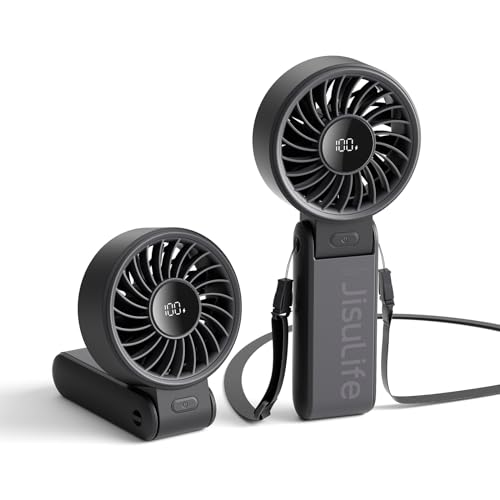
5. JISULIFE Life7 Fan: Best Battery Endurance
Pros
- 5, 000mAh battery with up to 19.5 hours at speed one
- Handheld, desk, and neck modes
- Battery and wind-speed display
- Five speed settings
Cons
- Heavier than the smallest handheld choices
- Listed noise range reaches 70 dB
- Long runtime is tied to the lowest setting
Best for: long commutes, workdays, and outdoor trips where recharging is difficult.
The JISULIFE Life7 Fan makes a convincing case for buyers who hate charging small gadgets. Its 5, 000mAh battery is rated for up to 19.5 hours at speed one, which is the longest low-speed claim among the handheld models here. That does not mean nearly 20 hours of maximum wind, but it does make the Life7 well suited to a full day at a desk, a long travel day, or a night of occasional personal cooling.
A 12-blade design and upgraded brushless motor are intended to move more air than a basic personal fan. Five speeds provide the essential range, and the display shows the selected wind speed and remaining battery. That visibility is useful for an endurance-focused fan because it makes it easier to preserve battery before an outlet becomes available.
The Life7 works as a handheld, desk, or neck fan. Its foldable body can sit on a table, while the included lanyard supports hands-free cooling. The listed size is 7.59 by 3.31 by 1.65 inches and the weight is 8.82 ounces. That makes it noticeably heavier than the Bearwind and PlayHot, but still reasonable to carry in a backpack or tote.
Noise is the point to consider carefully. The product lists a range from 40 dB to 70 dB measured across speeds and distances. Low speed should be the more discreet setting, while the upper range is better suited to outdoor use than a quiet office. For a calmer desk experience, the Warmco D3 has a below-40 dB low-speed claim and a larger stand-up format.
The Life7 is not the most compact or the most forceful fan in this group. The PlayHot and Bearwind prioritize concentrated turbo airflow, and the Diveblues folds smaller. The Life7 wins by making battery capacity, a display, and three modes work together. Choose it when running out of power is a bigger concern than carrying a few extra ounces.
6. Warmco D3 Travel Fan: Best Quiet Desk Fan

Pros
- Up to 24 hours on low
- Below 40 dB on speed one
- Foldable stand and digital battery display
- USB-C input and output
Cons
- Too large for handheld use
- Weighs more than the personal fans
- Four speeds rather than five or more
Best for: desks, bedside tables, hotel rooms, and travel where steady quiet airflow matters.
The Warmco D3 Travel Fan is the most sensible choice here for a stationary personal space. Its seven-inch width and foldable stand give it a stable footprint that handheld fans cannot match. Set it on a desk, nightstand, cruise cabin surface, or tent platform and it can provide a consistent breeze without being held or hung.
The 10, 000mAh battery is rated for up to 24 hours on low and up to 10 hours on high. Those figures make the D3 a practical overnight or workday fan, especially when the fan will remain in one place. Four speed settings and a five-blade design keep the controls simple, while the brushless motor is specified below 40 dB on speed one.
A real-time display shows battery percentage and the current speed. That is more useful on a desk fan than it may sound, since the D3 can be left running for hours at a time. USB-C supports both input and output at 5V/2A, so the fan can also provide power to another device in a pinch. The included 2-in-1 cable reduces the number of cables needed in a travel bag.
The dimensions explain its trade-off. It measures about 7.0 inches wide, 8.4 inches high, and 1.6 inches deep, with a listed weight of 0.88 pounds. It folds flat enough for a backpack, but it is not a natural handheld or neck fan. The FRIZCOL is more capable for outdoor base-camp use because it adds a light, remote, and hook, while the Warmco is quieter and slimmer for ordinary indoor travel.
Do not choose the D3 if you want a fan to carry through a theme park or use while walking. Its advantage is stability and gentle sustained airflow, not pocketability or turbo output. For readers deciding between this and the JISULIFE Life7, the Warmco is the better desk companion, while the Life7 is easier to hold and wear.
7. Kimguard Turbo Fan: Best Speed Control

Pros
- Speed adjustment from 1 to 199
- Claimed 8.5 m/s airflow
- Instant-cool semiconductor function
- Handheld, desk, and neck modes
Cons
- Cooling function uses substantial power
- Fine control is less immediate than preset buttons
- Heavier than some compact rivals
Best for: people who want unusually precise airflow adjustment and an extra cooling surface.
The Kimguard Turbo Fan takes a different route from the five-speed models. Its control range runs from 1 to 199, allowing very small changes in airflow rather than five broad steps. That can be helpful when a standard low setting is too weak but the next setting feels too aggressive. The fan also claims a maximum wind speed of 8.5 m/s from a seven-blade design and three-phase brushless motor.
The other distinctive feature is the instant-cool semiconductor function. Rather than relying only on moving air, it is designed to act like a small cooling pad. The product specifically warns that prolonged use of this function consumes a lot of power, so it should be treated as a short burst of added relief rather than a feature to leave enabled all day.
The battery is rated for up to 20 hours, with a stated two-hour recharge through a regular outlet, power bank, or USB-compatible source. The broad five to 20 hour range is more revealing than the maximum figure. Your selected speed and use of the cooling function will determine where the fan lands in that range. It supports handheld, desk, and neck use, and the listed weight is about 0.56 pounds.
The Kimguard is physically close to the PlayHot and Bearwind in concept, though it weighs more than both. It offers much finer adjustment than either, but the PlayHot has the higher claimed wind speed and a simpler display-led control experience. The Diveblues also offers a 1 to 100 stepless mode in a smaller design, so Kimguard's main argument is the combination of 199 settings and the cooling function.
That combination may be more control than most people need. Changing among 199 levels can slow down a quick adjustment, and the cooling surface is useful only if you are prepared to watch battery consumption. Skip this model if you want simple buttons and predictable modes. Choose it when precise personal airflow is the feature you will actually use.
8. PlayHot Turbo Fan, White: Best Light-Colored Option

Pros
- Up to 10 m/s claimed airflow
- Five speeds and a smart LED display
- USB-C charging
- Foldable 3-in-1 design
Cons
- The white finish may show marks more easily
- High settings will use more battery
- No camping light or remote
Best for: travelers who want PlayHot's compact turbo design in a white finish.
The PlayHot Turbo Fan, White is the same basic design as the black PlayHot model, so the buying decision is mostly about finish and listing identity rather than a different feature set. It uses the same 13, 550 RPM brushless motor, seven-blade airflow system, and claimed top speed of 10 m/s. For a handheld fan, that is the kind of output that can remain useful outside instead of disappearing in warm ambient air.
Five speed settings make the fan manageable for quieter indoor use. A smart LED display shows the selected speed and battery status, giving it a practical advantage over the Bearwind's simpler controls. The display is particularly helpful when switching between gentle airflow at a desk and stronger airflow during a walk, since you can see the setting rather than guess.
The fan's battery is rated for up to 12 hours and takes about three hours to recharge over USB-C. Charging from a wall adapter, laptop, power bank, or car charger keeps it suitable for travel. The 180-degree foldable body can operate as a handheld, desk, or neck fan, and its listed dimensions are about 6.9 inches wide, 2.4 inches long, and 2.2 inches high, with a listed weight of 0.525 pounds for this version.
The white finish is the only meaningful distinction from the black PlayHot in this dataset. The black version is slightly lighter in its listed product information, while the performance and design claims are otherwise the same. That means the Bearwind remains the more balanced alternative, and the Diveblues is the more packable alternative, but this PlayHot is the natural pick for readers who prefer a lighter-looking carry kit.
Its weakness is not performance but duplication. There is little reason to choose it over the black PlayHot unless the finish matters to you, and neither PlayHot belongs on a quiet bedside table at maximum output. Choose the white model for its appearance and the same strong handheld format, not because it offers a separate performance class.
9. JISULIFE 4000mAh Turbo Fan: Best Simple Turbo Fan

Pros
- Five straightforward turbo settings
- 4, 000mAh built-in battery
- Handheld and desktop use
- Lanyard and nonslip mat included
Cons
- No display
- Does not fold into a neck-fan configuration
- Lower claimed wind speed than the newest turbo picks
Best for: shoppers who want a familiar handheld fan with simple controls and no extra modes.
The JISULIFE 4000mAh Turbo Fan is the least complicated handheld choice in this group. It uses JISULIFE's Air Turbo and Air Jet vortex technology, a five-speed control, and a built-in, non-removable battery. There is no display to interpret and no cooling plate or remote to manage. Press the button to move through the settings, then hold it to turn the fan off.
Its motor is listed at 3, 300 to 6, 100 revolutions per minute, with a claimed maximum wind speed of 4.8 m/s. That is below the Bearwind, PlayHot, Diveblues, and Kimguard claims, so this model is better suited to personal range cooling than to pushing a strong stream across a room. The five settings still provide useful flexibility, particularly when the fan is held close.
The 4, 000mAh battery is rated for three to 16 hours, depending on speed, with a three-hour recharge through a regular outlet, power bank, or another USB source. The fan can be held or placed on a flat table using the nonslip mat, and the lanyard makes it easier to carry outdoors. Its listed dimensions are 6.2 by 3.2 by 1.7 inches and its weight is about 0.49 pounds.
The JISULIFE Life7 is the more capable sibling for buyers who want a display, neck mode, 12-blade design, and longer low-speed endurance. The Bearwind is a better fit for someone who wants a foldable body and stronger claimed airflow. The older-style simplicity here is the selling point, not a weakness for every buyer.
The trade-off is that the JISULIFE 4000mAh Turbo Fan gives up information and versatility. There is no battery readout, no foldable neck configuration, and no fine-grained control. It is a reasonable choice for someone who wants a compact fan that can sit on a desk or hang from a wrist, but readers seeking the widest range of use should move higher up the list.

How to choose best portable fan
The right fan depends less on the number of modes than on where you will use it and how long it needs to run.
Airflow and speed control
A handheld fan's airflow determines whether it can cool you outdoors or only provide a faint breeze at close range. Claimed wind speeds in this group range from 4.8 m/s on the JISULIFE 4000mAh Turbo Fan to 10 m/s on the PlayHot models. Higher claimed output can help in still, hot air, but it may also bring more motor noise and faster battery drain.
Preset speeds are easier to adjust quickly. Stepless controls, such as the Diveblues range of 1 to 100 or Kimguard's 1 to 199 range, let you fine-tune the breeze when broad steps feel uncomfortable. That precision matters most when the fan will be used close to your face or in a quiet room.
A high top speed matters outdoors, but a genuinely usable low setting matters every night and every workday.
Battery capacity and runtime
Battery capacity gives a rough idea of endurance, but advertised runtime always depends on the selected speed and extra functions. The small handheld fans range from 3, 600mAh in the Diveblues to 5, 000mAh in the JISULIFE Life7. The FRIZCOL and Warmco use larger batteries because they are designed to run as stationary fans for longer stretches.
Look for a clear charging method and a battery display if you will be away from outlets. USB-C is convenient because the same charger can often serve a phone or other travel gear. A fan with a high maximum runtime may still need frequent charging if you use its highest setting or, in the Kimguard's case, its cooling function.
Portability and positioning
A handheld fan should be comfortable to carry, but portability also means having a practical way to aim the airflow. Foldable models can stand on a desk or hang from a lanyard, while the Diveblues adds a carabiner for clipping to a bag. The Warmco and FRIZCOL are better placed on a table because their bodies are larger and heavier.
Think about the position you will use most. A neck fan leaves both hands free, a desk fan works during calls or makeup, and a handheld fan is easiest to aim while walking. A stable base is more important than a tiny folded size if the fan will spend most of its life beside a bed or laptop.
Noise
Noise becomes more noticeable when a fan sits close to your face or runs beside a microphone. The Warmco lists operation below 40 dB on its lowest setting, while the FRIZCOL lists noise below 30 dB in its product details. The JISULIFE Life7 gives a broader range of 40 dB to 70 dB across its speed levels.
No fan is silent at its highest setting. For sleep, reading, and video calls, prioritize a gentle low setting and a stable desk position. For a beach, stadium, or outdoor queue, stronger airflow matters more than a quiet motor.
Extra functions
A display, light, remote, hook, cooling surface, or carabiner can make a fan much easier to use, but each extra feature adds another trade-off. The FRIZCOL's remote and light are useful in a tent, while the Kimguard's semiconductor cooling function is aimed at short bursts of added relief. A display on the PlayHot, Diveblues, Warmco, or JISULIFE Life7 helps you manage battery and speed.
Do not choose extras simply because they make a product page look more complete. Match them to the setting. If your cooling needs are more substantial than a personal breeze, how much airflow a room really needs is a better question than counting handheld fan modes. For a desk-only setup, the features that make a desk fan easier to live with may matter more than a lanyard.

Frequently asked questions
Are portable fans useful outdoors?
Yes, provided the fan produces a concentrated enough stream and is aimed close to you. The PlayHot, Bearwind, Diveblues, and Kimguard models have the strongest claimed handheld airflow in this group. A fan cannot lower the surrounding air temperature, but moving air across skin can make hot outdoor conditions feel more tolerable.
Can these fans run all night?
Several models are designed for extended low-speed use. The JISULIFE Life7 is rated for up to 19.5 hours at speed one, the Warmco D3 for up to 24 hours on low, and the FRIZCOL for 11 to 60 hours depending on operation. High-speed use will shorten those figures considerably.
Which portable fan is easiest to carry?
The Diveblues D6036 is the most travel-focused design because it folds flat to about four inches, weighs about 6.6 ounces, and includes a carabiner. The Bearwind and PlayHot models are also compact at about 6.7 inches and roughly 0.42 pounds. Larger battery fans are better for stationary use than everyday pocket carry.
Do handheld fans work as desk fans?
Several do. The Bearwind, PlayHot, Diveblues, JISULIFE Life7, Kimguard, and JISULIFE 4000mAh models can stand on a desk or use a foldable body for desktop airflow. The Warmco D3 and FRIZCOL are more stable choices if the fan will remain on a table for hours.
Is a higher speed count always better?
No. Five preset speeds are quick and simple, while 100 or 199 adjustment levels offer more precision but can take longer to set. Stepless control is most useful when you are sensitive to airflow strength or need a very specific breeze. For ordinary travel, a well-chosen low, medium, and high range may be enough.
Which model is best for camping?
The FRIZCOL Camping Fan is the clear camping specialist. Its 24, 000mAh battery, adjustable head, hanging hook, two-level light, timer options, and remote are all useful in a tent or outdoor base. It is much heavier than the handheld choices, so it is not the right pick for walking trips.

The bottom line
The Bearwind Portable Turbo Fan is the Best portable fan for most people because it balances strong claimed airflow, five settings, USB-C charging, a compact body, and handheld, desk, and neck modes. The PlayHot Turbo Fan is the better choice when maximum claimed handheld airflow and a battery display matter more than having the most balanced design.
Choose the FRIZCOL Camping Fan for a tent, campsite, or outdoor workstation, and choose the Warmco D3 Travel Fan for quiet, sustained airflow on a desk or bedside table. The JISULIFE Life7 is the sensible long-runtime alternative for people who need a handheld fan through a full day.
If you are undecided, get the Bearwind unless your main use is camping or quiet desk cooling.
As an Amazon Associate we earn from qualifying purchases.