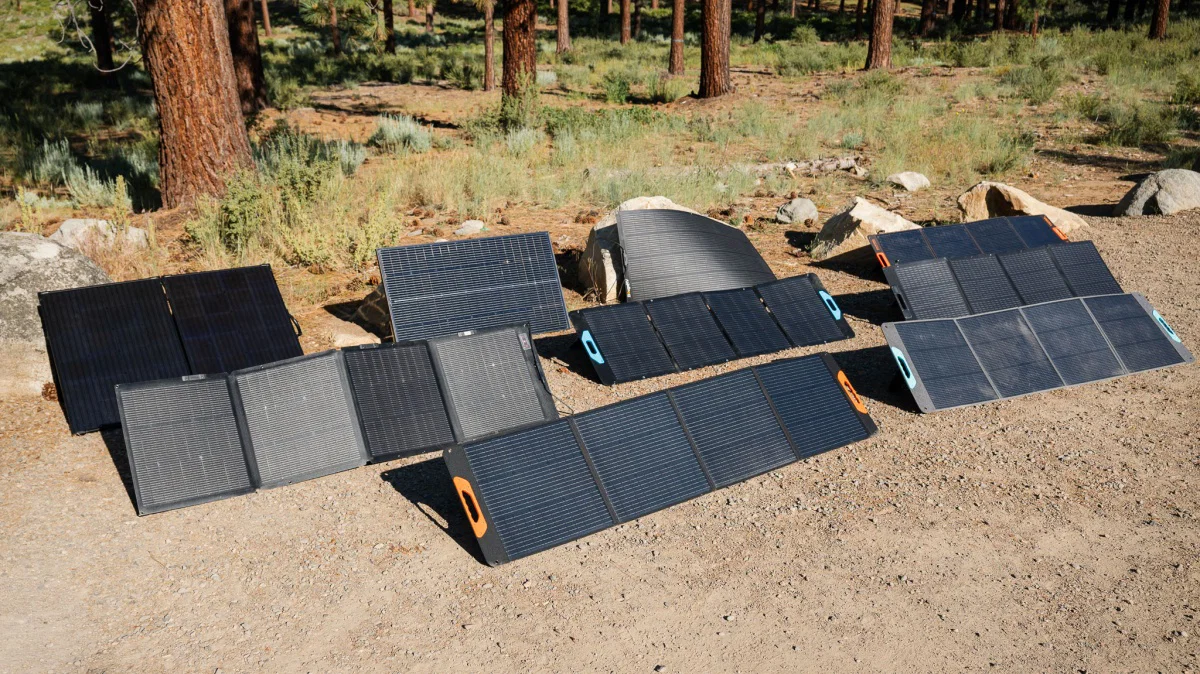

A portable panel has to do more than produce a large wattage figure. It needs to fold into a manageable shape, stay pointed at the sun, connect to the power station you already own, and survive the occasional dusty campsite or sudden shower. The wrong panel can be awkward to carry or incompatible with a low-voltage input.
The Best portable solar panels in this roundup range from a lightweight 100W charger to large 450W and 400W models for high-capacity power stations. We prioritized usable output, connection flexibility, setup, folded size, and weather protection rather than treating the biggest number as an automatic win.
Renogy E.Flex 200W is our top pick for its strong efficiency, unusually low weight, useful device-charging ports, and practical four-kickstand design. The rest of the lineup includes high-output blankets, rugged fiberglass panels, compact travel options, and panels made for specific power-station input ranges.
Comparison table
| # | Product | Award | Output | Efficiency | Folded weight | Weather rating | Best for |
|---|---|---|---|---|---|---|---|
| 1 | Renogy E.Flex 200W | Best overall | 200W | 25% | 13.89 lb | IP65 | Most campers and RV owners |
| 2 | Renogy 400W Blanket | Best high-output blanket | 400W | 25% | 16.09 lb | IP65 | Large power stations with limited storage |
| 3 | SOKIOVOLA 200W | Best connector bundle | 200W | 25% | 16.31 lb | IP68 | Owners of varied power stations |
| 4 | GRECELL 200W | Best adjustable setup | 200W | 23.5% | 16.53 lb | IP65 | Ground deployment |
| 5 | SOKIOVOLA 220W | Best extra-output option | 220W | 25% | 17.08 lb | IP68 | Campers wanting more than 200W |
| 6 | ZOUPW 450W | Best for large power stations | 450W | 25% | 29.5 lb | IP68 | 40V to 60V input systems |
| 7 | TWELSEAVAN 200W | Best device charging | 200W | 24% | 15.7 lb | IP65 | Charging phones and tablets directly |
| 8 | FlexSolar 100W | Best lightweight panel | 100W | 23%+ | 4.08 lb | IP67 | Hiking and compact kits |
| 9 | BougeRV 200W | Best fiberglass build | 200W | 25% | 13.8 lb | IP65 | Frequent setup and transport |
| 10 | Ecosonique 400W | Best six-angle stand | 400W | 23.5% | 22.9 lb | Not specified | Flexible panel positioning |
1. Renogy E.Flex 200W: Best Overall

Pros
- 25% efficiency from N-Type 16BB cells
- 13.89-pound carry weight
- Four kickstands with three angle settings
- USB-C and two USB-A charging ports
- Magnetic closure and handle
Cons
- IP65 protection is for splashes, not soaking
- USB-C output is limited to 45W
- The panel is still broad when deployed
Best for: campers and RV owners who want a balanced 200W panel with direct device charging.
The Renogy E.Flex 200W is the panel we would keep in the vehicle for the widest mix of trips. It folds into a compact 23.72 by 22.99 by 1.97 inches and weighs 13.89 pounds, which makes it noticeably easier to move from a campsite to a sunny patch than the heavier GRECELL 200W. The magnetic closure is a small but welcome improvement over hook-and-loop straps, especially when packing up with dusty hands.
Its 25% efficiency comes from N-Type 16BB cells. That figure does not mean the panel will produce 200W in every patch of sunlight, but it gives the panel a strong starting point when roof space or campsite space is limited. The four kickstands let you use 40, 50, or 60 degree positions, and the reinforced grommets provide another way to attach it to an RV, tent, or other structure. The built-in accessory pouch keeps the connection hardware from wandering around the vehicle.
This is also one of the more useful panels for people who want to charge small electronics without routing everything through a power station. One USB-C port supports up to 45W, while the two USB-A ports are rated at 18W and 15W. The MC4 output handles a power station or a 12V battery system, including AGM, LiFePO4, and deep-cycle batteries. The panel can charge three devices simultaneously, though the USB-C ceiling is lower than the 60W port on the TWELSEAVAN 200W.
The weakness is its IP65 rating. It is protected from dust and water splashes, but Renogy says it is not a panel to leave exposed to a soaking storm. The panel is also not the smallest option here once opened, and anyone who needs the highest possible output should look at the Renogy 400W Blanket or ZOUPW 450W instead. For ordinary camping, emergency backup, and RV use, the Renogy E.Flex 200W has the most complete combination of portability, output, connections, and setup flexibility.
2. Renogy 400W Blanket: Best High-Output Blanket

Pros
- 400W output in a 16-fold design
- 25% efficiency with N-Type 16BB cells
- Only 16.09 pounds
- Ten-foot cable
- Multiple installation options
Cons
- Requires a 40V to 60V capable system
- Large surface area when deployed
- IP65 protection does not mean immersion resistance
Best for: owners of large power stations who need substantial solar input without carrying a rigid panel.
The Renogy 400W Blanket solves a specific problem: getting serious solar input into a vehicle without dedicating a large, rigid slab of storage space to it. Its 16-fold design packs down to 16.54 by 15.83 by 4.13 inches, and the panel weighs 16.09 pounds. That is an unusually favorable weight for a 400W product, though the folded bundle is thicker than the E.Flex 200W.
The 25% efficiency rating and N-Type 16BB cells are useful when a campsite has only one good patch of sun. Renogy describes several ways to deploy it: across an SUV or pickup windshield, on the ground away from a shaded vehicle, or vertically between trees and racks. That flexibility matters more than a bare output number when the vehicle itself is under tree cover. A ten-foot, or 3-meter, cable also makes it easier to keep the power station in a dry or shaded location.
The blanket uses military-grade ETFE lamination and reinforced stitching, with an IP65 rating. The stated operating temperature range is minus 10 degrees Celsius to 65 degrees Celsius. Those details make it better suited to repeated outdoor handling than a delicate foldable mat, while the padded handle and shoulder straps help with transport. Renogy also lists UL 61730 certification along with CE, RoHS, FCC, CA65, and PSE compliance.
The important catch is compatibility. This panel makes sense only when the power station can accept its output, and a 400W panel can be excessive for a small unit. The Renogy E.Flex 200W is easier to deploy and has direct USB ports, while the Renogy 400W Blanket is about feeding a larger battery system quickly. Choose this one for high-capacity setups, not for a lightweight day hike or a small power bank.
3. SOKIOVOLA 200W: Best Connector Bundle

Pros
- 25% efficiency
- IP68 water and dust protection
- Five-in-one connection cable
- 10.49-foot extension cable
- Magnetic handle and four mounting holes
Cons
- 16.31-pound carry weight
- No direct USB output listed
- Power-station input limits still apply
Best for: buyers who use more than one brand or connector type with a portable power station.
The SOKIOVOLA 200W earns its place through connection flexibility. It includes an MC4 to five-in-one cable with XT60, DC5521, DC7909, DC8020, and Anderson connectors, plus a 10.49-foot extension cable. That is a practical advantage for households with a mix of power stations, because the right adapter is less likely to become the missing part at camp.
The panel uses A+ grade monocrystalline cells with a stated conversion efficiency of up to 25%. It folds to 21 by 23 inches and weighs 16.31 pounds, so it is reasonably manageable for car camping but not a panel we would recommend for carrying over a long trail. A magnetic handle helps with the short trip from the vehicle to the deployment spot, and four holes support attachment to an RV or another fixed surface.
Its ETFE coating and IP68 rating give it the strongest stated weather protection among the 200W SOKIOVOLA and Renogy options here. IP68 still does not mean the connectors should be submerged, but the rating is reassuring when the panel is exposed to wet grass, dust, or a sudden change in weather. The included panel bag also makes the cable bundle easier to keep organized.
The limitation is that a multi-connector cable cannot override the input ceiling of a power station. SOKIOVOLA specifically warns that some mobile units will restrict the received power. The GRECELL 200W is easier to angle with its four built-in stands, and the Renogy E.Flex 200W is lighter with direct USB charging. Pick the SOKIOVOLA 200W when compatibility across several systems is more important than the lowest carry weight.
4. GRECELL 200W: Best Adjustable Setup

Pros
- Four built-in adjustable kickstands
- 23.5% conversion efficiency
- Four-in-one cable
- ETFE lamination and 840D Oxford cloth
- Cable storage pouch
Cons
- IP65 rating requires protection from heavy rain
- Heavier than the Renogy E.Flex 200W
- Direct charging requires the appropriate controller for batteries
Best for: campers who want a stable ground setup with quick angle adjustment.
The GRECELL 200W is built around the setup itself. Four adjustable kickstands support the panel on the ground, and the angle can be changed without improvising with rocks, coolers, or bags. That makes it a good fit for a campsite where the sun moves throughout the day and the panel needs occasional repositioning.
Its six-layer ETFE lamination and monocrystalline cells are rated for 23.5% conversion efficiency. The outer 840D Oxford cloth is described as scratch-resistant and moisture-resistant, while the IP65 rating protects against water splashes. Four edge grommets offer another mounting option, and the built-in cable bag has two-way zippers for keeping the wiring and small outdoor items together.
The panel folds to 25.82 by 21.1 by 2.95 inches. The data lists its weight as 16.53 pounds in the product information, while the feature description says 17.94 pounds, so shoppers should expect a panel in roughly that range rather than a lightweight carry. It includes a four-in-one cable and can work with many portable power stations. A charging controller and alligator clip are not included for direct 12V battery charging.
Compared with the Renogy E.Flex 200W, GRECELL gives up some efficiency and carries more weight, but its kickstand arrangement is particularly convenient. The TWELSEAVAN 200W is lighter and has stronger direct USB-C output, while the SOKIOVOLA 200W has a higher IP rating and more connector types. The GRECELL is the sensible pick when repeatable ground positioning matters more than maximum efficiency or a broad adapter bundle.
5. SOKIOVOLA 220W: Best Extra-Output Option

Pros
- 220W rated output
- 25% efficiency
- IP68 weather protection
- Five-in-one connector cable
- Magnetic handle
Cons
- 17.08-pound carry weight
- No direct USB ports listed
- Three mounting holes offer less flexibility than four
Best for: RV and camping setups that can accept more than 200W from a foldable panel.
The SOKIOVOLA 220W is a straightforward extension of the 200W formula. It adds a little more rated output while retaining the folding design, magnetic handle, multi-connector cable, and IP68 protection. That extra capacity is useful for a compatible power station that can accept it, particularly when charging loads compete for the same battery during a day outdoors.
The panel uses A+ grade monocrystalline cells with a stated efficiency of up to 25%. It folds to 23 by 22.24 inches and weighs 17.08 pounds. Those dimensions make it easy enough to store in an RV or vehicle, but the weight is more noticeable than the Renogy E.Flex 200W and BougeRV 200W. Three mounting holes support attachment to an RV, though they give you fewer anchor points than the four-hole designs elsewhere in this group.
SOKIOVOLA includes an MC4 to five-in-one cable for XT60, DC5521, DC7909, Anderson, and DC8020 connections. It also includes a 10.49-foot charging cable and three adapters. The compatibility list covers many common power-station families, but the output limit of the receiving station remains decisive. A panel cannot force a battery system to accept more than its input circuitry allows.
This is the panel to choose over the SOKIOVOLA 200W when the receiving system supports the extra output and the small increase in carry weight is acceptable. The Renogy 400W Blanket is a much larger step for high-capacity stations, while the Renogy E.Flex 200W is more polished for direct device charging. The SOKIOVOLA 220W sits in the middle, with useful headroom and sturdy weather protection.
6. ZOUPW 450W: Best for Large Power Stations

Pros
- Highest rated output in this roundup
- 25% efficiency with N-Type 16BB cells
- IP68 protection
- Four adjustable kickstands
- Bypass diodes for partial shade
- 36-month warranty listed
Cons
- Weighs 29.5 pounds
- Not compatible with systems below 30V input
- Large deployed footprint
Best for: large power stations with a 40V to 60V solar input range.
The ZOUPW 450W is not a general-purpose camping panel. It is a high-input tool for a large power station, and that distinction should determine the purchase. Its stated open-circuit voltage is 45.9V, and ZOUPW specifies a 40V to 60V input range. The company specifically warns that the panel is not compatible with low-voltage units below 30V, including certain Jackery and Bluetti models.
For a compatible system, the 450W rating gives this panel the most charging headroom here. It uses N-Type monocrystalline cells in a 16-busbar design with a stated 25% efficiency. Smart bypass diodes are intended to keep output moving when part of the panel is shaded by trees or debris, though the product instructions still advise against prolonged operation under shade. That makes it a better match for overlanding, RV boondocking, and emergency deployment than for a small day pack.
The fiberglass structure weighs 29.5 pounds and has four kickstands adjustable to 45 degrees. The panel measures 121.85 by 34.57 by 0.79 inches in the listed product dimensions, so it needs a real deployment area. IP68-rated lamination protects against rain and dust, but the connectors should not be soaked. The included adapter cable supports XT60, Anderson, DC7909, and DC8020 connections, and the package includes ground stakes and a storage bag.
Its weight and compatibility restrictions are significant. The Renogy 400W Blanket is much easier to carry and stores in a smaller folded package, while the ZOUPW provides more output and a more explicit high-voltage target. Buyers with a small or low-voltage power station should skip this panel entirely. For a 2kWh-class system that accepts the required input, the ZOUPW 450W is the strongest option in this list.
7. TWELSEAVAN 200W: Best Device Charging

Pros
- 60W USB-C PD port
- QC3.0 and standard USB output
- 24% conversion efficiency
- Eight-in-one connection arrangement
- 15.7-pound weight
Cons
- IP65 protection is not intended for soaking rain
- Lower efficiency than the 25% models
- No direct AC output
Best for: campers who want to charge small electronics directly from the panel.
The TWELSEAVAN 200W stands out because it treats phones, tablets, cameras, and power banks as first-class loads rather than assuming every device will be connected through a power station. Its USB-C port supports up to 60W PD, the QC3.0 port supports up to 18W, and a second USB port is rated at 5V and 3A. The panel can charge those ports simultaneously, subject to sunlight and the connected devices.
Its A+ monocrystalline cells are rated at 24% conversion efficiency, with an ETFE laminated surface and light transmission above 95%. That places it just behind the 25% panels on paper, but the difference is less important than the ports if the goal is to keep personal electronics running. A 9.8-foot MC4 cable and three DC adapters create an eight-in-one connection arrangement for power stations from several major families.
The panel weighs 15.7 pounds and folds to 23 by 22 inches. Four adjustable kickstands make ground positioning quick, and the magnetic handle helps with carrying. The rear uses high-density polyester canvas, while the IP65 rating covers dust and water splashes. TWELSEAVAN lists a 24-month warranty and a 30-day money-back guarantee.
The Renogy E.Flex 200W is lighter and has a higher efficiency rating, but its USB-C port is limited to 45W. The TWELSEAVAN therefore makes more sense for a laptop, tablet, or other USB-C device that can use the additional output. It is not the panel we would choose for maximum weather exposure or the largest power station, but it is one of the most convenient for a mixed load of electronics at camp.
8. FlexSolar 100W: Best Lightweight Panel

Pros
- Only 4.08 pounds
- Compact folded design
- IP67 dust and water protection
- 45W USB-C PD output
- 100W DC output
Cons
- Half or less of the output of the larger panels
- No built-in kickstand details listed
- Lower absolute charging capacity
Best for: hikers, emergency kits, and anyone who values low carry weight above maximum output.
The FlexSolar 100W is the only panel here that feels genuinely comfortable to carry beyond a vehicle. It weighs 4.08 pounds and folds to 12.99 by 10.43 by 2.17 inches, with a carry bag included. That changes the use case completely. A 200W panel may be more productive at a campsite, but the FlexSolar is much easier to keep in a hiking pack, emergency kit, or small vehicle.
The panel unfolds to 45.47 by 26.18 inches and uses monocrystalline cells with a stated conversion efficiency above 23%. Its outputs include a 100W DC connection, USB-C PD 3.0 up to 45W, and USB-A up to 18W. A four-in-one cable covers DC5521, DC7909, Anderson, and XT60 connections, so it can feed compatible power stations and devices without requiring a large panel setup.
IP67 protection covers dust and water exposure, making this a stronger weather-resistance proposition than several larger IP65 models. The E-Film lamination is described as rugged for outdoor use. The compact folded profile is the main advantage, though the product information lists dimensions with a slightly unusual decimal conversion, so the practical takeaway is simply that it stores in a small, thick bundle rather than a flat briefcase.
The trade-off is output. A 100W panel will take longer to replenish a large battery, and it cannot replace the Renogy 400W Blanket or ZOUPW 450W for high-capacity systems. It also has less charging headroom than every 200W option here. If your priority is a panel that will actually come along on foot, however, the FlexSolar is the clear choice. For more ideas about keeping small electronics running away from an outlet, the connector and capacity trade-offs in compact charging gear are useful to consider.
9. BougeRV 200W: Best Fiberglass Build

Pros
- 25% efficiency with N-Type cells
- Fiberglass layer helps resist cracking
- 13.8-pound weight
- 8.2-foot extension cable
- XT60 and DC7909 connectors
Cons
- Connector selection is narrower than several rivals
- IP65 protection is limited to water resistance
- No direct USB ports listed
Best for: frequent campers who want a lighter 200W panel with added structural reinforcement.
The BougeRV 200W is a good example of a panel where the construction story matters more than a long accessory list. A fiberglass layer is intended to resist cracking and surface abrasion during repeated setup and transport. That is useful for people who move a panel in and out of an RV, truck, or storage compartment often, rather than deploying it once and leaving it in place.
Its N-Type cells are rated at 25% conversion efficiency, and the panel weighs 13.8 pounds. It folds to 23.6 by 22.9 by 1.8 inches, putting it close to the Renogy E.Flex 200W in both carry weight and storage footprint. Built-in side handles make hand carrying easier, while an 8.2-foot extension cable gives reasonable freedom to put the panel in direct sun and keep a BougeRV battery or power station in a shaded spot.
BougeRV includes XT60 and DC7909 connectors for compatible devices. That is enough for a straightforward setup, but it is less flexible than the five-in-one bundle supplied with the SOKIOVOLA panels or the broader adapter arrangement on the TWELSEAVAN. The IP65 rating helps against rain and dust exposure, though it is not a reason to leave the panel in a downpour.
The Renogy E.Flex 200W remains the better all-around panel because it adds direct USB charging and adjustable angle positions. BougeRV is more compelling when fiberglass reinforcement and a low carry weight are the priorities. Buyers who need many connector standards should choose SOKIOVOLA instead, while buyers who need the panel itself to handle a larger system should step up to a 400W model.
10. Ecosonique 400W: Best Six-Angle Stand

Pros
- 400W rated output
- Six-angle kickstand
- Three-meter MC4 cable
- 23.5% conversion rate
- Six-fold storage design
Cons
- Heaviest 400W panel here
- Weather rating is not specified
- Folded dimensions are relatively large
Best for: users who want a high-output panel with many positioning angles and long cable reach.
The Ecosonique 400W is built for people who expect to adjust a panel throughout the day. Its six-angle kickstand provides more positioning choices than the fixed angle options on some competitors, which can help when the sun is low or the campsite is uneven. A three-meter MC4 cable also makes it easier to separate the panel from the power station.
The panel uses CPC lamination and folds six times to a stated 26 by 22 by 3 inches. It weighs 20.3 pounds in the feature description, while the product information lists 22.9 pounds. That discrepancy is worth keeping in mind when planning transport. Either figure puts it above the Renogy 400W Blanket, which is one of the reasons the Renogy is a more attractive choice when storage and carrying matter.
Ecosonique lists a 23.5% conversion rate, compatibility with EcoFlow, Jackery, Bluetti, and Anker power stations, and included MC4 to XT60, Anderson, and DC8020 connections. The CPC and Oxford fabric construction is described as tear-resistant, dustproof, and waterproof. The product also lists automatic restart technology after interruptions and smart protection, but no IP weather rating is specified in the provided information.
That missing rating is the main reason this panel ranks below the other high-output options. The Renogy 400W Blanket offers a more compact folded form, a stated IP65 rating, and 25% efficiency, while the ZOUPW 450W provides more output for systems that can accept its higher voltage. Ecosonique makes sense when the six-angle stand and long cable are more useful than the lightest carry weight or the clearest weather specification.

How to choose best portable solar panels
The right portable solar panel is determined by the receiving power station as much as by the panel itself. Check these factors before choosing a wattage.
Power output
A panel rated at 100W, 200W, 400W, or 450W describes its maximum nominal output under favorable conditions. Sun angle, clouds, temperature, cable loss, and the receiving power station all affect what you actually get. A 100W panel is easier to carry, while 400W and 450W models make more sense for large batteries that can accept their input.
Do not select a high-output panel solely because the number is larger. The station must be able to accept the panel's voltage and current, and some systems impose an input ceiling well below the panel's rating.
Efficiency and cell design
Efficiency describes how much sunlight the panel can convert over a given surface area. The 25% N-Type 16BB designs in this roundup can be useful when the available deployment area is limited. A 23.5% or 24% panel may still be the better practical fit if its connections, weight, or stand design suit your setup.
Efficiency is not the same as guaranteed output in cloudy conditions. It is one part of the decision, alongside the panel's size, orientation, and the weather at your campsite.
Voltage and compatibility
Connection plugs are only half of compatibility. The ZOUPW 450W, for example, is specified for systems accepting 40V to 60V and is not intended for units below 30V. Other panels include MC4 cables with XT60, Anderson, DC7909, DC8020, or DC5521 adapters.
Read the power station's solar input voltage, current, and maximum wattage before buying. A connector that physically fits does not prove that the electrical specifications match.
A panel is only as useful as the power station that can safely accept its output.
Folded size and carry weight
A portable panel spends a lot of time folded, stored, and carried. The FlexSolar 100W weighs about 4.08 pounds, while the BougeRV 200W and Renogy E.Flex 200W are around 14 pounds. The larger 400W and 450W panels can weigh from 16.09 to 29.5 pounds.
Look at both folded and deployed dimensions. A compact folded panel may still need a broad, unobstructed patch of ground once opened. If your trips involve hiking, the lighter FlexSolar is more realistic. For RV use, a heavier high-output panel may be easier to justify.
Weather protection and construction
IP ratings provide a useful shorthand, but they are not permission to ignore the manufacturer's instructions. IP65 covers dust and water splashes, while IP67 and IP68 indicate stronger water protection under defined conditions. Connectors can have different practical limitations from the panel surface.
ETFE, fiberglass reinforcement, CPC lamination, Oxford fabric, and reinforced stitching all address durability in different ways. Look for the construction that matches your handling pattern. A panel repeatedly moved across gravel needs a different priority from one mounted beside an RV for occasional use.
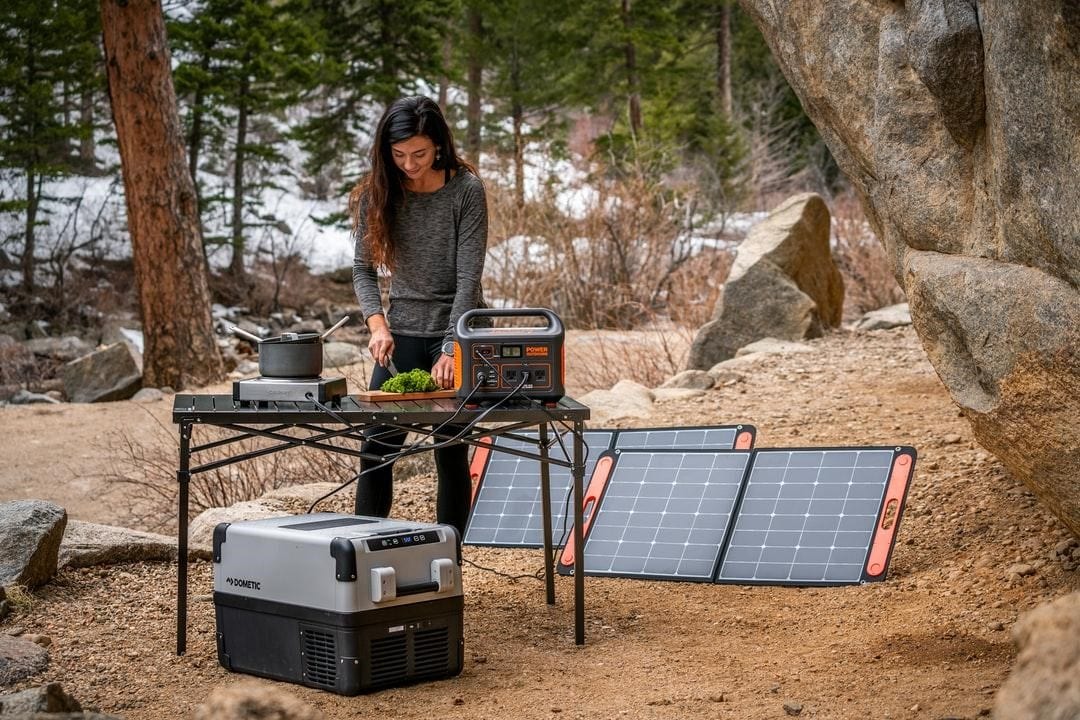
Frequently asked questions
Can a portable solar panel charge any power station?
No. The power station must support the panel's voltage, current, connector, and maximum input wattage. An adapter can change the plug shape, but it cannot make an electrically incompatible panel safe to use.
Is a 200W panel better than a 100W panel for camping?
A 200W panel can provide more charging capacity, but it is usually heavier and larger when deployed. The FlexSolar 100W is easier to carry on foot, while the Renogy E.Flex 200W and similar panels are better suited to vehicle camping and larger batteries.
Can these panels charge devices directly?
Some can. The Renogy E.Flex 200W has one USB-C port rated at 45W and two USB-A ports, the TWELSEAVAN 200W has a 60W USB-C PD port plus two USB ports, and the FlexSolar 100W has USB-C and USB-A outputs. The other panels are primarily intended to connect to a power station or battery system.
Can portable solar panels stay outside in the rain?
The answer depends on the panel's protection rating and the manufacturer's instructions. IP65 panels are designed for dust and water splashes, while the SOKIOVOLA and ZOUPW models list IP68 protection. Connectors should still be kept from soaking, and no panel should be treated as permanently weatherproof without checking its instructions.
What does solar panel efficiency mean?
Efficiency describes the percentage of sunlight converted into electrical energy under stated conditions. A higher efficiency can help when the panel has limited surface area, but it does not guarantee a particular wattage in changing sunlight.
Do I need a charge controller?
A power station generally has its own solar input management. Direct battery charging is different and may require an appropriate charge controller, wiring, and battery-specific protection. GRECELL specifically notes that a controller and alligator clip are not included for its direct 12V battery use.

The bottom line
The Best portable solar panels need to match the power station before they match the campsite. Renogy E.Flex 200W is the strongest all-purpose pick because it combines 25% efficiency, a 13.89-pound carry weight, four kickstands, direct USB charging, and a useful MC4 output. It has a real weather limitation, but its balance is hard to beat.
For larger systems, Renogy 400W Blanket is the better high-output choice when storage space is tight, while ZOUPW 450W is the specialist option for power stations with the required 40V to 60V input. Hikers and compact-kit users should choose FlexSolar 100W, and anyone managing several connector types should look closely at SOKIOVOLA 200W.
If you are undecided, choose the lightest panel that meets your power station's input requirements, then confirm the connectors and voltage before ordering.
As an Amazon Associate we earn from qualifying purchases.