
A rain gauge only helps if you can read it after the storm, keep it stable in the soil, and empty it without turning the job into a chore. Short tubes disappear behind flowers, clear plastic can be hard to read in bright light, and a poorly designed collector can make a downpour look wetter than it was.
We compared 10 options ranging from simple magnifying tubes to wireless displays that record rainfall history. The Best rain gauge for most gardens is the JMBay 29-Inch Rain Gauge, while the other picks cover indoor monitoring, large storm totals, decorative planting beds, and straightforward wall mounting.
Comparison table
| # | Product | Award | Capacity | Height or display | Best for |
|---|---|---|---|---|---|
| 1 | JMBay 29-Inch Rain Gauge | Best overall | Not specified | Adjustable to 19 or 29 inches | Tall garden placement |
| 2 | AcuRite Magnifying Rain Gauge | Best simple gauge | 5 inches | 12.14 inches | Quick visual readings |
| 3 | AcuRite Wireless Rain Gauge | Best wireless option | Self-emptying collector | Indoor display | Rainfall history |
| 4 | WondMall Metal Rack Rain Gauge | Best metal holder | Not specified | 7-inch tube | Yard and fence mounting |
| 5 | JMBay Adjustable Rain Gauge | Best extra-tall design | Not specified | Adjustable to 18, 27, or 37 inches | Reading above dense plants |
| 6 | YZDTECH Metal Rack Rain Gauge | Best readable rack gauge | Not specified | Large-font tube | Fence or soil installation |
| 7 | Headwind EZRead 26-Inch | Best long-distance reading | Not specified | 26 inches | Reading from across the yard |
| 8 | Holdly 11-Inch Rain Gauge | Best storm capacity | Up to 11 inches | 14 inches | Heavy rainfall records |
| 9 | JMBay Digital Rain Gauge | Best digital monitor | Self-emptying collector | 7.1-inch console | Indoor rainfall and temperature |
| 10 | WCRG Copper Rain Gauge | Best decorative gauge | 5.5 inches | 24-inch stake | Decorative year-round display |
1. JMBay 29-Inch Rain Gauge: Best Overall

Pros
- Adjustable 19-inch or 29-inch height
- Large scale and red floating buoy
- Thickened transparent plastic tube
- H-shaped foot helps anchor it in soil
Cons
- No indoor display or rainfall history
- Requires assembly
- Capacity is not specified
Best for: gardeners who want a conspicuous, readable gauge that stays above grass and flowers.
The first thing that makes the JMBay 29-Inch Rain Gauge useful is its height. At 29 inches with all three sections installed, it is much easier to spot at the back of a planting bed than a short tube sitting at ground level. Remove the middle section and it becomes a 19-inch gauge, which gives you a practical option when a lower profile suits the location better.
JMBay uses a thickened transparent plastic tube and a cast iron frame. The plastic is described as frost-resistant and shatterproof, while the frame is intended to resist rust, fading, and deformation. Those claims do not make it indestructible, but the construction is more reassuring for year-round outdoor use than a very thin standalone tube. The removable inner tube also makes emptying and checking the reading simple.
Reading the water level is the product's strongest detail. Large bold markings are paired with a colored strip behind the tube, and the red floating buoy gives the water line a distinct visual target. That combination should be easier to interpret from a normal standing position than a plain clear cylinder, especially when sunlight creates reflections. The patented collector-mouth design is intended to keep the collection area consistent with the tube body, avoiding excess intake.
The JMBay beats the AcuRite Magnifying Rain Gauge when height and garden visibility matter, while the Headwind EZRead 26-Inch is the better fit for someone who wants a gauge designed specifically for reading from farther away. JMBay's weakness is the lack of a stated capacity and any indoor record keeping. Skip it if you want automatic totals, alerts, or temperature information. For a visible, traditional garden gauge, this is the one we'd keep.
2. AcuRite Magnifying Rain Gauge: Best Simple Gauge

Pros
- Magnifies numbers by more than 35 percent
- Measures up to 5 inches
- Can hang or be staked
- Compact acrylic construction
Cons
- Shorter than the tall garden models
- No floating buoy or wireless display
- Simple mounting options only
Best for: anyone who wants a compact manual gauge with markings that are easy to see.
The AcuRite Magnifying Rain Gauge is the uncomplicated pick. It does not try to be garden sculpture or a weather station. It gives you a clear tube, bold white inch markings, and an optical magnifying effect that makes the reading larger than it would appear on a plain narrow cylinder.
Its stated capacity is 5 inches, enough for routine daily measurements and many individual storms. The acrylic construction is described as durable and weather resistant, and the unit measures 12.14 inches tall. That makes it easier to place beside a small garden, patio, or fence without the visual prominence of a 29-inch stake. The compact shape also makes it less awkward where a tall gauge would be knocked by people or pets.
Mounting is flexible but basic. An integrated hang hole lets you attach it to a suitable surface, or you can stake it into the ground. That is convenient, though it does not provide the sturdy cast iron rack found on the WondMall Metal Rack Rain Gauge or the adjustable planting-bed height of the JMBay Adjustable Rain Gauge.
The trade-off is visibility from a distance. Magnification helps when you are standing close, but this is not the gauge to choose if you want to read rainfall across a large yard. It also lacks a red float, colored background, history, and alerts. Choose the AcuRite when you want a readable manual tube and nothing more. For guidance on combining precipitation data with broader household conditions, the kinds of measurements a home weather setup can track are a useful next step.
3. AcuRite Wireless Rain Gauge: Best Wireless Option
Pros
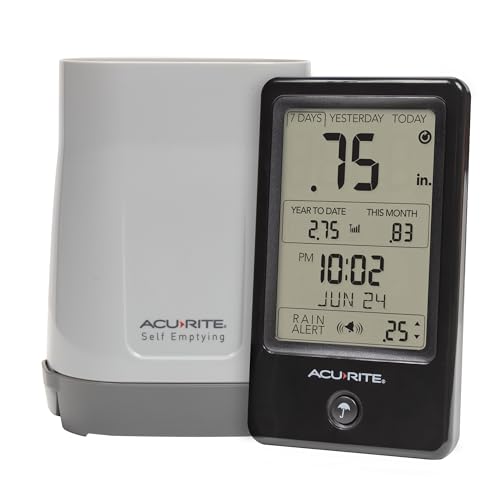
- Sends outdoor readings to an indoor display
- Self-emptying collector
- Tracks day, week, month, and year totals
- Customizable audible rainfall alert
- Shows current date and time
Cons
- Requires an indoor display and outdoor collector
- No visible manual tube for quick garden reading
- More setup than a basic gauge
Best for: households that want rainfall information without walking outside after every storm.
The AcuRite Wireless Rain Gauge changes the routine completely. Instead of checking a tube in the yard, you read rainfall from the vertical indoor display. That is particularly handy when the collector is mounted away from the house, the yard is muddy, or you want to check the total before deciding whether plants need watering.
The outdoor collector is self-emptying, so it does not need to be manually dumped after each reading. The system sends the measurement wirelessly to the display, where you can view totals for the current day, yesterday, the past week, month, and year. Those time windows are far more useful for tracking watering patterns than a single tube that only tells you what is in it right now.
A programmable alarm can sound once a chosen rainfall total is reached. That gives the gauge a practical role in irrigation planning, although the product data does not specify the wireless range or battery life. Its indoor unit measures 6 inches high, 4.9 inches wide, and 2.3 inches deep, so it should be easy to place on a desk or shelf without taking over the room.
The JMBay Digital Rain Gauge offers more display functions, including temperature, eight rainfall views, a graph, calendar, and radio-controlled time. AcuRite is the cleaner choice if rainfall history is the priority and you want a less crowded feature set. Its weakness is that it cannot give you the instant visual charm of the WCRG Copper Rain Gauge, and installation is more involved than setting a tube into soil. Choose it for people who want rainfall records available from indoors.
4. WondMall Metal Rack Rain Gauge: Best Metal Holder

Pros
- Cast iron two-in-one mounting rack
- Large-font scale with red float
- Can mount to a post or go into soil
- Removable replacement tube
- Thickened transparent plastic
Cons
- No adjustable height
- No indoor readout or rainfall history
- Capacity is not specified
Best for: gardeners who want a traditional rack-mounted gauge that can move between a fence and the ground.
The WondMall Metal Rack Rain Gauge has the familiar garden-gauge shape, but its holder gives it more flexibility than a bare plastic tube. The cast iron rack can be attached to a post or fence with screws, or used with its pronged foot in soil. That makes it a good choice for a yard where the best measuring spot is not necessarily the most convenient place for a stake.
The tube uses thickened transparent plastic, and the maker describes it as resistant to freezing and breakage. A removable inner tube makes it easier to empty and clean than a permanently fixed collector. WondMall also uses a blue strip behind the water column and a red float inside the tube. The blue background reduces the washed-out effect that can make clear plastic hard to read, while the float gives you a more definite water level.
The scale uses larger lettering than a conventional narrow gauge. The product title identifies the tube as 7 inches, but the available data does not state a total rainfall capacity, so we would not treat that figure as a capacity measurement. The listed dimensions are for the product packaging or item listing and do not establish a useful measuring range.
Compared with the nearly identical YZDTECH Metal Rack Rain Gauge, WondMall makes the same basic case: rack stability, a large-font tube, and two mounting methods. The JMBay 29-Inch Rain Gauge is more versatile when plant height is the problem, since its sections can be adjusted. WondMall's real weakness is the fixed format and lack of digital tracking. Pick it when a sturdy-looking holder and easy manual reading matter more than data history.
5. JMBay Adjustable Rain Gauge: Best Extra-Tall Design

Pros
- Reaches 37 inches
- Adjusts to 18 or 27 inches
- Large font with ten divisions per inch
- Colored strip and red float improve contrast
- Can hang from a fence or stand in soil
Cons
- Tallest setting may need careful placement
- No stated rainfall capacity
- No wireless or indoor display
Best for: dense gardens where ordinary rain gauges vanish behind foliage.
The JMBay Adjustable Rain Gauge is the solution for a very specific annoyance: the rain gauge is there, but the plants have swallowed it. Its four-section design reaches 37 inches, making it the tallest manual model here. Remove sections to use it at 18 or 27 inches, so you are not locked into the full height when the garden changes.
Its measurement tube uses large markings divided into ten equal parts per inch. That finer visual structure should make small changes easier to judge than widely spaced, generic markings. JMBay also adds a colored metal strip behind the tube and a red float inside it. Together, those features are intended to make the water level stand out against a transparent surface and reduce reflection problems.
The thickened transparent plastic tube is described as resistant to freezing and cracking, while the cast iron frame is intended to resist fading and deformation. The H-shaped metal legs help hold it in soil, and a rear hook provides a fence-hanging alternative. The tube is detachable for emptying and cleaning, which is especially useful when the gauge is installed high enough that handling the whole frame would be awkward.
The JMBay 29-Inch Rain Gauge is the more restrained version and probably the better fit for a typical flower bed. The Headwind EZRead 26-Inch is easier to justify when distance reading is the main goal. This JMBay's weakness is stability at full extension: a 37-inch gauge needs a sensible location and firm soil. Skip it for a low border or exposed spot where a tall structure could become inconvenient. Choose it when visibility over foliage is non-negotiable.
6. YZDTECH Metal Rack Rain Gauge: Best Readable Rack Gauge

Pros
- Large-font tube with red float
- Blue strip improves contrast
- Cast iron rack supports soil or fence mounting
- Removable tube is easy to empty
- Thickened plastic is intended for outdoor use
Cons
- Fixed height
- No stated capacity
- No digital record keeping
Best for: a conventional manual gauge that needs both fence and ground mounting options.
The YZDTECH Metal Rack Rain Gauge is a straightforward alternative to the WondMall design. It uses a cast iron two-in-one holder, so you can place it in soil with the pronged stake or secure it to a post or fence with screws. That choice of mounting matters more than decorative detail when the yard has loose soil, a retaining wall, or a preferred observation point along a fence.
The clear plastic tube is thickened, and the product description says it is less likely to crack in freezing conditions. The tube comes out of the holder for emptying and reuse. This is the kind of small practical detail that makes manual monitoring less irritating, because you can remove the tube instead of trying to pour it out while it remains attached to a stake.
Readability is handled with large numbers, a blue strip behind the tube, and a red float. A plain clear tube can disappear against a bright lawn or reflect the sky, so the contrast aids are welcome. They do not turn it into a precision instrument, and the listing does not provide a capacity or exact graduation specification, but they should make ordinary garden readings quicker.
WondMall is the closest comparison, and the two products overlap heavily in their stated construction and use. The AcuRite Magnifying Rain Gauge is smaller and simpler, while the JMBay Adjustable Rain Gauge is the stronger choice for tall planting beds. YZDTECH's weakness is that it offers no height adjustment or indoor history. Buy it when you want a readable rack gauge and already know where it will be mounted.
7. Headwind EZRead 26-Inch: Best Long-Distance Reading
Pros
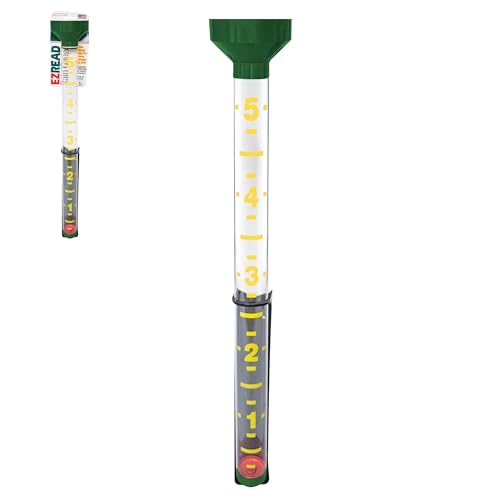
- 26-inch oversized format
- Designed to be read from up to 50 feet
- Funnel helps keep leaves and debris out
- High-visibility float and water-level magnification
- Mountable with included plastic hanger
Cons
- Mounting is not described as a freestanding stake
- No rainfall history or indoor display
- Capacity is not specified
Best for: large yards where walking up to the gauge for every reading is inconvenient.
The Headwind EZRead 26-Inch is built around distance. The gauge stands 26 inches tall and is designed to be readable from up to 50 feet, which is a meaningful advantage for someone checking rainfall from a porch, kitchen window, or the opposite side of a yard. Its oversized format also gives it a stronger visual presence than compact acrylic gauges.
The water level is made more visible with a float and magnification. Headwind also includes a funnel intended to keep leaves and other debris from entering the tube. That is a useful design detail in a garden with nearby trees, since debris can clog a collector or make the reading less trustworthy. The data does not state a capacity or exact graduation size, so this is a visibility-focused gauge rather than one to choose for a documented fine-grained scale.
Installation uses an included plastic hanger and is described as suitable for most surfaces. That makes it a natural fit for a fence, wall, or post, but the available product details do not describe a ground stake. If you need a freestanding installation, the JMBay 29-Inch Rain Gauge has a more clearly specified H-shaped foot, and the WondMall Metal Rack Rain Gauge offers both soil and fence mounting.
Headwind's weatherproof construction and bright colors should keep it noticeable in cloudy conditions. The weakness is placement flexibility: a mountable gauge can be excellent in the right location and awkward in the wrong one. Choose it for a fixed mounting point and long sightline. If you want a second device for broader household readings, the difference between rainfall tracking and a fuller home weather setup is worth understanding before you buy.
8. Holdly 11-Inch Rain Gauge: Best Storm Capacity

Pros
- Measures storm totals up to 11 inches
- 0.01-inch graduations in the inner tube
- UV- and heat-resistant polycarbonate
- Removable bracket simplifies emptying
- Suitable for post or pole mounting
Cons
- Less decorative than the garden stake models
- Requires a secure vertical mounting surface
- No wireless display or alert
Best for: careful rainfall recording in regions that see large storms.
The Holdly 11-Inch Rain Gauge is the measurement-first option. Its inner tube shows rainfall in 0.01-inch graduations, giving it a more precise reading format than the products that focus mainly on large lettering and decorative placement. The first inch is measured in the inner tube, while additional water collects in the outer cylinder for staged readings up to 11 inches.
That high total capacity is the reason to choose Holdly. A small tube can fill during a severe storm and leave you guessing about the total. Holdly is designed to keep collecting instead. Its clear polycarbonate construction is described as UV and heat resistant, which suits regular outdoor exposure, though the product does not promise a wireless record or automatic alert.
The removable mounting bracket attaches vertically to a post or pole. You can take the gauge out for reading, emptying, and cleaning, then return it to the bracket. This is more convenient than a fixed tube, but it also means you need a stable, properly aligned mounting location. The listed item dimensions are 14 inches high, 4.2 inches long, and 4.2 inches wide, so it has a more substantial footprint than a narrow acrylic gauge.
The AcuRite Wireless Rain Gauge is better for checking totals from indoors, and the WCRG Copper Rain Gauge is more attractive in a decorative garden. Holdly's weakness is that it looks and works like a dedicated instrument rather than a piece of yard décor. Choose it when accurate manual records and extra storm capacity matter more than a colorful float or wireless convenience.
9. JMBay Digital Rain Gauge: Best Digital Monitor

Pros
- Self-emptying wireless outdoor collector
- Eight rainfall measurement views
- Indoor and outdoor temperature readings
- Programmable rain alarm
- Blue backlight for nighttime viewing
Cons
- More functions than some gardeners need
- Requires a console and outdoor sensor
- No manual tube for a quick visual yard reading
Best for: households that want rainfall history, temperature, time, and alerts in one indoor console.
The JMBay Digital Rain Gauge is closer to a small weather station than a traditional garden tube. Its outdoor sensor collects rain and sends the information to an indoor console, so the useful part of the product is available without stepping outside. The self-emptying design also removes the need to dump a tube manually after each storm.
The console provides eight rainfall views: current, one hour, 24 hours, today, seven days, month, year, and total. It also shows a cylindrical rainfall graph, which gives the recent pattern more context than a single number. A programmable rain alarm can help with watering decisions or alert you to unusually heavy precipitation.
Rain is only part of the display. The system provides real-time indoor and outdoor temperatures, a radio-controlled time function, a calendar, and a dual alarm clock with snooze. Press the light button and the blue backlight stays on for 15 seconds, making the display easier to check at night. The console measures 7.1 inches wide, 5.1 inches high, and 4.3 inches deep, so it needs a reasonable shelf or desk space.
The AcuRite Wireless Rain Gauge is the better choice if you want a simpler rainfall-focused history display. JMBay offers more information, but that extra information also makes it a less focused purchase. It cannot replace the immediate visibility of the JMBay 29-Inch Rain Gauge in a garden, and setup is more involved than placing a tube in soil. Choose it when indoor monitoring and temperature readings are central to the job.
10. WCRG Copper Rain Gauge: Best Decorative Gauge

Pros
- Solid copper decorative finish
- 24-inch powder-coated steel stake
- Measures up to 5.5 inches
- Reads in inches and millimeters
- Shatterproof polycarbonate floating tube
- Designed for freezing conditions
Cons
- No indoor display or rainfall history
- Lower capacity than Holdly
- Decorative finish is not for every garden
Best for: gardeners who want a durable rain gauge that looks intentional in a planted space.
The WCRG Copper Rain Gauge is the one that looks like it belongs in the garden rather than being temporarily placed there. Its solid copper finish is designed to develop a natural patina, while the 24-inch powder-coated steel stake gives it a clear vertical presence. It is a practical gauge, but decoration is plainly part of the appeal.
The floating tube measures up to 5.5 inches of rainfall and uses large numbers in both inches and millimeters. That dual scale is useful if you compare local readings with weather reports or gardening references that use metric measurements. The floating design also makes the level easy to see without relying on a digital screen.
Durability is stronger than the decorative presentation might suggest. The tube is made from shatterproof polycarbonate, and the product is described as winter-safe and resistant to cracking in freezing conditions. The steel mount is rust resistant, and the product is assembled and designed in the USA using domestic and imported components. Those details make it a better candidate for leaving in place across changing seasons than a fragile glass ornament.
The JMBay 29-Inch Rain Gauge is easier to adjust and offers stronger reading contrast with its colored strip and red buoy. The Holdly 11-Inch Rain Gauge is the better instrument for unusually large storm totals. WCRG's weakness is the absence of digital history and its more limited capacity. Choose it when the gauge will remain visible in a garden bed and should look good between storms.
How to choose best rain gauge
The right gauge depends on where you will install it and whether you want a single reading or a record of changing rainfall.
Reading clarity
A rain gauge should show the water line without requiring you to crouch, squint, or move it into different light. Large numbers, magnification, a colored background, and a floating marker all help. The AcuRite Magnifying Rain Gauge uses magnification, while the JMBay, WondMall, and YZDTECH models use contrast strips and floats.
A gauge that is technically readable but hidden behind foliage is not useful in daily gardening.
Height and placement
Tall gauges are easier to see above flowers, grass, and shrubs. The JMBay Adjustable Rain Gauge reaches 37 inches and can be shortened, while the JMBay 29-Inch Rain Gauge adjusts between 19 and 29 inches. A shorter gauge is more discreet, but it needs a clear line of sight.
Check how the product mounts before choosing a location. Some models stand in soil, some hang from a fence, and the Holdly uses a removable bracket for a post or pole. The Headwind is specifically designed for mounted installation.
Capacity and graduations
Capacity matters most where storms can exceed a few inches. The Holdly can measure totals up to 11 inches, while the WCRG measures up to 5.5 inches and the AcuRite Magnifying model measures up to 5 inches. A smaller capacity is not automatically a problem if you empty the tube regularly.
Graduation detail matters when you are recording small changes. Holdly specifies 0.01-inch graduations, while the JMBay Adjustable Rain Gauge describes ten equal divisions per inch. Several other products provide large markings but do not state an exact graduation size.
Materials and winter use
Outdoor plastic needs to tolerate sunlight, temperature changes, and accidental knocks. Polycarbonate, acrylic, and thickened transparent plastic appear across this group, with different products describing resistance to cracking, weather, heat, or freezing. Metal holders add stability, but they also need protection against rust and fading.
The WCRG combines a polycarbonate tube with a rust-resistant steel stake. The rack-style WondMall and YZDTECH models use cast iron holders. If the gauge will remain outside year-round, material claims and a removable tube are more useful than appearance alone.
Wireless monitoring
A manual tube is best when you enjoy checking the garden directly. Wireless models make more sense when you want rainfall history, alerts, or readings from inside the house. The AcuRite Wireless Rain Gauge records periods from the current day through the year, while the JMBay Digital Rain Gauge adds eight rainfall views, temperature readings, a graph, and time functions.
These systems require more setup and an indoor console, but they remove the need to inspect a wet yard after every storm. For related planning, how indoor and outdoor measurements work together at home can help clarify whether you need a single-purpose rain monitor or a broader household display.
Frequently asked questions
Where should a rain gauge be placed?
Place it in an open area away from roofs, trees, walls, and large shrubs that can redirect water into the collector. The gauge should also be easy to see and reach for emptying. A stable, unobstructed location matters more than placing it close to the plants you are watering.
Are wireless rain gauges more accurate than manual gauges?
Wireless operation does not automatically make a gauge more accurate. Its main advantages are indoor access, automatic collection, history, and alerts. Accuracy depends on the collector design, placement, and how well the system is maintained.
How often should a manual rain gauge be emptied?
Empty it after recording each reading if you want separate daily or storm totals. Emptying also prevents an already full tube from losing useful information during the next storm. Removable tubes, such as those on several rack models, make the process easier.
What capacity should a garden rain gauge have?
A 5-inch capacity is sufficient for many routine garden measurements, but areas that receive intense storms benefit from more. The Holdly reaches 11 inches through its inner tube and outer cylinder arrangement. If your region has frequent heavy rainfall, capacity deserves more attention than decorative styling.
Can a rain gauge stay outside in winter?
Several products in this list describe their tubes as resistant to freezing or cracking, including the WCRG, JMBay, WondMall, and YZDTECH models. Even so, installation and material quality vary. A removable tube makes inspection, cleaning, and seasonal storage easier.
Do tall rain gauges measure better?
Height alone does not guarantee better measurement. It mainly improves visibility and helps keep the collector above vegetation. The collector opening, level placement, clear graduations, and an unobstructed location matter more to the reading itself.
The bottom line
The Best rain gauge for most gardens is the JMBay 29-Inch Rain Gauge. Its adjustable height, contrasting reading aids, removable tube, and sturdy H-shaped base solve the everyday problems that make manual gauges frustrating. It is not the choice for indoor history or alerts, but it is the strongest all-around garden design here.
Choose the AcuRite Wireless Rain Gauge if you want rainfall totals available indoors, or the JMBay Digital Rain Gauge if you also want temperature, graphs, time functions, and multiple rainfall views. For careful storm records, Holdly's 11-inch capacity is the standout, while WCRG is the more attractive long-term garden fixture.
If you are undecided, choose the tallest manual gauge you can place securely, unless indoor history is the feature you will use most.
As an Amazon Associate we earn from qualifying purchases.