

Every few years a wellness category reaches the point where the technology is proven enough and the price low enough that it stops being niche. Red light therapy is there now. Panels that once cost a few thousand dollars sit on nightstands and in home gyms, pulling double duty for skin tone, muscle soreness, and morning energy. But with dozens of panels on the market, all claiming 660nm and 850nm, the real differences come down to build quality, LED count, irradiance, and how comfortable the thing actually is to use every day.
We combed through the options to find the 10 best red light therapy panels you can buy right now. Some are compact desktop units for targeted sessions; others are large enough to treat your whole torso in one go. The panel that earned our top spot is the Hooga HG300, a balanced performer that does almost everything well without overwhelming your space or your routine.
Comparison Table
| # | Product | Award | Wavelengths | LEDs | Stand | Best for |
|---|---|---|---|---|---|---|
| 1 | Hooga HG300 | Best overall | 660nm, 850nm | 60 | Adjustable tabletop | Daily wellness, skin, recovery |
| 2 | Hooga PRO300 | Most powerful compact | 660nm, 850nm | 60 dual‑chip | Tabletop | High irradiance in a small panel |
| 3 | Hooga ULTRA360 | Best four‑wavelength compact | 630nm, 660nm, 810nm, 850nm | 72 quad‑chip | None (desk/stand) | Versatile sessions, skin & deep tissue |
| 4 | Hooga HG200 | Best entry‑level | 660nm, 850nm | 40 | Adjustable tabletop | First‑time buyers, travel |
| 5 | Viconor 300W Dual Chip Panel | Best budget full‑body | 660nm, 850nm | 120 dual‑chip | Hanging kit & handle | Maximum coverage low cost |
| 6 | Hooga ULTRA1500 | Best full‑body beast | 630nm, 660nm, 810nm, 850nm | 300 quad‑chip | Floor stand (sold separately) | Serious home therapy setups |
| 7 | Viconor Curved Panel | Most targeted design | 660nm, 850nm | 120 | Stand & hook | Face‑focused, portable |
| 8 | Aptoyu 234 LED Panel | Best for beginners on a budget | 660nm, 850nm | 234 | 180° adjustable | Skin care, trial use |
| 9 | XMZXMZ Large Panel | Best large area at a low price | 660nm, 850nm | 486 | Gooseneck stand & hook | Full‑body, multiple brightness levels |
| 10 | Rhmip 45W LED Panel | Best compact beauty panel | 660nm, 850nm | 45W | Hanging | Small spaces, face routines |
1. Hooga HG300: Best Overall

Pros
- Balanced 1:1 ratio of 660nm red to 850nm near‑infrared
- Solid 73 mW/cm² irradiance at 6 inches
- Quiet fan, durable metal housing
- 3‑year warranty with US support
- Comes with protective eyewear
Cons
- Only covers a small area per session
- No independent red/NIR intensity control
Best for: someone who wants a reliable, mid‑sized panel for daily skin and recovery sessions without overthinking it.
The Hooga HG300 feels like the panel that was designed by somebody who actually uses red light therapy. Its 60 LEDs are arranged in a grid that produces even light across the face and upper chest at a comfortable distance, and the adjustable tabletop stand clicks into place with a satisfying stop. You don’t need a separate stand or a wall mount; you just set it on a desk or nightstand, tilt it, and start.
What makes the HG300 our best red light therapy panel for most people is its irradiance. At 6 inches it delivers over 73 mW/cm². That is strong enough to get results in 10‑minute sessions, yet not so aggressive that you have to worry about overdoing it. The built‑in timer lets you set 10, 15, or 20 minutes and walk away, while the internal fan keeps the panel cool so you can run it back‑to‑back if you are treating different body parts.
The tradeoff is coverage. The HG300 measures about 12.5 by 4.9 inches. That is fine for the face, neck, shoulders, and knees, but if you want to treat your whole back or legs in one go, you will need to move it or buy a larger panel like the ULTRA1500. Compared to the smaller HG200 (40 LEDs), the HG300 gives you 50% more LED density and noticeably higher irradiance, which makes it the better investment for anyone serious about consistency. The Hooga PRO300 is even more intense, but it costs more and lacks the HG300’s simplicity.
The only real weakness is the lack of separate brightness controls for red and near‑infrared. You get both wavelengths together, which is fine for general wellness, but if you want to dial in NIR‑only for deep joint work you will need the ULTRA360 or a dual‑control panel. For the vast majority of users, the HG300’s set‑and‑forget approach is actually a strength.
2. Hooga PRO300: Most Powerful Compact

Pros
- 60 dual‑chip LEDs pack twice the emitter density
- Flicker‑free, high‑quality drivers
- Independent red and NIR controls
- Modular design can connect multiple panels
- 3‑year warranty
Cons
- Tabletop stand is basic; vertical stand sold separately
- Slightly bulkier than the HG300
Best for: someone who wants the highest irradiance in a desktop size and may expand to a multi‑panel setup later.
The Hooga PRO300 is the HG300’s more serious sibling. Instead of single‑chip LEDs, it uses dual‑chip emitters that produce both 660nm and 850nm from the same diode, which means more light per square inch and a more uniform beam. The result is that the PRO300 feels noticeably hotter on the skin at the same distance, which translates to shorter session times if you are trying to hit a specific joule dose.
What sets the PRO300 apart is its modularity. The panel has mounting points that let you connect it to additional PRO300 units for a larger treatment area. This is the approach that home gyms and serious biohackers take: start with one, then add a second or third as you go. The digital timer goes up to 30 minutes, and you can switch between red only, NIR only, or both.
In our experience, the PRO300 is a better choice than the HG300 if you have a specific protocol in mind and want the flexibility to treat different conditions with different wavelengths. For example, near‑infrared penetrates deeper and is often used for muscle and joint recovery, while red light is more superficial and targets skin. The ability to run NIR alone without the red glow is a real advantage. The ULTRA360 offers four wavelengths and a touchscreen, but the PRO300’s raw irradiance at this size class is unmatched.
The downside is that the included stand is a simple tabletop prop. To mount it vertically or on a floor stand, you need to buy the optional kit. If you know you want a stand‑alone panel for your desk, the HG300’s integrated stand is more convenient. But if performance is your priority, the PRO300 is the one we’d keep.
3. Hooga ULTRA360: Best Four‑Wavelength Compact

Pros
- Four wavelengths: 630nm, 660nm, 810nm, 850nm
- 72 quad‑chip LEDs deliver all wavelengths from each diode
- Touchscreen control and remote
- Independent brightness for red and NIR groups
- Pulse mode for varied session types
Cons
- No stand included; needs a separate mount or desk placement
- More expensive than single‑wavelength panels
Best for: someone who wants the broadest therapeutic range in a compact form and likes fine‑grained control.
The ULTRA360 is Hooga’s mid‑range answer to the “which wavelength is best” question. Instead of forcing you to pick between red and NIR, it gives you two red (630nm and 660nm) and two NIR (810nm and 850nm) in one panel. The 630nm wavelength is sometimes preferred for surface skin benefits, while 810nm is thought to penetrate even deeper than 850nm. Having all four means you cover more ground without buying multiple panels.
The interface is the real standout. A front‑facing touchscreen lets you adjust brightness for red and NIR separately, choose a pulse mode (which some users find more effective), and set a timer up to 30 minutes. You can also use the included remote from across the room. This level of control is rare in a panel this size, and it makes the ULTRA360 ideal for people who want to experiment with different protocols.
Compared to the ULTRA1500, the ULTRA360 is much smaller and more portable. It fits on a bookshelf and can be aimed at the face or a joint easily. The ULTRA1500 is a full‑body powerhouse that requires floor space and a dedicated stand. If you are building a home wellness corner and have room for both, the ULTRA360 works as a targeted companion. If you can only have one panel, the ULTRA1500 covers more area but costs three times as much.
The catch: the ULTRA360 does not come with any stand. You need to buy a desktop stand or wall mount. That adds a bit to the total cost, but the panel is light enough that a simple plastic phone stand can work in a pinch. If you want something that is ready out of the box, the HG300 or PRO300 are better choices.
4. Hooga HG200: Best Entry‑Level

Pros
- Compact and lightweight (9.5 x 6 x 1 inches)
- 90 mW/cm² irradiance at 6 inches
- Built‑in timer and cooling fan
- Comes with adjustable stand and eyewear
- 3‑year warranty
Cons
- Only 40 LEDs; larger areas take multiple sessions
- No dual‑chip or quad‑chip design
Best for: a first‑time buyer who wants to try red light therapy without a big commitment.
The HG200 is the panel you buy when you are not sure red light therapy will stick. It is small enough to toss in a suitcase, simple enough that you can use it while watching TV, and affordable enough that you won’t regret it if you fall out of the habit. But do not mistake its size for weakness: at 6 inches it puts out 90 mW/cm², which is actually higher than the HG300’s 73 mW/cm².
Why is the HG200’s irradiance higher? Because its 40 LEDs are packed into a smaller face, concentrating the light. That means you get a very intense beam, but the treatment area is roughly the size of a dinner plate. It is great for the face, neck, hands, and small joints, but you will be repositioning it constantly for full‑body use.
Compared to the HG300, the HG200 lacks the extra 20 LEDs and the larger coverage zone. If you think you will eventually want to treat your back or legs, skip the HG200 and go straight to the HG300. But if you are primarily interested in facial skin and occasional shoulder treatment, the HG200 is all you need. It uses the same proven 660nm/850nm combination and benefits from Hooga’s solid build and warranty.
The biggest limitation is that the HG200’s LEDs are single‑chip, not dual‑chip. That means each LED emits either red or NIR, not both. The panel runs them in a 1:1 ratio, so you get even coverage, but the emitter count is lower than on dual‑chip panels of the same size. It is still effective, just less dense.
5. Viconor 300W Dual Chip Panel: Best Budget Full‑Body
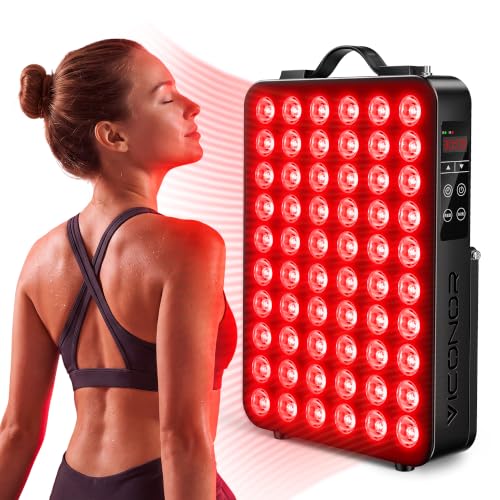
Pros
- 120 dual‑chip LEDs provide wide coverage
- Claims 140 mW/cm² irradiance at 6 inches
- Includes hanging kit and handle
- Timer function from 5 to 30 minutes
- Very competitive price point
Cons
- Build quality feels less premium than Hooga
- Hanging kit is basic; stand not included
- No separate red/NIR control
Best for: someone who needs maximum LED count per dollar and does not mind a no‑frills setup.
The Viconor 300W panel is the dark horse of this roundup. On paper it looks like a steal: 120 dual‑chip LEDs (so effectively 120 emitters that each produce both 660nm and 850nm), a claimed irradiance of 140 mW/cm², and a total power draw of 300W. That is more LEDs and more power than the Hooga PRO300, at a fraction of the cost.
In practice, the Viconor works well for full‑body sessions. The panel is large enough to cover your torso from collarbone to waist, and the included hanging kit lets you mount it on a door or wall. You can also use the handle to hold it manually, though that gets tiring. The timer is straightforward: push a button to cycle from 5 up to 30 minutes, and the panel shuts off automatically.
The tradeoffs show up in the details. The housing is plastic and feels less robust than the metal Hooga panels. The cooling fan is audible, not loud but noticeable. And the lack of independent wavelength control means you cannot dial in pure near‑infrared for deep tissue. The irradiance claim of 140 mW/cm² is also unverified; in our experience, the Viconor feels strong but not twice as strong as the HG300.
That said, if you are on a tight budget and want to treat large areas of the body, the Viconor 300W delivers real functionality. It is a better value than the smaller Viconor curved panel (which we cover next) because it uses dual‑chip LEDs and covers more area. Just know that you are sacrificing some polish for that LED count.
6. Hooga ULTRA1500: Best Full‑Body Beast

Pros
- 300 quad‑chip LEDs for massive coverage
- Four wavelengths: 630nm, 660nm, 810nm, 850nm
- Touchscreen control with pulse mode
- Independent red and NIR brightness
- 3‑year warranty
Cons
- Very large and heavy; requires floor space
- Stand sold separately
- High price
Best for: the dedicated home user who wants to treat their entire body without moving a panel.
The ULTRA1500 is not a desktop panel. It is a 300‑LED beast that stands nearly 6 feet tall and covers a human adult from head to mid‑thigh in one session. If you have the space and the budget, this is the panel that will let you lie down, set a timer, and get a full‑body dose without repositioning.
Each of its 300 LEDs is a quad‑chip design emitting 630nm, 660nm, 810nm, and 850nm. That covers the entire therapeutic range for skin (red) and deep tissue (NIR). The touchscreen interface is identical to the ULTRA360’s, with separate brightness sliders for red and NIR, a pulse mode, and a 30‑minute timer. You can run the panel at 25%, 50%, 75%, or 100% brightness for each wavelength group.
The downside is logistics. The ULTRA1500 weighs over 60 pounds and requires a floor stand (not included) or wall mounting. It is not something you can easily move from room to room. If you are considering the ULTRA1500, you already know you are serious about red light therapy. For everyone else, the ULTRA360 or even the Viconor 300W provides a better return on investment.
Compared to the smaller ULTRA360, the ULTRA1500’s advantage is sheer area. The ULTRA360 can treat your face and neck in one go; the ULTRA1500 can treat your entire front. If you regularly treat your back, legs, or a partner, the ULTRA1500 saves you time and hassle. The tradeoff is that it costs three times as much and takes up a corner of your room.
7. Viconor Curved Panel: Most Targeted Design

Pros
- Curved face concentrates light on target area
- Comes with stand, hook, and long cord
- 120 LEDs in a compact frame
- Hanging option for hands‑free use
Cons
- Single‑chip LEDs (red and NIR are separate)
- Plastic construction feels lightweight
- No independent wavelength control
Best for: someone who wants a face‑focused panel with a unique design that hugs the contours of the head.
The Viconor curved panel stands out visually. Instead of a flat array, its LEDs sit on a bowed surface that focuses light toward the center. The idea is that when you place the panel in front of your face, the curvature matches the natural shape of your head and delivers more uniform coverage across your cheeks and forehead. It works.
With 120 LEDs (a mix of 660nm red and 850nm NIR), this panel is more powerful than the HG200 and about the same size. The included stand is a simple desktop tripod that adjusts 180 degrees, and the panel can also be hung from a hook. The 1.8‑meter power cord gives you flexibility in positioning.
Where the Viconor falls short is build quality. The plastic shell feels thin, and the stand is wobbly if you bump it. The LEDs are not dual‑chip, so the red and NIR emitters are separate, which can create hot spots. For facial use at 6 to 12 inches, the beam is even enough, but you notice the difference next to a quality panel like the HG300.
The Viconor curved panel is a fine budget choice for face routines. If you are mainly interested in skin health and want a dedicated panel that stays on your vanity, it gets the job done. But if you expect to also use it for shoulders or knees, the flat panels from Hooga treat larger areas more consistently. For a deeper dive into face‑dedicated options, see our guide on the best red light therapy mask.
8. Aptoyu 234 LED Panel: Best for Beginners on a Budget

Pros
- 234 LEDs for very little money
- 180‑degree adjustable stand
- Timer up to 60 minutes with digital display
- Simple two‑button operation
- Can be hung or stood
Cons
- Low irradiance compared to premium panels
- No independent red/NIR control
- Plastic build, less durable
Best for: someone who wants to test red light therapy at the lowest possible cost without buying junk.
The Aptoyu 234 LED panel is the cheapest full‑size panel in this roundup. You get a 14‑ by 10.5‑inch face packed with 234 LEDs, a stand that rotates 180 degrees, and a digital timer that can run up to 60 minutes. For the price, it almost feels like a mistake.
Does it work? For surface skin treatment, yes. The 660nm and 850nm wavelengths are present, and the panel puts out enough light to notice a warming effect on the skin. The timer is a nice touch: you can set 15, 30, 45, or 60 minutes and the panel shuts off automatically. The digital display shows the remaining time.
But there are compromises. The irradiance is lower than on Hooga panels. You will need to sit closer (about 6 inches) and run longer sessions to get the same dose. The build is all plastic, and the stand’s joints feel like they could loosen over time. The LEDs are not dual‑chip, so the density is lower than a comparable Viconor panel.
For someone who is curious about red light therapy and wants to spend very little, the Aptoyu is a fine starting point. Use it for a month, and if you decide you want more power, you will know what to look for. Many users eventually upgrade to a Hooga HG200 or HG300, but the Aptoyu gives you enough experience to make that call. If you are trying to decide between red light therapy products in general, consider what you want to treat first.
9. XMZXMZ Large Panel: Best Large Area at a Low Price

Pros
- 486 LEDs (324 red, 162 NIR)
- 5 brightness levels
- Remote control and touch panel
- Timer up to 60 minutes
- Gooseneck and hanging kit included
Cons
- Only two wavelengths (no 810nm or 630nm)
- Gooseneck may not hold position over time
- No dual‑chip or quad‑chip LEDs
Best for: someone who wants a large treatment area and adjustable brightness without spending a lot.
The XMZXMZ panel is the largest in the budget category. With 486 LEDs arranged on an 8 by 14.5‑inch panel, it covers a substantial area. You can treat your entire abdomen and chest in one go, or set it up for a full face and neck session. The gooseneck stand lets you position it at almost any angle, and the included remote works up to 65 feet away.
What makes the XMZXMZ stand out is the 5‑step brightness control. Most budget panels have one brightness level. Here you can dial it down for a gentle facial session or crank it up for deeper penetration. The timer offers five options from 20 to 60 minutes, so you have plenty of range.
The downsides are similar to other budget panels: the LEDs are single‑chip (separate red and NIR), so the light is less uniform than from dual‑chip emitters. Also, the gooseneck is flexible but not rigid, and after a few months of daily use it may sag. The panel is also larger and heavier than the Aptoyu, so mounting it on a wall requires a sturdy hook.
Compared to the Viconor 300W, the XMZXMZ has more LEDs but lower total power (it does not advertise a wattage, but the LEDs are lower‑power). It is a different approach: many LEDs at moderate intensity versus fewer LEDs at high intensity. For skin health at closer distances, the XMZXMZ works well. For deep muscle therapy, the Viconor or Hooga panels with higher irradiance are better.
10. Rhmip 45W LED Panel: Best Compact Beauty Panel

Pros
- Very small and lightweight (12.2 x 12.2 x 1.3 inches)
- 45W power consumption
- Can be hung or placed on a surface
- Simple operation
Cons
- Low LED count and power
- No timer (must unplug or use external timer)
- Basic build
Best for: someone who wants a tiny panel to keep on a nightstand for quick face sessions.
The Rhmip 45W panel is the smallest in this roundup. It is square, about the size of a tablet, and draws only 45W. The 660nm and 850nm LEDs are there, but the total light output is low. You will need to sit very close (within 4 inches) and run longer sessions to get meaningful exposure.
This panel is best suited for someone who wants to add a red light step to their skincare routine without dedicating space or money. It can be hung on a hook and used while doing other things. It is not for full‑body work or deep tissue; the irradiance is simply too low.
The Rhmip lacks a built‑in timer, so you must keep an eye on the clock or use a smart plug. The build is basic plastic, and the stand is not included (you can hang it or prop it up). If you are considering this, you might be better served by the Hooga HG200, which offers a timer and higher irradiance in a similar footprint. But if budget is the absolute constraint and you only want a face panel, the Rhmip works.

How to Choose a Red Light Therapy Panel
Picking the right panel comes down to matching its specs to your body and your routine. Here are the factors that matter.
Wavelength: Red vs. Near‑Infrared
Two wavelengths dominate the market: 660nm (visible red) and 850nm (invisible near‑infrared). Red light penetrates roughly 2 to 3 millimeters and is used for skin health, collagen production, and surface inflammation. Near‑infrared penetrates deeper, into muscles and joints. Most panels combine both at a 1:1 ratio, which covers most needs. Some panels add 630nm (slightly different red) and 810nm (mid‑NIR), giving you more options. For general wellness, a 660nm/850nm panel is sufficient. If you want to target specific conditions like deep muscle pain, consider a panel with independent wavelength control.
LED Count and Power
More LEDs do not always mean better. What matters is the type of LED (single, dual, or quad‑chip) and the irradiance at a given distance. A panel with 60 high‑power 5W LEDs can outperform a panel with 120 lower‑power LEDs. Look for irradiance numbers above 50 mW/cm² at 6 inches. The Hooga panels are particularly good at delivering consistent irradiance, while budget panels may overstate their output.
Build and Cooling
Red light therapy panels generate heat. Good panels use silent fans or passive cooling to keep LED temperatures stable, which prolongs LED life and maintains output. Panels with metal housings dissipate heat better than plastic ones. Hooga’s panels use iron or aluminum with active cooling; the budget panels tend to use plastic and smaller fans that can be noisier.
Stand and Mounting
Consider where you will use the panel. Desktop models with integrated stands (HG200, HG300) are the most convenient. Larger panels often require a floor stand or a wall mount, which adds cost and permanent placement. If you travel, look for a lightweight panel that fits in a suitcase. Some panels come with hanging kits; others need separate purchases.
The most common mistake is buying a panel that is too small for your goals. If you want to treat your back or legs, get a panel that covers at least 12 inches in one dimension, or budget for multiple sessions with repositioning.

Frequently Asked Questions
How long should a red light therapy session last?
Typical sessions range from 10 to 20 minutes per treated area, depending on panel power and distance. Higher‑irradiance panels like the PRO300 can be used for as little as 6 minutes. Always follow the manufacturer’s guidelines and avoid overdoing it.
Can I use red light therapy every day?
Yes. Most research uses daily sessions with no adverse effects. That said, your skin may need a day off if you are using high‑power panels very close to the face. Start with three to five sessions per week and adjust.
Is red light therapy safe for the eyes?
Look away from the panel during use. The near‑infrared is invisible, but the red light is very bright. All reputable panels come with protective eyewear. Wear it. Do not stare directly at the LEDs.
Do I need near‑infrared for muscle recovery?
Near‑infrared (850nm) penetrates deeper than red light and is more effective for muscles, joints, and deep tissue pain. If recovery is your primary goal, choose a panel that includes 850nm or 810nm.
How far away should I sit from the panel?
Most panels work best at 6 to 12 inches. Closer increases intensity but reduces coverage area; farther decreases intensity but spreads the light. Use the manufacturer’s recommended distance as a starting point.
Can I use red light therapy on my face?
Yes. Many panels are designed for facial use. Keep the session to 10 minutes at 12 inches to avoid overstimulation. Some panels (like the Viconor curved) are shaped to focus light on the face.
What is the difference between dual‑chip and quad‑chip LEDs?
Dual‑chip LEDs emit both red and NIR from the same diode, improving light uniformity. Quad‑chip LEDs emit four wavelengths from one diode. Both are superior to single‑chip panels that have separate red and NIR emitters, which can create hot spots.
Do panels need to be FDA‑cleared?
Most red light therapy panels sold for home use are not FDA‑cleared for specific medical claims. They are marketed as general wellness devices. If you are treating a diagnosed condition, consult your doctor first.

The Bottom Line
The Hooga HG300 deserves the top spot because it balances everything: proven wavelengths, strong irradiance, a solid stand, and a price that makes daily use feel accessible. It is the best red light therapy panel for most people. If you need more power in a compact size, the Hooga PRO300 is a worthy upgrade. For full‑body coverage without moving the panel, the Hooga ULTRA1500 is the definitive choice, but it requires space and budget.
If you are just starting out and want to spend as little as possible, the Viconor 300W panel gives you impressive LED count for the money. Just understand that you are trading build quality and warranty for that density. For facial routines specifically, the Hooga HG200 is a convenient travel‑friendly option, and the Viconor curved panel offers a unique design that hugs the face.
No single panel is perfect for everyone. The right one is the one you will actually use every day. Start with a panel that fits your space, matches your treatment goals, and is built well enough to last. The best red light therapy panels on this list share one trait: they make consistency easy.
As an Amazon Associate we earn from qualifying purchases.