

A robot dog has to do more than walk forward and bark. The good ones react to touch, perform tricks, accept custom commands, or create enough personality to keep a child interested after the first afternoon. The poor ones are little more than noisy remote-controlled vehicles with legs.
Our Best best robot dog picks range from the remarkably capable Loona AI Pet to simple dancing companions for younger children. Some are built around programming and STEM play, while others are better at comfort, follow mode, or imaginative pet games.
For most families, Ruko 18011 LED Puppy is the single best pick. The lineup also includes an AI-powered companion, a plush comfort dog, all-terrain stunt machine, and several approachable first robot pets.
Comparison table
| # | Product | Award | Controls | Standout capability | Best for |
|---|---|---|---|---|---|
| 1 | Ruko 18011 LED Puppy | Best overall | Remote, gestures, touch | 30+ expressions, 50 custom moves | Most children |
| 2 | Loona AI Pet | Best AI companion | Voice, gestures, app | Camera, ChatGPT, auto charging | Interactive companionship |
| 3 | Dingdongwu STEM Dog | Best for coding | Voice, app, remote | 30+ actions, custom programming | Kids age 6 and up |
| 4 | Ozega Smart Dog | Best for control range | Voice, app, remote, touch | 13 voice commands, 50 sequences | Indoor and yard play |
| 5 | Chongker Companion Dog | Best comfort companion | Touch, voice | Heartbeat simulation, plush body | Seniors and soothing play |
| 6 | Ruko 18011 LED Faces | Best expressive toy | Remote, touch | 30+ LED faces, obstacle sensing | Pretend play |
| 7 | Dingdongwu 3-in-1 Dog | Best stunt machine | Voice, remote, coding | Wheels, claw, cannon modes | Active play |
| 8 | yiman RC Dog | Best first robot dog | Remote, voice | Dancing, songs, 2-hour play | Younger children |
| 9 | VATOS Pink Dog | Best programmable toy | Remote, touch, follow | 17 functions, 100 commands | Ages 3 and up |
| 10 | great dachong Interactive Dog | Best follow mode | Touch, follow, remote | Tricks, dancing, custom routines | Active pretend play |
1. Ruko 18011 LED Puppy: Best Overall

Pros
- Expressive LED face with more than 30 animations
- Remote, gesture, and touch control
- Programs up to 50 custom moves
- Obstacle avoidance helps indoors
- USB charging and a compact body
Cons
- A full charge takes about 3 hours
- Playtime is limited to up to 45 minutes
- Remote needs two AAA batteries
Best for: families wanting one versatile robot puppy for tricks, pretend play, and beginner programming.
The Ruko 18011 LED Puppy gets the basic robot-dog idea right: it feels responsive before a child has learned every button. Touch the head and it answers with sounds and movements, or use the remote to make it walk, spin, wag its tail, dance, and lift a leg. Those small bits of behavior give it more personality than a toy that only drives around.
Its face is the main visual attraction. Ruko uses 70 LED lights to create more than 30 animated expressions, so the dog can look happy, silly, or surprised during pretend play. The 2.4GHz remote works from up to 98 feet away, a useful range for a living room, hallway, or backyard. Gesture control adds a more immediate way to play when a child is standing next to it.
Programming makes this more than a series of canned demonstrations. Kids can arrange up to 50 custom moves, turning a few tricks into a dance routine or a little parade. That is a gentler introduction to sequencing than a formal coding kit, but it still gives children a reason to plan, remember, and revise what the dog does. Obstacle avoidance is useful in crowded indoor spaces, too, since the puppy can sense walls and furniture instead of hitting every object in its path.
The limitation is endurance. A full charge takes about three hours and provides up to 45 minutes of play, and the included USB A to C cable is not compatible with USB C to C charging. The remote also needs two AAA batteries. The 8.86 by 8.86 by 9.84-inch body is easy enough to store, but this is still a floor toy rather than a lap companion. Compared with the Dingdongwu STEM Dog, Ruko has the more polished mix of expressions and obstacle sensing. Compared with Loona AI Pet, it is much less conversational, but also far simpler for a child to pick up and play with.
The Ruko is the one we'd keep for a child who wants a little of everything. It has enough programming to grow with the child, enough expressive movement to work for younger players, and enough control options to stay entertaining without requiring a phone every time.
2. Loona AI Pet: Best AI Companion

Pros
- Voice commands and real-time conversation
- Recognizes faces and gestures
- High-definition RGB camera and ToF depth sensor
- Preset auto-charging routes
- Includes a charging dock
Cons
- Needs a well-lit environment for its camera
- Dock needs clear space around it
- Large footprint compared with toy-focused picks
Best for: households seeking an interactive digital pet rather than a conventional remote-controlled toy.
Loona AI Pet is in a different class from the other robot dogs here. It is designed to observe, respond, and interact rather than simply run through a fixed set of tricks. Its high-definition RGB camera and ToF depth sensor let it recognize faces, understand gestures, and follow a person like a puppy. That makes the interaction feel less like operating a toy and more like sharing a room with a digital companion.
Voice control is the defining feature. Loona uses Amazon Lex and ChatGPT for voice commands and real-time conversation, which gives it a much wider range of responses than the preset voice systems in the Ozega Smart Dog or VATOS Pink Dog. Its app also includes games and quizzes, and it can chase a laser pen, fetch balls, and interact with objects around the home. The home-monitoring mode adds a camera and speaker for checking in when you are away.
The automatic charging system is unusually important for this kind of companion. Loona takes about 2.5 hours to complete charging and can use preset routes from different rooms to return to its dock. The dock must sit in an open area with no obstruction on either side or in front. A software update described in the product information improves route matching and adds mobile hotspot connectivity, though camera cleanliness and lighting still matter for reliable sensing.
At 18 inches wide, 19 inches long, and 18 inches high, Loona occupies considerably more floor space than the Ruko 18011 LED Puppy. The camera also needs a well-lit setting, and a family buying this for a small child should be comfortable with a connected device that uses voice and home monitoring features. This is not the pick for someone who wants a quiet, offline toy with a basic remote.
For the richest interaction, Loona is the clear choice. It is more demanding to place and set up than the other picks, but its face recognition, gesture control, conversation, and self-charging behavior make it the closest thing here to an AI pet.
3. Dingdongwu STEM Dog: Best for Coding

Pros
- More than 30 programmed actions
- Voice, app, and physical remote control
- Custom programming for STEM play
- App can adjust volume and lock controls
- USB-C charging
Cons
- Best suited to children age 6 and up
- App adds setup and screen time
- Smaller expression system than the Ruko puppy
Best for: children who want to create routines and experiment with programming.
The Dingdongwu STEM Dog is the most straightforward educational pick in the group. It starts with entertaining actions such as Kung Fu, handshakes, somersaults, and the deliberately silly “pee attack, ” then gives children room to build their own sequences. That combination matters. A robot that only teaches programming can feel like homework, while this one provides instant tricks before asking a child to design anything.
There are three ways to control it. Voice commands suit quick demonstrations, the touchscreen app provides more detailed control, and the physical remote keeps play possible without a phone in hand. The free iOS and Android app can adjust volume, change between Chinese and English, and lock controls. Those parental options are useful when the dog is being used around younger siblings or in a shared room.
The included 600mAh battery is described as providing up to six hours of runtime, with a full USB-C charge taking about 1.5 hours. That is a notable advantage over the Ruko 18011 LED Puppy, whose listed play session is up to 45 minutes after a longer charge. Dingdongwu also lists an auto-shutdown feature to protect the motors during collisions, and the 12.2 by 5.5 by 7.2-inch body has a durable ABS construction with smooth surfaces.
This dog is less visually distinctive than the Ruko models. It does not have the same focus on a large animated face, and its programming experience depends on a child being willing to use the app. The Dingdongwu 3-in-1 Dog offers more physical variety with wheels and attachments, but it is oriented toward stunts rather than a clean introduction to custom action sequences.
Choose the STEM Dog for a child who asks how the tricks work and wants to make a routine instead of just replaying one. It is a particularly sensible bridge between a toy and an early robotics activity.
4. Ozega Smart Dog: Best for Control Range

Pros
- Remote range up to 100 feet
- Voice control recognizes 13 commands
- App and remote offer flexible operation
- Stores up to 50 personalized motion sequences
- Touch sensor adds close-up interaction
Cons
- Battery duration is described only as hours
- Voice control depends on clear commands
- Less suited to children who do not want an app
Best for: children who want to steer a robot dog across larger indoor or outdoor spaces.
Ozega Smart Dog is built around control flexibility. A child can use the 2.4GHz remote from up to 100 feet away, switch to the app for a different interface, speak one of 13 recognized commands, or touch the sensor on its back for an immediate response. That range gives it an advantage over the yiman RC Dog, whose infrared remote is listed at up to 33 feet.
The programming mode can store up to 50 personalized motion sequences. A child might combine forward movement, a dance, and a turn into a routine, then trigger it again without manually issuing every command. The LED face supports the pretend-pet angle, while anti-slip wheel paws are intended to move on carpets, wood floors, and lawns without tipping easily.
The 6 by 9 by 10-inch body is a manageable size for indoor play, and the Type-C port avoids disposable batteries for the dog itself. The product information describes its battery as supporting hours of play, but it does not give a more precise runtime. That makes it harder to plan long sessions than with the stated figures for the Dingdongwu STEM Dog or yiman RC Dog.
Ozega's main weakness is that its feature set can feel scattered. The remote is the easiest starting point, but voice commands, app control, touch sensing, and programming each require a little learning. Children who mainly want music and automatic dancing may prefer VATOS Pink Dog, while children who want range and custom movement will get more from Ozega.
This is the right pick for a child who likes driving toys across a room and then switching to command-based play. Its broad control options give it a longer runway than a simple remote-only puppy.
5. Chongker Companion Dog: Best Comfort Companion

Pros
- Soft plush construction
- Touch sensors across the head, back, neck, tail, and leg
- Simulated heartbeat and purring
- Customizable voice interaction
- USB-C charging with a status indicator
Cons
- Not a stunt or remote-control toy
- Long charging time and runtime are not specified
- Large stuffed-animal footprint
Best for: seniors, children, or anyone who wants a soothing companion rather than a racing toy.
The Chongker Companion Dog is the outlier, and that is exactly why it deserves a place here. Its purpose is not to perform acrobatics or teach programming. It is a plush robotic dog designed to respond to gentle contact, producing dog sounds and purrs when someone touches the head, back, neck, tail, or leg.
The strongest feature is the simulated heartbeat. A long press on the back sensor activates it, creating a steady tactile response that feels more comforting than a blinking LED face. Sleep mode can provide gentle purring, and the product description also mentions customizable voice interaction and the ability to customize its name. Those details make it better suited to quiet companionship than the energetic great dachong Interactive Dog.
This is a soft plush dog with carefully placed sensors rather than an ABS plastic toy. At about 23.6 inches long, 9.8 inches wide, and 9.1 inches high, it is closer to a large stuffed animal than the compact floor toys in this roundup. A built-in rechargeable battery charges through a USB-C port on the belly, and the indicator glows red while charging and green when full.
The trade-off is obvious: there is no remote, app programming, obstacle avoidance, or listed trick library. Families seeking movement should choose the Ruko 18011 LED Faces or Dingdongwu 3-in-1 Dog instead. Runtime and charging duration are not specified, so it is also difficult to schedule use around a fixed battery window.
The Chongker is a thoughtful choice for an elderly person, a child who wants a cuddly pet, or a household where a noisy stunt toy would be out of place. It earns its award by offering a kind of interaction the other robot dogs cannot match.
6. Ruko 18011 LED Faces: Best Expressive Toy

Pros
- More than 30 playful LED expressions
- 50 custom action sequences
- Obstacle avoidance for indoor play
- Remote range up to 98 feet
- Touch response and expressive sounds
Cons
- About 3 hours to charge
- Up to 45 minutes of play per charge
- Remote requires two AAA batteries
Best for: children who care most about facial expressions, tricks, and roleplay.
The Ruko 18011 LED Faces is closely related to the first Ruko pick, but this version is presented with a black and gold finish and puts the animated face front and center. It walks, spins, slides, dances, wags its tail, and performs the familiar leg-lifting gag. Touching its head triggers sounds and movements, which makes the toy inviting even before the remote is unpacked.
Its face uses 70 soft-glow LED beads to display more than 30 expressions. That gives children something to interpret during pretend play, whether they are inventing a story or treating the robot as a digital puppy. The expressions are more important here than raw driving performance, and they give it a stronger personality than the yiman RC Dog, whose appeal is more about songs and simple stunts.
Programming allows up to 50 custom actions. Children can build a dance, combine tricks, or create a repeated routine, then use the 2.4GHz remote to direct the robot from up to 98 feet away. Obstacle sensing helps it avoid walls and furniture, which is valuable in a bedroom or living room where a remote-controlled toy can otherwise spend much of its time stuck.
The battery requires about three hours to charge and offers up to 45 minutes of play. Charging uses the included USB A to C cable, not a USB C to C cable, and the remote takes two AAA batteries. The body measures about 8.86 by 8.86 by 9.84 inches and weighs roughly 2.45 pounds according to the product information. Those details make it reasonably easy to store, but the short session length remains the biggest frustration.
Choose this model over the Ruko 18011 LED Puppy if the darker finish and expressive presentation appeal more to your child. The two share much of the same underlying play pattern, so the decision comes down to the version you prefer rather than a major capability gap.
7. Dingdongwu 3-in-1 Dog: Best Stunt Machine

Pros
- Three configurations for different kinds of play
- 30+ bionic actions
- Mecanum wheels move in multiple directions
- Voice, remote, and coding control
- Up to 50 minutes of continuous play
Cons
- Recommended for children age 6 and up
- Attachments make it less like a traditional puppy
- Active movement needs more open floor space
Best for: children who prefer vehicles, stunts, and action play to pretend-pet behavior.
The Dingdongwu 3-in-1 Dog is the pick for a child who sees a robot dog and immediately asks what else it can become. It switches between a standard robot dog, a battle-bot configuration with a cannon, and a rover with a working claw. That variety gives it a much more active identity than the pet-focused Chongker Companion Dog.
Its four-wheel Mecanum drive is the mechanical highlight. The robot can travel forward, backward, sideways, and through 360-degree spins, so it is not limited to the clumsy turning circle of a basic wheeled toy. The product says it can handle carpet, tile, and grass, and its robust wheels and ABS body are aimed at indoor and outdoor play. The blue LED lights on its eyes and body add visibility and a futuristic look.
There are more than 30 programmed bionic actions, including crawling, handshaking, and dancing. Control is available through voice commands, the included 2.4GHz remote, or custom-coded sequences. That progression works well for a child who starts with stunt demonstrations and later wants to arrange their own moves. The control system is more involved than the simple remote on the yiman RC Dog, but it also offers much more room to experiment.
The design has clear limits. The attachments change the character of the toy, so families wanting a convincing puppy should choose Ruko or Ozega. It is also 13.1 inches long, 6.1 inches wide, and 10 inches high, which means it needs more clear floor space for sideways movement and spins. The recommended age is 6 and up, and younger children may need help changing configurations.
Its rechargeable battery provides up to 50 minutes of continuous play. For children who enjoy building, driving, and staging robot battles, that combination of movement and transformation is hard to beat. It is less cuddly than the other dogs, but much more exciting for hands-on action play.
8. yiman RC Dog: Best First Robot Dog
Pros
- Simple remote control for younger children
- Voice trigger activates dancing modes
- Three songs and bright LED eyes
- Up to 2 hours of play after a 2-hour charge
- Adjustable volume and sleep mode
Cons
- Remote range is limited to 33 feet
- Fewer advanced controls than the STEM picks
- Infrared remote needs a clear line of sight
Best for: younger children who want music, movement, and easy controls without a complicated app.
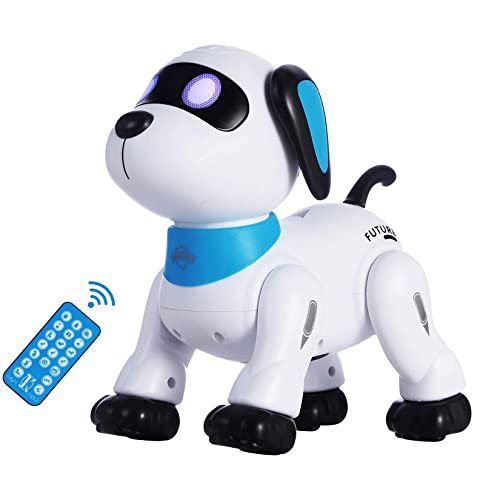
The yiman RC Dog is refreshingly uncomplicated. It is small, light, and ready to dance, make dog sounds, and perform familiar tricks such as sitting, handstands, push-ups, and leaning forward. That makes it a comfortable starting point for a child who may find a programming app or multi-mode control system overwhelming.
The remote controls movement from up to 33 feet away, while a voice trigger activates dancing modes when the child applauds twice. Three songs, bright LED eyes, and smooth movements give it a show-and-tell quality. It is not as expressive as the Ruko 18011 LED Faces, but it asks less from the child and gets to the fun quickly.
The built-in 3.7V 500mAh battery provides up to two hours of play after a two-hour USB charge. It enters sleep mode after 90 seconds without activity, a useful way to avoid leaving the motor and sound running in an empty room. The body measures about 7 inches in its listed size and weighs roughly 1.1 pounds, so children can carry it easily.
The short control range is the main compromise. The Ozega Smart Dog reaches up to 100 feet with its remote, and the Ruko 18011 LED Puppy reaches up to 98 feet, so both are better for larger rooms or yard play. yiman also has less programming depth, despite allowing children to arrange actions, and the infrared remote will be less forgiving if the receiver is blocked.
For ages 3 and up, this is a sensible first step into robot pets. It favors songs and repeatable tricks over sophisticated learning, but that simplicity is precisely what makes it approachable.
9. VATOS Pink Dog: Best Programmable Toy

Pros
- 17 interactive functions
- Follow mode uses an infrared sensor
- Stores up to 100 instructions
- Adjustable volume
- Rechargeable design
Cons
- Exact runtime is not specified
- Pink finish will not suit every child
- Less detailed control information than the STEM picks
Best for: younger children who want follow mode and a large library of programmable actions.
The VATOS Pink Dog focuses on automatic interaction. If a child does not choose a function after turning it on, it begins a sequence of actions every five seconds, including sitting, rolling, push-ups, saying hello, and making dog sounds. That keeps it active without requiring constant remote input, which is useful for younger children who want to watch a pet perform.
Follow mode is the standout feature. An infrared sensor lets the robot walk alongside a child, giving play a little more movement than the stationary dance routines of the yiman RC Dog. Touch also triggers random sounds and movements, while the metallic pink body is designed to catch attention. Volume adjustment is welcome when the robot is being used indoors.
Programming goes further than most of the simpler options. VATOS allows up to 100 instructions in a custom sequence, more than the 50 custom moves listed for the Ruko 18011 LED Puppy and Ozega Smart Dog. The distinction is not just a larger number. A longer sequence can create a more elaborate routine, though younger children may need help remembering how to build one.
The product does not provide a precise runtime, so it is difficult to compare its battery endurance with models that list 45 or 50 minutes. It is rechargeable, which avoids disposable batteries for the dog, but the available information does not state the charging time either. The 9.25 by 5.71 by 9.65-inch dimensions make it a medium-sized floor toy.
VATOS makes sense for a child who will use follow mode often or enjoys creating long action chains. Pick it over Ruko when programming capacity matters more than obstacle sensing and animated facial expressions.
10. great dachong Interactive Dog: Best Follow Mode

Pros
- Touch and follow interaction
- Walking, dancing, and trick routines
- Programmable movement sequences
- Light-up eyes and music
- Compact 9-inch body
Cons
- Exact battery runtime is not specified
- Feature details are less precise than some rivals
- Follow play needs clear space
Best for: children who want a robot puppy that reacts to them and moves around during play.
The great dachong Interactive Dog is built around the feeling that the toy is paying attention. Pat its head and it responds with sounds, smooth movements, and a tail wag. Follow mode turns that response into a game, letting the robot accompany a child instead of waiting for the next remote command.
Its trick set includes sitting, bowing, handstands, push-ups, walking, dancing, spinning, and flips. Music and colorful light-up eyes make those routines feel like a small performance, while the programmable mode lets children create their own movement sequences. That gives it more creative potential than a remote-only dog, though the product information does not specify how many commands can be stored.
At 9 by 9 by 5 inches, it has a broad, low profile that should be easy for a child to see and carry. The product describes its construction as child-safe and durable, but it does not provide a battery capacity, charging time, or exact play duration. That lack of detail makes it harder to plan than the yiman RC Dog, which provides specific charge and play figures.
The follow feature is its strongest reason to buy, but it also creates the clearest limitation. The robot needs room to move, and a crowded bedroom will reduce the effect. The VATOS Pink Dog also offers follow mode and adds up to 100 programmable instructions, while the great dachong model leans more heavily into tricks, music, and touch response.
This is a good fit for a child who wants a moving companion without the app complexity of the Dingdongwu STEM Dog. It is not the most technically detailed option, but its combination of touch, follow behavior, and lively tricks makes it engaging.

How to choose best robot dog
The right robot dog depends on the kind of interaction a child will actually repeat: programming, driving, following, conversation, comfort, or simple dancing.
Control methods
Remote control is the easiest starting point, but the range and connection type matter. The Ruko and Ozega models list 98-foot and 100-foot remote ranges, while yiman lists 33 feet. Voice control is useful for hands-free commands, and app control gives access to settings and programming, but it also adds a phone to playtime.
Touch control feels more like pet interaction, especially when the dog responds with sounds or a movement. Loona goes further with gesture recognition and voice conversation. For a younger child, a physical remote and touch sensor are usually easier to understand than an app with several control modes.
Programmability
Programming works best when children can see an immediate result. Ruko and Ozega list up to 50 custom moves or sequences, while VATOS lists up to 100 instructions. Dingdongwu combines custom programming with more than 30 preset actions, giving children a reason to experiment after they have learned the basics.
A larger command capacity is not automatically better. The interface matters, too. If the child is age 6 or older and enjoys arranging steps, an app or coding mode can be worthwhile. If the goal is quick pretend play, a shorter routine with clear controls may hold attention better.
The most useful robot dog is the one a child can control before needing an adult to explain it.
Movement and floor space
Some robot dogs are primarily pets, while others are miniature vehicles. The Dingdongwu 3-in-1 Dog uses Mecanum wheels for forward, backward, sideways, and spinning movement. Ozega is designed for carpets, wood floors, and lawns, and several models offer obstacle sensing or follow mode.
Measure the play area before choosing a large or highly mobile model. Loona measures 18 by 19 by 18 inches, while the yiman dog is listed at about 7 inches. A stunt dog needs clear floor space for spins and attachments, whereas a plush companion can stay on a bed or chair.
Expressions and interaction
LED faces, sounds, music, touch sensors, and follow behavior determine whether a robot feels like a pet or a vehicle. Ruko's more than 30 LED expressions are especially useful for storytelling. Loona's camera and gesture recognition create more responsive interaction, while Chongker uses touch sensors, purring, and a simulated heartbeat for comfort.
For younger children, automatic demonstrations and simple reactions can be more engaging than technical capability. Older children may prefer voice commands, app games, or custom movement sequences. Think about whether the child wants to operate the dog or build a relationship with it through repeated responses.
Battery and charging
Battery information varies considerably across these products. Ruko lists up to 45 minutes of play after a 3-hour charge, Dingdongwu's STEM Dog lists a 1.5-hour charge and up to six hours of runtime, and the 3-in-1 Dog lists up to 50 minutes. yiman lists up to two hours after a 2-hour USB charge.
Some products only say that the battery supports hours of play, without a precise figure. That is a meaningful omission if the dog will be used for travel, parties, or long sessions. Also check the charging connection. The Ruko cable is USB A to C and does not support USB C to C charging.

Frequently asked questions
What is the best robot dog for younger children?
The yiman RC Dog is the simplest starting point because it combines a physical remote, dancing, songs, and voice-triggered play. The VATOS Pink Dog is another option for younger children who want follow mode and automatic actions. Adult supervision is sensible when younger children are learning the controls.
Which robot dog is best for programming?
The Dingdongwu STEM Dog is the clearest coding-focused option, with an app, voice commands, remote control, and custom action sequences. Ruko and Ozega also support up to 50 custom moves or sequences. VATOS lists up to 100 instructions, making it appealing when a child wants longer routines.
Which robot dog can follow a child?
The VATOS Pink Dog and great dachong Interactive Dog both include follow behavior. Loona can also follow people using its camera and depth sensor, while offering face and gesture recognition. Follow mode works best in an open, well-lit space with a clear path.
Does a robot dog need Wi-Fi?
Not every model needs Wi-Fi. The remote-controlled and touch-operated dogs can be used without a home network, though app features may require a phone connection. Loona uses connected features for voice interaction, games, camera functions, and mobile hotspot support.
Which robot dog is best for companionship?
Loona is the strongest choice for conversation, face recognition, gestures, games, and home monitoring. Chongker is better for quiet comfort because its plush body responds to touch with sounds, purring, and a simulated heartbeat. They serve very different ideas of companionship.
How long do robot dogs take to charge?
The listed times range from about 1.5 hours for the Dingdongwu STEM Dog to about 3 hours for the Ruko models. yiman lists a 2-hour USB charge, while Loona takes about 2.5 hours to complete charging. Several products do not provide a precise charging duration.
Can these robot dogs be used outdoors?
Some can be used in a yard, but outdoor suitability varies. Ruko describes remote control and play in a backyard, Ozega lists lawns among its usable surfaces, and the Dingdongwu 3-in-1 Dog is designed for carpet, tile, and grass. Keep water, mud, and rough terrain away unless the product explicitly supports them.
The bottom line
The Best best robot dog for most children is Ruko 18011 LED Puppy. It combines touch response, a 98-foot remote range, obstacle avoidance, more than 30 LED expressions, and up to 50 custom moves without becoming as complicated as Loona. Its 45-minute play limit and 3-hour charge are real weaknesses, but the overall mix is unusually well judged.
Choose Loona AI Pet when conversation, camera-based interaction, gestures, and self charging matter more than simple toy controls. For coding, Dingdongwu STEM Dog is the stronger fit, while Chongker Companion Dog is the one to choose for tactile comfort and quiet companionship.
If you are still undecided, choose Ruko for active play, Loona for AI companionship, and Chongker for soothing interaction.
As an Amazon Associate we earn from qualifying purchases.