

Sticky kitchen spills, paw prints by the back door, and grit hiding under furniture are exactly the jobs a robot mop should handle. The hard part is finding one that can mop without dragging dirty water around, avoid cords and toys, and return to its dock before the floor is half-finished.
Our Best robot mop picks range from compact self-charging cleaners to advanced machines with heated mop washing, edge-reaching arms, and sophisticated obstacle avoidance. The roborock Q10 S5+ is the best all-rounder, while the other nine make stronger cases for pet hair, deep mopping, low furniture, large homes, or simple daily cleaning.
Comparison of the Best Robot Mops
| # | Product | Award | Suction | Mopping system | Dock or runtime | Best for |
|---|---|---|---|---|---|---|
| 1 | roborock Q10 S5+ | Best overall | 10, 000 Pa | Dual-zone sonic vibration | 70-day dust bag | Most mixed-floor homes |
| 2 | WSUANE D15S MAX | Best hands-free runtime | 10, 000 Pa | Vacuum and mop combo | 90-day bin, 160 minutes | Large homes and pet owners |
| 3 | eufy C28 | Best roller mop | 15, 000 Pa | 28 cm HydroJet roller | 75-day station | Messy hard floors |
| 4 | roborock Qrevo S5V | Best edge mopping | 12, 000 Pa | Dual spinning pads | Auto-wash and warm-air dry | Detailed room-by-room cleaning |
| 5 | eufy E25 | Best deep-cleaning roller | 20, 000 Pa | Always-clean HydroJet | 75-day bag, 125 minutes | Pet hair and stubborn stains |
| 6 | roborock Saros 10R | Best premium navigation | 22, 000 Pa | Lifting dual spinning mops | 60-day collection | Low furniture and clutter |
| 7 | iRobot Roomba 505X | Best for obstacle avoidance | 70x more suction than Roomba 600 series | Dual spinning mop pads | 75-day dock | Busy homes with pets |
| 8 | roborock Qrevo S Pro | Best quiet automated clean | 18, 500 Pa | Dual mop system | 7 to 9-week bag | Quiet daily cleaning |
| 9 | Tikom G8000 Max | Best compact cleaner | 5, 000 Pa | Electronic water control | 150 minutes | Small homes and low furniture |
| 10 | ROPVACNIC S1 | Best simple self-charger | 5, 200 Pa | Four-stage water adjustment | Self-recharging | Straightforward hard-floor care |
1. roborock Q10 S5+: Best Overall

Pros
- Strong vacuuming across hard floors and carpets
- Sonic mop scrubbing reaches 3, 000 vibrations per minute
- LiDAR mapping and structured-light obstacle avoidance
- Self-emptying dock supports up to 70 days
Cons
- Supports 2.4GHz Wi-Fi only
- Mop lift is limited to 8mm on carpet
Best for: households that want reliable vacuuming, useful mopping, and minimal daily upkeep.
The Q10 S5+ is the robot mop we would put in the most homes because it gets the fundamentals right without making the cleaning routine complicated. It vacuums carpets and hard floors, scrubs rather than merely dragging a damp cloth, and returns to a dock that takes care of much of the unpleasant maintenance. The combination feels more practical than chasing the highest suction figure alone.
Its 10, 000 Pa HyperForce suction is enough to target crumbs, embedded pet hair, and debris in floor crevices. The dual-zone VibraRise 2.0 system scrubs at up to 3, 000 times per minute, which gives dried marks a better chance of coming loose than a passive pad. On carpet, the mop modules lift up to 8mm, and ultrasonic carpet detection raises them automatically while increasing suction.
Navigation is another reason this model leads the list. Its LiDAR system scans 360 degrees, creates detailed maps, and supports multiple floors. Structured-light ReactiveTech obstacle avoidance helps it work around furniture and clutter, while the app lets you set no-go zones, choose mopping levels, schedule cleaning, and adjust emptying behavior. The dual anti-tangle design, with a JawScrapers main brush and specialized side brush, should also reduce the amount of hair maintenance.
The weakness is that the mop lift is not especially generous for thicker rugs, and the dock is not a full mop-washing station. The WSUANE D15S MAX offers a larger dust container and longer stated runtime, while the eufy C28 is more convincing when wet cleaning is the main job. Still, the Q10 S5+ has the most balanced mix of navigation, vacuuming, scrubbing, and automation. It is the right starting point for anyone who wants the Best robot mop without building a complicated cleaning routine around it.
2. WSUANE D15S MAX: Best Hands-Free Runtime

Pros
- 90-day self-emptying dustbin
- Up to 160 minutes in quiet mode
- dToF LiDAR mapping with multi-level maps
- Hair-cutting roller brush design
Cons
- Maximum runtime drops to 70 minutes
- Mopping details are less advanced than the leading picks
Best for: large homes and pet owners who want long unattended cleaning sessions.
The D15S MAX is built around the idea that the robot should stay out of your way for as long as possible. Its 3.5-liter self-emptying dustbin is rated for up to 90 days of hands-free dust collection, which is particularly useful if pet hair fills a smaller bin quickly. That large capacity is the headline feature, but the navigation and battery support the same low-intervention approach.
The brushless motor reaches 10, 000 Pa in its strongest mode, with lower settings of 6, 000, 2, 000, and 800 Pa. That gives you a way to trade noise and battery use against cleaning intensity. The listed 160-minute runtime applies to silent mode. Standard mode is listed at 120 minutes, powerful mode at 80 minutes, and maximum mode at 70 minutes, so larger homes may need the quieter setting for full coverage.
Its dToF LiDAR sensor maps large spaces and supports multi-level layouts. Three ground-detection sensors provide 8cm anti-drop protection, while six anti-collision sensors help it navigate around furniture. The anti-tangle roller includes a blade mechanism that cuts hair after the cleaning task finishes. That is a different approach from the brush designs in the Q10 S5+ and Qrevo S5V, and it may appeal to households that routinely find long hair wrapped around rollers.
The compromise is a less ambitious mopping system. The product combines vacuuming and mopping, but the listed features do not describe sonic scrubbing, spinning pads, or an actively cleaned roller. It is better understood as a long-running floor-maintenance robot than a specialist stain remover. If the dock capacity and endurance matter most, it is compelling. For more demanding wet messes, the C28 or E25 is the better fit.
3. eufy C28: Best Roller Mop

Pros
- 28cm HydroJet roller with continuous self-cleaning
- 15, 000 Pa suction with automatic carpet boost
- 3L bag, mop washing, and 50°C hot-air drying
- Designed to manage long hair and pet fur
Cons
- Large, heavy dock takes substantial floor space
- Mop lift is 10.8mm, which may not clear every rug
Best for: homes where sticky spills and frequent hard-floor mopping matter more than compact hardware.
The C28 is one of the clearest departures from the usual robot mop formula. Instead of relying on two small pads, it uses a 28cm HydroJet roller that continuously refreshes itself while cleaning. Twenty-four water ports feed the roller, which spins at 270 RPM, or nine rotations per second. A built-in scraper separates collected dirt into the wastewater system instead of leaving the roller to spread the mess.
That approach makes the C28 especially interesting for hard floors with paw prints, food marks, and everyday spills. Its 15, 000 Pa suction also gives it more vacuuming headroom than the Q10 S5+ and WSUANE D15S MAX. Carpet boost is automatic, and the mop lifts 10.8mm when short carpet is detected. The DuoSpiral brush is designed to handle hair up to 30cm long without wrapping around the roller.
The station handles dust emptying, mop washing, hot-air drying at 50°C, and wastewater collection. Its 3-liter dust bag is rated for up to 75 days of hands-free cleaning. The LiDAR navigation system avoids obstacles at least 3cm by 3cm by 3cm without using cameras, a useful detail for readers who prefer laser navigation and want to avoid an onboard camera.
The limitation is physical rather than functional. The dock measures 18.14 inches high, 15.47 inches long, and 14.6 inches wide, and the robot weighs 24 pounds. That is a serious footprint compared with the compact Tikom G8000 Max or ROPVACNIC S1. Its stated operating noise is 54.89dB, but the station still needs a permanent place near water and power. Choose the C28 when the cleaning roller is the priority, not when you need the smallest setup.
4. roborock Qrevo S5V: Best Edge Mopping
Pros
- FlexiArm reaches around furniture legs and into corners
- Dual spinning mops rotate at 200 RPM
- 30-level water-flow adjustment
- Supports up to four floor maps
Cons
- Supports 2.4GHz Wi-Fi only
- Large dock and body need careful placement
Best for: people who notice the unclean strip along baseboards and furniture edges.
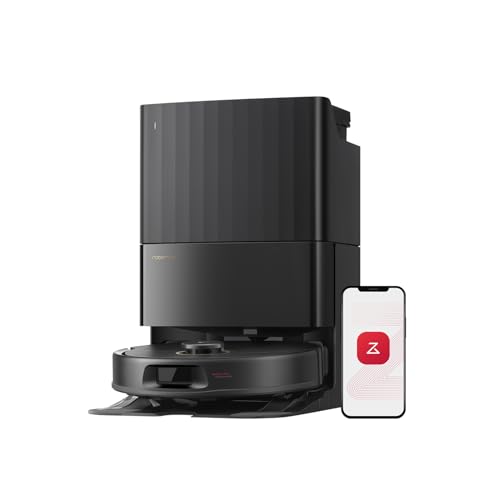
The Qrevo S5V earns its place by treating edges as a real cleaning problem. Its FlexiArm mop extends toward corners and furniture legs, areas where a fixed circular pad usually leaves a narrow dry or dirty strip. The dual spinning pads rotate at 200 RPM, giving the machine a more active scrubbing motion than the basic combo robots lower on this list.
Vacuum performance is strong too. The brushless motor produces 12, 000 Pa of suction, and the rubberized floating main brush is paired with an arc-shaped side brush designed to resist hair tangles. The side brush has an SGS-certified zero-tangle claim in the listed specifications. The mops lift 10mm over low-pile carpet, and the app offers 30 water-flow levels so you can use a lighter application in sensitive areas or more water on hard-floor messes.
The all-in-one dock auto-empties dust into a storage bin rated for 10 weeks, washes the mops, dries them with warm air, and refills the water tank. Roborock’s LiDAR mapping supports four floor plans, while structured-light obstacle avoidance handles cables, toys, and furniture legs. The app can suggest no-go zones and adjust cleaning room by room.
Compared with the Q10 S5+, the Qrevo S5V is the better choice for edge work and automated mop care, but it is a larger, more involved machine. The C28’s roller is better suited to wet spills, and the Qrevo S5V’s spinning pads can still struggle with the most stubborn dried patches. Pick it for homes with many hard-floor edges, furniture legs, and multiple levels rather than for a compact apartment.
5. eufy E25: Best Deep-Cleaning Roller

Pros
- 20, 000 Pa suction
- HydroJet roller refreshes with clean water twice per second
- CornerRover arm reaches baseboards and furniture legs
- Five-floor mapping and automatic floor switching
Cons
- Heavy 37.48-pound system
- Maximum-mode noise is listed at up to 61dB
Best for: pet households that need aggressive vacuuming and a continuously refreshed mop.
The E25 is the C28’s more forceful sibling. Its 20, 000 Pa suction is the highest conventional suction figure in this group, and the HydroJet roller is refreshed with clean water twice per second. That matters when the robot is cleaning a kitchen after a spill or moving through several rooms where a single damp pad would gradually become dirty.
The roller system is designed to remove tough marks such as coffee and sauce while keeping the cleaning surface fresher. The DuoSpiral anti-tangle brushes target pet hair, and the CornerRover arm extends toward baseboards, furniture legs, and tight corners. A 10.8mm mop lift helps protect short carpet, while the robot can climb thresholds up to 21mm.
Its all-in-one station auto-empties dust into a 3-liter bag rated for about 75 days, washes the roller, dries it with 50°C hot air, and refills water. Laser-guided navigation supports up to five floor plans with automatic floor switching. The stated runtime is 125 minutes in standard vacuum and mop mode, which is enough for many homes but not as generous as the WSUANE D15S MAX in quiet mode.
The E25 is not a discreet machine. The listed weight is 37.48 pounds, and the station is substantial. Noise is listed at 61dB or less in maximum mode, so the strongest cleaning setting will be noticeable. The Saros 10R navigates clutter and low furniture more elegantly, while the Q10 S5+ is easier to recommend for ordinary mixed floors. The E25 makes sense when pet hair and wet-floor cleaning are the main jobs.
6. roborock Saros 10R: Best Premium Navigation

Pros
- 3.14-inch profile reaches under low furniture
- 22, 000 Pa suction
- AdaptiLift chassis handles thresholds up to 4cm
- Hot-water mop washing and automated detergent dispensing
Cons
- Built-in RGB camera may concern privacy-focused buyers
- Supports 2.4GHz Wi-Fi only
Best for: larger, cluttered homes with low furniture, cables, and varied thresholds.
The Saros 10R is the most technically ambitious robot here, and its slim body is the feature you notice first. At 3.14 inches tall, it can reach beneath beds, sofas, cabinets, and coffee tables that stop taller LiDAR robots. The StarSight Autonomous System 2.0 uses 3D sensing and is designed to identify 108 obstacle types, including cables and irregular furniture.
Its cleaning hardware matches that ambitious navigation. The 22, 000 Pa HyperForce system targets debris on hardwood, tile, and carpet, while the Zero-Tangling DuoDivide main brush and FlexiArm Riser side brush reduce hair wrapping. The side brush and mop extend toward corners, and the AdaptiLift chassis raises the robot to handle obstacles up to 4cm high. On carpet, the dual spinning mops and their bracket lift to avoid wetting long-pile surfaces.
The Multifunctional Dock 4.0 washes mops with 176°F water, dries them with 131°F air, collects dust for up to 60 days, refills the tanks, dispenses detergent, and cleans the dock with hot water. It can also remove the mop for vacuum-only operation. A stated 2.5-hour quick-charge feature helps it return to work sooner after a long cleaning session.
The catch is privacy and complexity. This model includes an RGB camera, two-way video calls, and pet search features, which some households will appreciate and others will not want inside the home. It is also more machine than a small apartment needs. The Qrevo S5V covers ordinary edge cleaning with less elaborate hardware, while the Saros 10R is the better answer for low clearance, clutter, and difficult thresholds. Buy it when those problems are genuinely present.
7. iRobot Roomba 505X: Best for Obstacle Avoidance
Pros
- PrecisionVision AI recognizes cords, socks, and pet accidents
- Dual spinning mop pads with SmartScrub
- AutoWash Dock empties, washes, and heat-dries pads
- Mop pads lift over carpet
Cons
- Suction comparison is tied to the Roomba 600 series
- Hands-free mopping is listed for up to four weeks
Best for: homes where toys, cords, socks, and pet messes make robot navigation difficult.
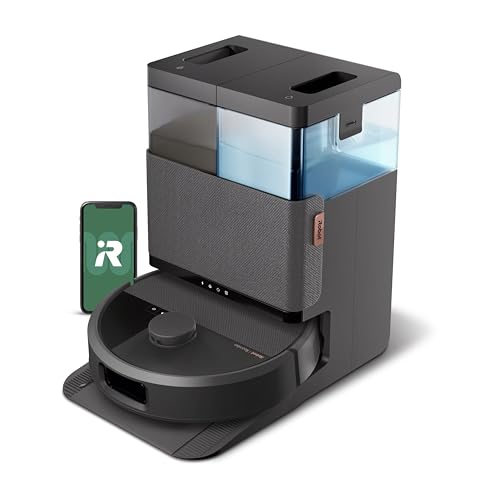
The Roomba 505X takes a practical approach to the messes that make many robot cleaners unreliable. Its PrecisionVision AI recognizes common obstacles such as cords and socks, and it can identify wet and dry messes ahead. Instead of blindly pushing through, it steers around hazards and makes extra passes when a dirty area needs more attention.
The cleaning system combines up to 70 times the suction of the Roomba 600 series with a multisurface rubber brush, an edge-sweeping brush, and dual spinning mop pads. SmartScrub applies extra pressure to dried food, muddy paw prints, and kitchen splatter. PerfectEdge technology is designed to reach deeper into corners and along walls, while the listed comparison claims 18% more floor coverage than standard vacuum and mop mode under its stated test conditions.
The ClearView Pro LiDAR system maps the home day or night, and cliff sensors help protect the robot near stairs and ledges. The Roomba Home app lets you target rooms, increase suction in high-traffic areas, add scrubbing to kitchens, and choose vacuum-only, mop-only, combo, or vacuum-then-mop cleaning. Alexa, Siri, and Google Assistant support add simple voice control.
Its AutoWash Dock empties debris for up to 75 days and washes, refreshes, and heat-dries the pads. The listed hands-free mopping period is up to four weeks, shorter than the dust collection period. The Q10 S5+ offers more transparent vacuum suction data and a longer stated mop-related automation feature set, while the Roomba is the stronger pick for homes with clutter and pet accidents. Readers focused on the Roomba ecosystem can also compare its approach with how automated floor cleaners handle everyday pet hair, but the 505X stands out here for obstacle recognition.
8. roborock Qrevo S Pro: Best Quiet Automated Clean

Pros
- 18, 500 Pa suction
- Listed operating noise of 55dB
- 3.8-inch low-profile design
- Automated dock cleaning and mop drying
Cons
- Supports 2.4GHz Wi-Fi only
- Dock is wide and requires dedicated space
Best for: families and pet owners who want strong daily cleaning without a loud robot.
The Qrevo S Pro is a strong middle ground in Roborock’s lineup. It has much more suction than the Q10 S5+, a lower 3.8-inch profile than the larger Qrevo S5V, and a stated operating noise level of 55dB. That combination makes it well suited to regular cleaning in homes where the robot may run while people are working, sleeping, or looking after children.
Its 18, 500 Pa suction is aimed at dust, cat litter, crumbs, debris, and pet hair across hard floors and carpets. The dual mop system handles daily splashes, paw prints, and footprints, while adjustable water flow lets the robot adapt to different rooms. The all-rubber main brush, zero-tangle side brush, and easy-to-clean omnidirectional wheel reduce the number of hair-heavy maintenance tasks.
The dock uses a sealed 2.7-liter bag rated for seven to nine weeks. It self-cleans with water heated to 167°F and dries the mops with 113°F warm air. The robot lifts its mops 10mm for carpet and uses obstacle detection to avoid shoes, toys, and furniture legs. Roborock SmartPlan 2.0 can adjust cleaning settings based on the layout, floor types, and cleaning history.
It lacks the Qrevo S5V’s named FlexiArm edge-mopping system, and the Saros 10R is slimmer and more capable around complex obstacles. The Qrevo S Pro is the calmer choice for a normal home with mixed floors and regular pet debris. For a closer look at how these features compare across one brand, the differences between Roborock vacuum and mop designs are useful to understand before choosing.
9. Tikom G8000 Max: Best Compact Cleaner

Pros
- 2.99-inch height reaches under low furniture
- 150-minute quiet-mode runtime
- App, remote, voice, and button controls
- Four cleaning modes
Cons
- No self-emptying dock
- Mopping uses a combined 300ml water tank
Best for: smaller homes that need a slim, uncomplicated vacuum and mop.
The G8000 Max is the straightforward option in this group. It does not try to provide a large wash station or advanced LiDAR mapping. Instead, it keeps the robot compact, gives you several control methods, and handles simultaneous vacuuming and mopping in one pass. Its 2.99-inch height is useful under beds, sofas, and cabinets where bulkier machines cannot reach.
The 5, 000 Pa suction is aimed at pet hair, dust, and debris on hard floors, short-pile carpet, and medium-pile carpet. The combined dustbin and water tank hold 450ml and 300ml respectively. That arrangement is convenient for a small daily clean, though it means capacity and maintenance are more limited than on the self-emptying models above it.
You can control the G8000 Max through its app, remote, voice commands, or physical button. Spot, edge, zigzag, and manual modes cover the common cleaning patterns, while the listed 150-minute maximum runtime applies in quiet mode. Anti-collision and anti-fall sensors help it avoid walls, stairs, and obstacles, and large wheels are designed to cross thresholds.
The main compromise is the lack of a self-emptying dock. You will empty the bin and manage the mop yourself, so this is not the hands-free Best robot mop for a large pet-filled home. The ROPVACNIC S1 offers a similar compact format with slightly more suction and no-tangle claims, while the G8000 Max has the clearer runtime and control package. It is a sensible fit for a modest floor plan and a reader who wants fewer dock components.
10. ROPVACNIC S1: Best Simple Self-Charger

Pros
- 5, 200 Pa suction
- Four-stage water adjustment
- Compact 2.99-inch body
- Automatic charging and scheduled cleaning
Cons
- No self-emptying or mop-washing station
- Navigation is less sophisticated than the LiDAR models
Best for: hard-floor homes that want basic scheduled vacuuming and mopping.
The ROPVACNIC S1 is designed for buyers who want the robot routine without a complicated base station. It vacuums, mops, returns to recharge, and supports scheduled cleaning. Its 2.99-inch profile is low enough to reach under many beds and cabinets, making the compact design more useful than its simple feature set might suggest.
Its 5, 200 Pa suction handles dust, crumbs, and pet hair on wood, hard floors, and low-pile carpets. The product uses three suction levels, while the electronically controlled mop offers four water settings. That adjustment is helpful when moving between sealed hard floors that can tolerate more moisture and surfaces where a lighter application is safer.
The S1 uses several cleaning modes and can be controlled from a smartphone or by voice through Alexa and Google Assistant. Its sensing system detects obstacles, changes direction, and returns to charge automatically. Dual rotating electric side brushes are intended to sweep pet hair from edges, and the listed no-entanglement design avoids the traditional roller-brush cleanup problem.
The limitations are clear. There is no self-emptying dock, no LiDAR mapping, and no detailed obstacle-recognition system like the Roomba 505X or Saros 10R. The Tikom G8000 Max is similarly compact but offers four control methods and a longer stated runtime. Choose the ROPVACNIC S1 for simple hard-floor maintenance, not for a large multi-room home that needs precise maps and unattended dock care.

How to choose best robot mop
The right robot mop is defined less by one headline number than by how its vacuum, mop, navigation, and dock work together in your home.
Mopping mechanism
Robot mops usually use a damp pad, spinning pads, a vibrating pad, or a powered roller. A passive pad is fine for light dust and footprints, but it is less convincing on dried food. Spinning and sonic systems add agitation, while a HydroJet roller actively refreshes the cleaning surface with clean water.
The C28 and E25 are the strongest choices when wet-floor cleaning is central. The Q10 S5+ and Qrevo S5V are better balanced for homes that need both vacuuming and active scrubbing.
A robot that carries dirty water across the room is not mopping well, no matter how high its suction number looks.
Suction and brush design
Pa figures are useful for comparing the listed hardware, but brush design and carpet boost matter just as much. Strong suction helps pull pet hair and grit from carpet, while rubber or anti-tangle brushes reduce maintenance. Look for automatic carpet boost if your home mixes rugs with hard flooring.
The Saros 10R, E25, and Qrevo S Pro have the highest listed suction figures in this group. The Q10 S5+ remains more balanced, and the Tikom and ROPVACNIC models are better suited to lighter daily debris.
Dock automation
A self-emptying dock removes dustbin chores, but full mop automation goes further. The most capable stations wash mop surfaces, collect wastewater, dry the mops with warm or hot air, refill clean water, and sometimes clean the dock itself.
The C28, E25, Qrevo S5V, Saros 10R, Roomba 505X, and Qrevo S Pro include substantial dock automation. The G8000 Max and ROPVACNIC S1 require hands-on emptying and mop care, while the WSUANE D15S MAX focuses heavily on extended dust collection.
Navigation and obstacle avoidance
LiDAR creates accurate room maps and helps a robot follow efficient routes. Structured-light and camera-based systems can add better obstacle recognition, which matters in homes with cables, toys, socks, or pet accidents. Basic sensor systems can work in open rooms but need more preparation.
The Q10 S5+, Qrevo S5V, and Qrevo S Pro use LiDAR with detailed mapping. The Roomba 505X adds PrecisionVision AI for household obstacles, and the Saros 10R goes further with 3D sensing. For a broader comparison of navigation and floor coverage, how robot cleaners handle open rooms and cluttered layouts is a useful next step.
Clearance, thresholds, and floor maps
Measure the gap beneath your lowest furniture before buying. The Saros 10R is only 3.14 inches tall, the Tikom and ROPVACNIC models are 2.99 inches, and the Qrevo S Pro is listed at 3.8 inches. Also check the transition between floors. The E25 is rated to climb thresholds up to 21mm, while the Saros 10R is designed to handle obstacles up to 4cm.
Multiple floor maps matter in a multilevel home. The Qrevo S5V supports four, the E25 supports five, and the Saros 10R also offers advanced whole-home mapping. A single-floor apartment has less need for that feature.

Frequently asked questions
Can a robot mop replace manual mopping?
A robot mop can maintain hard floors and handle everyday footprints, crumbs, paw prints, and light spills. Powered rollers, spinning pads, and sonic vibration are more effective on stuck-on marks than a passive cloth. Dried or heavily soiled areas may still need manual attention.
Should I choose a roller mop or spinning mop pads?
A roller mop is the better fit for frequent wet messes because it can continuously refresh its cleaning surface. Spinning pads are useful for targeted scrubbing and can be easier to lift over carpet. The eufy C28 and E25 use HydroJet rollers, while the Qrevo models and Roomba 505X use active pads.
Can these robots mop over carpet?
Several models detect carpet and lift the mop. The Q10 S5+ lifts up to 8mm, the Qrevo S5V and Qrevo S Pro lift 10mm, the C28 and E25 lift 10.8mm, and the Saros 10R lifts its mop bracket over long-pile carpet. Always check the height and thickness of your rugs because lifting does not guarantee clearance for every surface.
Do I need LiDAR navigation?
LiDAR is especially useful in larger or multi-room homes because it creates maps and supports efficient route planning. It also helps with room-specific schedules and no-go zones. Smaller open homes can work with sensor-based navigation, but you will generally get less precise mapping and obstacle handling.
Which robot mop is best for pet hair?
The eufy E25 has strong suction, HydroJet mopping, and DuoSpiral anti-tangle brushes. The roborock Q10 S5+, Qrevo S5V, Saros 10R, and Qrevo S Pro also include anti-tangle brush designs. The Roomba 505X is particularly useful when pet accidents and scattered household objects are part of the problem.
How often do robot mop pads need care?
The answer depends on the dock. Stations that wash and hot-air dry the mops reduce daily work, but dirty-water tanks, filters, brushes, and the dock itself still need periodic cleaning. Models without washing docks, such as the Tikom G8000 Max and ROPVACNIC S1, require you to remove and clean the mop after use.
Does a larger dustbin mean less maintenance?
Usually, but not by itself. A large self-emptying bin extends the interval between dust disposal, while a mop station also needs clean water, wastewater, and pad care. The WSUANE D15S MAX emphasizes a 3.5-liter bin, while the Q10 S5+ uses a 2.7-liter dust bag and the C28 and E25 use 3-liter bags.

The bottom line
The Q10 S5+ is our top pick among the Best robot mop options because it combines strong 10, 000 Pa vacuuming, active sonic scrubbing, LiDAR mapping, carpet detection, and a 70-day self-emptying system. It is not the most advanced at wet-floor cleaning, but it asks fewer compromises from a typical mixed-floor home.
Choose the eufy C28 or E25 when mopping performance and pet-hair control matter most. The C28 is the more balanced roller-mop choice, while the E25 adds stronger suction and longer multi-floor capability. For low furniture and complex obstacles, the Saros 10R is the more sophisticated alternative.
If you are undecided, choose the Q10 S5+ for balanced cleaning, the C28 for serious hard-floor mopping, or the Tikom G8000 Max for a compact setup that stays simple.
As an Amazon Associate we earn from qualifying purchases.