

A dead house battery can turn a comfortable campsite into a hunt for hookups, while the wrong starting battery may leave the engine silent when it is time to move. The Best best rv battery depends first on whether you need engine cranking, deep-cycle house power, or both.
We compared AGM and LiFePO4 batteries across compact Group 24 replacements, larger Group 31 models, and high-capacity off-grid options. The top picks range from a dual-purpose AGM battery for conventional RV systems to lightweight lithium batteries with cold-weather protection and expandable configurations.
Interstate Batteries Marine/RV 100Ah AGM is our top pick for dependable dual-purpose RV power. The list also includes strong lithium upgrades, large-capacity house batteries, and proven AGM alternatives.
Comparison table
| # | Product | Award | Chemistry | Capacity | Size or fit | Best for |
|---|---|---|---|---|---|---|
| 1 | Interstate Batteries Marine/RV 100Ah AGM | Best overall | AGM | 100Ah | Group 31M | Dual-purpose RV and marine use |
| 2 | VEMDIA 100Ah Group 31 LiFePO4 | Best lithium upgrade | LiFePO4 | 100Ah | Group 31 | Lightweight house power |
| 3 | Renogy 200Ah AGM | Best large AGM | AGM | 200Ah | 20.5 by 9.4 by 8.8 inches | High-demand house systems |
| 4 | Weize 100Ah AGM | Best compact AGM | AGM | 100Ah | 12.99 by 6.73 by 8.43 inches | Straightforward RV replacements |
| 5 | ECO-WORTHY 280Ah LiFePO4 | Best high-capacity lithium | LiFePO4 | 280Ah | Metal case | Large off-grid systems |
| 6 | SUPER EMPOWER 100Ah Group 24 LiFePO4 | Best Group 24 lithium | LiFePO4 | 100Ah | Group 24 | Compact auxiliary power |
| 7 | Interstate Marine/RV 70Ah AGM | Best smaller dual-purpose AGM | AGM | 70Ah | Group 24M | Smaller RVs and boats |
| 8 | Renogy 100Ah AGM | Best standard AGM | AGM | 100Ah | 13.1 by 6.9 by 8.6 inches | Solar and RV systems |
| 9 | OPTIMA D34M BLUETOP | Best vibration resistance | AGM | 55Ah at C20 | Compact sealed case | Starting and moderate house loads |
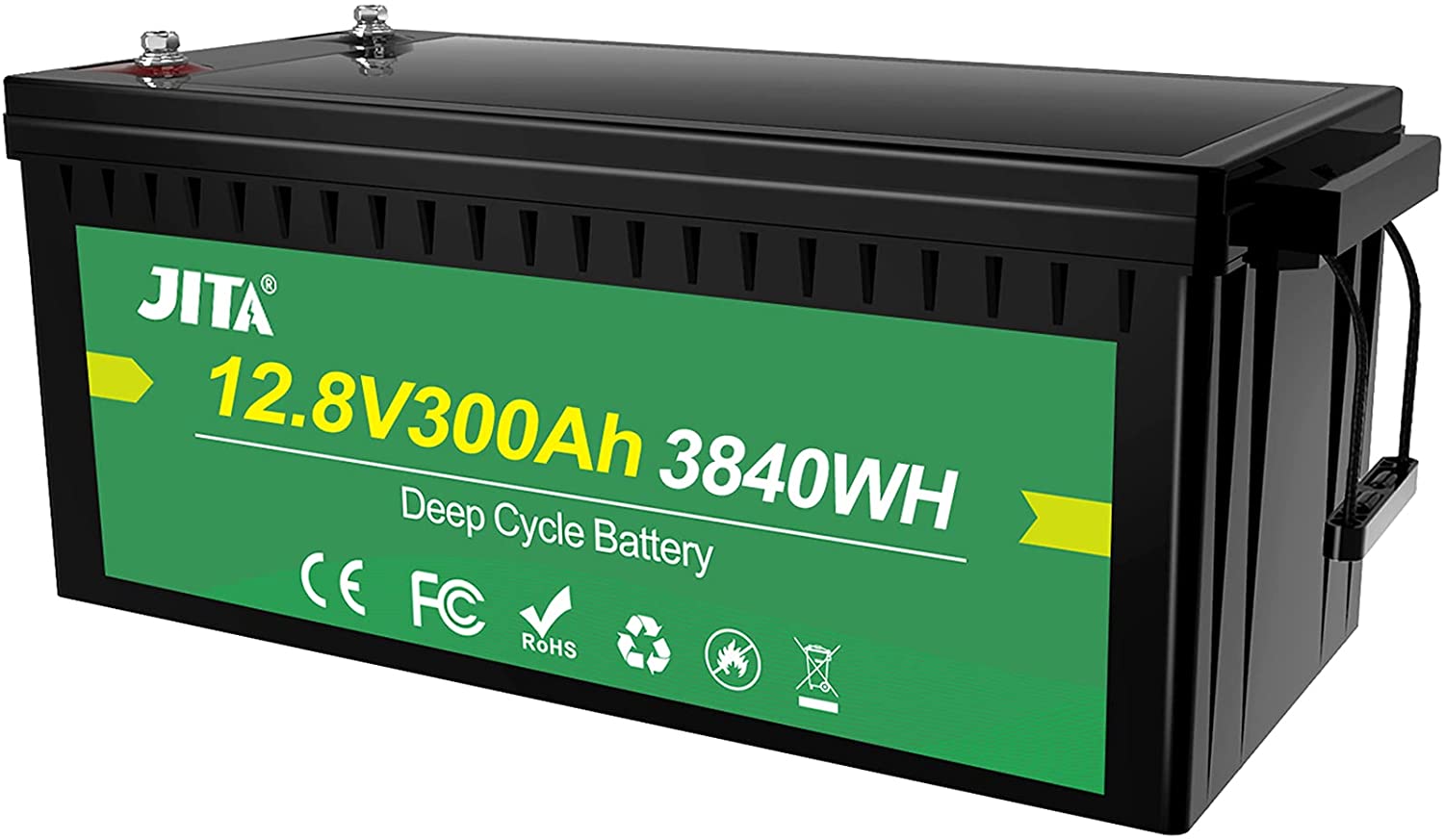
| 10 | Dyness 100Ah LiFePO4 2-Pack | Best two-battery setup | LiFePO4 | 100Ah each | Group 31 | Expandable lithium banks |
1. Interstate Batteries Marine/RV 100Ah AGM: Best Overall

Pros
- Dual-purpose starting and deep-cycle design
- 825 CCA from a Group 31M case
- Thick plates and sealed AGM construction
- Built for RV, marine, and accessory loads
Cons
- Weighs 64.5 pounds
- AGM is much heavier than the lithium picks
- Group 31 fit needs more compartment space
Best for: RV owners who want one sealed battery for starting and house accessories.
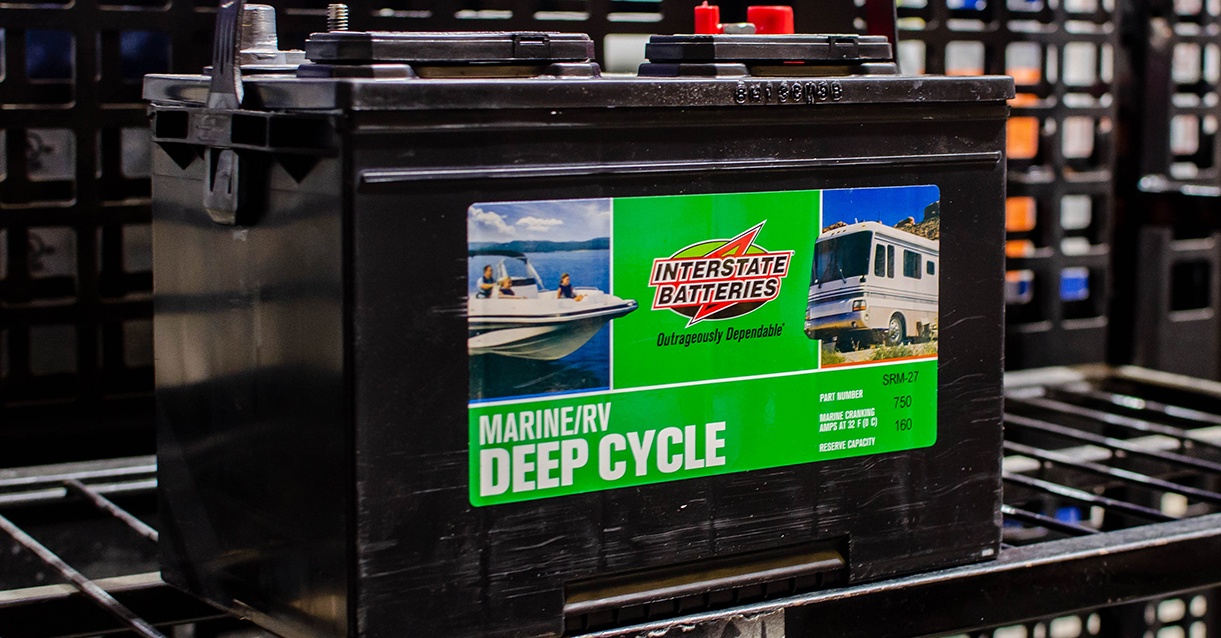
The Interstate Batteries Marine/RV 100Ah AGM is the easiest recommendation for an RV that needs one battery to cover several jobs. It is not a lightweight lithium conversion, but its dual-purpose design makes sense when the battery may need to start an engine, run a trolling motor, and support lights, televisions, pumps, or other RV accessories.
Its 100Ah capacity gives it useful deep-cycle reserve, while the 825 CCA rating gives it a meaningful starting role. That combination is more flexible than a house-only LiFePO4 battery such as the SUPER EMPOWER 100Ah Group 24, which the manufacturer specifically says is not suitable for engine cranking. The Group 31M format is also a practical clue about fit, though RV battery compartments should still be measured before ordering.
The sealed AGM construction avoids acid refilling and is designed for repeated discharge and recharge. Interstate says its pure, non-alloy lead and thick plates are intended to improve service life over conventional AGM and flooded designs. Those claims do not make this battery maintenance-free in every sense, since charging settings, storage, and ventilation still matter, but they point to a sturdy conventional setup.
The weakness is weight. At 64.5 pounds, it is more than twice the listed weight of the VEMDIA lithium battery and substantially heavier than the Dyness units. It also gives up the consistent voltage and deep usable capacity associated with lithium chemistry. Choose the Best best rv battery here when engine starting and simple compatibility matter more than cutting weight.
2. VEMDIA 100Ah Group 31 LiFePO4: Best Lithium Upgrade

Pros
- 24-pound Group 31 lithium format
- Smart 100A BMS
- Low-temperature charging cutoff
- Supports up to 4S4P configurations
- Long cycle-life claims
Cons
- Not presented as a starting battery
- Requires lithium-compatible charging
- Listed dimensions conflict with the stated Group 31 fit
Best for: RV owners replacing a heavy house battery with a lighter lithium system.
The VEMDIA 100Ah Group 31 LiFePO4 changes the feel of an RV battery installation immediately. Its listed weight is 24 pounds, compared with 64.5 pounds for the Interstate Batteries Marine/RV 100Ah AGM. That makes carrying it into a compartment and removing it later far easier, especially when the battery sits under a bed or in a tight storage bay.
The battery uses LiFePO4 chemistry and a smart 100A BMS for overcharge, over-discharge, over-current, short-circuit, and temperature protection. The low-temperature cutoff is particularly relevant to RV use. Charging stops below 32 degrees Fahrenheit, while the stated discharge range extends from minus 4 to 140 degrees Fahrenheit. A lithium battery still needs the RV converter, solar controller, or alternator charging system configured correctly.
VEMDIA lists 15, 000 or more cycles at 60 percent depth of discharge, more than 8, 000 at 80 percent, and 6, 000 at full discharge. Those figures are manufacturer claims rather than a guarantee of service life in every RV. The useful practical point is that lithium is designed for frequent cycling and tends to maintain a steadier voltage as it discharges. The battery can also be connected in up to 4S4P arrangements for larger systems.
One detail deserves caution: the listing calls this a Group 31 replacement but also gives dimensions of 12.9 by 6.7 by 8.5 inches, while the product information section provides a different set of unusually small dimensions. Measure the compartment and confirm terminal placement rather than assuming a drop-in fit. The VEMDIA beats the Interstate on weight and cycling, but the Interstate remains the safer pick when engine starting is part of the job.
3. Renogy 200Ah AGM: Best Large AGM

Pros
- 200Ah capacity
- Low self-discharge claim below 3 percent monthly
- High discharge capability
- Sealed, maintenance-free AGM design
- Performs in below-freezing discharge conditions
Cons
- Extremely heavy at 127.9 pounds
- Large footprint
- Must be installed upright unless special circumstances apply
Best for: RV house banks that need substantial storage without switching to lithium.
The Renogy 200Ah AGM is less a casual replacement than a foundation for a serious conventional house bank. Its 127.9-pound weight makes installation a two-person task in most RVs, but the large capacity gives it a clear role for owners running several 12V loads away from shore power.
Renogy lists a 200Ah reference capacity at the C20 rate, with lower figures at faster C3, C5, and C10 discharge rates. That distinction matters because a battery can appear to have ample capacity on paper while delivering less under heavy demand. The thick AGM separators and valve-regulated construction keep the battery sealed, so there is no routine electrolyte maintenance.
The battery measures 20.5 inches long, 9.4 inches wide, and 8.8 inches high. Those dimensions are far larger than the compact Weize 100Ah AGM, and the weight is more than double. Renogy says its plate design can support discharge currents up to 10 times the rated capacity, though the actual RV installation still needs appropriately sized cables, fuses, and charging equipment.
This is the choice for someone who wants more capacity from familiar lead-acid technology and has a compartment that can carry it. It is not the right answer for an owner who frequently removes the battery, has limited payload, or wants the rapid cycling and lighter handling of lithium. The VEMDIA or Dyness options are easier to live with physically, while the Renogy is the stronger conventional option for a fixed house system.
4. Weize 100Ah AGM: Best Compact AGM

Pros
- Compact 100Ah sealed AGM design
- 1 to 3 percent monthly self-discharge claim
- Defined charging and discharging temperature ranges
- Familiar lead-acid replacement format
Cons
- Weighs 57 pounds
- One-year warranty
- Not a lithium battery for frequent deep cycling
Best for: replacing a conventional 12V RV battery without changing the charging system.
The Weize 100Ah AGM is a straightforward choice for an RV owner who wants sealed lead-acid construction and a familiar installation. It measures 12.99 by 6.73 by 8.43 inches, which gives it a relatively manageable footprint for a 100Ah battery. The 57-pound weight remains significant, but it is easier to handle than the large Renogy 200Ah model.
The AGM design is maintenance-free in the routine sense, with no water refilling and less concern about acid leakage than a flooded battery. Weize lists a monthly self-discharge rate of 1 to 3 percent and recommends keeping the battery charged during storage. That makes a proper storage charger or the RV's charging system important for keeping it ready after periods of nonuse.
Its listed charging range runs from 14 to 122 degrees Fahrenheit, while discharging is listed from 5 to 122 degrees Fahrenheit. The battery also lists a maximum discharge current of 1, 100A for five seconds. That is a short-duration figure, not a promise that the battery can sustain that output for an RV inverter or other heavy load.
Compared with the Renogy 100Ah AGM, the Weize has a similar capacity and purpose but a slightly different physical format and a shorter listed warranty. Compared with the VEMDIA, it is heavier and offers less lithium-style cycle performance, but it avoids the need to convert to lithium charging equipment. Pick it for a simple AGM replacement where the existing compartment and charging setup already suit lead-acid batteries.
5. ECO-WORTHY 280Ah LiFePO4: Best High-Capacity Lithium

Pros
- 280Ah capacity
- 200A built-in BMS
- Bluetooth monitoring
- Metal enclosure with mounting feet
- Low-temperature charging protection
Cons
- Large 16.54 by 8.64 by 9.65 inch case
- Requires careful compartment planning
- More capacity than many small RV systems need
Best for: large RV house banks and off-grid systems with substantial electrical loads.
The ECO-WORTHY 280Ah LiFePO4 is the battery to consider when a single 12V unit needs to support a large house system. Its 280Ah capacity is well above every other single battery here, and the listing gives a maximum energy figure of 3, 584Wh. That reserve can support longer periods away from hookups, though actual runtime depends on inverter losses, appliance draw, and the usable depth of discharge.
The metal case is more substantial than the plastic enclosures used by many compact batteries. ECO-WORTHY says the enclosure resists heat, shock, and vibration, and includes four mounting feet for direct installation in an RV or camper. A low-current power switch allows output to be shut off during installation or maintenance. Those details make more sense in a permanently installed house bank than in a battery that is moved often.
Bluetooth monitoring lets an owner view voltage, capacity, and charge or discharge status in an app. The built-in 200A BMS protects against overcharge, over-discharge, over-current, short circuits, and temperature problems. The low-temperature protection is designed to cut off charging in cold conditions, which is important because LiFePO4 batteries should not be charged below freezing without suitable protection.
The trade-off is physical size. At 16.54 inches wide, 8.64 inches deep, and 9.65 inches high, it may not fit a standard battery compartment without modification. It is also more capacity than a small trailer running lights and a few USB devices may need. The ECO-WORTHY is a stronger house-bank choice than the 100Ah models, but only if the RV's compartment, wiring, charger, and load plan can support it.
6. SUPER EMPOWER 100Ah Group 24 LiFePO4: Best Group 24 Lithium

Pros
- 21.58-pound Group 24 format
- 100Ah LiFePO4 capacity
- 100A BMS
- Low-temperature charging and discharge protection
- Supports up to 4S4P expansion
Cons
- Not suitable for engine starting
- Requires a lithium charging profile
- Group 24 fit still needs terminal and box checks
Best for: compact RV house banks that need lithium capacity in a Group 24 footprint.
The SUPER EMPOWER 100Ah Group 24 LiFePO4 is a strong fit for an RV owner moving from lead-acid to lithium while keeping a familiar battery-box size. The listed dimensions are 6.49 by 10.24 by 8.98 inches, and the battery weighs 21.58 pounds. That is much easier to install than the 57-pound Weize AGM and lighter than the other conventional options.
Its integrated 100A BMS protects against overcharge, over-discharge, overcurrent, short circuit, and temperature extremes. Charging pauses below 32 degrees Fahrenheit and resumes above 41 degrees, while discharge protection is listed down to minus 4 degrees. These safeguards help in cold-weather camping, but the RV's charger and solar controller still need a LiFePO4 setting.
The battery supports up to four units in series and four in parallel, with a stated maximum configuration of 51.2V and 400Ah. That makes it suitable for expansion, although a single Group 24 battery is the more natural fit for a compact auxiliary system. The manufacturer also specifies M8 terminals, a detail worth checking against the RV's existing cables.
This model has a clear limitation that should not be overlooked: it is designed for energy storage and is not suitable for engine cranking. That makes it a house battery, not a universal replacement for the Interstate dual-purpose models. Choose it when the RV has a separate starting battery and you want light, stable auxiliary power in a compact compartment.
7. Interstate Marine/RV 70Ah AGM: Best Smaller Dual-Purpose AGM

Pros
- Dual-purpose starting and deep-cycle design
- 750 CCA
- Group 24M format
- Sealed AGM construction
- Suitable for smaller marine and RV systems
Cons
- Only 70Ah capacity
- Weighs 44.6 pounds
- Less house-power reserve than 100Ah models
Best for: smaller RVs needing a compact dual-purpose battery for starting and accessory loads.
The Interstate Marine/RV 70Ah AGM is the smaller sibling to the top-ranked Interstate model. It keeps the dual-purpose idea, so it can provide engine-starting power and support accessories when the motor is off. That is useful in smaller RVs and boats where a Group 31 case would take up too much room.
Its 750 CCA rating is substantial for a Group 24M battery, and the listed dimensions are 11 inches wide, 6.81 inches long, and 8.98 inches high. The 44.6-pound weight is still far above the lithium options, but it is more manageable than the larger Interstate and Renogy AGM batteries.
Interstate describes the battery as a pure-lead AGM model with thick plates for repeated discharge and recharge. It is designed for lights, televisions, appliances, water pumps, and similar accessory loads, though 70Ah gives less reserve than the 100Ah Interstate or Renogy choices. The smaller capacity is a real boundary for owners who use inverters or spend several nights away from hookups.
This battery makes more sense than a 100Ah model when the Group 24M format is the required fit or when starting performance is more important than maximum house capacity. It loses to the larger Interstate for runtime and to the SUPER EMPOWER for weight. Before choosing it, confirm that the RV's battery box and cables accept the Group 24M layout.
8. Renogy 100Ah AGM: Best Standard AGM

Pros
- 100Ah sealed AGM design
- 1, 100A maximum discharge for five seconds
- Below 3 percent monthly self-discharge claim
- Supports series and parallel configurations
- Broad stated discharge temperature range
Cons
- Weighs 63.9 pounds
- Not intended for the lightest installations
- Requires upright installation in normal use
Best for: RV owners who want a conventional 100Ah AGM battery for house and solar systems.
The Renogy 100Ah AGM is the conventional middle ground in this group. It gives an RV 100Ah of sealed lead-acid capacity without the very large case of the 200Ah model. Its 13.1 by 6.9 by 8.6 inch dimensions are fairly familiar for a 12V battery, though the 63.9-pound weight makes it one of the heavier 100Ah choices here.
Renogy lists a maximum discharge current of 1, 100A for five seconds, which suggests useful short bursts for demanding loads. That figure should not be confused with continuous inverter output. Cable sizing, fusing, ventilation, and the RV converter remain just as important as the battery's headline current number.
The battery is designed for series connections without a stated limitation and parallel connections up to four units. Its self-discharge rate is listed below 3 percent per month at 77 degrees Fahrenheit, helping it retain charge during storage when properly maintained. Renogy also gives a discharge operating range from minus 4 to 140 degrees Fahrenheit.
This model is less specialized than the Interstate dual-purpose batteries and much heavier than the lithium alternatives. It is best for a house system where the existing charger is already set up for AGM and the owner wants a familiar replacement. Renogy says the battery should be installed upright, with side installation reserved for special situations, so compartment orientation matters.
9. OPTIMA D34M BLUETOP: Best Vibration Resistance

Pros
- SpiralCell AGM construction
- Dual starting and deep-cycle purpose
- 750 CCA and 120-minute reserve capacity
- Compact case
- Resistant to vibration
Cons
- 55Ah C20 capacity
- Lower house-storage capacity than most picks
- Heavy for its capacity
Best for: RV owners who prioritize starting power and vibration resistance in a compact case.
The OPTIMA D34M BLUETOP is aimed at the RV owner who values a compact, rugged dual-purpose battery more than maximum house capacity. Its SpiralCell construction uses 99.99 percent pure lead, and OPTIMA says the design is 15 times more resistant to vibration than a standard flooded battery. That trait is relevant in vehicles that spend their time on rough roads or boat trailers.
The battery provides 750 CCA, an 870 MCA rating, and a 120-minute reserve capacity. Its C20 capacity is listed as 55Ah, which is substantially lower than the 70Ah Interstate and the 100Ah models. It can start an engine confidently, but it is not the first choice for an RV owner running an inverter, refrigerator, and entertainment system for extended periods.
The compact case measures about 10 inches long, 6.88 inches wide, and 7.8 inches high in the product information, while the stated battery size is 10 by 6 7/8 by 7 13/16 inches. It weighs 43.5 pounds and uses dual SAE and 5/16 inch stainless steel stud posts. Check the existing cable ends before assuming the terminals will be a direct match.
The OPTIMA is more specialized than the Renogy 100Ah AGM. Its strengths are starting response, sealed construction, and resistance to vibration, while its weakness is limited energy storage. Select it for a smaller RV or marine application with frequent engine starts, not as the primary battery for a power-hungry house bank.
10. Dyness 100Ah LiFePO4 2-Pack: Best Two-Battery Setup

Pros
- Two 100Ah LiFePO4 batteries
- 100A BMS in each battery
- Low-temperature charging protection
- Group 31 format
- Supports up to 4S4P expansion
Cons
- Two-battery installation needs careful balancing
- Lithium charging equipment is required
- Listed weight is 25.3 pounds per battery
Best for: RV owners building a modular lithium house bank from matched batteries.
The Dyness 100Ah LiFePO4 2-Pack is the most direct route here to a 200Ah lithium bank. Each battery is listed at 100Ah and 25.3 pounds, with a Group 31 format measuring 13 by 6.77 by 8.43 inches. A matched pair can provide more house capacity than a single 100Ah unit while staying far easier to handle than the Renogy 200Ah AGM.
Each battery includes a 100A BMS with protection against overcharge, over-discharge, overcurrent, overheating, and short circuits. Dyness also lists dust resistance, salt spray resistance, and IP65 waterproofing. The low-temperature charging cutoff activates below 32 degrees Fahrenheit and resumes at 41 degrees, while discharge protection is listed down to minus 4 degrees.
The batteries can be connected in up to 4S4P configurations, with a stated maximum of 20.48kWh for the expanded arrangement. That flexibility is useful for a growing solar or off-grid system, but a two-battery installation still needs matched cables, appropriate fusing, and a charger configured for LiFePO4. The recommended recharge rate is 0.2C, another reason to plan the charging system rather than simply swapping batteries.
The Dyness pair beats the VEMDIA on included capacity and gives a more modular path than the single SUPER EMPOWER battery. It also costs the RV owner more space and more installation work than one battery. Choose it when the RV has room for two Group 31 units and the goal is a scalable lithium house bank.

How to choose best rv battery
The right RV battery starts with the job it must perform, then narrows down by chemistry, capacity, fit, and charging equipment.
Starting and deep-cycle capability
A starting battery must provide a short, powerful burst of current to crank an engine. A house battery spends longer periods running lights, pumps, electronics, refrigerators, and inverters. Dual-purpose AGM models such as the Interstate and OPTIMA combine both roles, while the SUPER EMPOWER battery is explicitly for energy storage and not engine starting.
Do not install a house-only lithium battery where the engine-starting battery is supposed to be.
If the RV already has a separate starting battery, a deep-cycle LiFePO4 battery can make a strong house-bank upgrade. If one battery must do everything, check for a starting-current specification rather than choosing solely by amp-hour capacity.
Battery chemistry
AGM batteries are sealed lead-acid units with familiar charging requirements and broad compatibility with conventional RV systems. They are sturdy and practical, but the models here weigh from 43.5 to 127.9 pounds. LiFePO4 batteries are dramatically lighter and designed for repeated deep cycling, but the charger and converter need a lithium-compatible profile.
LiFePO4 batteries also use a BMS to manage current and temperature protection. That protection is valuable, though it does not remove the need for fuses, correct wiring, or a suitable charger.
Capacity and usable runtime
Amp-hours describe stored electrical capacity, but runtime depends on the load and discharge rate. A 70Ah battery can suit a small setup with modest overnight use, while a 200Ah or 280Ah battery is more appropriate for inverters, extended stays, and larger solar systems.
The Renogy 200Ah AGM and ECO-WORTHY 280Ah LiFePO4 offer the most single-battery capacity in this group. The Dyness two-pack creates a 200Ah lithium bank from matched units. Before adding capacity, list the actual wattage of the appliances you use and how many hours they run.
Physical fit and terminals
Measure the battery compartment's length, width, height, and usable clearance above the terminals. Group 24 and Group 31 labels are useful starting points, but they do not replace measuring. The Interstate 100Ah uses a Group 31M format, the SUPER EMPOWER uses Group 24, and the Dyness pair uses Group 31.
Terminal position matters just as much as case size. Cable length, positive and negative orientation, terminal hardware, and hold-down points all affect whether a battery is genuinely drop-in.
Cold-weather charging
Cold-weather discharge and cold-weather charging are different problems. LiFePO4 batteries should not be charged below freezing unless they have suitable low-temperature protection. VEMDIA, SUPER EMPOWER, ECO-WORTHY, and Dyness list charging cutoffs around 32 degrees Fahrenheit.
AGM batteries can be more familiar in cold climates, but they still need the correct charging settings and storage care. RV owners who winter camp should check the battery's stated temperature ranges and make sure the charger cannot force current into a cold lithium battery.
For more equipment that supports life on the road, the accessories that make an RV easier to live in are worth considering alongside the battery itself. A battery upgrade also works better when the charging hardware is correctly matched, so how a dedicated charger should be matched to battery chemistry deserves attention before installation.
Frequently asked questions
Can an RV battery start the engine and run house accessories?
Some can. Dual-purpose AGM batteries such as the Interstate Marine/RV models and OPTIMA D34M BLUETOP are designed for both starting and accessory use. Deep-cycle lithium batteries in this list are primarily house batteries, and SUPER EMPOWER says its model is not suitable for engine starting.
Is AGM or LiFePO4 better for an RV?
AGM is easier to use with many existing RV charging systems and offers familiar sealed lead-acid operation. LiFePO4 is much lighter and better suited to frequent deep cycling, but the RV charger, solar controller, and alternator setup need to support lithium charging.
How much battery capacity does an RV need?
That depends on the appliances and the time spent away from hookups. A small RV using lights, phones, and a water pump may work with 70Ah to 100Ah, while inverter use, refrigeration, medical equipment, or several days off-grid may justify 200Ah or more.
Can lithium batteries be charged in freezing weather?
Not without suitable protection. Several lithium batteries here automatically stop charging below 32 degrees Fahrenheit and resume after warming. The RV owner should still avoid charging a cold battery and verify that every charging source uses the proper lithium profile.
Do Group 24 and Group 31 batteries fit the same RV compartment?
No. They are different physical formats, and terminal positions can vary as well. Measure the compartment and compare the battery's dimensions, terminal layout, and hold-down arrangement before ordering.
Can RV batteries be connected in series or parallel?
Some models support both, but the exact limit varies. VEMDIA, SUPER EMPOWER, and Dyness list support for up to four batteries in series and four in parallel, while Renogy lists series support and parallel connection up to four units for its 100Ah AGM. Use matched batteries, equal cable lengths where appropriate, proper fusing, and a charger suited to the final bank voltage.
The bottom line
The Best best rv battery for most conventional RV owners is the Interstate Batteries Marine/RV 100Ah AGM. Its 100Ah capacity, 825 CCA, Group 31M format, and dual-purpose design cover both engine starting and house accessories without requiring a lithium charging conversion.
For a dedicated house bank, the VEMDIA 100Ah Group 31 LiFePO4 is the more appealing upgrade because it weighs only 24 pounds and includes low-temperature charging protection. The ECO-WORTHY 280Ah LiFePO4 is the stronger choice for a large off-grid system, while the Renogy 200Ah AGM remains a sensible conventional option when capacity matters and the RV can carry its 127.9-pound case.
If you are undecided, choose AGM for compatibility and dual-purpose starting, or choose LiFePO4 when lighter weight and frequent deep cycling matter most.
As an Amazon Associate we earn from qualifying purchases.