

A dead phone is inconvenient at home and potentially serious on a trail, at a campsite, or during a power outage. The tricky part is that a solar power bank has two jobs: store energy before you leave and collect enough sunlight to remain useful away from an outlet. Those jobs are not equally easy for every model.
Our Best solar power bank picks range from compact phone chargers to a full portable power station. The lineup covers magnetic charging, built-in cables, hand cranks, rugged weather protection, and multi-device charging. For most people, the BLAVOR Solar Power Bank 20K is the one to buy, while the others make stronger cases for capacity, emergency features, or AC power.
Comparison
| # | Product | Award | Capacity or output | Solar setup | Charging | Best for |
|---|---|---|---|---|---|---|
| 1 | BLAVOR Solar Power Bank 20K | Best overall | 20, 000mAh | Solar charger | 20W USB-C, wireless, built-in cables | Multi-device camping |
| 2 | BLAVOR Solar Power Bank 10K | Best compact pick | 10, 000mAh | Single solar panel | 20W USB-C, wireless | Day hikes and travel |
| 3 | SolarTred 20K Four-Panel | Best weather protection | 20, 000mAh | 4 panels | Up to 5 devices | Wet, dusty trips |
| 4 | FEELLE 50K Magnetic Charger | Best emergency backup | 50, 000mAh | Solar panels and hand crank | 3.0A USB-C, magnetic wireless | Extended outages |
| 5 | SOARAISE 48K Wireless Charger | Best high-capacity cable kit | 48, 000mAh | 4 panels | 3A USB-C, wireless | Group charging |
| 6 | BLAVOR 20K Hand Crank | Best hand-crank design | 20, 000mAh | Solar panel and hand crank | 20W USB-C, wireless | Emergency readiness |
| 7 | Durecopow 20K Charger | Best lightweight cable kit | 20, 000mAh | Solar panel | 3 ports, built-in cables | Hiking and day trips |
| 8 | Mregb 42.8K Charger | Best flashlight backup | 42, 800mAh | Solar panel | QC 3.0, 3 devices | Emergency lighting |
| 9 | SOARAISE 48K Four-Panel | Best blue finish option | 48, 000mAh | 4 panels | 3A USB-C, wireless | Large-capacity camps |
| 10 | ZeroKor 300W Power Station | Best for AC appliances | 300W output | 60W panel included | AC, DC, USB-A, USB-C | Base camps and outages |
1. BLAVOR Solar Power Bank 20K: Best Overall

Pros
- 20W USB-C charging
- Wireless charging for phones and Apple Watch
- Four built-in cables and three ports
- Flashlight, camping light, compass, and thermometer
- Weather-resistant outdoor construction
Cons
- Heavy at 1.72 pounds
- Solar charging is supplemental rather than a quick refill
- Its long body is less pocket-friendly than the compact BLAVOR 10K
Best for: campers who want one charger for phones, wearables, and small accessories.
The BLAVOR Solar Power Bank 20K is the most convincing all-rounder here because it solves the annoying little problems that appear on a real trip. You can forget separate charging leads, top up a phone wirelessly, illuminate a tent, and still have a compass and thermometer attached to the same unit. It is not small, but its feature mix feels purposeful rather than decorative.
Its 20, 000mAh battery is aimed at several phone charges, and BLAVOR says it can provide about four charges for an iPhone 17, 3.4 for a Galaxy S26, and 2.7 for an iPad Mini 6. Those figures vary with device and charging losses, but the practical point is clear: this is sized for a weekend kit rather than one emergency refill. The USB-C port reaches 20W, and the company says an iPhone 15 can fully charge in about 50 minutes. That is a meaningful step up from slow emergency chargers.
The charging arrangement is unusually flexible. Four built-in cables include two USB-C leads, an iOS lead, and a USB-A lead, while separate USB-C, USB-A, and iOS ports support up to six devices at once. The wireless area also works with phones and Apple Watch. Its flashlight has three modes, and a separate camping light offers three brightness levels. The shell uses flame-retardant ABS and PC with silicone protection, and the listing describes the unit as waterproof, shockproof, and dustproof.
The weakness is weight. At 1.7196056436 pounds and 7.28 inches tall, it is more comfortable in a pack than in a pocket. The four-panel SolarTred 20K has stronger stated weather protection, while the BLAVOR Solar Power Bank 10K is much easier to carry. Pick this one when cable freedom and broad device support matter more than keeping your load light.
2. BLAVOR Solar Power Bank 10K: Best Compact Pick

Pros
- Compact 0.58125-pound design
- 20W USB-C output
- Wireless charging and simultaneous charging for three devices
- IPX5 water resistance with dustproof and shockproof construction
- Dual flashlight and compass carabiner
Cons
- 10, 000mAh capacity is modest for multiple people
- Single-panel solar design is less ambitious
- Fewer built-in cable options than the larger BLAVOR models
Best for: day hikers, travelers, and anyone who wants a solar charger that stays manageable in a small bag.
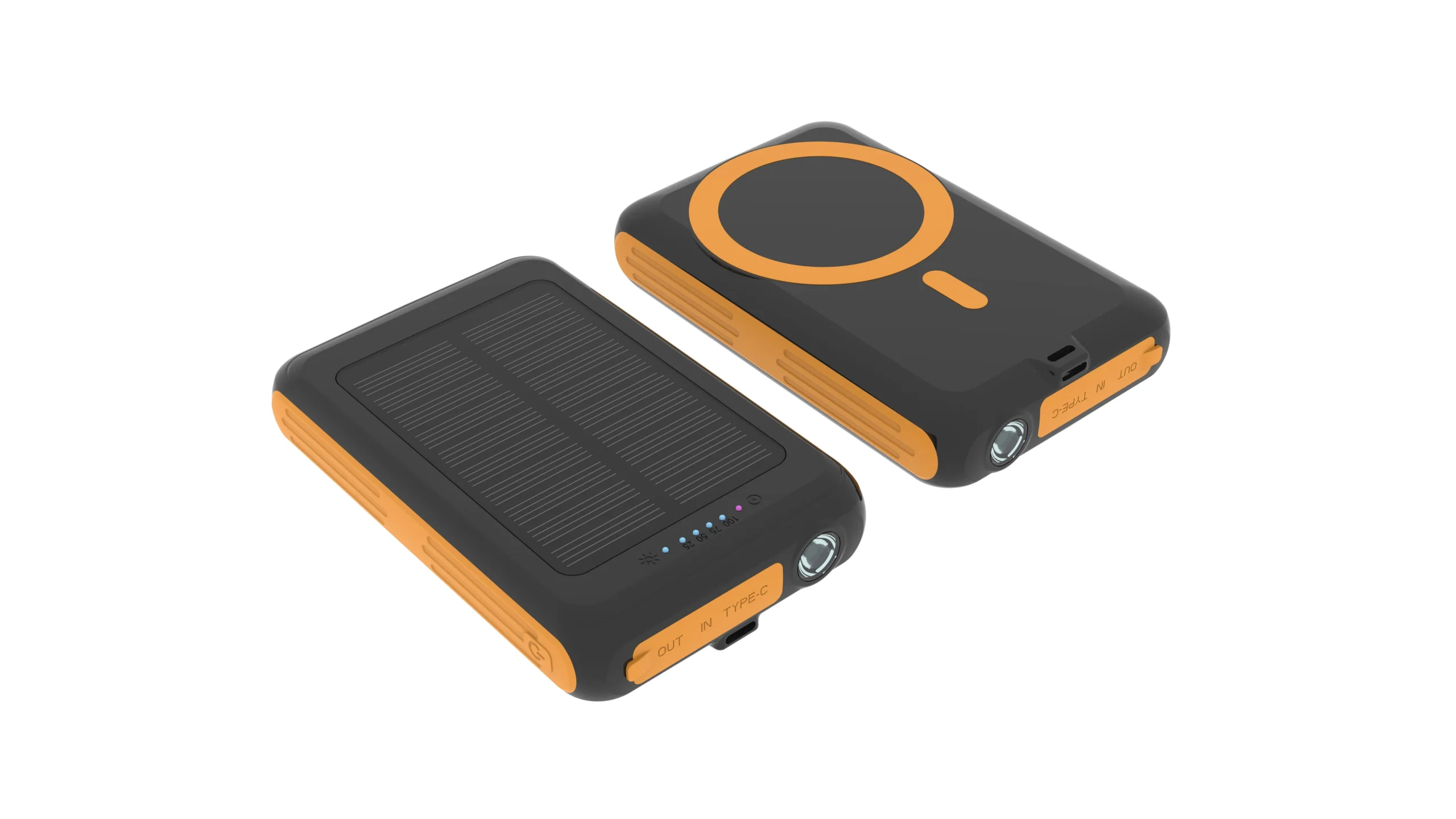
The BLAVOR Solar Power Bank 10K is the one that makes the most sense when carrying comfort matters. At 5.9 by 3.1 by 0.8 inches and 0.58125 pounds, it is substantially easier to stash than the 20, 000mAh and 48, 000mAh models here. It still has the outdoor essentials: a flashlight, a carabiner with compass, and an IPX5 rating for water resistance.
The 10, 000mAh battery is enough for a day away from outlets, not a group expedition. BLAVOR says it can charge an iPhone 8 3.6 times, an iPhone 14 Pro 2.2 times, and an iPad Air once. Those reference devices show the capacity's intended scale. The USB-C output reaches 20W, and the listing says an iPhone 15 can reach 65 percent in 30 minutes. That makes it more useful as a normal fast charger than many solar-branded alternatives.
Wireless charging is available, and the unit can charge three devices simultaneously. The shell combines flame-retardant ABS and PC with a silicone exterior, while the lithium-cobalt battery is described as offering 50 percent more cycling times than a normal lithium-polymer battery. The solar panel is best treated as a way to add charge during a sunny stop, not as a substitute for fully charging the bank before leaving.
Compared with the Durecopow 20K Charger, this BLAVOR is lighter and has a faster stated USB-C output, but Durecopow offers twice the listed capacity and four built-in cables. The BLAVOR Solar Power Bank 20K is more capable for a group, though it is much heavier. Choose this compact model if your usual problem is a phone running low during a day outdoors.
3. SolarTred 20K Four-Panel: Best Weather Protection

Pros
- Four integrated solar panels
- IP67 waterproof, dustproof, and shockproof design
- Supports up to five devices
- Dual flashlight and separate camping light
- Over-current, over-voltage, and temperature safeguards
Cons
- Weighs 1.54103121138 pounds
- No wireless charging is listed
- Four-panel construction is bulky compared with compact banks
Best for: outdoor users who put weather resistance and flexible solar exposure ahead of low weight.
The SolarTred 20K Four-Panel stands out because its design is aimed at messy outdoor conditions. The IP67 rating is the strongest stated protection in this group, and the listing also calls out dustproof and shockproof construction. That combination is more reassuring around rain, sand, and rough campsite handling than a basic single-panel charger.
Its 20, 000mAh lithium-polymer battery gives it a useful middle ground. SolarTred says the bank can fully charge an iPhone 17 more than four times and can handle an iPad Pro one to two times. It also supports up to five devices, with three built-in cables, two USB-A outputs, and a Type-C input/output port. The arrangement is less universal than the four-cable BLAVOR models, but it reduces the need to pack separate leads.
The four integrated panels are the main reason to consider it. More exposed panel area should make it easier to collect sunlight than a narrow single-panel bank, especially when the charger is laid flat or attached to a pack. The product also includes a dual flashlight with steady, SOS, and strobe modes, plus a camping light with three brightness levels. The two lighting systems cannot be used simultaneously, a limitation worth remembering at night.
At 6.9291338512 by 3.543307083 by 1.4173228332 inches and 1.54103121138 pounds, this is not a casual pocket accessory. The BLAVOR Solar Power Bank 10K is a better companion for lightweight travel, and the BLAVOR Solar Power Bank 20K offers more charging conveniences. Choose SolarTred when the trip is wet, dusty, or hard on equipment and the IP67 design matters more than a slim shape.
4. FEELLE 50K Magnetic Charger: Best Emergency Backup

Pros
- 50, 000mAh stated capacity
- 15W magnetic wireless charging
- Four built-in cables and three ports
- Hand crank, compass, and flashlight
- Shockproof outdoor construction with covered ports
Cons
- Thick 1.97-inch profile
- Weighs 1.10231131 pounds
- Magnetic charging works best with a phone case no thicker than 3mm
Best for: emergency kits that need stored capacity plus hand-powered backup features.
The FEELLE 50K Magnetic Charger is built around redundancy. It has the largest stated battery capacity among the handheld banks here, a solar charging system, and a hand crank for the moment when the battery and sunlight are both unavailable. The crank is not a replacement for normal charging, but it gives the unit a useful last-resort role during an outage.
The 50, 000mAh lithium-polymer battery is intended to keep several people's phones and small devices running. Its 15W magnetic wireless pad works with compatible iPhone 12 through iPhone 17 series models, and FEELLE recommends a standard magnetic case no thicker than 3mm. A thick case can weaken the connection and reduce charging efficiency, so this is not a universally effortless magnetic experience.
Four built-in cables cover USB-C, phone, Micro, and USB-A connections. Three ports include USB-C input/output, USB-A output, and Micro-USB input, while the bank can power up to six devices at once. The USB-C port is rated at 3.0A, and the listing says it can take an iPhone from zero to 60 percent in 30 minutes. A flashlight offers steady, SOS, and strobe modes, and a hook lets you attach the charger to a backpack.
The tradeoff is bulk. Its 7.24 by 3.54 by 1.97-inch dimensions make it a substantial object, even though the stated weight is lower than some 20, 000mAh competitors. The BLAVOR 20K Hand Crank is easier to justify for ordinary camping, while the SOARAISE 48K Wireless Charger offers a slimmer-looking alternative with four panels but no hand crank. Pick FEELLE for preparedness, not for a lightweight day pack.
5. SOARAISE 48K Wireless Charger: Best High-Capacity Cable Kit

Pros
- 48, 000mAh lithium-polymer battery
- Four solar panels
- Four built-in cables and wireless charging
- Three ports with 3A USB-C
- Supports up to seven devices
Cons
- Large 1.57-inch depth
- No hand crank is listed
- Solar charging still depends heavily on sunlight
Best for: families or groups carrying several phones and cable types.
The SOARAISE 48K Wireless Charger is a cable-management solution disguised as a large battery bank. Its 48, 000mAh lithium-polymer battery is designed for long trips, and the four built-in cables mean a group does not need to remember a separate USB-C, phone, USB-A, and Micro lead. Add wireless charging and this becomes one of the easiest models here to share.
The four-panel solar arrangement is more useful than the tiny panel found on many rugged banks. SOARAISE describes the panels as five times faster than standard single-panel chargers, though actual results will depend on sunlight, angle, and the bank's remaining capacity. Solar charging is most useful for extending a trip or topping up gradually. It should not be the only charging plan for a large battery.
The bank has two USB-A outputs and one USB-C input/output, plus a wireless charging pad. The USB-C port is rated at 5V/3A, and the listing says an iPhone can move from 15 percent to 60 percent in 30 minutes. It can support up to seven devices, which gives it an edge over the smaller banks for group use. The claimed compatibility covers phones, tablets, and Galaxy models.
SOARAISE lists dimensions of 6.38 by 3.43 by 1.57 inches. That is a lot of charger to carry, and there is no hand crank or explicit weather rating in the provided details. The nearly identical SOARAISE 48K Four-Panel offers the same core feature set in a different listed color, while the FEELLE 50K Magnetic Charger adds a hand crank. Choose this SOARAISE when shared cables and high stored capacity are the priority.
6. BLAVOR 20K Hand Crank: Best Hand-Crank Design

Pros
- 20, 000mAh battery
- Hand crank plus solar charging
- 20W PD USB-C
- 15W wireless charging
- Built-in cables, camping light, and survival tools
Cons
- 1.25-pound weight
- Crank power is intended for emergencies
- Long 7.16-inch body
Best for: campers who want manual backup power without carrying the largest bank in the group.
The BLAVOR 20K Hand Crank has a more focused purpose than the standard BLAVOR 20K. Both are multi-device chargers, but this version adds a hand crank, making it more suitable for power outages and remote trips where an emergency light matters as much as phone capacity. BLAVOR says one minute of cranking can provide up to five minutes of emergency lighting.
The 20, 000mAh battery is listed as enough for up to 4.1 iPhone 17 charges, 3.6 Galaxy S24 Ultra charges, or 2.7 iPad Mini 6 charges. The USB-C port supports 20W PD charging, and the product says it can be taken on airplanes as carry-on baggage. A 15W wireless pad supports several wireless charging levels, up to 15W, with the listing claiming a phone can reach 50 percent in 30 minutes.
Four built-in cables include two USB-C leads, an iOS lead, and a USB-A lead. Three more ports, one USB-C and two USB-A, let it charge up to seven devices at once. The outdoor feature list is extensive: flashlight, camping lantern, compass, thermometer, carabiner, and rope. Its flame-retardant ABS and PC shell has silicone protection and is described as waterproof, shockproof, and dustproof.
The 7.16 by 3.86 by 1.7-inch body and 1.25-pound weight are noticeable in a day pack. The BLAVOR Solar Power Bank 20K is a better everyday multi-device charger because it includes wireless charging for Apple Watch, while the FEELLE 50K Magnetic Charger stores more energy and has a larger emergency reserve. Choose this model when a hand crank is genuinely useful, not simply an appealing extra.
For trips where every ounce matters, how to keep a portable charger manageable in a small pack is a useful planning question before choosing a high-capacity model.
7. Durecopow 20K Charger: Best Lightweight Cable Kit

Pros
- 20, 000mAh capacity
- Four built-in cables
- Three ports and charging for up to six devices
- Dual flashlight with SOS and strobe modes
- Lightweight 0.551155655-pound body
Cons
- Solar panel is not a four-panel array
- No wireless charging is listed
- USB-C charging details are less specific than the BLAVOR models
Best for: hikers who want a large stated capacity and built-in cables without a heavy chassis.
The Durecopow 20K Charger is surprisingly light for its stated capacity. It weighs 0.551155655 pounds and measures 5.9 by 3.14 by 0.78 inches, making it easier to carry than most of the 20, 000mAh options in this roundup. Its design is straightforward, with the emphasis on built-in connectivity and outdoor durability.
Three built-in output cables cover Type-C, Lightning, and Micro USB, while a fourth USB-A cable serves as an input. Two USB outputs and a Type-C input/output port can power up to six devices simultaneously. That arrangement is convenient for a mixed group, though it lacks the wireless charging pad found on the larger BLAVOR models.
The dual LED lights provide steady, SOS, and strobe modes. Five indicator lights show battery status, and separate colors indicate solar or USB charging. Durecopow describes the unit as water-resistant, shock-resistant, and dustproof, with silicone covers over the ports. It also includes a carabiner and compass, both sensible additions for outdoor use.
The listing says the bank can recharge through solar power or an outlet and has more than 1, 000 recharge lifecycles. It does not give a solar wattage or a fast-charge wattage, so buyers should not compare it directly with a 20W USB-C model based on capacity alone. The BLAVOR Solar Power Bank 10K is smaller and faster over USB-C, while the SolarTred 20K Four-Panel offers stronger weather protection and more solar surface. Durecopow is the sensible middle ground for light travel and cable variety.
8. Mregb 42.8K Charger: Best Flashlight Backup
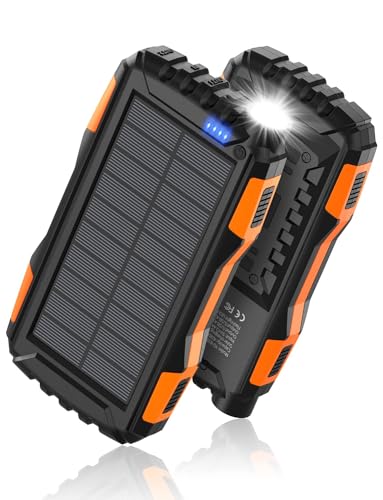
Pros
- 42, 800mAh stated capacity
- QC 3.0 support
- Three-device charging
- IP67 waterproof, dustproof, and drop-proof design
- Flashlight rated for up to 100 hours
Cons
- Solar charging is explicitly described as slow
- No dimensions or weight are provided
- No wireless charging or built-in cables are listed
Best for: emergency kits where a long-running flashlight is as important as phone charging.
The Mregb 42.8K Charger takes a practical emergency-kit approach. Its headline feature is a 42, 800mAh high-density battery, but the more distinctive detail is the flashlight, which the listing says can run for up to 100 hours. That makes this a more interesting choice for outages and roadside storage than a charger that treats its light as an afterthought.
It can charge three devices simultaneously through two USB outputs and a USB-C port that works as both input and output. The bank supports QC 3.0 for compatible devices and is described as compatible with USB-powered phones and tablets. The provided data does not list a wireless pad, built-in cable set, or a specific USB-C wattage, so its charging setup is less convenient than the BLAVOR and Durecopow alternatives.
The enclosure uses ABS material and carries an IP67 description for waterproof, dustproof, and drop-proof protection. Those traits suit a garage, car, or emergency drawer where the unit may be exposed to rough handling. The product also makes clear that solar charging is affected by sunlight intensity and duration and will be very slow with such a large battery. That unusually direct warning is useful: solar is an emergency extension, not the normal refill method.
Mregb is less versatile for a group than the SOARAISE 48K Wireless Charger, which offers four cables and wireless charging. The SolarTred 20K Four-Panel is a better fit when solar collection and weather protection are the main concerns. Choose Mregb if you want a high-capacity backup with a long-running light and already expect to recharge it from an outlet.
9. SOARAISE 48K Four-Panel: Best Blue Finish Option

Pros
- 48, 000mAh lithium-polymer battery
- Four-panel solar design
- Four built-in cables
- Wireless charging and three ports
- Supports up to seven devices
Cons
- Large and thick for a handheld bank
- No hand crank is listed
- Solar performance remains dependent on conditions
Best for: group trips that need the same large-capacity, multi-cable format in a blue housing.
The SOARAISE 48K Four-Panel is functionally very close to the other SOARAISE 48K entry. Its 48, 000mAh lithium-polymer battery, four solar panels, four built-in cables, wireless pad, and three ports make it a group-oriented charger rather than a minimalist personal bank. The key difference in the provided details is the blue finish and a different physical layout.
The four cables cover USB-C, phone, USB-A, and Micro connections. Two USB-A outputs and one USB-C input/output port sit alongside the wireless charging pad, and SOARAISE says the bank can support up to seven devices. The USB-C port is rated at 5V/3A, with a claimed iPhone charge increase from 15 percent to 60 percent in 30 minutes. Those features reduce cable clutter when several people are sharing one battery.
The four solar panels are intended to collect more sunlight than a single-panel bank. SOARAISE says the arrangement can charge up to five times faster than standard single-panel chargers, but the supplied information does not provide a solar wattage. Treat the claim as a design comparison, not a guarantee of a full recharge under ordinary daylight. The large stored capacity makes pre-trip charging especially important.
Its dimensions are 6.3779527494 by 1.574803148 by 3.4251968469 inches. The shape is still substantial, and the provided information does not identify an IP rating or hand crank. The SOARAISE 48K Wireless Charger offers the same core capability in orange, while the BLAVOR 20K Hand Crank gives up capacity for a hand-powered emergency feature. Pick this model when the blue version suits your kit and you want maximum cable flexibility.
If the solar panel itself is the deciding factor, how panel size and output affect outdoor charging explains the tradeoff more clearly than capacity labels alone.
10. ZeroKor 300W Power Station: Best for AC Appliances

Pros
- 300W portable power station output
- 60W solar panel included
- Two AC outlets
- USB, DC, and car charging options
- Built-in battery protection and cooling fan
Cons
- Much heavier at 5.08 pounds
- Not a pocket-sized phone power bank
- Solar-panel junction box must be kept dry
- Devices over 300W are not supported
Best for: campsite base power, small electronics, and outages that require AC outlets.
The ZeroKor 300W Power Station is the outlier in this roundup, and that is exactly why it earns a place. It is not a pocket charger with a decorative solar panel. It is a small power station with two AC outlets, a 60W panel, and enough output for phones, tablets, laptops, headphones, and other small camping equipment.
Its 300W limit defines what it can do. The listing warns against appliances above 300W, including examples such as coffee makers, hair dryers, water pumps, and some devices with compressors or heating elements. The station also includes a DC port rated from 9V to 12.6V at up to 10A, three USB ports rated at 5V/3A, and a quick-charge USB port supporting 5V/3A or 9V/2A.
The included 60W monocrystalline panel is listed with 20.5 percent conversion efficiency. It has USB-A, USB-C, and DC outputs, and the power station can also recharge through a home AC outlet, a car connection, or a DC5521 solar input with built-in MPPT. The panel junction box is not waterproof, so it needs to stay dry even if the rest of a campsite is prepared for weather.
At 8.5 by 6.7 by 4.1 inches and 5.08 pounds, ZeroKor is several categories larger than the handheld banks. Its battery management system includes short-circuit, over-current, over-voltage, overload, and overheating protection, and a fan starts or stops based on internal temperature. Readers comparing this with the different ways portable solar generators handle camping power should focus on the 300W ceiling and AC outlets, not just the solar-panel label.
The ZeroKor 300W Power Station is the clear choice for a tent, cabin, or emergency shelf where AC power matters. For phones alone, the BLAVOR Solar Power Bank 20K is far easier to carry and offers more convenient built-in charging leads. Choose ZeroKor only when you will use its broader output options.
How to choose best solar power bank
The right solar power bank depends less on the biggest capacity printed on the case and more on how you will recharge it, carry it, and connect your devices.
Battery capacity
Capacity determines how many devices can run before the bank needs another recharge. A 10, 000mAh model suits a day trip or one phone, while 20, 000mAh banks make more sense for a weekend or several devices. The 42, 800mAh to 50, 000mAh models are better suited to groups and emergency storage, but they are larger and need more energy to refill.
Capacity figures are not the same as guaranteed output at the phone. Charging losses, device size, and simultaneous use all affect the result. Look for a capacity that matches the number of people and days you actually need to cover.
Solar panel area
A single built-in panel is convenient but limited. Four-panel designs expose more surface to the sun and can collect energy more effectively when unfolded or positioned outdoors. The SolarTred and SOARAISE models make this their central advantage.
Solar charging remains dependent on direct sunlight, angle, shade, and duration. A large battery can take a long time to replenish from a small panel. Pre-charge the power bank from an outlet, then use solar as a way to extend its runtime.
A solar power bank is most useful when its battery is already full before the trip begins.
Charging ports and cables
Built-in cables reduce the chance of forgetting a lead, especially when a group carries both USB-C and older devices. Wireless charging adds convenience, but it can be slower and less reliable through thick cases. USB-C output ratings matter when a phone needs a quick top-up.
Count the actual ports, not just the number of devices advertised. Charging several devices at once can divide available power, and the provided data does not specify the same output behavior for every model.
Outdoor protection
Water, dust, drops, and temperature swings are normal camping hazards. IP67 protection is stronger than a general statement that a charger is rugged, while silicone port covers help prevent debris from reaching the connections. A carabiner or hook also matters if the bank will hang from a pack.
Protection does not make a charger indestructible. Keep connectors covered, avoid submerging units unless the specific rating supports it, and protect solar-panel junction boxes that are not waterproof.
Weight and emergency features
A hand crank, compass, thermometer, lantern, and SOS light can justify extra bulk when the charger belongs in an emergency kit. They are less appealing when the goal is a light day-hike setup. The BLAVOR 10K is the easiest carry here, while the ZeroKor power station is intended for a base camp or outage.
Consider how often you will carry the unit. A feature-rich charger left at home is less useful than a smaller one that travels with you.
Frequently asked questions
Can a solar power bank charge a phone directly in sunlight?
Some models can collect solar energy while a device is connected, but the result depends on sunlight and the panel area. Small built-in panels usually work best as a slow emergency top-up rather than a fast phone charger. A pre-charged battery bank provides more consistent power.
Are four solar panels better than one?
Four panels expose more solar surface and can collect more energy than a single integrated panel under suitable conditions. They also make the charger larger and heavier. Panel count alone does not guarantee a specific charging speed because the data for these products does not provide a common solar wattage standard.
How much capacity should a camping power bank have?
A 10, 000mAh bank fits a day trip for one phone. A 20, 000mAh model is more suitable for a weekend or several devices, while the largest handheld banks target groups and emergency storage. Choose based on the number of devices and the time between outlet charges.
Is wireless charging useful outdoors?
Wireless charging is convenient when the phone and bank remain aligned and the case allows the connection. It avoids carrying a cable, but wired USB-C charging is usually the more predictable option for speed and compatibility. Magnetic alignment can help when the phone and case support it.
Do solar power banks need to be charged before use?
Yes. Charge the battery fully from an outlet before leaving whenever possible. Solar panels on portable banks are useful for extending runtime, but a large battery can take a long time to refill from sunlight alone.
What is the difference between a solar power bank and a power station?
A solar power bank is designed mainly for phones, tablets, and USB devices. A power station is larger and may include AC outlets, DC outputs, a higher wattage limit, and a separate solar panel. The ZeroKor model belongs to the power-station category because it offers 300W output and AC outlets.

The bottom line
The BLAVOR Solar Power Bank 20K is the Best solar power bank for most campers because it balances 20, 000mAh capacity, 20W USB-C charging, wireless support, built-in cables, and useful outdoor tools. It is heavy, but its broad device compatibility makes that weight easier to justify.
For a lighter setup, the BLAVOR Solar Power Bank 10K is the better personal charger. Choose the SolarTred 20K Four-Panel for stronger stated weather protection, the FEELLE 50K Magnetic Charger for hand-crank emergency backup, or the ZeroKor 300W Power Station when AC outlets matter more than portability.
If you are undecided, buy the BLAVOR 20K for multi-device camping and step down to the BLAVOR 10K only when keeping your pack light is the priority.
As an Amazon Associate we earn from qualifying purchases.