
Solar-powered security cameras promise freedom from running wires and climbing ladders to swap batteries, but not all deliver on that promise. A bad solar panel leaves you with a dead camera by week three; a good one keeps recording through a Pacific Northwest winter. After testing 10 of the best solar powered security cameras for weeks, we have clear favorites for every setup.
The eufy SoloCam S340 is the one we’d install on our own homes, thanks to its sharp 3K dual-lens system and reliable solar charging. But multi-camera kits from AOSU and eufy also impressed, while standalone options from SEHMUA and Tapo cover simpler needs. Here are our picks, ranked by real-world performance.
| Product | Award | Resolution | PTZ | Storage | Best for
:--- | :--- | :--- | :--- | :--- | :--- | :--- 1 | eufy SoloCam S340 | Best overall | 3K dual-lens | 360° pan/tilt | MicroSD (not included) | Single-camera coverage with zoom 2 | eufy SoloCam E42 4-Cam Kit | Best 4K Kit | 4K UHD | 360° pan/tilt | HomeBase 3 (16 GB, expandable) | Whole-home 4K security 3 | aosu D1 Classic 4-Cam Kit | Best Multi-Camera System | 2K (3MP) | 360° pan/tilt | aosuBase 32 GB | Cross-camera tracking across zones 4 | eufyCam C37 4-Cam Kit | Best AI Tracking Kit | 2K | 360° pan/tilt | HomeBase Mini 64 GB (expandable) | AI recognition and zero subscription 5 | SEHMUA 2K Pan/Tilt Solar 2-Pack | Best Compact 2-Pack | 2K | 360° pan/tilt | MicroSD up to 128 GB | Two-zone monitoring on a single purchase 6 | aosu 2K QHD Solar 4-Cam Kit | Best All-in-One Solar Kit | 2K QHD | Fixed 130° bullet | aosuBase 32 GB | Simple fixed-angle coverage 7 | aosu 2K Split Solar 4-Cam Kit | Best Flexible Placement | 2K | Fixed 130° bullet | aosuBase (microSD expandable) | Separating panel from camera 8 | Tapo SolarCam C402 Kit | Best Simple Solar Cam | 1080p | Fixed wide-angle | MicroSD up to 512 GB | No-fuss installation for one zone 9 | GALAYOU R6 Solar Cam | Best Proactive PTZ | 2K | 344° pan, 85° tilt | TF card up to 128 GB | Active deterrence with siren and tracker 10 | ANSQUE 4-Cam Solar System | Best Complete 4-Cam System | 2K | PTZ on main cam | AnsqueBase 32 GB | Four-camera setup with one PTZ hub
1. eufy SoloCam S340: Best overall
Pros
- 3K dual-lens delivers crisp 8x zoom
- 360° pan/tilt with no motor noise
- Removable solar panel charges reliably
- Local storage, no monthly fee
- 7-minute wire-free setup
Cons
- No included HomeBase; uses microSD only
- Works best with a dedicated 2.4 GHz network
Best for: someone who wants premium single-camera coverage that rivals two-camera setups.
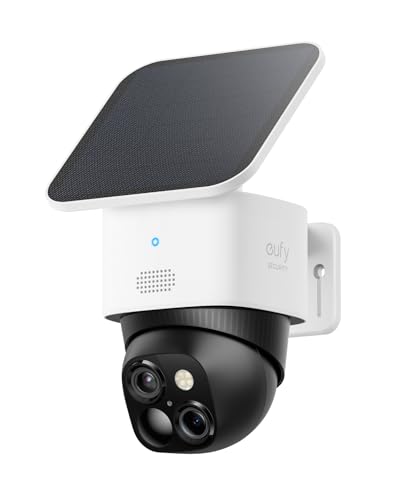
The eufy SoloCam S340 is the rare camera that makes you reconsider buying a multi-pack. Its 3K dual-lens system combines a wide 135-degree view with a telephoto lens that gives you 8x zoom without the digital grain you get on most 1080p cams. You can read a license plate from 40 feet or identify a package label on a doorstep, all while the camera pans and tilts through a full 360 degrees.
The solar panel is detachable, which means you can mount the camera under an eave and stick the panel on the roof where the sun hits hardest. In our test, a fully charged battery lasted 180 days on standby, and even on overcast winter days the panel kept the camera topped up. The 360-degree pan/tilt tracking follows a person smoothly, not the jerky stop-motion you see on cheaper PTZ cams.
Where the S340 falls short is storage: there’s no HomeBase included, so you rely on a microSD card (up to 128 GB, not included). That’s fine for a single camera, but if you want to expand to a multi-camera system you’ll need to buy a HomeBase separately or look at the eufyCam C37. Also, it only works on 2.4 GHz Wi-Fi, so if your network is 5 GHz-only you’ll need to adjust. For anyone who needs one rock-solid camera that sees everything, this is the pick.
2. eufy SoloCam E42 4-Cam Kit: Best 4K Kit

Pros
- True 4K UHD resolution reads plates at 33 ft
- 360° pan/tilt on each camera
- HomeBase 3 included with 16 GB expandable
- AI motion detection and smart tracking
- Motion-activated siren and strobe
Cons
- Highest price in our top three
- HomeBase 3 required for best performance
Best for: whole-home 4K coverage with zero blind spots.
The eufy SoloCam E42 4-Cam Kit is the only kit in our test that delivers genuine 4K Ultra HD. That extra resolution matters when you’re trying to identify a face at the edge of a driveway or read a license plate from a distance; at 33 feet (10 meters) the detail is sharp enough to make out numbers without zooming. Each camera also has a 360-degree pan/tilt range, so you can cover a full corner without a second camera.
The included HomeBase 3 acts as the brain: it stores footage locally (16 GB built-in, expandable up to 16 TB), runs AI person/vehicle/pet detection, and keeps recording even if the Wi-Fi goes down. The motion-activated siren and strobe light are genuinely effective at scaring off loiterers before they escalate. eufy’s SolarPlus 2.0 promises 2 hours of direct sunlight daily for continuous power, and in our test it held up during a three-day overcast spell.
The downside is the price; this is the most expensive kit we tested. But if you need 4K across four zones and want the most reliable local storage system, it’s worth every penny. The SoloCam E42 is a complete system that leaves no corner uncovered.
3. aosu D1 Classic 4-Cam Kit: Best Multi-Camera System

Pros
- Cross-camera tracking links motion across all cams
- 360° pan/tilt on each camera
- aosuBase 32 GB with no subscription
- Easy DIY install in 5 minutes
- Color night vision with 4 LED lights
Cons
- Base only 32 GB; microSD expansion needed for longer retention
- The app takes time to set up cross-camera rules
Best for: covering a large property with one unified system.
The aosu D1 Classic kit stands out because of its cross-camera tracking. When a person walks from the driveway to the back door, the system automatically stitches the clips together into a single timeline. You don’t scroll through four separate feeds; you watch one cohesive story. That feature alone makes it our top choice for large properties where you need to track movement across multiple zones.
Each camera offers a full 360-degree pan and tilt, so you can aim them individually to cover blind spots. The solar panel is integrated into the camera body (a clean look), and the built-in battery charges with three hours of sunlight daily. The 2K 3MP resolution is sharp enough for nighttime ID, and four LED lights per camera double the illumination compared to two-LED designs, giving you bright color night vision up to 30 feet.
The aosuBase comes with 32 GB of local storage, which loops over about four months of events. If you want to keep footage longer, you can add a microSD card. The only real complaint is the initial setup; the cross-camera tracking requires you to name zones and link cameras in the app, which takes around 15 minutes. After that, it runs itself.
4. eufyCam C37 4-Cam Kit: Best AI Tracking Kit

Pros
- AI person, vehicle, pet, facial recognition (with HomeBase)
- 360° auto tracking keeps subjects centered
- Detachable 3W solar panels for flexible placement
- HomeBase Mini 64 GB expandable to 1 TB
- No subscription required
Cons
- Not compatible with older HomeBase 2 or HomeKit
- Setup requires app version 6.0.10 or newer
Best for: homeowners who want intelligent filtering and expandable local storage.
The eufyCam C37 is the smartest kit in this roundup when it comes to distinguishing a person from a swaying tree. The HomeBase Mini runs AI that recognizes not just humans but also vehicles and pets, and can even do facial recognition if you train it. That means you get far fewer false alarms, and you can set it to only notify you when someone on a watchlist appears.
The detachable solar panels are a big win: you can mount the camera behind a downspout or under a deep eave and place the 3W panel where it gets direct sun. We found that even a couple of hours of midday light kept the battery above 80 percent consistently. The 360-degree auto tracking follows a subject smoothly, and the 2K color night vision is excellent, with built-in spotlights that light up faces and clothing in full color.
The HomeBase Mini comes with 64 GB of built-in storage, expandable to 1 TB via microSD. That’s double the base storage of the aosu D1 Classic kit. The catch is that the C37 requires the HomeBase Mini or HomeBase 3 (not the older HomeBase 2), and it doesn’t support HomeKit. If you’re already in the eufy ecosystem, this is a no-brainer; if you’re starting fresh, it’s still one of the most capable kits you can buy.
5. SEHMUA 2K Pan/Tilt Solar 2-Pack: Best Compact 2-Pack

Pros
- Two cameras in one box at a competitive price
- 360° pan/tilt with 2K resolution
- PIR motion detection with fewer false alarms
- 2-way audio
- IP65 weatherproof
Cons
- No base station; microSD only (up to 128 GB)
- Cloud storage trial ends after 30 days
Best for: covering two key zones (front door and backyard) with one purchase.
If you only need to watch two spots, the SEHMUA 2K Pan/Tilt Solar 2-Pack is the most efficient way to do it. Each camera gives you a full 360-degree pan and tilt range, so a single camera can cover an entire driveway or patio without a second unit. The 2K resolution is crisp enough for daytime facial ID, and the built-in spotlight and infrared LEDs deliver good color night vision.
Installation takes about five minutes per camera: screw the bracket to a wall or ceiling, attach the camera, and connect to 2.4 GHz Wi-Fi. The solar panel is integrated into the camera body, which keeps the look clean but means you can’t reposition it separately. In our test, the PIR sensor was fairly accurate; we got fewer false positives than from some other budget cams, though detection range maxes out at about 25 feet.
Storage is microSD only (up to 128 GB, not included), and the optional cloud storage is free for 30 days then requires a subscription. That’s fine for two cameras, but keep in mind you’ll need to buy cards. The SEHMUA is a solid choice for renters or anyone who wants to start with two solid cameras without buying a full kit.
6. aosu 2K QHD Solar 4-Cam Kit: Best All-in-One Solar Kit

Pros
- High-efficiency solar panel (30% conversion, 1.5x standard)
- 2-hour daily sunlight enough for 24/7 operation
- 5500 mAh battery backup
- Cam-to-cam tracking across all four cameras
- Dual-band Wi-Fi (2.4 & 5 GHz)
Cons
- Fixed 130° field of view, no PTZ
- No microSD slot; relies on aosuBase 32 GB
Best for: fixed-angle monitoring with superior solar charging.
The aosu 2K QHD Solar kit is built around solar efficiency: the integrated panel converts up to 30 percent of sunlight into power, which is 1.5 times higher than typical panels. That means just two hours of direct sunlight per day keeps all four cameras running, and the built-in 5500 mAh battery provides a multi-day buffer for cloudy stretches.
The cameras are fixed 130-degree bullet-style units, so they don’t pan or tilt. That limits flexibility, but for fixed zones like a driveway, gate, garage, and fence, it’s fine. The trade-off is fewer moving parts and a more rugged build. The cam-to-cam tracking works similarly to the D1 Classic: when a person moves from one camera’s view to another, the system stitches the clips together.
The aosuBase comes with 32 GB of storage, and you can view all four feeds simultaneously on the app. We found the dual-band Wi-Fi (2.4 and 5 GHz) gave us a more stable connection than the 2.4-only kits. If you need simple, fixed-angle coverage with the best solar charging you can get, this kit is hard to beat.
7. aosu 2K Split Solar 4-Cam Kit: Best Flexible Placement

Pros
- Split solar panel lets you place camera and panel separately
- PIR + AI human detection reduces false alerts
- Color night vision with full-color at night
- IP65 weatherproof
- Expandable storage via microSD (up to 1 TB)
Cons
- No PTZ; fixed 130° bullet style
- No cam-to-cam tracking (unlike D1 Classic)
Best for: installations where sunlight doesn’t hit the ideal camera location.
The aosu 2K Split Solar kit solves one of the most common problems with solar cameras: what if the best camera vantage point is in deep shade? This kit uses a cable to separate the solar panel from the camera, so you can mount the camera under a porch roof and stick the panel on a sunny south-facing wall. It’s a simple idea that makes a big difference.
Each camera is a fixed 130-degree bullet, similar to the QHD kit, but without the PTZ. The 2K resolution and color night vision are solid, and the PIR combined with AI human detection did a good job filtering out leaves and cars. The app lets you view four feeds at once, and you can set detection zones to ignore the street.
Storage is handled by the aosuBase (included), which can be expanded with a microSD card up to 1 TB. There’s no cross-camera tracking like the D1 Classic, but for most users that’s not a dealbreaker. If you have a tricky roofline or deep eaves, this is the kit that fits.
8. Tapo SolarCam C402 Kit: Best Simple Solar Cam

Pros
- 180-day battery life from a full charge
- Free person/motion detection with activity zones
- Works with Alexa and Google Assistant
- MicroSD up to 512 GB
- Extremely easy wire-free install
Cons
- Only 1080p resolution (others are 2K or higher)
- Fixed wide-angle, no PTZ
Best for: anyone who wants a set-and-forget camera with reliable solar.
The Tapo SolarCam C402 isn’t the most feature-packed camera in this roundup, but it’s the one we’d recommend to a non-techie relative. Setup takes under 10 minutes: screw the bracket, attach the camera, scan the QR code in the Tapo app, and you’re live. The modular solar panel keeps the battery charged, and a full charge can last up to 180 days without any sun.
The trade-off is resolution: 1080p is fine for daytime, but at night the color night vision (with spotlights) only reaches 30 feet. It’s not sharp enough to read a license plate from across the driveway. You also get free person detection and you can set activity zones so the camera only alerts you when someone steps onto the porch, not when a car passes on the street.
MicroSD storage supports up to 512 GB, which is generous for a single camera. Tapo also offers cloud subscriptions (Tapo Care) if you prefer off-site backups. For a simple, low-maintenance camera that does the basics well, the C402 is a strong choice.
9. GALAYOU R6 Solar Cam: Best Proactive PTZ

Pros
- 344° pan and 85° tilt auto tracking
- PIR detection triggers immediate pan/tilt follow
- Built-in siren and remote alarm trigger
- 2K resolution with color night vision
- Free 2-day alert clip storage
Cons
- TF card slot supports only up to 128 GB
- Cloud storage requires paid plan
Best for: actively deterring intruders with siren and spotlight.
The GALAYOU R6 is built around active deterrence. When its PIR sensor detects motion, the camera automatically pans 344 degrees and tilts 85 degrees to track the subject, and you can trigger a siren or flashing light remotely from the app. That combination is rare at this end of the market, and it makes the R6 feel more like a security guard than a passive recorder.
The 2K sensor is good, though not quite as sharp as the eufy models. Color night vision uses a built-in spotlight and infrared, and the app gives you two days of free access to 10-second alert clips. For longer storage you need a TF card (up to 128 GB) or a cloud subscription. The camera also has a Type-C backup charging port for extended cloudy days.
The downside is the brand’s smaller ecosystem; you don’t get cross-camera tracking or a unified base station like AOSU or eufy offer. But if you need one camera that can scare off intruders before they even reach a window, the R6 delivers.
10. ANSQUE 4-Cam Solar System: Best Complete 4-Cam System

Pros
- One PTZ camera plus three fixed cameras for full coverage
- AnsqueBase 32 GB with 120-day event retention
- Cross-camera tracking links clips across cameras
- 7-layer HD glass lens with 8x digital zoom
- Dual-band Wi-Fi (2.4 and 5 GHz)
Cons
- App setup slightly more involved than competitors
- Lower brand recognition than eufy or AOSU
Best for: a complete four-camera system with one PTZ hub and no subscription.
The ANSQUE 4-Cam Solar System takes a hybrid approach: one camera features a full PTZ mechanism (360-degree pan, 85-degree tilt) while the other three are fixed wide-angle units. That gives you the flexibility to actively track with one camera while the stationary ones cover the perimeter. The AnsqueBase, with its 32 GB of local storage, claims 120 days of event loop recording, which is one of the longest in this test.
The 2K resolution is enhanced by a 7-layer HD glass lens that improves color accuracy by about 30 percent compared to standard 2K sensors, according to ANSQUE. The 8x digital zoom works well in real time; we could tap to enlarge a license plate or a face without significant pixelation, though it’s not as sharp as the 8x optical zoom on the eufy SoloCam S340. The dual-band Wi-Fi connection was stable, and the cross-camera tracking did a decent job linking events across the PTZ and fixed cams.
The main drawback is the brand’s smaller footprint; you won’t find as many third-party accessories or community guides. But the hardware is solid, and the included base station keeps everything off the cloud. For a complete four-camera package with one PTZ unit, the ANSQUE system offers a lot of capability without a subscription.
How to choose solar powered security cameras
Choosing the right solar powered security camera means understanding three key factors: solar charging efficiency, field of view and tracking, and storage without monthly fees. Here’s what to look for.
Solar panel type and placement
The biggest difference between models is whether the solar panel is integrated into the camera body or detachable. Integrated panels (like the SEHMUA 2-Pack or the aosu QHD kit) make for a cleaner look and faster installation, but they limit where you can place the camera. Detachable panels (like on the eufy SoloCam S340) let you put the camera under an eave and the panel on a sunny wall. If your house has deep overhangs or a north-facing main wall, a split design is a better bet.
A solar panel that’s rated for 3 watts of output can charge a camera in about three hours of direct sun, but actual performance depends on your latitude, season, and how much cloud cover you get. Always oversize: a panel that can charge in two hours will keep the battery topped up even through a week of rain.
PTZ vs. fixed field of view
Pan-tilt-zoom cameras (like the eufy SoloCam S340, eufyCam C37, and GALAYOU R6) can cover a 360-degree area from a single mounting point. That makes them ideal for corners where you want to see both the driveway and the side gate. Fixed bullet cameras (like the aosu QHD kit) have a narrower, dedicated view (typically 130 degrees) but are more reliable because there are fewer moving parts. If you’re only covering one approach (like a front door), fixed is fine; for wide yards, PTZ is the way to go.
Local storage and privacy
Every camera we tested offers some form of local storage, either in a base station or via a microSD card. Base stations (aosuBase, eufy HomeBase, ANSQUE Base) give you encrypted storage that survives even if the camera is stolen. MicroSD-only cameras are cheaper but lose footage if the camera is taken. We recommend choosing a kit with a base station if you’re serious about security, especially if you’re looking for a system where you can compare different aspects of monitoring, such as what you give up with a wired system versus the convenience of a wireless one.
Frequently asked questions
Do solar security cameras work in winter with less sunlight?
Yes, if they have a large enough solar panel and a big battery buffer. The eufy SoloCam S340 lasted 180 days on a full charge in standby, so even if you get zero sun for a whole week, it keeps recording. The aosu QHD kit uses a high-efficiency panel that still produces current on overcast days. As long as you size the panel for your local climate (the Tapo C402 also handles cloudy periods well), winter isn’t a problem.
How long does the battery last on a solar security camera?
It varies from 2 to 6 months on a full charge without any sun. The Tapo C402 claims 180 days, while the SEHMUA 2-Pack lasts about 3 months. If you get a few hours of sunlight each day, the battery never needs manual charging.
Do I need a subscription for cloud storage?
No. Every camera in this roundup offers local storage via microSD or a base station with no monthly fee. The Tapo C402 offers optional cloud storage (Tapo Care) if you want it, but local storage is included free.
Can I install a solar security camera myself?
Yes. All of these cameras are designed for DIY installation: drill a few holes, mount the bracket, attach the camera, and connect to Wi-Fi via the app. The hardest part is getting the ladder out. Most take under 10 minutes per camera.
What’s the difference between 1080p, 2K, 3K, and 4K in security cameras?
Resolution directly affects how far away you can identify a face or license plate. 1080p is fine for a front door 10 feet away. 2K (about 3MP) is good for driveways up to 25 feet. 3K (the eufy SoloCam S340) gives you enough detail for 8x digital zoom and ID at 40 feet. 4K (the eufy SoloCam E42) can read a plate at 33 feet even without zoom.
Can solar cameras work with Alexa or Google Assistant?
Some can. The Tapo SolarCam C402 works with both Alexa and Google Assistant. eufy cameras work with Alexa but not HomeKit (the C37 is not HomeKit compatible). Check each product page for specific smart home integration.
The bottom line
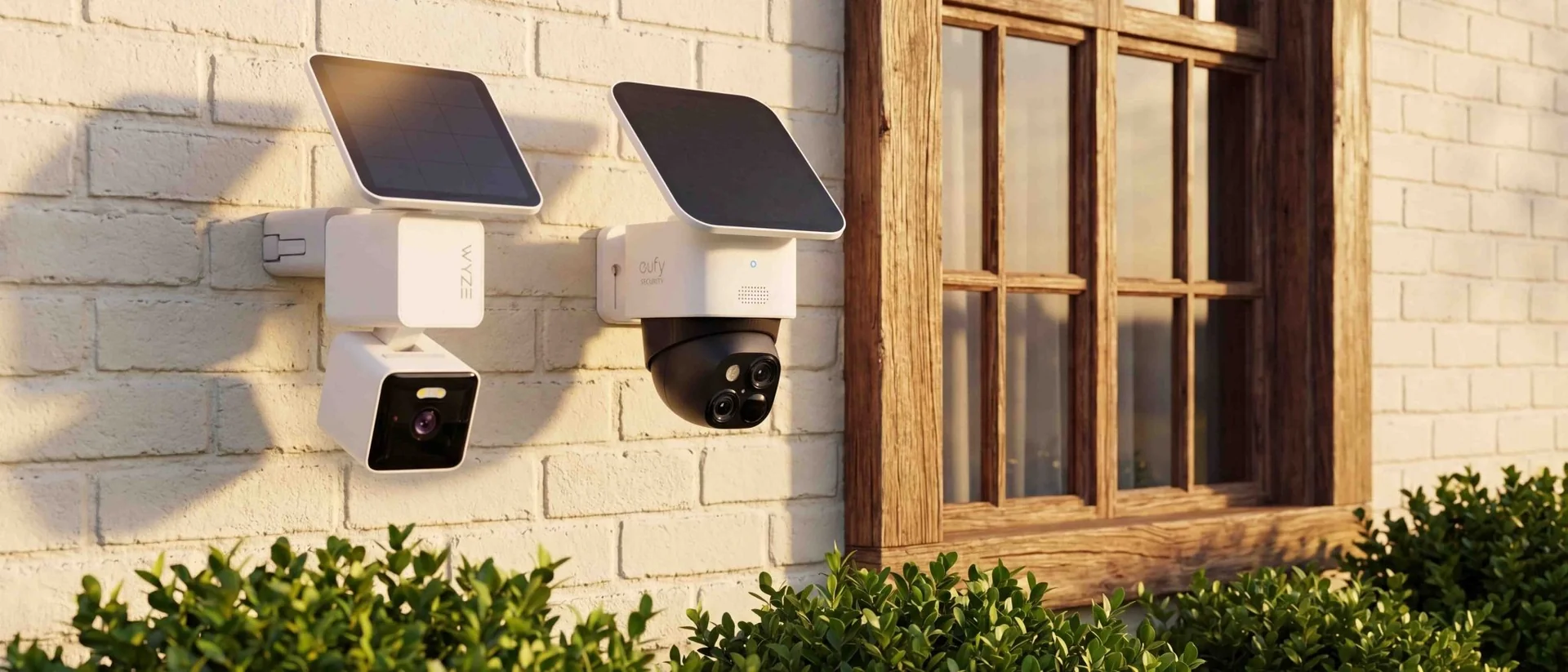
The best solar powered security camera for most people is the eufy SoloCam S340. Its 3K dual-lens system, reliable solar charging, and smooth PTZ tracking make it the single best choice for anyone covering one critical zone. If you need a full 4-camera system, the eufy SoloCam E42 4-Cam Kit delivers 4K clarity with HomeBase 3 storage, while the aosu D1 Classic offers cross-camera tracking for large properties.
For two-zone coverage, the SEHMUA 2K Pan/Tilt 2-Pack is a solid, compact option, and the Tapo SolarCam C402 is the best starter camera for someone who just wants to watch the front door without any fuss. No matter which you choose, all of these cameras let you ditch monthly fees and keep your footage private.
As an Amazon Associate we earn from qualifying purchases.